Posts Tagged ‘dark’

Hallow Ground – September 2017

Christopher Nosnibor

Hallow Ground is one of those niche little labels that exceeds in catering to a small but devoted audience. The quality is pretty consistent, and while you know broadly what you’re going to get from anything in their catalogue, there’s nevertheless a sense of challenge with each release. And so it is with The Expanding Domain, which is pitched as showcasing the way in which the producer’s ‘fascination with ambient becomes a blank slate upon which [he] and his collaborators serve shimmering Trance-derived melodies, murky Industrial grooves and all-consuming Harsh Noise attacks.’

If it sounds like a difficult and disparate blend, it is, making for 23 intense minutes, but it works. ‘Cold Bloom’ may be brief, but moves through a succession of quite contrasting passages, from ominous ambient rumbles and analogue tweets through expansive orchestral strikes lifted straight out of 90s clubland. As such, it condenses all aspects of the album into under two and a half mind-punishing minutes.

On the one hand, it seems like a bad idea and waste of energy to become overly concerned with genre definitions and intersections. On the other, The Expanding Domain seemingly less invites and more demands that type of scrutiny.

‘Lil Puffy Coat’ – which I’m taking as a playful reference to The Orb’s ‘Little Fluffy Clouds’ amalgamates dislocated Krautronica with shades of abstract industrial to forge a sinister expanse of liquid concrete: grey, heavy, but tactile, its form transitional, not yet set firm, and therefore difficult to define.

The volume and aggression are ratcheted up on the heavily percussive attack that is ‘Fear in Reverse II’, the pounding barrage of metallic hammering reminiscent of Test Department providing the perfectly painful foil to the howling discord that screeches above it.

The title track is definitive: with Dominick Fernow (aka Prurient) and Death Grips drummer Zack Hill contributing additional percussion and Dirch Heather bringing the modular synths, it’s a perfect hybrid of delicate, semi-ambient electronica, gnarly, dark ambient that broods and churns, and throbbing industrial. The result is immersive and unsettling, an album somehow at ease with its incongruity which is melded into a perversely cogent form.
Dedekind Cut – The Expanding Domain

Ipecac Recordings – 1st September 2017

Christopher Nosnibor

Dälek have always been about progress and evolution, and not only remaining contemporary but pushing the parameters. Since they emerged in ’98, they’ve stood at the forefront of the challenging end of hip-hop, a genre which has witnessed immense expansion over the last two decades – but has equally seen its horizons shrink dramatically within the suffocating avenues of the commercial mainstream. One might say that this polarity is a key fact in the framing of Endangered Philosophies. The polarisation between the mainstream and everything else musical is representative of the world at large: the political landscape provides perhaps the most significant and substantial indicator here, with left and right parties both moving further away from centre and claiming almost equal ground in the process, and not just domestically here in England.

Endangered Philosophies is an album for the now, as the press release points out: ‘Within the context of the current political landscape, the title Endangered Philosophies certainly brings to mind pertinent issues of moment, notably the rampant rise of anti-intellectualism, as well as the all too rapid erosion of genuinely progressive values in the face of fearful reactionary forces.’

‘Echoes Of…’ launches the album with a nauseating washing machine churn that grinds along before the thumping rhythm crashes in. the vocals are low in the mix – rare and seemingly contradictory for a hip-hop album, but this is Dälek, an act as inclined toward rock and industrial tropes as conventional hip-hop stylings. It’s a gnarling industrialised trudge, and the whiplash scratching and other overt concessions to genre form are crushed hard against one another into an oppressive and intense slab of sound.

‘Weapons’ is woozy, dark, and suffocating. ‘Few Understand’ is less abrasive, but rides on a dense, pulsating swell of sound underpinned by a plodding beneath that carries a real weight. Sometimes, a live drum sound is all it takes to elevate a hip-hop track above the conventions and into fresh, liberated territories.

With the vocals enveloped in delay and heavy layers of extraneous noise, the lyrics aren’t always entirely prominent, but the sentiment is entirely clear at all times. The shuffling trudge of ‘Son of Immigrants’ is underpinned by an almost subsonic bass. In contrast, there’s something approaching a levity about ‘Beyond the Madness’, the semi-ambient synths drifting cinematically over the insistent rhythm, and the seven-minute ‘A Collective Cancelled Thought’ is monumentally weighty, the bass churning beneath a shifting, turning squall of sound. ‘Battlecries’ is slow and bleak, with lyrics about black males being murdered and the state of culture and society providing the message to the work of the mixed medium.

It’s the contrasts which lie at the heart of the compositions on Endangered Philosophies which make it the album it is, and which render it so compelling.

Dalek_EP_Cover

Nuclear Blast – 1st September 2017

Christopher Nosnibor

When charged with the task of covering a new release by a ‘big’ name act, or an act which has been around a long time and developed a significant global following, but that you’re not an ardent fan of, the pressure is on. As a reviewer, you’re supposed to know everything about every aspect of every band ever, and the kind of act who has an established fanbase is also the kind of act who has a fanbase who expect critics to really know their shit before passing comment on ‘their band. At least, that’s my perception based on hard experience from sitting on both sides of the fence.

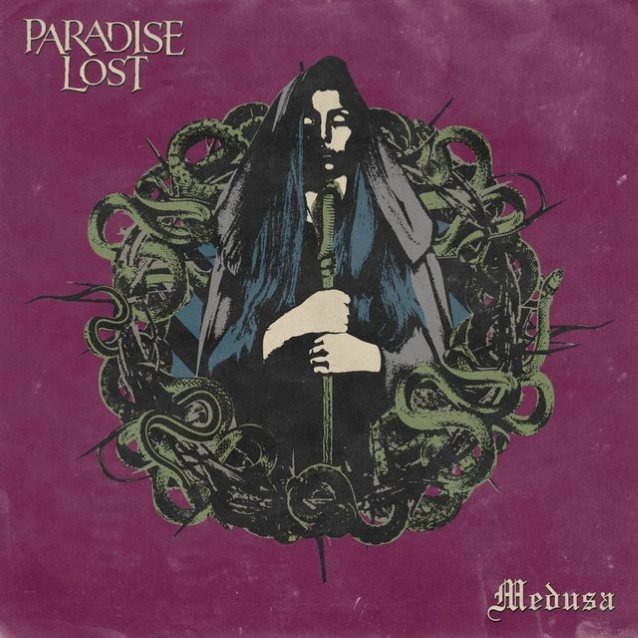
That progenitors of gothic metal Paradise Lost are still here to launch the fifteenth album of their career is impressive by any standards. And while I’ve been aware of them for an eternity – as a Sisters of Mercy fan for an even longer eternity, it was their cover of ‘Walk Away which provided an introduction – I’ve never really spent any time getting acquainted with their back catalogue. Nevertheless, and despite their death / doom roots, the fact Medusa is strong and proper heavy is even more impressive, especially given their forays into Depeche Mode-style synthpop and electronica and a stint on EMI which saw them move further into more commercial territories.

As the press release notes, ‘most people will know Medusa as the Gorgon from Greek mythology; she is the infamous beast with venomous snakes for hair who will turn anyone that dares to look into her eyes to stone. It is this hideous creature who Paradise Lost have chosen to be the figureheard for their 15th studio album, as, from a philosophical perspective, she is more than simply a monster.’

It’s the epic, doomy trudge of ‘Fearless Sky’ which grinds out for over eight and a half minutes which gets the album off to a dark and suitably intense start and demonstrates they’ve still got the high-art bombast which defines their sound, and of the poem which gave them their name in the first place. It was hearing segments of Milton’s immensely epic poem read aloud by one of my university’s more eccentric but enthusiastic professors which turned me on to his work, and in context, it all fits together. Medusa is an immense and ambitious album, and it’s also as heavy as hell.

The thunderous tribal drumming which propels the low-end focused sludge riffery of ‘Gods of Ancient’ leads the album deeper into darkness before the snarling desolation of ‘From the Gallows.’ ‘The Longest Winter’ is perhaps more accessible with its processed, dry and altogether more melodic vocals, but the guitars are still are thick and overdriven as you like. As for the title track, it brings the sense of immense portent with its groaningly heavy guitars and noodling lead, paired with a sense of gothic theatricality which lends it a kind of poeticism.

This is an album that trudges, dark and heavy, for the duration, and any comparisons to other bands from either the goth or metal sides of the equation are essentially redundant because it was this band who effectively spawned the hybrid which Medusa so perfectly epitomises anyway.

What makes Medusa a great album is that while it is heavy, it’s heavily gothy and it’s ultra metally in the snarling, guttural sense, and it’s also got immense range. As such, it doesn’t ever feel formulaic or dull, and ultimately, Medusa is a strong album which stands up in the Paradise Lost catalogue.

paradiselostmedusacd

‘Gravity’ is the first video from the debut of New York-based Ω▽ (OHMSLICE)’s debut album Conduit. One interesting aspect of the video is that it uses footage  from well-known experimental film maker Mark Street’s films with Street’s wholehearted approval. The album was recorded at Ft.Lb Studios in Brooklyn, produced by the outfit’s premium mobile multi-instrumentalist and instrument inventor Bradford Reed (King Missile III, creator of the electric board zither he calls the “pencilina”). The album is being released September 8 by Imaginator Records.

Ohmslice formed around Reed’s experiments in processing percussion  through a modular synth. Layered over a sonic framework of double-drummed syncopated rhythms  and analog pulses and drones are the sultry vocals and driving, often abstract lyrics of poet Jane LeCroy (Sister Spit, Poetry Brothel).  Joined by a rotating crew of collaborators including Josh Matthews (Drumhead, Blue Man Group) on drums, the legendary and ubiquitous Daniel Carter (Thurston Moore, Yo La Tengo) on trumpet and saxophones and Bill Bronson (Swans, The Spitters, The Gunga Den, Congo Norvell) on guitar. The album combines formal structures and heavy grooves with a sonic meditation on the nature of human-electronic improvisation.

OHMSLICE-duo

Conduit was recorded live over a two-year period. The album is an organized documentation of spontaneous creation and exploration and moves from the fuzzed-out psychedelic of “Crying on a Train” to the meditative ambient cycles of “Broken Phase Candy” and beyond.  Within this realm, the listener is meticulously guided through beautiful harmonic and rhythmic phase mosaics and held captive by an innovative and violently unquantized approach to groove based electronic music. Combined with LeCroy’s visionary mixture of philosophy, reflection, language and song Conduit illuminates a path to a rare and alluring space that reveals endless layers with each new listen.

‘Gravity’ is a brain-bending piece of jazz-infused experimentalsim, and coupled with the cut-up visuals, the promo makes for quite the multisensory experience.  You can check out the video here:

Crónica – CRÓNICA 126-2017

Christopher Nosnibor

The title of the latest album by the super-prolific experimental composer and student of film and musique concrete, Emmanuel Mieville, comes from the Japanese translation of the Sanskrit word and alludes to a chapter of the Lotus Sutra, a renowned text from Māhāyana Buddhism. Apparently. It’s hardly my field of expertise. And so the inevitable question arises: what’s my point of entry?

Juryo is by no means an accessible album and its four longform tracks, which span between nine and eighteen minutes don’t readily lend themselves to lengthy debates about Buddhism and the path to enlightenment. Similarly, that the album consists of four compositions shows no obvious correlation with the twenty-eight chapters of the Lotus Sutra. As such, it’s fair to surmise that the allusion which connects the title to the contents is in largely an oblique one, beyond the fact that the album features field recordings captured in Asia.

This is swampy, abstract, murky noise. On the surface, it’s a formless conglomeration of noise, grating, grinding scrapes and bumps. Woozy rippling bubbles flit and floom over tidal waves of surging extranea, which may or may not be the swash of actual water rippling over rocks: it could equally be an aural illusion, or an intentional simulacrum.

Top-end whistles sustain for an eternity and aggravate not only the aural receptors but the mind on ‘Nyorai’, although in the mix are recordings of Tibetan nuns and FM radio from Hong Kong. These manifests as chants and clattering chimes and finger cymbals which emerge around the midpoint of the seventeen-minute sonic journey. According to the liner notes, ‘Murasaki’ means ‘purple’ in Japanese, but the spinning, swirling sonic discombobulations which eddy and swirl present a kaleidoscopic vista.

In the sleeve notes, Mieville explains that ‘Taisi Funeral’ (the fourth and final track) is a ‘recording of Buddhist chanting for a deceased person recorded in a small village in Taiwan, mingled with my own synthetic sounds. Tanit Astarté is a quotation from Antonin Artaud’s book Héliogabale and refers to the moon goddess, as described in Phoenician myths’. It’s certainly the most overtly musical and rhythmic of the four compositions, but as a rising surge of amorphous sound rises to wash away the voices and the rhythm peters out, it transforms to an altogether more ambient soundscape. Morever, while still linking back to the overarching theme of the Lotus Sutra, we can see that Meiville’s sphere of reference is considerably broader than may first appear.

Juryo is subtly complex and had both range and depth. It doesn’t readily conform to any one genre, but to lazily slot it into the broad space occupied by ‘experimental / avant-garde’ is to fail to recognise the spectrum of stylistic elements it incorporates.

Emmanuel Mieville – Juryo

Front & Follow – F&F046 – 1st September 2017

Christopher Nosnibor

Having followed Mark Kluzek’s Doomed Bird of Providence for some time now, I was keen to hear the latest instalment. Over the last six years, he and his collaborators have produced a series of concept albums centred around Australian history, all using the medium of dark folk with heavy echoes of Nick Cave. Burrowed into the Soft Sky is very much an album devised as being suited to a vinyl release, and is perhaps the most challenging Doomed Bird release yet, consisting as it does of just two tracks each with a duration of some twenty minutes. While still pursuing what the bio refers to as ‘Kluzek’s obsessive and singular foray into early colonial history’, Burrowed into the Soft Sky discards the vocal element, meaning the narrative, such as it is, is purely musical.

To understand the objective and the context of the album and the individual tracks, it’s beneficial to quote liberally from the accompanying press release.

‘The underlying themes for each track are contrasting yet tie together via their historical context; a period where indigenous Australian belief systems and day-to-day lives were irrevocably assaulted. The song Burrowed into the Soft Sky is based on a passage from Patrick White’s novel Voss. The book is very loosely based on the final (and fatal) journey through the northern regions of Australia by German explorer Ludwig Leichardt. Kluzek took a passage from the book where a comet passes over and Voss, his team and a tribe of Australian Aboriginals engage with and interpret the experience until it is ‘burrowed into the soft sky’.’

How this manifests is in a piece which exits as a sequence of gradually-shifting transitions, sparse and haunting woodwind drifting across an urgent acoustic thrum, while percussion builds, and then draws back again. Around the mid-point it bursts into a sustained crescendo, with sweeping strings cascading over an insistent, energetic beat, but for the most part, it’s less about overt drama and more about the brooding. The closing segment is a dolorous fanfare, with nostalgia-evoking horns sounding out over a slow march that finally tapers to a twinkling glockenspiel that does evoke something approximating a soft sky.

Mark Kluzek- The Doomed Bird of Providence8

The press release provides the following explication for the track which occupies side B: ‘The Blood Dimmed Tide is Loosed takes a significantly darker turn shining a light on a pattern of atrocity that took place in the north east of Australia at a time where a dynamic of back and forth, invariably initiated by colonists, took place and culminating in a “dispersal” of a tribe, “by shooting them down – men, women and children, the object being to destroy as many as possible.” This is based on accounts of such events in the book Exclusion, exploitation and extermination: race relations in colonial Queensland (Raymond Evans, Kay Saunders, Kathryn Cronin). Attacks of this nature on tribes were commonplace.’

As indicated, the track immediately plunged into darker territory, uncomfortable, tense tones forging a claustrophobic atmosphere. Strings scrape like nails down a blackboard over ominous fear chords before a militaristic imperial march emerges from a tempest of percussion and screeding feedback. This in turn coalesces into a repetitious throb, imposing and intense, which bludgeons the listener’s senses as cymbals crash violently, and by the mid-point it’s collapsed into a wash of hums and drones, interrupted by clattering flickers and subterranean moans and skitters. The closing section again builds an oppressive mood, the thudding percussion partially submerged by a swell of ever-thickening noise.

A priori knowledge of the context is by no means essential to the appreciation of Burrowed into the Soft Sky. It does of course benefit the listener to have a sense of placement, but given that the correspondence between the tracks and their inspiration / meaning is far from obvious in any case, it’s an album which can readily be heard – if not necessarily ‘enjoyed’ – on its own merits. As a work which wanders through a number of instrumental musical territories, Burrowed into the Soft Sky is interesting and rewarding.

DBOP_coverFINAL

Cleopatra Records / Practical Records – 23rd June 2017

Interdisciplinary artist Rachel Mason has spent the best part of the last two decades carving out her own niche from within the hotbed of the NYC and LA scenes, with music being only one of the many strands of her creative explorations. In between making films, sculptures, and creating performance art pieces which range from the playful to the weird, she’s released quite a lot of albums. Her latest, Das Ram, is billed as ‘a full-blown modern pop-rock album of catchy songs with flamboyant flavor, dramatic vocals in between Siouxsie Sioux and SIA, captivating melodies and poignant lyrics’.

It’s not easy to focus on the lyrics, poignant or otherwise, when there’s so much going on. Das Ram is an album that’s very much geared toward delivering songs with groove and big energy. ‘Rosie’ kicks off with a delicate shoegazey pop verse that blossoms into a glorious chorus propelled by a super-frenetic drum machine with hectic hi-hats and a glistening, glittering energy shimmers.

Rachel Mason 2 - credit Kerwin Williamson

Das Ram is an eclectic set, and wildly varied. The dramatic orchestral strikes which jut and jar through ‘Heart Explodes’ provide a dramatic landscape for Mason to prowl through en route to a soaring chorus which indicates what Florence and the Machine could sound like if Flo Welch and her crew had any grasp on subtlety.

Single cut ‘Tigers in the Dark’ is a flamboyant gothic-hued disco cut that pulls together the danger of Siouxsie with the brooding electropop sensibilities of Ladytron or Goldfrapp. ‘Marry Me’ goes all Disintegration-era Cure in the mid-section, but Mason’s vaguely shrill and increasingly desperate-sounding imploring to form marital unity (part Kate Bush, part PJ Harvey) is actually quite scary. You’d probably agree just to avert the danger of being strangled in your sleep, although it would only be a temporary postponement).

‘Cancer’ is a wild, woozy ride, a blizzard of wibbling electronica and car horns and stammering programmed drum ‘n’ bass percussion providing the sonic terrain for lyrics that veer from the abrasive to the abstract. ‘The end stage is on!’ she squeals as a refrain before a gritty, funk-infused bass cuts in half way through.

Das Ram is good. Really good. It’s a pop album, and one which will evoke myriad comparisons. And it’ll touch them all favourably, because Rachel Mason assimilates her influences in a way which isn’t merely derivative, but innovative, and Das Ram is an album which wanders through infinite shades of weird, and bristles with tension and myriad shades of darkness.

Spiegelman/Rachel Mason

Hominid Sounds – 30th May 2017

Christopher Nosnibor

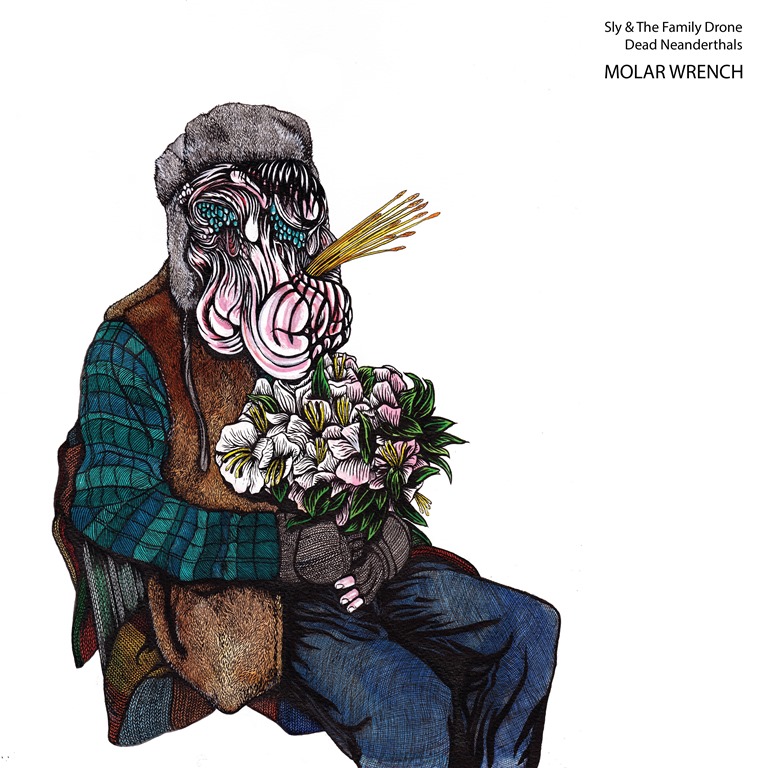
Matt Cargill’s project still has one of the best names around: it’s not only an example of punning genius, but also one of those band names which sets expectations as to what you’re going to get musically. I say musically, but that’s very much a matter of perspective. SATFD don’t make music in the conventional sense, and Molar Wrench is as sonically challenging as any of the previous releases SATFD have put out. On this outing, they’re joined by Dutch/British free jazz unit Dead Neanderthals, to form what they describe as ‘the ultimate tag team of the murky European underground’.

Given that the two acts featured on a split release last year, this collaboration seems like a logical progression. It certainly marks a departure for Sly, in that the trademark subterranean grind of endless, dark drones and unsettling atmospherics is matched with and at times consumed by the maddest jazz shit going.

The album contains just four tracks, but packs in a hell of a lot of racket. It all kicks off with a frenetic, a wild, free jazz cacophony, a melange of clamorous, ultra-hyped parping horns, sonorous lowed drone and is dominated by truly frenzied, cacophonous bent. Circuits fizz and hum while the percussion thrashes and crashes arrhythmically, throwing the listener around with reckless abandon a rollercoaster of tempestuous sonic mania.

There are two ‘Muck Man’ tracks and the first is ten minutes of slow, throbbing churn made up primarily of low and mid-range sludge, the drums holding a ragged but hard rhythm amidst a maelstrom of thick, dirty, pulsating noise. It’s almost a riff, but more a succession of waves in a rhythmically surging sonic tide, a with the density of liquid mud. Immersive would be one word.

‘Muck Man Part 2’ is altogether more low-key, a dark, atmospheric piece that manifests as a prehistoric sulphur swamp in sonic form. Slowly, the murky drift builds to a screaming tempest of noise; the brass develops from a low drone to a shrill shriek of pain and the drumming transitions from a sedate trudge to an explosive riot of noise, abrasive blasts of snarling electronica and whatever the fuck else bursting in waves of sonic shock.

The title track closes off the album, and it’s an eleven-minute trudge that calls to mind the claustrophobic brutality of Swans’ ‘Young God’ EP. The plodding percussion provides a doomy and tense prickling spine to the oppressive grind that lumbers on for what feels like a skull-crushing eternity.

There is a definite structure to Molar Wrench, in that it starts off wild and winds down to a grinding crawl, but it by no means feels like the energy displayed at the outset dissipates as the album progresses. It’s more a case that having exhausted the listener with frenetic kinetics and gone all-out on the attack at the front end, the album seeks to bludgeon the listener into submission in the later stages. And highly effective it is, too.

cover

Christopher Nosnibor

Perhaps I need a break. I love music and I love reviewing it. But looking through my to-review pile and my groaning inbox, I feel overwhelmed and despondent, disinterested even. I look at the tiles and the artists, knowing instinctively that some will leave me cold and others will irritate me. Perhaps stirring my frustration with break the ennui, but it’s almost 11p, and

I pick up Nonmenabsorbium on a whim. The dark cover, not so much black and white as many shades of grey, from mostly within the darker end of the greys spectrum, tells me nothing. I can’t locate the accompanying press release. I’m flying blind, with only my senses and my instinct to guide me.

It’s pleasing to discover that Nonmenabsorbium contains no music in the conventional sense. No songs, no singing. No chords, no melodies, no tunes. No identifiable shapes or structures, no instruments or rhythms. Sparse, minimal drones and high-end tweets trill and hover. Thuds and thumps, sounds recorded seemingly too close to the microphone and booming through disproportionately loud against the barely-there backdrop jolt the senses. These are sounds without context and without overt structure or direct relation to one another. Often, the incidentals are disproportionate in volume to the ever-shifting grain of the backdrop, booming and crackling mic and speaker distortion as single notes ring out and resonate.

During ‘Abholicater’, the churning clatter coalesces to create a sort of arrhythmic percussive form, hammering and beating amidst a swirling swell of amorphous grey sound, which gradually dissipates to be replaced by the fizz and pop of electrostatic, shrieking diodes and the grumbling grind of low-end hum. #

‘2nd nalicii – 197degree5’ sounds very like R2D2 building for a breakdown, an electronic work based around rising frequencies which threaten to burst the tension. But it doesn’t happen. Sonar pulses radiate amidst the crackling clatter and wowing incidental of the eleven-minute closer ‘Horrorrydclowses’, as a rain of static pink noise showers down on electronic Catherine wheels. Monitor bleeps blast into cerebral flatlines amidst a relentless whupping churn and grind of static noise which owes a clear debt to the lineage which brought us early 80s Whitehouse, Prurient, Merzbow et al. Meirin and Garcia may belong to a different musical heritage, but Nonmenabsorbium is an intense sonic assault that requires a cautious approach.

The atmosphere is one of building expectation, and tension builds with the growing sense that there must be a point at which the threat of all-out noise is realised. But such cathartic release fails to materialise. Instead, the bumps and clanks are nerve-fraying after a time, and it becomes increasingly difficult to distinguish from the sounds on the disc the possibility of someone ascending the stairs, moving in the next room, stumbling around between plant pots and dustbins in the back lane or the yard outside. Consequently, the pleasure to be derived from listening to Nonmenabsorbium is perhaps a rather perverse one. Nonmenabsorbium provides an unsettling distraction, a removal from the humdrum and the sonic wallpaper of the everyday / mainstream. But, by way of escape, and also as an example of difficult but rewarding listening, Nonmenabsorbium offers an immersive and awkward sense of entertainment.

Francisco Meirin Miguel A. Garcia

SOFA – 7th April 2017

Christopher Nosnibor

I recall that in my teens, having read the word ‘ephemeral’ just once, I used it in conversation and mispronounced it, much to the amusement of one of my fellow students. My phonetic pronunciation is replicated in the title of Miguel Angel Tolosa’s album. There’s little relevance to this anecdote in the wider picture, but that’s actually the point. It was a brief moment in time, long past and irrelevant and inconsequential on every level but for the fact that it lives on as a moment of embarrassment in my memory. And herein lies the relevance. Moments only exist in the moment: any record or document of the moment may change the context, the complexion and the enduring recollection of the moment, but in the context of the ongoing continuum of time, once the moment has passed, it’s past.

There’s surely something of a contradiction in a recorded work centred around the concept of ephemerality. The very act of committing the sound to a recorded medium captures it in time, imparts a date stamp (literal or otherwise) and locks the moment for perhaps an eternity. Ephimeral exists within these contradictions. It doesn’t exactly explore them, but the compositions – individually and collectively – serve to create a fleeting atmosphere centred around transitions and contrasts.

While the majority of the album’s compositions are preoccupied with ambience – wide, sweeping sounds, building ever-shifting cloud formations in sonic form, with the threat of a storm always looming but never becoming an actuality – there are other pieces which break the mould of fleeting, fractal aural nebulousness to coalesce into something denser, if not necessarily more tangible or readily compressed into structured musicality.

The album starts dark, ‘Rio de Cristal’ dominated by an undulating low-end drone, which segues into ‘Tropismos’, on which a dark, murky swamp of sound is rent with barrages of grinding noise and attacks of snapping shrapnel akin to machine gun fire. It’s the kind of aural experience that makes the skin crawl and the nerves jangle.

Light and dark are juxtaposed throughout, often simultaneously, with menacing chords and notes which scrape like metal against fillings filtering beneath soft, expansive clouds of sound. And perhaps it’s in the experience and the sensations this music provokes within the listener that the ephemerality of Tolosa’s work is truly apparent. The listener is left chasing fragmentary thoughts and feelings, often conflicting, arising in response to the simultaneous aspects of the music.

So how does Ephimeral leave you feeling? By turns elated but tense, strained but calm, and ultimately confused and conflicted and adrift, at odds with oneself.


Miguel Angel Tolosa – Ephimeral