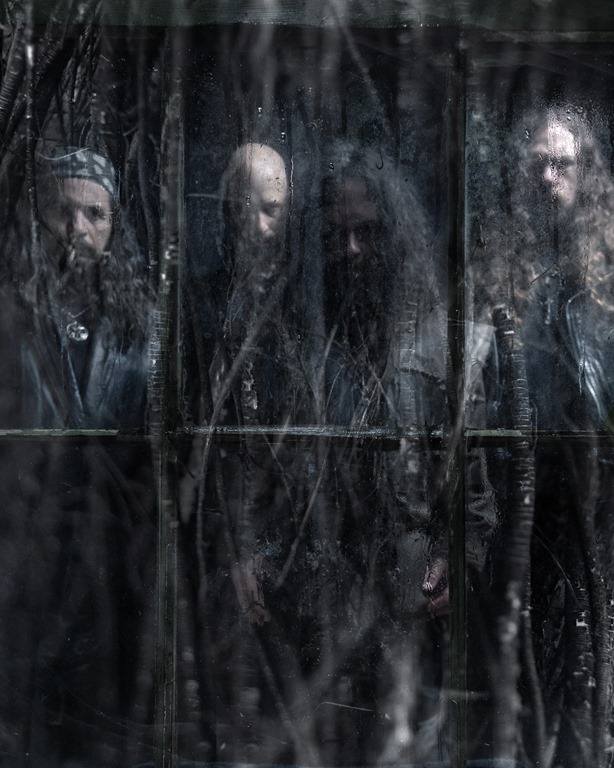
Century Media – 23rd October 2026
Christopher Nosnibor
Estuary: the short dictionary definition being the part of a river or other area of water where it joins the sea, and where fresh water and salt water are mixed. An expanded encyclopaedic definition is perhaps more instructive when it comes to the latest album by ‘Heretics of the Black Metal genre and the Kings of USBM’, Wolves in the Throne Room’, which details ‘a partly enclosed coastal body of water in which river water is mixed with seawater. In a general sense, the estuarine environment is defined by salinity boundaries rather than by geographic boundaries. The term estuary is derived from the Latin words aestus (“the tide”) and aestuo (“boil”), indicating the effect generated when tidal flow and river flow meet’.
Described as ‘their most ferocious and genre-bending record to date’, it does veritably boil, a collision of analogue haze and crystal-clear, razor sharp focus. While black metal as a genre is very much centred around stylistic tropes – not least of all the frantic pace, snarling, raspy vocals, and detailed lead guitar work – all of which are entirely present and correct here – Wolves in the Throne Room have always pushed the parameters in various ways, from taking those commonplace stylistic elements toward their logical conclusions, to incorporating elements from beyond the established sphere of reference. And so it is with Estuary, which, as they put it, ‘is resonant with that hardwiring; rawer, more volatile with the storming sensuality of noisy industrial elements, evolving through the domain of warm rain, majestic forests and diffused starlight. Massive percussion and seething gothic guitars wipe the listener’s psyche clear of all stagnation, transforming them into active, evolutionary conduits’.
Oh yes, and it’s a concept album based on post-apocalyptic survivalism. To return to the accompanying material for a final time, Nathan Weaver (lead vocals, guitar) comments: “Estuary takes place 1,000 years in the future, after the death of civilization. I’ve always felt such calm at the idea of humanity vanishing from the world, and nature reclaiming everything. I dream of being alone in this setting and experiencing total calm and peace. This has been a recurring theme in all of Wolves’ music but for Estuary, it is at the forefront.”
Personally, I think 1,000 years in the future is an extremely generous timescale, and wonder if the wake of the environmental apocalypse will be quite as rapturous. Nature always wins, that much is true, and there will be life on earth long after humans have become extinct – and the sooner the better would probably be ideal for every other species on the planet – but the post-human environment (I mean that in the sense of an environment post-human extinction, rather than the transcendental, technologically-evolved sense of posthuman) – is likely to be a dark and inhospitable one, where large segments of the current land mass is submerged by significantly higher sea levels following the melting of polar ice. But this is black metal with a concept, not a calculated environmental sci-fi novel. And it’s a monster, with just six tracks, but a running time of some forty-nine minutes, and only one of the songs clocking shy of seven minutes.
It’s the title track which blasts in first, a snarling frenzy of post-apocalyptic noise, which, despite some elements which border on shoegaze and some major chords and soaring lead work, is drenched with melancholy and despair. The hints of a sunrise optimism are countered by a soul-crushing weight, and the end of the track carries the listener on a swell that leads outwards, to the vast oceanic expanse.
Following a grand, almost ceremonial opening, ‘Knights of Tiamat’ goes widescreen expansive, but at the same time into no-pissing-about heads-down, hundred-mile-an-hour fury. It’s five minutes into this blistering beast of a track that they bring the first foray into the kind of frenzied fretwork solo common to black metal. Elsewhere, there are sedate strolls and layers of enticing detail, with picked, chorus-treated guitar which is decidedly goth – perhaps more Field of the Nephilim than, say, The Sisters, but gothy and atmospheric nevertheless.
‘Foretold in Reflections’ is the album’s indisputable centrepiece – a dingy, dark, but extravagantly theatrical composition, spanning beyond ten minutes and with a particularly flamboyant and detailed bassline beneath the blanket of guitar fury. It’s truly peak black metal, but it’s also more, particularly in the mid-section where synth-like sounds come to the fore and the drums slow to a crawl before the double-pedal power returns.
The attention to detail here is outstanding. The percussion dominates throughout, and even that ranges from all-out frantic black metal frenzy to more measured, quite tempered work.
‘The Orca Cliffs’ lunches the first of a trilogy of roaring behemoths that run the album to the close. And there’s so much texture, so much detail to be found during this run. Of course there are chthonic, demonic, rasping vocal utterances, but there are (brief), passages – particularly in ‘The Orca Cliffs’, but also the extended mid-section of ‘Ghosts Among the Obelisks’ that they produce music which is truly beautiful, even melodic.
In contrast, there are also segments which are nothing short of sickening, abrasive churning industrial loops. Estuary is never predictable, and never lets up in the way it seems to broaden horizons. With Estuary, Wolves in the Throne Room give us black metal, but expanded. And then some.
AA
AA