Posts Tagged ‘Brion Gysin’

3rd October 2025

Christopher Nosnibor

Foldhead has been quiet on the output front of late, after something of a purple patch around lockdown, there was a lull, broken by Mirfield Pads in 2022, with only the ‘Single’ release with …(something) ruined since, and a live outing or two. This is the only kind of quiet you’ll get from Foldhead, mind you: the Yorkshire maker of mangled noise likes to turn it up and blast the frequencies – and tones.

If Mirfield Pads ventured towards mellower, more Tangerine Dream-like electronica, Paris Braille sees a return to the harsher territories more frequently wandered by Foldhead.

Paris Braille – the title likely a reference to two cut-up novels by the late Carl Weissner (who not only appeared in some collaborative / split works with Burroughs, including the seminal pamphlet So Who Owns Death TV?, but translated many of his novels for the German market), namely The Braille Film and Death in Paris – is a typically abrasive affair, with the title track being a nine-minute loop of noise which captures of the essence of the ‘derangement of the senses’ Brion Gysin strove to achieve with his multi-sensory performance pieces which extended the concept of the cut-ups to its logical extreme. The thunderous beat, when surrounded by and endless loop, becomes almost trance-like and strangely euphoric. It’s difficult to discern precisely what’s in the mix here: there may be voices, or it may simply be a tricky of the human ear – my human ear – in its quest to seek recognisable forms amidst the formless sonic churn, in the same way one finds the shapes of animals and faces in clouds. In the right context, say, as a remix on a Cabaret Voltaire EP (where it would be right at home, and the William Burroughs / cut-up connection is again relevant here), this would be hailed as an industrial dancefloor stomper – largely because that’s what it is. Intense, hypnotic, relentless, it’s a pulsating, shifting noise beast that slowly spins off its axis and out of control in a swelling surge of sound.

‘CW Loop’ unashamedly harks back to the tape experiments of Burroughs and Gysin from the late 50s and early 60s, which in turn were a huge influence in Throbbing Gristle, and in particular Genesis P-Orridge, who released a selection of archival recordings on the Nothing Here Now But the Recordings LP on Industrial Records in 1980. It is, quite simply, short vocal sample, heavily bathed in echo, looped, and overlayed with a churn of undulating noise.

The third and final track, ‘Film Death’ – the title echoing and mirroring that of the first – round the set off with a return to the thunderous, beat-driven sound of ‘Paris Braille’, this time with a squall of shrill feedback and full-spectrum static. The result is akin to Throbbing Gristle covering Matal Machine Music. In the world of Foldhead, this is absolutely mission accomplished.

AA

a3884873763_10

Futura Resistenza – 27th January 2025

Christopher Nosnibor

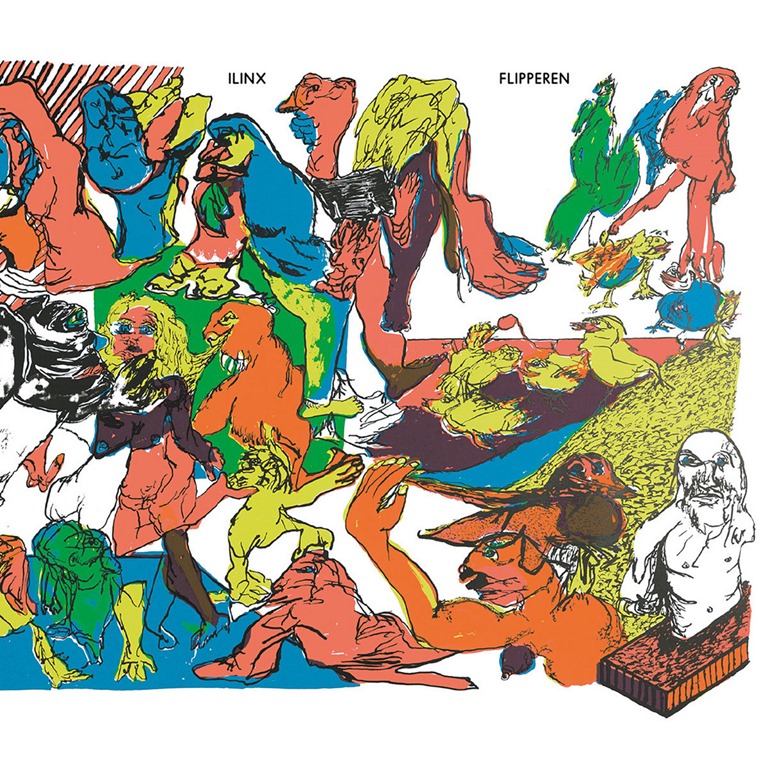
Some years ago (like about seventeen years ago), when I embarked on my reviewing journey proper, I was introduced to whacky experimental work and the world of microtonality. It was an absolute revelation. Just as, growing up in the 80s and raised on the Top 40 singles and Now That’s What I Call Music, discovering goth, alternative, John Peel, and Melody Maker completely changed my head, so did entering this new world. Onje thing that completely spun me was the way in which some artists extrapolated and academicized some pretty stupid or mundane stuff. This is a reasonable example. To quote: ‘Flipperen takes the randomness of pinball and turns it into music. Using recordings from old pinball machines, the music mixes chaos and structure, reflecting the Fluxus spirit of play and chance. It’s a wild ride through sound, where things don’t always make sense–but that’s the fun of it.’

Flipperen began as a lockdown / COVID project, of course. As they detail, ‘During the quiet and strange Covid days, Suzana Lașcu, Robert Kroos, and Reinier van Houdt began a recording project based on the soundbites of pinball machines. They visited the empty Dutch Pinball Museum in Rotterdam and captured field recordings of machines from the 1960s to the 1990s. From these, they selected 28 samples to serve as thematic starting points for what they called ‘game pieces,’ recorded in two sessions at Sonology Studios in The Hague. The recordings were then shaped into sound collages using cut-up techniques and probabilistic processes.’

These processes mean that the end product is a very long way removed from the actual sounds of metal balls pinging and rolling about inside a glass-covered case. Instead, landing between Brion Gysin and John Cage, we get a collection of weird and woozy fragmentary pieces – compositions would be something of a stretch – ranging from awkward ambience to crashing and banging that sounds like a prepared piano fitted with lump hammers. There’s playful, whimsical sighing and trilling, psychedelic trippery and some fairly straight jazz-flavoured piano in the mix. There’s Clangers-like whistling and clattering and clanking, pops and thuds, explosive industrial noise and frenzied country. There are moments which sound like someone grunting through a comb with greaseproof paper, others which sound like the strumming of an egg-slicer, others still which create the impression of a piano being dropped down a flight of stairs.

The final cut features twenty-six tracks, the majority of which are around a couple of minutes long, or even significantly shorter. But there are a couple which run to around six and a half minutes of uncoordinated chaos, and it’s a lot to take in.

The appeal from a sonic and experimental perspective is that ‘Pinball is a game that combines control and randomness—each action leads to an unpredictable result, and the outcome is always uncertain’, and as such, the patterns which provide the material for these pieces are erratic, unpredictable, and ultimately, not really patterns at all. And so it is that Flipperen shunts forwards and backwards, crackles and pops with zany snippets of this, that, and everything, conjuring a wild collage of disparate elements and all kinds of discord.

As much as pinball machines lie at the heart of Flipperen, it’s really a wide-ranging collage work with randomness at its heart. It’s fun, it’s fascinating, it’s brain-bending – and one might say it’s a work of Flipperen genius – but you definitely have to be in the mood for something quite this far out.

AA

a2489366009_10

5th July 2024

Christopher Nosnibor

Sometimes, I really do feel as if my brain is my enemy. Word association and wordplay are a particularly frequent and annoying curse. Oftentimes, I keep this to myself, but midway through listening to this, it struck me, completely at random, that Killzones isn’t a million miles away from Calzone, at least when written down. So why share this? A problem shared, and all that, for one. But as much as anything, I felt the urge to purge, or moreover to crack open the challenges that present themselves as part of the creative process. Writing – and finding something new and interesting to say – about music, day in, day out, is a challenge in itself, without other factors.

Seemingly, the recording of this EP proved rather less challenging for its makers, who came together and developed it swiftly and fluidly –although the same can’t be said for listening to it. That’s by no means a criticism. In a climate where the airwaves are jammed solid with anodyne sameness and slickly-produced beige sonic slop disguised as raw or edgy on account of some explicit content and some choice language that requires beeps or asterisks in the mainstream media, anything that does something different offers a welcome challenge in the way many pit themselves against the Great North Run or similar. We’ve grown accustomed to everything being delivered neatly-packaged and pre-digested, and feeling like following a recipe from Hello Fresh makes us a Michelin chef. Collectively, we’ve forgotten how to chew – meaning that this will either kick-start your metabolism or simply make you spew if you’re unaccustomed to anything that’s this high-fibre. Just look at that cover art. It’s dark, grainy, uncomfortable. It’s the perfect encapsulation of the music it accompanies.

Machine Mafia is quite the collaborative paring: Adam Stone of gritty northern grimsters Pound Land and Jase Kester of ever-evolving experimental noisemakers Omnibael / Omnibadger have come together to do something different. Very different.

As Jase explained to me, the EP features ‘no live instruments, leaning into the way dub reggae was so embraced by punk right in the early days.’ And there’s no question that it has both – simultaneously – the spaciousness of The Ruts (D.C) and the density of early PiL. It’s a formidable combination, that’s for sure.

The title track assembles sampled snippets as its foundation, drawing parallels with the collaging methods of Cabaret Voltaire and Throbbing Gristle, evolved from William Burroughs and Brion Gysin’s late-50s tape experiments – in turn a progression from the cut-ups on paper. Atop of this slice ‘n’ splice selection of political speeches and an almost subsonic, floor-shaking bass, Stone delivers a mumbling, drawling semi-spoken spiel. It’s like Sleaford Mods on Ketamine, a heavy trudge of ever-degenerating sound which eventually collapses to a low-end buzz and a crisp sample that makes the pair’s political position clear through antithesis.

On ‘Faces’, scrapes of discord, distortion, and a thudding beat half-submerged in the mix grinds out the opening before a dark, dense bass groove starts a gut-shaking growl. The drawling, atonal vocals, too, are distorted and low in the mix, and I’m reminded of some of the more obscure Ministry offshoots witch Chris Connelly – the vibe is dingy, sleazy industrial, a bit early Pigface, and sounds like it was recorded in a damp mould-stained basement on a salvaged reel-to-reel.

The songs get slower and heavier – and longer – as the EP progresses. ‘I Am Not You’ comes on as if Dr Mix and The Remix had done dub, while ‘Lecture 0.3B’ goes all out on transforming a simple spoken-word piece into a cut-up tape experimental headfuck with loops and delays and effects galore, all laced with crackles of distortion and sonic degradation fuzzing and fading the edges. It lands somewhere between the JAMS, Max Headroom, and Throbbing Gristle’s ‘Hamburger Lady’ – weird, unsettling, dystopian, with near-familiar elements twisted and recontextualised in an ugly mash-up collage work.

Conceptually, Killzones is far from new – but then, there’s no claim to innovation here, explicitly drawing a line from the past. But the kind of reference points and influences in evidence here are not the ones you find often, if ever – independently, perhaps, but the whole point of intertextuality as a method of creating is the nexus of divergent touchstones and the way in which they’re combined. With Killzones, Machine Mafia deliver a crash course in experimental music 1976-1994. It’s a mangled, messy cognitive assault. It’s knowingly, and purposefully, difficult, unpleasant, and a complete creative success.

AA

a0890048129_10

22nd December 2023

Christopher Nosnibor

We live in strange times – times which have gone beyond the established expectations of what defines postmodernism into a period which is something else. Something else we’re yet to come to terms with, let alone define. Postmodernism heralded the arrival of what one might call ‘the nostalgia schtick’ by meshing together past, present, and future to conjure something of a liminal territory in which all times exist simultaneously. But if postmodernism, as defined by the likes of Francois Lyotard and Frederik Jameson is primarily defined by an accelerated pace of communication and an overwhelming blizzard of media, one thing which no critics or theorists could have readily anticipated when defining the term was the rush to cling to the recent past, or that the next big boom in industry would be nostalgia and revivalism.

The advent of the Internet heralded a revolution in terms of all things archival. Back in 1996 or thereabouts, when I first got online – with AOL on a floppy disc and a 14k dial-up modem plugged into a second-hand IBM 486 ­ it seemed like a new dawn. It was basic, but text from obscure zines from the 60s, 70s, and 80s and pretty much anything you could ever wish for from the depths of the most subterranean archives was suddenly available, as was anything else. By the early 00s, Warren Ellis’ Crooked Little Vein was the world as it was: if it existed, it was on the Internet. But then the Internet got hijacked by big business, MySpace ceased to be the anarchic free virtual world that it had been, and everything turned to shit. Because capitalism ruins everything.

Amidst all of this, postmodernism is – or was – characterised by a celebration of depthlessness, of rejoicing in its own disposability, what Stewart Home referred to as ‘radical inauthenticity’. Postmodernism was laced with irony, knowingness, self-awareness. We seem to have lost the sense of irony and humourous knowingness somewhere along the way, and as we grapple with AI, deep fakes, and music industry plants, we have come to return to the question of authenticity as something which should perhaps be valued. Admittedly, these debates are perhaps minority issues, because for the most part society is split between those who believe everything they’re told and those who believe nothing, and there is only limited space for nuanced critical debate. It is, of course, hard to have a nuanced, critical debate in segments of 140 characters or so, and this compression, coupled with an ever-decreasing collective attention span has, undoubtedly been damaging in many ways.

The tug-o-war regarding the value of authenticity has been particularly apparent in music, as fellow musicians and critics alike have descended on punk and ‘indie’ bands to challenge their authenticity as exponents of punk and indie. With the rise of the ‘industry plant’ threatening the integrity of the DIY and indie music scene, it does make sense, but the point I suppose I’m ultimately making is that nothing really makes sense anymore, and that everything is a contradiction.

So, at the same time as AI has surged forwards to recalibrate the means of production, we’ve also witnessed a sustained boom in all things nostalgia. As much as it would pain many to admit it, it’s that same pining for the past that has driven the demand for vinyl, cassettes, grunge, tribute bands, as brought us Brexit. Admittedly, a yearning to return to the days of the Empire and when England resembled a Hovis advert is more socially damaging than basking in the glory days of Britpop, but it’s a pretty close call. A significant portion of the success of Stranger Things, for example, is its retro context, which has seen many hailing it as bearing parallels with The Goonies. I can’t help but wonder if this passion for the not-so-distant past is a means of escaping the absolutely hellish present and the utterly-fucked-up future we’re hurtling headlong into.

Conflux Coldwell’s latest project is one which plunges deep and direct into nostalgia, and as such resonates with the zeitgeist which has been simmering for a few years now. We’ve all seen it: the ersatz recreation of scratchy recordings, crackles and pops of old vinyl and the warps and snow of videotapes. And now everyone’s back to buying vinyl and audiotapes… how long before the VHS renaissance? And at the same time, it raises the question of ‘the archive’, of the (im)permanence of documents. We have always believed that documenting and recording events was the route to immortality, and that the advent of modern media would solidify our legacy in the same way as The Anglo-Saxon Chronicle or The Bayeux Tapestry. It was not so long ago that the Internet was supposed to be an eternal archive of everything ever. Only now, it’s apparent that modern technology is as ephemeral and disposable as our very culture, and that online archives vanish the moment their owners stop paying for the domain.

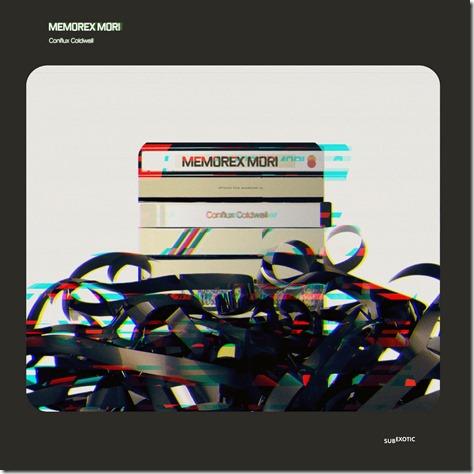
Memorex Mori is an unusually authentic work, born out of an excavation of -personal archives, as Coldwell explains: ‘Last year I found a dusty box of old unlabelled VHS tapes at my parent’s house, including some early work of my own I’d long forgotten about. Unfortunately the tapes were all in very poor condition and I only managed to recover some of the material. Despite the bad quality I decided to sample the videos anyway and make something new out of the various noisy remnants – the final result of that extended process is Memorex Mori.

Coldwell himself isn’t outside the frame of nostalgia with this ambitious project, either, as he continues: ‘VHS was the medium of my childhood in the 80s and 90s, and was still routinely used for budget productions by the time I started making films and music of my own. Looking through the old tapes made me realise the ultimate fragility of all our recordings and the memories they hold. These analogue tapes only have an estimated lifespan of 25 years, and this artificial life is only granted to the videos we actually decide to keep. The vast majority ended up in landfill when the world went digital – what was lost in the waste? In contrast, we might think that current digitisation and cloud storage allows our memories to live forever, but they are still fallible. The major difference is that with digital archives this mortality is hidden – with analogue media we can potentially witness that death happening in slow motion before our eyes.’

It’s an interesting and valid distinction between analogue and digital: growing up in the 80s and 90s myself, I remember being told not to vacuum clean near any video tapes, and so on, while toward the turn of the millennium the emerging digital future was presented as eternal. But now, it’s clear, that there is no such thing as permanence, or the eternal, and that any archive is as fragile as life itself.

And so, Memorex Mori is a multi-faceted, multi-dimensional, multi-media project, where past, present, and future collide, and postmodernism melts into the as-yet-to-be-defined present. It’s a film and it’s a soundtrack, and both can be appreciated independently of one another, as intended.

Coldwell expands on his notes, explaining ‘This project continues a lineage started by William Basinski and The Caretaker, exploring themes of memory loss, entropy and spectrality, through the sampling of destroyed recordings. But Memorex Mori extends this idea into the visual realm, presenting a feature-length music video alongside the music. As well as sampling early Conflux works from tape (Traveller, Glitch, Machinedance and Trainboy) various other unknown recordings were appropriated from the video box – all sorts of forgotten cultural detritus including my Mum’s 30 year old Open University programmes. A few modest pieces of equipment were used to add extra sonic layers – including the Korg NTS-1 and a home-made Marantz tape delay – then all bounced back to VHS.’

The video is a disorientating barrage of film clips, from train journeys to clouds, via small aircraft lifting off and droplets of water rippling out. Everything flickers and fades , glitches and warps. At times, we’re simply submerged in a snow of magnetic degradation and ruination, and it’s not always easy to discern what we’re actually being shown. But, often devoid of context, these detached, fragmentary scenes take on a sense of significance. The effect is an uncanny emotional response, a pull in the lower intestine as something unexplained and inexplicable evokes something within. There’s a comparison to be drawn with Memorex Mori and the experimental works created by William Burroughs and Brion Gysin in the late 50s and early 60s – in the soundtrack, the tape experiments, perhaps, but more so the whole audiovisual project, which calls to mind films such as Towers Open Fire, produced in the mid-60s with Anthony Balch, and a step closer to what Gysin’s quest to realise ‘a derangement of the senses’.

The soundtrack is the perfect soundtrack to this endlessly unsettling sequence, an eternally shifting sonic drift that’s at times noisy, even harsh, while at other altogether more ambient. Like the visuals, it draws you in, but it also stands independently as a purely sonic experience, and it’s also a smooth, expansive scene for reflection, and perhaps it’s to be expected that the soundtrack has greater impact when experienced in isolation, without the distraction of the visuals.

As a whole, or in part, Memorex Mori is quite an unsettling experience: visually compelling, and aurally challenging. It demonstrates the fragility of any documentation, any archive, and of life itself. Nothing lasts forever. And it speaks of how, as memory fades, so the documents diminish in value: moments captured in moving or still images which seem so essential at the time lose meaning over time: where was that picture taken? What was I doing there? Why did I think that would be worth filming / photographing? Who even is that?

I feel a weight descend as I reflect on all of these things while immersing myself in Memorex Mori. I can’t even begin to imagine the experience of assembling it. Then again, I can’t really assimilate the experience of other viewers or listeners, either. What’s intensely personal to an artist is likely to hit a spot with the audience, but for each, the reception will differ, based on their own experiences, their own immediate headspace.

But, regardless of individual interpretation, the vast ambition of Memorex Mori is matched by its accomplishment. THIS is a document. A powerful work, which will stay with you long after the silence descends.

AA
a2043088135_10

Bearsuit Records – 31st August 2022

Christopher Nosnibor

I may have mentioned it before, but I always get a buzz when I see a jiffy marked with an Edinburgh post stamp land on my doormat mat and I realise it’s the latest offering from Bearsuit records. Because while whatever music it contains is assured to be leftfield and at least a six on the weirdness spectrum, I never really know what to expect. That lack of predictability is genuinely exciting. Labels – especially micro labels which cater to a super-niche audience tend to very much know their market, and while that’s clearly true of Bearsuit, they’re willing to test their base’s boundaries in ways many others don’t dare.

Andrei Rikichi’s Caged Birds Think Flying is a Sickness is most definitely an album that belongs on Bearsuit. It doesn’t know what it is, because it’s everything all at once: glitchy beats, bubbling electronica, frothy screeds of analogue extranea, mangled samples and twisted loops and all kinds of noise. As the majority of the pieces – all instrumental – are less than a couple of minutes long, none of them has time to settle or present any sense of a structure: these are fragmentary experimental pieces that conjure fleeting images and flashbacks, real or imagined.

‘They Don’t See the Maelstrom’ is a blast of orchestral bombast and fucked-up fractured noise that calls to mind JG Thirlwell’s more cinematic works, and the same is true of the bombastic ‘This is Where it Started’, a riot of rumbling thunder and eye-poppingly audacious orchestral strikes. Its counterpart and companion piece, ‘This is Where it Ends’ which closes the album is expensive and cinematic, and also strange in its operatic leanings – whether or not it’s a human voice is simply a manipulation is immaterial at a time when AI—generated art is quite simply all over, and you begin to wonder just how possible is it to distinguish reality from that which has been generated, created artificially.

Meanwhile ‘At Home I Hammer Ceramic Golfing Dogs’ is overtly strange, a kind of proto-industrial collage piece. ‘What Happened to Whitey Wallace’ is a brief blast of churning cement-mixer noise that churns at both the gut and the cerebellum. Listening, you feel dazed, and disorientated, unsettled in the stomach and bewildered in the brain. There is simply so much going on, keeping up to speed with it all is difficult. That’s no criticism: the audience should never dictate the art, and it’s not for the artist to dumb things down to the listeners’ pace, but for the listener to catch up, absorb, and assimilate.

‘Player Name: The Syracuse Apostle’ slings together some ominous atmospherics, a swampy dance beat and some off-kilter eastern vibes for maximum bewilderment, and you wonder what this record will throw at you next.

In many respects, it feels like a contemporary take on the audio cut-up experiments conducted by William Burroughs and Brion Gysin in the late 50s and early 60s, and the titles only seem to further correspond with this apparent assimilation of thee random. I suppose in an extension of that embracing of extranea, the album also continues the work of those early adopters of sampling and tape looping from that incredibly fertile and exciting period from the late 70s to the mid-80s as exemplified by the work of Throbbing Gristle, Cabaret Voltaire, Test Dept, Foetus. These artists broke boundaries with the realisation that all sound is material, and that music is in the ear of the beholder. This strain of postmodernism / avant-gardism also follows the thread of Surrealism, where we’re tasked with facing the strange and reconciling the outer strange with the far stranger within. Caged Birds Think Flying is a Sickness is an album of ideas, a pulsating riot of different concepts and, by design in its inspiration of different groups and ideas, it becomes something for the listener to unravel, to interpret, to project meaning upon.

Caged Birds Think Flying is a Sickness leaves you feeling addled and in a spin. It’s uncanny because it’s familiar, but it isn’t, as the different elements and layers intersect. It’s the sonic representation of the way in which life and perception differ as they collide.

AA

a3019257531_10

The Helen Scarsdale Agency – HMS064 – 6th May 2022

Christopher Nosnibor

As William Burroughs said of his collaboration with Brion Gysin, The Third Mind, ‘No two minds ever come together without, thereby, creating a third, invisible force which may be likened to a third mind’. This wasn’t an entirely original concept, as he was referencing Napoleon Hill’s self-help book Think and Grow Rich, published in the 1930s. Self-help books are notorious for dispensing band advice and convincing the incapable that they’re capable of anything, but there’s a powerful shred of truth in this nugget: collaboration can – although there are absolutely no guarantees – throw open portal and new horizons and unlock unexpected avenues and whole worlds of potential. That more or less all of my attempts at collaboration have swiftly ended in failure – or, more accurately, fallen apart without producing anything more than a few paragraphs at best – probably says more about me than collaboration or my collaborators, but then when things have worked out… Yes, they’ve delivered. When it happens, it really happens. You can’t force or predict ‘gelling’: it simply happens, or it doesn’t, and when it does, alchemy ensues. You tend to find that strengths and weaknesses interlock, and all bases are covered, to use a poor assemblage of cliches.

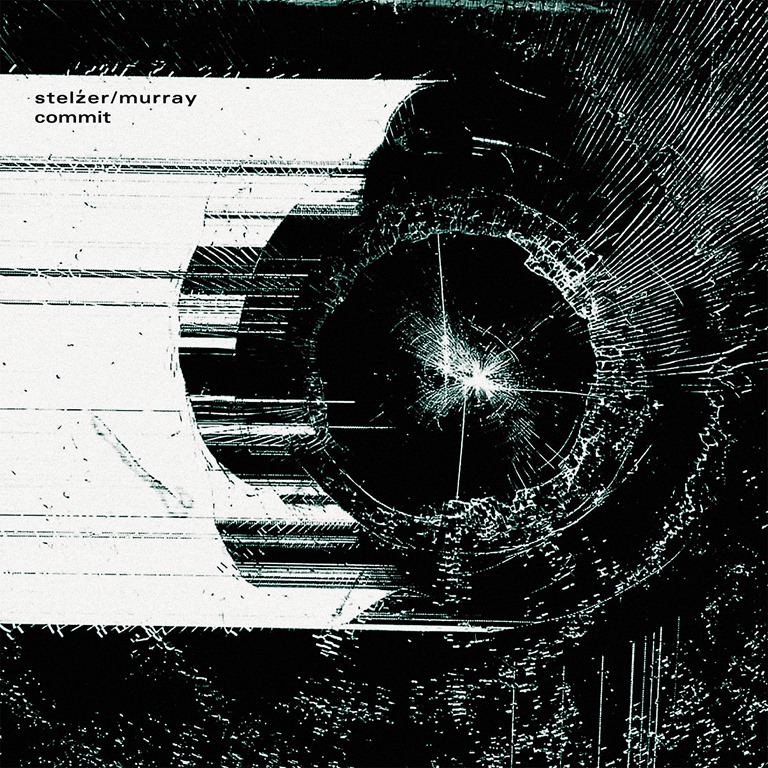
The accompanying text for the third production from the Stelzer/Murray project says that it ‘hits a sweet spot of slippery, industrial occultation that harkens back to an almost forgotten period of music from the late ‘80s and early ‘90s. Think Cranioclast, Arcane Device, Phauss, Small Cruel Party, Organum, and pretty much everything from the Quiet Artworks label… Exquisitely composed and overtly nocturnal without ever falling into the tropes of dark ambient and with plenty of gestures, signals, and threats that allude to any number of allegorically inclined processes (i.e. tape manipulation, time-delay accumulation, electro-acoustic minimalism, etc.).’

No question, despite their apparent absence of recollection of the actual process, Stelzer and Murray are the perfect foils for one another. Alchemy clearly has ensued – but make no mistake, this is some seriously dark alchemy, conjuring thick, black clouds of lung-clogging smoke that drifts, chokes, and suffocates.

On Commit, the atmosphere is dark, dank, doomy. The album is structured over two sides with the two parts of the title track, clocking in at around nine minutes apiece occupying side one before the nineteen-minute gloomfest that is ‘The House is Coming from Inside the Call’ smogging blurrily all over side two. The two parts of ‘Commit’ are darkly intense. They rumble and drone, groan and grind. There ae slow swells of cymbal, and a distant clicking, glitching that pulses time on ‘Commit 2’

is ‘The House is Coming from Inside the Call’ is sparse yet intense, and manifests as a series of movements over its duration. The atmosphere is heavy and oppressive, and the noise builds – and it is indeed noise that builds: it starts off as light drone and evolves into a thundering blast of grinding noise, clattering clanks of machinery and a howling siren that warns of danger, of imminent doom. You want to run for cover, to tale refuge, but there’s no escape and no shelter: thirteen minutes in and it’s built to a gut-churning, punishing churn of industrial noise, with clattering spanners and metal grating against metal.

In the dingy realms of dark ambient, Commit is a strong piece of work. It is dark, and dense, and intense. It possesses an unforgiving density, and it only gets darker and denser as it progresses. It’s an immersive and well-realised work, but Christ, is it bleak.

AA

HMS064_front

ZEHRA – 6th March 2020

Christopher Nosnibor

There’s always some impending doom or looming crisis facing us. As a species, we seemingly need some end of days narrative and a horizon shaded with the colours of oblivion in order to function – or maintain order. Collectively, we thrive on the drama. Given the state of the planet and of western democracy, it’s something of a shame that we’re still here, that we’ve not obliterated ourselves in a nuclear holocaust, that the earth hasn’t been swallowed by a black hole or supernova, that the millennium didn’t bring about the collapse of civilisation, that Ah Pook failed to materialise in 2012.

I’m listening to the mystical, timeless sounds of The Master Musicians of Jajouka, as captured on the colossal double album Apocalypse Across The Sky while being inundated with updates on the ever-accelerating spread of COVID-9: my office have emailed telling me that having pulled international travel a couple of weeks ago, there’s no travel between UK offices, including those within the same city, and that I’m to be prepared for enforced home-working. Could it be that where SARS and Bird Flu failed, we finally have the 21st century’s answer to bubonic plague? Time will tell, but it very much does feel as if there is indeed Apocalypse Across The Sky. Bring out your dead!

Having first come into being in 1950 and been introduced to a wider audience via the conduit of polyartist and William Burroughs collaborator Brion Gysin, The Master Musicians of Jajouka really broke into western consciousness in the late 60s, after Gysin took Rolling Stone Brian Jones to the village in Morocco – although there are now two groups purporting to be the ‘real’ Master Musicians: the one on this album, which ‘features’ Bachir Attar is the one Brian Jones encountered on his visit, when Attir’s father was at the helm. It’s ironic, as this is music that transcends all boundaries.

Apocalypse Across The Sky doesn’t sound especially apocalyptic, or radically different from any of the other recordings of the Master Musicians (in either iteration) I’ve heard that were captured since Brian Jones’ 1971 Pipes of Pan album, via the snippets captured in 1973 which appeared on the Burroughs album Break Through in Grey Room (my first encounter, and one which, with murky recordings sandwiched between various tape experiments, encapsulated the cut-up experience in a most singular way), the performances of various Joujouka musicians who performed at Gysin’s 1001 café in the mid-50s, released on One Night @ 1001 in the 90s, and on to more recent recordings.

Perhaps it’s my untrained ear: perhaps it’s that like many strains of dance and trance, which are very much dependent on the effects of repetition on both the mind and body, that much Sufi trance music sounds similar by design. But then again, when I described this music as timeless, I meant that the expectations of progression and evolution which are part and parcel of contemporary genre tropes simply do not apply here: folk music is steeped in tradition, and this is folk music in the truest sense, and therefore its very purpose is to remain unchanged and to preserve the past.

That isn’t to say all the pieces sound the same: some place considerably greater emphasis on the trilling pipes, while others are dominated by the complex polyrhythms, and Apocalypse Across The Sky does its thing and does it nicely, again capturing the experience of The Master Musicians of Jajouka. It’s hypnotic, captivating, resonant on a subliminal, psychological level.

AA

The Master Musicians of Jajouka feat Bachir Attar – Apocalypse Across The Sky

Nonclassical – cnclss024

Christopher Nosnibor

Langham Research Centre originated through late-night experimental gatherings at the BBC studios, and have evolved to produce long-form radiophonic works, of which 2014’s Muffled Ciphers was inspiredby JG Ballard’s seminal novel -which challenged the very notion of the form – The Atrocity Exhibition. Created with an accumulation of rare and obsolete instruments and devices, and inspired by early electronic composers spanning John Cage, Alvin Lucier, and Delia Derbyshire, Tape Works Vol. 1 is pitched as ‘a collection of modern musique concrète.’

The first thing I noticed was that my copy is number 11 of an edition of 30 promos. This knowledge spurs me to get my finger out and provide some coverage. The second thing I notice, on scanning the track listing, before reading the biography containing the above, is that it features tracks with the titles ‘The Voices of Time’ and ‘The Terminal Beach’ – the former of which is a collection of short stories by Ballard, and the latter of which is the title of one of the stories in that collection, which first appeared in 1963 under the title The Four-Dimensional Nightmare.

On Tape Works Vol. 1, the Langham Research Centre (and doesn’t that sound so Ballardian in itself… I’ve spent hours scanning my collection to see if there’s a character named Langham in Ballard’s oeuvre and have drawn blanks before ultimately deciding it’s better to actually get the work done than disappear down another rabbit-hole of research) explore all the dimensions. And while at times it confirms to the template of so much experimental analogue work, at times it ventures in the truly weird.

‘LOL, Pt 1’ mixes monkey chatters and R2D2 bleeps with eerie abstractions, bibbling bloops, fractured vocal snippets and small samples of laughter enter the mix alongside the kitchen sink to from an uncomfortable, disorientating sound collage.

There’s a lot of stopping and starting, whistling and droning, woe and flutter and infinite disruption. This is the sound of dislocation, a soundtrack designed to induce maximum disorientation.

Bleeps and squiggles, trilling squeals rising to a high-pitched hum collide with woozy, groaning bass frequencies. Notes bend as if on a stretched tape, and tape whips back and forth through heads. There are moments which recall the head-spinning cut-up and drop-in tape experiments conducted by William Burroughs, Brion Gysin, and Iain Sommerville in the late 50s and early 60s.

Birdsong. New snippets. A plane roars overhead. A conglomeration of voices. Static. Interference. A howling wind. Sparse, arrhythmic beats clatter and clang. Yes, this is life: fractured discordant, difficult. Simultaneous. Overwhelming. This is essentially how I feel about it. I cannot compute. I feel dislocated, alienated. I feel tense. Nothing new there. But Just as reading Ballard makes me feel uncomfortable in my own skin, so Langham Research Centre’s fucked-up sampling of old adverts and blending them with minimalist dark ambient twists me into a state of discomfort.

At time gentle, at others abrasive and bordering on the attacking treble whistles and white/pink noise crackle of early Whitehouse and Merzbow, Tape Works Vol. 1 is at no point accessible, easy, cuddly. But it does push the senses and question linearity and accessibility and even the boundaries of musicality. And as such, it fulfils its objective.

AA

Langham

Metropolis Records – 13th October 2017

Christopher Nosnibor

I’ve lost count of how many bands and songs I’ve encountered that reference ‘dream machine.’ The first was perhaps back in maybe 1992, aged seventeen, on purchasing Scenes from the Second Story by The God Machine. Although I had read Naked Lunch, Junky, and Queer (which was the limit of William Burroughs material available in my local Waterstones), I had yet to discover the weirder and more wonderful, experimental side of Burroughs, let alone his accomplice Brion Gysin, who was as responsible for the advent of the cut-ups as Burroughs himself. It was electronics technician, computer programmer, and peripheral Beat Generation associate, Ian Sommerville who invented the stroboscopic device know as the Dream Machine in 1960. I do sometimes wonder how many of those references to Dream Machines are aware of its origin and history, but given Burroughs’ popularity in industrial / related circles, the chances are probably fairly high. Which then leads to the question – just how much is this about trip, and how much about hip?

Inertia have been kicking out technoindustrial tunage for almost two and a half decades now. Over that time, they’ve acquired a respectable fanbase and released a slew of albums. As is always the case with the ‘goth’ scene, it’s all happened more or less invisibly, underground, and internationally rather than domestically.

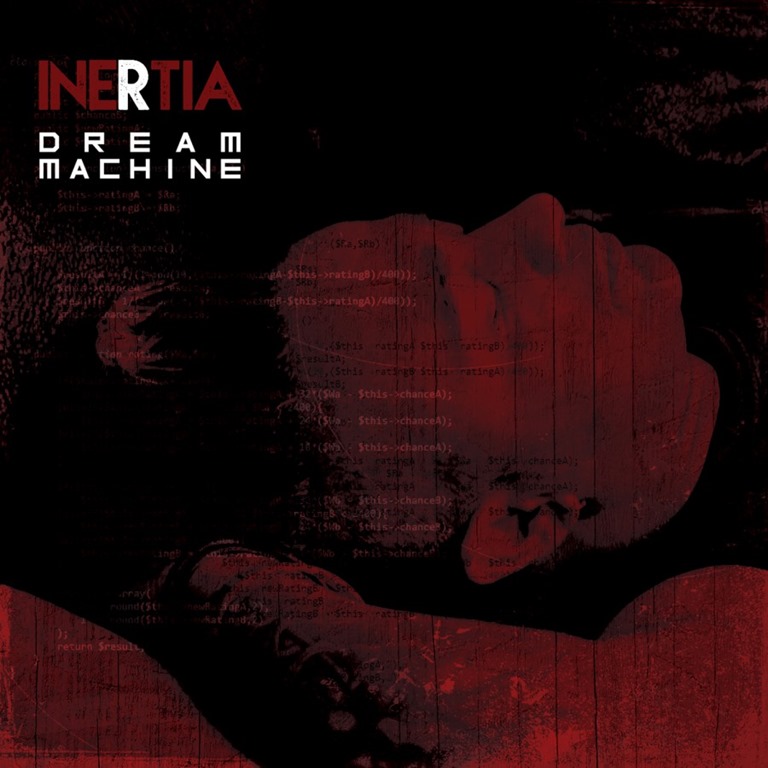
Dream Machine is very much an album which follows established templates: insistent, bubbling synths heave and grind over thumping sequenced beats with a toppy edge and hard dancefloor edge. It’s solid, and it has tunes. It’s got the right balance of attack and melody, edge and groove. In fact, it’s pretty much back-to-back tracks you could get down to on the dancefloor at a goth night, and steel toe caps would be recommended.

The drum pattern at the start of ‘Only Law’ is a near-lift of the intro to ‘Burn’ by The Sisters of Mercy, before it all goes Music for the Masses Depeche Mode. It’s not just the insistent synths and jittery sequenced bass, or the hard-edged beats, but the soulful, melodic, backing vocals. Elsewhere, ‘Thorns’ goes Ministry circa Twitch. But for the most part, as is so often the case with longstanding technoindustrial acts, I hear Depeche Mode, with a dash of early Nine Inch Nails. I’m by no means averse to the sound, the style, or the influences: in fact, I’m a huge fan of both DM and NIN and have more Wax Trax! 12” than I could play in a week.

So where’s the beef? It’s all a bit samey. I feel like I’ve been listening to the same hardfloor techno-driven industrial-strength electro grooves for more than twenty-five years. Cybergoth, Darkwave, EBM, Aggrotech, Industrial Dance Music… the terminologies matter not. Some came, some went, but musically, it’s much of a muchness and I’m not up for debating the semantics of microgenre aesthetics.

Dream Machine is ok. It’s got some decent tunes. And it sounds like countess albums I’ve heard before.

AAA

Intertia - Dream Machine

Editions Mego – EMEGO226 – 24th February 2017

Christopher Nosnibor

The latest work from Florian Hecker, A Script for Machine Synthesis is described as ‘an experimental auditory drama and a model of abstraction’. The press release continues, explaining that ‘A Script for Machine Synthesis presents a complex simplicity that spirals in an unending manner as an audio image of the uncanny valley. It is the third chapter in the trilogy of text-sound pieces Hecker has collaborated with the philosopher Reza Negarestani. A resynthesized voice outlines procedure as procedure itself unfolds… The suggestive encounter with a pink ice cube is a conceptual point of departure for a scene in which linguistic chimeras of descriptors are materialized through synthetic trophies, mental props and auditory objects. Exeunt all human actors, A Script for Machine Synthesis is an experiment in putting synthetic emptiness back into synthetic thought.’

I’m reminded of a number of theory-based text works centred around automation and abstraction, ranging from William Burroughs’ cut-ups and Brion Gysin’s permutations, to Philippe Vasset’s 2005 novella, ScriptGenerator©®™, via Stewart Home’s experimental audio piece, ‘Divvy’, which used computer-generated voices to read the two simultaneous narratives. The concept of the removal of the author from the creative process is nothing new, and while a robotic takeover may have been more greatly feared in science fiction works of the 1970s and 1980s, the fact of the matter is that the threat is greater now than ever before – but people are generally too wrapped up in reality TV or killing themselves just to make ends meet and to pay the bills that the technological developments of the last decade or so have gone largely unnoticed: instead of a seismic shift, the takeover has been gradual and insidious.

A Script for Machine Synthesis exists in a strange territory between territories, or, more specifically, times. While drawing heavily on the paranoias – and, by its sound, technologies – of preceding decades, it’s very much a contemporary work in terms of its concept if not so much its rather retro-sounding execution.

A Script For Machine Synthesis is not an album one listens to for its textual content: it is a drab, monotonous work which centres – aside from the introduction and credits – around a single track some fifty-seven and a half minutes in duration. Slightly fuzzy monotone voices narrate the process of the process in the style of technical manuals, and lecturing a highly complex theory in the driest, dullest of styles, while bubbling synths and electronic scratches and bleeps provide distracting incidentals which aren’t quite distracting enough to break the monotony. It’s hardly riveting from a sonic perspective, either. At points, the words become practically inaudible as digital distortion and file corruption disrupt the audio. Skittering, warping interference do more than interfere with the audio flow, but create a certain cognitive dissonance which engenders a sort of subliminal tension: I find myself growing twitchy and jittery, manifesting in increasingly awkward head-scratching, and a difficulty in sitting still. It could just be a unique individual response, ad of course, any experiment will produce different results with different subjects, but sitting by candlelight with a relaxing pint, I can’t readily identify any other factor which may explain my growing discomfort.

This is, of course, the ultimate synthesis of theory and practice, and more than anything, the experience of listening to A Script For Machine Synthesis bears strong parallels to the digitally-generated screeds of text published by Kenji Siratori in the late 90s and early years of the new millennium. That is to say, it’s a concept work which, while far from enjoyable, is undeniably admirable in its audacity and its absolute commitment to explore the concept at its core to its absolute end. This is art.


Hecker - Script