Posts Tagged ‘Avant-garde’

2nd October 2025

Christopher Nosnibor

The context for Ashley Reaks’ sixteenth solo album – and his third in three years (not counting the compilation of demos released earlier this year) – is weighty. He has written openly and extensively of his health issues, while sharing images and commentary nocturnal wanderings, and these both inform At Night The World Belongs To Me, of which he writes:

The looming spectre of death and loss haunt the album: Reaks survived two major health scares and a misdiagnosed terminal illness over the last 18 months, experiences that inform the reflective, poetically gloomy lyrics, and the 4 am downtempo grooves. Adding to the sense of loss, guitarist and long-term collaborator Nick Dunne died suddenly at home just one week after completing his guitar parts for the record.

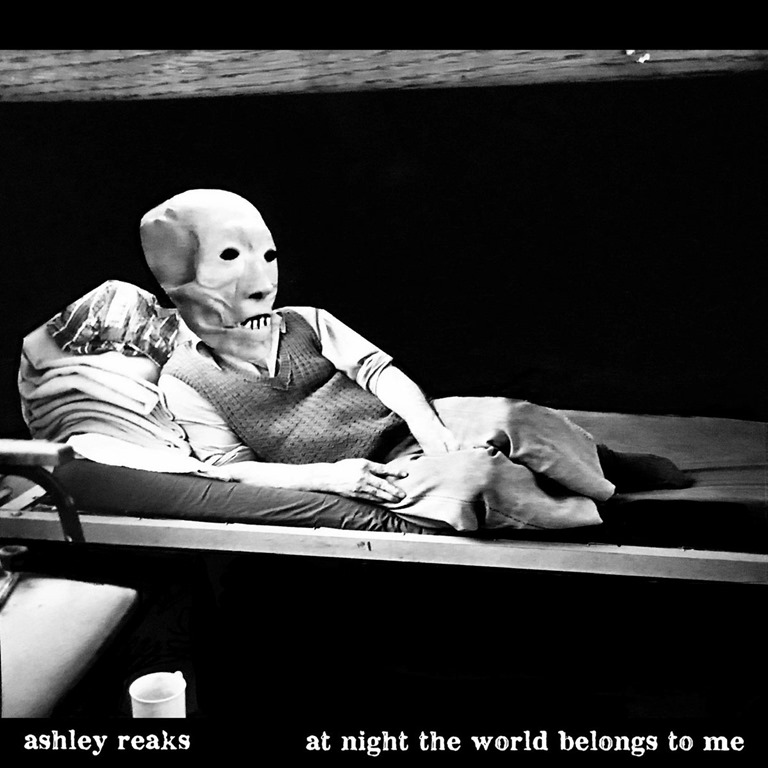
Through all of this, he has continued to collage and write prodigiously, but At Night The World Belongs To Me marks a distinct change of tone from its immediate predecessors, The Body Blow of Grief (2024) and Winter Crawls (2023). The usual elements are all present and correct – the sense of experimentalism, the collaging of genres, melding post-punk, jazz, and dub – but this feels darker, more introspective. The cover art, too, reflects this. While it has the same rather disturbing, grotesque strangeness of his usual work, the grim-looking figure in repose has connotations of ailment, frailty, even the deathbed.

The first track, ‘Playing Skittles With The Skulls and Bones’ has a bass groove that calls to mind The Cure’s early sound, melded to a rattling rhythm reminiscent of ‘Bela Lugiosi’s Dead’. The smooth sax that wanders in around the mid-point provides something of a stylistic contrast, but at the same time, it’s minor-key vibes keep the song as a whole contained within a bubble of reflection, evoking the stillness of night. I know, I’m sort of dancing about architecture here, but something about Reaks’ work prompts a multi-sensory response.

‘Rimmed With Yellow Haloes’ brings soaring post-rock guitars atop of an urgent ricochet of drumming and solid bass. On the fact of it, it’s almost poppy, but it soon shifts to take on a folksy aspect, while Reaks sings of death and funeral pyres, and the refrain, delivered with lilting, proggy overtones, ‘The Lord gave the day to the living, the night to the dead’. In context of the album’s title and theme, there is a tangibly haunting foreshadowing here, a suggestion that Reaks has not only accepted his mortality, but has assumed his place. It’s powerful, and deeply moving. Of course, Reaks can’t help but introduce incongruous elements, with some horns which are pure ska and some super whizzy 80s pop synths providing a pretty wild counterpoint to it all. It’s hard not to smile, because there’s an audacity to this approach to composition and arrangement – a lot of it simply shouldn’t work, but it does, and it’s uniquely Reaks.

The album’s shortest song, ‘Things Unseen’ is snappy, poppy, Bowie-esque, an amalgamation of post-punk and electropop, a standout which is succinct and tight, and consequently, the dark connotations of the bleak shuffle of ‘Life Forever Underground’ – a rippling synth-led tune – are rendered more profound. The sequencing of this album is such that the shifts between songs accentuate their individual impact.

‘Mask the face, unmask the soul…’ he sings softly on ‘Mask The Face’, which has a somewhat spacey Krautrock feel to it – before a guitar solo that worthy of Mark Knopfler emerges most unexpectedly. And as dark as things get here, Reaks never ceases to bring surprises. At Night The World Belongs To Me perfectly encapsulates the reason he’s so respected and critically acclaimed, but orbits light years outside the mainstream. In a world defined by an exponentially reducing capacity for sustained attention, Ashley Reaks makes music that requires real engagement, the musical equivalent of complex carbs and high fibre foods in a processed, white bread culture. But also, contemporary mainstream radio music favours short songs which cut straight to the chorus, where the hook has to land in the first twenty seconds. Here, we have eight songs, all but one of which are over five minutes long. They take their time, they’re expansive and exploratory, there’s atmosphere, there’s depth. And as ‘Eyeing Up The Sky’ tapers away on a buzzing drone, we’re left with much to chew on, much to consider.

AA

a2008509738_10

This October, the indefatigably enigmatic trio The Necks will release Disquiet, their 20th full-length release, a triple disc via Northern Spy. It’s an absolutely intoxicating listen, over three hours of incredible music.

The band has shared the mesmerizing 26-minute ‘Causeway,’ as a first listen. Hear it here:

AA

Necks

Photo credit: Dawid Laskowski

New Irish trio Rún are preparing to release their debut self-titled album on Rocket Recordings on 22nd August, and today share with us another taster in the form of ‘Strike It’.

About the track the band comment, “’Strike It’: A barely contained explosive doom riff with an industrial patina; points to the hypocrisy of a religious institution in profound dereliction of its duty to the most weak and vulnerable of us. The song addresses the macabre details of the Tuam babies controversy in Co. Galway, Ireland.”

The Irish word Rún can mean secret, mystery, or love, or perhaps some elusive combination of the three, reflecting the many aspects of life that defy easy explanation. In wrestling with these, it can become necessary to commit oneself entirely, to jump in at the psychic deep end in search of the vibrations and feelings at hand. This is where the band Rún come in.

The debut album of Rún – the result of three powerful artists locking horns and bringing equally passionate and uncompromising approaches to bear – is no less than an extraordinary collective catharsis. Yet more evidence that true heaviness is about much more than a cranked amp. It’s an emotionally driven and richly atmospheric journey into the darkest recesses of states earthly and unearthly, from a spiritually intrepid outfit who alchemise experimental methods and improvisatory states to reach intimidating heights of sonic and psychic intensity.

AA

Live dates:

21 Aug / Galway / Roisin Dubh
22 Aug / Cork / Nudes
27 Aug / Dublin / Spindizzy Records (instore)
29-31 Aug / Birmingham / Supersonic Festival
6 Sep / Sligo / Minor Disturbance Festival
15 Nov / London / Rich Mix (w/ Sirom)
19 Nov / Glasgow / The Glad Cafe
20 Nov / Newcastle / The Lubber Fiend

Rún comprise firstly Tara Baoth Mooney – sometime Jim Henson voice artist, with a longstanding background in everything from folk and choral music to experimental film-making. Diarmuid MacDiarmada – Nurse With Wound co-conspirator and brother of Lankum’s Cormac, brings with him the experience of avant-garde collaborations with a plethora of artists stretching back over thirty years. Drummer, sound designer and engineer Rian Trench, meanwhile, has worked on everything from the psychedelic IDM of Solar Bears to auto-generative experiments to orchestral arrangements, and owns the studio – The Meadow on Ireland’s East Coast – in which the album was made.  
The disparate artistic practices of the three members of the band collude in this context to create something no member could have foreseen. “Beyond the larger themes we explore, the work is often inspired by dreams, synchronicities, and other uncanny influences found in everyday life” reckons Diarmiud.

Besides this, an extremely diverse range of musical influences make their presence felt here, from William Basinski and Pauline Oliveros to Om, Coil and The Necks. “Suffice to say that there was a variety of sacred musics, acid-folk, cosmic jazz, stoner / sludge-metal, avant-garde composers and a hint of R&B being ground up and baked in with everything else in our wonky witches’ kitchen.” They say, “Things that possibly shouldn’t go together are juxtaposed to create something surprising and new.”

AA

Run-bird2colour1-990451014504513c

Photo by Robert ‘Scan’ Watson

Saccharine Underground – 1st July 2025

Christopher Nosnibor

This one hell of a hybrid. Just when you think post-punk has been explored to the point at which it has been hollowed out, exhausted, and has only well-worn and instantly recognisable tropes to offer, along come Washington DC’s Zabus, purveyors of avant-garde post-punk with an EP which is something of a ‘best of’ with tracks from their two recent albums, Automatic Writhing (September 2024) and Floodplain Canticles (January 2025), plus a new track which paves the way for their next offering Whores of Holyrood (due in August).

With its immense, reverb-laden sound and expansive, drifting desert-like soundscape ‘Grafhysi Fyrir Alla’ makes four and a quarter minutes feel like a hypnotic span of double that duration. The shuffling bass and big, booming bass are pure dub. The guitar chimes and floats into the ether as everything swashes around in a huge echoic pool.

Of ‘Grafhysi Fyrir Alla’, lifted from last year’s Automatic Writhing, project founder and focal member Jeremy Moore says it’s about “the societal imposition of unobtainable standards of beauty, and our obsession with physical perfection at the expense of true happiness”. This is certainly not a case of style over substance, but a coming together of musical inventiveness with a level of intellect which is rare. “Psychopathologies like body dysmorphic disorder, at the extreme, can lead to a path of ruin, if most of your life is spent chasing a ghost—what you believe the world wants you to be. Death doesn’t discriminate. The end is always the same.”

This is some pretty heavy – and dark – philosophy on offer here, and it’s welcome: as much as there is much to be said for the benefits of the escapism music can offer, there’s equal solace to be found in art which articulates one’s own world view. And so it that that Zabus portray contemporary dystopia from a range of camera angles.

‘Orphalese’ is more uptempo and is decidedly cinematic with its broad-sweeping layers of synths driven by propulsive, rolling drums. There’s no verse / chorus structure, but instead a hypnotic expanse of sound, the aural equivalent of standing on a summit and looking out at a three-sixty horizon through a heat haze. It’s immersive, utterly absorbing, and transportative.

The first of the tracks lifted from Floodplain Canticles is the six-minute ‘Tearful Symmetries’, which is low and slow, Jeremy Moore’s reverb-drenched baritone croon approximating the late, great, Mark Lanegan against a dubby backdrop punctuated the clangs and scrapes of guitar drones and sculpted feedback. ‘This is the end….’ He reflects, but not with sadness or panic, but a sense of inevitability.

‘Golden-rot’ goes all out for the theatrically gothic experience: it’s as big on drama as it is on sound, as an insistent mechanised drum beat pounds away, cutting through a smog of murky guitar and thick, booming bass, and if I wasn’t already perspiring hard from the humidity and thirty-degree heat, this would make me sweat, with its tension and crackling energy.

And so we come to the title track, the first taste of Whores of Holyrood. It’s different again, although the cavernous reverb is a constant. This cut is a brooding piece that borders on country, once more evoking the spirit of Lanegan. It’s spacious, but its intensity brings an almost suffocating weight.

Shadow Genesis provides a perfect introduction to Zabus, and at the same time whets the appetite for what’s to come. And let me tell you, it’s something to get excited about.

Zabus - Shadow Genesis cover art

Cold Spring Records – 23rd June 2025

Christopher Nosnibor

It may be a heretical stance, particularly as a big fan of Throbbing Gristle, but Psychic TV never really did it for me. They felt a bit meandering, wanky folky, in the same way as a lot of David Tibet’s stuff does. This may be to my detriment, and I may be missing the joys and benefits of a huge catalogue, but… I can shrug it off, and I will live.

TG and seminal filmmaker Derek Jarman were kindred spirits, provocative, avant-garde, and testament of their reciprocal artistic respect is cemented in their 1980 collaboration, where TG soundtracked Jarman’s movie Under the Shadow of the Sun (with the soundtrack being released some four years later).

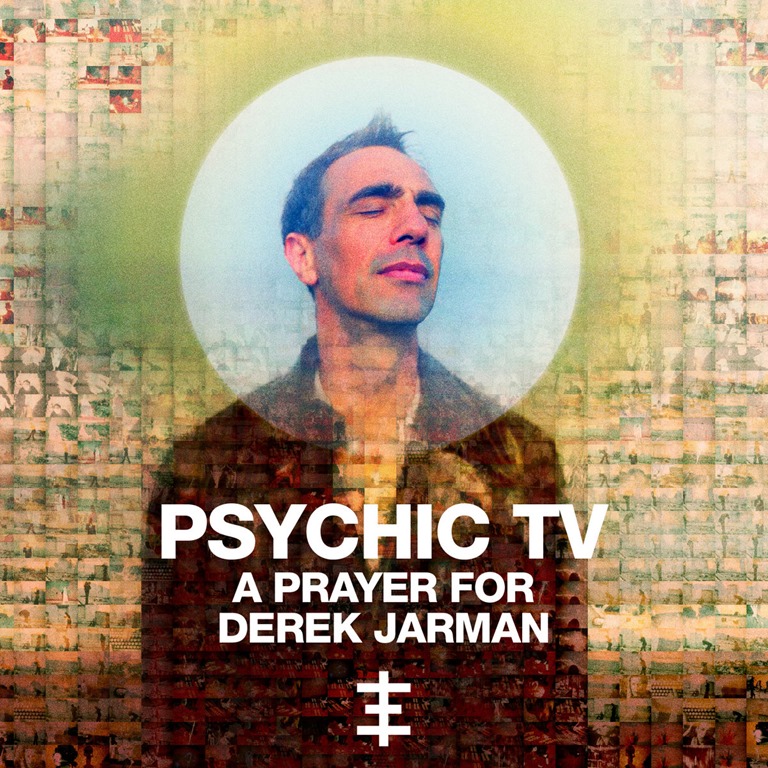
A Prayer For Derek Jarman was recorded later, on LP in 1985 by Temple Records and subsequently reissued as an extended CD version by Cold Spring in 1997. As the accompanying text explains, ‘Unavailable for almost three decades, this collection from the Cold Spring archive has been repackaged and remastered with new artwork. A documentation of the soundtrack work created by Psychic TV for the film-maker and artist Derek Jarman, it serves as a demonstration of why PTV were one of the most important groups in the underground scene of the 1980s and 1990s.’ The material on this disc was – as far as I can discern – last available in 2011 as part of the Themes six-CD box set, also released via Cold Spring, and this represents a solo release of disc two.

There’s no mistaking that both Jarman an PTV were important, although I would personally rank the former above the latter – that may be a rather subjective position to take, though, and there is no denying the immense shadow Genesis P Orridge would cast over the scene for many a year and perhaps an eternity.

The titular ‘Prayer For Derek’ is intended as an invocationary prayer and is based on Tibetan rituals; a collage of sounds including field recordings of the lulling waves running aground on the shingle beach opposite Jarman’s Prospect Cottage in Dungeness, Kent, home of some of the UK’s best preserved ‘sound mirrors’ – alongside bird song, crying babies and massed ritualised chants to aid the late director in his after-life journeys. It follows the seventeen-minute churning abstract noise whorl that is ‘The Loops Of Mystical Union’ – and which is, on balance, as good as any of Throbbing Gristle’s expansive dark noise works, and ‘Mylar Breeze (Parts 1 & 2) on which the promo for the album is predominantly pitched, and the ‘Mylar Breeze (Part 3)’. These compositions are piano-led and border on neoclassical. Dainty, charming, and musically eloquent, they certainly mark a departure from the work more commonly associated with Orridge or PTV, as well as evidencing the reasons why they are such a difficult act to pin down, or even distinguish the ‘good’ and ‘not so good’ works in their immense and wide-ranging – and variable – catalogue. With its echoed, looped vocal layers redolent of Gregorian chants, it’s not so hard to determine why ‘Mylar Breeze (Part 3)’ is not mentioned in the promo, although it’s entirely captivating.

As the accompanying text observes, ‘Other tracks feature elongated drones, washes of dissonance, melancholic guitar chime, evocative piano scoring, Burroughs cut-ups, gothic chants and snarling dogs.’ ‘Rites of Reversal’ marks a clear contrasts from the delicate piano-led compositions, diving in with some hard-edged grinding oscillations, which, again, lean more toward the kind of dark noise that was the TG trademark.

A Prayer For Derek Jarman is broad in scope and mood, and this is as appropriate is it is likely deliberate. It certainly presents the more experimental aspects of Psychic TV, and as varied as it is, the quality is also there.

AA

AA

a2838757322_10

Futura Resistenza –16th June 2025

Christopher Nosnibor

Much of Felix Kubin’s work since the turn of the millennium has involved radio, although film and theatre and other soundtrack works have also been a feature. Der Tanz Aller is one such soundtrack work, which was ‘created for the performance of the same title by the experimental arts collective LIGNA. The group specialized in site-specific, participatory works. Der Tanz Aller is based on Rudolf von Laban’s radical 1920s concept of ‘Bewegungschöre’ (movement choirs), collective dances in public space that aimed to reimagine social order through shared movement.’

The context and objective behind the composition are particularly useful to be aware of when listening to this album in isolation, as Kubin sets out: ‘When the performance group LIGNA approached me in 2012 to compose music for a play based on Rudolf von Laban’s revolutionary kinetic theories and so-called ‘Bewegungschöre’ (movement choirs), I thought of a soundtrack that would be both rhythmically engaging, abstract and mechanical. I knew there would be pre-recorded voices talking about his philosophy and guiding the audience via headphones. So, I had to leave some “air” in the arrangements, allowing the visitors to concentrate on the spoken words, while simultaneously becoming dancers. In LIGNA’s conceptual works – just like Laban’s idea of the movement choirs – the audience members become the performers.’

I shan’t dwell too long on the conceptual aspects here, beyond noting that this predates John Cage’s 4’33” by more than two decades, and while Cage’s silent work was on many levels a quite different proposition, the way in which any sound made by the audience – be it a cough or the shuffling of feet or the creaking of a chair – immediately becomes part of the performance indicates clear common ground. Likewise, William Burroughs’ cut-ups, which invited ‘creative reading’ whereby the engagement of the reader and their experience and perception was integral to their success, arrived some thirty years later. As such, ‘Bewegungschöre’ represent the cutting edge of avant-gardism, belonging to the era which brought us Duchamps’ readymades and – perhaps more pertinently – Tristan Tzara’s directions to make a Dadaist poem.

For the most part, the ‘air’ in the arrangements is apparent: there is space, separation, and while we can only imagine the prerecorded voices talking about Laban’s philosophy through headphones, it’s possible to get a sense of how it would work. But then, occasionally, Kubin’s compositions get father more busy, as on ‘Dämonen der Zerstreuung’, with big band percussion and noodlesome orchestration that’s of a strong jazz persuasion, but has a whole lot happening, and often simultaneously. There’s drama with orchestral strikes, and creeping, urgent glockenspiels that bring a noirish, detective movie feel – not a chase scene, but a cat-and-mouse scenario.

There are some spoken-word passages, in German, as on ‘Raumstunde Vera Skoronel’, accompanied by evolving sonic backdrops, the likes of which I find hard to imagine inspire dancing, but spasmodic twitching and erratic lurching, while the title track is a slice of jerky, and quite insular and intense, Kraftwerkian synth bleepery, and ‘Rotes Lied’ is a perfect exemplar of sparse, spaced-out, glooping, blooping, reverby weirdery with occasional chimes and stuttering shot of snare. There is plenty of air here, as you sit and wonder what exactly is going on?

Who knows? And does it even matter at this point? The percussion builds from all sides, and the nagging away – until suddenly it doesn’t.

The unpredictability of Raumstunde Vera Skoronel is its strength. It is weird, unexplained in many respects, beyond simply the initial onboarding awkwardness. We should probably celebrate this weirdness, this sense of separation. Raumstunde Vera Skoronel is never dull, but always strange and alien – and these are reasons to appreciate it.

AA

AA

RESLP040 front

Strategic Tape Reserve – 21st March 2025

Christopher Nosnibor

It’s certainly been a while since we last heard from Justin Watson, the epically-bearded being who formerly ran the Front & Follow label, but here he has temporarily resurfaced as one half of the absurdly-monikered Cromwell Ate A Twix Here on a split release with underground noise legend YOL, released by Spanish cassette label Strategic Tape Reserve. As such, even before hearing a sound, one can predict that this is destined to be unpopular – by which I mean an ultra-cult release for a microniche audience – or, put simply, the noise scene.

The bio for Cromwell Ate A Twix Here tells us more about what they aren’t than what they are, hammering home that ‘Justin ran Front & Follow and definitely doesn’t now. It’s over. He’s half of MORE REALISTIC GOALS, a third of The Incidental Crack and a quarter of The Watson Marriage Experiment (2006-)’. So in the wake of its brief revival for the charity fundraising Rental Yields series of complications not so long ago, we can be confident that the lid is now firmly nailed onto the coffin of F&F and even Dracula wouldn’t resurrect the label’s activity. But this is how it tends to be with those of a creative bent. They simply can’t not do anything forever. It’s not even an itch: it’s a compulsion. ‘Fragile’ occupies side one, and is eighteen minutes of expansive, filmic music, constructed around quavering, wavering drones, sparse pseudo-strings and soft, supple abstractions by way of an accompaniment to a somewhat surreal spoken-word narrative about… what is it about, exactly? Death, yes, but also a new relationship, interaction… The music fades into the background during the narrative, rising to the fore between passages. David Yates’ delivery is natural, down to earth, friendly, even, and is fitting for a tale which is largely given to quite mundane details before shit gets weird at the end. The audio begins to grow more unsettling, a shade disturbing around the seven-minute mark, and things only get darker thereafter.

And then there is eighteen minutes of Yol, which is pure derangement. Anyone acquainted with his work will be expecting nothing less. It begins with him stuttering and choking in convulsions over a mess of noise about ‘wheel of life, wheel of cheese’, and he yelps and roars, sounding as if he’s utterly possessed or dying, spasmodic ranting overloading over a horrific mesh of feedback and sonically rough terrain. You can practically hear your speakers wilting as the blasts of distortion scratch and scrape and glitch and burst and grind and buzz like so much sputtering, sparking, damaged circuitry. The whole thing is deranged, although it’s no less deranged than Liz Truss’ famous proclamations about cheese or any statement issued by The Whitehouse in recent weeks. He knows this, of course: however insane his work sounds, there are political undercurrents and a certain knowingness to his brand of frenzied avant-gardism, as evidenced on viral cats and dogs (2021).

The fact that this is just short of twenty minutes of a man yelping and barking and seemingly losing the plot before a microphone, and yet making more sense than five minutes spent perusing the news or social media tells us where we are in the world right now.

The two sides of this split release may be very different, but the contrasts are complimentary, and in combination, offer a welcome excursion beyond the everyday madness we’re living through, offering insights into rather more specialist madness instead. But this is artful madness, or good mad, or something. These guys won’t wreck the economy, invade or annexe your country, or fuck you over. They’ll just be over there making some weird noise. I’ll be over there with them, and you’re more than welcome to join us.

AA

a4054677057_10

Futura Resistenza – LP Mar 24, DL Feb 28

Christopher Nosnibor

Most blurbs which accompany releases are either factual, unspectacular in their biographical detail, or tedious in their technicality. Some are vaguely amusing or otherwise entertaining, but the words accompanying Jeugdbrand’s 3 × hullo, hullo, courtesy of  Lieven Martens are outright deranged. I mean, there’s a narrative there, but it’s more of a slab of gonzo fiction than anything. And that’s before we get to the whole mole thing….

‘Well, it went like this: I open the glass door to the garden, the early morning coming to its midday end. That everyday anxiety that overcomes late risers from time to time kicks in. “Fuck, almost half a day wasted!” But abruptly, this sentence in my head gets overdubbed by the Queen’s English: “That shit mole, that blimey shit cunt mole!” I see the expat owner of our Airbnb punching his bare fists on his green lawn. A spotless lawn, but with here and there a few molehills. His grass, like a billiard cloth in a smoked bar, serves as a contrasting pathway to the black volcanic rocks at the back of the house. Behind these rocks, the ocean foams and growls. “Luv, get the poison! I wanna finish the bugger now and for good. Bloody hell!” I watch this scene with amusement, until suddenly, when the landlord notices me, he cleans up his act. “Ooh, these are funny little creatures, eh, these furry moles. Cheeky peng. Eh, fancy a cuppa?” The landlord’s head and belly are so ridiculously red that I can almost hear a lobster scream in a pot of boiling water. He looks like a walking can of Spam, its contents cooked by countless days under the Indian Ocean’s sun. The Indian Ocean, where sharks migrate between Africa and Australia. And where the Hawaiian-shirt-wearing tourist bravely builds new islands of trash. Yes, the very true meaning of re-creation. Someone once told me that lobsters don’t really scream.’

I once caught some shrimps and prawns in a rockpool while on holiday in Devon. I was probably about twelve. We took them back to the cottage, and my dad cooked them up, tossing them into boiling water. I understand the sound of them being boiled alive was actually the air escaping their shells, but they did sound as if they were screaming, and I have referred to them as ‘squealy prawns’ ever since.

That I have digressed in response to an epic digression seems only fitting, and all of this seems appropriate when it comes to this album. 3 × hullo, hullo definitely falls into the category of ‘weird shit’. ‘Lonely, Sure, but It Is Getting Late and My Grandmother Is Calling’ flits between blasts of noise, stuttering percussion, jolting rumbles, whistling feedback, mumbling, grumbling, and demented yelling, yodelling and ululation. It’s a lot to pack in to less than six minutes, particularly when it’s six minutes spent scratching your head, looking around and wondering what the fuck is going on.

By the end of the album’s five tracks, I’m none the wiser. It makes me think of when I see a post on social media which is both seemingly cryptic and linguistically nonsensical, and yet it’s followed by a series of responses which bewilder not only in their equally coded babble, but in the realisation that people actually understand the initial post. It isn’t that I don’t get the way language evolves and how each generation develops its own spin, but… words. They mean what the mean, no? No. It seems I am wrong.

In fairness, I do understand the words and the narrative Jeugdbrand offer, it’s just that the narrative is crackers, and it’s fitting because the album is also crackers, a collage of craziness from beginning to end. ‘Tomorrow, Tomorrow? I’m Talking About Now, Forget about It!’ starts with a ticking clock and then goes haywire, making for a head-spinning eleven and a half minutes of tribal percussion, drones, discordant church organs, surges of sound add rapid depletions, hollers, yells, grunts, and yelps. Elongated notes quaver, quiver, and fade in and out, while there are twangs of guitar and the occasional, incidental thump and scrape. ‘There’s No Word for Ambient in Dutch’ is dark, haunting – at least after its strange, murky start, reminiscent of Throbbing Gristle’s noisy, oddball experimentalism.

‘Motorcycle Oil on Canvas’ is eleven and a half minutes of spooky, spaced-out woozy, warping drones and oddity, again with snippets of chants, record scratching, clicks, pops, crackles, toots and parps and, amidst the rumble of engines and the snarl of prehistoric reptiles, one finds oneself completely adrift and perplexed. It ends with anguished wailing atop a tempest of noise. There is a lot going on. Much of it is hard to process.

I’m accustomed to all shades of avant-garde and experimentalism, and I’m even more accustomed to my friends defining my musical tastes as ‘weird’, but this is far and away some of the weirdest shit I’ve heard – period.

AA

a2998600553_10

Reinhold Friedl & Costis Drygianakis – ta amfótera en / two into one

zeitkratzer productions – 28th February 2025

Christopher Nosnibor

Reinhold Friedl has been a significant contributor to the world of avant-garde music for a long time, not only as a leading explorer of the potentials of the prepared piano, as pioneered by John Cage, but in excavating the works of historical composers and reconfiguring those of more contemporary ones, leading the zeitkratzer ensemble through performances of Metal Machine Music and selected cuts from Whitehouse’s catalogue.

This particular collaboration coalesced during the pandemic, after which, as we learn, ‘Costis Drygianakis recorded Reinhold Friedl’s special piano sounds on a Blüthner grand piano with a bunch of extremely diverse microphones, ranging from a beautiful old Neumann U67 to a cheap tape cassette machine and even a Dictaphone. The resulting recordings have been classified, selected and processed at his home studio in Kritharia, Greece. No other sounds have been used.’

ta amfótera en is one continuous piece, just over an hour induration, and it’s a journey, to say the least. By ‘journey’, I mean torturous experience. It’s dark, punishing, pulverising, scraping, nightmarish. The first two minutes alone are a soundtrack to extreme horror – fear shaking amidst tremulous piano, heavy discord rumbling low and disconcerting to the point of spiking anxiety, after which there are protracted warped drones and rumblings which drag on, scraping and twisting, sonorous and uncomfortable. Amidst rolling, swirling, churning ambience and awkward, uncomfortable noise, random piano notes spike, seemingly at random. Gongs chime, crash, and clash.

When I was a child, the warping, discordant intro to ‘Rio’ by Duran Duran intrigued me. It created a palpable tension which affected me inexplicably at the age of nine. Perhaps this brief snippet of sound, dissonant, metallic, paved the way to my later obsession with musical otherness. The specific reason I reference this formative experience is that lengthy segments of two into one sound almost exactly like those opening bars of ‘Rio’ – scraping, discordant, a little like twisting metal.

two into one warps and hums, scrapes and drones, and occasionally plonks and thunks, the sounds rising from a random and seemingly unarranged twisting spill of sonic strangeness. There are chimes, and chsllenges.

There is much space – just as there are whistles and feedback – on two into one. The experience is, perhaps inevitably, disorientating, vaguely bewildering, even. There is something about this work which lifts you off the planet: to attempt to pin it to the particulars of contemporary rock music seems to be missing the point. Explore this release… and discover.

AA

Friedl 2

Futura Resistenza – 27th January 2025

Christopher Nosnibor

Some years ago (like about seventeen years ago), when I embarked on my reviewing journey proper, I was introduced to whacky experimental work and the world of microtonality. It was an absolute revelation. Just as, growing up in the 80s and raised on the Top 40 singles and Now That’s What I Call Music, discovering goth, alternative, John Peel, and Melody Maker completely changed my head, so did entering this new world. Onje thing that completely spun me was the way in which some artists extrapolated and academicized some pretty stupid or mundane stuff. This is a reasonable example. To quote: ‘Flipperen takes the randomness of pinball and turns it into music. Using recordings from old pinball machines, the music mixes chaos and structure, reflecting the Fluxus spirit of play and chance. It’s a wild ride through sound, where things don’t always make sense–but that’s the fun of it.’

Flipperen began as a lockdown / COVID project, of course. As they detail, ‘During the quiet and strange Covid days, Suzana Lașcu, Robert Kroos, and Reinier van Houdt began a recording project based on the soundbites of pinball machines. They visited the empty Dutch Pinball Museum in Rotterdam and captured field recordings of machines from the 1960s to the 1990s. From these, they selected 28 samples to serve as thematic starting points for what they called ‘game pieces,’ recorded in two sessions at Sonology Studios in The Hague. The recordings were then shaped into sound collages using cut-up techniques and probabilistic processes.’

These processes mean that the end product is a very long way removed from the actual sounds of metal balls pinging and rolling about inside a glass-covered case. Instead, landing between Brion Gysin and John Cage, we get a collection of weird and woozy fragmentary pieces – compositions would be something of a stretch – ranging from awkward ambience to crashing and banging that sounds like a prepared piano fitted with lump hammers. There’s playful, whimsical sighing and trilling, psychedelic trippery and some fairly straight jazz-flavoured piano in the mix. There’s Clangers-like whistling and clattering and clanking, pops and thuds, explosive industrial noise and frenzied country. There are moments which sound like someone grunting through a comb with greaseproof paper, others which sound like the strumming of an egg-slicer, others still which create the impression of a piano being dropped down a flight of stairs.

The final cut features twenty-six tracks, the majority of which are around a couple of minutes long, or even significantly shorter. But there are a couple which run to around six and a half minutes of uncoordinated chaos, and it’s a lot to take in.

The appeal from a sonic and experimental perspective is that ‘Pinball is a game that combines control and randomness—each action leads to an unpredictable result, and the outcome is always uncertain’, and as such, the patterns which provide the material for these pieces are erratic, unpredictable, and ultimately, not really patterns at all. And so it is that Flipperen shunts forwards and backwards, crackles and pops with zany snippets of this, that, and everything, conjuring a wild collage of disparate elements and all kinds of discord.

As much as pinball machines lie at the heart of Flipperen, it’s really a wide-ranging collage work with randomness at its heart. It’s fun, it’s fascinating, it’s brain-bending – and one might say it’s a work of Flipperen genius – but you definitely have to be in the mood for something quite this far out.

AA

a2489366009_10