Posts Tagged ‘Ambient’

1st December 2023

Christopher Nosnibor

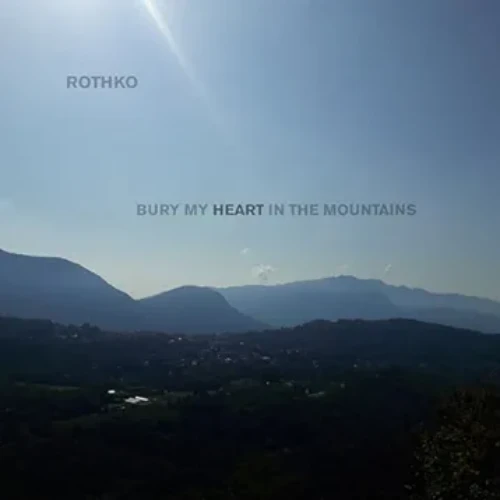
The latest offering from Mark Beazley’s Rothko follows 2022’s Let Space Speak EP, and standalone single ‘Summer In October, Winter In July’, which was an uncommonly loud and abrasive work by his usual standards, although, in context, it made sense, as he wrote, ‘Things have been blurred, uncertain, scary…here’s to certainty soon’, adding ‘I got my brain scan results today, they all came back showing nothing untoward. Good news on a personal level after such uncertainty, but close friends of mine have not had such positive news this year. This is for all of us.’

It would be a stretch to say I found solace in those words following the loss of my wife at the beginning of the year, but having found grief to be an extremely isolating experience, even with the support of friends, it helps in some small way to realise that you’re not the only one dealing with extreme personal difficulty. It’s easy to go through life feeling somewhat blasé, shrugging ‘hey, what’s the worst that can happen?’ But when confronted with the stark realisation of ‘the worst’, your mindset changes. And after the worst has happened, what then?

The five compositions on Bury My Heart In The Mountains take their titles from the names of peaks in the Swiss Alps, and capture the brooding beauty of these spectacular summits. Mountains possess a powerful magnetism: simultaneously alluring and foreboding, they can mean so much to so many. It would be misguided of me to even begin to attempt to comprehend or to make assumptions about Beazley’s own relationship with these impressive peaks – I can only know my own relationship with those I have climbed or otherwise stood in awe of, here in the UK, particularly the Lake District, a curious blend of exhilaration and tranquillity, joy and fear. Because the mountains may provide the perfect escape, the ultimate experience of life-affirming freedom, but you can never treat them with too much respect, and while they may in themselves be immutable, they’re prone to rapid change when it comes to conditions, and each mountain has its own character of sorts – and this is something which the six pieces on Bury My Heart In The Mountains conveys in the most nuanced of fashions.

The first track, ‘Monte San Giorgio’ extends beyond eleven minutes in duration and brings together all of the different expressions of terrain and the associated emotions, marking the start of an exploratory adventure that’s contemplative and largely calm, but not without peaks and troughs and moments of mounting drama.

Field sounds create a thick atmosphere at the start of ‘Monte San Salvatore’, with cooing and gurgling, and extraneous sounds, before delicate picked guitar notes drift off into the crisp, clear air, while it’s Beazley’s bass which dominates the grumbling yet expansive ‘Säntis’. A chill wind blows on the arrival of ‘Monte Tamaro’, before drifting into a brittle, cold conglomeration of chimes and drones. The final track, ‘Monte Bre’ is but a brief outro, all of the elements of the preceding compositions compressed into a minute and a half, bringing calm and tension simultaneously. It’s unexpected, sending ripples of disquiet through the stilling waters left in the wake of the slow ebbing of ‘Monte Tamaro’ moments before. One suspects that this brief judder is intentionally placed, and leaves the atmosphere that bit less smooth and soothed than before, a reminder that it doesn’t do to become complacent or too comfortable or settled, because life is full of surprises, and you never know what’s around the corner.

Cruel Nature Recordings – 24th November 2023

Christopher Nosnibor

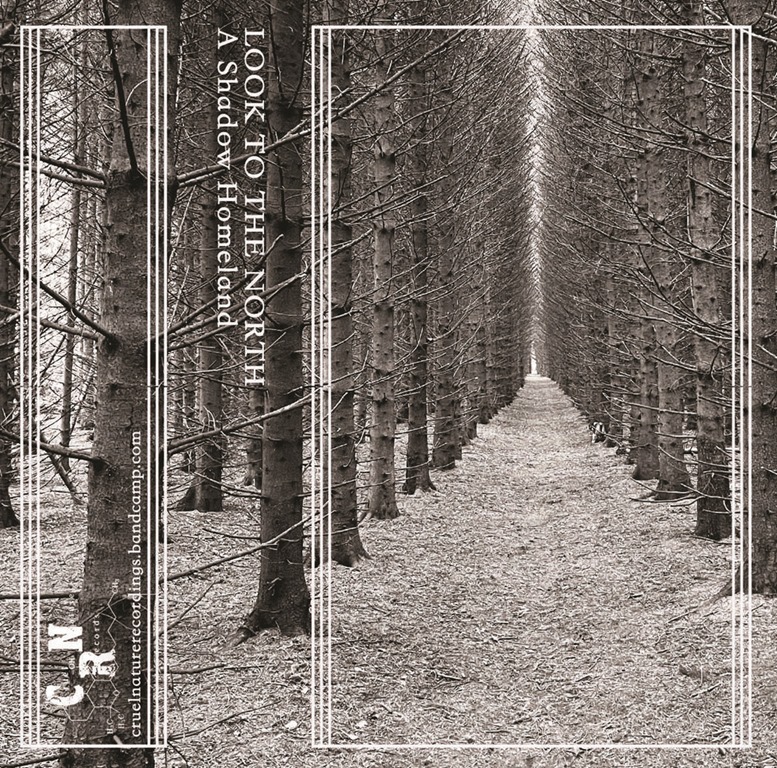
The brief accompanying biography tells us that ‘Look To The North is the ‘dronefolk’ duo comprising David Colohan (United Bible Studies, Raising Holy Sparks) and Zachary Corsa (Nonconnah, Lost Trail)’, and that ‘Recorded in 2021, A Shadow Homeland is 4 tracks of atmospheric other-worldly introspection; melancholic ambience interspersed with sparse piano, spoken word and field-recordings, creating an immersive transcendental twilit experience.

We’re immediately in with what initially sounds like some form of narrative, and joining as we do seemingly in the middle of it, it’s difficult to orientate oneself in terms of context. Soon, soft droning tones drift in like mist and rings out heraldic over the hills and draping the woodlands with string-like sounds amidst images of clouds and nature, interlaced with spiritual abstractions rich in poeticism, but their meanings obscure. The title of this first composition, ‘Disintegrating Consoles And Cartridges’, has a ‘found sound’ connotation, a suggestion of decaying histories and lost origins, and in time, distant voices mutter almost imperceptibly while piano notes roll in and out. Increasingly I find sparse piano notes which are allowed to resonate conjure the saddest and most bereft of emotional sensations, and by the end of eight minutes, I find myself feeling empty, heavy of heart, and pining for something lost – something I can’t quite recall beyond a vague sensation, like the occasional pang of pining for childhood or people and places left long behind, the melancholia of hazy reminiscences which creep at the fringes of a fugue-like memory.

‘The Water That Shattered Their Image’ feels darker at the start, Not necessarily ominous, but there are grainy textures scratching lower in the layers of sound, elongated whisps and broad sonic washes, and they bring a certain discordance and discomfiture. Human voices mingle into wolf-like howls, baying, crazed, before growing hushed, as if in anticipation of the album’s dominating finale, the seventeen-and-a-half-minute ‘An Amulet For The Flux Of Blood’. Here, the piano is very much the central instrument, but surrounded by layers of organ and organic-sounding drones. These sounds coalesce to create a haunting yet smoothly tranquil atmosphere.

To suggest that it seems to share more in common with post-rock than any form of folk is perhaps to pick pedantically at irrelevant details, but I mention this because these genre distinctions have a tendency to set certain expectations. But as elegiac pastoral works, infused with subtle elements of collaging and experimentation, the pieces which make up A Shadow Homeland certainly don’t disappoint, and indeed, confound any expectations one may have. Mood-wise, I’m left feeling uncertain; neither uplifted now downcast, but somewhere in a strange place and a sensation of something missing. It’s neither pleasant nor unpleasant, but remarkable that such understated instrumental works can resonate in such a deep and complex way.

AA

a0117392340_10

Mind Altering Records – 13th November 2023

Christopher Nosnibor

Back at the start of 2021, I penned a pretty positive review of the solarminds album Her Spirit Cracked the Sky. The combination of ambience and extreme weight was a thrilling proposition. And it was – and still is – monumentally epic. It feels a long time ago already, and much has happened in the interim. If emerging from the pandemic was trailed for a long time by the release of myriad ‘lockdown’ projects, we’ve subsequently trickled into a ‘world’s turned to shit’ phase, and like the pandemic, it feels like there’s no end in sight. Trump may be out of office, but he still looms large and continues to pose a threat in the arena of world politics, and it’s a world at war, and a world where alternately wild fires and floods decimate swathes of land. Slowly but surely, the planet is becoming less inhabitable. And yet, still, people jet off on skiing holidays and bemoan the lack of snow despite being the cause of the lack of snow, and whenever it rains, people take to their cars to make five-minute journeys to avoid getting wet, thus ensuring it will rain an awful lot more in the time to come.

And since the release of Her Spirit Cracked the Sky, after more than a decade, Chris Miner has put the project to bed. But, like the proverbial phoenix rising from the ashes, he now returns with Sun Colour Sound, and the first in a projected trilogy of releases. On the evidence of this first one, it will be something special.

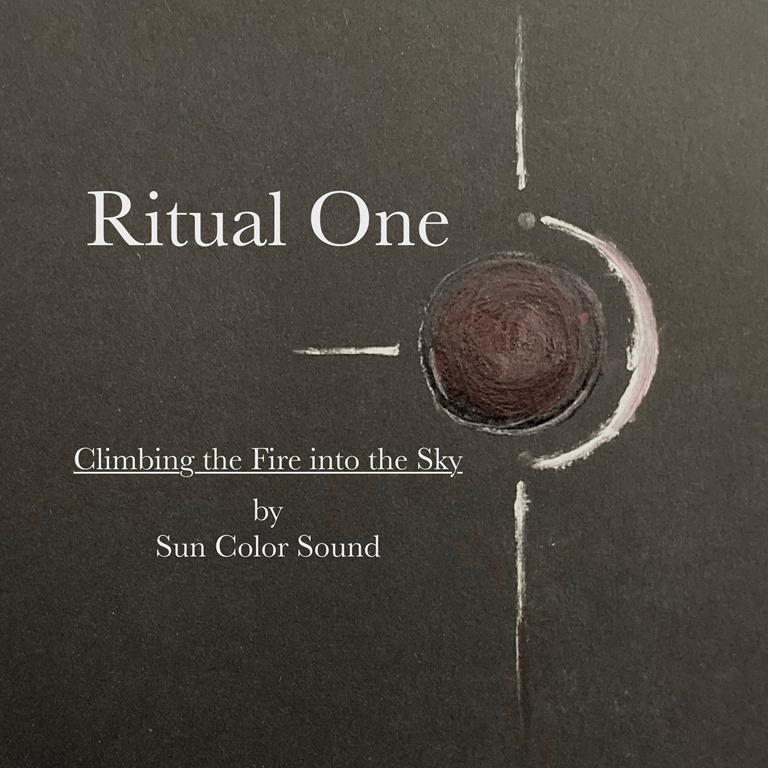
Ritual One (Climbing the Fire into the Sky) consists of a single piece, which runs just short of half an hour, and it shares many elements with solarminds – namely a fair bit of noise, some hefty guitars and punishing percussion, at least in the first two thirds, and it’s heavy, harsh, noisy, and it crashes straight in with some grating, heavy drone, twisting feedback and thudding drums.

This is one of those tracks which stars like the end of many sets, and it feels like it’s winding down from the offing. This is by no means a criticism, simply an observation that what in the context of many works is a climactic, tempestuous crescendo finale, is simply the start of a ferocious sonic storm. It does very much call to mind Sunn O))) and the epic, swirling instrumental passages of contemporary Swans, although the guitars are very much geared towards generating howling feedback rather than crushing, clashing chords that sound like buildings being demolished. Therte’s something of a psychedelic twist in the spacey delivery, too. As whining, whistling notes ring out, the percussion builds from the occasional roll to a relentless thunder. The combination is immensely powerful, and assails the senses with a real physicality. Buy around the thirteen-minute mark, it’s reached wall-of-sound levels, a dense, shimmering sonic force which shimmers and ripples while coming on like a bulldozer, at the same time as hand drums fly at a frantic pace and evoking something spiritual in the midst of a hypnotic frenzy. And still, it goes on, surging forwards.

The shift in the final third occurs subtly: the percussion continues to clatter away, but the guitar abrasion tapers away, to be replaced by altogether softer strings.

Ritual One (Climbing the Fire into the Sky) is more than just a really long piece of music: it’s an ambitious piece in every way, and its scope and scale are immense. There is so much depth and detail here, and it takes repeated listens to really appreciate just how much is happening, especially given that the first reaction is simply to bow to its sheer sonic force.

But the last ten minutes belong to a different world from the first portion. Hypnotic, soothing, graceful, the tension dissipates and Eastern vibes radiate through the gauze-like layers which drift and float over the busy but altogether more subdued percussion.

So while it is an ambitious work, it also delvers far above any expectations, and it’s both unique and special.

AA

Version 3

Ni Vu Ni Connu – 2nd November 2023

Christopher Nosnibor

While the late 80s and early 90s saw the absolute peak in format-driven consumer exploitation, with the major labels finding evermore extravagant and ostentatious ways pf presenting a single or an album to boost its chart position by milking hardcore fans who would buy every format for the sake of a bonus track, a remix, or a poster, there’s been a strong return for physical releases in recent years. Admittedly, the days of CD singles packaged in tri-fold 12” sleeves, cassette singles in album-sized boxes, 12” boxes in which to house a series of CD singles, albums released in boxes as six 7” singles, and the like are well over, the fetishisation of the object is very much enjoying a renaissance, most likely as a reaction to the years when everything became so minimal and so digitised that no-one actually owned anything.

This was a bleak period. As someone who had spent a lifetime accumulating books, records, CDs, even tapes, I found it difficult to process. I had grown up aspiring to own a library and a wall of records, and found myself foundering, drifting in a world where entire lives were condensed to a playlist on a phone and a few kindle picks. I’d walk into houses – admittedly, not often, since I’m not the most sociable of people – and think ‘where’s the stuff?’ Stuff, to my mind, is character. It’s life. People would endlessly wave their Kindles and tell me ‘it’s just like a book!’ and rejoice at their Apple playlists on their iPods because they had their entire collections in their pocket and no clutter. I suggesting I should clear out my ‘stuff’, these techno-celebrants were missing the point, and continue to do so. Rifling through a collection, finding lost gems, engaging in the tactility, remembering when and where certain items were purchased is an integral part of the experience. My collection isn’t simply a library of books and music, it’s a library of memories.

In more underground circles, the existence of the artefact remained more consistent, perhaps because more niche artists and labels always understood the relationship between the artist and the consumer as conducted via the medium of the object. The release of this epic retrospective as a 4-LP box set is, therefore, less a case of getting on board with the Record Store Day vinyl hype in the way that HMV are now carrying more vinyl – at £35 a pop for reissues of 70s and 80s albums you can find in charity shops and at car boot sales for a fiver (and you used to be able to pick up in second-hand record shops until they died because no-one was buying vinyl), and more a case of business as usual.

a2289573057_10

Vienna- and Berlin-based ensemble Polwechsel have a thirty-year career to reflect upon, and with a substantial back-catalogue to their name, and it’s a landmark that truly warrants a box-set retrospective. Although it’s not a retrospective in the conventional sense: this is a work created in collaboration with a selection of instrumentalists and improvisers who share their exploratory mindset. Traditional compilations feel somewhat lazy, and are ultimately cash-ins which offer little or nothing new to the longstanding fan. And so this set serves to capture the essence and style of their extensive catalogue, rather than compile from it.

There’s a lot of ground to cover, too. As the accompanying notes detail, ‘Vienna- and Berlin-based ensemble Polwechsel have been making music at the interface of collective improvisation and contemporary composition. With their changing cast, the group have been at the forefront of musical experimentation, from style-defining works in reductionism in the 1990s, which concentrated on silence, background noises and disruptions, to a change in direction in the 2000s, which saw the introduction of traditional musical aspects such as tonal relationships, harmony and rhythm. Through varying constellations, instrumentations and collaborations, Polwechsel have developed a unique body of work that has firmly established them as one of the driving forces in contemporary music-making… Their music has mostly straddled a line between contemporary music and free improvisation, and is characterized by quiet volume, sustained drones, and slowly developing structures.”

And so it is that for EMBRACE, Werner Dafeldecker, Michael Moser, Martin Brandlmayr and Burkhard Beins are ‘joined by a roster of likeminded guest musicians and former band members to perform a series of new pieces reflecting the whole breadth of their musical investigations.’

‘Jupiter Storm’ is spacious, spatial, strange and yet also playful, an assemblage of sounds that lurch from serious and atmospheric to sleeve-snickering toots and farts, and everything in between over the course of its eighteen minutes, with slow—resonating gongs and trilling shrills of woodwind and plonking random piano all bouncing off one another, while the bass wanders in and out of the various scenes in a most nonchalant manner. On ‘Partial Intersect’, drones and hesitant drones occasionally yield to moments of jazzification, parps and hoots and squawks rising from the thick, murky sonic mist which drifts ominously about for the track’s twenty-minute duration.

Sides C and D contains ‘Chains and Grain’ 1 and 2, again, longform pieces almost twenty minutes long, comfortably occupying the side of an album, are the order of the day. Clanking, clattering, chiming, bells and miniature cymbals ring out against a minimal drone which twists and takes darker turns.

cover

The tracks with Andrea Neumann are eerie and desolate, and occupy the third album. These pieces are different again, with the two ‘Magnetron’ pieces building from sparse, moody atmospherics to some piercing feedback undulations. The shrill squalls of treble, against grating extraneous noise, make for some tense listening. The second in particular needles at the more sensitive edges of the nerves. ‘Quartz’ and ‘Obsidian’, are more overtly strong-based works, but again with scratches and scrapes and skittering twangs like elastic bands stretched over a Tupperware container. The fourth and final album contains two longform pieces, with ‘Orakelstücke’ occupying nineteen and a half minutes with creaking hinges, ominous tones, and a thud like a haunted basketball thwacking onto a bare floorboard. There are lighter moments of discordantly bowed strings, but there’s an underlying awkwardness with crackles and scratches, muttered conversation in German. The fifteen-minute ‘Aquin’ is sparse, yet again ominous and uneasy, majestic swells of organ rising from strained drones and desolate woodwind sinking into empty space.

The set comes with a thirty-two page booklet containing essays Stuart Broomer, Reinhard Kager and Nina Polaschegg (in both German and English) and some nice images which are the perfect visual accompaniment to the music, and while it’s doubtless best appreciated in luxurious print, a digital version is included with the download.

EMBRACE is a quite remarkable release – diverse and exploratory to the point that while it does feel like an immense statement reflecting on a career, it also feels like four albums in their own right. It’s a bold release, and an expansive work that certainly doesn’t have mass appeal – but in its field, its exemplary on every level.

Prohibited Records – 27th October 2023

Christopher Nosnibor

The… the… you know? Clicking fingers, gesticulating, waving hands in a rolling motion around your ears. The… thing? The… you know? The thing? The thing!

We’ve all been there. It’s on the tip of your tongue, the fringes of your memory. It hangs like a shadow, a fraction beyond the reach of the active brain. You curse your mind because you know it, and your interlocutor would, too, if only they had a clue what you were on about. The thing. The fucking thing.

The very prospect of reviewing Shane Aspergen’s EP flung me into a spin , because the title tossed me into the frantic headspace in which words run out and everything feels overwhelming, and it’s all down to the title. Because… well, that’s the thing. What is the thing? And how do you even begin to describe it?

This EP, we’re told, ‘comes as a precursor to a forthcoming album (tentatively titled Emblems of Transmuting Heat) that was finished a few months prior to the conceptualization of this four-track EP. While recent in its development, the music originates from the same period of transition, during which Shane Aspegren relocated from Hong Kong to Los Angeles.’

It feels like the sonic articulation of transition, of movement, and it feels transitory, ephemeral, fleeting moments, some of which leave an indelible imprint, others which fade instantly or barely even register in the moment. Precisely how or why this is, it’s hard to pinpoint with any kind of exactitude. But then, that feels like the point: the pieces are impressionistic sound collages. It’s a molecular morass of clamorous, scrabbling treble and scratching insectoid busyness and bubbling synthines which dissolves in a fuzzy hum and clatter; a cross of Gregorian chant, ambient, experimental electronica, and dance.

Aspegren explains how the title track ‘is a complete reworking of a different piece [he] started in 2022. “I completely abandoned the original in its initial form — the raw vocalizations were the only thing that I wanted to keep when I went back to revisit those sessions. The voices were recorded as a form of cathartic release during a period of time that I was heavily exploring voice and frequency as a form of somatic connection and release. In the end, this morphed through several different iterations, and finally turned into this version more than a year later, after moving to LA.” The sense of movement here is one of a forward propulsion, which comes largely from the subtle but insistent beat.

‘Imaginal Pathway’ is but a brief interlude, as was intended, penned as an interlude for the Imaginal Pathways app for which Aspegren was the lead artist. It’s a mere minute and a half – of eddying ambience layered with light, hovering drones which bends and droop amidst birdlike tweets, over which a narrative – seemingly lifted straight from an education video – explains the workings of the ear, a ‘magical’ organ ‘which transports perceptual vibrations from the physical realm into the experiential’.

The final track, ‘iTiS’, is the most recent composition, which came about following his relocation, with Aspegren recounting “It started with a Moog Subharmonicon improvisation and turned into a slow build of layers and structure. Strangely, it feels like the oldest track to me… like I made it in another era of my life.”. It certainly sounds like music from another era, too, the contemporary kit very much harking back to more vintage analogue sound. There’s a soft, squelchiness to the bass tones, a blurring edge to the broad space-filling sweeps. But perhaps sometimes the equipment determines the mood and the sound more than the creator. Either way, it makes for a fitting close to the EP – for having brought the listener through a journey of upheaval, of uncertainty, of feeling unsettled, it ends with what feels like a sense of final settlement, of resolution. And end, but also a new vista, and the possibility of a new beginning.

AA

PRO065_art

Ipecac Recordings – 13 October 2023

Christopher Nosnibor

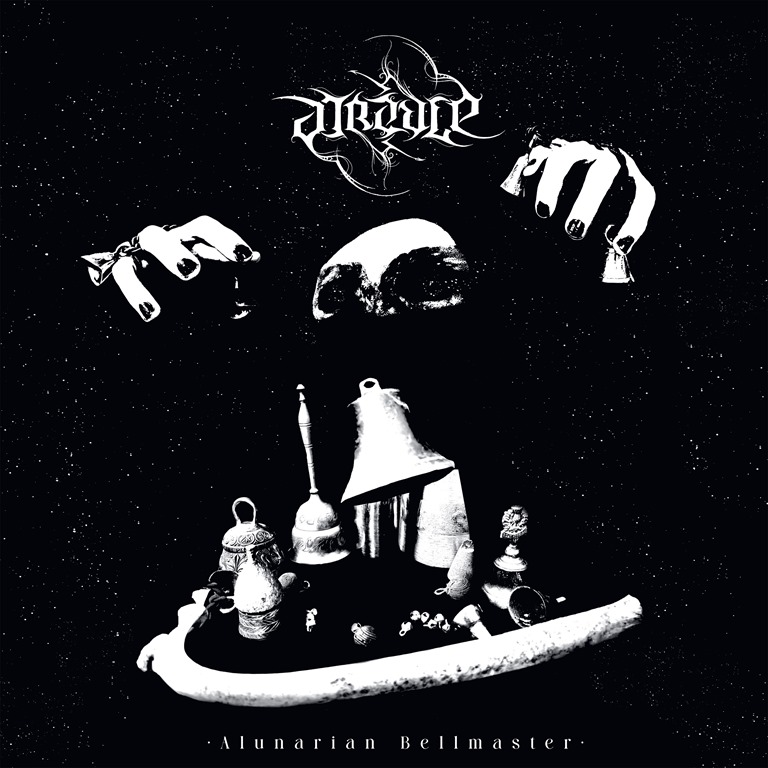
Having recently aired the video for the last single cut from Venera’s eponymous debut, in the form of ‘Ochre’ featuring HEALTH, I was feeling energised to explore their eponymous debut.

As their bio outlines, “Venera enigmatically launched their debut single ‘Swarm’ in July. No information, no pre-sale, simply the three-minute single released in tandem with a mysterious screed and a pulsating black-and-white video directed by EFFIXX.”

Some of the excitement is dulled by the unveiling which followed, as the band subsequently revealed themselves as James Shaffer (Korn) and Atlanta-based composer/filmmaker, Chris Hunt. Why? Not because I’m down on Korn: they’re an act I’ve never really felt any gravitation towards. Wrong place, wrong time. But essentially Venera are another supergroup / side project for a major act, which means they’ve already got a head start which places them head, shoulders, and torso above pretty much any other ‘new’ band. What’s more, several guests join Hunt and Shaffer on Venera. Drummer Deantoni Parks (Mars Volta, John Cale) plays on ‘Erosion’ and ‘Disintegration,’ HEALTH’s Jacob Duzsik contributes vocals on ‘Ochre’ and Alain Johannes lends his voice to ‘Triangle.’ The album was self-produced.

Should it matter? Probably not: I judge any music on its own merits, but I am aware that music doesn’t necessarily reach an audience or receive exposure based on the same criteria.

But here we are, and on merit alone, Venera is a strong album: dark, atmospheric, electronic and often beat-driven, but with layers of noise. It couldn’t be much further from Korn, stylistically. The album has range, too: ‘Erosion’ is like minimalist drum ‘n’ bass contrasts powerfully with the surging, enigmatic ethereality of ‘Ochre’. ‘Triangles’ finds Alain Johannes deliver a magnificent vocal that sits somewhere between Scott walker and David Bowie, crooning and emoting over a slow, dense backing of thick but dispassionate 80s synths reminiscent of The Sisters of Mercy’s Floodland. Clocking in at under four minutes, it feels as if it’s only just beginning to take form – not so much unfinished, but it just could do with there being… More.

‘Disintegration’ transitions between bombastic doom and frenzied blasts of noise, an enigmatic pancultural implosion that hints at Eastern influences, but also melts in droning sonorous low-end synths, and percussion that sounds like a brutal attack. In the context of this week’s world news, it simply makes me feel tense, but it’s but a brief passage before it shifts to clattering jazz-inspired energy rattling around amongst the drift. ‘Holograms’, featuring VOWWS is perhaps the album’s biggest surprise: a slow-burning ethereal and dreamy trip-hop song with a vaguely industrial / gothic edge, it’s supremely well-realised and has immense radio potential.

As a critic, declaring something to be ‘good’ or ‘not good’ feels somewhat redundant, like a teacher leaving comments on a piece of homework. Technically, this is good. Sonically, it’s good. The songs – where there are songs – are good: atmospheric, evocative, haunting – while the same is true of the instrumental passages. Venera succeeds sonically, and as a significant departure for its contributors. And perhaps, over time, I shall come to appreciate it more personally. But first impressions are conflicted: I like it, I like what it does, but I simply don’t feel an emotional connection, there’s nothing that elicits a physical pull in my chest or in my gut.

AA

746105

Kranky – 13th October 2023

Christopher Nosnibor

One thing I’ve learned as I’ve grown older (apart from the fact you never grow younger, despite the fact that I was amused to recently stumble upon the ‘people also ask’ Google question prompt ‘Is Benjamin Button a true story?’), is that a diversified appreciation of music is particularly useful as you come to recognise the diversified nuances of mood. Adherents to a single genre: how do they deal? How do they find the right soundtrack?

I’m not previously familiar with the music of Justin Walter, but the accompanying notes inform me that it ‘veers between nebulous and numinous, coaxed from the translucent tonalities of his signature instrument, the EVI (Electronic Valve Instrument)’ and that ‘Destroyer, his latest, and third for Kranky, marks his most multifaceted work yet. Inspired by minimalistic urges (evading grandiosity, condensing scope, embracing spatial restraint) tempered with the drama of triptychs (becoming, destruction, aftermath), the album’s 11 tracks thread.’

If the album’s title implies aggression and obliteration, it’s overtly organic analogue synth vibes are quite the opposite. That isn’t to say it’s all shades of mellowness, because Walter weaves in extraneous noise and all sorts and messes with the dials to render soft tones bent and broken, twisted and warped to create a less than silky-smooth air of tranquillity at times. But at others, there are some simply magnificent passages where you feel calm and at ease. The title track is exemplary: it’s an ambient work at heart, soft, supple, gentle, but with serrated edges and spiny burrs that occasionally break through the surface.

Walter obviously has a clear sense of flow. The eleven pieces on Destroyer flow seamlessly from one to the next, and as a consequence, Destroyer feels like an album, despite the contrasts which present themselves across the work. The flow begins with an instant attention-grab in the wibbly shape of ‘For Us’, which blasts in with a blaring drone over which phasey noodles tangle over in ever-increasing layers with adrenalizing effect. While the majority of the album is rather softer, a defining feature of the composition is the exploration of interplay between tones and timbres and the notes their timings gradually shift to create the subtlest of tensions. This is particularly noticeable duribg the second half of the album, which feels slower, softer, and more soporific than the first half. Close your eyes, exhale slowly, and you really start to absorb Destroyer. And you have every reason to do that.

‘Cliff the Cloudcatcher’ is a gentle, bubbling synth piece, while the eight-minute ‘Inner Voices’ is a mellifluous movement in many directions simultaneously, which pulls together to take form, becoming graceful, and in places the sounds mimic woodwind, but sculpted into something otherly… backwards, perhaps, and the sounds bend and push and pull – gently, but they do – before a darker turn around two minutes in brings shade, clouds thickening and becoming denser.

Destroyer distinguishes itself from so many other ambient-orientated works by virtue of its dynamics. There are some thick, tones and dense blankets of noise which present themselves, often emerging from cloud-like drifts of near-nothing. But these moments of rising tension resolve to easy washes and ripples of sound, to cloud-like softness.

And this is the album’s real accomplishment, in that is balances many shades, many tones, many textures. Those darker passages serve to remind that life isn’t all easy or plain sailing, and that plans can go wrong. You can set the controls for plain sailing, but there will always be disturbance, disruption. Whatever you plan or expect, there will always be deviation.

AA

114931

Dret Skivor – 1st September 2023

Christopher Nosnibor

This twenty-two-minute continuous composition is ‘A consideration and contemplation of the stupidity of people who have more money they could ever spend and fritter it away on dick-waving projects instead of paying the tax they should be paying and contributing to society’, adding ‘Billionaires shouldn’t exist at all and we need to start having this conversation.’

Yes. Yes. And yes. It’s been something I’ve been silently raging and experiencing existential agony over in recent months. During the summer, half the planet was on fire. Meanwhile, tax-avoiding billionaires were jetting off into space and planning cage fights to settle the argument of who’s the bigger testosterone-fuelled egotistic manchild.

August saw Oregon flooded following hurricane Hillary and a billion-dollar plus restoration project in its wake: the same week, Virgin Galactic was jetting people into space for fun at a cost of around half a million dollars a ticket. If the ticket fees had been put towards the recovery operation, they’d be well on the way. But these cunts just don’t care. Fuck the plebs in their flooded homes: they’ve all got multiple penthouses well above sea level and they’ve earned their jollies – through the labour of the people who have so little, and some who have even lost everything.

I suffer corpuscle-busting rage at people who jet off on skiing holidays bemoaning the lack of snow. They’re one of the primary reasons there is no snow. How fucking hard is it to grasp? And if cars and planes are heavy polluters, launching rockets is off the scale. Not that they give a fuck. They’ll be dead before the earth becomes inhospitable to human life, and their hellspawn will have all the money and can go and live on Mars, so everything’s fine in their megarich world.

It begins with a grand organ note, as if heralding the arrival of a bride or clergy…and so it continues. On… and on. Five minutes in, and very little has changed. Perhaps some light pedal tweaks , a shift in the air as the trilling drone continues, but nothing discernible. The note hangs and hovers. It fills the air, with the graceful, grand tone that is unique to the organ, a truly magnificent instrument – and I write that with no innuendo intended, no reference to the Marquid de Sade submerged for my personal amusement here.

Admittedly, I had initially anticipated something which would more directly articulate my frothing fury at the fucked-up state of the world, but begin to breathe and relax into this rather mellow soundtrack… I start to think that this abstract backdrop is the salve I need to bring my blood pressure down, and think that perhaps this is the unexpected purpose of this release… but by the ten-minute mark, I find myself bathed in a cathedral of noise, and before long, it’s built to a cacophonous reverb-heavy blast which sounds like an entire city collapsing in slow-motion. And this builds, and builds. Fuck. I’m tense again. I feel the pressure building in my chest, the tension in my shoulders and back aches. It makes sense. This is the real point of this recording. Everything is fine until you log onto social media or read the news, and you see the state of things. Momentarily, you can forget just how fucking terrible everything is, how the world is ruined and how there is no escape from the dismalness of everything, and how capitalism has driven so much of this, creating a life stealing hell for those who aren’t in the minuscule minority.

Fact: 1.1% of the population hold almost 50% of the global wealth. A further 39% of wealth is held by just 11% of the population. 55% of the world’s population hold just 1.3% of the wealth between them. So remind me, how is capitalism working for the world? Trickle-down economics is simply a lie as the wealthy retain their wealth and simply grow it. Liz Truss may think that the UK importing cheese is ‘a disgrace’, but this statistic is mind-blowing.

Eighteen minutes in and my mind is blown, too. It feels like it could be part of the soundtrack to Threads. It’s a dense, obliterative sound, a blowtorch on a global scale, the sound not of mere destination, but ultimate annihilation. It seems fitting, given the future we likely face.

AA

a0916419313_10