Posts Tagged ‘Ambient’

Sound in Silence – 5th December 2024

Christopher Nosnibor

As my final review of the year, what could be more fitting than a work, the title of which, suggests an element of reflection on the recent past. Businesses provide regular reports, people and musical ventures tend not to, with perhaps the notable exception of Throbbing Gristle, but then, they were an exception to more or less everything before or since. Their debut album proper, The Second Annual Report, which followed a brace of cassettes, The Best of Throbbing Gristle Volume I, and The Best of Throbbing Gristle Volume II, set new precedents in so many ways.

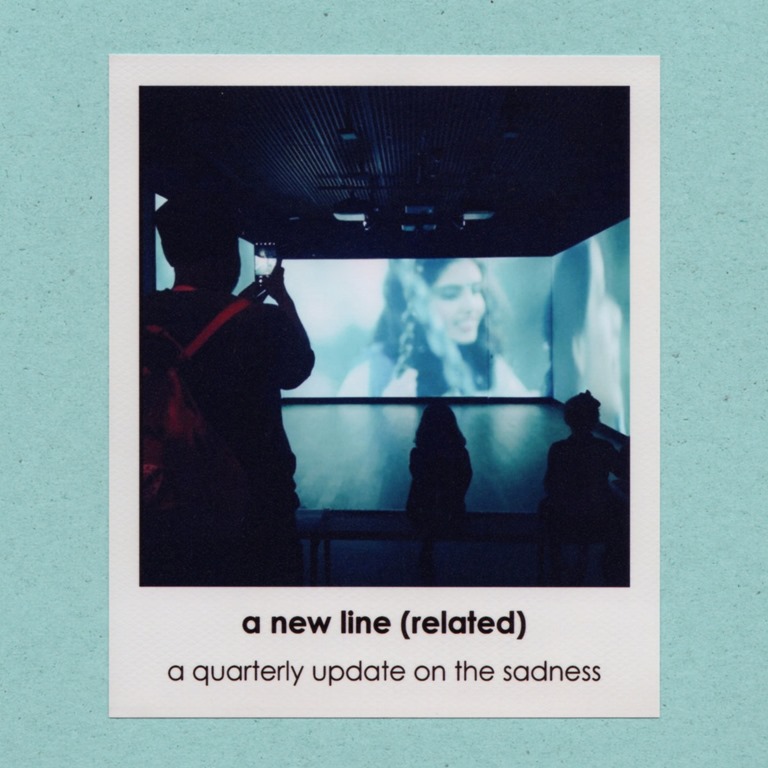
Arriving to the latest release from A New Line (Related) – the solo project of Andrew Johnson, who has previously released music as a member of bands such as Hood, The Remote Viewer, and Famous Boyfriend among others, one feels compelled to wonder ‘just how is The Sadness, and how has it been of late?

This is his third album, which we’re forewarned is an ‘immersive’ work, which ‘balances between minimal techno, dub house and ambient pop.’

‘Calapsis’ drifts in with low-key beats pulsing beneath delicate waves which ebb and flow subtly, gusts of compressed air which build to a hypnotic close. It’s not until the glitchy, disjointed groove of ‘3AM Worry Sessions’ arrives that we begin to get a sense of The Sadness. Stress and anxiety manifest in many ways, and while worry and panic may manifest differently their cousinly relationship It heaves, jittery unsettled and tense, conveying an uncomfortable restlessness.

The globular grumblings of ‘The Ballad of Billy Kee’ emerge from a rumbling undercurrent or mirk to glitch and twitch like a damaged electrical cable sputtering and sparking. Elsewhere, there’s a certain bounce to ‘Only Star Loop’ which gives it a levity, but the scratchy click of cymbals which mark out the percussive measures feels somehow erratic and the time signatures are apart from the bubbling synths and the distant-sounding, barely-audible vocal snippets, which give echoes of New Romanticism. Overall, the track has an elusive air of whispering paranoia.

In many ways, not a lot happens on A Quarterly Update On The Sadness, and the sparse and repetitive yet curiously dynamic title track is exemplary. It leaves you feeling strangely disconsolate, bereft, not only as if you’ve perhaps missed something, but that you’re missing something – not from the music, but from your own life. It seems, in conclusion, that The Sadness is thriving in its own, understated way.

AA

a0970760296_10

Room40 – 3rd January 2025

Christopher Nosnibor

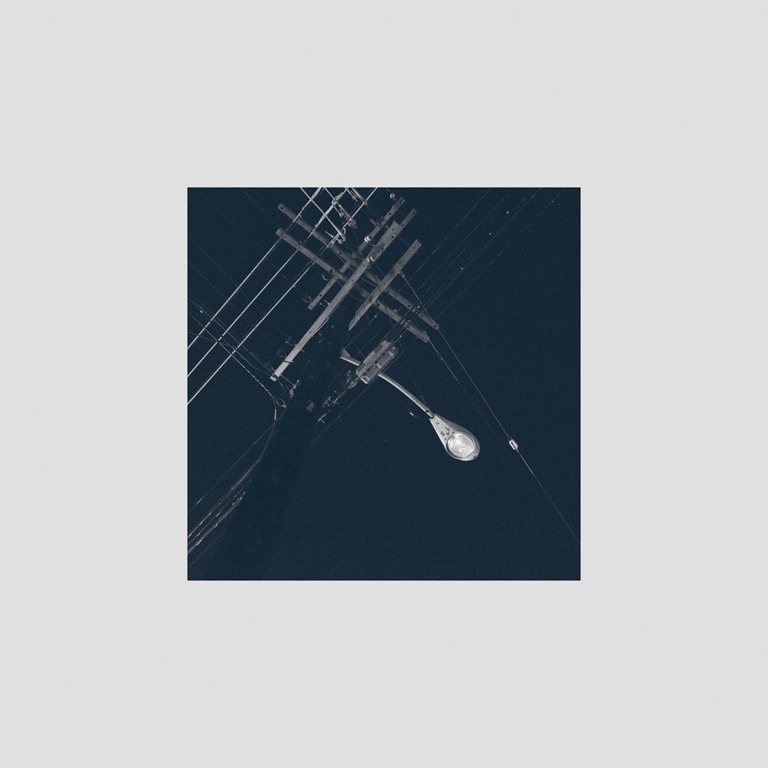
Ian Wellman’s works are usually responses to environmental issues, be they derived from articles covering global matters or more immediate or personal situations. His latest, Can You Hear The Street Lights Glow, sits very much in the latter category, as he details in the accompanying notes, which I shall quote in full:

I moved to Pasadena during the fall last year. One of the first new sounds I noticed were the mercury-vapor street lights that filled the air as the sun went down every evening. Under the sidewalks, exhaust vents hummed along to the song of crickets and the rumble of traffic. Being away from the inner city, more individual details in the soundscape emerged.

As a way to explore the new area, I walked around at night with my equipment. I placed geophones and contact mics on every metal surface I could. I ran electromagnetic sensors across electronics accessible by the sidewalk. I put mics out on quiet streets, behind shopping areas, and in parking lots. I felt very compelled and inspired to listen and learn about my new home. Can You Hear The Streetlights Glow? is the result of these listenings.

Certainly, the first part of this is something I find quite specifically relatable – not due to relocation, but to finding myself suddenly discovering a heightened awareness of my immediate surroundings. Like many people, I used to walk around with earphones in, listening to music to cut out the noise around me. This was essential on my daily commute, as listening to music as I walked through town created a separation between home and work, and while on the bus from town to the office, it shut out the babble of other people, and created a barrier between myself and anyone from work on the bus who may have been inclined to strike up a conversation. And on the way home, the same was also true but listening to music also helped me decompress – or mirror my angst – after a day in a noisy open-plan office. Lockdown changed that. I suddenly felt the need to be alert in case of approaching runners or cyclists or people kicking off in queues for the supermarket because someone wasn’t observing the two-metre rule or otherwise losing the plot over COVID restrictions. In short, I was scared – terrified, even. Not so much of the virus, but other people. I felt I needed to be on high alert at all times, because people are simply so unpredictable. One byproduct of this was that when I left the house form my allotted hour of exercise, I became acutely aware of the quietness – the absence of the thrum of traffic, the absence of chatter, and in their absence, I could instead hear the wind, birdsong, my own footsteps. In fact, I could hear everything. In the quiet, the small sounds were suddenly so much louder. The quiet wasn’t nearly as quiet as it first seemed. It was the aural equivalent of one’s eyes growing adjusted to the dark.

The auditory voyage of discovery Wellman charts on Can You Hear The Streetlights Glow bears clear parallels to my experience, but takes things a step or three further with his use of an array of equipment in order to capture sonic happenings in these spaces and his interrogation of the sounds in order to reach a deeper, more intimate understanding of his environs.

The results are quite fascinating, and range from a cluster of brief snippets, of under a minute and a half to just over two minutes, to more expansive segments – 5G Antenna Power Box is almost five and a half minutes, and ‘Mercury-vapor Lights’ is a full twelve and a half minutes in length. The titles of the pieces are location-specific, and some are quite evocative in themselves – notably ‘Time Depleting on Bird Scooter’ and ‘Gas Pipes Behind Smoothie Shop’. On the one hand, they’re utilitarian in their descriptions; on the other, they create an image of a filmic world in which sound events happen in particular places.

Most of those sound events are different levels of hum and drone, but these varying levels of low-level throbbing serve as reminders of how mankind has interfered with the naturally-occurring sounds which are the true sounds of the outdoors. While I am likely to note the hum of the power lines as I pass a pylon, and so on, I am still attuned to the wind in the trees, the scurry of squirrels. The sounds on Can You Hear The Street Lights Glow are all entirely man-made, mechanical, and despite Wellman’s relocation to a more rural setting facilitating the opening of his ears, the locations are all noteworthy for their constructed, non-natural nature. People may interpret this differently, and Wellman’s intentions may have been different again, but the leading thing I take away from this is just how hard it is to truly escape the mechanised world we’ve made. But equally, Can You Hear The Street Lights Glow is a document which highlights the extent to which even in silence, there is sound – lots of it.

AA

a1805176232_10

Mortality Tables – 24 December 2024

Christopher Nosnibor

There’s something about Christmas that really does send people spiralling in one of two directions. The people who absolutely love it seem to love it just too much to be considered sane, and this year has been one of the worst I can remember for people actually buying chocolate and putting their trees up almost immediately after hallowe’en. Amusingly, I’m seeing them taking down their trees and decorations from Boxing Day, declaring that they’ve had enough now. Well, it’s hardly surprising after three months. I really for feel sorry for the kids of these deranged households: it must be quite confusing for them, not least of all seeing their parents troughing whole selection boxes to themselves in November as they effervesce about the Christmas spirit and plaster their hedges, bushes, trees, and house frontages with lights – which is as trashy as it is environmentally unsound (‘oh, we use green energy, it’s 90% nuclear now!’) – only to tear them down a whole tend days before twelfth night. But these are the kind of people who call what they do – things like going to work and parenting – ‘adulting’ and piss and moan about it on social media, while posting pics of their decorations at the start of November. And it’s cunts like these who make me loathe Christmas with a passion I didn’t even know I possessed. They spoil it for more moderate, more sane people – and people who just despise other people and herd mentality twattery in general.

And so I’m with Mat Smith, the main man behind Mortality Tables, and am one hundred percent into ‘Grouch Thoraces (II)’, pitched as ‘The festive sentiments of a misanthrope, processed into dark and enveloping ambient texture. An updated version of a release from 2023’. In fact, I consider this to be a release that stands alongside – in spirit, if not necessarily sonically – with my own Festive Fifty noisework, released on December 20th. Against the tidal wash of syrupy, saccharine Christmas tunes – shit covers or endless rereleases or just the same toss that’s been the staple of the airwaves since the 70s and even earlier – nothing says ‘fuck this commercial Christmas shit’ like some dark noise.

‘Grouch Thoraces’, released on Christmas Eve in 2023 was a dank, murky cut, presenting just shy of five minutes of the most rumbly dark ambience. This year – to use a phrase I despise almost as much as the cheery festivity fanatics who bounce around the office in Christmas jumpers and Deely boppers or reindeer antler headbands and start arranging secret Santa and team drinks and buffets from the middle of November – Smith has doubled down on his anti-festive sentiments with a reworked ‘Grouch Thoraces’: this time it’s even darker and danker and almost eight minutes in length. It’s a churning, disorientating mess of stuff thrown together, found sounds and elongates drones twisting together to forge a thick morass of unsettling, uncomfortable noise. According to the credits, there’s a vocal by Carroll Spinney, but it’s submerged in the slow-sinking swamp. There are chimes clattering in the dark whorl of purgatorial noise, but they sound like the ching of broken decorations swinging in a post-apocalyptic nuclear wind as the survivors crawl, blind, skin peeling, through the ruins of what little remains.

On its own merits, this is a strong dark ambient work with a certain edge: in context, it speaks. Fuck this festive shit, fuck this commercial shit, fuck the obligation to socialise: let’s celebrate stepping back from it all and just getting through it, without feeling the need to pretend that we love any of it. We misanthropes need to stand together.

AA

a0412538683_10

Room40 – 13th December 2024

Christopher Nosnibor

Nostalgia is a subject I’ve touched on on a number of occasions in recent pieces, because it’s become something of a preoccupation in contemporary culture. Arguably, this is the natural evolution of the postmodern, an epoch in which the new was primarily a fresh – or not so fresh – permutation of the old. The culture of the twenty-first century has been marked by an ever-increasing acceleration of more of less everything: the accelerated communications and technological innovations and ensuing blizzard of media Frederic Jameson wrote of when defining postmodernism has gone into overdrive, and we’re now moving at a pace whereby we’re nostalgic for breakfast by lunchtime.

Nostalgia is big, big business, and this has been no more evident than in the response to ABBA’s hologram shows and the Oasis reunion. This isn’t to overlook other huge musical events – Taylor Swift’s Eras tour, for example – but it’s fair to note that she’s been established for over a decade and a half now, and can’t be viewed as representing ‘newness’ in any way – especially given that four of her last six albums were rerecordings of previous albums. This encapsulates the way in which culture laps up endless recycling on account of its familiarity.

Comfort culture is rather like comfort food: you know what you’re going to get, there are no unpleasant surprises, there’s probably not a great deal of chewing involved, and it’s less scary than the unknown. The world’s gone to shit, and people feel a real and quite desperate need for that blanket of safety and reassurance that there are still at least some things you can rely on. The good old days have happened, they’re fixed and can’t be taken away. And nostalgia has a universal appeal, because it’s something we all feel for certain things at certain times. We tend to feel – and I accept this is a colossal generalisation – that our childhoods and teenage years took place in simpler, better times. They didn’t, but because we didn’t have the burden of adult responsibility, and were discovering things for the first time, they’re coloured with brighter hues.

This latest offering from Glim – a project by Vienna based musician and composer Andreas Berger – is steeped in nostalgia. Berger outlines the inspiration and creative methodology with enthusiasm:

I have a particular love for cassette tapes and how they can influence the character of sound – even just by the simple fact of being played on different quality sources. I like the way they can color audio material, especially when using lower-quality gear. It adds modulation, sometimes (a long time unwanted) degradation of sound, but also gives a certain nostalgic touch – at least for me.

I recorded (and played) most of the material on an old Walkman cassette player, and what I got in return were some faded sonic Polaroids which might trigger a hidden memory or at least evoke a vague feeling of nostalgia.

Perhaps somewhat ironically, Tape I is only available as a download, or to stream online. The tape revival remains some way behind vinyl, despite the format being considerably cheaper to produce. Perhaps it’s because tapes just don’t have the same effect on Instagram, or hung on your wall.

Having grown up in the cassette / tape era myself, I can vouch for the unique nature of the format. When I started making music, I would sketch stuff out with a condenser mic on a portable tape deck, later progressing to a four0-track portastudio, bouncing tracks down to create additional tracks. Each stage would erode the quality of the audio by some incremental degree, but what it lost in fidelity it would gain in character. You just don’t get those happy accidents with infinite digital tracks, just as you don’t get the same sense of the personal with a link to a playlist as one-off compilation tape with handwritten track-listing, smudges and misspellings and all. Don’t get me wrong: tapes were a massive pain in the arse, difficult to skip tracks, easily chewed, easily overrecorded – and for these and other reasons, I have not leaped aboard the tape renaissance train. I’m happy with my memories, thank you, and don’t feel the need to start spooling reels with a biro to remember the good old days of recording songs off the radio.

It’s the happy accidents, the whorling analogue fogs, the fuzzy edges and softened-off corners which define the eight pieces on Tape I, unnamed beyond sequential number. But while I feel richly textured, immersive atmosphere, and the pull of strains of sonic palimpsests filtering through the recordings like ghostly whispers, vague, elusory, like memories which linger in the hard-to-reach recesses of the mind, and with a somewhat grainy texture like an old photograph or a photocopy of a photocopy, akin to the kind of fanzines which used to circulate in the eighties, I don’t feel as if I am truly connected to Berger’s sense of nostalgia.

Herein lies the paradox of memory, and of nostalgia: as much as there is a unification to be experienced from reminiscing with friends about those good old days, we each harbour subtly different recollections of those experiences, and as such, our experiences all differ. It also highlights the scope for the disparity between intent and end product. ‘1_4’ is incredibly haunting, eerie, and a quite magnificent exercise in ethereal dissonance, and ‘1_6’ is at times barely there, thin streaks of aural contrails drifting through a big and darkening sky. I feel a certain melancholy, a creeping chill, perhaps, but not any real sense of nostalgia. And yet it’s apparent that his creative process has involved a quite intense and personal engagement with the source materials and the tools necessary to create this diaphanous gauze of slow-drifting ambience. This simply highlights, however, the way in which, while large social brackets have a collective appreciation and nostalgia for one thing or another, the detail, when boiled down to an individual level, looks very different when viewed from that specific individual perspective. It’s here where you realise that you are completely alone: not even your partner or your best friend sees that shade of green or purple the same as you do. No-one else’s perception is entirely aligned to yours, and no-one sees, or hears, the world in exactly the same way.

AA
DRM4201 art

It’s been another incredible year for Benefits, and one which has seen them evolve – and drop a single with Pete Doherty ahead of their second album, Constant Noise, due on 21 March 2025 via Invada Records.

And what a treat for Christmas eve – a new tune which is, again, more ambient than noisy, but which pitches a low-key and quite menacing-sounding spoken-word assessment of the state of things as war rages around the world and death tolls continue to increase as do tensions as the West bankrolls mass destruction and civilian slaughter.

New Benefits may not be quite as in-yer-face sonically, but don’t think for a second that they’ve gone soft.

Check ‘Missiles’ here:

AA

471339238_897662605683873_8615911540289970348_n

Sound In Silence – 5th December 2024

Christopher Nosnibor

Ludvig Cimbrelius has been around for some considerable time now, and the label bio outlines how the Swedish musician – now based in Turkey – has, for over a decade, been producing music ranging from ambient and modern classical to deep electronic and minimal dub techno, under his own name and many different aliases such as Eternell, Purl, Illuvia, and others. His latest offering incorporates sound sources such as ‘calm acoustic piano, ethereal vocal spheres, atmospheric electric guitars and field recordings’

Despite containing only six tracks, Here has a running time of almost fifty minutes. These are expansive, contemplative works, and offer more than a hint of neoclassical gentility. Hearing ‘Left But Never Left’ is a wonderfully calming experience. It’s true, of course, that any individual’s response to anything musical or otherwise creative is entirely personal, but Cimbrelius transcends the layers of atmosphere between floating adrift and arriving in layers of mist and haze. The notes flow with space in between, and this space provides a lull in which to exhale, and to reflect. This piece, at just under four minutes in length, is just a prelude to the immersive soundscapes which follow.

‘When Warm Tears Fell from the Sky’ is a composition of the kind of ambience which evokes the soft wash of diluted watercolours spreading on paper to conjure, as if by some form of magic, a sky, a sea, fields, with just a few simple brush strokes, whereby the effect is greater than the input, at least to the eye. This is the sound of currents in the air, of mist, of cloud drifting, evaporating, reforming, changing shape as it moves through the sky.

The fourteen-minute ‘These Flames I Gently Let’ encapsulates the essence of the album in its entirety within its parameters. It begins with lilting, light-as-air piano and gradually melts into a soft swash which includes what sounds like rainfall and wordless vocalisations which slowly run into the broad flow of non-specific sound which slowly slips from being the focus of your attention into the background. It is, in this sense ambient in its purest form, falling into the background. ‘Lost in the Mists at Dawn’ is the soundtrack to the narrative vignette contained in the title: haunting, evocative, it conjures the scene in your imagination without actually saying anything, and its power lies within the depths of its wispy vagueness.

The execution of Here is magnificent. The tracks trickle into one another imperceptibly, creating a seamless sonic flow. The layers are interwoven so as to meld into a finely-textured gauze, and everything is so smooth, so soothing and soporific.

AA

a2808403183_10

Cruel Nature Records – 6th December 2024

Christopher Nosnibor

The ever-prolific Aidan Baker has been a frequent and recurrent feature on the pages of Aural Aggravation since its inception in 2016, and I’ve been listening to, and covering, his works since a fair few years earlier. He’s an artist who never fails to intrigue, and his manifold collaborations see him revealing new aspects to his creativity.

This three-way collaboration was, according to the accompanying notes, ‘recorded live at Morphine Raum in Berlin, Germany on February 21, 2024 by Canadian guitarist Aidan Baker, Korean-American guitarist Han-earl Park, & German drummer/percussionist Katharina Schmidt. The group brings together their respective, disparate musical backgrounds to explore the intersections of ambient music, improvisational (free) jazz, and musique-concrète.’

It’s worth noting just how many live releases of collaborations there seem to have been released recently: in fact, only yesterday I was delving into the dynamics of the latest offering by CEL. This may be a ‘cost-of-living’ matter, in part: economic circumstances really aren’t favouring anyone who isn’t two-homes-and-at-least-one-cruise-a-year rich, and this is a global issue, whereby post-pandemic the disparity between the wealthy and the rest has increased exponentially (a word I’m mindful of tossing about being aware of its actual meaning), and it’s never been a tougher time to be a musician, unless you’re Taylor Swift, or Ed Shearan or Elton John or Coldplay… you get the idea. And it’s certainly not (only) because of the shit streaming revenues paid (or not) by Spotify. Studio time is expensive: getting together for intercontinental collaborations is expensive… and when it comes to it, it’s not always easy, or even possible, to recreate the energy, the frisson, the immediacy of a live performance in the studio.

And so here was have Thoughts Of Trio, which captures a set from the start of the year, mastered as eight segments, simply titled sequentially ‘TOTone’ to ‘TOTeight’. The arrangements are often sparse, and combine nagging, regular repetitions with erratic irreglularities: ‘TOTone’ sounds like a pulsating wave or a slow alarm simultaneous with a game of ping-pong and some urban foxes foraging through bin bags. I mean, it doesn’t really sound quite like that, but the different elements belong to different places, and while it does work, it does not feel like a composition in any conventional sense. And this is very much the form of the album: there are no overt structures, there is no sense of cohesion or linearity.

But where Thoughts Of Trio evades the pitfall of being a discordant disaster is in just how they somehow keep things together, with an absorbing, if loose, sense of rhythm, which is both absorbing and bewildering, but, however subtly, ever-present. ‘TOTthree’ features springing guitar twangs and lurching grumbles, but a distinct sense of almost abstract rhythm. Clanking rattles and slow-bending, woozy drones hover and slowly wilt, with scrapes and subterranean bumps and nudges unpredictably rising and falling.

There’s no obvious shape to any of this, but amidst a set of pieces which are five or six minutes long, the eighteen-and-a-half-minute ‘TOTseven’ stands out a dominant track on the album, although one suspects that for those who were actually there, it was difficult to differentiate the pieces, which tend to bleed into one another. It rumbles and hums, tense and dense, simmering, without ever breaking through the tension that holds down the surface.

There’s little to no audience noise, no applause in the interludes or intersections, which works well in terms of the overall listening experience, but means that this doesn’t sound or feel like a live album. That’s by no means a criticism, and again illustrates how live recordings can replace studio recordings for so artists. This simply doesn’t sound or feel like a live recording, and that’s not only due to the lack of audience noise, but the way everything flows.

For all of the discord, the twists and knots and disparities, Thoughts Of Trio comes together somehow. While it’s is by no means overtly, jazz, Thoughts Of Trio sits between jazz and ambient, with an experimental / avant-garde. Ultimately, it does its own thing.

AA

AA

a4098448952_10

Mortality Tables – 22nd November 2024

Christopher Nosnibor

Matthew’s Hand by Nicholas Langley is the twenty-fifth instalment in Mortality Tables’ LIFEFILES series, now in its third season. The principles of this ongoing project are simple: ‘Recordings of places, people, objects, moments in time, environments and quotidian events are shared with a range of artists working across different disciplines. Those artists are free to respond to the recordings in any way they like.’

Simple principles, but in actuality, giving free reign to the artist to respond to the source material offers near-infinite possibilities. And so it is that Nicholas Langley presents to six-minute pieces in the form of ‘Milton Keynes University Hospital, 3 April 2024’ and ‘Milton Keynes University Hospital, 17 April 2024’.

Label head Mat Smith provides the following context for the source material for this release: ‘On 2 April 2024, I fell over while walking near Smithfield Market on my way to work, and broke my hand. The two recordings used by Nicholas were both made at Milton Keynes University Hospital – the first while waiting for an x-ray that confirmed the fracture the following day, and then two weeks later while in the waiting room for the cast to be removed.’

I’ll spare the tale of the time I fell and broke my ribs and shredded my hand one night, but shall move to the point that for some of us, the reaction to an event which contains an element of shock and even mild trauma is to document it. Having photographed my bleeding palm, and recorded the horrendous roar of the oxygen machines which were installed in our living room for the final nights my wife was with us, I can only conclude that recording these things creates a separation which enables us to process them as being ‘media’, for wont of a better term, rather than the painful reality of our actual lives. I certainly prefer this rationale to the idea that it’s a sociopathic impulse to revel in experiences of trauma and pain.

‘Matthew’s Hand’ captures the ambient chatter and clatter of a waiting room, at least initially, before this fades out to be replaced with something that one might describe as echo-soaked abstract synth jazz. Langley applies the principles of dub reggae, but without the percussion. The sonic experience is in some ways like the lived experience of the waiting room, as the chatter dims into the distance and your head slowly swims in a sea of overwhelmed strangeness as you wish you were elsewhere.

Someone recounts the grim tale of someone who was close to a mortar explosion at the beginning of ‘A Mortar Went Off Near Him’, before heavy elongated, humming drones enter the mix, and Langley builds a dense soundscape of whistles, hums, and whooshes which owes as much to early 80s industrial as it does to more contemporary dark ambience. A monotonous throb emerges, and it’s overlaid with scrawls of feedback and sharp, needling treble. Ultimately, little happens over the course of its seven-minute duration but somehow, you feel the effect.

Taken together, the two tracks have an impact which somehow extends beyond their sound alone.

AA

a1808514016_10

Cruel Nature Records – 29th November 2024

Christopher Nosnibor

Creativity can have immensely therapeutic effects. The psychology behind it is likely complex, if it’s even fully understood, but immersing oneself in something creative, be it music, writing, or visual arts seems to uncoil the mind in ways nothing else can quite manage.

With I: Awakening The Ancestors, described as ‘a profound journey through sound, blending experimental folk, noise, and shamanic practices’, Stuart Chalmers, under the moniker of Nomad Tree, presents ‘the culmination of an 18-month exploration from burn-out and self-doubt to discovering a new voice. Using feedback techniques, contact mics on frame/bass drums, amplified dulcimers, gongs, and percussion made from natural materials, the album creates a dark, hypnotic soundscape. Recorded in unique locations like Cathedral Cave and Luds Church, the tracks evoke a sense of ancient connection to the land and spiritual practice. It’s a cathartic release aimed at healing and altered states of consciousness’.

And so it is in Chalmers’ case, perhaps, that the creative process, paired with reconnecting in some way with nature, and with places which inspire a sense of ancient history, a time before religion as it now exists, before civilisation as we know it, even, has provided a sense of escape from the all-pervasive shit of the now.

I: Awakening The Ancestors consists of three longform pieces, each over ten minutes long, and these are compositions laden with dense atmosphere. ‘On Sorcerous Wings Take Flight’ is so dense as to be oppressive: heavy, thunderous percussion rings out across barren moorland and reverberates around thick forests. Winds blow and the very earth moans and mumbles. Darkness creeps ever closer, growing ever heavier. There is a sense of a presence, but, at the same time, the absence of anything which feels overtly human is conspicuous. Although the track’s evocation is ancient mists, my mind takes me to a most contemporary on-line discussion around the hypothetical question ‘If you were alone in the woods, would you rather encounter a bear or a man?’ It’s a talking point around women’s safety, but in the last year I have taken to going on ever-longer walks in a quest to be in nature, but away from people. As Brion Gysin said, ‘man is a bad animal’, and as unnerving as the unknown and the unseeable may be, the prospect of encountering other people is considerably scarier.

‘Seeking Through Deepest Fears’ careens into dark space with droning, melancholic string sounds, wheezing, rumbling, polytonal tension and low, slow-building layers, to which primitive percussion eventually joins. There’s an oddly psychedelic sheen to this piece as it settles into a hypnotic groove overlayed with what sounds like scrawling, scraping walls of feedback, and it lands somewhere between Black Angels and latter-day Swans in terms of the listening experience: intense, almost overwhelming, but also uplifting on account of the complete immersion it engenders.

If the liner notes imply a sense of progression, a narrative arc, or any sort of linearity, the actuality of I: Awakening The Ancestors confounds that expectation in its merciless gloom. With tribal beats bashing away, hard, ‘Amongst Forest Spirits Or Wild Beasts’ conjures a sense of tapping into something elemental. It eventually tapers away to silence amidst a clamour of chimes, leaving a sense of emptiness, and much to reflect on.

AA

AA

a0749069146_10

Tsuyukusa Records Tsuyu— 8th November 2024

Christopher Nosnibor

Tomoyoshi Date’s biography makes for an interesting read: he’s described as ‘a physician and musician known for his releases on prominent ambient labels such as 12K (US), LAAPS (France), and QuietDetails (UK)’. There’s much to be said for having a creative outlet which is completely separate from one’s day-job, especially when that day-job carries a degree of responsibility and likely brings with it no small level of stress.

Tomoyoshi Date has gone a step further, though. You couldn’t really call being a musician releasing ambient works on avant-garde microlabels a ‘side-hustle’ – which seems to be all the rage of late, and seems to be something people are proud of and the media love as much as they used to love contestants on Big Brother after they’d left the house, rather than acknowledging that this is a symptom of how capitalist structures are failing so many working-class people: this is more of a parallel career, and presumably Tomoyoshi Date’s ‘professional’ occupation affords the time and space to pursue the ‘other’ career.

Having recently written on how the four-CD box by Dolium, and the near hour-long single track album Leaves never fall in vain by Fear of the Object require a certain time commitment, I’m here in the face of not one, but three albums. Because Piano Trilogy is not a set of three compositions, but three separate works, recorded between 2021 and 2024, which collectively form a trilogy, released as a cassette package in an edition of 150 copies. It’s niche, alright, and as I said, there’s no way this would pay the rent as a primary occupation – which is a shame, but it’s the crappy capitalist world we live in, unfortunately. Were things different, I could write about music all day long and put food on the table.

This trilogy is formed of ‘ 438Hz, As it is, As you are, released by LAAPS and selected as one of Bandcamp’s Best Ambient albums in January 2023; Tata, composed for Silver Gelatin’s exhibit at Tata in Koenji, Tokyo; and Requiem, a piece dedicated in memory of a close friend who passed away too soon’ and ‘All three albums are packaged in special jackets featuring found photographs curated by Silverわ Gelatin and are being released simultaneously.’

An album trilogy released simultaneously is a lot to assimilate, and few, if any, listeners are ever going to listen to these three albums back-to-back, not even Tomoyoshi Date’s biggest fans. But for review purposes, that’s precisely the task I have set myself.

Date is clearly a gifted composer and musician, and it’s certainly no criticism to observe that the music drifts by, lightly and effortlessly. Amidst the piano notes which ripple serenely are stutters and glitches which deviate from the more classically-orientated template and explore more electronic, experimental territories. But Date does so subtly, delicately.

438Hz, As it is, As you are is a most soothing work, consisting of four compositions spanning around half an hour. Drones and slow-turning ambient tones, and birdsong occupy much of the space between piano notes, and the effect is relaxing, like a walk in nature. It’s the shortest of the three, with Tata and Requiem both stretching well beyond forty minutes I duration.

Tata is more ‘pure’ piano, and runs for almost forty-five minutes, while Requiem is sparse and melancholy, and stands apart: a pure piano work, it comprises six pieces, all over five minutes and up to more than eight and a half minutes in length, and rich in low-key melancholy.

These are clearly separate and distinct works, but they’re very much complimentary, and work together as a suite.

0031744212_10