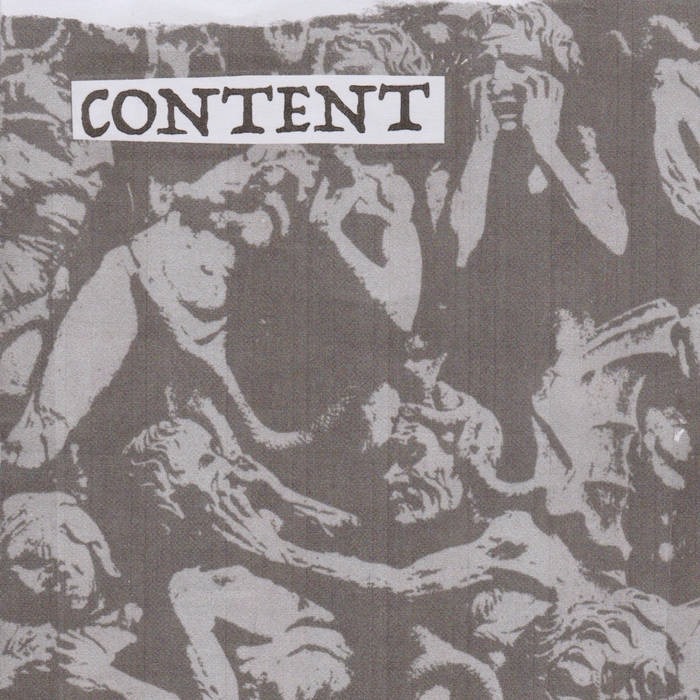
Nothing says ‘niche’ and ‘underground’ more than a limited edition of 17 copies. Pitched as a work of ‘radical ideology for fans of Crass, Pet Shop Boys and Nitzer Ebb from the rotten half of Normal Man’, this six-tracker is a gnarly mess of electronics, popping beats and a disorientating sonic swirl.
It’s an aggressive spluttering nailgun blast of percussion that assaults the ears first on ‘Permanent Contract’. There’s a bumping bass beat beneath it, but it’s the clusterfuck of cranium-splitting treble that dominates. The vocals veer between Sprechgesang and wavering atonal singing as layers of extraneous noise build and passages of warped discordance provide the breaks, before everything slides into a buzzing whorl of flange.
‘If Hard Work Pay Show Me Rich Donkey’ is more minimal, an ominous multitonal drone providing the primary backdrop to the repetition of the title for two minutes and twenty-one seconds. ‘No Big Idea’ and ‘Nu Cringe’ grind out gritty, primitive synths geared toward the lower end of the sonic spectrum over insistent bash-bash-bash electronic percussion, and ‘What You Want’ doesn’t exactly deviate too much from the same formula. ‘You’re Stupid and So Am I’ presents a more overtly punk sound – although it’s punk with the mechanoid twist of Metal Urbain or Dr Mix.
The production is ultra DIY, the audio quality is murky and clangs with swampy reverb, and Content very much channel the spirit – and the sound – of Throbbing Gristle here. Lyrically, when decipherable, they’re keen exponents of the three Rs – repetition, repetition, repetition, and the ethos and aesthetic is very much in line with that of post punk and the origins of industrial, with slogans and soundbites welded to cyclical motifs.
Combining vintage sounds with contemporary politics, it’s not necessarily ‘clever’, but it’s uncompromising and highly effective, and gets my vote.
Because I like my shit weird, I’m always thrilled to receive new releases from Bearsuit Records, and Harold Nono’s latest is one of a brace of fresh releases – brimming with weird shit, of course.
The title We’re Almost Home suggests a relaxation, an easing into the home straight. Instead, what Nono delivers is a brain-bending sonic tempest, with ideas lifted from all corners of the planet.
Nono’s straight in with insistent stuttering rhythms that pound systematically over the point as the title intimates, against a jolting japandroid clash of fragmented robotix. Like all of Nono’s previous releases, it’s a whimsical culture clash, stop-start chillout dance grooves are juxtaposed with trilling synths, samples, scratchiness and warping
‘Shaking on an Iron Bed’ is a calamitous crash of wild jazz horns and cymbal bursts that give way to pulping disco with orchestral strikes, while the jazz tones keep on coming. All the ‘what the fuck?’, all the ‘why?’ and all the ‘no need!’ and yet, despite everything, it’s all the reasons Nono is worthy of you ear. It shouldn’t work, and on paper doesn’t work, and even at times in actuality is kind of off the mark, but the transitions are so rapid that it’s doing something else completely different before it’s even registered.
There are moments of Stereolab-like mellow doodling to be found in places, as on ‘Let the Light In (Prince of Darkness)’, heavy dark ambience, as on ‘Ron’s Mental Leap Coach’ and tripped out semi-ambient space electronica, as on ‘The Fall Reprise’. There is oddness and drama, and a whole bunch of abstract glitchiness, and it’s all characteristic of both Nono and Bearsuit. If you’re curious to take a walk on the weird side, then this comes recommended. If you’re not, then you need to expand your horizons, and this is still recommended.
It’s inevitable that a city the size of New York would throw up a large quantity of bands. Big cities tend to simply by virtue of the fact it’s more likely there’ll be likeminded individuals to collaborate with, as well as an audience who’ll appreciate even the nichest of styles. But as a city, New York is a place of extremely, of polarities, and so is all things. A cultural melting pot, a city of dreams a disappointment, a lifemaker and a lifebreaker.
The 80s No Wave threw up a host of bands who captured the gritty realities of living in a city where the pace of life is relentless, and conveyed the drudgery of life at the bottom of the pile, for who, life isn’t about swanky parties in oft apartments, but 12-hour shifts in low-paid jobs that rely on tips just to cover the rent for a grimy, cockroach-infested one-bed hellhole. Bands like Swans, Unsane, and Cop Shoot Cop soundtracked the grim realities of the everyday: not so much the seedy underbelly, as the day-to-day reality of the masses.
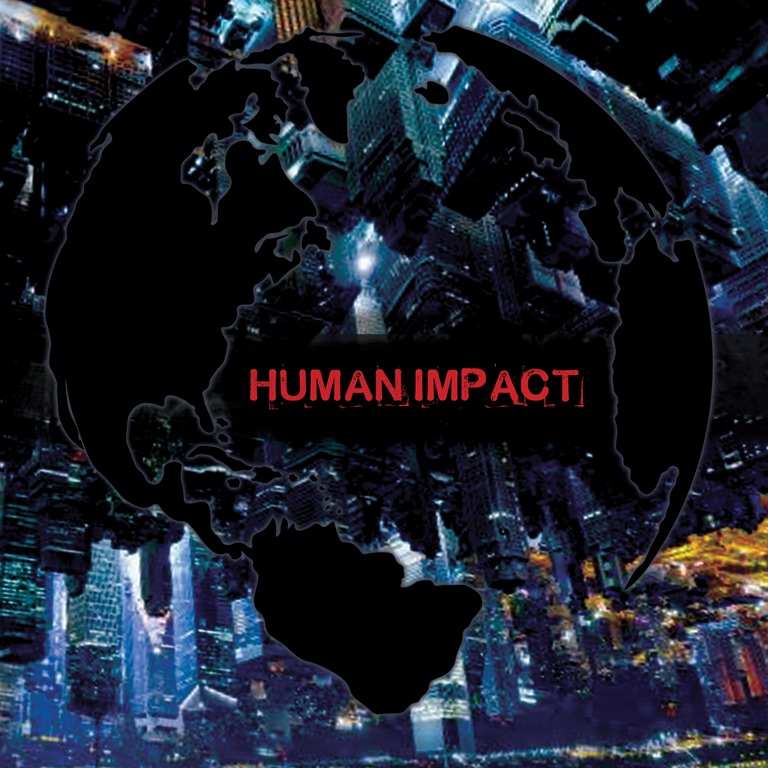
As the press release notes, ‘Human Impact’s first recordings are a dark mirror held up to the band’s collective pre-history – the sound and story of Unsane, Swans, Cop Shoot Cop, and New York City itself. It’s sound is cinematic post-industrial filth rock, a dozen run down subway stops away from recognizable civilisation, as futuristic as it is grounded in its sordid heritage. The result is a potent, hard-boiled distillation of this sonic ethos’. It’s a fair summary, and the album is every bit as hard-hitting as the parts and the sum intimate
Released as the first single (although what actually constitutes a single these days seems to be increasingly vague), the six-minute ‘November’ stood as a statement of the band’s intent, and serves the same purpose in opening the album: it’s a grainy-mid-tempo grindout built around a nagging, woozy bass that has hints of broken jazz chords and it loops around itself and weaves through jagged shards of twisted guitar. Second advance release, ‘E605’ (a highly toxic insecticide) crashes in immediately after, making for twin-pronged attack by way of an opening salvo: it’s slower, steelier, bringing the grey monotone nihilism of Unsane and blending it with the relentlessness of Swans. The result is paranoid and claustrophobic.
While pinning itself into a dingy, piss-spattered, litter-strewn corer of a back alley in a cityscape dominated by surveillance and oppressive government, there’s a fair range of texture, tone, and tempo across the album as a whole, if not necessarily much by way of levity. ‘Protester’ has the swagger and swing of Unsane at their best, but brings with it a melody and a synth doodle that brings some kind of levity, at least in comparative terms and in context, and the result is vaguely reminiscent of another New York-based act, Girls Against Boys.
‘Respirator’ gets a bit Killing Joke (certainly no bad thing), while ‘Cause’ is almost poppy, in a throbbing industrial goth sense of the word, like Ministry covering The Cure, darkly brooding, bleak, brimming with a sense of apocalypse.
Human Impact’s sound isn’t heavy in most common musical sense, and certainly not in the metal sense; the guitars aren’t absolutely raging with distortion, it’s not sludgy or doomy, and nor is it overtly industrial for the most part. Nor is it heavy in the 34BPM thud of early 80s Swans. And yet, as a listening experience, Human Impact is a heavy one, It’s the relentless bleakness which has a cumulative and harrowing effect, articulating the emptiness of a sustained level of defeat, fury, and resentment at the injustices of the world. These are dark, difficult, and unpleasant times, and Human Impact capture it in the most unsparing detail.
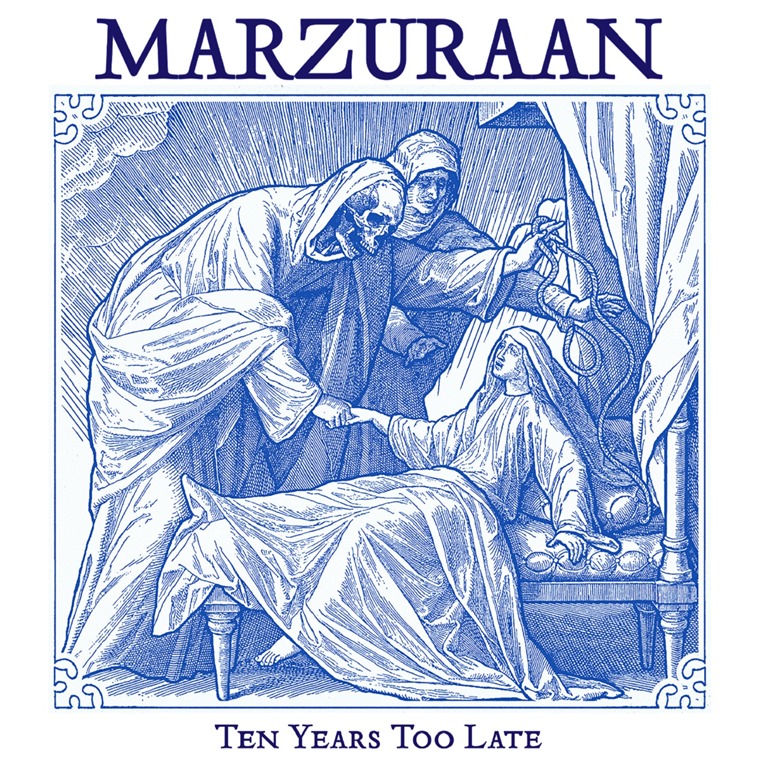
Cruel Nature clearly aren’t going for a major cash-in with this release, a 12-years-after-the-fact album containing the final recordings of a band who, while building a cult national following during their existence between 2002 and 2008, were predominantly a local phenomenon in their stomping grounds around Gateshead. Which means you may be forgiven for not being entirely au fait with Marzuraan and their work, of if you haven’t been o the edge of your seat and dripping with anticipation for this limited-to-75-copes cassette compendium.
For those not up to speed (and I’ll include myself here), the potted history of Marzuraan is that they started out as the duo of Pete Burn (guitar) and Lee Stokoe (Culver) (bass) before evolving into a full band with the introduction of Rob Woodcock (drums) and Stu Ellen (voice). ‘Taking their cue from bands such as Melvins; Black Flag; Harvey Milk; Earth; Godflesh and Loop, they soon cemented themselves as a pivotal band in the North East’s burgeoning Drone-rock / Trudge-core scene. Revered locally with a strong cult following nationally, they released 3 studio albums, appeared on countless compilations and split records influencing bands such as Bong and Pigs Pigs Pigs Pigs Pigs Pigs Pigs, before disbanding in 2008’. The title, therefore, is on point and self-aware to the max. But t’s never too late, right?
The recordings here – apart from two tracks which featured on an obscure compilation and split 7” back in the day – represent their final cuts, dating back to 2005 and 2006, and they’ve lain neglected in the proverbial vaults ever since.
But if anything, the timing couldn’t be better: what goes around comes around, and heavy music is very much enjoying a renaissance right now, and the north-east scene is also thriving thanks to various acts associated with microlabels represented by Cruel nature and Panurus Recordings.
It’s the seven-minute ‘Morphine Waterfall’ from the Mare Nero compilation that introduces the release, and it’s a dislocated, angular dirge of a tune that plods and trudges disconsolately through barren territory that alludes to early Swans and 90s Touch and Go, along with peer obscuritants like Oil Seed Rape and Zoopsia: it’s grunge distilled and chilled to sub-zero and as it builds toward the end, the guitars become increasingly discordant, while the snarling, rapping vocal becomes increasingly desperate.
It’s Tar and Girls Against Boys that come to mind through the low-end murk of the chunky riff grind of ‘Golden Roman’, and everything is there for a killer tune but the recording, despite having been remastered last year prior to release. It’s as muddy as hell. It doesn’t actually detract, for what I’s worth, and in many ways is integral to the gritty, lo-fi charm.
It very much sets the level: ‘Muckbucket’ and ‘Blowin’ Cool Breeze’ are built around thumping, repetitive riffs, but the guitars are trebly and skew off at divergent angles.
The final track, ‘Moneybox’, which previously featured on a record split with SINK is a doomy trudge that pushes the influence of early Melvins to the fore as it crawls in a sea of howling feedback and a 23bpm percussive trudge that’s paired with a gut-quiveringly downtuned bass. It’s ace. If you can cope with infinite suspense between drum beats and the striking of a single chord, that is.
Ten Years Too Late shows that Marzuraan were both a band of their time, and a band ahead of their time, sounding utterly contemporary now. Maybe it’s time for a reunion…
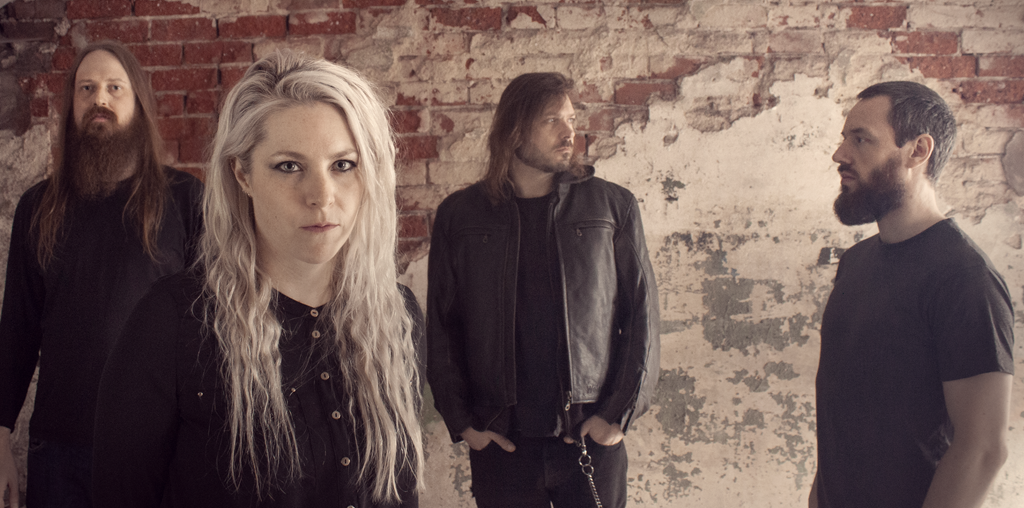
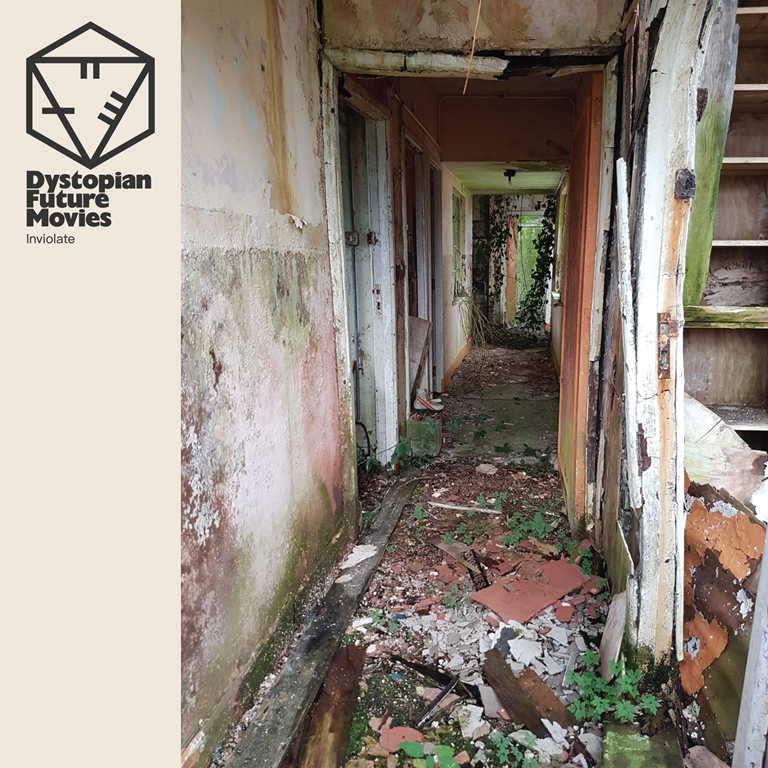
The follow up to 2017’s Time finds the emotive avant-rock guitar quartet moving further into cinematic territory while exploring an expanding range of forms. Everything contained in their previous releases is very much present on the seven songs that make up Inviolate, only so much more in every sense. Everything about Inviolate is bigger, bolder, more pronounced and yet more nuanced, shaper and more keenly felt and articulated. And every corner of the album is imbued with a sense of enormity, both sonic and emotional: Inviolate feels major-scale, from the driving riffs to the heartfelt human intensity.
‘Countenance’, which has been a standout of their recent live sets, kick-starts the album with a short blast of overdriven guitar that hits like a punch in the mouth, before immediately pulling back into a soft, post-rock chime. And so it goes: rapidly alternating between tempestuous bursts of gut-busting overdrive propelled by thunderous percussion and lacework of heart-rending delicacy. Chopping back and forth, it’s almost schizophrenic, and it’s impossible to settle into, and instead, the listener is drawn into an emotional maelstrom articulated through the medium of sound.
Things get darkly hypnotic on the slow-burning ‘Wreckage’, the guitars wrap serpentine around a slow-twisting bass with alternating hypnotism and jarring angularity, and it’s only near the end that the tension breaks in a searing blast of twisted chords, and then they go spiralling off into a jolting sonic cataclysm, it’s with some heavy prog leanings that call to mind early Oceansize. Meanwhile ‘Rules’ is a slow, spaced-out affair that crashes somewhere between shoegaze and grunge. Indeed, placing Dystopian Future Movies in terms of genre is nigh on impossible: the landslide guitar assaults aren’t remotely sludgy, and so they’re leagues away from the stone/doom vogue, and the softer, interweaving passages and crescendos aren’t twee post-rock or even post-metal, although they exploit the quiet / loud dynamics of grunge and the sustained crescendos characteristic of post-rock. And yet I’m reminded fleetingly of a number of bands – all lesser-known, misfit acts from the 90s – The God Machine, Eight Storey Window, Milk.
Writing on their performance in Leeds supporting Jo Quail last September, I wrote that ‘Their allure is not in the volume or force, but the threat, as if they’ve got a lot in reserve, simmering beneath the surface.’ This is very much true of Inviolate: there’s a lot of detail, a lot of texture, hints of psychedelia and some deep shoegaze as the guitars cascade kaleidoscopically in shimmering sheets of sound. It’s also very much about contrast. But also, on numerous occasions, they come good on that threat, delivering moments of explosive noise. Throughout, the strongest contrast lies in Caroline Cawley’s voice: it’s graceful, melodic, and there’s a soulful folksy feel to it, and even a certain hint of poppiness. Hers is certainly not an overtly ‘rock’ vocal style – post-rock, maybe – and certainly not grungey or remotely metal, and in eschewing any gnarly backing vocals, DFM place a firm distance between themselves and their infinite more metal peers. In fact, they place a distance between themselves and any other band, and utilise Cawley’s magnificently melodic tones to wander some softly rippling sonic waters and darker undercurrents, with ‘All the Light’ heavy on shadow.
‘Black-Cloaked’ has everything: a soft, melodic verse shaped by delicate, clean, chorus-dappled guitar that explodes into the most driving of riffs, before the soaring shoegaze sonic blizzard of ‘Ten Years’, a tidal wave of kaleidoscopic guitar shimmering to the close of an album that simply feels immense, and also really quite special.
Electric Sewer Age began as a collaborative project between Peter ‘Sleazy’ Christopherson (of Throbbing Gristle, Psychic TV, and Coil) and Danny Hyde, who continued the project together with John Deek, who subsequently passed away in 2013. It’s perhaps only natural that a sense of bleakness, of darkness, of a certain sense of grief permeates Electric Sewer Age, as a project strewn with loss.
Contemplating Nothingness is the third release by Electric Sewer Age, and the second one that Hyde finished alone, following on from Bad White Corpuscle, originally released in 2014, and re-released in 2016.
Contemplating Nothingness is pitched as ‘a lysergic tapestry culled from the deep end of the collective pop cultural unconscious’. It begins with some spaced-out trippy, doodly interweaving drones and some disorientating analogue latticeworks and shuffling electronic judderings providing the backdrop to some reverby, echoic vocals before transitioning into woozy dance territory, a stammering heartbeat bass beat fluttering beneath shifting layers of disquiet which collide with elliptical elisions to dance tropes.
‘Got some bad news this morning / which in turn made my day’, Hyde wheezes in a distorted Al Jourgensen-style vocal on ‘Whose Gonna Save my Soul’. I try not to wince too hard and the grammatical error and instead focus on the dark atmospherics the song conjured. Moreover, this single line encapsulates the contradictions which stand at the very foundations of this album, and the track itself delves into swampy dark ambience, dominated by a rhythmic wash, with Eastern motifs twisting in and out sporadically amidst a lower-end washing ebb and flow while the vocal, half-buried, is detached, distant.
Like its predecessor, Contemplating Nothingness is dark and difficult. Slow beats that land somewhere between heavy hip-hop, trip-hop and industrial drive ‘Chebo’, a delirious drag of chimes and electronic ululations. ‘Surrender to the Crags’ plunges into dark, dank, murkiness, but retains that eastern vibe that calls to mind both The Master Musicians of Joujouka and the otherness of the Tangiers scene in the 50s and 60s as depicted by William Burroughs.
‘Self Doubting Trip’ brings a dark intensity that will likely resonate for many: it’s claustrophobic and uncomfortable, and stands as something of a highlight in the way it attacks the psyche. You hate yourself enough already, but there’s a slight comfort in knowing your self-flagellation is not unique as you chastise yourself for simply living.
It makes the last track, ‘Dekotour’, feel like an electropop breeze by comparison, the chiming synth tones more early Depeche Mode than anything, but they bend, warp, twist and weave across one another to create a difficult knot of noise, with a thick, gloopy bass rising into the increasingly tangled textures.
There’s a certain nihilism at the heart of Contemplating Nothingness, which extends beyond merely the title and its implications of introverted emptiness, but it’s paired with a less certain and altogether less tangible levity which lifts it above dark ambience and into a space that’s given to contemplation and awakening. While ultimately minimal, there is variety and depth on display here, making for an album that deserves absorption and deliberation.
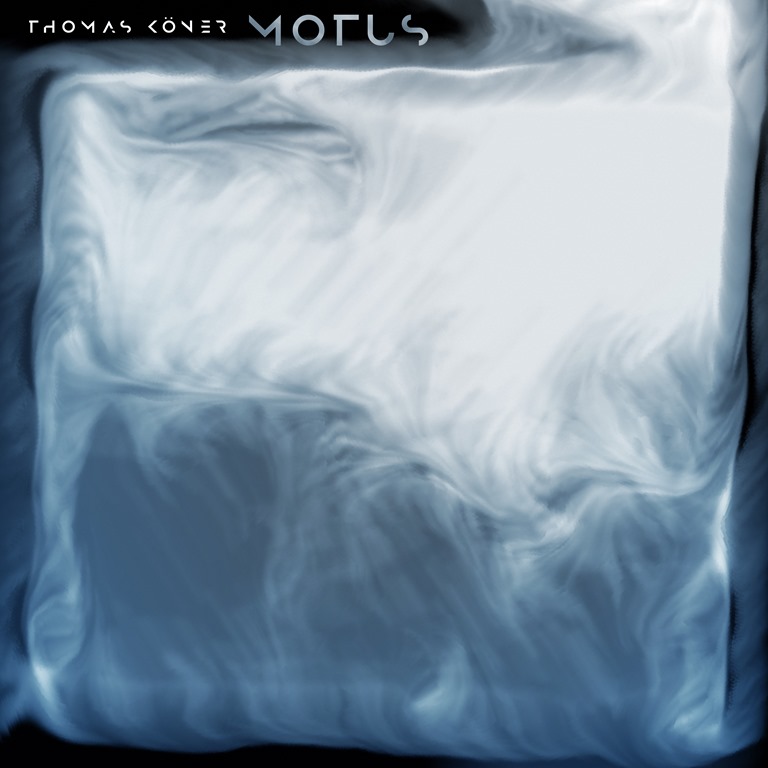
Motus is one of those albums that spreads eight pieces across four sides of vinyl. Most of these pieces are around seven minutes in duration, and manifest as grumbling, low-end analogue electronic instrumentals. Indulgent? Depends on your position, maybe. Audiophile quality? Vinyl addiction? While the pieces which make up Motus don’t immediately intimate a need for attention to detail and there’s no scope for the listener to bask in hearing the rich production values optimally through the medium of vinyl, the frequencies and tones that Köner explores probably do benefit from that full-spectrum vinyl sound, the audio uncompressed and benefitting from the full dynamic range, particularly those low-end sounds, some of which are so low as to almost disappear beneath the average listener’s hearing range.
Motus is steeped in theory, which is fitting given its release on Mille Plateaux, which takes t name – and also its ideologies from radical theorists Gilles Deleuze and Félix Guattari, after whose 1980 text Achim Szepanski’s Frankfurt label devoted to minimal techno, glitch, and other various other experimental electronic forms takes its name.
Köner says of the album that ‘Motus is more (to me) than just music made with analogue synthesizers, it is about attitude, a way of relating to sound and the (e)motion it affects. A lifestyle, where movement, being moved and moving become one. My practice is vibrational, about the skin, touch and surfaces and the gaseous medium in between.
Vibrational it is: these pieces tremble and quiver and grate and grind and shudder and shake and judder and growl.
The first piece, ‘EXTENSION (Attack)’ is a low, glutinous throb, a gelatinous bellyache of a pulsation, rent with crackling, grating treble spurs that scrape at the walls of the cerebellum and scratch the lining of the gut. It’s unsettling, and marks the start of the album’s trajectory, which is unexpectedly linear, and follows a slow descent towards sluggish sludge that’s barely a muddy bubble by the end.
Along the way, ‘SUBSTRATE (Binaural)’ is a low, oscillating throb that expands and resonates over seven brain-bending minutes: there’s something about the more subtle of variations having the most torturous effect, especially when there’s a metronomic pulsing beat lurking beneath, while ‘OSCILLATOR (Luminous)’ reduces everything to an ambulating low-end slip and slide, a muddy melt of trudging bumps. The final cut, ‘SYNTHESIS (Carnal)’, takes things lower and slower still, to the point of near subliminality, slowly winding and grinding into the ground.
Motus is an odd one, an album that undermines itself as it evolves, reducing itself to a lesser sonic amount with each piece. And yet, as the sounds shrinks to little more than a gloopy brown puddle, the effect grows.
The moon has possessed a mystical power as long as it has a physical one, the pull of the tides and the regularity of the lunar months forces mankind has never and will never assert control over. The waxing moon, when the moon is growing larger in the sky, is considered by some to be a phase of new beginnings. But new beginnings are equally the reverse aspect of endings: if the moon shows us anything, it’s that everything is cyclical. Time is not linear, and linearity is but a construct that facilitates an accessible narrative.
Rebecca Foon’s Waxing Moon is an album that shimmers and glows an ethereal hue: enigmatic, mysterious, and conjuring a sense of otherness, it’s possessed of a magic that’s difficult to pinpoint.
Rebecca Foon is the composer and musician behind Saltland and Esmerine, as well as having enjoyed a lengthy spell with Thee Silver Mt. Zion Memorial Orchestra. She’s best known for her cello work, but it’s her skills as a pianist and singer that are placed to the fore on Waxing Moon. For Waxing Moon, she’s joined by an impressive array of contributors, including Richard Reed Parry (Arcade Fire) and Mishka Stein (Patrick Watson) on acoustic and electric basses, Sophie Trudeau (Godspeed You Black Emperor) on violin, Jace Lasek (The Besnard Lakes) on electric guitar, and Patrick Watson as co-vocalist on ‘Vessels’.
But understatement is the key here, and the composition very much favour the sparse, low-key and minimal, demonstrating with aplomb the truth of the adage ‘less is more’. Instead of pushing the sound outward, she focuses in and goes deep into the heart of the feelings of each song.
The instrumental ‘New World’ get the album off to an affecting start, and sometimes in a world full of ceaseless noise and endless words babbled without thought, it’s easy to forget just how strongly simple notes played softly can be so richly imbued with emotion that they cam be more moving than any lyrical articulations.
When Foon sings, it’s in breathy, low tones, a sultry croon, as on ‘Pour’, which, with its brooding piano, subtly layered harmonies and haunting guitar, or the ominous, string-led ‘Another Realm’, it calls to mind some of Jarboe’s most evocative work. There’s something vaguely Leonard Cohen that goes beyond vague evocations of ‘Famous Blue Raincoat’ in the deep melancholy splendour of ‘Ocean Song’, while there’s something of a folksy feel to ‘Dreams to be Born.’ It’s semi-sad, entirely captivating.
The instrumentation and mood are focused on low-key, low tempo, for the most part exploring subtle shifts and microcosmic variations, although landing around the middle of the album, ‘Wide Open Eyes’ steps up both tempo and key to venture into folk-infused indie territory driven by an insistent rhythm and repetitive motif to hypnotic effect.
Waxing Moon is subtle, and has a slow pull that’s almost subliminal. It’s this soft-focus partial abstraction that renders the album so powerful: it’s by no means direct, but nevertheless conveys a deep underlying strength.
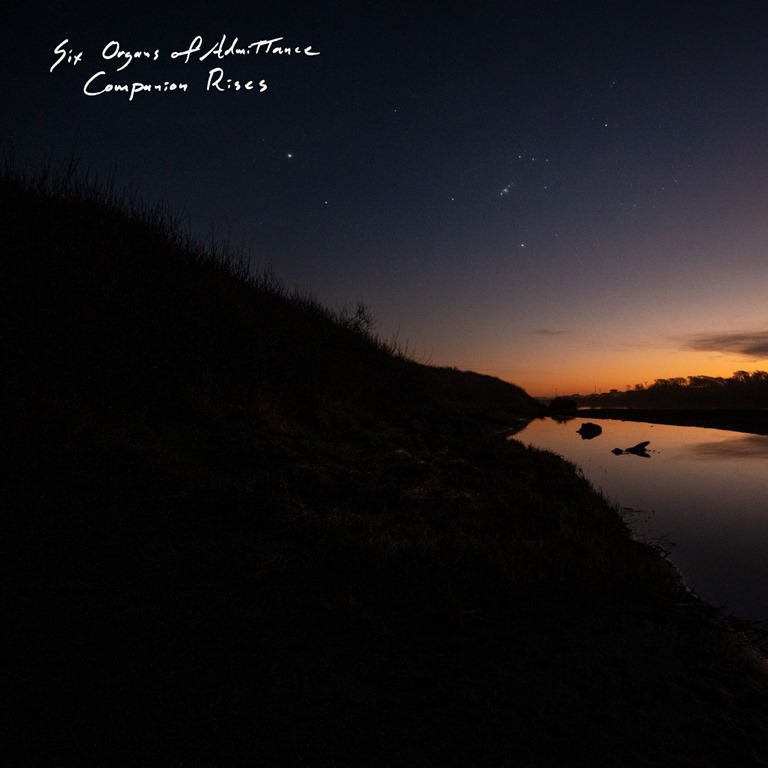
One thing you can never criticise Ben Chasny for is a lack of ideas, and over the course of twenty-two years, he’s pursued a line of technical and theoretical experimentation that’s yielded some remarkable results, perhaps most keenly exemplified by the recent Hexadic trilogy which spanned three years of deep and intensely focused and highly structured theory/practice-based work. The sequence was punctuated by Burning the Threshold in 2017, and is now finally broken with Companion Rises, which the single release of ‘Haunted and Known’ hinted at the form of.
According to the blurbage, ‘methodologically, Companion Rises sometimes recalls the early-mid lo-fi Six Organs records, with digital processes substituting for the analog techniques of yore and, instead of Ben Chasny’s hand percussion overdubs, algorithmic programs generating rhythms’. We also learn that Chasny ‘created all sounds and programs, all the recording and mixed the entire record, also like some earlier ones’, but the emphasis is less on revisiting the past than it is expanding on those early principles and practises to forge something altogether new and quite different.
From the surging synth organ swell of the intro, ‘Pacific’, it’s immediately apparent that Companion Rises is a different kind of beast: too ruptured, fractured and dissonant to be ambient, too vague in form to be conventionally categorizable as a ‘song’ even as an instrumental, it twists and squirms around and creates a certain sense of disturbance, and while it sits apart from the rest of the album in almost every sense, it also reflects the spirit of experimentalism.
Stylistically, it’s a curious hybrid of wonky folk and indie, played rough and loose and recorded cheap. ‘Two Forms Moving’ is a hypnotic, looping affair, that builds layers, and the zany lead guitar work is magnificently at odds with the hypnotically repetitive strum that forms the song’s basis, and it’s as if the two forms are moving in different directions yet somehow collide perfectly.
This is a large part of what makes Six Organs such an enduringly interesting proposition: as much driven by theory and experimentation conducted within set parameters, Chasny makes music that doesn’t quite sound like anyone else’s. Those defined parameters or specific methodologies, often a feature of John Cage’s compositions, are more commonly the domain of electronic or electroacoustic artists, and are more usually found in the domain of the avant-garde, while ‘rock’ music is – broadly speaking – more concerned with concepts than technical executions where compositions are concerned. Companion Rises chucks it all in the blender and whirls up something novel, but without it being novelty: songs are still very much the focus.
Those songs are diverse and tend not to place too much priority on conventions of verse and chorus, but there are hooks, nagging motifs, dainty, dreamy folky atmospherics and lilting melodies, and wrapped up in a lo-fi buzz that’s definitely not Dolby and all the more immediate because of it.
And we’re back once again in the divergent and varied field of what’s come to be goth in the 21st century, and it’s a very far cry from its post-punk roots. The late 70s and early 80s saw the emergence of Siouxsie and the Banshees, Bauhaus, The Cure, The Sisters of Mercy, The March Violets, Christian Death and a slew of bands who would subsequently be labelled as ‘goth’, and who were subsequently joined by the likes of Red Lorry Yellow Lorry, The Cult, Fields of the Nephilim, The Mission, etc., etc. The fact of the matter is, there was little commonality between these acts, and that goth was something of a media fabrication. What about the fans? Let’s not confuse the fans and the artists, or a subculture with its icons. So what was a scene that never was morphed into an evermore diffuse group of subcultures, with an ever-broader range of bands who had little or nothing in common beyond their shared fanbase. After metal, there can be few labels that provide an umbrella for a greater range of styles.
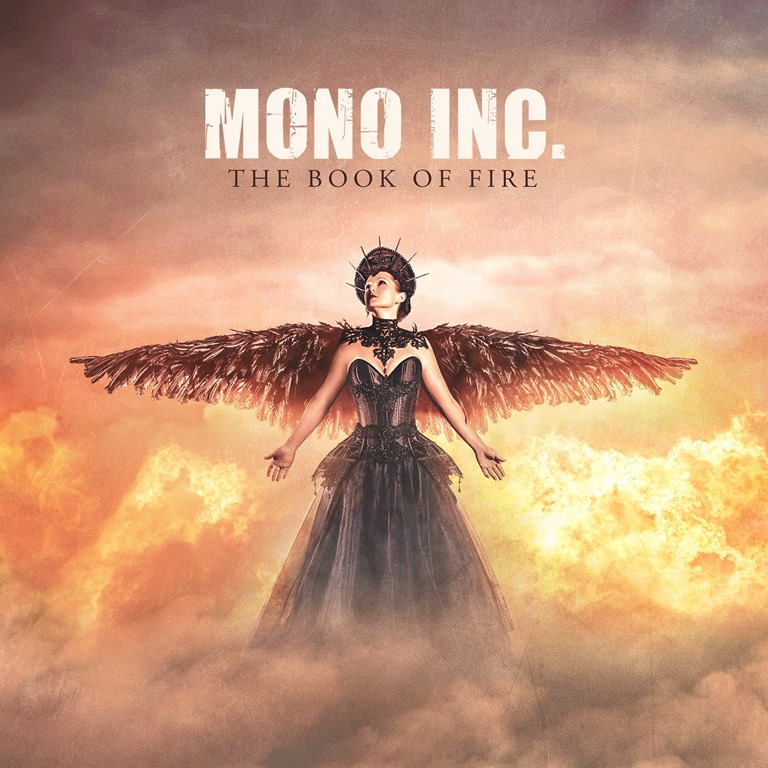
So here we are, presented with The Book of Fire, the eleventh album by German goth-metal act MONO INC. And while it’s goth, it’s not really my kinda goth, and couldn’t be further from the dark post-punk or art-rock stylings of the first wave of bands. Is this evolution, or dilution, cross-pollination and contamination? I suppose that’s a matter of perspective.
The album’s first song, the title track, is over seven and a half minutes long. It begins with a slick guitar that almost manages to sound like a harpsichord, and then it glides into some kind of Celtic folk metal and it very soon starts to become uncomfortable. Uncomfortable because such buoyant energy is more the domain of the hoedown knees-up. The folk-hued power-metal of ‘Louder Than Hell’ brims with positivity about strength and stuff, and explodes with crisp synths and choral backing vocals and it’s fun enough, but it’s also pretty cringy: it’s the kind of thing Germany might enter into Eurovision.
Then again, ‘Shining Light’ has such a massive chorus and a hook so strong that it’s hard to resist even when you’re hating it: it has that uplifting surge that lifts you and carries you away on the tide from the inside.
The euphoria swiftly dissipates with the next song, ‘Where the Raven Flies’, which is the definition of theatrical cliché melodrama. And herein lies the problem, which I accept is entirely personal, at least on a primary level. In short, I think it’s cheesy and naff.
On a secondary level, and one which is more objective, what The Book of Fire represents is very much a commercial take on the genre; theatre and drama don’t necessarily equate to an absence of depth, but this is good-time party goth, and any emotional sincerity is polished away under a slick veneer of pomp and overblown production. In this way, it’s as credible as examples of either folk or goth as Ed Sheeran’s ‘Galway Girl’ or Doctor and the Medics’ rendition of ‘Spirit in the Sky’. It displays all the trappings, but none of the authenticity. For all the theatre, there’s a woeful absence of substance, the brooding is third-rate thespianism rather than the anguish of tortured souls.
Elsewhere, ‘The Last Crusade’ is riven with choral bombast, but is little more than an obvious ‘This Corrosion’ rip-off, that once again leans heavily on Germanic folk tropes, and ‘The Gods of Love’ similarly brings together Floodland-era Sisters with Rammstein. I’m sure plenty will view this as a good thing, but they’d be wrong, so wrong. ‘What have we done?’ they ask repeatedly on the final and suitably epic finale track ‘What have We Done’, and it’s a fair question: whatever it is, it’s not good.
In fairness, it’s not quite ‘Rocky Horror’ bad on the spectrum of play-goth, but it’s not far off, and while it’s sonically ambitious, creatively, it’s depressingly derivative.



 Aural Aggravation