Posts Tagged ‘Album Review’

29th December 2023

Christopher Nosnibor

Alright, I’ll get the moment of amusement about the fact that US stoner / prog / space rock / psychedelic indie trio We Are Space Horses have a member named Kevin Vanderhoof out of the way before getting down to business – the business of getting to grips with this expansive seven-track EP, which sees the band really explore texture and detail across its duration. I make no apologia for my flippancy, since first and foremost, I’m here to offer a detailed and serious critique, and a small amount of levity is no bad thing.

The first track, ‘To Let Go… Absolutely’ is representative, beginning with a screed of noise which backs off to leave us with a simple acoustic guitar and wafting falsetto vocal. The vibe is very much 70s prog, accentuated by some bold guitar breaks over the song’s six-and-a-half-minute duration. It’s not so much leaning on this artist or that, so much as assimilating the broader oeuvre.

Bass and drum-led ‘Haunt’ mines some blued-based seems with some gutsy Led Zep-inspired riffology delivered with some serious swagger. The contemporary production values and overall gritty heft places it alongside the likes of Rival Sons. Now, on a personal level, I’m in two minds about the latest heavy blues revival and in particular about Rival Sons, and this comes from the perspective of someone who spent their early teens almost exclusively at pub gigs watching blues acts, electric and acoustic, and seeing countless blues artists in York around 2005, not least of all because every other pub was host to live acoustic blues at that time. And I learned you can have too much of a good thing.

We Are Space Horses are unquestionably a good thing, and that’s a fact, and best of all, when they transcend beyond the blues template to wander exploratory space, as they do on the meandering but beefy ‘God is a Ghost’ they’re hugely exciting.

If ‘Ketoacidosis’ is a bit standard alt-rock and is the sound of black-shirt wearing beard-sporting clean progressive metal, it is at least well-executed: there can be absolutely no doubting these guys’ musical competence or their capacity for dynamic structures, and the songs across the album as a whole are imbued with palpable emotional sincerity. ‘Stale Skies’ thunders in with an intro that’s pure Joy Division before pairing off towards something starker, sparser, more 80s AOR, but stretching its way boldly into more contemporary prog. Clean chords strike off in different directions as the bass rolls and strolls, moves and grooves before lunging in with some chunky distortion.

The vogue for epic last tracks may have become somewhat predictable of late, but I really can’t complain. Way back in the 80s, even, the killer epic longer last song by way of a closer became, for me, the mark of an album that was special. And of course, slower: from Duran Duran’s ‘The Chauffeur’ to The Sisters of Mercy’s ‘Some Kind of Stranger’, the extended, emotion-tugging closer emerged as a thing and over time, it’s become more pronounced, although I won’t suggest more indulgent – bands have simply created space to extend beyond their limits to deliver spectacular album finishes. And this is a spectacular finish to a spectacular album.

Apologia is bold, varied, and ambitious, and finds the band taking risks. More often than not, they pull them off, too, making for an album that’s bold, confident, and exciting.

AA

AA

a0967635177_10

New Heavy Sounds – 26th January 2024

Christopher Nosnibor

It begins with a yawning, wailing drone, before thunderous bass, drums, and a rolling piano crash in tempestuously. But if you think this is just another heavy doom-leaning record with a dash of theatre, the arrival of Amber Gardner’s vocals changes everything. She brings an antagonistic, nihilistic punk vibe at first, but then, as the song transitions into a grand, sweeping expanse, reveals a softer side. And so it is that ‘White Noise’, the album’s eight-and-a-half-minute opener is a real shape-shifter, sliding back and forth between crushing weight and spellbinding atmosphere. But when it goes heavy, it’s utterly pulverising, and the sustained crescendo which occupies the last three minutes is gut-wrenching, annihilative, a rare exhibit of raw, chest-tightening emotional heft combining with the most punishingly brutal instrumentation, which leaves the listener feeling wracked, drained, ruined.

It may sound strange, but it’s often more difficult to write about albums which really hit you, which have the most impact. To scrabble for an analogy, it’s like being kicked in the chest and left lying breathless on the ground then being asked to describe the experience while still barely able to draw oxygen. It’s like… like… It leaves you stunned, numb, dazed, and at a loss. Regeneration is one such album. It’s all well and good clutching and comparisons and scratching for similes, but no words can really come close to articulating the spectrum of sensations which engulf your very being when faced with something so intense, so close to overwhelming. Yes, it’s dancing about architecture. What you want to do, more than anything, is to forcibly sit people down and say “listen to this! No, really, listen! Feel that!”

New York-based GUHTS (pronounced ‘guts’) declare themselves to be an ‘avant-garde post-metal project, delivering larger than life sounds through, deeply emotional music’. It’s the emotional aspect that hits harder than the punishing power chords, but it’s the combination of the two which really is the killer here.

The album’s seven tracks are incredibly ambitious in scope and scale, and in terms of balancing emotional depth and sheer brutal force. For the most part, the compositions extend beyond the five-minute mark, but are confined to under eight, and are effectively doom/goth epyllia – expansive, dense, cinematic. The prominence of piano – particularly notable on the slower, intensely wrought and dynamically varied ‘The Mirror’. One of those songs which sustains a surging sensation from the very beginning, it’s truly worthy of the ‘epic’ descriptor.

‘Till Death’ has hints of Cranes about it in Amber’s ethereal vocal delivery, but it’s paired with megalithic guitars of absolutely crushing weight, while the shortest song on the album, ‘Handless Maiden’ is monstrous in its unyielding heaviness. Gardner brings another surprise with her rabid howl, which is utterly petrifying.

There isn’t a weak track here, nor a single second that doesn’t feel utterly vital and doesn’t crackle with intensity, and Regeneration is an immense and powerful album. ‘Generate’ rolls into graceful shoegaze territory, with rolling drums and chiming guitars which wash and ripple mesmerically, gradually building to a sonic tsunami.

There’s something inevitable and completely perfect about the way it all leads the way to the ten-minute ‘The Wounded Healer’, which comes as a truly monumental finale. And what a finale! It begins delicately, ringing xylophone or glockenspiel chiming out mellow tones, before a grinding low-end grinds in and from here, the build is slow and inexorable. Gardner traverses the sonic space, shifting mood and tone in a flicker. The guitar twists and spins, tense and serpentine against the ever-swelling wall of booming bass and by only halfway through, you’re drowning, the air pressed form your lungs… and then… then… Christ. Gardner is possessed, and the guitars pulverise and you feel your skull beginning to compress. Finally, around the seven-minute mark, there is levity. Clawing for aa comparison, I arrive at Amenra, although it’s less than half the story of a song, and an album, which is utterly peerless and completely beyond spheres of comparison.

Regeneration is special, hard-hitting, unique. Really. Listen! Feel that!

AA

a3406377299_10

Fysisk Format Records – 26th January 2024

Christopher Nosnibor

The arrival of single ‘Mjelle’ just the other day provided a strong alert to the imminent arrival of Heave Blood & Die’s Burnout Codes. The band’s name may have a certain comic-book flippancy about it, but their fourth album comes with altogether less cartoony connotations: as the accompanying text explains, ‘Dedicated to bassist Eivind Imingen, who decided to end his life just following the recordings of the album, Burnout Codes is shrouded in sadness and tragedy, and shows the Norwegian collective offering their most textured and innovative album to date.’

It’s not even a mater of English as a second-language: the phrase ‘decided to end his life’ is a difficult one to digest, and one which reminds us that there is no comfortable way to articulate death, and particularly premature death by suicide. Words simply don’t work, they don’t fit, they don’t sound right, they don’t read right. There are no words. But of course, the job of the artist it to find words, and to articulate these essentially unspeakable, incomprehensible things, by various media, be it words alone music, visuals, a combination of any or all of these.

Some albums stand out, at least to me, as being weighted by the perspective of events which would follow soon after: Nirvana’s In Utero and One Last Laugh In a Place of Dying by The God Machine, and, of course, Joy Division’s Closer all resonate with the echoes of foreshadowing deep tragedy, and would also add the altogether lesser known album Nails Through Bird Feet by Chris Tenz – one of the first albums I reviewed on here (positively), to learn some time later that Chris had not only taken his own life just a few weeks later, but did so after visiting York in his final days.

I struggle with the dichotomy between the contemporary dialogue around these things: while there is a huge drive to encourage open discussions about mental health, some feel that anything mentioning anxiety, depression, and suicide should come with a trigger warning and that people should be able to be excused from being confronted with these topics. I do understand that they’re difficult and upsetting, but how does one navigate life by avoiding anything difficult, upsetting, even traumatic? Being recently bereaved myself, I feel I need to front up to one of life’s only certainties, namely that it will end.

Like all of the albums mentioned previously, Burnout Codes is not an album which is about suicide, or grief, but a dark album which explores these challenging themes, and has taken on further dimensions on release due to the addition of unforeseen context. We shouldn’t judge the album within these contexts alone, though.

Sonically, Burnout Codes is a fiery blast of fury out of the traps with the buzzing throb of ‘Dog Days’, a furious collision of grunge and raging hardcore punk which leaves you dazed and breathless, and it’s immediately followed by the sub-three-minute assault that is ‘Men Like You’, which slams in, drums to the fore before locking into a scuzzy wall of guitar and synth, like Girls vs Boys produced by Steve Albini.

‘Hits’ is built around a nagging, throbbing pairing of guitar and synth and a shouty vocal that evokes all the fist pumping. But no, there’s more detail than that. The synths are stark, chilly, droning, the sound of Closer­ era Joy Division, early New Order, The Cure even, but the guitar is positively grungy, and these contrasts create a dynamic tension that serves to sonically articulate a mood of internal conflict, of the experience of feeling jittery, adrenalized, and it’s ramped up threefold on ‘Stress City’, a crackling soundtrack to that sense of feeling overwhelmed, overloaded, overstimulated. If you’ve ever been there, it will resonate deep and hard – and if you haven’t, it’s still a rush of a tune.

Single cut ‘Mjelle’ sits in the middle of the album and marks a shift in placing the synths to the fore and pulling back the guitars, and it’s an obvious single choice with its more clearly-defined chorus and hints of Gary Numan. A slower song, and the album’s longest, extending beyond five minutes, it stands out in the set, but make no mistake that the atmosphere is pretty fucking bleak.

‘Things That Hurt’ races back in with a fierce post-punk darkness, a serpentine synth intertwining with a slippery guitar lead and pounding drums which bring an explosion of energy.

The contrasts and shifts in pace and mood are integral to Burnout Codes, and for this reason, ‘HEATWAVE 3000’ packs a late surprise with its rawness and 80s synth oscillations and strolling bass: it comes on like Killing Joke, with a full, bass-led production.

‘Seen it All’ brings a harrowing conclusion, and bringing the album to a heavy conclusion, Desolate (Keepin) repeats the phrase ‘everything burns’, a crunch of distortion and a rasp of desperation accentuating the pained, ragged appraisal of the mess of life. The statement can be taken metaphorically and literally as we recall how wildfires ripped through Greece last summer in the world’s hottest year on record. The worlds is on fire. Wars rage around the globe. Everything does, indeed, burn… and eventually, burns out.

AA

945712

Karlrecords – 21st January 2024

Christopher Nosnibor

Reinhold Friedl’s career has been long and interesting, and continues to be so. The list of collaborations on his resumé is beyond outstanding, and he has taken the concept of the prepared piano, as first conceived by John Cage, to limits beyond imagination. As such, while the idea may not have been his own, Friedl’s advancement over the last twenty years has been the definition of innovation. But what makes Friedl such a remarkable figure is his capacity to explore so many different and divergent avenues, and to turn his hand to so many different projects – and this latest, with Martin Siewert is exemplary. Siewert’s instrument is the guitar, but his style of playing is far from conventional, tending to conjure atmosphere from feedback and sustain and otherwise working the space between the notes instead of blasting chords. As such, this is an inspired pairing.

Lichtung blasts in with a thick, heavy, grindy drone that almost borders on Sunn O)) territory: the twenty-four-minute first track, ‘Genese’ is a journey, which begins with an all-out assault of thick, gut-twisting drone and shards of shrieking feedback which twist into a maelstrom of chaos before receding to reveal altogether more tranquil shores. From this, it builds, a droning, churning wash, buzzing drones and dramatic crashes. And from the rising tempest, lone piano notes rise… These particular notes are identifiable as a regular piano, rather than a ‘prepared’ one – but that’s the nature of the tweaked instrument: random items on the strings create random sounds. It’s a curious array of sounds, and over the course of the track, the sound rises and falls, ebbs and flows, but the water is always choppy, the storm building and rumbling before it rages its full force. ‘Genese’ feels like it could be an album in its own right, but there’s a whole lot more to come.

‘Gedstade’ is a mere interlude at five minutes in duration: with plinking, plonking random twangs and scrapes and woozy drones, not to mention extraneous noise and crashes and more, it’s strong on atmosphere and oddness.

Often when interacting with music, or when critiquing music – and these are two different, if quite proximate experiences – I will ask myself, or otherwise consider, ‘how does this make me feel?’ Because ultimately, music, like any art, is about the experience of the recipient, and that experience defines its success and / or impact. To expand on that, and to clarify, many may dislike and so decry a great work of art on account of their singular experience, because it’s difficult to rationalise or otherwise quantify said work. As a critic, to baldly declare ‘they’re wrong’ would be a mistaken and to devalue the experience of others. But if others share a very different experience… then that is their experience.

And so we arrive at ‘Gestitche’, the album’s third and final track, a fifteen minute exploratory work which begins with crashes of low-end piano which sound like thunder and shake the ground beneath this exploratory composition. It’s heavy, doomy, dolorous. The scratchy, discordant guitar work only accentuated the album’s immensely broad sonic range. Squalling squealing guitar ruckus and feedback riot tears its way through the tempest of noise and plunging piano and sputtering sparks of wires. As the track progresses, things evolve and escalate, the thunder builds to a tempest, and at times you feel thoroughly assailed.

To my ears, then, Lichtungis a compelling experience. Lichtung is unquestionably niche, like all of Friedl’s but that in no way diminishes its value. And the joy of Friedl’s work is its variety, and the way in which he interacts with his collaborators. To this end, this album is a work which brings joy.

AA

a1344738009_10

22nd December 2023

Christopher Nosnibor

We live in strange times – times which have gone beyond the established expectations of what defines postmodernism into a period which is something else. Something else we’re yet to come to terms with, let alone define. Postmodernism heralded the arrival of what one might call ‘the nostalgia schtick’ by meshing together past, present, and future to conjure something of a liminal territory in which all times exist simultaneously. But if postmodernism, as defined by the likes of Francois Lyotard and Frederik Jameson is primarily defined by an accelerated pace of communication and an overwhelming blizzard of media, one thing which no critics or theorists could have readily anticipated when defining the term was the rush to cling to the recent past, or that the next big boom in industry would be nostalgia and revivalism.

The advent of the Internet heralded a revolution in terms of all things archival. Back in 1996 or thereabouts, when I first got online – with AOL on a floppy disc and a 14k dial-up modem plugged into a second-hand IBM 486 ­ it seemed like a new dawn. It was basic, but text from obscure zines from the 60s, 70s, and 80s and pretty much anything you could ever wish for from the depths of the most subterranean archives was suddenly available, as was anything else. By the early 00s, Warren Ellis’ Crooked Little Vein was the world as it was: if it existed, it was on the Internet. But then the Internet got hijacked by big business, MySpace ceased to be the anarchic free virtual world that it had been, and everything turned to shit. Because capitalism ruins everything.

Amidst all of this, postmodernism is – or was – characterised by a celebration of depthlessness, of rejoicing in its own disposability, what Stewart Home referred to as ‘radical inauthenticity’. Postmodernism was laced with irony, knowingness, self-awareness. We seem to have lost the sense of irony and humourous knowingness somewhere along the way, and as we grapple with AI, deep fakes, and music industry plants, we have come to return to the question of authenticity as something which should perhaps be valued. Admittedly, these debates are perhaps minority issues, because for the most part society is split between those who believe everything they’re told and those who believe nothing, and there is only limited space for nuanced critical debate. It is, of course, hard to have a nuanced, critical debate in segments of 140 characters or so, and this compression, coupled with an ever-decreasing collective attention span has, undoubtedly been damaging in many ways.

The tug-o-war regarding the value of authenticity has been particularly apparent in music, as fellow musicians and critics alike have descended on punk and ‘indie’ bands to challenge their authenticity as exponents of punk and indie. With the rise of the ‘industry plant’ threatening the integrity of the DIY and indie music scene, it does make sense, but the point I suppose I’m ultimately making is that nothing really makes sense anymore, and that everything is a contradiction.

So, at the same time as AI has surged forwards to recalibrate the means of production, we’ve also witnessed a sustained boom in all things nostalgia. As much as it would pain many to admit it, it’s that same pining for the past that has driven the demand for vinyl, cassettes, grunge, tribute bands, as brought us Brexit. Admittedly, a yearning to return to the days of the Empire and when England resembled a Hovis advert is more socially damaging than basking in the glory days of Britpop, but it’s a pretty close call. A significant portion of the success of Stranger Things, for example, is its retro context, which has seen many hailing it as bearing parallels with The Goonies. I can’t help but wonder if this passion for the not-so-distant past is a means of escaping the absolutely hellish present and the utterly-fucked-up future we’re hurtling headlong into.

Conflux Coldwell’s latest project is one which plunges deep and direct into nostalgia, and as such resonates with the zeitgeist which has been simmering for a few years now. We’ve all seen it: the ersatz recreation of scratchy recordings, crackles and pops of old vinyl and the warps and snow of videotapes. And now everyone’s back to buying vinyl and audiotapes… how long before the VHS renaissance? And at the same time, it raises the question of ‘the archive’, of the (im)permanence of documents. We have always believed that documenting and recording events was the route to immortality, and that the advent of modern media would solidify our legacy in the same way as The Anglo-Saxon Chronicle or The Bayeux Tapestry. It was not so long ago that the Internet was supposed to be an eternal archive of everything ever. Only now, it’s apparent that modern technology is as ephemeral and disposable as our very culture, and that online archives vanish the moment their owners stop paying for the domain.

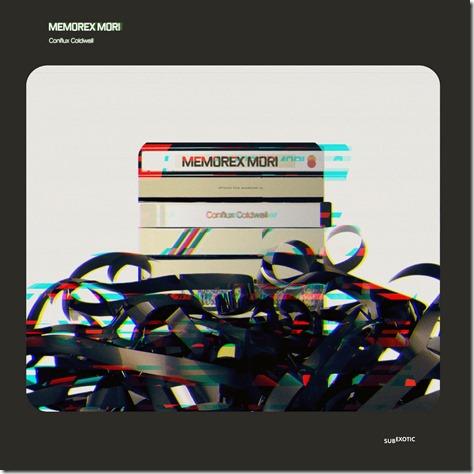
Memorex Mori is an unusually authentic work, born out of an excavation of -personal archives, as Coldwell explains: ‘Last year I found a dusty box of old unlabelled VHS tapes at my parent’s house, including some early work of my own I’d long forgotten about. Unfortunately the tapes were all in very poor condition and I only managed to recover some of the material. Despite the bad quality I decided to sample the videos anyway and make something new out of the various noisy remnants – the final result of that extended process is Memorex Mori.

Coldwell himself isn’t outside the frame of nostalgia with this ambitious project, either, as he continues: ‘VHS was the medium of my childhood in the 80s and 90s, and was still routinely used for budget productions by the time I started making films and music of my own. Looking through the old tapes made me realise the ultimate fragility of all our recordings and the memories they hold. These analogue tapes only have an estimated lifespan of 25 years, and this artificial life is only granted to the videos we actually decide to keep. The vast majority ended up in landfill when the world went digital – what was lost in the waste? In contrast, we might think that current digitisation and cloud storage allows our memories to live forever, but they are still fallible. The major difference is that with digital archives this mortality is hidden – with analogue media we can potentially witness that death happening in slow motion before our eyes.’

It’s an interesting and valid distinction between analogue and digital: growing up in the 80s and 90s myself, I remember being told not to vacuum clean near any video tapes, and so on, while toward the turn of the millennium the emerging digital future was presented as eternal. But now, it’s clear, that there is no such thing as permanence, or the eternal, and that any archive is as fragile as life itself.

And so, Memorex Mori is a multi-faceted, multi-dimensional, multi-media project, where past, present, and future collide, and postmodernism melts into the as-yet-to-be-defined present. It’s a film and it’s a soundtrack, and both can be appreciated independently of one another, as intended.

Coldwell expands on his notes, explaining ‘This project continues a lineage started by William Basinski and The Caretaker, exploring themes of memory loss, entropy and spectrality, through the sampling of destroyed recordings. But Memorex Mori extends this idea into the visual realm, presenting a feature-length music video alongside the music. As well as sampling early Conflux works from tape (Traveller, Glitch, Machinedance and Trainboy) various other unknown recordings were appropriated from the video box – all sorts of forgotten cultural detritus including my Mum’s 30 year old Open University programmes. A few modest pieces of equipment were used to add extra sonic layers – including the Korg NTS-1 and a home-made Marantz tape delay – then all bounced back to VHS.’

The video is a disorientating barrage of film clips, from train journeys to clouds, via small aircraft lifting off and droplets of water rippling out. Everything flickers and fades , glitches and warps. At times, we’re simply submerged in a snow of magnetic degradation and ruination, and it’s not always easy to discern what we’re actually being shown. But, often devoid of context, these detached, fragmentary scenes take on a sense of significance. The effect is an uncanny emotional response, a pull in the lower intestine as something unexplained and inexplicable evokes something within. There’s a comparison to be drawn with Memorex Mori and the experimental works created by William Burroughs and Brion Gysin in the late 50s and early 60s – in the soundtrack, the tape experiments, perhaps, but more so the whole audiovisual project, which calls to mind films such as Towers Open Fire, produced in the mid-60s with Anthony Balch, and a step closer to what Gysin’s quest to realise ‘a derangement of the senses’.

The soundtrack is the perfect soundtrack to this endlessly unsettling sequence, an eternally shifting sonic drift that’s at times noisy, even harsh, while at other altogether more ambient. Like the visuals, it draws you in, but it also stands independently as a purely sonic experience, and it’s also a smooth, expansive scene for reflection, and perhaps it’s to be expected that the soundtrack has greater impact when experienced in isolation, without the distraction of the visuals.

As a whole, or in part, Memorex Mori is quite an unsettling experience: visually compelling, and aurally challenging. It demonstrates the fragility of any documentation, any archive, and of life itself. Nothing lasts forever. And it speaks of how, as memory fades, so the documents diminish in value: moments captured in moving or still images which seem so essential at the time lose meaning over time: where was that picture taken? What was I doing there? Why did I think that would be worth filming / photographing? Who even is that?

I feel a weight descend as I reflect on all of these things while immersing myself in Memorex Mori. I can’t even begin to imagine the experience of assembling it. Then again, I can’t really assimilate the experience of other viewers or listeners, either. What’s intensely personal to an artist is likely to hit a spot with the audience, but for each, the reception will differ, based on their own experiences, their own immediate headspace.

But, regardless of individual interpretation, the vast ambition of Memorex Mori is matched by its accomplishment. THIS is a document. A powerful work, which will stay with you long after the silence descends.

AA
a2043088135_10

25th November 2023

Christopher Nosnibor

Pink Floyd, Joy Division, and Queens of the Stone Age don’t leap to mind as compatible influences for the pollination of a new musical venture, but we learn from the outset that these are the touchstones of Manchester act Dirty Laces, whose debit album, Blink for Nothing has been fully six years in the making. It’s a fully DIY venture, too – self-produced, self-released, and presented in their own artwork. Steve Albini would approve. It may be that Blink for Nothing won’t sell truckloads, but there’s much satisfaction in knowing that any proceeds will go straight to the band, meaning that any profits will, too, instead of lining everyone else’s pockets first before the band receive any leftover change, if they’re lucky. The model is fundamentally flawed, but of course, the industry thinks otherwise: of course it does, because artists who turn a profit turn a profit for labels, management agencies, etc., etc., and those who don’t, find themselves ejected pretty swiftly. It’s unlikely that the industry machine would have afforded these guys six years to evolve and hone their sound, their songs, and tinker with everything, while giving them complete creative control.

‘Midnight Mile’ makes for a strong opener with a bold, melodic lead guitar line carving an entry into a song that packs in so many different elements while keeping it all tightly together with some strong hooks. With some digital bleepery and kicking guitars and an atmospheric breakdown about two-thirds in, it’s got a very 90s/00s alt-rock indie vibe, and somehow manages to land somewhere between Jesus Jones and The Cooper Temple Clause, all delivered with an archetypal Mancunian swagger.

The swagger is something that could be rather divisive, and the baggy beats and bass runs which crop up here and there make nods to the likes of The Stone Roses and The Charlatans which feel a shade derivative and don’t necessarily do them any favours. But despite these features, ‘Old Friend’ is innovative and solid, some nonsensical lyrics aside (‘There’s an old friend I know / Never seen him before)’, and transitions from paired-back and primarily acoustic to big and – yes, I’ll say it – anthemic. ‘All I See’ does the big, expansive funk-tinged blues thing, but unexpectedly, Charlie Jordan’s vocals are soulful and in combination, the end result is rather more like Mansun than anything – and then it really blasts off. these guys really know how to build a song and bring a rushing climax.

The guitar licks on ‘Another Day’ are a bit Dire Straits, but they fire both barrels on ‘Seeker’, which again boasts a chorus that’s absolutely fucking massive, and the fact it reminds me of several other songs, none of which I can put my finger on, doesn’t detract. ‘Tomorrow Comes Again’ arrives as something of a surprise: a slow-burner that again brings hints of Mansun and even a more guitar Duran Duran.

The fact I’m personally conflicted is no bad thing, and while no doubt some will be absolutely gripped by this from the first listen, it’s healthy to accept that music isn’t always an instant grab, especially when there are moments that feel just a bit standard, a bit Oasis, even. I might not get much of Pink Floyd, Joy Division, or Queens of the Stone Age from this – apart from the mid-section of ‘Wanna Know’, where a bassline worthy of Peter Hook lunges into a dirty riff that does have a strong whiff of QOTSA, that is – but what I do get is a shedload of ideas and some strong attitude, backed up with some solid musicianship.

AA

Dirty Laces Artwork

Sacred Bones – 1st December 2023

Christopher Nosnibor

Released simultaneously with the reissue of their eponymous debut, Khanate’s second album originally released in 2003 – which is, incomprehensibly, 20 years ago further evidences just how far out they were at the time. And the time is worth assessing: in 2003, Nu-Metal was in its final throes, and Post-Rock was in the early arc of its ascendency. It was something of a wilderness time in many respects, with no real dominant trend: it was the year Avril Lavigne and Evanescence broke and Muse exploded, amidst an ocean of limp indie and even shitter commercial pop and r’n’b. The underground was the only place of interest, but even in those underground circles, there wasn’t anything quite like this.

The bio accompanying the release points us toward the darkness that pervades the album and does so from the start: ‘“Pieces of us in my hands, on the floor, in my pockets/red glory,” Dubin howls on opener ‘Commuted,’ setting the stage for Khanate’s second installment of existential dread. Dripping in death, murder and desperation, the album is somehow less forgiving than its predecessor. Which was probably the point”.

On this outing, they really do seem to have gone all-out to engineer an album that’s as stark and brutal as is possible, and the four tracks are drawn out to torturous lengths to achieve maximum discomfort. The aforementioned opener, ‘Commuted,’ is over nineteen minutes long, and the instrumentation is sparse, minimal and heavy with lugubrious atmosphere, while Alan Dubin howls like he’s having his fingernails pulled out slowly and painfully, one by one. It’s as bleak and harrowing as one of Derek Raymon’s ‘Factory’ series novels. It’s not pleasant, not even slightly, it’s not even enjoyable, but it’s perversely compelling. When a rhythm and guitars do coalesce, it’s at a glacial BPM, the kind of crushing, feedback-strewn, bludgeoning grind of Swans around the time of Cop, but with the more paired-back, spacious sound of Greed and Holy Money. But Khanate didn’t simply take these as templates – they scrawled all over them and then trampled on them in order to forge something even more challenging and even more fucked-up. There are lengthy passages where there is little more than crackle and hum, and the occasional burst of percussion. It may employ the tropes of avant-garde jazz, but it ain’t jazz. But what it is is hard to define. It’s not industrial, and it’s not doom. It’s not really metal in any recognisable form. But it is heavy. And it is unsettling, harrowing, and an absolute endurance test.

By the end of ‘Commuted,’ you feel utterly beaten and find yourself wilting from the sheer brutality of it all. And then ‘Fields’ crawls in, lower and slower, taking obvious cues from Earth 2 and marking clear parallels with Sunn O))). This is sinister, chthonic, demonic, not so much other-worldly as nether-worldly. It’s almost ten minutes before the bowel-juddering billows of overdriven, low-tuned guitar slides in like a slow-crawling river of lava. It’s monstrous, ugly, explicitly outright horrible. The hovering hum that takes hold around the fifteen-minute mark isn’t in any way a calming pause, but a nuclear wasteland of tension that pressurises the skull. Dubin raves maniacally like a psychotic locked in a soundproofed cell, and there’s a sense that the whole of Things Viral is a prison, whereby the listener is trapped within walls of sound. ‘I did this for you’, he screams murderously. It doesn’t sound like a kind favour, but like it’s time for payback. It’s chilling and grotesque. This is a fair summary of Things Viral overall. Even the quiet segments – and there are many – are occupied by sections of such weight that make your body feel as if its being dragged down, not by gravity, but by a darker force, one which will suck your very soul.

‘Dead’, at ten minutes, is but an interlude, but it radiates serial killer raving lunatic mania vibes for its entire duration, as the guitars throb and burn. It’s messy, and so, so heavy: you feel the pressure in your ribs, a weight in your limbs. The final track, ‘Too Close Enough To Touch’ is an absolute monster, which sits more closely alongside the harsh noise and overt extremism of Whitehouse and the point at which industrial strains its mangled way into power electronics than anything even remotely metal. ‘Stay inside… stay inside’ Dubin snarls, his vocals distorted and crazed. You barely dare move a muscle, let alone leave the house.

Things Viral goes way beyond darkness, and plunges into purgatorial depths that would have terrified Milton, and 20 years on, still sounds like the dankest, nastiest thing you could hear in any given year.

AA

a2725064236_10

Cruel Nature Recordings – 24th November 2023

Christopher Nosnibor

Spanish electronic musician Julio Tornero has been producing minimal techno, IDM and experimental music since 2015. He’s one of those people who has a million different projects and as many different pseudonyms, also recording as Dark Tibet, Oceanic Alpha Axis, Sequences Binaires, with his work published by a multitude of labels including Fmur, Intellitronic Bubble, Detriti, Phantasma Disques.

I never cease to be amazed by artists who simply effuse and froth with creative output: how do they do it? How do they have the time, let alone the headspace? Given the economics of art in the 21st century, the likelihood of a life on the further recesses of obscurity in the most obscure of genres could provide a living seems improbable, but then to have the capacity to produce art after the slog of a day-job seems almost superhuman. And this, this is not just some easy, off-the-cuff, going-through-the-motions half-arsed toss-off.

Tierra de Silencio is pitched as ‘A homage to the formative years and evolution of electronic music’, with nods to Nurse With Wound and other progenitors of that nascent industrial sound, which was born primarily out of a spirit of experimentalism, and a desire to be different, facilitated as it was by emerging technology.

It’s perhaps hard to really assimilate now how the late 70s and early 80s witnessed a technology explosion, which not only witnessed the advent of new synths and drum machines, but saw them become available on a low-budget, mass-market basis. But while many bought them up and started making synth pop, some oddballs did what oddballs always to and decided to push the kit as hard as they could. And some of the results were utterly deranged. Tape loops and all kinds of messing yielded results with varying degrees of listenability, from Throbbing Gristle to NWW to Foetus and Cabaret Voltaire.

With only four tracks, this is one of those albums which would lend itself to an extravagant 2×12” release, with a track per side, since these are very much longform works, with ‘Duermevela’ stretching out beyond seventeen minutes, and the title track lasting more than a quarter of an hour. But if the expectation is for a set of compositions which are primitive, difficult, and in some way steeped in nostalgia for that early 80s noise, this isn’t that album. Despite the analogue feel, Tierra de Silencio finds Tornero exploring the spirit of the period, rather than striving to recreate the sound.

The first track, ‘Metamorph’ splashes in at the dancier end of the spectrum with some hard groove vibes. Fast, urgent, flickery, and glittery, it’s a shimmering curtain of electronica which ripples over a driving, dynamic beat that doesn’t let up. It’s got heavy hints of DAF, but it’s still not without a taste of Yello or Chris and Cosey. And it keeps on going for eleven and a half minutes. In time, the beat peters out and we’re left in a whirlpool of fizzing electronics.

The aforementioned ‘Duermevela,’ the album’s second track, draws on 70s electronica, with endless bubbling, rippling synths and incursions of altogether harsher sounds. Blasts of dark noise deluge over the bleak explosions of dankness. The beats are busy, and also metrononomic, and the effect is mesmerising.

Something dazzles for a moment. Then the lights flicker. What is this? This is likely panic. Negatividad Absoluta binks, bonks, bleeps and tweets, and the atmosphere is 70s sci-fi, something on the cusp of strangeness, jarring, alien, robotic. There are crunches and fizzes, crackles of distortion, and top-end tones ping back and forth like ping-pong.

Tierra de Silencio is very much an album which pushes an experimental vibe, while maxing out on what feels now like more contemporary dance tropes, largely on account of the rippling synths and glooping repetition. But it also incorporates elements of Kraftwerk and early Human League in its deployment of those vintage synth sounds and layerings. It’s an intriguing and entertaining work, and it passes hypnotically in what feels like no time at all.

AA

AA

a0904785816_10

Gringo Records – 15th December 2023

Christopher Nosnibor

By way of a name, Reciprocate doesn’t give much away. With its connotations of collectivism and collaboration, it could be anything from limp indie to a jazz ensemble, although to my ears, it suggests ska-punk or some other corny right-on festival friendly guff. But no: they’re an avant-rock trio, and something of a supergroup when it comes to representatives of the UK DIY scene, consisting of Stef Kett (Shield Your Eyes), with drummer Henri Grimes (Shield Your Eyes, Big Lad), and Marion Andrau (The Wharves, Underground Railroad) on bass, and the name, it transpires, is a reflection of the synergy between the three, promising ‘intoxicating, super catchy good-time, big heart music – a human album delivering a human message of love and love lost.’

The blurbage goes on to outline how Soul To Burn proceeds at a cadence all of its own, halting and blasting, ducking and weaving, zooming away from its distant cousins: Taste era Rory Gallagher or Mr Zoot Horn Rollo of Beefheart’s Magic Band, leathering it at full throttle, fuelled by virtuosic back beats that remind of somewhere between the rolling rock of Mitch Mitchell and the fractured noisebeat of Lightning Bolt’s Brian Chippendale: immediate, innovative, virtuosic, exhilarating.

The album’s ten songs are concise and precise, with ninety percent keeping below the four minute mark, and it’s perhaps this focus which really makes Soul to Burn pop. ‘Sleevetugger’ is pretty minimal, and has soulful, bluesy vibe with even a dash of county twanged into the mix – but it’s played with a wonkiness worthy of Pavement, and that absolutely changes everything. They amp it up on the groovesome ‘Rhodia’, where a riff that comes on like a Led Zep lift is delivered with a rough and ready noise-rock approach.

For context, my first exposure to live music was electric blues acts playing in pubs in my home town of Lincoln, at the tail end of the 80s and very dawn of the 90s. While I was just starting to discover alternative music – via the top 40 and also Melody Maker – I was still that bit too young to go to ‘proper’ gigs, and besides, there weren’t (m)any in Lincoln back then. But what struck me was the musicianship of so many of the acts, many of which would play a mix of originals and covers, and I also came to appreciate how everything blues-based springs from an extremely limited root stock. ‘Derivative’ isn’t really a criticism that holds any water. But, to make blues rock work, it has to either the executed extremely well, or otherwise fuck with the formula in some way, and bring something different to the party. Either is really, really hard to do in such an immense field. The last decade or so has seen countless acts achieve success with some pretty mediocre blues rock played loud: I began to think I was bored of blues. But then an album like Soul To Burn turns up unexpectedly, doing it with a real punk attitude, and turns everything around.

Whereas many power trios – not to mention duos, who are the power trio of the post-millennium years – go all-out to fill every inch of space with sound, Reciprocate create space and separation. Everything isn’t blasting to the max, and instead, what we get is a rare level of detail. The bending strings, the fret buzz, the rattle of the snare, the ragged imperfections – they’re all there, and are integral to the fabric of the recordings.

They do melody and groove, and it’s enjoyable, but when they wander off track, as they do most spectacularly towards the end of ‘Pissed Hymn’ there’s something truly glorious about it. The title track is ahead-on collision between Shellac-like mathiness and raucous, rabble-rousing folk. Everything gets twisted and knotted up, the template gets tangled and torn, and it’s unpredictable and exciting.

And it’s got a cat on the cover. 10/10

AA

Reciprocate - Soul to Burn cover 3000px