Posts Tagged ‘Album Review’

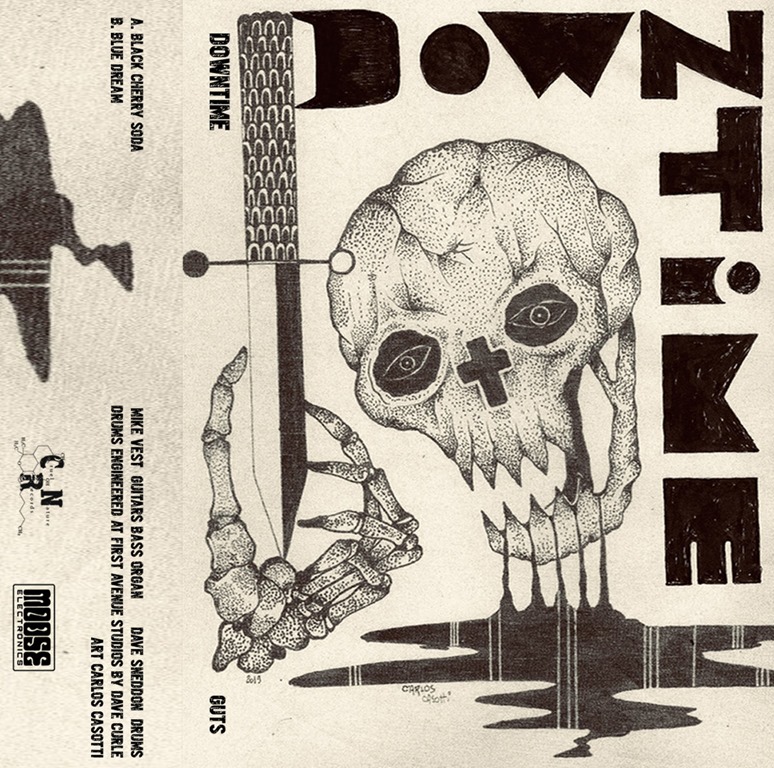
Cruel Nature Records – 26th July 2024

Christopher Nosnibor

Who’s got guts nowadays? Who even talks about guts nowadays? When I was growing up, guts was a big deal. Succeeding or achieving against adversity took guts and the papers would applaud. Now, you’ll occasionally hear of artists giving gutsy performances, but it’s rare.

But Downtime – ‘the dynamic duo of Dave Sneddon and Mike Vest’ – yeah, they’ve got guts. But then, Mike Vest clearly has restless guts, his monumental and ever-evolving CV listing Guitar Oblivions, BONG, Drunk In Hell, Blown Out, Haikai No Ku, Modoki, Depth Charms, Brain Pills, Hollow Eyes, Lush Worker, and 11Paranoias. Collaborations include Mitsuru Tabata (Acid Mothers, Boredoms), Aoki Tomoyuki (UP-Tight), Fred Laird (Earthling Society, Artifacts & Uranium). When does this guy actually sleep?

Anyway: the naming of this project is likely ironic, and Vest’s concept of downtime differs from that of the rest of the world. He calls it downtime: we call it having a night off to sleep after finally taking a piss.

On Guts, Downtime immerse themselves in long, long, guitar and rum noise workouts, exploiting textures to the max.

The album contains but two tracks, each stretching out to the twenty minute mark.

‘Black Cherry Soda’ goes deep into a psychedelic groove, but it’s dominated by layers of feedback and blistering noise. I’m reminded of Head of David’s HODICA unofficial live album, which captured the band intentionally sabotaging a showcase gig that would have landed them a record contract by playing none of the songs and instead blasting out an ear-shredding wall of noise ;aced with a slew of uncleared samples. As middle fingers to the industry go, this stands, even now, as one of the best. The track drives forward and crashes through every fence and gate standing in its way, picking up pace and volume as it careers, out of control, onwards, ever onwards, on a heartstopping collision course towards its final resting place – smouldering in wreckage having slammed headlong against a wall, feedback and howling tones still spewing forth from the calamitous chaos. But we’re still only seven minutes in… and then shir really goes off the rails in a tempest of truly shattering noise. Every minute sounds and feels like the end, and every second is pulverising. The mess of noise, underpinned by a deep, strolling bass, is a chaos of discord, but also a spectacular document of collaborative musical capability. And this sounds like the work of more than two people.

Colossal noise is an understatement, and ‘Blue Dream’ fades in where ‘Black Cherry Soda’ tapers out, on a tidal wave of feedback before locking into a hefty psychedelic groove with thumping percussion, a foot-to-the-floor bass thunder and a blistering guitar racket that’s truly tranportative.

Downtime have no such specific agenda here, but the bottom line is that that they’ve no interest in the machinations of bigger labels and are quite content to have their staunchly uncommercial noise released to a small sliver of ‘the masses’ by a label who actually cares about what they do. If you dig noisy psychedelia, you need this.

AA
a0740017337_10

Room40 – 9th August 2024

Christopher Nosnibor

Reinhold Friedl was one of the composers / musicians who provided an introduction to new musical forms to me when I started doing this ‘properly’ late in 2008. I’d done bits and bobs of reviewing in local and regional inkies in the mid- to late-nineties, but at that time, I was very much preoccupied with a fairly narrow spectrum, not that I realised at the time.

While I had got into the likes of Throbbing Gristle and Cabaret Voltaire at that point, it was while researching my PhD on William Burroughs’ cut-ups that I came to appreciate John Cage and the prepared piano, meaning that when I was introduced to the work of Reinhold Friedl, I was finally ready.

I certainly don’t want to perpetuate a sense of elitism around this kind of music or art; quite the opposite. I feel that comprehension grows from exposure, and that what’s needed is wider exposure to art which is considered niche. Anyone who has studied the avant-garde will have likely come to understand that much of what is mainstream has evolved from the avant-garde, the underground, before being repurposed, repackaged, commodified and marketed. This is the nature off the avant-garde; this is the nature of capitalism.

But like Burroughs, like Cage, Friedl has remained fringe, underground. The same is true of Gwennaëlle Roulleau, whose biographical details seem rather more obscure.

strata & spheres is a quintessentially experimental collaborative work, which brings together the elements of both contributors in equal measure, with squelchy, microtonal rivulets running through the channels which lay open between slow, ponderous chimes of almost piano notes. Surges and scrapes, like factory workings or excavations, rub against glitchery insectoid flickerings and harsh polar winds.

More often than not, albums such as this, even when released as a download, tend to feature compositions of a similar length, broadly corresponding with sides of vinyl, be it two or four. This seems to be something that many avant-gardists have ingrained in their creative psyche, a certain connection to physical formats – which is rather strange, when one considers the function of the avant-garde, and, simultaneously, the way in which physical formats are now inherently entwined with nostalgia. But strata & spheres is unevenly weighted, and conspicuously so, with ‘Papillon’ having a duration barely over five minutes after the ten-minute ‘Tectonique’, before the two ‘side two’ pieces each spanning a solid fifteen minutes.

In context, the discordant scrape, the buzzing discord, the rattle and crash of piano abuse and broken mic distortion of ‘Papillon’ feels like a mere interlude – albeit a chaotic, violent one. But then, the elongated drones and sighs of ‘Entre les vides’ and ‘Frottements’ are far from mellow; these are difficult, disjointed compositions, full of twangs and scrapes and sounds which simply set the teeth and lungs on edge, and you find yourself, on the edge of your seat, neck muscles tense. The former flits between doomy drones and hyperkinetic movements like liquid mercury rolling as if shaken around a maze.

Clattering, clanking, chiming, and slow liquid bubbling conclude the track before heavy drones and fracturing, snapping strings split apart the arrival of the woozy, droney, fragmented ‘Frottements’. Twangs and scratches pass through low hums and hovering feedback, creating a haunting, atmospheric effect.

While violence and chaos breaks out around the country, strata & spheres may be far from an exercise on calmness and blissful relaxation, but it is immersive and a work which offers a certain escape from reality and the every day. The fact that it’s sonically quite weird at times is welcome.

AA

a3688775077_10

Metropolis Records – 7th June 2024

Christopher Nosnibor

Oi, Nosnibor? Call yourself a goff? Well, yes… and no. Y’see, much as many people scoff at Andrew Eldritch insisting The Sisters of Mercy aren’t goth despite displaying so many of the trappings of goth, he does have a point, and one I’m willing to defend when it comes to my own musical preferences.

The Sisters, The Cure, Siouxsie, Bauhaus, bands I came to quite early in the formation of my musical tastes in my teens, are all largely considered exponents of ‘goth’, but were well-established long before the label existed. Tony Wilson said in an interview that there was something ‘gothic’ about Joy Division, and while they were contemporaries, and similarly dark, and – like the aforementioned acts – emerged from the post-punk scene, along with the likes of Alien Sex Fiend, The March Violets, The Danse Society, but somehow manage to avoid the goth tag. Ultimately, the whole thing was a media construct based largely on a false perception of a bunch of disparate acts who shared a fanbase. Just how much bollocks this was is evidenced by the fact the likes of All About Eve, New Model Army, and Fields of the Nephilim – again, bands who shared nothing but a fanbase, in real terms – came to be lobbed into the ‘goth’ bracket.

But then bands started to identify as ‘goth’ themselves, most likely as a way of pitching themselves in press releases, and things started to head south rapidly thereafter.

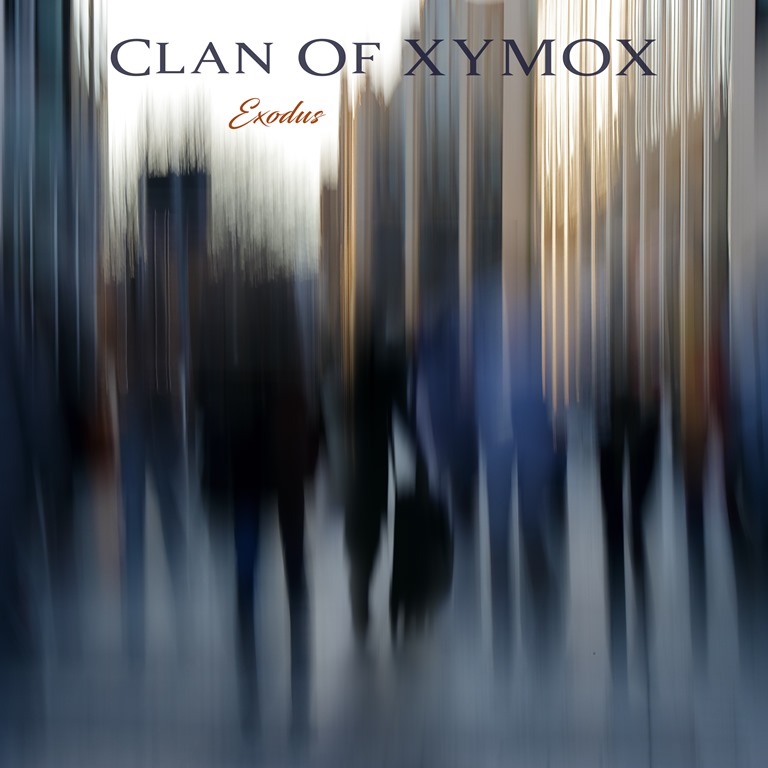
Having formed in 1981 and being signed to 4AD, home of The Cocteau Twins, and releasing their debut album in 1985 – the same year The Sisters released their seminal debut First and Last and Always – Clan of Xymox belong to the initial wave of proto-goth, in the same way X-Mal Deutschland do. Yet for some reason, they’ve bypassed me. Seventeen albums in, I’m perhaps a bit late to the party, and while I can’t claim to be fashionably late, it’s better late than never, right?

This does mean that I’m approaching Exodus with no benchmark in terms of their previous albums, and with the weight of recently-jettisoned preconceptions and prejudices. Perhaps not a strong standpoint for objectivity, but it’s worth getting these issues out of the way first.

It’s amusing to read how retrospective reviews of their debut criticised the fact it sounded cliché and dated, not least of all because of the synth sounds which dominate. What goes around comes around and vintage synths and drum machines, however tinny, fuzzy, basic, are all the rage once more, with people willing to pay crackers prices for the precise purpose of recreating those sounds.

Exodus sounds like an early-to-mid-eighties dark electro album, showcasing all of the elements of goth before it solidified, before the cliches became cliches. The drum machine programming is quintessentially mid-80s, a relentless disco stomp with a crisp snare cracking hard and high in the mix.

They slow things swiftly, with the brooding, moody ‘Fear for a World at War’ – a timely reflection on the state of humanity – landing as the second track. It’s moving, haunting, but drags the pace and mood down fast, samples and twinkling synths hovering and scrapping over a hesitant beat and reflective vocals.

‘The Afterglow’ combines chilly synths and fractal guitar chimes to forge a cinematic song. It’s unquestionably anthemic, and has the big feel of an album closer. Where can they possibly go from here? Well, by pressing on with more of the same… Much of Exodus is reflective, darkly dreamy, vaguely shoegazy, very Cocteau Twins – at least sonically, being altogether less whimsical in content. It’s undeniably a solid album, and one steeped in the kind of sadness and melancholy that’s quintessential brooding gothness. ‘X-Odus’ hits a driving techno goth sound that borders on industrial, but equally owes as much to The Sisterhood’s Gift, which is really the point at which ‘goth’ intersected with dark disco.

Eighteen albums in Exodus sounds predominantly like the work of a contemporary dreamwave / goth act plundering the old-school with some heavy dashes of late eighties Cure, and while many fans will be hard into it, to my ears, it’s good – really good – but much of its appeal is nostalgia and familiarity, and objectively, it’s just a shade predictable and template.

AA

064556

33.3 – 24th July 2024

Christopher Nosnibor

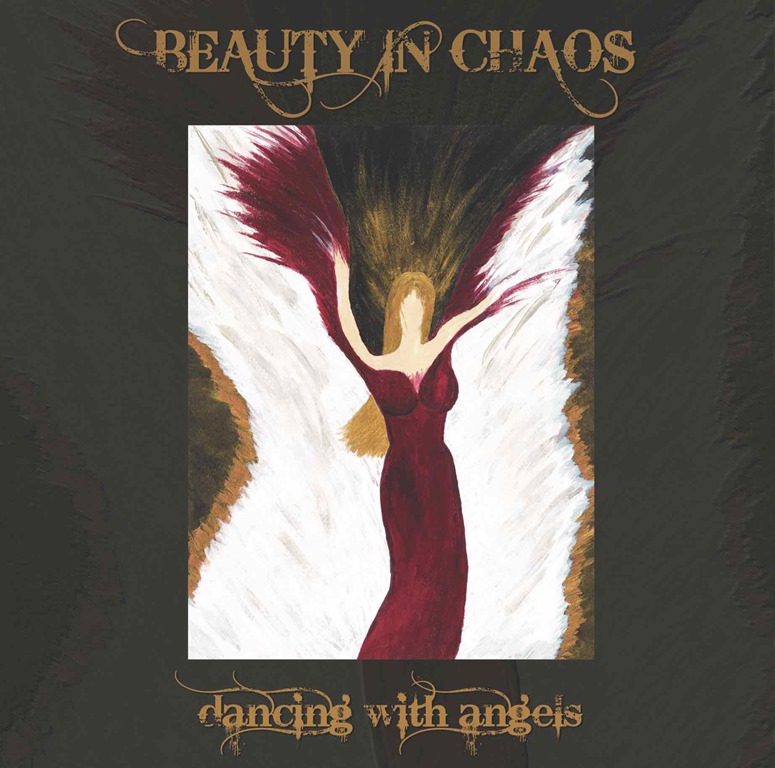
Since their inception and debut album Finding Beauty in Chaos in 2018, the project helmed by Human Drama and Gene Loves Jezebel guitarist Michael Ciravolo has presented a staggering array of collaborators and contributors. Not so much a band as an open music collective, they return with Dancing With Angels, which promises appearances by ‘luminaries from The Mission, The Bellwether Syndicate, Holy Wars, Kommunity FK, The Awakening & Strangelove.’ Indeed, Wayne Hussey has been a regular contributor, and he, and wife, Cynthia return this time around to appear on the dreamy, Cure-esque single cut ‘Diving for Pearls’, with chiming guitars and bulbous bass sound reminiscent of ‘Pictures of You’.

Each of the album’s eight atmospheric gothy post-punk hued songs features a different vocalist or vocalists, with duties shared by William Faith and Sarah Rose Faith of The Bellwether Syndicate on opener ‘Present Tense’, a cut that harks back to the sound of the alternative scene circa 1986, when The Mission were taking their first steps and Gene Loves Jezebel were at their commercial peak. Given Ciravolo’s other work, this isn’t entirely surprising – but what is welcome, and impressive, is the extent to which the sonic blueprint is expanded to incorporate a broad range of styles, stretching out to the shimmery shoegaze dream pop of ‘The Devil You Know’ at one end of the spectrum, and the brooding anthem that is ‘Echoes and the Angels’ via the crackling guitar-driven indie of ‘Kiss Me (Goodbye)’.

With its rippling piano and swooning vocals, courtesy of Cynthia Isabella of Lost Gems (and formerly of Silence in the Snow’, ‘Hollow’ is delicate and emotive, while ‘Holy Ground’ brings soaring lead guitars to a solid rockin’ tune. It may be because it’s sandwiched between ‘Hollow’ and the slow-burning closer, ‘Made of Rain’ (featuring Ashton Nyte making a fifth appearance with Beauty in Chaos), but it feels like the weakest of the songs here.

Whether or not Ciravolo wrote the songs with the singers in mind, or if they evolved around them once they were on board, the fact each guest brought their own lyrics means they feel like they’re in their natural environment, and each songs sounds like it belongs to them. The end result has something of a mixtape feel to it, while retaining that essential coherence.

Nevermore has the project’s moniker felt more apposite: conjured from a whirlwind, an effervescent creative froth of a diverse range of creative minds, Dancing With Angels stands as testament to the power of collaboration.

AA

551286

25th July 2024

Christopher Nosnibor

The art world is not so much a desert as a breakers’ yard, stacked to the sky with abandoned and aborted projects, works which were commissioned and shelved or otherwise dropped, canned, kicked into touch. The endless hours spent on projects which have never seen the light of day hardly bear thinking about. A career in the arts is likely to be one dominated by failure over success, even for a successful creator. But what is success? Artistic success and commercial success exist in different spheres, and while the world at large seems to judge more or less anything by the measures of the latter, one should ask why this us. Units shifted, radio plays, streams on Spotify, these are the metrics of success, based on the monetisation of art. Something is simply not right.

Ian Williams’ latest release is a product of failure. Le Mystère Lucie (Dossier Secret) (that’s Codename Lucy (Spies Against Nazism)’, a companion piece to the recently-released Le Mystère Lucie (Des Espions Contre Le Nazisme), his recent soundtrack album of music for the 2023 French documentary Le Mystère Lucie (Des Espions Contre Le Nazisme) / Codename Lucy (Spies Against Nazism).

As the accompanying blurb expounds, ‘it features music composed for but ultimately not used in the documentary, which was originally conceived as a 75 minute film but eventually released as a 52 minute TV broadcast. It seemed a pity not to make these additional themes and sketches available, so here they are, another collection of World War II spy music – melodic, electronic, orchestral, tuneful, abrasive, with both releases showcasing Williams’ knack of fusing big tunes with occasional blasts of industrial noise.’

Grand, bold, epic, expansive… these adjectives give a hint of the cinematic compositions n offer here. Being designed as a soundtrack, the album’s seventeen compositions are brief – largely under three minutes – and gentle, employing smooth synth bass and conjuring an atmosphere which is accessible to the ear. The tracks blur into one another with great rapidity, as one would expect for a soundtrack, where the segments flow with the scenes.

Le Mystère Lucie (Dossier Secret) is rich in mood and atmosphere, as befits its subject. There’s not much industrial noise present here but string-soaked cinematic sweep abound. Le Mystère Lucie (Dossier Secret) feels filmic, it builds drama and layers of simmering tension, as well as lakes of brooding darkness and ripples of uneasiness. It’s an accomplished score, and one which most certainly was too good to go to waste.

AA

a2382814546_10

1st May 2024

Christopher Nosnibor

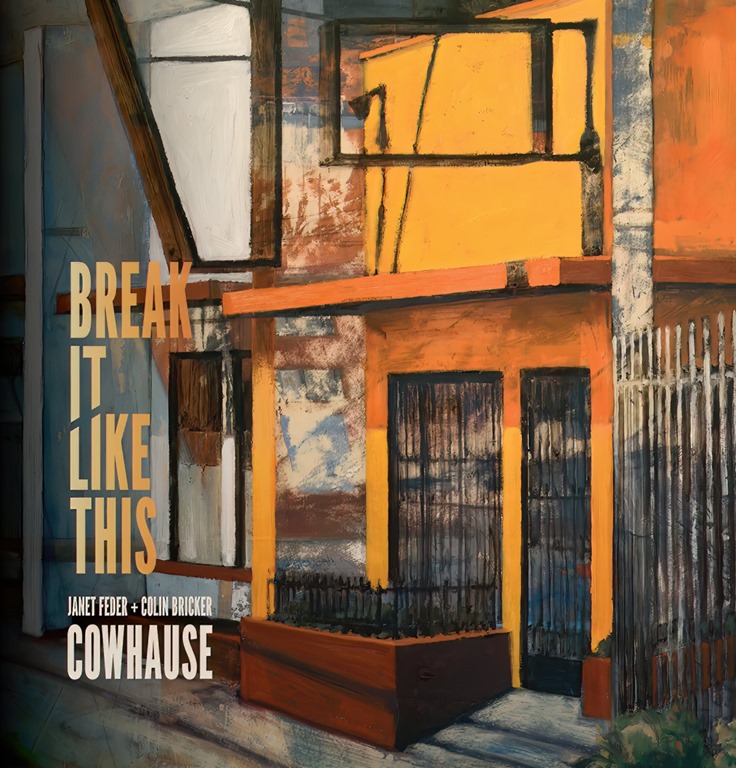
Once again, I’m late on this one, but also, once again, not nearly as late as the artist. This album has been a long, long, long time in coming. And that’s an understatement. As the bio details, ‘Janet Feder plays mostly baritone guitars and analogue, hand-made sounds; Colin Bricker (aka Brokerclinic) is an electronic musician and record producer known for his cutting-edge computer music, characterized by beautiful, twisted, broken soundscapes and skittering rhythms. This is their first new album in 19 years.’

19 years! Consider that for a moment. Almost two decades: there will be people who have been born, gone through school, got married and have started families of their own in this time. After such a protracted time out, it feels perhaps likes less of a return and more like starting afresh. Not that Janet has been creatively dormant during this time by any stretch (I recently covered the reissue of See It Alone by Sorry For Laughing, on which she features, and there have been numerous other releases in recent years, but collaborating with different people inspires different approaches and Break it Like This sounds and feels fresh, inspired and invigorated.

Break it Like This is brimming with ideas and range. The first composition, the appropriately-titled ‘Opening’ introduces the album’s manifold varied elements – scratchy guitar scraped and manipulated more often than picked or strummed intersect with extraneous noise and stuttering electronic beats. The volume see-saws and things suddenly break down at the most unexpected moments, disrupting any emerging flow.

Then again, there are some folksy runs of picked notes, and some heavily treated vocals, as on ‘Angles & Exits’, a crackling collision of disparate elements. Gentle guitar and clattering percussion joust it out as if two songs are overlaid in a sonic palimpsest, and what could be a beautiful pastoral tune is rendered as wreckage.

There are tangles of notes and serpentine rhythms which clamour, clatter, and crack from every whichway, and the mix is such that details spring from left and right, from the back of the room, from above your head and around your ankles, adding to the extreme disorientation of jarring pieces like ‘Blue State’. There are so many hints of songs and melodies which exist in a potential state; there are moments where something threatens to take shape, but simply never emerges. ‘Plan to Live’ offers haunting echoes of something atmospheric, splintered by rapid-fire beats which seem completely at odds with it. ‘Banjo’ reconfigures hillbilly wanderings into a postmodern, post-apocalyptic, post-everything soundscape which evokes visions of broken down cars and broken down society, a fatigued scraping out of making music after there’s nothing left but desolation, the notes ringing out into ruins and rubble, a theme which continues through the desolate flamenco-tinged ‘Heater’, before it swings into a psychopathic dance groove. It feels like the soundtrack to a bleak, Ballardian tale set amongst drifting sands, rusting vehicles, and dilapidated buildings, while the only survivors are the deranged.

A deep-running sense of ‘otherness’ runs through Break it Like This. Familiar elements, twisted and misshapen to a point that they no longer feel so familiar, and instead take on a more curious and uncomfortable form, abound. So many moments feel so close, and yet so far, in their proximity to the things we know and are comfortable with. But twisted, distorted, mangled, they take on more sinister forms, shadowy, strange.

Break it Like This is testing, nudging at the senses, piling up the discord and the irregularities of the structures and stoking a sense of bewilderment. This is experimentalism and collaboration at its best, excavating new terrain and forging something unexpected and challenging – while retaining a musicality which keeps it within the realms of listenability.

AA

a0587584873_10

Drek Skivor – 5th July 2024

Christopher Nosnibor

It’s been a little over a year since we last heard from Fern. Previous release, Deformed, was, as I put it, ‘appropriately titled’ and ‘some mangled shit.’ Such is Fern’s approach to music-making, it would seem, seeing damage as potential, an opening, a possibility. It may be a perverse pleasure, but it can be a pleasure nonetheless, to hark at the sound of breakage and malfunction. Perhaps because it’s noise which possesses an honesty that’s rare in so many musical recordings, where the more common ambition is to create the best, most polished, or otherwise superior version of something, be it a song in the conventional sense, or a live recording of something perhaps less conventional. It’s a rational and valid objective, but the reason I suggest that the sound of something broken is honest is because it feels rather truer to life’s lived experience.

How many obstacles must one surmount to achieve that polished definitive version? Moreover, how many obstacles must one surmount to simply get through the days? Life has a habit of throwing shit at you. Just when you think you’re having a good day, an ok week, something breaks – and it nearly always costs money. Your laptop dies, your phone screen cracks or your charger cable breaks. The shower starts leaking or there’s a power cut. Some days – and weeks, and months – it simply feels like everything is against you. Something goes awry at every turn. Life, then, is imperfect, an endless succession of glitches and breakages, against a backdrop of noise and distortion and shouting and frustration and confusion and just a whole load of shit in general.

I arrive at Error having recently had a couple of posts removed by Facebook having been flagged by their bots as ‘spam’ due to my attempts to artificially gain likes by tagging people. Those people specifically being the Aural Aggravation page, the band, and their PR and / or label. Somehow, this is spammier than sponsored links to shit I have no interest in that repeatedly crop up every time I return to the site and spammier than the relentless porn links and so on posted in groups. And so I arrive at Errors frustrated, antagonised, feeling that systems are against me, and feeling – in some way – persecuted, as if this is some deliberate obstruction to my efforts to promote obscure music. Music like this.

‘Is this music the result of a degaussing error? Or is it a long gone and forgotten tape shaped and distorted by time and a chewing cassette deck, still here for us to experience……’ This is the way the release is famed on Bandcamp. And I find that Errors isn’t as messed up as all that. It’s not exactly easy listening, but…

The first track, ‘slip ‘n’ slide’ is a fairly standard work of glitchy minimal electronica: a bit dark, a bit stark, bit trip-hop. ‘abrupt morning’ hums and crackles, and something about the production renders everything muffled, distant, in the way The Cure’s Seventeen Seconds feels simultaneously claustrophobic and distant. It is not a comfortable sensation. It is a work of sonic wizardry, to create a sound which stands at such polarity.

‘mellow dream’ is a more conventional ambient work, a buffeting sonic cloud carried by the wind, although there are some less mellow moments where darkness enters the equation and unsettling undercurrents rumble disquietingly.

‘ignite interlude’ goes all-out on deep bass hip-hop, but sounds like listening to a Wu-Tang side-project from the pavement as it plays from a car pulled up at traffic lights with the windows up, before ‘c’mon intro’ hits a slamming industrial dance seam – but again, it sounds as if it’s bleeding through the wall from next door. The album takes a solid turn towards the dancefloor in its second half, although the insistently percussive ‘bits and pieces’ is more reminiscent of Throbbing Gristle. ‘generative form’ feels like something of a collapse into a formlessness defined only by a looping repetition, emanating a kind of fatigue that paves the way for the suffocating collage of loops and electronica of ‘lambs’ – where they sound as if they’re being tortured and strangled. It’s a scrambled melange of sounds collaged from wherever, which brings the album to a suitably dark and unsettling conclusion.

I’m not quite sure what I’ve heard here, or whether I like it or not, but that, I feel, is the desired effect – and it’s certainly a desirable one.

a2358833930_16

The Helen Scarsdale Agency – 14th June 2024

Christopher Nosnibor

For some time now, The Helen Scarsdale Agency has homed some quite challenging experimental noise and industrial-orientated releases. It seems somewhat incongruous, the name suggesting they’re a stuffy literary agency or something.

The notes which accompany this latest offering from Ekin Fil are instructive and informative, in terms of expectation and context, and as such, worth reproducing here:

‘The drone-pop consternations of Ekin Fil emerge through vaporous tone and forlorn, distant song, as if plucked from a dream. These exist on their own accord, moving with their own internal logic of an emotion heaviness that belies any the passing observation of this as mere shoegazing ambience. Her songs, her compositions find themselves adjacent the fragmented etherealization of Elisabeth Fraser’s voice from a forgotten scene of a particular David Lynch film, as a ASMR trigger for Proustian recollection. Something profound. Something hidden. Something desolately sad.’

Do I want to feel something sad? This is a question I asked myself in all seriousness. Everyone has felt deep, desolate, profound sadness at some point, to varying depths and degrees, and while wading through the mires of a recent bereavement I find I can be set off easily and unexpectedly. But sadness is necessary, and is sometimes something to be embraced. To embrace sadness is not the same as to wallow, and to face sadness squarely is to accept its presence, and perhaps begin to make peace with it. And only in making peace with it is it possible to begin to move on.

The album’s first piece, ‘Sonuna Kadar’ is a billowing cloud of thick ambience, suffocating, disorientating. Occasional chimes do little to light the way, and the vocals drift, lost, lonely through this tentative space. Things grow darker still with ‘Stone Cold’: long noes echo out like sirens, and soft, fizzy-edged notes ripple before being absorbed by cruising waves of thick, heavy sound. The organ is almost without question the heaviest of sounds, a droning, wheezing sound that has the capacity to be uplifting, but, more often than not, is slow a d mouthful. It’s a synthesized organ drone with slowly throbs away on ‘Reflection’, too lugubrious, soporific effect.

Vocals echo as if reverberating in caverns, cathedrals, while the instrumentation is abstract, its direction unfathomable. ‘Sleepwalkers (Version 2)’ is heavy with atmosphere, and the experience is haunting.

The absence of percussion or structure renders these pieces formless, rootless, shapeless, and consequently they hang like heavy cloaks which drag the head down to the ground, and, staring at your feet you contemplate the weight of the world.

Sleepwalkers is one of those albums which seems to build in effect cumulatively over its duration, and wile it’s not overtly heavy with, say, distortion or volume, it brings a weight that drags you down, and the final composition, the ten-minute ‘Gone Gone’ pulls the shoulders down.

Listening to Sleepwalkers doesn’t fill me with sadness, as much as a sense of unease. It does unquestionably bring a sense of weight, but on listening I feel a sense of uneasiness and uncertainty more than anything. But music presents much of what you pitch in and bring to it. With Sleepwalkers, Ekin Fill presents music with open doors. What will you bring?

AA

a0105911352_10

Regenerative Productions – 7th June 2024

Christopher Nosnibor

The last couple of years – and 2024 in particular – has seen a huge upturn in acta reconvening after lengthy breaks. Anticipation for the Autumn drop of the first album from the Jesus Lizard in over two decades is immense, but then only this week I wrote – extremely favourably – on the new album by The March Violets, released eleven years on from its predecessor, and From Fire I Save The Flame by Three Second Kiss – twelve years down the line from their last album. They all have their reasons for pausing, and for the timing being now, but as much as its perhaps coincidental, it makes for exciting times for fans who had little to no expectation of ever hearing new material. And what’s more, and perhaps most remarkable, is that these albums have been proving to be GOOD – not some damp squib, reheated soufflé reunions which sully their catalogues and make you wish they hadn’t bothered (in the way Bauhaus’ Go Away White was such a monumental let-down).

And so here we have Norwegian death-metal outfit Okular with their first full-length release in eleven years since their 2013 second album Sexforce.

I will confess to being unfamiliar with their previous work, which means I’m unqualified to comment on how the aptly-titled Regenerate stands in comparison. But I do feel able to consider Regenerate on its own merits.

Blasting in with ‘Back to Myself and Beyond’ the sound is dirty, murky, dingy as fuck, snarling, gnarled vocals spewing venom and gargled gasoline over churning guitars, from which emerge the occasional squealy note before flicking into a quickly-woven blanket or fretwork wizardry. Underneath it all, the bass and drums thump and thud away at a hundred miles an hour, muffled, muddy, and manic.

The two-and-a-half-minute title track follows this five-minute titan, and it’s a fast-and-furious fretfest, on which the vocals switch between menacing growl, strangled rasp, and raw deep-throated demonic howl.

All of the requisite tropes are in place: a hefty percussive barrage and super-fast fingerwork provide the backdrop to ugly, bowels-of-hell vocals, with some rapid drops and sudden breakdowns, and when it comes to genres, missing these elements is case for disappointment. That said, there is still scope for invention, and ‘A New Path’ brings what its title proffers, opening with a soft acoustic almost country-tinged grunge intro, before doom-laden power chords crash in, an unstoppable chuggernaut – and the two elements play off one another to forge a really interesting dynamic.

The album’s shortest track, ‘Debauchery’ surprises again, with another almost folky acoustic flavour to start, before simmering up to a boil to deliver what it promises in the shape of some spectacular soloing, preceding the album’s longest track, the six-and-a-half-minute epic what is ‘Another Dimension of Mind’. It’s a delicate, lilting, layered acoustic segment – which is really quite technical and borders on a blend of folk and neoclassical – which plays out on the album’s closer, ‘Elevate’, and it’s really quite nice. Of course, everything blasts in at double the standard intensity for the final minute, and it’s positively incendiary, a ground-scorching flame-thrower assault that hits like a tsunami before an abrupt and unexpected end.

Regenerate is a smart album. By its nature, technical prowess and musicianship is portrayed almost extravagantly, but, as is the law, it’s contrasted with the dirtiest, hardest, fastest riffs. But Regenerate offers so much more – more texture, more stylistic diversity, more range, a really ambitious approach to songwriting that goes beyond the confines of genre.

AA

a2807309953_10

Metropolis Records – 19th July 2024

Christopher Nosnibor

Metropolis Records – 19th July 2024

Cut back to not so long ago – in real terms – and the prospect of a new album from The March Violets was simply not something you’d imagine. 1987/88: The Sisters of Mercy had broken through in a major (label) way with ‘This Corrosion’ and Floodland; The Mission’s ‘Tower of Strength’ almost reached the UK Top 10 before Children scaled the heights of number two in the album charts, and this was the commercial heyday of goth… and one-time peers, The March Violets were a footnote in the genre’s history, having gone pop and signed to a major, only to go nowhere far and call it a day. They were fondly remembered by those who did, and compilation The Botanic Verses documented their body of work in the early 90s, but… Rosie was busy doing poetry and the like and Si was hiding behind smog as Nurse to Dr Avalanche as part of The Sisters of Mercy’s touring crew.

Then, in 2007, twenty years after they vanished, the band reconvened for a show in Leeds at what was then still the Met. It was a glorious celebration, not only of The Violets and their career, but also the heritage of the Leeds scene, with The Chris Reed Unit representing one of the city’s most singular and longstanding acts, and Merciful Release stalwart James Ray presenting thee magnificently eccentric ambient dance grooves of 25 Men.

Health issues stalled things for a while, but miraculously, 2013 saw the eventual release of Made Glorious – which was in fact their debut album, since the three previous long-players had all been compilations (I’m including the US-only Electric Shades among these). And now, after further setbacks – notably Denbeigh’s departure from the band following a stroke, but also some not insignificant touring under their belts – they deliver album number two, Crocodile Promises a mere eleven years later.

No-one could, or should, expect a band who’ve been going for so long and undergone so many changes – both personnel and personal – to sound exactly the same as they did when they started out. And nor should anyone want a band to exist in a state of suspension or arrested development. Here’s where The March Violets are a rare thing: a band which has evolved, expanded, grown, but equally has never lost sight of their roots. As their Bandcamp bio summarises it neatly, ‘Original Post Punk Drum Machine Band From Leeds. Started at the Beginning, Imploded, Reborn for the 21st Century. Play Loud Play Purple.’ Yes, they’ve even retained their original slogan. And it still works, too.

Whereas Made Glorious was a sprawling beast of a release, comprising sixteen tracks – a double album, effectively, Crocodile Promises is a taut, succinct nine-song document.

Single release ‘Hammer the Last Nail’ kicks the album off in classic style with a snaking drum-machine groove and twangy gothy guitar interweaving behind Rosie’s sultry, vampy vocals.

Where Made Glorious felt a tad slick, Crocodile Promises returns to the pumping, gritty sound that made the band one of the greatest first-generation post-punk acts. ‘Bite the Hand’ is a tangle of metallic, trebly, chorus-hazed guitar against a thrumming bassline and pumping mechanised drum machine, and it’s got the hunger and edge they displayed back in ’83. It’s likely a coincidence that the title is a phrase which featured in a quote from Andrew Eldritch when commenting on the Violets’ departure from Merciful Release… right?

‘Virgin Sheep’ maintains the angular energy, and once again recaptures blistering force of their first iteration, calling to mind the frenzy of ‘Radiant Boys’. ‘Mortality’, the title track from the album-in-progress which was shelved on account of Denbeigh’s stroke is another classic Violets cut, and what becomes apparent while listening to Crocodile Promises is that feels natural, comfortable, not a struggling, forced effort to recreate the past. Of course, the timing is beneficial: the next generation of new music-makers are discovering grunge, post-punk, shoegaze, and goth, and suddenly, the bands who were the progenitors of these styles are finding new audiences, and instead of sounding dates, the styles feel fresh once more.

Of course, great songs are timeless, and great songs are a feature of Crocodile Promises. ‘Crocodile Teeth’ is perhaps more fractal dream pop than goth or post-punk, but it’s got that late-80s Siouxsie vibe that gives the dreaminess a serrated edge. Its inclusion brings balance and space to the album, too.

It would be wrong to say that The March Violets are quite the same band they were without Denbeigh’s snarling interjections, but it would equally be a mistake to criticise the current iteration on account of this. The March Violets are survivors – and a great band. Ever-present co-founder Tom Ashton continues to prove pivotal in defining their sound, and, equally, their attitude. As much as they were a part of that early 80s Leeds milieu, The Violets stood apart, and that slightly wonky, sharp-edged, skewed guitar was, and remains, integral. And moreover, Crocodile Promises is a great album. Its strength lies not only in its consistency, but also its energy and its atmosphere, both of which it brings in abundance. But best of all, this is a true return to form. There isn’t a dud cut here, and every song is up there with the singles up to ’86. It’s incredible that a band at this stage in their career could drop a definitive album – but that’s exactly what The March Violets have done.

a2052340793_10