Posts Tagged ‘Album Review’

Roman Numeral / Machine Tribe Recordings – 24th January 2025

Christopher Nosnibor

Having premiered ‘Opilione’ just over a week ago as a taster for this blackest of black sonic expulsions, I’ve now had some time to digest the album in its entirety. And it’s an acrid, acidic tang of bile which burns the throat and scorches the trachea, and a bilious discomfort which emanates from every noxious moment of this absolutely hellish effort.

The Finnish duo’s Bandcamp simply describes them as ‘BLACK VOID NOISE’, and it’s hard to better that, really. Black Abyss Invocation, which essentially launches Vomitriste phase two, having drawn the curtain on phase one with the Droneworks (2022-2024) compilation.

Black Abyss Invocation is relentlessly dark. In fact, it goes beyond being merely ‘dark’: darkness connotes an absence of light. Here, Vomitriste create a negative balance, subtracting, subtracting, endlessly subtracting, sucking out both light and air, like a black hole which drags the listener into a vortex of perpetual purgatory, while hanging over the smouldering pits of hell.

‘Opilione’ is entirely representative: each of the album’s six compositions last between five and eight minutes, providing ample time for the agonizing atmospherics to wrack every one of the senses in the most torturous fashion, and seeming to manifest in physical ways as you find your skin crawling and your muscles tense.

The album opens with ‘Void Sermon’ – a rumbling blanket of sound that’s between dark ambience and harsh noise wall at first, before vocals – rasping, demonic screams, shit-your-pants inhuman – roar in before the very bowels of hell open wide and drag you down, down, down. Void Sermon? Void bowels would be equally apt.

From here, it’s less about progression, as slow subtraction. Listening to Black Abyss Invocation, I find myself reflecting on various methods of punishment and torture from throughout the ages – rat torture, for instance, or coffin torture, or the breaking wheel. The slow, agonising tortures which almost invariably resulted in a protracted and extremely painful death. Or perhaps, one I discovered on a visit to York dungeons, the ‘blood eagle’, referenced in Norse literature. Certainly, by the arrival of ‘Fleshwards’, on feels as if one’s ribs are being severed from the spine with a sharp tool, and the lungs pulled through the opening to create a pair of “wings” – because this is brutal, cacophonous noise and howls of anguish echo from subterranean caverns without mercy. To survive to the end of the album is to still be awake and alive in the hell that is life on earth in 2025.

Black Abyss Invocation is truly the stuff of nightmares: there is no escape from the abyss, and there is none more black.

AA
a3185354594_10

Room40 – 31st January 2024

Christopher Nosnibor

It begins with a rumbling roar, like a persistent strong wind rushing over moorland, before ripples of piano delicately drift over it to altogether calmer effect – although the roar continues beneath. The juxtaposition brings a balance of sorts.

Just a few days ago, I wrote on Circuits From Soft Frequencies by Jamie Lee, which was recorded among the sound mirrors at RAF Denge, in Kent, and touched on the fascinating nature of these structures, and opined that ‘often, the most alien and seemingly otherworldly creations are, in fact, man-made’.

Lawrence English’s latest work seems to contribute to this dialogue, albeit approaching from a different perspective.

‘I like to think that sound haunts architecture,’ he writes, and goes on to remark, ‘It’s one of the truly magical interactions afforded by sound’s immateriality. It’s also something that has captivated us from the earliest times. It’s not difficult to imagine the exhilaration of our early ancestors calling to one another in the dark cathedral like caves which held wonder, and security, for them.’

English also writes of the relationship between space and place, and how ‘Spaces hold the opportunity for place, which we create moment to moment, shaped by our ways of sense-making… Whilst the architectural and material features of space might remain somewhat constant, the people, objects, atmospheres, and encounters that fill them are forever collapsing into memory.’

The album comprises eight numbered segments, ETHKIB I – VIII, all formed using fundamentally the same sound palette, and which flow into one another seamlessly to create a single, continuous piece, which is best experienced without interruption.

The piano and the undercurrents, which evolve from that initial roar to altogether softer drones which drift, mist-like, develop an interplay whereby the dominant sound switches, sometimes with one or the other fading out completely – but this happens almost imperceptibly… It isn’t that you don’t listen to the music, but the preoccupation of the listening experience is absorbing the atmosphere, and it possesses almost a physicality. By ‘ETHKIB V’ the sounds has built such a density that the sensation is like being buffeted. Amidst the deep drones, there are, in the distant, whirring hums and elongated scrapes which evoke images of disused mills and abandoned factories. Perhaps there’s an element of the power of suggestion, but it’s difficult to contemplate purely abstract visualisations, or nature without some human aspect somewhere in the frame.

The soundscapes English creates are evocative, and in parts, at least, haunting – although ultimately, what haunts us is our own experience, our thoughts, our memories. And in this way, from space, we create our own sense of place, and tie things to them in an attempt to make sense of the world as we experience it.

By ‘ETHKIB VIII’, it’s the piano alone which rings out, in a reversal of the opening, and some of the mid-sections, ending on a single, low note, repeated, held, reverberating, leaving, ultimately silence, and a pause for reflection.

AA

RM4245 front

Electric Valley Records – 31st January 2025

Christopher Nosnibor

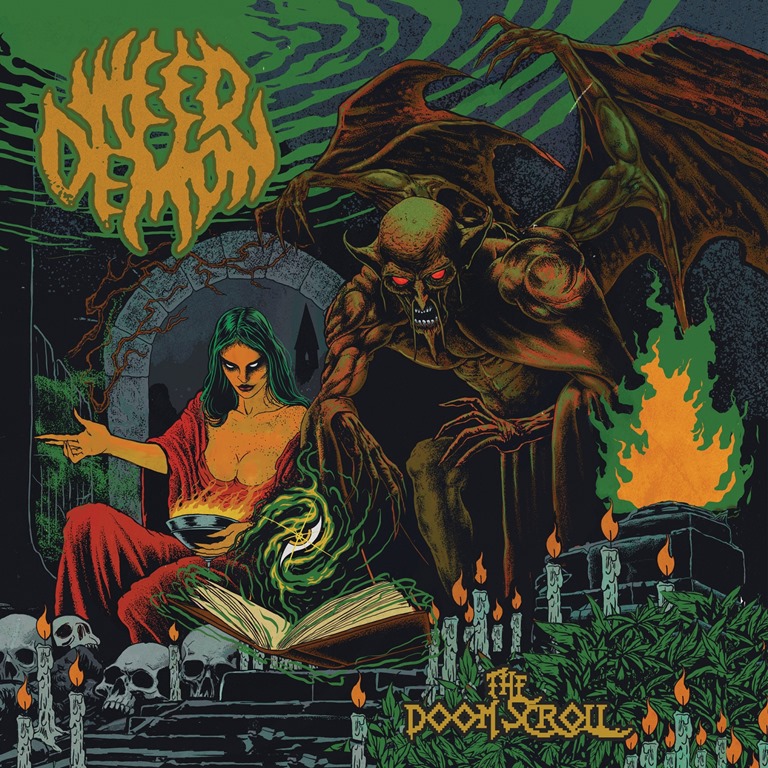
The four-piece ‘sludge ‘n’ roll stoner metal band’ from Columbus, OH, come with the description of being ‘the audio equivalent of bong water spilled on a Ouija board’

The Doom Scroll – such an obvious but well-placed piece of punning – is their third album, and lands a full decade after their debut EP – or as they put it, they ‘exhaled a cloud of riffs over the doom metal scene with their debut EP, Stoned to Death… [and] since then, they’ve consistently delivered a steady dose of sludgy, groove-laden stoner doom potent enough to make Beelzebub himself bang his horns.’

For this outing, they promise ‘a reinvention of their signature sludge ‘n’ roll style of doom. Equal parts unrelenting and crushing, yet infused with heavy blues-inspired riffage, this new chapter sees Weed Demon expanding their sonic horizons like never before… Expect doom, gloom, sludge, thrash, death, blues, and even a dash of dungeon synth for good measure.’

That this is an album which contains just five tracks (six if you get the vinyl, which features a cover of Frank Zappa’s ‘Willy the Pimp’) is a fair indication of its form and the duration of said tracks: apart from a couple of interlude-pieces, they’re all six-plus minute sprawlers, with the colossal ‘Coma Dose’ spreading out over more than nine and a half minutes.

And so it is that after the slightly pretentious and proggy-sounding synth-led instrumental intro that is the woozy, wibbly, ‘Acid Dungeon’, they’re thundering in with the rifftastic ‘Tower of Smoke’. It’s a quintessential stoner-doom effort, a mid-paced slab of thick, distorted riffage with a strong Sabbath via Melvins vibe to it. It’s big on excess – of course it is. It simply wouldn’t work without the widdly flourishes that spin their way up from the dense, grainy overdrive that just keeps on ploughing away. And it keeps going on – and on. As it should, of course. It simply wouldn’t be befitting to batter a leaden riff for three or four minutes – you can’t mong out to that.

‘Coma Dose’ starts out gently with some desert rock twangs and a shuffling beat that’s almost a dance on the beach kind of groove, and there are – finally – some drawling vocals low in the mix. A couple of minutes in, of course, the riff lands, and the vocals switch from spacey prog to growly metal, and just like that, things get dark and they get heavy. But for all the weight, there’s still a floaty trippiness about it, a softer, mellowed-out edge: it’s heavy, but it’s not harsh, or by any means aggressive. There are some flamboyant drum fills and a super-gritty bass break over the song’s protracted duration, and at times, it sounds as if the batteries are starting to run low as it slows to a thick, treacly crawl and Jordan Holland’s vocals sound as if he’s being garrotted – and again, this is all on point.

There are elements of hardcore to the shouted vocals and pummelling power of ‘Roasting the Sacred Bones’, while ‘Dead Planet Blues’ brings a quite delicate blues-rock twist and even a hint of Alice in Chains circa Jar of Flies.

Rather than push hard at the parameters of the genre, Weed Demon nudge at the edges in all directions, and this works in their favour. There’s plenty here to keep diehard fans of all things sludgy, stonery, and doomy content without straying into territories that don’t sit well, but then there’s enough to make it different and interesting.

AA

349891

24th January 2025

Christopher Nosnibor

These are dark days. I feel as if I’ve written words to this effect a lot in recent months and years. It would perhaps be rather too much to expect there to be the sunrise of a new, optimistic dawn breaking over the horizon, but when there is nothing but the glow of flames beneath a pall of smoke on so many very real horizons, any sun on the metaphorical horizon is eclipsed by a billowing pother and clouds of ash. And then, last night, I felt my heart sink yet deeper still as Donald Trump signed away the protection of the Arctic in his quest for ‘liquid gold’, and declared a ‘state of emergency’ over the Mexican border and promised mass-deportations – ‘millions and millions’, being his megalomaniacal mantra, while the man who owns him, the richest man on the planet, who seeks not only world domination, but galactic domination, threw Nazi salutes to a huge crowd of fanatics.

Fighting the urge to assume a foetal position on the hearth rug in front of the fire and stay there for the next four years in the hope there may still be a world after that, I poured a strong winter ale and took some time to sift through my submissions for something that might make suitable listening.

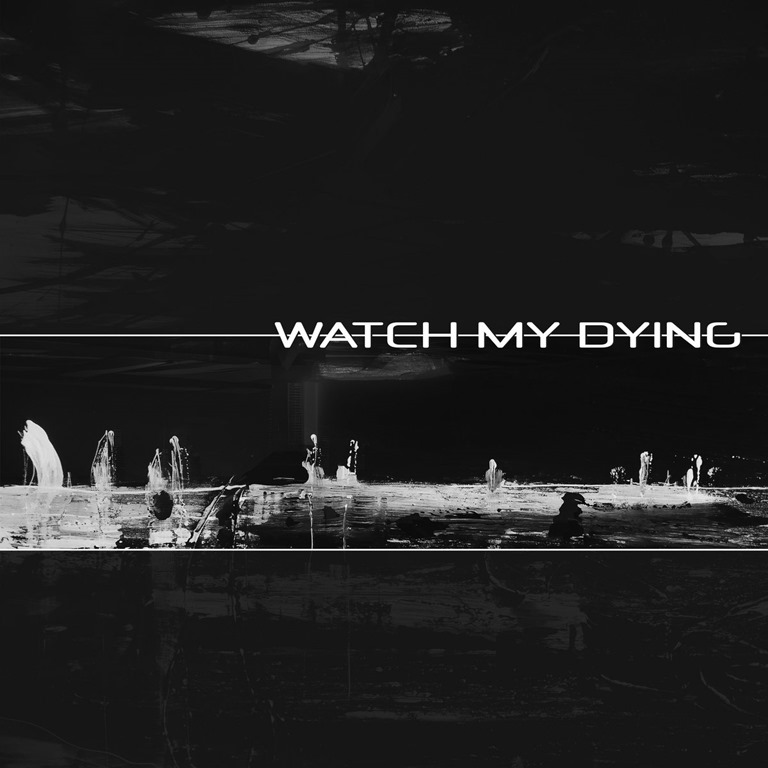
Listening to light music in the face of such darkness and despondency feels inappropriate, somehow, so stumbling upon the latest album by Watch My Dying felt fortuitous. Extreme metal has a way of providing a means of escape, sometimes.

According to their bio, ‘Watch My Dying has been a cornerstone of the Hungarian metal scene for 25 years, a hidden gem for international fans of extreme metal. Formed in 1999 in Hungary, the band quickly became a defining force in extreme tech/groove metal throughout the early 2000s… Known for their philosophical and socio-critical Hungarian lyrics, WMD stands out in the extreme metal genre, with excerpts of their work inspiring novels and poetry in Hungary.’

It’s the title track which opens the album, with a slow, atmospheric build, before heavy, trudging guitars enter the fray, and it’s only in final throes that all fury breaks loose.

While there’s no shortage of archetypally death- and black-metal riffs, WMD forge a claustrophobic atmosphere with chunky, chugging segments, enriched by layers of cold, misty synths, and some thick, nu-metal slabs of overdrive, too: ‘Kopogtatni egy tükrön’ is exemplary. ‘Jobb nap úgysem lehet’ provides an interlude of heavy drone and hypnotic tribal drumming before one of the album’s most accessible tracks, ‘Napköszörű’ crashes in. It’s hardly a party banger, but brings together industrial and metal with a certain theatricality, finished with some impressively technical details – but none of it’s overdone. ‘Minden rendben’ is more aggrotech than anything specifically metal, and it’s a banger.

Egyenes Kerőlő isn’t nearly as dark as a whole as the first few songs suggest, but it’s still plenty heavy and leads the listener on something of a sonic journey. They cram a lot into the eleven tracks, especially when considering that the majority are under four minutes, with three clocking in around the minute mark. It’s certainly varied, and while not all the songs have quite the same appeal – the last track, ‘Utolsó Fejezet’, borders on Eurovision folk – the fact that they’re in no way predictable is a strong plus.

So many technical players are so busy showcasing their skills that they forget the value of songs. This is not the case with Watch My Dying: the groove element is strong, and there are melodies in the mix – just not in the vocals. The end result is more accessible and uplifting than I would ever have imagined. I almost forgot that the world is ending for a good twenty minutes.

AA

a1664588283_10

Mortality Tables – 17th January 2025

Christopher Nosnibor

Given Mortality Tables’ liking for location-based field recordings, Circuits From Soft Frequencies makes for a comfortable fit in their rapidly-expanding catalogue.

As the liner notes explain, Circuits From Soft Frequencies originated ‘as a four-channel sound art installation developed using field recordings from sites around the South East of England.’

‘Drawing on soundtracks taken from 70s minimalist sci-fi films, both the samples used and the overall composition are based on different terrains encountered during Jamie’s field trips, describing huge shingle beaches, swamps and clifftops. The installation which was exhibited at MK Calling in Milton Keynes during the summer of 2024 also consisted of fabricated ‘cymbal speakers’, incorporating sensor-based technology to respond to changes in their environment.’

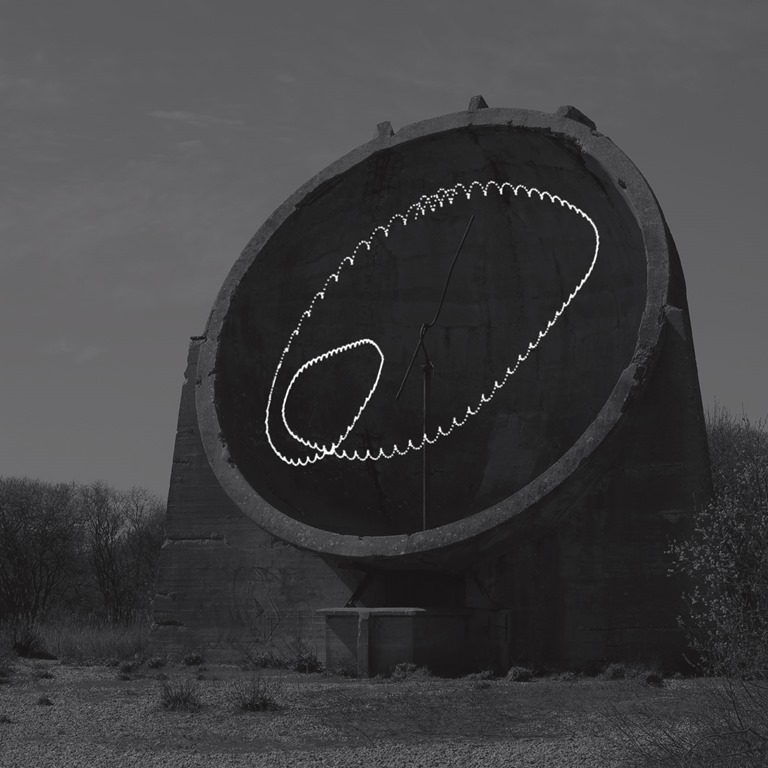
The cover art depicts one of the ‘sound mirrors’ which were constructed at various sites around the UK shortly between the world wars as an experimental early warning system, as a precursor to radar. While there are sound mirrors at two sites in Kent, those at Denge are the most renowned and best preserved, and it was here, one assumes, that the recordings of percussion, ‘incorporating cymbals, bells, gongs and clocks’, took place.

The installation, the notes go on to explain, ‘repurposes four cabinet speakers to transmit sounds collected during field trips to sites featuring [the] huge, concrete sound mirrors’.

This release contains a nineteen-and-a-half-minute recording of the installation, and highly atmospheric it is, too. Ther ticking watch not only keeps time, but gives a sense of tension and urgency which runs fast, in contrast to the long, low, reverby thuds and slow splashes of cymbals. That everything – apart from the watch – sounds somehow dulled, muffled – only adds to the atmosphere. It’s likely that this eerie, swampy echoiness is the product of the location, which features not only the thirty-foot concave ‘ear’ shown on the cover, but a two-hundred foot concrete wall. Images of the site stir the imagination, and one gets the impression to actually be in the presence of these strange-looking objects must be truly awe-inspiring. The sounds which emanate from the speakers while listening to Circuits From Soft Frequencies evoke the same sense of the alien, the otherworldly. Spurs of noise occasionally burst through, interjections of dissonance pulse through the building layers of sonic collage to unsettling effect.

It’s a reminder that often, the most alien and seemingly otherworldly creations are, in fact, man-made – and often connected in some way to war, and mankind’s destructive tendencies. I was struck, not so long ago, by the quite chilling experience of touring the cold war bunker in York – not a place of refuge, but a cramped and claustrophobic subterranean observatory which, in the event of the fulfilment of its purpose, would assure the deaths of its crew.

The sound swells and glitches, scratches and hums, and at times exudes a nightmarish quality that makes your muscles tense and your scalp tighten and crawl. It’s a remarkable piece of work, but one of those where the end comes as something of a relief.

AA

cover

Cruel Nature Records – 14th January 2025

Christopher Nosnibor

Released on various formats by various labels in different countries, the latest offering from genre-blasting French instrumental trio Toru is being released on cassette (and download) by Northumberland’s Cruel Nature in an edition of 65. Following on from 2020’s eponymous debut and a split release with Teufelskeller, which saw Toru join forces with CR3C3LL3, this time around, they’re different again, and having been featured as album of the day at Bandcamp Central just the other day, the signs are that Velours Dévorant could see them significantly expand their fanbase – and deservedly so.

Velours Dévorant featires five V-themed tracks defined by some riotous riffmongering and big, dirty, overdriven guitar noise with tempo shifts galore. Blasting in with ‘VHS’, it’s a manic ride through waves of tempestuous, bludgeoning racket from the very start. Trilling feedback fulfils the duty of a lead guitar line, while a shuddering, ribcage-rattling bass tears its way out from the chaos atop some heavy, but highly skilled jazz-inspired drumming.

Some will likely describe their sonic blitzkrieg as ‘experimental’, but that’s something of a misrepresentation, in that it suggests a lack of coherence, a haphazard and unplanned approach. The sudden stops and starts, the moments where a chord hangs, suspended in the air for just the briefest moment before the fractionally-delayed snare smash or cymbal crash, where the three of them simultaneously draw breath in just a split second… those microcosmic moments require remarkable precision – unquestionably, intuition is key, but rehearsal too. The skill is to make it sound haphazard, unpredictable, to keep the listener on the edge of their seat, buttocks clenched, while having it all worked out. Every composition contains moments which feel like the sonic equivalent of watching trapeze artists, where you tense and momentarily stop breathing as they fly through the air, seemingly in slow-motion, tense in case they fail to grab on: will they keep it together, or will everything collapse into a mess of sludge like a sewer rupturing and spewing a fountain of slurry?

These are long tracks – the shortest is over five and a half minutes – with infinite twists and turns. The skewed, surging jazz-grunge of ‘Voiles’ – a whopping eleven and a half minutes in duration – is representative, and encapsulates the essence of the album. The guitars squall and screed in a showcase of noise-rock par excellence, while the bass lurches and snarls, grooves and grinds, and the percussion is simply wild. It’s like listening an instrumental version of every track by the Jesus Lizard all at once. There’s a low-impact, atmospheric mid-section that rolls and rumbles, yawns and splashes… lazily would e the wrong word, but it takes its time, with bent guitar chords twanging like elastic bands, while the sparse percussion meanders seemingly without aim. But then it all reshapes and takes form once more, building, building, and then exploding so hard as to detonate so hard as to blow your eyeballs out of their sockets. Fuck, when these guys hit the pedals, they really do go all out.

I’ve heard a plethora of zany noise-rock acts, and have loved many – most of whom are so obscure that to reference them or draw comparisons would be the most pointless exercise imaginable: ‘hey, wow, this band I’ve not heard of sound like a bunch of other bands I’ve never heard of, that’s informative!’.

On Velours Dévorant, Toru take the tropes of post-rock, with its protracted delicate segments and slow-building atmosphere, and incorporate them within a noise-rock setting, with the result being epic tunes with some incredibly graceful, and ultimately poignant expanses, pressed tight against some of the most explosive overloading, overdriven abrasion going. And then, of course, there are the jazz elements: ‘Volutes’ is the apex of jazz/grunge hybridization, and it works so well. Not sold on Nirvana meets The Necks? Trust me.

The fourteen-minute title track is… special. It is, in many respects, the evolution of post-rock circa 2004. Chiming guitars, infinite space, haunting atmosphere. The intro is magnificent, beautiful. Her Name is Calla’s sprawling ‘Condor and River’ comes to mind. That use of space, that simmering tension, that sense of something growing which is more than… well, it’ s simply more. There are things hidden. When the riffing lets rip, holy shit, does the riffing let rip, fully shredding blasts of distortion tear through with obliterating force. The track feels like an album in its own right.

It seems like a while since I’ve felt compelled to describe an album as ‘epic’ – but this… this is next-level epic.

AA

a0213833004_10

Mortality Tables – 10th January 2025

Christopher Nosnibor

Ambient music is, in many ways, music for reflection. Or perhaps, music which provides the backdrop to reflection. Time was that I had very little interest in ambient music, but I have come to appreciate it has having quite significant functions, whether by the design of the artists or not. Reviewing requires a level of focus and attention that regular music listening does not, and when it comes to ambient works, a greater level of attention is necessary: I feel there is a requirement to tilt the ears and pluck out the details, the textures, to venture into the depths to extrapolate the moods and meanings. Sometimes, I fail, and find my mind wanders down different paths as space opens up through sonic suggestion, and random associations are triggered completely unexpectedly. Regardless, ambient music is generally best received in darkness, or by candlelight. Please… close your eyes and absorb without distraction.

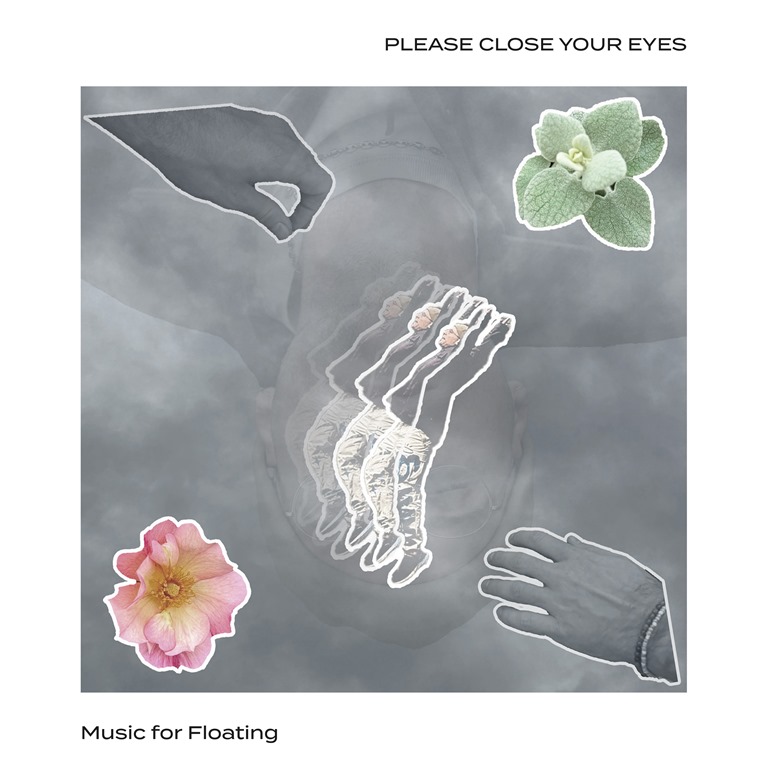
As Oliver Richards – aka Please Close Your Eyes – writes, “Music for Floating is a document of transition. It collects pieces that were made over a three year period, nearly three years ago. They were all made before my last Mortality Tables release, ‘Nibiru’ / ‘Heaven On The Fourth Floor’…It’s a consciously-composed modern classical album. I have no classical training at all, but when I was making it, I set out with the intention of composing for the first time, consciously and intentionally. The music I made before under the name Goodparley was all created improvisationally and instinctively. With this I would step back and ask myself, ‘What am I actually going for here?’”

I ask myself this question often, and not just about creative endeavours, but life generally. How many of us really have any idea, about anything? Music for Floating, then, provides a magnificent soundtrack for contemplation and reflection, on the world, on life, and all things. But it’s not simply an ambient work: it’s a collection of pieces which span a broad sonic range, and while gentle and mellow throughout, there’s much more to it than drifting clouds and soothing sonic washes.

There’s something of an underwater, soft-edged soporificness about ‘The Moment Before We Sleep’, and it’s one of those pieces which lends itself to immersion and letting oneself cut adrift. In contrast, ‘The Hollow’ brings a busier, more bustling feel, not to mention something of a progressive vibe, as synth piano ripples and rolls with waves of energy. Augmented by synth strings and other elongated, organ-like sounds, the seven-minute ‘Piano for Floating’ is a standout, compositionally, structurally, and sonically. It’s subtle, layered, and casts the listener adrift on a rippling expanse of tranquil sound. Music like this has a profound effect that’s both physical and mental: you can feel your spine elongating, your muscles gradually becoming less knotted. I find myself yawning, not out of boredom, but through a rare relaxation.

At under three minutes, ‘Deeper Blue’ provides an interlude at what stands as the notional start of side two, before the six-minute ‘Heaven, Faced: or, The Fairies’ Parliament’, and the epic finale, the nine-minute ‘The Time Before the Last’. The former traces shimmering contrails through an azure sky; it’s the sound of slowly rippling aroura, of silent snowfall in a windless winter sky, of your mind spinning in amazement at the wonder of natural phenomena… while the latter brings slow abstract drifts which evoke the vastness of space, eternal in its expanse. It’s bewildering, but so, so calm… Time evaporates, and nothing matters. There is nothing.

AA

cover

skoghall rekordings – 10th January 2025

Christopher Nosnibor

The notes which accompany this release are more of an anti-pitch than a promotion: ‘depression, dourness, gloom, sex, drinking, drugs and male anxiety – some of it true, some made up.’ I had been warned. Should this maybe even come with a trigger warning?

Hell no. Art is life., and life doesn’t come with a rigger warning. If you truly want to avoid anything that’s a potential trigger, you probably just need to die right now, because there is no other way to avoid everything.

But my misery is your reward is pretty fucking bleak. It’s not Dave Procter’s first foray into acoustic-based musical work, and by no means the first release to feature his first spoken word works, although it is perhaps his first to present both these and an array of other styles with the purpose of exploring a core theme, namely of being fucking miserable.

I should make the up-front presentation of the fact that I am absolutely by no means being critical of the album’s miserabilism. For years, the theme of much dialogue has been ‘we need to talk more about mental health! We need to destigmatise mental health! We need to talk about mental health more openly!’ And I agree without reservation… but… It seems that the limit of most conversations – and this is perpetuated, sadly, by sufferers, and by artists, and by bosses (especially bosses) and by social media –remains at ‘I’m having trouble with my mental health’/ ‘Oh dear’. That is not talking about mental health. But people are not comfortable discussing the details, the way those troubles manifest, what it really means. Tell someone what that really means and oftentimes it will likely be a very brief and one-sided conversation. Male anxiety: are we even close to a place where blokes can sit and talk about their disturbed sleep and panic attacks down the pub with their mates? Are we hell.

The spoken-word pieces – succinct and pithy – are impactful partly because they say so much with so little verbiage, but equally because of the monotone delivery recorded close to the mic, with no studio slickness, no compression or reverb, but dry, as if Procter is leaning forward to confess in low tones the unutterable darkness. ‘no sleep no peace’ is exemplary:

I get no sleep at night

No peace in the day

There’s shit in the kitchen

There’s shit on the floor

There’s shit all on my life

Since you walked through the door.

So many of us will have lived with some squalid fucker at some point, and what may on paper appear trivial can in fact become a living hell.

The majority of the songs are sparse acoustic guitar and vocal works which sit between bedroom gloom and neofolk, with similarly direct and downcast lyrics: ‘the choices are stark enough / between dope / and a rope / it doesn’t take much these days’, he sings on ‘not much’. They’re simple and super lo-fi, and wouldn’t work any other way, because the nature of the recordings imbues them with an intimacy which brings a lump to the throat on many occasions. Even the bits that are made up, because it’s all interwoven and ultimately inseparable.

Elsewhere, ‘the visitor’ has the haunting reverb-drenched melancholy of Leonard Cohen, while ‘his face, my place’ is like a demo for a goth take on the kitchen sink non-drama of The Wedding Present, and ‘when you want her back’ sounds like David Gedge in collaboration with Stereolab.

As the label’s Bandcamp page states, Skoghall exists to present ‘a collection of past and present work involving Dave Procter’, and my misery is your reward is very much a work mines from the archives, ‘originally recorded during several periods of the above in Leeds and Stockholm in 2007 and 2008, although the ideas have been around since late 2005…’ Procter adds, ‘I think they call it catharsis. This LP is meant to be listened to in one sitting.’

Almost twenty years since conception and seventeen or so years since its recording, some may consider it curious that an (extremely) active artist would serve up these somewhat primitive and one might even say juvenile recordings now. But there does come a point in life when, perhaps we make peace with our discomfort and awkwardness and with the distance of time, can appreciate the merits of those works which were necessary in the evolutionary journey to the artists we become. To finally release it… yes, there must be an element of catharsis in casting out those thorny thoughts, the kind of twisty, churny recollections that insist on needling away, years after the fact.

my misery is your reward is a world away from Procter’s work as Legion of Swine or Fibonacci Drone Organ, and even the no-nonsense spoken word of Dale Prudent, and there’s a touching humanity, and the lack of sophistication is an asset when it comes to conveying difficult emotional states in a relatable fashion. Yes, we need to talk about mental health, and what we also need is for documents of unflinching honesty and for artists to take the lead. This is what we need.

AA

AA

a2113781565_10

10th January 2025

Christopher Nosnibor

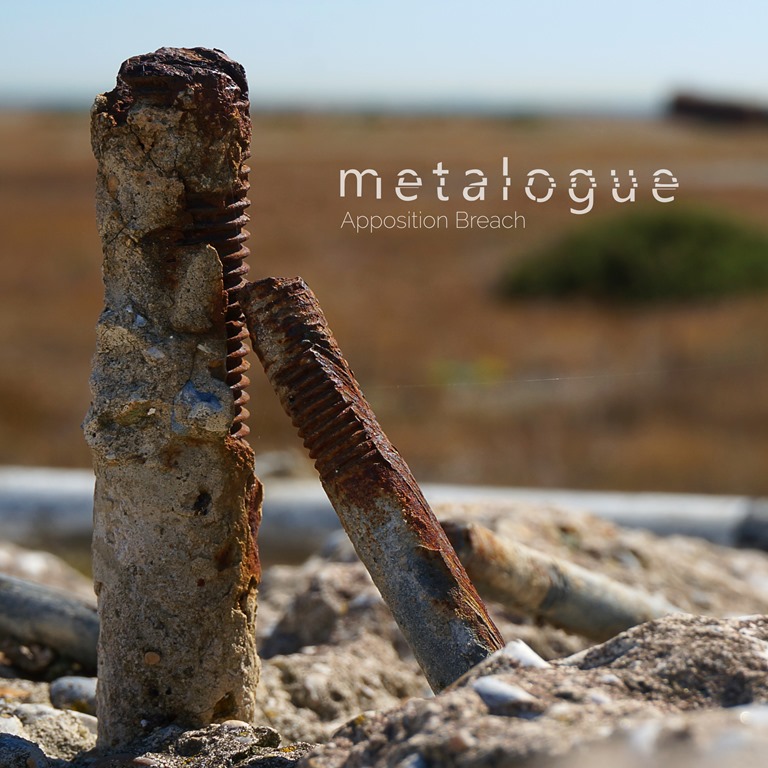
Metlaogue’s Bandcamp pitches the project as ‘Industrial/IDM/breakcore with cinematic tendencies’, while the notes for Apposition Breach note how it ‘explores the threshold of geography and inner world – where landscape becomes the medium for emotion’. This, for me, seems to carry almost Ballardian connotations, the idea of inner geographies, the way in which the geometry of a landscape can slide between the literal and the metaphorical, how one can become an analogue of the other. The inner and outer worlds exist almost separate of one another, and the only point at which they intersect is in the mind as one processes the physical world as experienced through the shading of the emotional state. A sunny day may be a joy to behold, but may not bring joy in the face of a trauma. How we respond to our surroundings is influenced by not only circumstance, but the way we react to it. Yet rarely do we pause to consider these variables. Why did you have a shit day at work? Was the work itself shit, or did you arrive carrying the burden of something else which made something comparatively minor a catastrophe? You may walk the same route daily for a year, but it will never be the quite the same experience. The variables are infinite, and on Apposition Breach, Metalogue interrogates those variables and the reflex of memory and their complex relationship on a nuanced suite of compositions, some six years in the making.

The atmospheric ‘Threshold’ draws the listener into that fluid space, where soft ambience wraps itself around hard mechanical drones, and the percussion shifts in pace and intensity, at first muted, subtle, but firing forth in explosive bursts to become the dominant feature, and in doing so marking a dynamic shift in mood. It’s somewhat akin to climbing a gentle hill and suddenly finding a sharp crag just as the wind picks up and clouds darken the sky. The temperate changes with the change in tone.

While the images which accompany the release are illustrative, the soundscapes themselves evoke rusted machinery, dilapidated mills and farming equipment gradually yielding to the elements. As much as it’s industrial, Apposition Breach offers haunting echoes of industry, once-thriving communities and factories abandoned – not the collapse of civilisation, but the decline which comes with ‘progress’. Wraith-like synths wisp and envelop pulverising beats on ‘Triangulation’, a composition which builds and transitions through a series of different forms. The pieces tend to be on the longer side, in excess of six minutes and pushing to almost twelve on ‘Outer Margin’. This gives them time and space in which to evolve at a pace which feels natural and necessary.

‘Ilira’ is ominous, scraping drones create an eerie fog of tension which is punctured by hard, violent beats. Between the snarling mechanical grind of ‘Reflection’ and the dark, pulsating title track, Metalogue conjures an array of sonic sceneries which present a journey of sorts. Not a linear journey whereby one travels from A to B, B to C, but one which seers the retinas and scours the mind with a succession of scenes, flashbacks, rapid cuts, with the effect being not dissimilar to the way memory skips here and there in time and space when triggered by seemingly unconnected and unrelated prompts – a word, a sound, a smell, nothing at all – or a dream, in which one suddenly finds themselves in a different location or setting seemingly apropos of nothing. Just as William Burroughs remarked of his discontinuous narratives that he was not concerned with explaining how characters get from one place to the next, so it is that we, as participants in the immersive experience that is Apposition Breach, find ourselves effectively teleported.

There’s the hard attack of ‘Redoubt’ and the echoing mystery of the swampy but hypnotic ‘Day Marker’, and in between, all shades of hefty percussion and cold, razor-edged synths shiver and scrape kneed and throb to render an altogether uncomfortable experience. Apposition Breach is expansive, ambitious, and meticulously realised.

AA

cover