Posts Tagged ‘Album Review’

Christopher Nosnibor

Perhaps I need a break. I love music and I love reviewing it. But looking through my to-review pile and my groaning inbox, I feel overwhelmed and despondent, disinterested even. I look at the tiles and the artists, knowing instinctively that some will leave me cold and others will irritate me. Perhaps stirring my frustration with break the ennui, but it’s almost 11p, and

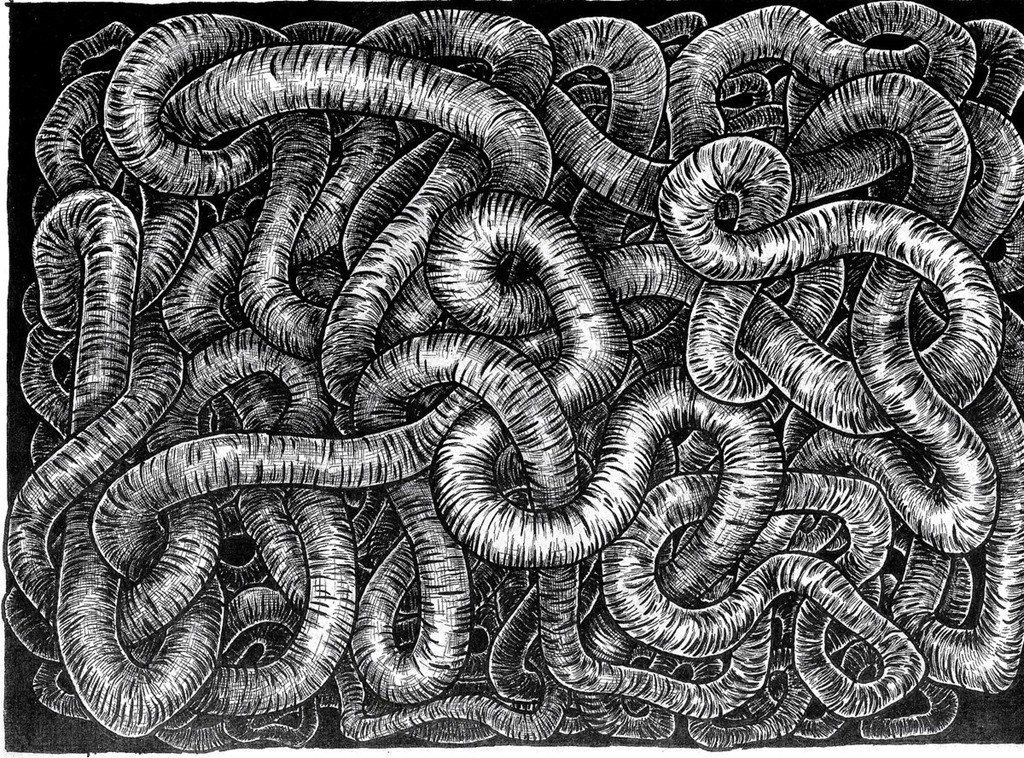
I pick up Nonmenabsorbium on a whim. The dark cover, not so much black and white as many shades of grey, from mostly within the darker end of the greys spectrum, tells me nothing. I can’t locate the accompanying press release. I’m flying blind, with only my senses and my instinct to guide me.

It’s pleasing to discover that Nonmenabsorbium contains no music in the conventional sense. No songs, no singing. No chords, no melodies, no tunes. No identifiable shapes or structures, no instruments or rhythms. Sparse, minimal drones and high-end tweets trill and hover. Thuds and thumps, sounds recorded seemingly too close to the microphone and booming through disproportionately loud against the barely-there backdrop jolt the senses. These are sounds without context and without overt structure or direct relation to one another. Often, the incidentals are disproportionate in volume to the ever-shifting grain of the backdrop, booming and crackling mic and speaker distortion as single notes ring out and resonate.

During ‘Abholicater’, the churning clatter coalesces to create a sort of arrhythmic percussive form, hammering and beating amidst a swirling swell of amorphous grey sound, which gradually dissipates to be replaced by the fizz and pop of electrostatic, shrieking diodes and the grumbling grind of low-end hum. #

‘2nd nalicii – 197degree5’ sounds very like R2D2 building for a breakdown, an electronic work based around rising frequencies which threaten to burst the tension. But it doesn’t happen. Sonar pulses radiate amidst the crackling clatter and wowing incidental of the eleven-minute closer ‘Horrorrydclowses’, as a rain of static pink noise showers down on electronic Catherine wheels. Monitor bleeps blast into cerebral flatlines amidst a relentless whupping churn and grind of static noise which owes a clear debt to the lineage which brought us early 80s Whitehouse, Prurient, Merzbow et al. Meirin and Garcia may belong to a different musical heritage, but Nonmenabsorbium is an intense sonic assault that requires a cautious approach.

The atmosphere is one of building expectation, and tension builds with the growing sense that there must be a point at which the threat of all-out noise is realised. But such cathartic release fails to materialise. Instead, the bumps and clanks are nerve-fraying after a time, and it becomes increasingly difficult to distinguish from the sounds on the disc the possibility of someone ascending the stairs, moving in the next room, stumbling around between plant pots and dustbins in the back lane or the yard outside. Consequently, the pleasure to be derived from listening to Nonmenabsorbium is perhaps a rather perverse one. Nonmenabsorbium provides an unsettling distraction, a removal from the humdrum and the sonic wallpaper of the everyday / mainstream. But, by way of escape, and also as an example of difficult but rewarding listening, Nonmenabsorbium offers an immersive and awkward sense of entertainment.

Francisco Meirin Miguel A. Garcia

23rd June 2017

Christopher Nosnibor

Ashley Reaks’ relentless release schedule continues apace with the arrival of Track Marks, his eleventh album. Because it’s an Ashley Reaks album, it’s characterised by off-kilter experimentations in dub and socio-political commentary. But whereas jazz provided the core influence on 2015’s Growth Spurts, it’s spectacularly spacious prog-rock wizardry that arrives fresh on Track Marks to bring the all-important new, unexpected and so-incongruous-it-shouldn’t-work-but-somehow-does feature of the material.

‘Stale Mate’ opens the album with a suitably eclectic mix of ingredients, with the blippy electronica of the opening bars immediately being submerged by one of the wandering basslines that define Reaks’ output regardless of what he’s doing. Somehow it moves from here to ultimately culminate in a knowingly gratuitous guitar solo.

‘I’ll Take My Pilgrimage’ is seemingly about as much a yearning to find faith as a criticism of religion per se, and melds a stormy, rolling drum to another phat bassline and some progtastic guitars and synths, while packing in some jazzy sax too. The jazz direction, which came to the fore on previous album, Growth Spurts, becomes increasingly dominant as Track Marks progresses. ‘Exposing Fiona’ gets pretty wild in its horn-parping intensity.

‘Stick Thin Worms’ pitches a stomping rhythm beneath some more abstract lyrical content, while poet and bluesman Paul Middleton (who hails from Reaks’ hometown of Harrogate) provides spoken word on ‘Tank From Grimsby’, which continues the extending thread of collaborative efforts which have become stablished as a feature of Reaks’ receny output. It’s actually a piece about some musicians, and marks a departure into mellow flamenco guitar.

If it all sounds like overload, it’s credit to Reaks that somehow, it all hangs together with a remarkable cohesion. It’s not immediate: one has to first surrender to the strangeness, the otherworldliness that Reaks creates. But there are some – many – undeniably great musical moments here. They’re not preoccupied with hooks or choruses, but there’s a certain atmosphere that envelops Track Marks – an album where the darker second meaning is (wisely) left unhinted at in the cover art. And once again, it’s Reaks’ refusal to pursue any obvious avenue which is the key to his success as an artist. Whether it’s a detriment to him in commercial terms, well, who knows? But that’s not what he’s about, and precisely why he deserves respect and attention.

cover

Ipecac Recordings – 7th July 2017

Christopher Nosnibor

Melvins’ 415th album since their formation in the Mezozoic era is a double: their first. As if the founding sludgelords, the masters of the megalithic, needed to take it to another level of epic indulgence. A Walk With Love and Death isn’t exactly a concept album, as much as an album of two halves. So says the press release. If anything, it’s actually two distinct albums released together: Death, a proper Melvins’ release and Love, the score to the Jesse Nieminen directed, self-produced short also titled A Walk With Love and Death.

But of course, it’s a Melvins album. Which means that, fundamentally, it sounds like a Melvins album. That’s no criticism: I want a Melvins album to sound like a Melvins album but then, would it ever sound like anything else?

They really make full use of the double-album format for this outing. It begins with a slow-building, expansive six and a half-minuter that has echoes of ‘Mine is No Disgrace’ from The Crybaby, but instead of erupting into a blistering wall of noise, keeps the focus tight on a proggy trip with a vaguely psychedelic hue.

‘Sober-delic’ follows, a mid-tempo trudge which also stretches beyond the six-minute mark and ‘Euthanasia’ is vintage Melvins, a hefty sludge trudge with heavily treated vocals. ‘What’s Wrong With You?’ is a warped psychedelic stoner rock tune with a twisted pop edge, propelled by a thumping bassline and wild guitars. The nine songs which make up the Death album don’t exactly offer up any surprises (which is arguably a surprise in itself given the band’s wildly varied output over the last 30 years), but do deliver a Melvins album that’s as solid as anything they’ve done. It brings the grind. It hammers with the riffs. It’s sludgy, grungy, yet packs some great pop moments. And what at times it lacks in terms of attack, it compensates in scale, with the prog leanings of ‘Flaming Creature’ partially submerged by the low-end churn that they’ve made their own.

Commencing with a vaguely experimental intro track, in which mellifluous piano notes drift through the sound of chatter, the Love set is a very different proposition. The fourteen tracks are shorter and stranger, leaning toward noisy ambience, and find Melvins revisiting the kind of territory explored on Prick and the playfully perverse ‘Cowboy’ single from the mid ‘90s.

When they do actually play tunes, it’s whacked out, trippy psychedelic pop or fucked -up jazz: ‘Give it to Me’ is a zany, mess of doodling Hammond organs and theramins duelling with thumping percussion that’s pure 60s garage. But mostly it’s weird shit like ‘Chicken Butt’ and ‘Halfway to Bakersfield’, and it’s all very much ‘what the fuck’?

It’s Melvins’ eternal capacity to confound which is an integral aspect of their enduring appeal. It would be so easy, and no doubt more career-savvy to work to their tried and tested formula and to put out an album of straight ahead sludge rock every two to three years, instead of going off on infinite tangents and releasing two albums a year. But the fact is, they’re actually very good at producing weird, far-out experimental shit, and the results of some of their collaborations have been as strong as unexpected. It’s their drive to create, and to endlessly push in so many different directions which keeps Melvins fresh, and above all, relevant.

Melvins - Love and Death

23rd June 2017

Christopher Nosnibor

I’m a huge sucker for that strain of Joy Division / Cure inspired 21st century post-punk as exemplified by Interpol, White Lies and early Editors – at least when done well. And On the evidence of their previous releases, Leeds’ Tabloids do it well. Given that they formed in 2013 and have to date only an EP and single to their credit, their debut album has effectively been some four years in the making. In doing so, they’ve created a work that feels meticulously crafted, but by no means sterile or overworked.

It’s also a very ‘Leeds’ affair: produced by Lee Smith and Jamie Lockhart (The Cribs, Pulled Apart By Horses) and mastered by Tom Woodhead, formerly of ¡Forward, Russia!. Their input has certainly been sympathetic to the band’s objectives, and they’ve balanced crisp pop sensibilities with atmospheric, analoguey tones and a vintage 80s snare-led drum sound.

The inclusion of the previous single releases does nothing to diminish the sense of All The Things That You’ve Become standing as a coherent album, although there’s very much a ‘debut album’ feel to it on account of this.

‘Pedestal’ reduces a Smiths-inspired jangle to a minimalist jag of tension skewed across a thumping bassline with a nagging lead guitar line and a falsetto vocal providing the key hooks to a killer alt-pop tune.

‘Circle’ is a magnificent, emotionally-charged slow-burner, and one of the album’s standout tracks. Taking the tempo and the drive back, it’s one of those songs that bursts into a climactic finale at precisely the right point.

Ordinarily, basing an album’s merit, or even its context, within a framework of reference points either smacks of lazy journalism or is otherwise indicative of a band who are painfully derivative. But when you’re looking at something which is knowingly and purposefully steeped in heritage, the touchstones are essentially serve to define the work. When operating in a critical capacity, it’s not necessarily as reductive as noting ‘X sounds like Y’ so much as questioning how the material holds up against the all-important points of influence. It is, of course, emblematic of the nostalgia which dominates our present space. We want bands which remind us, if only in some vague, notional sense of the past.

If heavy hints of Depeche Mode echo through the dark, sparse and soulful ‘Cannibals’, The Cure make an obvious reference point for ‘Vessels’, not least of all in Lloyd Bradley’s pining vocal, but also its funk-tinged but also dark-hued bass groove, but then, I’m also reminded of The Associates and, more contemporarily, The Cinematics. Closer ‘Toothache’ is short, but powerful, and makes for a satisfying finish to a rounded, solid album.

Tabloids

Constellation

Christopher Nosnibor

It’s been 29˚C in the shade today. I’ve been awake since 4am for the second day in a row, and at work in the day-job since 7:30am. I’m a flustered, strung-out sticky mess, dying of hayfever, trying to hold it together and keep myself cool and hydrated with a constant flow of Scrumpy Jack. It’s not working. But I am: instead of kicking back or chilling out, I’m desperately trying to chisel out words in my cramped home office space where it’s so humid I can barely breathe. And instead of taking the easy option of one of the million mellifluous ambient works in my never-ending to-review pile, or taking a soft hit with some straight ahead metal or whatever, I’m battling with this dizzyingly diverse effort by Avec le soleil sortant de sa bouche.

Sold as a kraut-rock ensemble, Montreal collective Avec le soleil sortant de sa bouche (which translates, I believe as ‘with the sun coming out of his mouth’) pack myriad influences into their second album. Although containing ten tracks, it’s ostensibly an album built around three primary movements.

Psychedelic rock, krautrock, desert rock, punk rock, noise rock, afrobeat, experimental pop, post-rock, electronic; all are touchstones for Avec le soleil sortant de sa bouche.

The album’s first track, ‘Trans-pop Express I’ manages to combine hypnotic psychedelic desert rock with wibbly analogue retro-futuristic spacey electronica and some kind of warped gospel/country infusion. It bleeds invisibly into the hypnotic pulsating riff-trippery of ‘Trans-pop Express II’

The opening minutes of the second movement ‘Alizé et Margaret D. Midi moins le quart. Sur la plage, un palmier ensanglanté’ (of which there are three parts) marries a martial beat to some skittering world music vibe and tops it with a desperate, yodelling vocal holler that’s far wide of carrying a corresponding melody, or even a tune. Over the course of the piece as a whole, the band push into new territories by unconventional roads. This is essentially the key to the pleasure to be found in Pas pire pop. Avec le soleil sortant de sa bouche are clearly a band who please themselves first and foremost, and enjoy themselves in doing so. And yet they largely swerve indulgence by virtue of their sense of movement: the tracks build and bed, trip and transition: the explosive crescendo at the end of the aforementioned first part of ‘Alizé et Margaret D’ is killer, and immediately loops back to the opening proggy motif on the second part. It’s like skipping back in time, like a glitch in the time continuum. It’s a minor detail in many ways, but it’s also a minor work of genius.

The final movement – in a colossal five parts – begins with a sweeping orchestral cascade which gushes every whichway over a thumping dance groove. It’s merely the beginning of a crazy journey through jazzy math-rock and noodlesome post-rock via some hefty noise and some Talking Heads-y post-punk oddness that works its way to a nifty finale by route of a tightly-woven funk groove meted to some clattering drums while whizzing electronic details fly like comes into the distance.

I’m oozing perspiration from every pore, especially the backs of my various joints: the knees, the elbows, the groin, and I find myself contemplating the complex musical conjunctions within the framework of the shifting tubular geometry of my limbs in context of the insane, overwhelming heat and its effect on my capacity for focused, linear thought, as if existing in some stylized Ballardian landscape of the mind.


Avec le Soliel

Southern Lord – 23rd June 2017

Christopher Nosnibor

Maybe I’m not nearly as musically ware as I thought. Or maybe some bands are simply so way off radar, it takes a poke from a PR to get things moving. And so it is that my introduction to Circle comes after they’ve already got over 30 albums to their credit. Before I even start listening, I find myself thinking ‘shit, I hope it’s not so awesome that I feel compelled to explore their entire back catalogue’. I’m still working on The Melvins after all, and have kinda parted ways with The Fall in recent years, not because I haven’t enjoyed any of their more recent release, but because I simply can’t keep up, and there’s so much music out there. Something’s got to give.

Terminal contains six tracks, all bar one of which extend beyond the five-minute mark, and opening with the thirteen-minute ‘Rakkautta Al Dente’. It’s got the lot woven into its epic, dense fabric, building on a mystical desert rock vibe that spins out for mile after mile, before a ravaged vocal, by turns demonic and magickal, leads through a preposterously theatrical rock opera of sorts, riding through a succession of crescendos and surges, with changes of style galore, ranging from medieval riffery to cinematic prog. And… well. It’s effectively an entire album in a single song. Over the top? Way over… but if you’re going to go over, there’s no point in just scraping the bar.

The title tracks kicks in with a punchy riff that leans heavily on ‘I Wanna Be Your Dog’ by The Stooges – or, from another perspective, that classic chord sequence that informs a near infinite number of songs – before flying off into motoric space rock territory. With ‘Saxo’ mining a manic post-punk seam and ‘Kill City’ coming on somewhere between Iron Maiden and GWAR before ‘Sick Child’ plays out with a thumping psychedelic trudge, Terminal is as eclectic as a heavy, guitar-based album is as likely to come.

Small wonder the Finnish act are almost unanimously hailed as the very definition of genre-defying. At its heart, you may say there’s a hard rock / heavy metal album lurking amidst the coalition of disparate elements which form Terminal. This would certainly sit with the narrative of an album released on Southern Lord. But the way in which everything is drawn together – sometimes seamlessly, sometimes audaciously and unexpectedly – means that this framing of the album doesn’t really work. All of this leaves more questions than answers in terms of how to frame, and therefore how to accommodate Terminal. But regardless of how one assimilates, or otherwise fails to assimilate it, Terminal is a wild ride, and while in places perplexing and vastly excessive, it’s never for a moment dull or predictable.

Circle - Terminal

SOFA – SOFA 557 – 21st April 2017

Christopher Nosnibor

Antipodean multi-instrumentalist, composer and experimentalist Jim Denley has been playing the flute since 1969 and has a formidable reputation in his home territory, not to mention an extensive resumé.

Denley has a preoccupation with location: as there is no flute tradition in his native Australia, his aim – according to his biography – is to situate his music within a global outlook, and takes is cues from flute traditions from other parts of the world, spanning Europe, Papua New Guinea, the Far East and the Amazon, and, in particular, the flute traditions of the Solomon Islands. There is always something to learn: with a background very much rooted in western music, particularly of the post-punk period and beyond, the fact that there are specific regional flute traditions is something I was unaware of. I suspect this is not something unique to me.

Denley is clearly immersed in his research of the traditions which inform his work, in particular this album, with the album’s second longform track, ‘For Celina Rokona’ dedicated to a flautist from Ataa in North East Malaita, who played the Sukute, described as ‘a curious combination of flute and percussion’. Who knew that the flute had such a lengthy and diverse, pan-continental history, or that there were so many hybridisations across the continents? This does perhaps explain why the two nineteen-minute compositions on Cut Air sound precisely nothing like any flute I’ve ever heard.

I’m unclear, after listening to Cut Air, if my knowledge and understanding of these various traditions is any more advanced. Aside from moments of fluttering, tweeting, looping harmonics much of Cut Air consists of quiet. It consists of interloping notes which quiver and quail, tremble and tremor. The air isn’t explicitly cut, but subject to soft, massaging vibrations which alter its movement, softly, subliminally, imperceptibly. This is not an immediate or direct work, and it’s very much an album which requires a degree of patience as it hangs, unobtrusively, in the background.

Jim Denley - Cut Air

SOFA – SOFA 556 – 7th April 2017

Christopher Nosnibor

Within a few weeks of moving into my current home, there was an immense storm, which led to my discovery that it wasn’t water-tight, on account of a) having no cover over the letter box b) some defective guttering c) a gap between the roof tiles and the brick work. Consequently, this – admittedly unusually heavy – downpour resulted in there being a pool of water, an inch or so deep and over two feet in circumference just inside my front door. Ok, it was more of a puddle than an actual pond, but the anecdote serves to illustrate that the surrealist image conjured by the title of Philippe Lauzier’s second album is neither strange nor funny when the abstract notion becomes an actual lived experience.

The album’s four tracks are built around multiple tracks of bass clarinet, but there is nothing on A pond in my living room which could be readily identified by ear alone as being woodwind, and the longform compositions are explorations of sound rather than structure, with not a trace of jazz or orchestral influence to be heard.

‘Bleu Pénombre’ opens the album in a long, swirling churn of feedback. Gradually, layers of sound build, granular textures roughen the surface of the undulating, elongated multitonal humming. It’s a richly atmospheric composition, which suggests a preoccupation with the relationships between sounds as much as with the sounds themselves. Higher pitches and nagging oscillations emerge as ‘Bleu Pénombre’ bleeds into the uneasy ‘Water Sprinkling’. The notes quiver and ripple, like a mirage through a heat-haze. Sharp blasts of white noise fizz against the creeping whines which populate the sparse, eerie ‘On the Window Side’. The result is ominous, unsettling, with the unpredictably-placed shards of static adding moments of shock to the tension which Lauzier sustains over the full duration of the ten-minute piece, which culminates in a dark, rhythmic pulsation.

None of the sound contained on the album carries connotations of water, or even any overt reference to the surreal juxtaposition the title suggests, but this only accentuates the air of abstraction which hangs over the album as a whole. The final track, ‘Napping in a Neglected Garden’ yawns and grates, a metallic creak like a rusty gate opening and closing replayed in half-time dominates the haunting eleven-and-a-half-minute work. Gradually, the slow, natural rhythm becomes subject to disruption and halting adjustments bring further disruption and twist the listener’s sensory adjustment.

A pond in my living room is more effective and affecting by virtue of its comparatively subtle approach. A pond in my living room is not a loud album, and does not rely on harsh textures and tones to achieve its discomforting impact.

Philippe Lauzier - Pond

Noble – NBL-221 – 15th April 2017

Christopher Nosnibor

Reliq is Serph. What’s the difference? Serph’s compositions are typically dream-like and utopian in their stylings, while Reliq’s work are edgier and more dance orientated. So says the press release. Life Prismic is the third album by Serph in his Reliq guise, and draws on music from a vast array of cultural and geographical origins for forge something

Life Prismic jangles and jingles, wows and flutters with swerving, loopy grooves and rippling rhythms which run into and across one another from perpendicular angles.

Plinky-plonk house piano tropes are bent and twisted through funnels of mellow head-nodding hipster dance vibes. The hyped-up chipmunk energy of ‘Ceramic Samba’ is nothing if not energetic, with flickering, clippy beats and hyperactive, pitched-up vocals. It demonstrates a playfulness at work, as well as a serious overdose of sugar, and it’s enough to leave anyone feeling vaguely giddy with the surging uptempo headrush.

Gentle, bleepy chillout zones are conjured with in between spaces, with xylophones and lad-back beats creating moments of comparative tranquillity, and ‘Morocco Drive’ introduces a range of strings and woodwind over a drifting synth to create an enigmatic, ethereal and exotic atmosphere before a frenetic drum ‘n’ bass rhythm powers in.

Each track bursts outward and reaches in multiple directions over its course: there’s nothing predictable about any of the structures or arrangements. Jazz licks, samples and other vocal snippets, bhangra beats and abstract incantations are all whipped into the same mix as thumping 4/4 dancefloor-orientated rhythms, and ‘Rain No More’ manages to pack in a low-down and dirty funk mid-section into its eclectic hybrid form.

It’s rather difficult to know exactly what to make of Life Prismic. In terms of ideas, it’s an explosive riot. That said, some of those ideas develop into recurrent themes over the course of the album, which in some respects diminishes their impact. But with 13 tracks and a running time in excess of an hour, there comes a point where it feels like overkill. No matter: in smaller chunks, Life Prismic is an entertaining listen.

Rwliq - Life Prismic

Immediata – IMM010 – 3rd July 2017

Christopher Nosnibor

One track spanning fifty minutes. It’s one of those compositions which lacks explicit firm, and creeps and crawls and spreads itself like a low fog that drifts under doors and through cracks in windows. Much of The Slow Creep Of Convenience is quiet, to the point of near inaudibility. It’s most definitely background music, and ambient in the purest sense, in that it affects the mood subliminally, infiltrating the psyche almost completely imperceptibly. It is, as the title suggests, a slow creep, an album which slowly, invisibly reaches in and subtly massages the edges of the mental state, rather than affecting an overt and direct transformation.

It’s almost exactly a year since Anthony Pateras released to very different albums simultaneously, and the style of The Slow Creep Of Convenience is very different from either of those, revealing an artist capable of significant creative diversity. The Moment In and Of Itself and The Long Exhale, while contesting and in some respects complimentary, were both overtly experimental. The Slow Creep Of Convenience is infinitely more restrained, focused. It’s very much a minimalist work.

We’ve covered the slow creep, but what about the convenience? Reading this as social commentary, and perhaps as a quieter parallel to Arsenal’s Factory Smog is a Sign of Progress, The Slow Creep Of Convenience stands as a document referencing the less positive aspects of the endless tide of progress and development. Just as industrialisation heralded the onset of the modern age and a new mode of existence, which brought with it infinite benefits but also new and unprecedented problems, so the shift toward convenience, toward tertiary industry, the advent of leisure industries, heralded the arrival of the age of stress, anxiety and dysfunction. We now live in a culture of endless immediacy, centred around instant online transaction and interaction, around immediate dispatch. Amazon Prime is nothing to on-line banking and Hungry House. Everything I available immediately, at the click of a button. Smartphones may have only come to the market in 2008 – less than a decade ago – but the revolution has already happened and we’ve all been utterly engulfed by the pace of development. So just how slow has his creep been in real terms?

In some respects, it doesn’t matter: our perception of time has changed. Time is accelerating, and in the age of convenience, it’s easier than ever to evaporate time. But who noticed?

The undulating, intertwining drones and hovering, jangling, multitonal hums with the texture of dragonfly wings which forge extended passages of this multi-faceted work intimate a nagging unease, the underlying discomfort of anxiety. It’s more than difficult to pinpoint, of course: it’s simply there in the background, yet impossible to ignore.