Archive for the ‘Albums’ Category

Gutter Prince Cabal – 16th February 2023

Christopher Nosnibor

There aren’t many guitar-based genres of music where one-man bands are particularly commonplace. Of course, I’m not talking about folk or acoustic-based music, but the kind of music where, on listening, you’d expect a full band. Industrial is something of an exception because early exponents like JG Thirlwell – aka Foetus – developed through the use of tape loops and studio experimentation, and the same is also true of later exponents like Nine Inch Nails, with Trent Reznor’s studio-based project evolving from being largely synthetic into a live proposition.

But black / death metal are genres unto themselves. One might joke that it’s because most of the people who make this kind of stuff have no mates or are too antisocial to form bands, although it may not be much of a joke. Either way, Melbourne-based Aaron Osborne is one of those one-man operations, handling all aspects of writing and playing to create the sound of several. And what a sound it is. If you want dark, dense, and sludgy, with bowel-loosening guttural vocals, then you’re in luck.

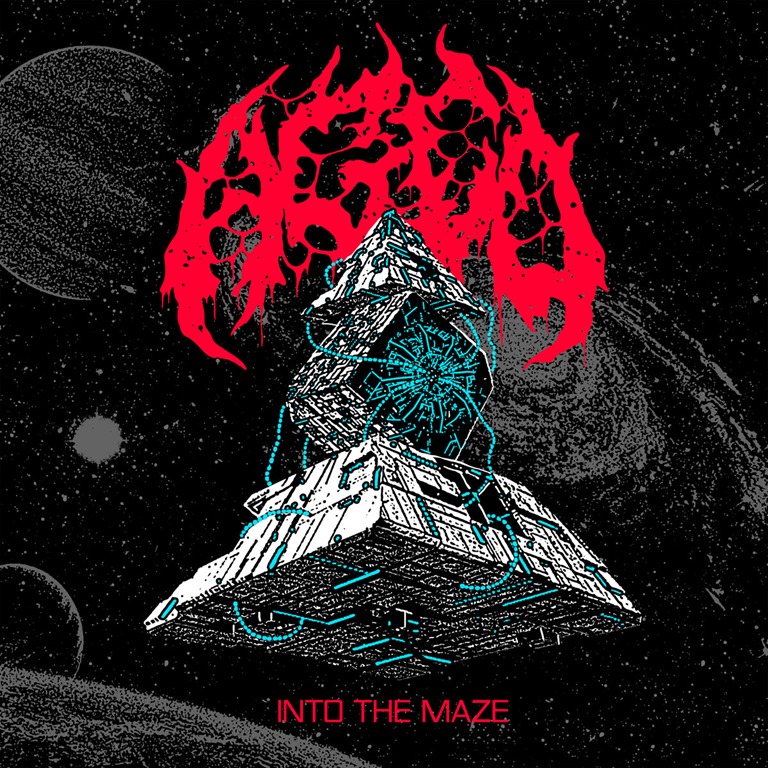
Into the Maze – a twenty-seven minute album – or mini-album – actually comprises two new songs plus four cuts previously released as the Collector EP.

You don’t listen to this stuff to be uplifted – but you do dive into it for escape, and Into the Maze brings that cathartic release.

The title track is monster slab of downtuned darkness. There are some guitar screeches which emerge from the relentless trudge that call to mind Fudge Tunnel, but this is denser, slower, doomier, and somehow less organic-feeling, like early Pitch Shifter but with live drums, and passing a nod to how they take ‘the swagger and groove of Entombed’s Wolverine Blues and infuse it with the tar-thick pull of doom’. But against Wolverine Blues, it’s half the pace and the lyrics are unintelligible grunts, so it’s very much an example of taking an influence and steering it in a different direction. And this is a good thing. The production is perfectly dingy and oppressive, and over the course of just short of half an hour it really grinds you down in just the way it should. In all, it’s pretty bloody brutal. I dig.

Oh, and that’s one hell of a logo.

AA

a3701776308_10

Northern Spy – 24th February 2023

Christopher Nosnibor

The Necks are never dull: an act that can be depended upon to deliver something different, which is no small feat for a band who’ve been going for more than thirty years. Travel sees them revisit the fundamental methodologies of Unfold, released in 2017 on Stephen O’Malley’s Ideologic Organ label. Admittedly, it’s not an album I’ve revisited all that many times since I wrote about it, but then, that’s true of many records I’ve appreciated. Some of it’s a time thing, but some of it’s an instrumental / jazz thing. I prefer to engage in the moment – and then the moment passes, and I too move on.

Where this album different from the majority of their others is that the format was integral to the form of the content, as the accompanying blurb points out, proving ‘four sub-20-minute pieces – instead of the typical 60+ minute arc for which the band is known – along with an obfuscated track list which leaves play order to the listener’s hand.’

Travel isn’t quite a straight live improv set, but does, they feel, come closest to recreating the live experience, and was recorded – save for some light overdubs and post- production – primarily live. And it’s very much oriented towards slow grooves and rhythmic repetitions. It’s hazy, mellow, almost sultry.

Side one is occupied by the twenty-one-minute ‘Signal’, built around a repetitive bass cycle and some rolling piano that brings with it a classical element, and, propelled by some busy hand drumming which transports the composition some way from what one would ordinarily expect off jazz-orientated works and into the realms of ‘world’ music (a term I try to avoid, with its connotations of western superiority and self-centredness, but sometimes short-cuts are necessary).

On side two, ‘Forming’, which again stretches languorously past the twenty-minute mark, is led by ripping piano, underpinned by some crunching bass stutters and rumbling groans. It’s jazzy in a psychedelic, Doorsy sort of a way. In this sense, it feels more like an extended mid-song workout than a piece in its own right, but it’s both pleasant and tense at the same time as it builds to a crescendo that never fully materialises.

‘Imprinting’, the album’s shortest cut at just over seventeen minutes, brings the multi-layered percussion to a more prominent position, and clanks and trembles along with almost hesitant-sounding keys and twanging strings drift in and out. It’s also perhaps the most overtly ‘jazz’ piece on the album, although it feels stretched out, the pieces pulled apart and as three instruments drift along together on a steady way, the sensation is quite hypnotic.

Organs always create a sense of grand scale and space, and the heavy drone and trill of ‘Bloodstream’ is utterly mesmerising. The piano is soft and ripples along atop the sustained mid-range drone as ethereal notes drift in and out. Part,

The album feels like a moment in time, somehow transient, and yet also something more. Travel may not really go anywhere, but it very much captures a mood – which is, for the most part, whatever mood you project onto it.

AA

Print

Thrill Jockey – 24th February 2023

Christopher Nosnibor

Some albums are so, so hard to review, because listening to them leaves you with no words. They stop you in your tracks and you sit, open-mouthed, speechless – thoughtless, incoherent. Blank. It’s not often this happens to me – unless it’s when presented with an album by BIG|BRAVE.

The Canadian trio made a huge impact with Vital, just under two years ago. They’ve been making waves since their 2014 debut, Feral Verdue, but hit a new seismic peak with this shuddering blast of minimalist rock. I’m used to knocking out a review in an evening, but that one took me an absolute age, because I simply ran out of words.

With nature morte, they’ve done it again. The title, in translation, is not dead nature, but instead refers to still life, or an image depicting inanimate objects. It seems fitting, not because it lacks movement, but instead because the spacious playing, slow and deliberate, creates moments where time stands still, frozen, suspended, and I find myself likewise frozen, my breath caught.

The formula may not be radically different from Vital, but the tone most definitely is. The dense, jarring music – and it’s music in the most minimal sense, shuddering chords crashing in, juddering and halting, simultaneous with pulverising percussion and it’s stark and harsh and heavy and suffocating, reminiscent of Greed-era Swans, and its exemplified nowhere more clearly than on the seven-minute opener ‘carvers, farrriers and knaves’. But then it builds into a truly monumental climax a mere three minutes in, and it’s clear that for all of their building tension, nature morte is an album of truly tempestuous release, and this is nowhere more apparent than in Robin Wattie’s vocal delivery. Here, her desperate, often plaintive, lost voice sounds more desperate, more trapped, more anxietised than ever. We’re accustomed to her sounding scared and but ethereal. Here, she sounds like she’s being buried alive and desperate to be heard and to escape before she suffocates under the weight of the music.

Of the six tracks, three extend well beyond nine minutes: epic is indeed the word, but none of the pieces feel overly long. In fact, the opposite is true: these are compositions not so much to get lost in, but submerged as if buried by a sonic landslide. ‘the one who bornes a weary load’ is a shuddering monolith of sound that thunders so hard it feels like the earth is shattering, and Wattie screeches and howls, ragged, anguished as if she’s clawing to dig herself out of a purgatorial hole and to cling for life with broken nails on fingers scraped to bone.

There are moments of softness, of quietness, delicate guitars ripple hauntingly on ‘my hope renders me a fool’ and ‘the fable of subjugation’, alluding to post-rock and even folk – if via latter-day Earth – and these moments are evocative, moving. But building to crescendos of monumental proportion, they’re the calms before the inevitable storms, making it impossible to settle back and drift along with these more delicate passages. Sure enough, around the four-minute mark, ‘the fable of subjugation’ erupts move violently than Vesuvius. The album may end on a light note with the short (sub-four-minute) acoustic song, ‘the ten of swords’, but one feels as though darkness lies ahead – as is fitting for a song which references the tarot card which indicates painful endings, deep wounds, loss, crisis, major disaster (or recovery and regeneration, depending on which way up it is). If you’ve seen the news in recent months, this seems unlikely, and it’s hard to imagine that nature morte offers light at the end of its long, dark, airless tunnel.

There’s still an aching beauty which permeates every second of the album, but it’s also ribcage-crushingly heavy and imparts a relentless pain and anguish that’s impossible to escape.

It’s hard to breathe listening to this. The weight lies heavy. For any expectations they may have set with Vital – and the bar was set hight to a point it was hard to imagine anything could even come close – nature morte smashes and obliterates them all.

AA

a3747569844_10

Cruel Nature – 6th January 2023

Christopher Nosnibor

The blurb prepares us for what to expect by explaining that ‘Finish Line is the debut EP from Seattle ex-pat Eugene Dubon’ and promising ‘Seven tracks of rhythmic bass-heavy post-punk fuzz atmospherics, with Eugene’s musings on subjects such as the goldrush and clocks drolly delivered in a dead-pan style. Unapologetic and upfront.’

Only, it doesn’t fully prepare us, because Finish Line is quite extraordinary. In amongst the morass of post-punk-inspired bands and tunes, Finish Line stands out for actually living up to any hype.

The title track smashes it all together: a nonchalant, level spoken word piece is pitched against some layered guitar and swirling noise, but it’s the relentless hammer of the drum machine that defines the sound and sets the parameters for the EP’s six tracks.

‘Last Page’ has a different energy, with a piston-pumping mechanised drum – more Big Black than anything else – keeping things tight against a swirling array of guitar chimes and Dubon narrates from a point of clinical detachment, with ‘Cruising’ proving particularly punchy and percussion-led. And thinking as the album progresses, Dubon’s monotone vocal is more Steve Albini than anyone else: croaking, cool, sardonic, detached.

Dubon’s deadpan delivery renders this as much a set of spoken word backed by music, but it’s not easy to pitch anything overtly literary or spoken word. You kind of lose yourself to the point that the words drift away, the vocals becoming another instrument, and that’s largely on account of the sameness of the delivery, the flat, evenness of it all, his dry baritone isn’t given to variety of tone or pitch, but it very much works with his material.

Halfway through ‘State’, while revelling in the fractal guitars, it occurs to me just how much this calls to mind Kompromat, the most recent album by I Like Trains, and ‘Signpost’ built around a repetitive loop of programmed bass and drum sounds like Sleaford Mods on heavy tranquillisers., with haunting Cure-esque echoes drifting in and out to provide accent and detail.

Rounding off with the slow, gloomy, ‘Conversation With Jean Claude Batois’, we find Dubon wandering into territory that sits somewhere between The Doors and Beat Generation jazz-infused spoken word poetry. It’s not a race to the finish line, but a slow, smoky and soporific meandering towards it. But the change of tempo is well-times, after six back-to-back bangers propelled by piston-pumping beats and snaking chorus-coated basslines. And while Finish Line clearly does belong within that post-punk bracket, it also sets Eugene Dubon apart as having an individual take on the template.

AA

a1915223150_10

Prophecy Productions – 3rd February 2023

Christopher Nosnibor

When I decided to strike out and create Aural Aggravation, the premise – at least in my head – was that I would write whatever I liked about whatever I liked, although the more detailed version of that was that I would pen essay-length reviews instead of the usual sub-three-hundred-word summaries that were, I suppose, about volume rather than depth. Equally, the idea at the time, back in 2016, was that it would be a vehicle by which to explore my relationship with music as much as the music itself. I haven’t always maintained this approach since: sometimes I’ve kicked out pieces simply chasing hits as the site has grown in its readership; others I’ve simply not felt like going deeper. And ultimately, I’ve thought ‘fuck it, my site, my platform’, and I have to say I’m comfortable with that. The quality of my writing is variable, and my typing and proofing even more so, but that’s part and parcel of keeping it real and with a view to the bigger picture that reviewing has to be – for me – about how I feel about the music I’m writing about. Because music isn’t something to simply be dissected clinically, assessed on technical merit. People listen to music because of the way it affects them, not because they’re on a battle of the bands panel critiquing like they’re judging Strictly.

You’d think that when things are unspeakably bleak and I’m facing struggles of a magnitude I find almost impossible to face, let alone articulate, the last thing I would want to do is wrap myself in a blanket of suffocatingly dark music, and that the last thing I could bear to listen to while in the process of arranging a funeral is anything by a band called FVNERALS.

But then psychology is complex.

I write to neutralise, to create distance. If it’s on the page, it’s not me, or my experience, it’s simply words. When I fell and broke my ribs some years back, I tore open the palm of my hand on landing. In shock, the first thing I did on arrival home wasn’t to clean the grit out and sterilize the bloody mess, but to photograph it. My wife asked why the hell I did that. It was a fair question. I hate blood, it makes me feel queasy, dizzy, faint. If it’s my own. A photograph of blood doesn’t bother me. So the photograph created separation. It was a hand, not my hand. If it had been my hand, I’d have probably passed out. A hand is just a picture, it’s just TV, like a movie.

I do not feel as if I am living in my own life right now. It doesn’t seem real. Having suffered a bereavement – expected, but at the same time unexpected – solace emerges from unexpected places. I’m not seeking comfort, and have no interest in exploring where I am on the journey of the five stages of bereavement. I am stepping back, and assessing the scene. It is not my life. And this is the soundtrack to my surveillance.

‘Darkness. FVNERALS have created an album that turns the emptiness of the void and the depth of the abyss into sound with their third full-length "Let the Earth Be Silent". The duo gives sonic shape to the silence of extinction that humankind brings to all life on earth and itself. Depression, isolation, and the despair that this existence brings ooze out of every note’.

Lead single and the album’s opening track, ‘Ashen Era’ sets the tone and is representative of the heavy, harrowing furrow the album ploughs, with warping, disorientating noise and disembodied vocals circulating in a mist around thunderous but muffled percussion. It’s all-immersive, dark, dense, and listening to it feels like being buried alive, but at the same time transcendental.

A crashing gong heralds the opening of the scene that is ‘Horror Eats the Light’, released back in November as a single. It’s a bass-dominated exercise in heavy, droning doom and ethereality.

The album’s song titles really do speak for the album as a whole: ‘Annihilation’, Yearning’, ‘Barren’. This is bleak and harrowing stuff. ‘Yearning’ begins brittle, before exploding into a landslide of crushing guitars bearing down. The beats – crashing a light year apar, paired with bass notes landing like detonations event minute or so, this is heavy, but a different kind of heavy.

‘Yearning’ pitches that kind of Swand circa ‘86 crawling dirginess with crushing weight paired with a sepulchral glooming ambience, while the album’s last track, ‘Barren,’ lives up to its title, presenting eight-and-a-half minutes of crushing gloom with ethereal vocals which ascend heavenwards like angels on a zephyr.

Let the Earth Be Silent feels like the final shudders of a dying planet, the collapsing death throes of eternity. It’s a vast and at times quite overwhelming experience. The sound is immense and there’s something of a ceremonial feel about parts of it, but elsewhere it simply feels like the outpourings of grief and is hard to listen to under any circumstances. It chokes you up. There’s something final and ultimately funereal about the droning organ that hovers out to the end, and it leaves you to reflect on the idea – the end. It’s beyond comprehension. But on Let the Earth Be Silent, FVNERALS have created an album that paves the way towards acceptance.

AA

a1345175263_10

Cruel Nature – 6th January 2023

Christopher Nosnibor

It’s something of a relief to discover that Score’s seventh long player for Cruel Nature isn’t some gentle exercise in self-help and mental health wellbeing, or otherwise the soundtrack to some existential post-pandemic breakdown – because the former are utterly fucking nauseating, and the latter, while I’m all for those primal screams of anguish, which I often find relatable, at least to an extent, variety isn’t only the spice of life but the key to staying within the marginal parameters of sane in an insane world. No, COPE, recorded in six weeks at the end of 2022, which somehow feels like a long time ago now already, takes its title from Julian Cope.

As the blurb explains, ‘the album was directly inspired by the musical descriptions to be found in the autobiographies of Julian Cope: Head On and Repossessed. Using Cope’s impassioned words as instructional starting points for each track, COPE references Mott the Hoople, Patti Smith, CAN, Duane Eddy, The Doors, Suicide, Dr John, Sly & The Family Stone and more.’

Julian Cope of one of those people who I’ve long been somewhat perplexed by, and, truth be told, haven’t spent too much time investigating, either musically or biographically. He has always struck me as having a career less centred around his relatively low-key musical output following a degree of commercial success with The Teardrop Explodes, and more around the fact that he’s Julian Cope. Some may want to set me straight on this, but right now, I don’t need to hear it, and a familiarity with the source material shouldn’t be a prerequisite of my ability to critique the work at hand, which interestingly, in drawing on his biographies, only serves to further indicate that Julian Cope spends more time writing about being Julian Cope than making music I need to hear.

COPE is a document to creativity under intense circumstances. To quote from the accompanying notes, COPE was ‘recorded as it was written, in one or two takes in a tiny garage and drawing on an old quote from the arch-druid himself as a creative manifesto: “It had to be very cheap, very fast, very loose. I needed to be an ambassador of looseness”’… ‘COPE is an exercise in embracing limitations and existing in the moment, a lyric-less love letter to Rock ‘n’ Roll itself, and a one-word command to the fried modern human.’

Containing nine instrumental compositions, COPE is a pretty demented journey, an absolute rollercoaster of a ride, that swings between psychedelia and krautrock, twangy desert rock, swampy jazz, with the six-minute ‘Brick’ bringing it all together with a Doorsy kind of trip with the added bonus of some woozy brass in the mix. ‘On The One’ goes deep into a funk workout that grooves hard, but ‘Old Prick’ stands out for its darker post-punk feel that suggests it could almost be a Psychedelic Furs or The Sisters of Mercy demo. The twelve-and-a-half-minute ‘Softgraundt’ is more than just expansive in terms of duration, and is a multi-faceted musical exploration that wanders hither and thither, shifting, evolving, a dozen or more songs in one. And perhaps this is the key to COPE – both the album, and the man. It’s everything all at once, and it’s more than you can really keep up with. It’s a challenge, and one I’m not entirely sure I’m up to, but there’s never a dull or predictable moment here.

a1384536327_10

Cruel Nature Records – 6th January 2023

If James Watts’ social media postings were to be taken at face value, you’d likely conclude he spends all his time loafing about, eating, giving the finger to his cat, shits a lot, and only showers before gigs. These may all be true, but he’s also ne off Newcastle’s most prolific purveyors of noisy shit, recording and performing with Plague Rider, Friend, Lovely Wife, Lump Hammer, Dybbuk, and Möbius, gigging locally on a constant basis, and touring frequently, too.

All The Heavens Were A Bell is a musical vehicle finds Watts collaborating with another prodigious powerhouse for scary dark noise, Esmé Louise Newman (Penance Stare, Petrine Cross, Fashion Tips, 1727), and A Wheel Of Burning Eyes is their second release, which they recorded in the spring of 2022, and it’s pitched – somewhat eclectically – as being ‘recommended listening for acolytes of Sunn O))), Coil, Deleuze & Guattari, Bastard Noise, Sarah Kane, William Blake, Les Legion Noires, Mark Fisher, Black Boned Angel, Laboria Cuboniks et al’.

I’m often intrigued when musical works reference literary sources as influences, especially when they’re not necessarily the obvious ones. Much as I am an immense fan and student of William Burroughs, I am conscious that his influence has been milked dry to a point bordering on desiccation. But what can be drawn from Mark Fisher and the labyrinthine complexities of the writings of Deleuze & Guattari to forge something musical?

Outlining an album created using ‘both self-constructed and commercially available sound machines, exploring the space between free improvisation and absolute intentionality, theopoetics, illness as vector, abstracted ritual, dread drone, trance-formation, black ambience, doomed electronics, hellfire submergence, and ophanim glow,’ A Wheel Of Burning Eyes offers intrigue and a certain intellect as its background.

Extrapolating all of that from the audio isn’t all that straightforward, of course. How it manifests on these two side-length tracks is in a shimmering, shifting wall of billowing noise. It’s not harsh, but it is dense, the churning drone of ‘Usurper, Destroyer’ churns clouds of sound on sound up on themselves, and there may be voices away in the distance or it might be your mind playing tricks or it might be tinnitus. Either way, it’s a gut-shredding experience expanding over eighteen minutes, and it doesn’t soften or diminish at any point – it’s a relentless grating grind of snarling noise as heavy as earthworks, and building to a thick, shredding wall of dense sound on sound that invites obvious comparisons to SUNN O))), but in fact does something quite different – and more intense – with the punishing layers and textures so rough as to tear off your skin several layers at a time.

‘Glowing Light of Ophanim’ references the wheels of the Lord’s Heavenly chariot referenced variously in the bible, and is derived from the Hebrew אוֹפַנִּים or ʿōp̄annīm. Many listeners won’t be that fussed about historical / biblical context detail when immersing themselves in these huge swathes of sound, but they ought to be, not just because it’s a tectonic slab of deep, dark, drone, but because it really does reach the parts so many dark doomy drone noise works never even get close to.

You feel A Wheel Of Burning Eyes resonate and reverberate around your body, encompassing and enveloping. And you know that this is special.

AA

cover

Human Worth – 3rd February 2023

Christopher Nosnibor

A shriek of feedback prefaces the gnarly blast of a monster rhythm section, thunderous drums paired with a snarling bass. And so begins ‘Short Distance Runner’, the first of six songs on Remote Viewing’s Modern Addictions. You know in an instant that it’s going to be good.

Of course, you know it’s going to be good before you hear a single sound.

Featuring members of Palehorse, Million Dead, Sly & The Family Drone, Nitkowski and Wound (to name but a few) is quite the underground supergroup. Plus, Modern Addictions is being released on Human Worth, which is in itself a guarantee of heavy, noisy shit of the highest calibre. So yes, you know it’s going to be good. But even then, it’s hard to be braced for something this good.

The guitar alternates between thick, sludgy chords and really sinewy lead lines that buzz and drill, twist and bend and wrap themselves around you and dig in like barbed wire. The tracks are backed back to back, making the cumulative effect of the heavy battering even more acutely felt. Single cut ‘Your Opinion is Wrong’, showcased here in December is broadly representative of the dense, chunky, churning sound of the album as a whole, but doesn’t fully convey the extent of its textures and variety.

It’s not all punishing density, and the band are keen to highlight that theirs is a sound that demonstrates a ‘broader sound that incorporates elements of hardcore, post-rock and shoegaze into the palette of sludge and noise-rock’.

There are some tight grooves amidst the racket, ‘Wasted on Purpose’ effortlessly transitions through a number of varied passages, from full-on balls-out riffage to delicate, evocative swirling post-rock chimes which gracefully convey a very different kind of emotional weight, and if the title ‘Cleveland Balloonfest ‘86’ suggests something bright and airy, sonically it’s more the Hindenburg disaster with it’s slow, low-slung growling guitar that grinds away at a crawl for six and a half anguish-filled minutes.

If ‘Watch Me For the Changes’ is a demonic dirge of epic proportions with a remarkably light ending (and you can’t help but suspect the title is perhaps a reference to the band’s directions for playing it) ,the final track, ‘A.B.B.A. ABBA’ springs an unexpected surprise as the band switch into disco mode. No, of course it doesn’t really. It’s seven minutes of dolorous doom, thick with atmosphere and dripping distortion. It’s the sound of weight so great that it feels as if it’s collapsing in on itself, decaying and crumbling on the way to a slow death, that leaves you feeling hollowed out and devastated. It’s the perfect finale to a superlative album.

AA

RemoteViewing_ModernAddictions_CoverArt

Christopher Nosnibor

The third – or fourth, depending on your source – album by electronic duo Akustikkoppler, is a work of starkness, of austerity, and a collision of vintage and contemporary, and quite the contrasting experience.

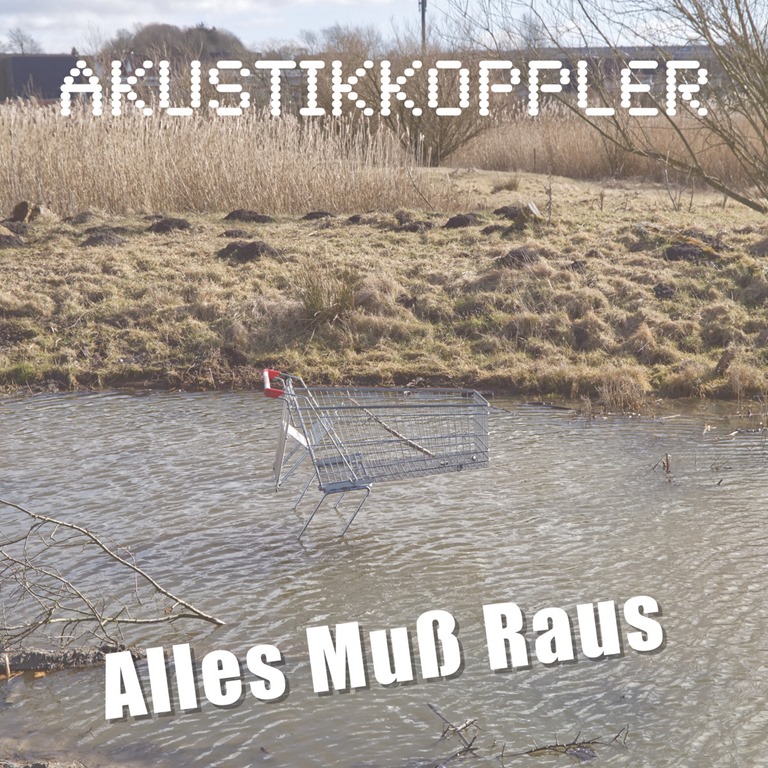
The cover looks like a photo I may have taken from my daily wanderings. I’m not saying it’s a good cover or a bad cover, this is merely an observation. The duo would likely say the same about the cover itself. It’s a snapshot that speaks for itself of the nature off people in our all-waste capitalist society.

I feel an almost inevitable shiver of nostalgia listening to this, despite the fact that the album’s style and sound predate my musical awareness. Instead, it makes me feel a nostalgic tug for my teens, when I was introduced to all of the weird and wonderful, experimental and starkly harsh music that had emerged in the late 70s and early 80s, to which Alles Muß Raus demonstrates a clear lineage.

As the blurb explains, ‘Inspired by the rough commercial industrial surroundings of Schusters Studio back then in Hamburg, Alles Muß Raus was produced on vintage and modern equipment. The two artists combine past and future to a sparkling, shimmering darkness.’ And industrial it is – not in the Ministry sense, but in the spirit of the early innovators utilising primitive synths, drum machines, and tape loops. And it ignites a spark of excitement, in that even now, this kind of music doesn’t sit comfortably with anything in the sphere of ‘normal’ music. The nostalgia, then, is in remembering how hearing TG, Test Department, DAF, et al for the first time completely changed my world, and my concept of what ‘music’ could be.

The analogue drum machines, mixed to recreate the sound of the late 70s and early 80s with a dominant synthetic snare is a defining feature. The first track, ‘Entrümpelung’ is a head-cracking, gut-smashing sub-bass groove that’s anything but vintage and pulls you in before the bass-driven churn of ‘Mitnahmequalität’ steps boldly into grinding, bass-led Throbbing Gristle-influenced industrial. In contrast, ‘Mittenmang’ is almost playful, with tempo changes and some d‘n’b rapidfire drumming bouncing alongside some busy, bloopy electronica. One of the shorter tracks, ‘Horses And Carriages Burn’ hints in the direction of The Cure’s ‘Carnage Visors’ while recreating the spirit of ‘Pornography’.

Entirely instrumental and assimilating so many disparate elements, despite some insistent grooves and accessible, melodic ,moments, Alles Muß Raus certainly isn’t a pop album, but contains many elements of electropop, even if the shade is turned down to twelve. While Kraftwerk may be an obvious touchstone, the vibe that radiates from Alles Muß Raus is much more DAF, with insistent, snare-driven beats driving relentlessly to define the sound and structure of a varied and meticulously arranged set.

AA

a1894982188_10

Mille Plateaux – 20th January 2023

Christopher Nosnibor

Less than a year on from Faces & Fragments, Neuro… No Neuro are back again with another substantial instalment of scratchy, glitchy electronica that’s rich in retro vibes.

Each piece is short – around two minutes – and drifts into the next. As the air floats past carrying soft analogue notes on a gentle waft, you suddenly realise you’re already five tracks in. It’s not that Compartments is undemanding, so much as that it’s subtle, meaning that it circulates in the atmosphere without dominating your headspace in an intrusive fashion.

The beats are backed off, even as they stutter and troll, flicker and jar. There’s a softness about the sounds and the way these woozy, warped snippets trickle together that’s almost soporific, especially when tinkling chimes cascade in ripples.

The Mille Plateaux website describes Compartments as Kawaii-Glitch (Kawaii being the Japanese culture of cuteness), noting that ‘The very artificial glitch aesthetics are not, as usual, depicted by a cold and sterile feeling; but quite contrary have the qualities of an artificial sweetener… Be careful when associating kawaii with just sweet, innocent or cute notions… just as Anime often masks grown-up topics with ‘childish’ surface structures, the album underlies a soft darkness & melancholy. Sometimes the unspeakable comes in disguise. Like the fashion style Yami-Kawaii, a bizarre mixture of kawaii-aesthetics with questions of depression and suicide, this album offers a mixillogical splice of life in which every second might take a turn into the irreal and eerie. To make distinctions between what is real and what are delusions, dreams or nightmares, emotional highs and lows, becomes impossible. In some sense it is ‘too much’ while still minimalistic in style.’

On the penultimate track, ‘Just Crumbling,’ things seem to come apart at the seams as stammering beats fly away from sounds firing in all directions like breaking springs. The temperature drops further at the finale, as those split sprockets echo into the cold night air and as the final sounds of the bonus-length last track, We’ll be Seeing You Soon’, which clanks and echoes for a fill four minutes, fade away, I sit, full, aurally content and calm… and worried. What subliminal toxicity has this album dispersed internally? How will I feel about Compartments once I begin to process and digest its multi-faceted contents? I don’t know but then, I don’t know if II trust what I heard, or my instincts on how to react. There is definitely more to Compartments than first meets the ear.

MP53_front