Archive for the ‘Albums’ Category

Room40 – RM481 – 13th July 2018

Christopher Nosnibor

Norman Westberg’s first full-length album since the termination of SWANS in its most recent configuration marks something of a departure, both in terms of sound and approach. Having previously recorded his solo works by what he calls his ‘one take; it is what it is’ method, After Vacation is a project of evolution, and also of collaboration, with Lawrence English acting as producer, weaving together the parts to create rich layers. The press release refers to Westberg’s ‘web of outboard processes, with delays, reverbs, and other treatments all transforming the sound of the instrument’s output. And yet After Vacation feels like so much more than this, as the guitar itself fades into the distance beneath the effects. The results are evocative, with careful details overlaid onto the broad washes of sound which define the compositional forms.

The album begins in expansive and haunting style, with what sounds like brooding, atmospheric orchestral strings and tense piano, but the shadowy shade of ‘Soothe the String’, like all of the album’s six pieces, features nothing but guitar. And with it Westberg creates lustrous layers of sound, drifting sonic mists and hazy hues. ‘Sliding Sledding’ forms an immensely deep, slow-turning swirl that moves like vapour, through which single notes ripple as they echo and fade.

The individual compositions are formed through subtle shifts and delicate transitions, and offer distinct and separate moods. However, they melt into one another, to create a vast vista of soft-edged ambience.

The title track which draws the curtain on the set marks a departure from the rest of the album, as Westberg picks at his guitar in an almost folksy fashion, and it sounds like a conventional guitar, although it’s accompanied by an organ-like drone that hovers in a long, unchanging note, which gradually rises to the fore as the plucked notes fade into the distance.

There’s a certain comfort in this conclusion, bringing the listener as it does to more familiar ‘guitar’ territory while still emblematising the experimental, treatment-orientated approach to reconfiguring the sound of the instrument.

#

AA

Norman Westberg - After Vacation

Ventil Records – V008

Christopher Nosnibor

Variations on Bulletproof Glass follows 2016’s Decomposition I-III which also featured Christina Kubisch, and set out to explore – and demolish – the well-worn thematics of field recordings.it represents something of a deviation in terms of its methodology, as well as its focus. This fourth decomposition collapses material rather than location, and places a very different focus on the concept of field recordings, centring not on the out and about, but the controlled space, and with a clearly defined specificity.

Variations on Bulletproof Glass is a literal title, being constructed from ‘waves which were transmitted through a bulletproof glass pane while it was exposed to major physical impacts’. But of course, like most works which are devoted to a microcosmic sound source, that source becomes increasingly obscured the closer the lens looms. While there are moments that do sound vaguely evocative of glass, cracking and splintering, there’s not a single classic crash and tinkle, a solitary smash and splinter. None of the sounds here betray their origins, and Kutin and Kindlinger have manipulated the source material to forge something altogether in a different sonic sphere from the pieces that lie scattered at source. There may be hints of scrapes and ricochets on/off glass, but there’s nothing which overtly says ‘this the sound of glass’ in the (de)construction of these samples. Because this is bulletproof glass, for a start. It has different properties, and can withstand greater punishment. The consequence is that so must the listener: this is challenging, and difficult to readily access.

‘X26’, the first of eight pieces, clanks and scrapes, and the chanking treble is countered by woozy bass. It has all the hallmarks of experimental dub, and even builds some dense, gut-churning rhythmic pulsations and dynamic beats – none of which even hint in the slightest at the source of the sounds. ‘Throne’ is a jolting, stop/start attack, and Elvin Brandhi’s vocals are stark, dishevelled, wild and wide-eyed. ‘PANE#2’ blasts away at a beat that echoes Throbbing Gristle’s ‘Discipline’ as synth-like sounds howl and wail aggressively before tapering to a quieter place.

Elsewhere, the sonorous, trilling done and scrape of ‘L.I.W’ is uncomfortable, and not for a single second does one listen to this and think that this is an album to mellow to, or even to function to. It’s not just distracting, but the sound of abstract obstruction.

AA

Kutin Kindlinger – Decomposition IV

The Sublunar Society 053 – 11th May 2018

James Wells

Just as Facebook advertising and Amazon recommendations prove that algorithms can be applied usefully but are no substitute for human input.

Of course, The Rosenberg Algorithmic Music Generator is subject to human input, in that it was created by Mick Sussman himself. A programme is designed to ‘compose’ ‘unique’ music, by ‘making decisions based on a sequence of randomised processes.’ The nineteen compositions collected here seem to suggest a greater leaning toward the random than the musical. There are notes and there are rhythms, but none of them seem to coordinate with one another, and the sounds are trebly synthetic, 80s computer gamey. The cover art has obvious ‘matrix’ connotations, and tells much of the story of what The Rosenberg Algorithmic Music Generator is about. Only, this is the sound of the matrix collapsing, of being stretched and pulled in all directions, twisted and tossed.

Sussman observes in the liner notes that in programming terms, Rosenberg is a primitive piece of coding, but is sufficiently versatile to enable him to vary musical phrasings and tempos – to the extent that one option enables the user to allocate a different tempo to each instrument. Why would anyone do this? Because, I suppose. It’s an indication of Sussman’s adoption of avant-garde principles, to disassemble and reconfigure that which has gone before, to build anew. It may well be that no-one has done this before not because they haven’t thought of it, but because they didn’t want to, but that’s every reason for Sussman to be the first.

The result is a disorientating, bleepy, bloopy clamour of sound, with digital notes flying in all directions in an exercise where the concept is considerably more appealing than the experience of the end product.

AA

Mick Sussman – The Rosenberg Algorithmic Music Generator

Alrealon Music – ALRN083 – 20th April 2018

James Wells

The title of Anita Loos’ 1925 novel and the 1953 film starring Marilyn Monroe may have passed into general acceptance, but if gentlemen prefer blondes, I personally prefer brunettes myself. Make of that what you will, but as such, a house of blondes has limited appeal ordinarily, although on hearing this, I’m inclined to make an exception. Time Trip is a varied and expansive electronic-led work which forges expansive spaces with nebulous synths and insistent beats.

‘Discovery #1’ builds ambient eddies of sound around a droning organ synth atop a motoric groove, and there are infinite nods to the likes of Kraftwerk and Tangerine Dream here, as undulation, oscillating synth repetitions bibble and tweet over long, undulating synth drones and insistent, repetitive beats.

There’s some droning, modular crackle and fizz to the yawning oscillations of ‘Mean Solar Time’, and the overall sensation of Time Trip is one of reaching back. It plucks flickers from shoegaze and ambience as well as the origins of electronica, positioning itself within a slow-arcing trajectory without defining its place in concrete terms.

This is music that billows, ripples, throbs and pulses, and is content to loiter on the peripheries of the focus-zone. The beats flicker and click, pitter and patter, while the synths glister and gleam, twisting in flange-soaked zero-gravity. It all feels very familiar, but at the same time, it’s rather nice.

AA

House of Blondes – Time Trip

Ritual Productions – 21st June 2018

Christopher Nosnibor

It’s perhaps fitting that self-professed occultist doom collective Drug Cult should unveil their debut long-player to coincide with midsummer’s day and the solstice.

They open with a nine-minute sludge-trudge that’s bursting with the trappings of psychedelia and old-school hard rock: ‘Serpent Therapy’ starts so slow, with so much distance between each chord that it sounds like an ending, a protracted grinding to a halt, rather than the start. Yes, this is slow, and this is heavy. The guitars are close to collapsing under their own weight, and threaten to bury Aasha Tozer’s reverb-drowned vocals in the process. It’s the soundtrack to a bad trip into the underworld, and while there’s nothing of such epic proportions to be found during the remainder of the album’s nine tracks, the darkness remains all-pervasive.

There’s a classic, vintage quality to the songs, but it’s all sludged up, twisted and messy, and what the songs lack in duration (the majority are below the four-minute mark) they more than compensate in density. The riffs lumber slow, low, and heavy, the bass grinds just as slow and even lower: the percussion doesn’t propel, but instead lands in thunderous ricochets while the cymbals wash in tidal waves. In fact, it’s like listening to an early Melvins 45 at 33, save for the vocals, which never sound anything less than borderline deranged.

The sense of volume is immense, speaker-shredding, earth-shattering. And just when it doesn’t seem possible to drive any deeper, grind any lower, ‘Bloodstone’ reaches a new low in low, the essence of doom-laden hard rock riffing distilled to its absolute. The form is still apparent: Drug Cult don’t take it beyond the limits as Sunn O))) do, but against contemporaries like Esben and the Witch and Big Brave, Drug Cult stand out for their concision and their eschewing of passages of levity: this is unforgiving, ultra-heavyweight from beginning to end. As such, it’s a truly megalithic work. Worship it.

AA

drug-cult-drug-cult

ROOM40 – RM491 – 12th April 2018

Christopher Nosnibor

It’s not even as much as a distant rumble. It’s barely the sound of air. An uneven hum eventually creeps into the realm of audible perception, but it’s still so quiet as to be questionable: is my mind playing tricks? Am I imagining sound to fill the silence. The whir of the disc in the player is still louder, and stands to the fore because of its higher pitch. But no, the rumble is growing now. I’ve been sitting here for three minutes or more, but now, the sound is upon me, and it’s like an approaching helicopter, thick, beating the air. It reaches a point of sustained crescendo, from whence if continues to grow, from a low roar to an excruciating multi-tonal blitz that fills the room and fills my head. Treble whines and drones above the gut-clenching low-end and scrapes. It makes for an intense and unsettling ten and a half minutes, and I’m reminded, perhaps inevitably, of Merzbow and Kenji Siratori in the way the piece’s power stems not only from the detail of tone, texture and volume: the shifts are gradual, but definite. And then it stops. Silence. The contrast. The silence is more bewildering than the noise, at first.

Thus I am introduced to the work of Australian artist Thembi Soddell. Love Songs is an exploration and articulation of experiences of ‘insidious forms of abuse within supposedly loving relationships, in connection to certain forms of mental illness.’ The album succeeds in that Soddell conveys the relatable, if not necessarily the universal, in the personal. Without the specificity of lyrical content, the listener is necessarily invited, even compelled, to pour their own experience into the spaces in the sound, to interact with the moments of dissonance and discomfort.

At times eerie and tense, at others calm, yet always with a certain undercurrent of unease, Love Songs is every bit as dark as the cover art implies. The accompanying text summarises it nicely, saying ‘it’s equal parts horror, anxiety, relief and exhilaration, often in the same instant.’

‘Repetition Compulsion’ alternates hushed passages with seering screeds of noise which halt abruptly and unexpectedly, and if ‘Who is to Blame’ employs the same type of approach, the explosions of noise are of an altogether different intensity, an all-out wall of noise that’s full Whitehouse at times, although Soddell’s focus on tonal variety is the key point of interest here. The final composition, ‘Epilogue’ returns to the territory explored on the first, ‘Object (Im)Permanence’, beginning as silence before erupting into a sustained, violent, sonic assault. The screaming upper frequencies are pure torture, and as the howl and whine of the sounds fuse to form an oppressive, painful and impenetrable wall, it feels like it will never end. And you want to… but equally, you don’t. I let the sound engulf me and a certain energy courses through me. Where is the release? There. Finally, in the arrival of silence. The end.

AA

AThembi Soddell – Love Songs

Touch TO:104 – 25th May 2018

The Revenant Diary feels like a long time ago now: perhaps because it was. Six years is long time (although Mark Van Hoen has released two albums as The Locust in between). And yet, it continues to haunt me in some way. Returning with Invisible Threads, Mark Van Hoen continues to explore ominous, shadowy territories.

This is a dark, immersive work. I’d had a tough – and very strange – day at work. Oftentimes, when weary, stressed, dazed, I will select an instrumental work as my review project for the evening, as I find I can simultaneously write and relax, allowing the sound to wash over me. It transpires that this may have been precisely the album – or not, depending on perspective – for the occasion. I say, staring blankly. Not really listening, not really engaged, and certainly not typing. Not thinking, and not doing anything else. I don’t know exactly how long I remained like this, to all intents and purposes, immobile, in a sort of fugue state.

On returning, and attempting to remain focused, I find Van Hoen’s dark, churning sonic nebulae every bit as arresting and distracting.

The album’s inspiration stems from multiple sources, not least of all Edgar Allen Poe’s short story The Conversation of Eiros and Charmion which he re-read while on tour. The album is in some respect designed as a soundtrack to this, but equally, the Invisible Threads refers to the intangible connection between all of the musical and personal influences that brought the record into being.

In truth, the context and background have only limited effect on the reception. The reception is pure: a direct engagement between sonic output and listener.

Low, humming, hovering tones undulate across the album’s seven subtle compositions. Creeping, interweaving, fragmentations of light dance across these cold, bleak expanses which often bleed together. Even the silence between seems to provide an integral part of the listening experience and contributes to the shape of the overall arc of the album.

It’s distinctly background but in a way that fulfils that criteria of ambience that affects and colours the mood rather than being sonic wallpaper, disappearing into the background unnoticed. Repeated listens to Invisible Threads have not lifted my mood: instead, I feel claustrophobic, tense, weighted by an indefinable oppression. I give up: my critical vocabulary is as exhausted as my mental state when faced with this album at this time. I take a shower. Reflect. Accept that perhaps this work is so immersive that I am, temporarily, drowned.

AA

Mark Van Hoen - Invisible Threads

Christopher Nosnibor

The missive which contains a link to the album lays out the facts. ‘August 2015: On a sweltering summer evening, Sly & the Family Drone brought their sweat-soaked carnival of chaos to east London. This is a recording of that night.’

Café Oto seems to be the venue of choice for weirdy, avant-garde experimental acts to capture their live sound – or perhaps it’s one of the few venues that truly embraces all that it weirdy, avant-garde and experimental in the first place. This, of course, is one of the benefits of operating on a not-for-profit basis. Art takes precedence over capital. It’s also an intimate space, where even a small crowd will make the place feel like it’s heaving, and it’s possible to really feel that connection between performer and audience in an up-close setting. Truly, here’s no substitute for being able to smell the sweat and see the whites of a perfomer’s eyes

Sly and the Family Drone have been pushing the parameters of messy noise for about eight years now, and while their recoded output explores all areas of murkiness and abrasion, their live shows are something else. Chaotic and cathartic, the only predictable part is percussion – that is to say, a lot of percussion.

This particular outing is heavy, and percussion-heavy from the outset. Thick, low-end blasts thunder through pounding drums. The percussion intensifies in both power and pace, while the droning bass frequencies bottom out to a place below the pelvic region while explosions of top-end squeal painfully. Less than ten minutes in, and they’ve hit total overload. Over the course of the album’s hour-long duration, they maintain it, and if anything, continue to push further, harder, louder, harsher. Crescendo hits after crescendo, and cumulatively, it’s punishing – in the best possible way.

It’s not just a hell of a noise: it’s all the noise. Even when the noise abates and the relentless battery of snare halts temporarily, eardrum-perforating feedback and whirring, hissing shards of treble fill the space. Through speakers, it hurts. Once can only imagine the impact and potential damage inflicted on those actually present. This is less a case of ‘you probably had to be there’ and more about ‘damn, I wish I’d been there’.

AA

cover

Young God Records

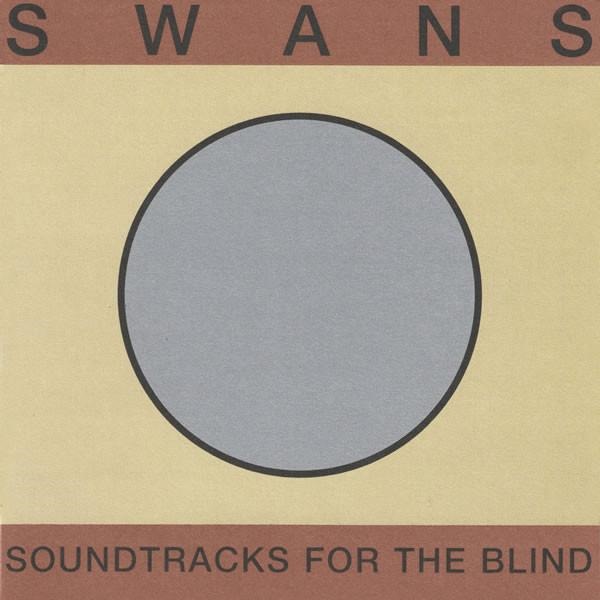
It’s perhaps too much to convey the experience of hearing Soundtracks for the Blind for the first time on its release in 1996. Admittedly, hearing any Swans release for the first time was memorable – I was introduced in the late 80s via Children of God, which, aged 17, was unlike anything I had heard before. It was what one might call a pivotal moment. I was compelled to explore their back-catalogue, which yielded a succession of further pivotal moments, not east of all on the discovery of Cop.

For all its length, The Great Annihilator was pretty straightforward, and represented a continuation of the White Light / Love of Life albums. Just a year later, Soundtracks for the Blind was altogether different, and represented a new expansion on all levels. It was about three hours long, for a start. The third song was over a quarter of an hour long, and there were extensive instrumental passages that bordered on ambient. Elsewhere, reworkings of older songs, bent almost beyond recognition (‘YRP’ and ‘YRP 2’ emerging from ‘Your Property’ from 1984’s Cop), surfaced amidst the churning soundscapes drawn from the contents of the library of tape loops and found sounds gathered by Michael Gita over the band’s whole career. It felt like the culmination of a lifetime’s work. It felt fitting it should be Swans’ final studio album, and it seems appropriate that its remastered reissue should arrive when Gira has again called time on the band. Its arrival gives us cause to reflect on the cyclical nature of the band’s career, and the differences and similarities between their first unbroken span and their later incarnation, which closed with another uber epic in the form of The Glowing Man and followed by a live document (as Soundtracks was accompanied by the conclusive Swans are Dead, so The Glowing Man was accompanied by Deliquescence).

This is the first time Soundtracks has been released on vinyl, and naturally, its formatting and packaging is something else: as the press release and Young God website detail, ‘the vinyl package will consist of four LPs in jackets enclosed in a box with a poster, insert and download card. The box set will be a limited edition of 4,000 copies worldwide and once sold out will be followed later in 2018 by a gatefold LP version. The album will also be reissued on CD featuring a repackage of the original digipak for the 1996 Atavistic release plus a bonus disc of the contemporaneous Die Tür Ist Zu EP (a German language version of some of the material from Soundtracks that also includes unique material) recently released for the first time on vinyl in the USA for Record Store Day 2018. Outside of the USA, Die Tür Ist Zu EP will be released as a limited edition companion piece double vinyl set, also on 20th July’. Yes, as with the previous reissues, they’ve gone all put to render a truly definitive edition.

Listening to Soundtracks now, it seems that Gira, having declared the band spent in 1997, spent a long time cogitating over the directions and possibilities that this album presented, and took them as the starting point for the post-millennial iteration: it certainly shares more with this period than its predecessors, with exceptions like ‘The Yum Yab Killers’ which delivers the same kind of punch as ‘Mother/Father’ on The Great Annihilator (and recoded live, with somewhat muffled sound, it still seems a shade incongruous in its inclusion here, although Jarboe sounds so fucking fierce I’d not want to make to big a deal of it). We’re reminded, too, that Soundtracks emerged during a fairly prolific spell for Gira, and it’s perhaps inevitable that elements of other projects – namely the solo album Drainland and The Body Lovers / The Body Haters. ‘All Lined Up’ is a different version of ‘I See Them All Lined Up’ which featured on Drainland. It’s simultaneously more distorted and weirded-out, and more explosive, more driving, more… Swans.

Some of the rambling monologues are quite disturbing (with recordings of Gira’s father talking about his life and excerpts from FBI tapes, amongst other things), but then so is the musical accompaniment that provides the backdrop: ‘I Was a Prisoner Inside Your Skull’ and ‘How they Suffer’ make for uncomfortable listening.

There are some incredibly tender, raw, emotive moments: Gira’s voice, cracked and plaintive on ‘Animus’, as woodwind bursts around him from a hovering hush, is one of Swans’ most affecting moments. For a band whose back catalogue contains some of the most intense sonic brutality ever committed to tape, it’s quite a contrast, and perhaps all the more moving in context.

It’s a sprawling expanse of sound, and it isn’t entirely cohesive. Gira’s conception of sound as something malleable and his approach to dynamics would evolve immensely in the time away from Swans, and as such, Soundtracks is as much a signpost toward the next phase as a bookend to the one it belongs. At the time, it was almost too much to digest. On revisiting, the same holds true. The density of both sound and ideas, the sheer scale of the album, the fact that it condenses fifteen years into two and a half hours… of course it’s too much to bear. This was always the way with Swans: even their gentler albums are delivered with an intensity that transcends words. And this, of course, is the ultimate objective of music – to touch body and mind in ways that are beyond any form of articulation. Soundtracks for the Blind doesn’t simply touch those parts, but poke, prod, squeeze and stab at them.

AA
soundtracks_grande

Unsounds – 60U – 1st June 2018

Christopher Nosnibor

Tout ce que je sais is the second part of Chaton and Moor’s ‘Heretics’ series, which, according to the blurb, sees the duo ‘revive the most obscure, violent, erotic passions, summoning the great gures of their personal mythologies. In the company of Caravaggio, Marquis de Sade, William Burroughs and gures such as Jose Mujica, the duo immerses the listener in another world history peopled by radical thinkers’. ‘Heretics’ pays homage to those heroes who have used transgression and excess as a necessary means for creation. In this new album, recorded live at the Carreau du Temple in Paris on the occasion of Périphérie du 35e Marché de la Poésie (2017), Anne-James Chaton and Andy Moor deliver a radical work at the confines of literary and musical creation.’ The first release came in a giant matchbox, complete with textured side and a huge matchstick. No, I haven’t burned my copy. Yet.

The fact it is a live recording creates a certain degree of difficulty in terms of how to weigh its realisation. Granted, there’s an immediacy to the stuttering, fractured ruptures of dissonance what scratch through at forty-five degree angles to the rhythms and overall shapes of the compositions. But to doesn’t feel like a definitive document: something is missing.

‘Casino rabelaisien’ is a stark, minimalist grind, throbbing and churning away at a short, repetitious sonic loop of bass and extraneous discord reminiscent of Suicide and with cluttering, scratchy guitars that call to mind The Fall pre-1980. The murky sound accentuates the claustrophobic atmosphere, and Moor’s monotone delivery. The words being spoken in French mean I’m excluded from their meaning and from their sense. Oftentimes, the language of sound is enough to transcend linguistic barriers. But with the musical aspect so minimal and the vocal aspect so much to the fore on this work, I fear that much of the significance – and quite simply much of the content – is lost. Burroughs et al – this is my field, so to speak. But I simply don’t recognise it, let alone connect on a level where I can engage critically in terms of its conceptual content. Nothing about Tout ce que je sais conveys the brutal perversion of de Sade on a sonic level, for example, and there’s nothing that brings the bewildering explosion of ideas or the narrative fragmentation of Burroughs’ writing here.

‘Conquins coquettes at cocus’ jolts and jars, the crunching guitars choppy over a haltering, stuttering rhythm worthy of Shellac. It’s sparse in instrumentation, but it’s intense, and Moor’s dry, almost inflection-free delivery provides a counterpoint and contrast.

There’s something deep and haunting in the very notes of ‘Clair Obscur’, but the limited instrumentation means it feels somehow incomplete, unfinished. And then here’s the applause and the shouting from the audience immediately after; while being there would have almost doubtless have been a quite remarkable experience, the material would equally doubtless benefit from a proper studio realisation in order to capture the nuance and the detail of the compositions and their arrangements.

‘The Things That Belong to William’ closes the set; a slowed-down, opium-slurred Burroughs drawl creaks through the jolting, jarring spasmic guitar chords. It’s interesting and uncomfortable, but doesn’t go any real distance to create the same kind of temporal dislocation of Naked Lunch or any of Burroughs’ cut-up works. Is this a failing? Probably not in real terms. We land, then, at a place where we’re faced with the disunion between expectation and actuality.

AA

Anne-James Chaton & Andy Moor – Tout ce que je sais