Archive for December, 2023

Spleen+ (Alfa Matrix) – 1st December 2023

Christopher Nosnibor

Christmas has come early this year, with an absolute deluge of releases landing on1st December, many from acts I like or am otherwise keen to hear. Hanging Freud are in the former bracket, and Worship marks their seventh album release, following 2021’s Persona Normal.

The duo have established themselves as purveyors of premium-quality dark, stark, gothy electro, and with Worship, they solidify their position with aplomb. Persona Normal was recorded at a leisurely pace between 2018 and-2020, and, like so many other releases in the last couple of years, Worship was written and recorded during the pandemic and under lockdown conditions, and the accompanying notes lay out both the contents and context in further detail:

‘The 10 songs featured on this album literally come from a place of contradiction hanging somewhere between courageous vulnerability and fearful resilience, and deal with themes such as collective distress and loss, finding beauty in tragedy or yet questioning about what makes us human in the symbolic contrasts of life and death…. It’s no surprise to hear that this “less is more” introspective ode to melancholia was written in particular claustrophobic circumstances during the pandemic lockdown. “Because of what was going on, we were essentially stuck in temporary accommodation in Scotland, away from our studio and forced into a period unexperienced before. The songs that came out therefore come from a different place. Everything was done within a laptop and is proudly 100% digital. It was recorded and mixed while literally sitting on the side of a bed in a mouse infested apartment…” explains Paula Borges.’

If it sounds like a grim and oppressive set of circumstances for creating art of any kind, then the singles which prefaced the album have set the tone and expectation, while affirming the claustrophobic intensity of the music which emerged from these challenging conditions.

The result is a hybrid of Siouxsie and 17 Seconds era Cure with a hefty dose of New Order’s Movement and dash of Editors circa On This Light and On This Evening. Reference points may be lazy journalism, but they serve a purpose. While this album stands alone like an icy obelisk, singular and a monument to the darkest introversions, some musical context is probably useful for discursive purposes.

The stark ‘Falling Tooth’ is as bleak and haunting as it gets: Paula’s vocals are breathy but theatrical, pitched over a strolling squelchy synth bass and a vintage-synth sound that wanders around over just a few notes, while ‘I pray we keep the world’ is low, slow, sparse, and lugubrious, as well as emotionally taut, and dominated by a truly thunderous drum sound. ‘This Day’ is particularly drum-heavy, withy only gloomy, droning synths sweeping through a heavy mist of atmosphere.

There are some who bemoan the use of drum machines, and who complain that they lack the vibe of a live drummer. Hell, there are contributors to forums and groups devoted to The Sisters of Mercy who question why they don’t get a real drummer, some forty-two years on from their inception. These people are missing the point. Drum machines can do things that human drummers can’t, and one of those is how drum machines can be louder, heavier, more monotonous than a live drummer. And in context for certain music, this can be a real asset, accentuating the sensation of dehumanised detachment of synth music that sits at the colder end of the spectrum. And Worship is one of those albums which will leave you with chapped lips.

It’s against brittle snare cracks and sweeping synths that Paula claws her way through complex emotions, and where the lyrics aren’t immediately decipherable, the haunting vocal delivery is heavy with implicit meaning. It resonates beyond words alone. Everything is paired back to the barest minimum, exposing the darkest recesses of the psyche.

Standing alone as a single, ‘A hand to gold the gun’ was bleak and heavy. Sitting in the middle of the album, this sensation is amplified, accentuated, and the gracefulness of the vocals as they drape around the broad washes of sound which surge and well is that of a dying swan.

‘Her Joy’ is perhaps the least joyful thing you’re likely to hear in a while, and if ‘Beyond’ feels somewhat uplifting, it’s only because it’s a flickering candle flame in an endlessly dark tunnel, as devoid of air as light. The mood is heavy, and presses on the chest, slowly pressing the air out and crushing the spirit, and as the album progresses, the effect is cumulative. By the time we arrive at the piano-led ‘Don’t save yourself for him’, I feel my shoulders sagging and my back hunched forward from the endless weight of this.

Worship is a masterful exercise in poise and restraint, a work which conveys the purest essence of isolation, of desolation.

AA
HFreud

The Kut just re-released her holiday single ‘Waiting For Christmas’ with £1 of every CD, vinyl or download sale & all streaming income going to Music Venue Trust this year.
According to MVT statistics, over 120 grassroots venues have closed in the past 12 months, including the shock closure of the iconic Moles Club, Bath this week.  There are also a further 84 venues in trouble, as grassroots venues continue to struggle despite their huge impact on artist development and the communities they serve.

“We know how important our grassroots music venues are, we live them and breathe them and so are delighted to support MVT in their goal to protect, secure and improve them” explained Maha (AKA The Kut) in her blog announcement this week.

Watch ‘Waiting for Christmas’ here:

The news comes alongside her confirmation as main support for legendary Canadian rocker Danko Jones on his imminent UK tour leg.  Hosted at a number of iconic venues this December, the tour visits Bristol, Glasgow, Nottingham, Manchester and London in a final 2023 showdown for The Kut and her all-star collective.

Initially released in 2020, ‘Waiting For Christmas’ is a melancholy take on the holiday period, highlighting the sombre pressures surrounding it, yet with an uplifting message, completed by orchestral strings and Christmas bells. The single charted in the Top 100 of the Official Single Sales Chart (No.65) and at No.10 in the UK Physical Singles Chart on release, where it has subsequently spent 6 weeks.
Recorded by Jack Ashley (Popes of Chillitown) at Fiction Studios London and mastered at Abbey Road by Frank Arkwright (e.g. Elton John), the accompanying music video was filmed during the recording session and selected for US airplay by MTV, LATV and Music Choice.

DANKO JONES + THE KUT

UK TOUR DATES

12/12 Thekla BRISTOL
13/12 King Tuts GLASGOW
14/12 Rescue Rooms NOTTINGHAM
15/12 Rebellion MANCHESTER
16/12 Garage LONDON

AA

Iob8n0Jdo4Vm

Panurus Productions – 1st December 2023

Christopher Nosnibor

What better way to mark the start of advent than with a new release on Newcastle’s Panurus Productions, home of noisy and weird shit on tape, eh?

This latest offering covers both bases, being noisy and weird, but predominantly weird.

Panurus releases always come with cracking explanatory notes, and they’re worth quoting for this one, too:

‘Glitching and laced with interference from its temporal transit, Splat R. intercepts nine broadcasts of lo-fi noise drenched beats from a possible future. Hooks lead you through what could be samples, generated electronica or interference noise, that at times meshes and augments the beat and others swells over and underneath it with a sense of menace. There’s a sense of retro-future to the album in its tones and the recognisability of some of the sound used, but presented as if those ideas were carried further forward before being thrown back towards us, warped and distorted; as if it was constructed from pieces of culture scavenged in the aftermath of some distant cataclysm.’

My work here is done.

Of course, I’m not being entirely serious, but whereas many press releases bring a heap of hype, much of which is a world apart from the product being presented, or otherwise fails to really explain what the release is about, Panurus always absolutely nail it in their summaries.

But of course there is more. ‘Kill Spill Thrill’ is a murky, messy mash-up which evokes The Last Poets, Dalek, and RZA’s Bobby Digital, as well as glitched-up, chewed-up, mangled elevator music. It’s chilled-out hip-hop, trip-hop, and ambient tossed together, melted down, and left to fester and ferment for a while. ‘peace to you, if you’re willing to fight for it’ adds a whole load of wrecking bass and distortion to the bubbling dingy mess, lurching into the territory of dirty experimental industrial noise in the vein of Throbbing Gristle, only with samples thrown in hither and thither. ‘reality denied comes back to haunt’ is plain fucking horrible: lurching booms of thunderous noise and trills of feedback and wailing synths pushed to their limits in a power electronics meltdown suddenly segues into a crackling mess of club-friendly dance, but distorted in a nightmarish way.

‘authentic creation is a gift to the future’ lurches so hard as to reach the pit of the stomach, before ‘there is nothing new under the sun, but there are new suns’ pumps a beefy beat that’s pure nightclub – but obviously, the vibe is anything but buoyant or euphoric. It’s bad trip, apocalyptic, the dance dynamics distorted to the shade of a nightmare, fizzing sparks and subsonic detonations occurring simultaneously, like a nuclear blast landing a direct hit on a night club.

I can’t decide if I need to puke or shit as the messy mass of stuttering overload stammers and rolls and lurches onwards. This is glitch of the highest order: the briefest, almost imperceptible of stammers are amplified to the most uncomfortable, blurring, bilious horrors which emulate the worst post-binge room-spin.

Kill Spill Thrill is a splurging, intestinal-churning, head-shredding sonic attach that lands thick and heavy. For all of its touchstones, it doesn’t sound quite like anything else, and it rips the ground before it to devastating effect.

AA

Cover

Chicago-based electronic pop artist Brittany Bindrim has released her debut single, ‘Obelisk’, today on Metropolis Records, accompanied by a beautiful yet dystopian video directed by Simona Noreik. Known for her catchy melodies and powerhouse vocal performances in the post-industrial rock band I:Scintilla, Bindrim now ventures into foreign sonic terrain as a solo artist with this hard-hitting, edgy song packed with punishing beats and harsh synthesisers.

This new chapter of Bindrim’s career takes her into experimental territory along with producer Matt McJunkins (A Perfect Circle, Puscifer, Eagles of Death Metal, Poppy). While the lyric for ‘Obelisk’ explores themes of tribalism, political divides, collective trauma and a surrendering to peace, Bindrim states that its music “is an interplay between the words and harder-edged, percussive musical elements. The heavier drums and the main driving bass synth line were written first, which then inspired a pleading vocal melody. I had previously written a lyrical seedling that was close to what ended up in the chorus lines, which I thought fit perfectly and helped spawn the rest of the lyric in conjunction with the harder, marching energy of the music.”

‘Obelisk’ is included on an album entitled ‘Velella Velella’ that is set for release on 8th March 2024. “The songwriting process for every song was a little different, but I didn’t try to force ideas or overthink things,” she continues. “Each song developed very naturally and instinctively."

From moody, ethereal ballads to gritty dance bangers, ‘Velella Velella’ showcases both the versatility and evolution of Bindrim’s work. Channelling transformation, sociopolitical climates and explorations to understand the darker side of human nature, her vulnerable and unapologetic lyrics showcase themes of self-discovery, empathy, apathy, disillusionment and growth.

Watch the video for ‘Obelisk’ here:

AA

aecc66569168663fb177d808391eb0aca555bbb0

Two years following the release of their Dead End EP, Portuguese melodic death-metal group KARNAK SETI are ready to drop a new EP titled Restos on January 12th.

Throughout four new tracks, the four-piece now comprised of António Jesus on guitars, Cláudio Aguiar on bass, Luís Erre on vocals and Luís Freitas on drums, continue to churn out a powerful and melodic combination of thrash and death metal elements.

Listen to leading single and title track ‘Restos’ here:

AA

Since 2001, Karnak Seti have consistently blended all the very best elements of thrash and melodic  metal, having released three demos, four studio albums and their latest EP Dead End, proving they’re one of most resilient and determined coming from the Portuguese island of Madeira.

AA

42bcc6dd-d401-ad9d-0c49-e7d5129d6fb2

Human Worth – 8th December 2023

Christopher Nosnibor

It’s only a bit of a brag – and a collateral one, at that – to say I’ve followed the Human Worth label since its inception. There’s a contextual reason to mention it, namely that while I’ve long raved about their being consistent in their selection of all things noisy, Human Worth isn’t a label with a ‘house’ style devoted to any one strain of music of an overdriven guitar nature. One need look no further than then recently-released angular indie noise-rock hybrid of Beige palace’s Making Sounds for Andy for evidence of that. It’s most definitely an ‘alternative’ record, in that it’s a million miles from the mainstream, but it’s not particularly noisy.

A. L. Lacey’s mid-bill placing on the label’s recent eight-act extravaganza in Leeds was an inspired one, as her graceful tunes provided the perfect respite from predominantly noisy guitar-based acts, and her performance set my level of anticipation for her album, Lesson.

It’s a landmark release for both Alice and Human Worth: having long established herself as a contributor to numerous acts in her locale of Bristol, Alice explains how “there was a frustrating sense of unfinished business. In that, my piano parts and ideas were being restricted to someone else’s’ vision – a vision which was often ‘less is more’ – a tasteful afterthought… A huge part of this project therefore became the need to challenge myself and to see what I could achieve or lessons I could learn, if I did things my own way – a bit of a journey towards autonomy – a predominant theme in most of my songs, along with finding purpose from confusion, and strength in your weaknesses.”

Lesson, then, is Lacey’s statement of identity, as she steps out from the shadows of other people’s work to present herself and her own musical ideas. And what’s striking is just how eclectic the album’s nine songs are.

‘Sewn’ opens up with rolling piano propelled by a vintage drum machine sound that’s pure late 70s/early 80s. But if this evokes the lo-fi sparseness and simplicity of Young Marble Giants, her vocals, swathed in reverb and strong yet delicate, are equal parts folk and shoegaze. And yet for all these elements, Lacey creates a maximal expansiveness with minimal instrumentalism. With swells of energy, it’s a soaring, uplifting piece, which hooks the listener immediately into the unique world she conjures with her magical fingers and tuneful voice.

It paves the way for eight further slices of creatively crafted musicality that combines elements of neoclassical, folk, and experimentalism. ‘Complaint’ is exemplary: the instrumentation is sparse, subtle, a soft wash of thrumming, droning synths underpinned by an insistent but understated beat. Incidental sounds weave in and out, creating depth, while Lacey’s multi-tracked voice is simultaneously trad folky and otherworldly.

There’s an energy and pace to many of the songs on Lesson which are far from the kind of bland, plodding fare common to many singer-songwriter types: ‘Memo’ may be but a brief note, but has the vintage pop vibes of Stereolab as it breezes on through and makes its mark. Elsewhere, the title track is wistful, swooning, without being remotely twee, and ‘Home’ brings post-rock dramatics to the proceedings. Bold yet understated, ‘Paper’ is worthy of all the airplay, and would sit comfortably on soundtracks and being performed at arena shows alike, being accessible, easy on the ear, hooky, emotive, and –

AA

Perhaps because she’s been doing this for a lot longer than the arrival of a debut would imply, Alice’s accomplishment as both a musician and a composer shine through every moment of this spellbinding collection of songs: the attention to detail the nuances of the playing and the production only accentuate the multi-faceted qualities of her songwriting and performance. It all adds up to a uniquely special album.

AA

HW026_ALLacey_Lesson_CoverArtwork

Cold in Berlin steps back into the spotlight with the second track taken from The Body Is The Wound EP … aptly entitled ‘Spotlight’.

Once more combining the tribal post punk beats of 80s goth with a crushing chorus of doomy fuzz, CiB delivers another gothic anthem for the ages.

The band comment, “’Spotlight is a lullaby about a haunting. We took the metre of a Victorian dirge and added our potent mix of post punk and gothic doom. We knew the visuals would have to feature a dancer and we’re very grateful to Amanda Dufour for her mesmeric performance. (Instagram @mandymakesshapes )

We found the perfect filming location at The Cavendish Arms – South London’s best pub and venue! There we could lean into the retro Music Hall vibes and Twin Peaks colour schemes.”

New Heavy Sounds recently announced a new multi-record project by Cold in Berlin ‘The Wounds’’  Consisting of an EP, The Body is the Wound, and an album, due in 2024, The Wounds is a musical vade mecum of what is to come in a fresh era for the band.  The Body is the Wound EP launches the next chapter in CIB’s journey.

Released on 19th January (New Heavy Sounds), the four tracks cover diverse musical ground, drawing ideas from krautrock, post-punk and doom, but always with the requisite  amount of weight. 

The Body is the Wound EP is the first new material from the band since the lauded 2019 album Rituals of Surrender.

The lyrical themes dance around sex, murder, suicide and broken dreams, brought together in loose storytelling that allows listeners to add their own experiences and bring personal meaning.

“I wanted to loosely tie the lyrics around two ideas,” explains Maya. “Psychology, which tells us the body houses the trauma we experience and carry with us – and Buddhism, which suggests there is no growth unless from pain; we choose to hold on to suffering even though we can learn not to, and so we continue in disillusionment – aware but not aware.”

The Body is the Wound was recorded at Dalston’s Bear Bites Horse studio by Wayne Adams (Green Lung – Woodland Rites) and is an exciting precursor to a new album in 2024.

Watch the video for ‘Spotlight’ here:

AA

CIB

By Norse Music – 1st December 2023

Christopher Nosnibor

First released in 1989, Gula Gula was Mari Boine’s second album proved to be her breakthrough, earning her a Norwegian Grammy award and providing the gateway to a career which continues over thirty years later as an international voice for the Sámi peoples. The album, originally self-released, would later come to the attention of Peter Gabriel, who would release it worldwide on his label Real World Records in 1993. But 1993 was twenty years ago already, and there are many – including myself – who will be unacquainted with this album, or even Boine’s work. This reissue comes with the added bonus of two previously unreleased tracks from the Gula Gula studio sessions which were only recently discovered.

That the songs of Gula Gula are primarily sung in the Northern Sámi language is both unusual and significant, being key to what her bio described as ‘the fight of preserving the culture of the Norwegian Sami people and the natural world. Two matters that lie close to Mari’s heart and are still threatened to this day. The indigenous people have a wisdom that says that the earth is our mother, and if she is harmed, we are harming ourselves.’

These feel more salient now than ever, as we witness the effects of global climate change and a world riven with cultural conflicts whereby dominant cultures continue to oppress and obliterate older, indigenous cultures in the name of ‘progress’ – as if the most brutal applications of capitalism are the only way. This album’s reissue happens to land in the same week that Israel resumed its onslaught to decimate the whole of Gaza in the name of defending itself against a minority terrorist organisation, while the UK government slammed down some truly brutal plans to slash immigration under the premise of benefiting the economy. This determination to stamp out difference is diabolical, but somehow accepted as reasonable by many. But in taking such destructive paths, it should be apparent that the harm goes far deeper and wider than the claimed intent. Similarly, those who vent their ire against the likes of Just Stop Oil and XR for employing methods which are disruptive and argue that these methods turn people off from their message are missing the point that a) non-disruptive protest hasn’t achieved anything like enough b) there should be no debate when it comes to their message. What they’re objecting to, then, ultimately, is that these protesters are trying to force them to face uncomfortable truths. The saddest fact is that those objecting to the protests don’t give a fuck and just want to get on with driving their SUVs to the McDonald’s drive-thru.

So, at the heart of Mari Boine’s songs is a certain tension which may not always be immediately apparent from their melodic musicality, especially if you’re not fluent in Northern Sámi. For that, you can be forgiven, and whether or not you’re versant in the sociopolitical aspects of their context, it’s easy to appreciate the music on a more superficial level.

The songs of Gula Gula are quite simply arranged, and are, fundamentally, manifestations of folk music. But while the instrumentation is predominantly acoustic, and serves to provide a backing to Mari’s voice, which while always melodic, shows at times a stirring degree of ferocity and passion, as on ‘Vilges Suola’ while the piano-led ‘Eadnán Bákti’ is a soft ballad. ‘It Šat Duolmma Mu’ brings both raw power and some intricate musicianship melded to a thumping subterranean groove.

‘Oppskrift for Herrefolk’ (‘Recipe for a Master Race’) finds Mari singing in Norwegian on the album’s most overtly political song. Musically, it marks something of a departure, too, with a screeching 80s rock guitar solo slicing through the trilling folksiness. It’s almost as if it’s there to reinforce a point. And it works. It’s worth considering for a moment that there are places where such a song could lead to arrest, and worse. This isn’t to say that the Sámi have it easy, but to highlight the fact that these struggles are real and often go widely unreported, unacknowledged, the voices unheard.

Whether taken in, or out, of context, Gula Gula is an enchanting and powerful album.

AA

a2659250302_10

Earth Island Books – 7th December 2023

Christopher Nosnibor

The blurb is a list of things that exist on the peripheries of my knowledge: bands I’ve heard of but barely heard, like Demented are Go, Long Tall Texans, and bands ‘’ve heard a bit but never paid much attention to: The Meteors (whose album with Screaming Lord Sutch hung on the wall of the secondhand record shop I worked at weekends, with a hefty price tag), and King Kurt (a guy in my school year was a massive fan and, at fifteen, was developing his quiff), and the legendary Klub Foot, which I was aware of from reading the music press (and seeing adverts in the back pages) from the mid-80s to the early 90s.

These were such different times. It’s likely hard to convince for those born post-1990 what a pre-internet world was like. The music press was the primary gateway and existed in printed tabloid format, but only touched the fringes of so many scenes. And so it was that no-budget fanzines not only existed but thrived. These weren’t slick efforts – usually one guy using cut-‘n’ paste and a wonky typewriter, stapling the Xeroxed pages together in a bedroom or basement or at work during a lunch break. They didn’t look they way they did in some attempt to look punk and adhere to some DIOY aesthetic: they were punk and DIY out of necessity, tossed together and banged out, typos and all because there was no other means of producing and circulating these things.

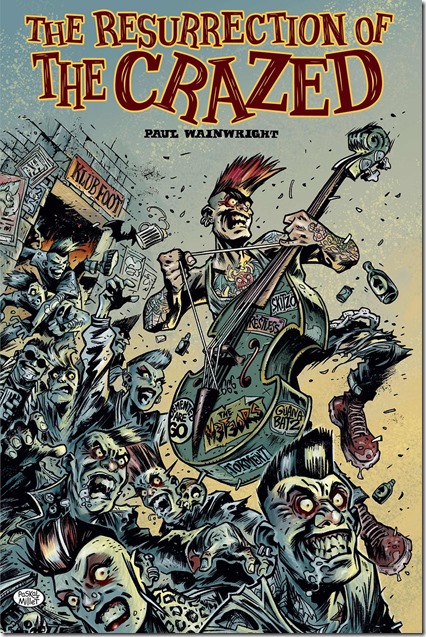
For better or worse, The Resurrection of The Crazed doesn’t replicate the original publications visually, but contains a typeset version of the text only, with a substantial selection of photographs and flyers, posters, tickets, and sketches, as well as the cover art from each issue. It may not have the same visual impact, but is no doubt easier on the eye, particularly with its generous font size which people of an age to have been there will likely appreciate.

For those who weren’t, it was The Meteors who are credited with being the progenitors of Psychobilly, with their amalgamation of punk and rockabilly, and, as Wikipedia notes, ‘fans of the Meteors, known as “the Crazies”, (a reference to the band’s 1981 single ‘The Crazed) are often attributed with inventing the style of slam dancing known as “wrecking”, which became synonymous with the psychobilly. And as such, the inspiration for the title, The Crazed. Fanzines tended not to stray too far from the obvious.

The Crazed may have only run for four issues, but like so many short-lived DIY publications, is fondly remembered and considered vital to the scene it represented, and this offers a neat alternative to scouring eBay to pay through the nose for dog-eared original copies – although I suspect many who will buy this book have already done that, and will be pleased to be able to put those into storage along with their various other tatty ticket stubs and the like.

What this compendium gives as an added bonus is a bunch of more recent interviews, and the benefit of hindsight. In addition to snippets of commentary, this comes in the form of a reflective piece which sits between the original zine material and the new, previously unpublished stuff, which Wainwright proffers essentially makes the fifth issue that never was. In it, he reflects on how the fourth issue was a slender tome with as little in terms of design as content, as well as being the smallest run. He writes, ‘I was still happy with the content of it, but no longer wanted to produce it as the initial enthusiasm I had when I started the fanzine had dissipated just like the Psychobilly scene that I had so loved. Looking back, it was a mistake as quite a few of the bands continued and some great records were to be released the scene where I left had virtually gone people had moved or were no longer into it.’

Enthusiasm is the essence of fanzines. Paul Wainright’s prose is not high literature: in fact, some of the writing is rough, amateurish – because that’s precisely the nature of such publications: by fans, for fans. But what Wainright published was a zine with original interviews, some of which are noteworthy for their stabs at greater depth, asking the kind of questions only a fan would ask – bringing knowledge and insight music journalists, notorious for going into interviews with either the most superficial of research, or otherwise proving themselves to be pretentious wankers – with the results often being vibrant exchanges, although this isn’t always the case, with some of the interviews, particularly the earlier ones, being fairly stilted and standard Q&As.

But for all the fandom, Wainright wasn’t entirely uncritical – slamming Demented Are Go’s performance at Dendermonde Psycho Festival in 1987 as a shambles. Although perhaps putting the ‘psycho’ into Psychobilly probably wasn’t the worst they could have done.

For Wainright, at least at the time, the story ended with the end of Klub Foot, and while this proved not to be the case in the longer term, it’s easy to relate to how it must have felt as the end of an era, akin to the closure of The Hacienda, or Stoke’s classic Northern Soul venue The Golden Torch – because every scene has its hub. And people grow up, move on, move out. But as The Resurrection of The Crazed shows us, nostalgia has significant currency, and what goes around comes around. Sure, most of those who were there are approaching retirement now, but that means they have time to reminisce at last, but also to spread the seed to younger generations, and The Resurrection of The Crazed captures the essence and energy of its time.

5cd2eb_a2f7da79a8d54226afc403ce7a233c60~mv2

(Click image to go to Earth Island Books site)

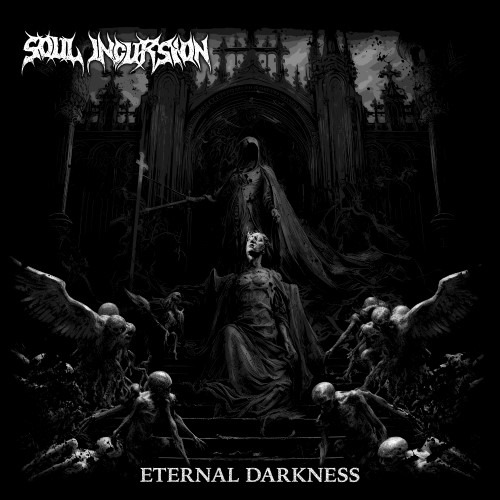
Two years following the release of their ‘Infernal End/Intracranial Form’ single, Helsinki-based death-metal quartet Soul Incursion now return with a new five-track EP titled Eternal Darkness, which is set to be self-released on December 15th.

Recorded by Tomi Uusitupa at Oxroad Studios & Oskar Bruun at Vallila ’87 Studios, mixed by Tomi Uusitupa at Oxroad Studios, and mastered by Matias Nastolin at Louhinta Studios, Eternal Darkness features the artwork of Vermin Graphics and sees the band distilling a brutal and vicious death-metal with a increased focus on crushing and heavy riffs and pummelling rhythms.

Listen to the EP’s leading single and title track here:

AA

Hailing from Helsinki, Soul Incursion was formed in early 2020, when guitarists Oskar and Henri started writing songs in the vein of old school death-metal bands like Pestilence, Death and Demolition Hammer, highlighting a penchant for an unrelentingly heavy, catchy riffage.

The band’s first studio recording, the ‘Infernal End / Intracranial Form’ single was released in late 2021 and found the Finns intertwining fast thrash-inspired riffs with a decimating death-metal attack and some catchy melodies.

With new member Arttu Turunen behind the drum kit, Soul Incursion returned to the studio to record five songs for a new EP and if their previous single suggested the path they might tread, this new EP confirms it and shows that Soul Incursion know how to write some serious and potent death-metal.

AA

c1f2611e-646f-a776-2433-5c5743a6e027