Archive for August, 2022

Cardiff electronic producer Conformist and gloom wave duo H O R S E S. ‘Heddiw’ ( ‘Today’ in English) collaborate for a collision of electronica and ominous post punk,  on a inventive framework of crunching beats and blips, haunted synth samples  and infused with the ominous vocals of duo H O R S E S, that bare more than a passing resemblance to Joy Division. A collaboration forged in the depths of lockdown, this haunting and bracing release is just a teaser of what’s to come in 2023.

Conformist says of the collaboration, it’s “a project that began by exchanging audio files between myself and H O R S E S on WhatsApp during the depths of Covid lockdown; I’m really pleased we can finally get this track out.  Vocals are by H O R S E S and production is by myself.  Hopefully this is just the beginning; we’re looking to follow up Heddiw in 2023 with a bunch of new ideas.”

Listen to ‘Heddiw’  here:

Conformist is one of the most respected names on the Electronic music scene in Wales, with early demos immediately catching the attention of Steve Lamacq, Huw Stephens, John Kennedy and Eddy Temple Morris.

Subsequent Conformist albums "Paid To Fake It" (2013) and "Lifestyle Bible" (2016) earned lavish praise:

"Paid To Fake It" is the sort of record that will take your breath away…bloody brilliant" The 405

"A musically kaleidoscopic head f***…brilliant" Louder Than War

"a head-spinning deluge of audacious beats and samples…staggering" Wales Online

Conformists’ production work is distinguished and full of unique character; staying leftfield but fresh and ahead of others; meticulous, dense and layered, revealing hidden detail with every listen – taking inspiration from Public Enemy’s Bomb Squad and cut n’ paste pioneers Coldcut, Steinski and The Dust Brothers to name a few.

Purveyors of dark hearted electronic music and inventors of the Gloom Wave genre, H O R S E S are formed by two gentlemen from a southeasterly part of Wales.

Casting a longing gaze on early 70s German electronica, mournful vocals escorted gently by cold beats and balmy synths evoke a brutalist image of Berlin, as the melodies wash between the brash concrete structures of your mind.

735276

Cruel Nature Records – 6th September 2022

Christopher Nosnibor

These are interesting times for Nadja, the ‘ambient / experimental / doom metal’ duo comprising Leah Buckareff and Aidan Baker. Luminous Rot was recorded during lockdown, and found a home on the legendary Southern Lord label. Released in the spring of 2021, it’s a veritable beast of a work, which combined metal with post-punk, cold-wave, shoegaze, and industrial.

Lockdown feels like something of not so much a distant memory as an unreality, and if by May 2021 it felt like life was returning to normal, the truth is that the wounds were still raw, and any attempt to move on as if life was back as it was before was simply a wilful act of delusion to stave off the effects of the trauma.

And with every trauma, there is some residual hangover, and you might say that Labyrinthine is the product of that. As the accompanying notes detail, the material was recorded during the pandemic and concurrently with Luminous Rot, and ‘explores themes of identity and loss, monstrosity and regret, extreme aesceticism, the differences between labyrinthes and mazes, taking inspiration from Haruki Murakami’s Killing Commendatore, Ursula K. LeGuin’s The Tombs of Atuan, and Victor Pelevin’s reinterpretation of the story of the minotaur and Ariadne, The Helmet of Horror.’

When a band chooses to self-release an album, it’s no longer an indication that it’s substandard or not worthy of a label release, and the case here is that Labyrinthine, which ‘this might be Nadja’s heaviest, doomiest album to date’, it’s clear that rather than consisting of session offcuts, it stands alone as a separate project from Luminous Rot, featuring as it does, a different guest vocalist on each track, and it’s worth listing them here:

Alan Dubin – legendary American vocalist from O.L.D. and Khanate and, currently, Gnaw

Rachel Davies – vocalist and bassist from the British band, Esben & The Witch

Lane Shi Otayanii – is a Chinese multi-media artist and vocalist in Elizabeth Colour Wheel

Dylan Walker – American vocalist from grindcore/noise band Full of Hell

With such a roll-call of contributors, it’s in no way possible to fee short-changed by the fact there are only four tracks, and ‘only’ is somewhat redundant when the shortest of these is almost thirteen minutes in duration. This is an album alright, and it’s an absolute fucking monster at that.

And while the CD release is on the band’s own label, Broken Spine, there are limited cassette versions by several different indie labels from around the world: Katuktu Collective (US), Cruel Nature Recordings (UK), Bad Moon Rising (Taiwan), Adagio830 (Germany), Muzan Editions (Japan), WV Sorcerer (France/China), Pale Ghoul (Australia), and UR Audio Visual (Canada) – and it’s perhaps noting that the running order differs between formats,  and I’m going by the Cruel Nature tape sequence here rather than the CD. It may be more intuitive from a listening perspective, but limitations off format and all…

This co-operative approach to releasing music is highly commendable, and seems to offer solutions to numerous problems, not least of all surrounding distribution in the post-pandemic, post-Brexit era where everything seems on the face of it to be fucked for any band not on a major label with global distribution and access to pressing plants and warehouses worldwide.

The title track is a lugubrious droning crawl: imagine Sunn O))) with drums crashing a beat every twenty seconds in time with each pulverising power chord that vibrates your very lungs. And those beats are muffled, murky, and everything hits with a rib-crushing density, that’s only intensified by the squawking, anguished vocals that shred a blasted treble in contrast to the thick billows of booming bass sludge, and it’s a truly purgatorial experience.

And then, here it comes, and it all comes crashing down hard over the course of the most punishing nineteen minutes in the shape of the brutal behemoth that is ‘Necroausterity’. In a sense, the title speaks for itself in context of a world in lockdown, and it’s sometimes easy to forget just what terrifying times we endured, watching news reports of bodies piling up in New York and elsewhere while governments and news agencies fed a constant stream of statistics around cases and deaths. It felt truly apocalyptic. And ‘Necroausterity’ is the sound of the apocalypse, tuned up to eleven and slowed to a crawl, the writhing torture of a slow, suffocating death soundtracked by guitar and drums do dense and dark as so feel like a bag over the head and a tightening grip on the throat. The recording is overloaded, distorting, and it’s a simply excruciating experience. And it simply goes on, chord after chord, bar after bar, slugging away… and on in a fashion that makes SWANS feel lightweight in comparison. It’s relentless, unforgiving, brutal, and punishing.

‘Rue’ broods hard with dark, thick strings and a heavy atmosphere, but it’s light in comparison. It’s dense, and weighty, but Rachel Davies’ ethereal vocal drifts gloriously within the claustrophobic confines and conjures another level of melody that transforms the thick, sluggish drones into something altogether more enchanting. It builds to a throbbing crescendo that is – perhaps not entirely surprisingly – reminiscent of Esben And the Witch or Big | Brave.

Wolves howl into the groaning drone of ‘Blurred’ and the guitars slowly simmer and burn: no notes, just an endless am-bleeding distortion before the power chords crash in and drive hard, so low and slow and heavy so as to shift tectonic plates and shatter mountains. Amidst the raging tempest, Lane Shi Otayanii brings an otherworldly aspect that transcends mere words, making for a listening experience with a different kind of intensity as it trudges and churns fir what feels like a magical eternity.

The sum total is the sound of hellish desperation, and while Labyrinthine may offer absolutely no solace in the bleakest pits of deathly despair, you’ll be hard-pressed to find an album that better articulates perpetual pain and anguish better than this.

AA

cover

Lonely Robot, the project masterminded by vocalist, guitarist & producer John Mitchell, are set to release their fifth studio album A Model Life on the 26th August 2022. With just a few days till release, a video for the album’s third single ‘Digital God Machine’ has been launched. Watch it now here:

John comments: “It’s the internet age people! And with every computer connected to it comes a free opinion. For some reason, the world of progressive rock fandom bears down on the timid musician struggling to make his way with the weight of said opinion. Said fandom LIKES and values it’s own opinion with much aplomb and shares it with alarming regularity from the bravery of great distance and safety. Thus is born the ‘Digital God Machine’.”

An album that brims with frustration at the state of things, while tugging remorselessly at the heart strings, A Model Life is plainly the most honest and vulnerable Lonely Robot record to date. From opener ‘Recalibrating’, which muses on the aftermath of a broken relationship, and ‘Digital God Machine’ – a sardonic tribute to keyboard warriors everywhere, to the boys-don’t-cry pathos of ‘Rain Kings’ and the absurdly moving, adoption-themed ‘Duty Of Care’, these new songs provide a scattershot but profoundly emotional soundtrack to a restless and uncertain world.

John comments: “Making A Model Life was very much a lifeline and indeed wake up call at the end of a particularly personally challenging couple of years. Creating it made me realise that ultimately, life is impermanent and the one true thing that gives me a focus and anchor is and has always been music. Long may that be the case.”

Lonely R

La Pochette Surprise / Membran – 18th August 2022

Sitting on the intersection where indie-rock, shoegaze, dreampop and neo-psych all meet, ’Noise Between The Shades’ is the second album by Hamburg-based quintet Melting Palms and a record that deserves to seem them established internationally. The song ‘Aurora’ has just been released as its fifth single.

Watch the video here:

AA

A collective as much as a group, Melting Palms were founded in 2017 when Mike Krumhorn (vocals, guitar), Teresa Koeberle (vocals, guitar, piano, synth) and Johann Wientjes (drums, sound design) began both musical and romantic entanglements. A debut EP and 2020 album (‘Abyss’) were recorded as a trio while performing concerts and rehearsing endlessly in their basement in a rundown area otherwise comprised of animal shelters and street prostitution, before they eventually recruited Tim Dajan Thiele (guitar) and Lukas Schulz (bass) to complete their current line-up.

Recorded at Clouds Hill Studio in their home city, ‘Noise Between The Shades’ is intoxicating and daring, contains surprising musical and lyrical twists, and emerges as a cascade of euphoria and drama. Boasting a spatial yet highly concentrated sound, it is a stunning combination of guitar-based music, noise and emotion.

Reference points include Melody’s Echo Chamber, Wand, Deerhunter and much earlier reverb/delay-heavy bands such as Sonic Youth, My Bloody Valentine, Ride, Pale Saints and the late ‘80s Creation/4AD guitar aesthetic in general. However, these Kraut-Punks do it all in a box-fresh fashion and ‘Noise Between The Shades’ has the power and ability to reach far beyond the German border.

Melting Palms also have a common non-musical goal, even a socio-political claim: humanism and idealism are a real concern for these five DIY utopians, one that embodies the notable resilience of the Hamburg scene in both attitude and aesthetics. All five group members have also been in or performed with other outfits on the city’s punk scene and their own signature sound has emerged from this special togetherness, a patchwork of many creative energies, the beautiful but also painful noise between the shades that every life guards.

AA

9b94c80b8ba67b087a7f7f5658c899c75a6b7622

gk. rec. – 13th August 2022

Christopher Nosnibor

Since taking control of his own release schedule – in addition to various releases via various labels – Gintas K’s output has shifted from rivulets to cascades, with this nature-themed album being just one among countless releases, live performances, exhibitions. soundtrack and compilation appearances so far this year, and, not least of all, Lėti in May, released on venerable experimental label Crónica.

There’s little explanation behind Mountains, runlets, caves & cascades, beyond a selection of quotes from HP Lovecraft and the detail that the album’s six pieces were ‘played, recorded live, at once without any overdub; using computer, midi keyboard & controller’ in 2020, and one suspects Gintas has a hard drive bursting with such recordings just waiting to be edited and mastered to form unified documents of his tireless output.

The first five pieces form the larger work that sits under the album’s overarching title, numbered one to five. They’re sparse, minimal, echo-heavy, like wandering around in a vast cavern while droplets fall into the subterranean lake that occupies the bottom, and who knows how deep it may be, how many tunnels are filled with millions of gallons of water that have run down through the ground and into this naturally-carved warren of rock-lined corridors beneath the ground.

In places, barely perceptible glimmers of sound, like bat sonar, jangle in the upper reaches of the audio spectrum. I’m reminded of the cat repellent device in my back yard, and I wonder if to some, these passages would actually appear as silence – or if for others, like my ten-year-old daughter, they would find the pitch unbearable and have to run from the room covering their ears. Quiet gurgles and trickles are the primary sounds on ‘Mountains, runlets, caves & cascades #3’ and I find myself feeling altogether calmer, picturing myself in a pine woodland with steep banks. I picture in my mind’s eye local scenery like Aysgarth Falls and Ingleton Falls and find myself at ease – but this being Gintas K, there’s disruption afoot, and blips and squelches zap in seemingly at random to remind us that this is digital art, and the fourteen-minute ‘#4’ marks the full transition into digital froth and sluices of laptop-generated foam.

And so it trickles into ‘#5’ which brings more bleeps and blips and jangling and some high-pitched rattling that for some reason makes me think of seeing footage of milk bottling plants in the 80s – back when milk came in glass bottles, and I trip on this trajectory of nostalgic reverie until the arrival oof the unsettling final track, the eight-minute ‘eastern bells’ that’s a slowed-down yawn of sound, metallic reverberations ringing out into the silence, echoing in the dark emptiness in ebbs and flows, like a conglomeration of sounds, drifting in a breeze.

Mountains, runlets, caves & cascades is a supremely abstract work, and while it’s not a huge departure for Gintas K, it does represent one of his softer, gentler, sparser and less frenetic works. It’s by no means an album to mediate to. But it is overall fairly sedate, and it not only allows, but encourages a certain quiet reflection.

AA

a3599404171_10

Expert Sleepers – 25th August 2022

Christopher Nosnibor

Fallout 4 is, as the title suggests, the fourth album in Darkroom’s Fallout trilogy.

Darkroom have been going for more than twenty years now, and have built up an extensive catalogue centred around fluid ambient work, which they’re keen to point out ‘stretches the definition of the genre to its limits in many directions: from quiet, introspective and naturalistic through celestial and melodic to intense, abrasive and synthetic.’

In presenting three longform compositions, Fallout 4 affords the collective to fully explore all of these elements.

As the accompanying notes explain, ‘Darkroom’s music has always been played not programmed, with a focus on human interaction and capturing the magic of live performance’, and the first two pieces hark back to the last performance of their 2012 tour. ‘It’s Clear from the Air’ is hypnotic, rippling, mesmerising, low, undulating drones providing a subtle low end to the textured interweaving synths that overlay subtle yet complex rhythms.

It bleeds into the twenty-five minute ‘Qaanaak (Parts 1 & 2)’ and immediately the tone is darker, denser, with a grumbling low and needling pulsations that create tension within the suffocatingly thick, beatless smoggy atmosphere. You find yourself lost, in suspension, somewhat bewildered as the tones twist and change. Electronic flares whip and lash as stuttering beats emerge through the relentlessly nagging pulsations, and continue to shift and mutate to a broiling, bubbling larva as booming bass tones surge and swell. The rhythm grows in urgency, but it’s muffled, constrained, which heightens the experience of a sense of airlessness and entrapment and as much as the throbbing oscillations are indebted to Can and Tangerine Dream, their abrasive edge hints at the uneasy, wheezing synth grind of Suicide.

The third piece, ‘Tuesday’s Ghost’ is perhaps the most conventionally ambient’ of the three, and is certainly the most overtly ‘background’ as is swims and floats and chimes along fuzzy lines of slow decay and loose, vague forms that have no shape, rise and fall. There is a discreet linearity to it, as it gradually, and subtly builds in depth and density, and it’s here that it become clear just how essential that human element is to Darkroom’s work – that sense of musicians bouncing off one another and understanding one another through intuition. There is no substitute for it, and you simply can’t programme the dynamics of form. It’s this intuitive, natural fluidity that breathes life into the compositions, and in turn, it’s this sense of life that the listener connects to and engages with. Fallout 4 may be ambient at heart or by genre… but it’s also far beyond the frontier of ambient.

AA

a2945227307_10

Melodeath-infused thrash metal gang Katapult has dropped ‘Comfortably Dumb,’ the second single of their upcoming debut album, Play Stupid Games, Win Stupid Prizes. An explosive banger, “Comfortably Dumb” slams the hypocrisy of accepting the meat industry.

“Tracking the vocals for Dumb was such a blast,” states Johan Norström, vocals. “All songs prior to this I had tracked all by my lonesome, but for ‘Dumb’ we tried out software that allowed us to stream high quality audio in real time, directly from the DAW. Having Florian on the other side really pushed me to try stuff I didn’t even know I had in the arsenal which ended up really cool,” informs Norström.

“What a hate anthem,” states Florian Moritz, Guitars. “The feeling you get is ‘Fuck everything and especially you!’ and I fucking love it. It’s a hateful Punk Song that’s just meant to get your juices flowing,” says Moritz.

Check the video here:

AA

Play Stupid Games, Win Stupid Prizes is slated to come out on 25 November 2022 via Discouraged Records digitally and on digipak CD.

e4e9b527-6f8a-da2a-22e8-1776650355ab

5th August 2022

Christopher Nosnibor

Lately, I’ve been seeing people on the Internet bemoaning the number of ‘lockdown’ albums, and even the emergence of ‘lockdown’ novels, questioning the need for anything that recreates, recounts, reflects upon or is otherwise set during the most recent of historical events. They all seem to make more or less the same case – that we all went through it, it was bad enough, and there’s no need to harp on or relive it. But artists tend to process and comprehend the world and their experiences of it through the act of creation, and just because we all experienced the pandemic and various lockdowns, no two people will have had the exact same experience or the exact same psychological response. Besides, isn’t more or less all art some form of response or reaction to the human condition, or otherwise a reflection thereof? No-one beefs about an excessive amount of war novels or poems or various genre novels, like crime or sci-fi or fantasy. Perhaps it’s because they prefer escapism to real life.

As the accompanying blurbage explains, ‘This album is a reflection of the dark days the world has seen in recent years. It’s about the tragedies many of us have faced and the effort to find the will to fight on. We remember those we have lost because it is through them that we carry on into tomorrow’.

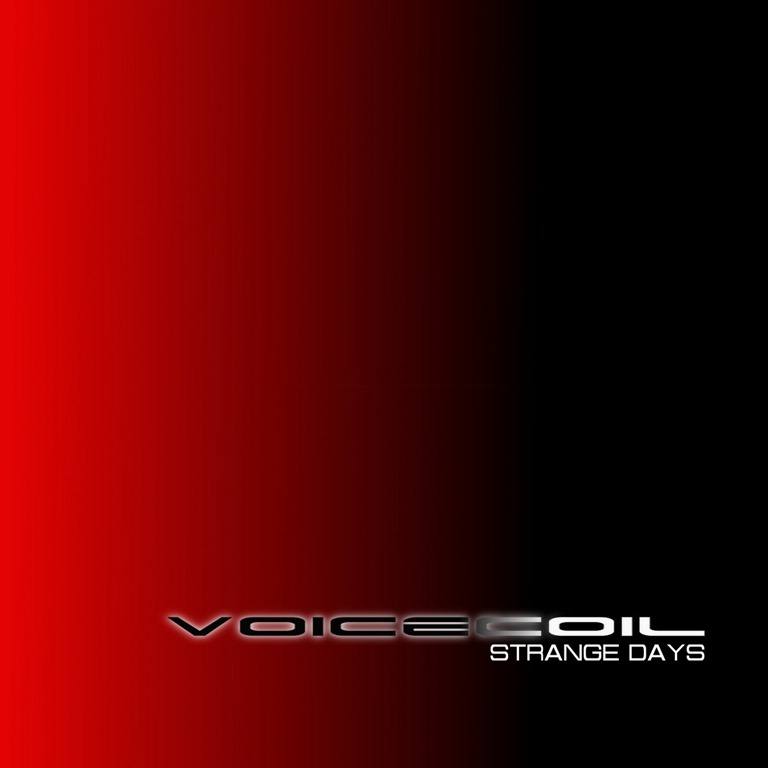
Strange Days is pitched as ‘a symbolic re-birth for the project, returning with a new zeal to create and perform’, and it’s not short on pumping beats and rippling synths. What sets it apart from so many other industrial / electropop / darkwave hybrids is Voicecoil’s vocal: it’s in that gothy baritone region, but for all of that, and the sense of performance and theatre that comes with those well-established genre tropes, his delivery had a certain emotional depth and sincerity that lifts the songs to another level.

So where ‘Versterbrogade’ comes on like a dance remix of a Depeche Mode in terms of its musical arrangement, and the verses observe the popular style of singing in the throat, a wheezy, grit-edged monotone, the verses unleash the hook and some ‘proper’ singing with heart and soul, and in doing so breathes life into the bleak experience of life where days drift and fade into one another. ‘Speak in Sine’ brings a harder-edged beat and a starker atmosphere, and it sits well with the themes of dislocation and alienation which run through the lyrics. ‘No Easy Reply’ is remarkably sensitive, not to mention accessible, and Strange Days has some great tunes, from the expansive, pulsating yet reflective ‘Why’ to the brooding piano-led curtain-closer of ‘Drift’.

While electronic music – particularly of that dark pop / industrial / goth disco persuasion – can often suffer from feeling sterile, detached, robotic, and impersonal, Strange Days is anything but. It possesses a certain warmth, a humanity, that resonates on numerous levels.

AA

a2292779137_10

Industrial / electronic black metal act Psyclon Nine has today unveiled a new video for the song  ‘See You All in Hell’ from the album Less To Heaven, also released today, 19th August.

Watch it here:

The music of Psyclon Nine is not for the faint-hearted. The brainchild of Nero Bellum, the dark, aggressive electronic assault of his group’s 2003 debut album ‘Divine Infekt’ immediately earned them popularity and notoriety worldwide. Its follow-up, ‘INRI’ (2005), displayed a marked evolution with a lyrical focus on religious themes. In the ensuing years, Bellum’s music has taken him down an even darker path, his distinctive whispered-scream vocals guiding us through an idiosyncratic take on modern underground music that has implemented elements of black metal and post-punk influences that, although often featuring haunting melodies, has often had an undercurrent of unbridled menace.

The brand new Psyclon Nine album, ‘Less To Heaven’, is a complex and immersive work that sees Bellum at a creative peak, with concussive, machine-precise drums, hammering guitars, scathing vocals and evil electronics all interplaying seamlessly. It also sees him charting undefined musical territory that bridges elements of metalcore with doom electronics, trip-techno with black metal, and experimental cinematic soundscapes with alternative rock. While many acts have a constant faster-louder approach to industrial-black metal, Bellum is unafraid to use all manner of tempos to build atmosphere.

2ddbf61d34abba6664810f1305b63f3f24a485f5

Weekend Recovery have announced the 2023 release of album number three, Esoteric, via Criminal Records, with a pretty plush video that’s all proggy/space rock… New direction? We’ll just have to wait and see…

Click the image below to preorder:

300180191_501516338644722_3230811486419289138_n