Archive for May, 2021

26th May 2021

Christopher Nosnibor

It’s been a whole month since we heard from lo-fi bedroom duo Videostore, and their latest effort continues the narrative trajectory that’s been running through so many of their releases.

The pair describe ‘Bounce Back’ as some ‘Cathartic song writing after they closed down the Videostore and everyone lost their jobs… Channelling some New York new wave/ no wave with special thanks to Blondie and Sonic Youth!’

This one starts of slow, stripped back and sedate, but as it builds, it balances lugubrious wallowing with some clean, poppy backing vocals. It’s one of their longer songs, and it’s a slow-burner that simmers before finally going off toward the four-minute mark – and when it does go off, it blazes hard.

AA

a0128443041_10

Ahead of the release of the first compilation on the NIM label – the snappily-titled Deprived of Occupation and Pleasure We Feast Aural Aggravation are immensely honoured to premiere ‘1010’ by Obviate Parade, the exploratory guitar vehicle for Paul McArthur of Damn Teeth.

With lyrics centred around Emily Dickinson’s 1010th poem, it’s a largely spontaneous cut, with all instruments and vocals recorded in a single take (albeit subsequently edited), it’s a magnificent balance of immediacy and controlled manipulation.

Don’t just take our word for it: get your lugs round it here:

AA

a2705195024_16

Year Of No Light have revealed their latest single, ‘Alètheia’, described by the band as ‘a double movement of light and darkness before burning our memories on the altar of the void’. The track is taken from their new album Consolamentum set for release via Pelagic Records on 2nd July.

Listen to ‘Alètheia’ here:

Pelagic Records are releasing not only their new album Consolamentum but also a wooden box set, to celebrate the band’s 20th anniversary, containing their entire discography of 5 studio albums, several split EPs, and the collaboration with Belgian composer Dirk Serries from the ‘Live At Roadburn’ recordings, on 12 vinyl records.

YONL 2

Demo Records / Crossness Records – 30th April 2021

Christopher Nosnibor

While I’m no fan of remix albums as a rule, the last year or so has clearly made it difficult for artists to create new material, and since touring’s been off the table, options for maintaining profiles – or making sales – have be limited to say the least. And with time to reflect and review, revisiting and revising previous output through fresh eyes seems more than reasonable.

It’s also refreshing to see ‘Could Divine, Remembered’, the release from anrimeal (the recording project of Ana Rita de Melo Alves), described not as a remix album, but a ‘meditative companion piece to her debut album ‘Could Divine’’. As the blurbage explains, ‘‘Could Divine, Remembered’ refuses the limits of the traditional ‘remix album’ – sure, there are remixes here, but amongst them you’ll find demos, reflections, confessions, rituals, and the artist’s own heartbeat. The sum of these parts is an immersive audio documentary about the making of Ana’s debut. For those familiar with ‘Could Divine’, this is a chance to look behind the scenes and magnify its meticulous detail; for those unfamiliar, it allows a first visit to an abundant internal world.’

I fall into the latter camp, although drawing lines across between the tracks on this new reworking and the original proves an informative exercise, and the reworked titles provide some insight into the inspirations or ideas behind these alternative renditions of each song (notably ‘Encaustic Witches’ returns here as ‘Encaustic Witches as an Ambient Track to Help Me Sleep’ and ‘Headrest’ appears as ‘Headrest, A Story About Feeling’. Elsewhere, explanatory or embellishing details appear, as ‘Death’ becomes ‘Death is a Burning Ritual’.

“When I think of nature, nothing happens,” she says at the very start of the album on ‘Hello and a Half’: it’s quite a contrast to the twitter of birdsong and lo-fi acoustic guitar that heralds the arrival of ‘Marching Parades’, the opener on ‘Could Divine’, and immediately we’re parachuted into the documentary aspect of this fascinatingly multi-fascinated work, which lays Ana’s workings out bare. Cars pass as the speech takes on an almost spoken word narrative form – but even that’s not straightforward as delays double-up her voice and as she explains how the album is about her ‘going into the wild’, it seems that some of that wild is more psychological than literal, an exploration of internal territories hitherto uncharted. At times, it ventures into the kind of disorientating cut-up tape works of William Burroughs and Brion Gysin in the late 50s and early 60s, and elsewhere, her monotone voice, against a sift, dappled backdrop is soporific and sedative.

This is an album of ideas and of origins, of snippets and sketches, as well as of reworkings and revisions. It’s bitty, but somehow hangs together remarkably well as an insight into Ana’s creative process. At the same time, in straddling the before and after that sit either side of Could Divine, it questions the notion of the ‘end product’, the idea that there is ever a ‘finished article’.

The demo of ‘Could Flower’ reveals the early shoots of the idea that would become the album’s title track. It’s a haunting acoustic folk piece, which would subsequently metamorphosise into a fragmentary, multi-segmented work that transitions as if through a dream sequence. There’s an ethereal, evasive quality to Could Divine, Remembered, and it places the album in a realm all of its own.

As an aside, all profits from the release will be donated to Plataforma de Apoio aos Refugiados, a Portuguese refugee support organisation. In bleak times, we once again see art being used as a conduit for good – and this, it has to be said, is good art.

AA

a3633893503_10

6th May 2021

Christopher Nosnibor

As the band’s name suggests, their roots and influences lie very much in the spirit of 1977. The year which saw ABBA, Bread, The Eagles, The Shadows, Johnny Mathis, and Fleetwood Mac dominate the album charts, and the year’s best-selling singles being by the likes of Wings’ ‘Mull of Kintyre’ and acts like Leo Sayer, Brotherhood of Man, and Hot Chocolate here in the UK, will also be forever marked in history as the year punk broke. Alongside all the anodyne MOR pap and slock disco, 1977 also saw the release of Never Mind the Bollocks, The Damned’s Damned Damned Damned , The Clash’s eponymous debut, The Buzzcocks’ Spiral Scratch EP, and The Dead Boys’ Young Loud and Snotty, as well as classic releases by The Stranglers and Richard Hell & The Voidoids.

These, of course, are the seeds these guys are referring to, although they also draw on a host of other stylistic elements, ranging from psyche to glam, and in a title that seems to echo Sham 69’s ‘Borstal Breakout’, the sextet have forged their debut long player in lockdown. As the title suggests, they’re keen to escape this interminable drag and get the fuck back out there.

There’s a choppy ska-tinged guitar that leads the high-octane opener ‘Kick it Out’, which sets out their stall nicely. It’s unaffected, and while the playing it tight, the production is direct and unfussy. The wandering bass cuts through the trebly guitars and it demonstrates all the hallmarks of authentic punk.

With the majority of the tracks clocking in at around the three-minute mark, it doesn’t take long for them to power through thirteen songs, and they’ve totally nailed that three-chord chop. But there’s also a sense of crafting behind the songs, with a solid grasp of dynamic range, and if most of the choruses are more about everyone shouting the hook than any real harmonies – it’s true to the spirit of the genre, being hooky in that most primitive of ways: keep shouting it till it sticks.

Then again they throw in some curveballs – ‘Lost_Found’ is a soulful piano-led duetting ballad augmented by aching strings, where the hell-for-leather drumming is replaced by a subdued machine. Placed mid-album, it’s a touching tune that serves as an interlude before the full-on chug of ‘Reality Bites’. The switching of lead vocals between Vince Mahon and Michi Sinn adds to the album’s range and dynamism: they’re both strong vocalists, but distinctive stylistically, beyond the obvious male / female.

Seeds of 77 have got some solid riffs and catchy choruses, but it’s the bass that really makes the sound, going far beyond the thudding four-square to-the-floor thud that’s standard, and instead showing some real flair – and when trad punk bands are two-a-penny, those distinctions count for a lot.

AA

a3694136328_10

Christopher Nosnibor

No two ways about it: coinciding with the NIM compilation album Deprived of Occupation and Pleasure We Feast, FEAST 4 offers the most jam-packed and solid quality lineup they’ve put on yet, with sets from a number of acts featured on the album and a stack more besides.

After some weird woozy shit off Territorial Gobbings’ recent Automatic for Nobody album release (which we covered and coveted here), where Theo Gowans hoarsely whispers corruptions of lines from REM, Rejections Ops kick things off early doors with a blitzkrieg of stuttering beats, squalling bass feedback and squealing, crackling synths: the guitarist’s wearing a veil and there are strobes galore. The noise is complete overload, a devastating mass of distortion, and while it would perhaps benefit from a little more contrast – it’s absolutely fucking full-on from beginning to end – it would just be amazing to witness in a small, sweaty room at proper ear-bleeding volume. I could happily go home now – but of course, I’m already home, and am thirsty for what’s to come.

DSC_7128

Rejections Ops

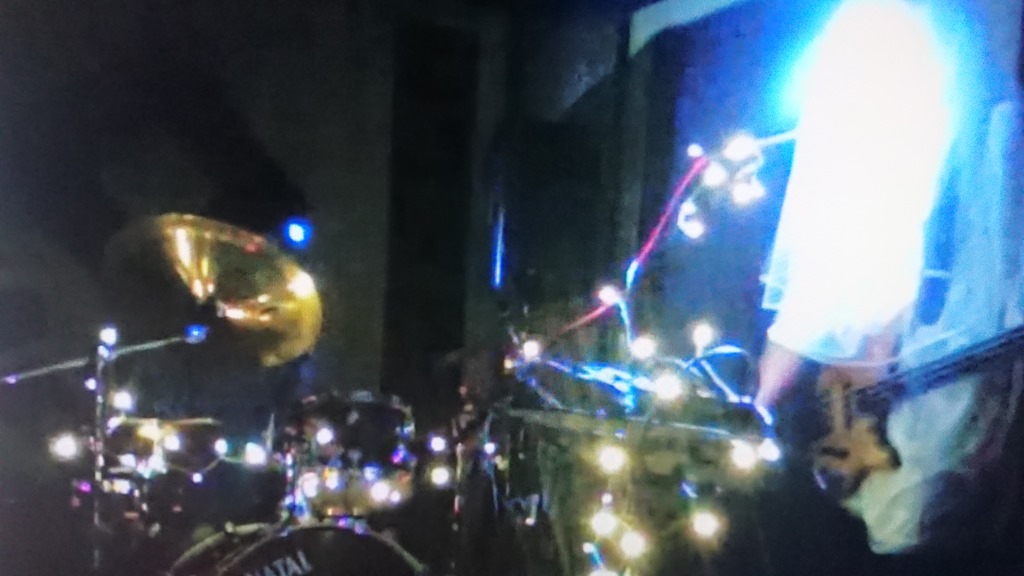
Hubble’s cover of Swans’ ‘No Cure for the Lonely’ from the aforementioned compilation provides a mellow interlude before Omnibael’s set. It’s another intense work, and probably their best yet. Stark, black and white footage accompany the duo’s low-down, dubby industrial scrapings. There are some mangled vocals low in the mix, while the crashing metallic snare is pitched up high, and driven by a relentless sequenced synth bass groove overlaid with explosive noise, the atmosphere is dark and oppressive.

DSCPDC_0003_BURST20210523204013324_COVER

Omnibael

Blackcloudsummoner brings more overloading electronica, dark, dense, story, tense, crunching electrodes crackling distortion, occasionally rent by trills of feedback. And it all sounds as if it’s coming from an immense cavern, about a quarter of a mile underground. The bass sounds like a nuclear experiment, and it’s all going off at once, making for an intense and disorientating experience.

AGED’s sound is rather more ambient, and considerably less abrasive, and it’s well-timed. That isn’t to say that this is in any way soft: there’s a crackling decay at the edge of the sound, and distant samples, barely audible, create a disorientating effect. And it’s over in the blink of an eye.

Making a return for …(something) ruined, the full-tilt, all-out noise abrasion with shouting seemed to hit the spot, and the altogether mellower sounds of Pigsticks and the Wonderbra, making droning harmonica noises in some woods arrives just in time to prevent any aneurysms. This is wonderfully weird, with leaves dropping and being raked creating a ‘field recording’ element to this curious experimental concoction. Birds tweet. A helicopter flies over. Atonal woodwind. Random words. What is it all about? The epitome of avant-garde oddity.

DSC_7133

…(something) ruined

Paired with Pressure Cooker Release valve for a collaborative set, Territorial Gobbing bring all the oddball experimentalism you’d expect. For TG, anything and everything is source material, and on this outing we witness some effervescent vitamin tablets fizzing in bowls, the sound contained by a folded IKEA box. And then they bring on the squeezy sauce bottles, which puff and sigh and gasp in their varying degrees of emptiness. Drainpipe and walkie-talkie, toast, toasters, lighters, phone ring tones, egg slicers, books, paint tube, polystyrene packaging, and kitchen sink also provide sound sources in this bizarre object-led experimental set. It almost feels like we’re watching an album being recorded in real-time. Maybe – and even hopefully – we are. With a track per object, it would work well.

DSC_7134

Territorial Gobbing / Pressure Cooker Release Valve

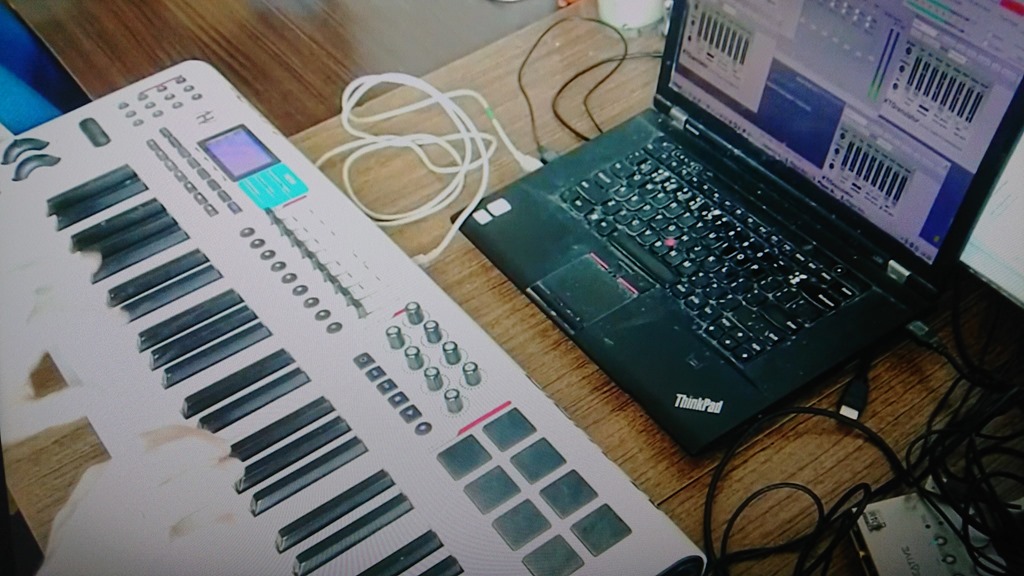
Gintas K’s set is a brain-bending bleepfest, a tangle of jangling synths and collapsing synapses that fray the nerve-endings. Everything squelches and zaps every which way, and we get to watch it all happen in real-time as the notes twitched away on his keyboard are run through software on a dusty Lenovo Thinkpad to create a crazy sonic foam that bubbles and froths all over. But deep, resonant bass tones boom out over the stuttering bleepage and groaning, croaking drones emerge. It all squelches down to a mere drip before finally fizzling out in a patter of rain, and it’s well-received, And rightly so.

DSC_7136

Gintas K

Hubble’s headlining set is accompanied by some eye-opening PoV visuals of a parachute jump and clips of people leaping off mountains, and the footage is so terrifying I actually hope it’s CGI even though it looks like it’s actually real. The freefalling blue sky space is the ideal accompaniment to the disorientating fretwork of the musical accompaniment which sounds like multiple guitars and keys playing interloping lines together and across one another. The rapid ebbs and flows are immersive, hypnotic, and a long, mid-range drone builds and hangs against the dizzying blanket of fretwork that weaves the rich and sense sonic tapestry of this bewildering sound on sound. It couldn’t be more different in sound from Ben’s regular gig as guitarist in NY noise act Uniform, but everyone needs a break, and this is wonderfully, if dizzyingly, realised. It makes for a top ending to a top night packed with all the weird and all the wonderful from the full noise spectrum.

Portuguese deathcore newcomers Inhuman Architects have just revealed a music video for a new song off the band’s debut full-length album Paradoxus , which is set for release on July 16th via Vicious Instinct Records.

Titled ‘Nephilim’, this new video is now playing here:

Box Records – 7th May 2021

Christopher Nosnibor

Gavin Miller’s hardly been slacking of late: in fact, it turns out I’ve been struggling to keep pace with his output this last year or so. While for many, time seems to have stalled since the sequence of lockdowns began some fourteen months ago, Miller’s had his foot firmly on the accelerator, expanding the already extensive worriedaboutsatan catalogue with five new releases, including an archival excavation (appropriately titled The Vault) and an expanded reissue of the Europa EP, and a split release with Capac, all of which followed a brand-new LP, in the form of Time Lapse.

This latest effort, releases on Box Records, run by Matt Beatty of Pigs x7, arrives almost a year to the day after Time Lapse, and is in many respects of the period since its predecessor was recorded, a period which has been both eventful and uneventful at the same time.

The liner notes detail Miller’s objective in piecing together the album as follows: ‘Resisting the urge to simply turn in more longform experiments in expansive post-rock informed electronica, Providence seeks to capture several different elements of the ‘satan sound, whilst attempting to thread it together into one cohesive whole.’

There has been a certain sense of linearity to the majority of previous ‘satan releases, although that sense of trajectory has, for me, always been most defined in the live sets, and the challenge here is very much how does one provide a sense of flow, of linearity, or narrative, of continuity; to what is, in many ways, a drifting desert of time, punctuated by so very little?

Since the departure of Thomas Ragsdale, at which point worriedaboutsatan again became Gain solo, the beat and bass elements of the sound have much more subdued, and sonically, Providence is very much classic Miller: rich ambient tones with subtle undercurrents that allude to post-rock and glitchtronica, and on paper, it probably doesn’t sound all that remarkable – although perhaps what is remarkable is that worrriedaboutstan started carving this nice back in 2006, before it became commonplace, making was trailblazers the world has gradually caught up with.

‘Stück Für Stück’ shimmers, rippling notes cascading delicately down like droplets of spring rain while a subdued, almost subliminal beat and bassline pule in the background, and ‘Für Immer’ finds Miller return to German for the track’s title – and perhaps some clues as to the narrative lie in the titles of the tracks. ‘Für Immer’ shares no obvious connections to the 1982 DAF album of the same title, but perhaps hints at the sense of eternity that pervades Miller’s work, not least of all as reflected in the name of his label, This is it Forever. It may be creative reading, it may be the enactment of reception theory or even projection on my part, but some of the track’s resonance lies in the sense that the soft ambience, directionless, lacking overt form, encapsulates the drifting emptiness of this span of disconnection, of aimlessness, of there being no end in sight, and the weak, powerless, listless, feeling is engenders, a sense reinforced by ‘On Your Own’, and all of the connotations of isolation and loneliness it carries.

Waves washing onto the shore splash through soft chimes on the short interlude that is ‘Everything is Fine’ (which I can’t help as read by turns as sarcastic and self-affirmation, but neither of which suggest that things truly are fine), while ‘Stop Calling My Phone’ is its antithetical scenario, and it’s a jabbing, petulant synth that dominates this track All or nothing: the desolate silence, or the bombardment of contact are both equally difficult to manage, and there rarely seems to be a happy medium.

If the nine-minute trance-inducing haze of ‘Stórar Franskar’ articulates the expansive drift of time and that sea of emptiness, then closer ‘Just to Feel Something’ is perhaps the companion to ‘Everything is Fine’, in that the numbness manifests as façade. Because everything is so empty, and so numb, and so absent, it’s difficult to retain focus, a sense of space, a sense of perspective.

Providence is the perfect soundtrack to those protracted spells of ponderance, that discomfort and dissatisfaction, the introspective reflection and self-doubt. It stands as a magnificent blank canvas into which to project and reflect. It’s also another strong addition to the worriedaboutsatan catalogue.

AA
a2413327704_10

Edelfaul Recordings – 5th June 2021

Christopher Nosnibor

Just as you should – at least ideally – never judge a book – or an album – by its cover, so you should never judge a musical project by its geographical origin, or judge the population by their government. This is particularly important as a point of note right now, and especially in context of this release. At home, we’re often led to believe that arts are of a lesser importance in the face of a pandemic or any other crisis, but history – and social media – will tell you otherwise: the natural human response to any trauma or crisis is to immerse oneself in either the creation or consumption of art or music. When bombs are dropping, people write poetry. It’s both a coping mechanism and a means of documenting events, and there is a clear logic to it: for me, writing helps to order things, both events and my own thoughts. The very act of writing gives mental effluvia a sort of solidity.

Spirit Skinned, the press release informs us, is ‘a duo rooted in the musical underground of Tel Aviv and Jerusalem’ and goes on to note that ‘The area is known worldwide as a high tension zone, and the small musical scene that bred Spirit Skinned enjoys a reputation for an uncompromising and often radical sound approach, paired with a rare level of perfectionism. If anything, their music lives up to that notoriety.’

Watching the news, one would be forgiven for being shocked and amazed that there would be any kind of music scene in Tel Aviv or Jerusalem, let an underground one. But even during sporadic war, life does go on, and citizens are always desperate to maintain some sensed of normality, and this is clearly true of Ben Ronen (aka diburnagua), former vocalist in various punk and noise projects in the Tel Aviv area and Ofer Tisser, producer/instrumentalist and a central figure in Jerusalem’s underground music scene, who have come together as Spirit Skinned.

The pair’s eponymous debut is pitched as ‘spanning the gaps between grime, industrial, hardcore, musique concrete, politics and expressionism’, and across the course of the album’s seven tracks, Spirit Skinned wanders far and wide stylistically. And you can’t criticise an album for any lack of focus when its focus is set so wide.

Many of Ronan’s crazed, yelping, barking vocals are largely impenetrable, and often partially submerged beneath layers of noise, not least of all highly dominant percussion: heavy industrial clanks and cracks dominant, but then again there are swamps of alternative and buoyant indie lurking in the mix.

‘Dry Season’ introduces the album with a slice of minimal DIY that’s brittle, spiky, and more than just a bit quirky, and lands somewhere between Young Marble Giants and Einstürzende Neubauten. Reverb bounces all over the place, while a slow, lowdown bass squirms away. They conjure seme tense and atmospheric scenes, and the claustrophobic, repetitious throb of ‘Leaving Room’ evokes the impotent rage of early Swans: it’s the sound of frustration vented through shouting into the void against a backdrop of music that bludgeons. ‘The Root’ is built around a monotonous pulsation that passes a significant nod in the direction of Suicide, but then there’s braying free jazz sax all over the top of it, and in combination, they’re pretty punishing. There’s a physicality to the music that’s affecting as they lunge from doomy drone to fractured, splintering harsh noise.

The album’s final track, the eleven-minute ‘Once Was Blind’ is sprawling monstrous hybrid of dark hip-hop, jazz, and psychosis. It’s like a beat poetry night on a bad trip. It’s a suitably weird end to a weird album, and one that’s well worth hearing.

EFT003_front

Elli Records – 21st May 2021

Christopher Nosnibor

Mathematic graduate turned musician (Conservatory of music and jazz studies) Daniele Sciolla has, it would seem, found a suitable home on Elli Records: just look at those precise, diagrammatic, geometrically-precise cover designs.

There was a time I’d have likely dismissed all of this as one massive nerdgasm, and have been largely unimpressed by the tale of his ‘trips all around Europe searching for rare synthesisers’, but through exposure I’ve come to appreciate the minutiae that are the obsessional objectives of works like this, which really probe deep into the tiniest nuances of sound which can be achieved through the working of these machines.

This EP goes deep into the relationship between sounds, tones, and individual notes, and as the notes explain, ‘On each track, synthesisers are either presented as a timbrical mass, or left alone by themselves, in which case even the smallest details of a single synth become audible.’

Once acclimatised and accustomed to the granular, detailed explorations, it’s not difficult to grasp why there is such a fascination with analogue equipment: the extraordinary versatility they offer when all of the variables are tweaked, even infinitesimally, is a thing of wonder.

Sciolla’s five comparatively short pieces – only one extends beyond four minutes, and the whole EP is under fifteen – retain a sense of musicality that’s often absent from many experiments in analogue, and while there are many wows and flutters, and rapid-bouncing stammers that sound like ping-pong being played at a million miles an hour, there are structural elements that give the pieces shape. There are even brief moments that fleetingly call to mind Hot Butter’s ‘Popcorn’, although to be clear, there’s nothing quite so buoyant or cheesy on offer here. But there is a sense of fun, a certain playfulness – or perhaps it’s the sound of sheer joy.

AA

EL33 digital 5