Posts Tagged ‘Sound’

Editions Mego – 21st February 2025

Christopher Nosnibor

Russell Haswell and Florian Hecker are both prolific as solo artists, each with numerous collaborations with other artists to their respective credits, Haswell also having been a contributor to and touring member of Consumer Electronics. The UPIC Diffusion Sessions are a long-running collaborative project which began in the early 2000s, exploring Iannis Xenakis’ UPIC system as the sole instrument.

As the accompanying notes outline, ‘The UPIC is a computer music system that generates sound from visual input. The original intention of the system developed by Xenakis was to make a utopian tool for producing new sounds accessible to all, independent of formal training. One can locate footage of Xenakis and a group of children making drawings for the system in the 70’s.’ They continue, ‘The duo set off experimenting with a diverse array of hand-drawn images to feed the UPIC system including news photographs of disasters and atrocities, “food porn” through to depictions of the natural world and microscopic images of molecular structures (including ‘the blackest ever black’). The resulting eccentric audio from these images is claimed by the artists to heighten synaesthesia and is as mysterious as it is baffling.

I suppose the potential outputs for the UPIC are as infinite as the inputs, and this alone makes for a fascinating project, and the results here are, indeed, mysterious and baffling. The recording from this session is represented by a single track, just over half an hour in length.

Immediately, trilling oscillator tones rise in pitch – and keep rising, until you feel the pressure build inside your skull. There are glitching spasms of sound which flash across like subliminal messages. The pressure drops and the siren wails fade out, before scuttering blasts of seemingly random noise collage and intersect across one another, buzzing and fizzing, humming and thrumming… the forms move quickly, and shift from dark to light, hard to soft instantaneously. Shimmering sprays of abstract sound burst like fireworks, short interludes of harsh noise wall, microtonal bubbles and ZX Spectrum like babbles and bleeps all intersect or pass within mere seconds of one another. It is, very much, a sonic collage, the audio equivalent of William Burroughs’ cut-ups, an aural articulation of the simultaneity of experience of life in the world. Burroughs’ contention was that linear narrative is wholly inadequate when it comes to representing the real-world, real-time lived experience, whereby overheard conversations, snippets of TV and radio, and all the rest, not to mention our thoughts and internal monologues, overlap, and to present them sequentially is not true to life.

Leaping disjointedly from one fragment to the next at a bewilderingly rapid pace, listening to this is rather like the way the mind, and often conversations, skip from topic to topic without ever seeing any single train of thought to a defined conclusion, bouncing hither and thither in response to triggers and associations which often seem to bear no logic whatsoever.

There are thick, farting sounds, buzzes like giant hornets, choruses of angry bees, weird sonic mists and transcendental illuminations… of course, these are all conjured in the mind in response to these strange, sometimes otherworldly, sci-fi sounds, part BBC Radiophonic Workshop, part tinnitus and nightmare of imagination. Unpredictable isn’t even half of it as alien engines and spurs of 80s laser guns crossfire against earthworks, roaring jets, explosive robotics, skin-crawling doom drone, whispers and whistles, proto-industrial throbs…it’s a relentless blizzard of sound.

‘Experimental’ has become something of a catch-all for music that draws on eclectic elements or perhaps incorporates a certain randomness: this, however, is truly experimental, given that there is no way of knowing how the programme will interpret the input provided. And as much as the output involves oscillatory drones and the kind of synthy sounds associated with analogue, and with woozy, warping tape experiments, it evokes the drones of collapsing organs, wild sampling and everything else your brain could possibly conjure.

At once exhilarating and exhausting, UPIC Diffusion Session #23 is… an experience.

AA

eMego316V front

Dret Skivor – 1st December 2023

Christopher Nosnibor

Yes, that’s fjord, not fox, meaning you won’t find these collaborating sound artists bouncing around the woods dressed as furry animals, making daft, random sounds. Well, you won’t find them bouncing around the woods dressed as furry animals, anyway, although Dave Procter did spend many years performing while wearing a latex pig’s head, but he put a stop to that after David Cameron started turning up at his shows.

This latest collaboration between Martin Palmer and Dave Procter is, in fact, inspired by the site of previous experimental audio tests in 2019, namely the sculpture “what does the fjord say?” in Trondheim harbour. As they tell it in the accompanying notes, ‘Armed with percussive sticks, contact microphones, audio recorders and the occasional toy and synth, they set about a full exploration of the sculpture and their own sonic ideas in and around the sculpture, using created and environmental sounds to answer the question posed by the sculpture. These recordings are Palmer and Procter’s replies.’

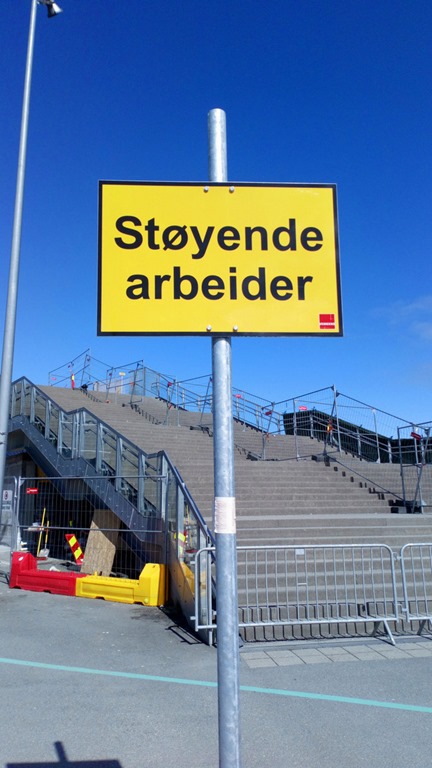
The first reply ‘støyende arbeider’ is more of a lecture than a simple reply, with a running time of twenty-one minutes. Consisting of random clatters, crashes, squidges, squelches and shifting hums which ebb and flow amongst an array of incidental intrusions, it’s more of a non-linear rambling explication, and exploration of the rarely-explored recesses of the mind than a cogent conclusion. But then, why should a reply necessarily be an answer. This, then, is a dialogue, a discussion, not an interview constructed around a Q&A format. It’s nothing so formal, and all the more interesting for its being open-ended, evolving organically. There are points at which the thuds, clanks and scrapes grow in their intensity, creating a sense of frustration, as if attempting to unravel a most complex conundrum and finding oneself stuck and annoyed by the fact that there is something just out of reach, something you can’t quite recall. And at times, this is also the listener’s experience. The way to approach this is by giving up on the expectation or hope of coherence, or anything resembling a tune, and yield to the spirit of experimentalism.

‘Moose Cavalry’ and ‘Mock Paloma’ are both significantly shorter pieces, the former being atmospheric and evocative, the animalistic calls conjuring images of beats roaming moorlands in the mist. Plaintive, droning moans and lows transmogrify into warped, pained cries and needling drones. The latter is different again: dark, tense, shrill tones scratch and scrape, flit and fly, reverberating from all directions. It’s unsettling, uncomfortable.

These three compositions are so different from one another, it superficially makes for a somewhat disjointed set, but on deeper reflection, what Palmer and Procter have forged a work which demonstrates how it’s possible, and even desirable, to approach a subject from multiple angles and perspectives. I still don’t know what the fjord says, but I do know that Palmer and Procter have posed some interesting musings in response.

AA

a3551752136_10

Montreal three-piece BIG|BRAVE  share an official video for ‘Sound’, a brand new track from their forthcoming third album, Ardor, due out September 15th via Southern Lord.  The trio also share headline tour dates in support of the album, with Jessica Moss (who features on the album) performing in support on some dates.

‘Sound’ speaks volumes regarding what’s to come in BIG|BRAVE’s next endeavor; swirling static, booming guitars, powerful drums—all the hallmarks that have made them one of experimental rock’s most exciting acts today.  With just three songs that clock in for a 40-minute-long LP, BIG|BRAVE have adopted a nearly unbearable level of urgency and intensity that weaves throughout Ardor.

Check out ‘Sound’ here (tour dates below):

TOUR DATES (SO FAR):

Sat 21/10 – UK, Brighton – Sticky´s Mike Frog**

Sun 22/10 – UK, Manchester – Star and Garter**

Mon 23/10 – UK, London – Underworld**

Tue 24/10 – FRA, Lille – Le Biplan

Wen 25/10 – FRA, Rennes – Barhic**

Thur 26/10 – FRA, Nantes – Soy Festival**

Fri 27/10 – FRA, Rouen – 3 Pieces

Tues 07/11 – FRA, Lyon – Sonic

Wed 08/11 – BE, Antwerp – Autumn Falls @ Het Bos

Thur 09/11 – NL, Utrecht – Le Guess Who?

Mon 13/11 – DE, Oldenburg – MTS

Tues 14/11 – DE, Mannheim – Kurzbar

Fri 17/11 – DE, Dresden – Scheune

**with Jessica Moss

(Further Dates to be confirmed soon)

Image result for big brave sound

clang records – clang032

Christopher Nosnibor

Stan Brakhage was an experimental filmmaker who sometimes closely shot glass objects. A huge influence on Frasconi, who sometimes makes music with glass instruments. The album title is a play on words, in reference not only to his artistic forebear but also the cracked quartz crystal bowl which was used to make this 20-minute musical work.

Having previously given the instrument a rather too vigorous workout during a rehearsal, Frasconi decided to explore its absolute limits. As Frasconi himself observes, ‘Glass is fragile. Glass is easily broken. Most glass instruments ignore these fact and instead focus on the material’s delicate beauty’.

Standing Breakage captures the artist’s efforts to complete the job he unintentionally began when the instrument – pictured on the front cover – became fractured. Ironically, despite labouring at the fracture in order to bring about the bowl’s ultimate destruction, he failed to achieve the desired moment of breakage. As such, for all its fragility, the glass held firm against a sustained assault.

An awareness of the circumstances of the album’s creation is, in this instance, integral to its appreciation, first and foremost, because if you didn’t know it was made using only the sounds created with a glass bowl, you would never guess that it was made using only the sounds created with a glass bowl. Because it doesn’t sound like it was made using only the sounds created with a glass bowl. In fact, it doesn’t sound like anything organic, or even of this world.

Standing Breakage finds Frasconi create an intriguing blend of chimes, rings, swirls and twangs, scrapes and chatters. Heavy, bulbous bass tones resonate, twisting and spinning upwards. Percussive thumps and sounds like scraping violin strings all emerge from the single instrument under the musician’s interrogation. Clanging, gong-like sounds crash. Eerie sounds that defy any obvious description, and sound alien and other-worldly in their origin drift. Booming synth-like notes balloon outwards, expanding in the air.

Tension mounts and builds. You sit, teeth on edge, fists clenched. You’ve no idea what will come next. You will twist and squirm. You’ll conjure myriad images in response to the strange sounds. But never once will you think ‘this sounds like someone pissing about with a glass bowl with a crack in it.’

Miguel Frasconi

Miguel Frasconi’s Website