Posts Tagged ‘nu-metal’

28th March 2024

It’s that time of year again, when, in the UK, you may be forgiven for thinking that the entire music industry is camped out at Glastonbury. This, however, is a chronic misrepresentation, and all around the world, there are quite literally hundreds of thousands of music-makers who have absolutely no connection with the event, no currency, and no interest.

Seeing a few brief snippets on BBC news, with grinning attendees being asked for their views on their experience so far and who they’re looking forward to, I was stuck by just how middle class – and / or middle-age – a lot of those taking heads are. These are the type of people who can afford the £350+ tickets on a punt for ‘the experience’ and the increasingly limited off chance of some decent or interesting acts. The headliners are so safe, predictable, bland, and there’s not much to be said of much of the lower orders, either: the only acts worth seeking out are probably those you’ve never heard of playing in the minor tents who’ve probably had to pay a heap to get in.

Despite the immense coverage and the vast audience, it’s not representative of the majority of the music scene, industry or beyond, and for that majority, things go on as normal. And so it is that we have a new single from Brighton’s brightest, brashest metal new hopes, Eville, hot on the heels of whipping up some crowds on tour with Glitchers, and likely winning new fans in the process.

Anyone who discovered them on this tour will not be disappointed, and having followed them from their very incarnation, I’m not, either.

This latest offering, co-written and produced by Harry Winks of South Arcade, pulls everything that makes Eville an exciting act together and blasts it out hard. With their roots and influences firmly in early noughties nu-metal, they’re as much, if not more about Deftones and Pitch Shifter than Limp Bizkit or Korn, exploring the darker terrains of a genre which came to be maligned as it mutated into sports metal.

As is typical of the genre but also a defining feature of what Eville have come to own as their sound, ‘Dead Inside’ pitches clean melody and rabid growling vocals against one another over a backdrop of guitars denser than lead. It’s the perfect balance of accessible levity and monstrous heaviness.

But they also embrace contemporary pop tropes, with the overt and sometimes quite wince-inducing application of autotune. In this respect, they’re quite the conundrum, and products of our confusing, conflicted, incoherent times. They are the very manifestation of the widening generation gap, appropriating from their parents’ generation while staunchly representing their own. There are no limits.

It’s both musically and emotionally articulate, and represents another flawless entry to their killer catalogue.

AA

Eville - Band shot 2

15th March 2024

Christopher Nosnibor

Following the stop-gap single release of their remixed version of their debut, ‘Messy’, Eville are back and firing on all cylinders with their first new material of 2024. While it incorporates the defining elements which made their previous two single, ‘Messy’ and ‘Leech’ – namely hard-driving nu-metal guitar slabs juxtaposed with electronic drum ‘n’ bass, which combine to drive a ‘a huge pop chorus,’ ‘Monster’ represents a clear step up, and is, as the title suggests, a monster.

Having a specific goal can provide vital focus in the creative process, and this was central to the creation of ‘Monster’.

If Yard Act are striving to make hits, self-professed ‘brat-metal’ trio Eville are all about the Pits, as Eva (Guitar and vocals) explains the objective for ‘Monster’: ‘We are building on the success of our singles by keeping up the standard our fans expect. ‘Leech’ and ‘Messy’ have done us proud, but we are ready to move up a level with ‘Monster’, I wanted to write a feral tune that would be perfect to open up mosh pits.’

It may be old-school, the notion of making music that will hit live and by playing support slots and touring to build a fan-base, but unless you’ve got massive label backing and PR that can score bags of radio play, it’s the only way for an independent act to grow. And it seems to be working pretty well for Eville.

With its stuttering electronic beats and muted, twisted, heavily filtered synthesized sound at the beginning, we’re instantly reminded of The Prodigy and turn of the millennium Pitch Shifter. Being in the demographic where the arrival of ‘Firestarter’ proved to be an absolutely pivotal moment in music – where a rave act brought in hellish guitars and brutal aggression and went absolutely stratospheric – hearing ‘Monster’ evokes the excitement of that time. It was a seismic shift from grunge, and while grunge served to articulate angst, what followed was more aggressive, more nihilistic, more angry.

What goes around comes around, and it figures that a nu-metal revival would ultimately happen following a lengthy grunge renaissance – but more than that, the generation of new bands are coming of age in truly shit times. It stands to reason that they’re feeling angry and nihilistic. And after many missed out on key life experiences during the pandemic, they’re now finally finding the cathartic release of going mental at a gig. The moshpit is the perfect release.

And yes, ‘Monster’ delivers the potential for an all-out mosh-frenzy. And it’s also got huge alternative radio potential, too. The production is super-crisp, ultra-digital sounding, in the way that on their emergence, Garbage slapped us with a sound that was at once dirty and slick. There are some mammoth guitar chugs, and they’re big and chunky, but smoothed and polished. It may only be a fraction over three minutes long, but this is a massive tune.

2nd February 2024

Christopher Nosnibor

What doesn’t kill you makes you stronger… so the cliché goes. ‘That must make me Hercules’ was JG Thirlwell’s response on the Foetus track ‘Grace of God’ from the album Flow. He’s a man who should know, having not only forged a career on the outermost limits of the fringes and survived a brief spell on Sony and else controversy and vilification and general unpopularity as a contrast to a rabid cult following add up to in combination.

Eville are living proof of Thirlwell’s take. When they wrote and first released ‘Messy’ they could not have had the vaguest inkling of just how messy things might get. Theirs is a classic story of disappointment and industry failings, but also of bloody-mindedness, stubbornness and ultimately of resilience.

While Eville’s debut release, ‘Messy’ was picked up – and received enthusiastically by a minority of outlets – and you know, I will take a moment to blow the Aural Aggravation trumpet here, because despite our extremely limited capacity, we do get behind those acts we recognise as having clear potential and which, given the right exposure could and should break through.

Instead of a straight-up re-release, they’re following up ‘Leech’ with a killer remix of their second single. Blair the Producer’s twist on it preserves the blunt force and ferocity of the original version, but brings some extra edge. It’s beefy as fuck and is the definitive sound of nu-metal for the new generation.

No doubt there’ll be middle-aged twats bemoaning how it’s too pop or it’s not the same as the shit that was coming out twenty-five years ago. Middle-aged twats – and generally people over the age of thirty-five, who’ve hit the wall and concluded there’s been no decent new music since they were twenty-one – are plain wrong, and they should be directing their dissatisfaction inwards, and not only examining their own sad old lives, but remembering what is was like when they were in their late teens and early twenties. The sad old cunts who still revel in the days of Britpop might want to remind themselves that the golden age they so revere was largely a revival of various bygone eras, primarily the days of 60s pop and mod – mashed up and rehashed. These people are missing the point that progress happens, and the next generation will inevitably pick up on the music of the one before, or the one before that, and make it their own, and instead of bemoaning kids and their lack of ideas, should take it as a compliment that they’ve picked up the baton and are running with it in their own direction. Eville have that baton clenched tightly, and are running far faster than the pack right now.

28th November 2023

Christopher Nosnibor

Following on from the interim Thrown Away EP release, which boldly, and perhaps somewhat unexpectedly – pitched a Papa Roach cover front and foremost, and taster single release in the shape of ‘Slow Blade’, Binary Order drop the new album The Future Belongs To The Mad. In doing so, Benjamin Blank’s techno / industrial / metal vehicle reveal just how much has evolved since previous album, Messages from the Deep.

So many acts in this musical sphere seem to exist in a sort of genre-specific bubble, grinding out endless psychodramas centred around dark sexuality and degradation, having taken the first couple of Nine Inch Nails albums as templates for their musical existence. Fair enough. It’s easy enough to become embroiled and fixated on the relentless turbulence of your angst and relationship disconnects and how they fuck with your head. At least when you’re a fucked-up hormone-explosion, which is pretty much anyone’s teens and probably twenties.

This could perhaps explain in part the difference in focus of The Future Belongs To The Mad. Blank has been operating as Binary Order since 2008 – the same year I got serious about reviewing music – and it’s been a ling and tempestuous fifteen years. Older, wiser… and more bewildered by the world.  Blank’s statement which accompanies the album is stark, bold, bleak, and honest – but at the same time suitably vague, and I shall quote in full in order to provide context:

“It’s never easy to be honest about these kind of things, but I feel it’s important with this release to be so. The Future Belongs To The Mad was written during possibly the most difficult period I’ve ever had to get through – a period I’m not actually done dealing with – and one from which I now fear I shall never depart.

This album is an expression of my own inability to find meaning or purpose in life. And the utter disdain and emotional distraught that comes from the accumulation of living like that year, after year, after year. With this album I’ve managed to turn something that is for all intents and purposes destroying me, and created what is without any doubt in my mind, the greatest accomplishment of my life.

I don’t know if there is going to be anymore Binary Order after this. Finishing this album felt like an impossibility at one point, and now it’s done I feel like I am too. I hope anyone who listens to this can find something of value for within it. If not then I just appreciate having this platform to express myself in this way because it has kept me alive.”

Whether so much of this existential trauma was triggered by lockdown or other personal circumstances, we don’t know, but the fact that Blank is British and subject to the daily hell of living in a country in turmoil and seemingly hell-bent on utterly fucking itself and its citizens is worth highlighting, in that this seems to reflect the mood of many people I know. It feels as though the mad have already taken over and are stealing the futures of the rest of us, and our children. From this vantage, you look in, you look out, and you feel hollow and broken.

The Future Belongs To The Mad is harsh, abrasive, and rages hard from the offset, with the blistering hot guitar inferno of ‘Consternation’, which judders and stutters, halts and race, blasts of noise slamming in your face in the first bars. The vocals alternate between snarling, impenetrable metal roars in the verses and cleanly melodic choruses abrim with bombast.

Elsewhere, ‘Perfect World’ builds to a truly magnificently anthemic climax, while ‘Feel Again’ brings some crisp dark electropop that calls to mind mid/late 80s Depeche Mode with its layered synths and backed-off but crunchy guitars, over which Blank wrestles with his entire soul over darker feelings. There are dank instrumental interludes to be found during the course of the album. ‘Hope is a Mistake’ is every bit as bleak and life-sapping as the title suggests. ‘Skin’ is tense and claustrophobic electro, but again, there are segments which are smooth and soulful. ‘Face Beneath The Waves’ is a black blast of aggrotech metal / glichy electro / industrial / emo which takes your face off then soothes your raw flesh with some nicely melodic passages.

If nu-metal at its best / worst battled with stylistic duality, Binary Order carry this through to a Jekyll and Hyde manifestation of internal struggle on The Future Belongs To The Mad, which incorporates elements of numerous genres. These contrasts serve the album well in terms of it being a dynamic, energised offering, but such schizophrenic sonic stylings make for an album that’s almost pitched at two or more different markets. But more than anything, it feels as if these stylistic conflicts are the manifestation of Blank’s internal conflicts – and with this interpretation, The Future Belongs To The Mad works well. Blank hauls the listener through his difficult experiences, one at a time, and you bear witness to his self-torment a song at a time.

The Future Belongs To The Mad is not an easy album, but it is one that carries much weight and is well-realised. I won’t be alone in hoping it isn’t the last of Binary Order – but if it is, it’s a grand final statement.

AA

a3124503610_10

20th October 2023

Christopher Nosnibor

It’s all been happening in the Eville camp since the release of their second single, ‘Messy’, back in June – and now they’ve been gathering advance airplay in spades for the follow-up, ‘Leech’. Again, produced by Jamie Sellers (best known for his work with the likes of Ed

Sheeran and Elton John), this offering sees them really step things up a few notches.

Whereas ‘Messy’ was grungy and melodic, ‘Leech’ is all fiery fury: the rapidfire clattering drumming and roaring guitars – and vocal howl – which kickstarts the song harks back to the point around the turn of the millennium, when Pitchshifter joined forces with Prodigy live guitarist Jim Davies to create a dance/industrial metal fusion and saw them find favour with the nu-metal crowd – and although their preferred reference points are more in the vein of Slipknot, for all the emotional rawness of the lyrics, there’s still a strong melodic edge to the vocals.

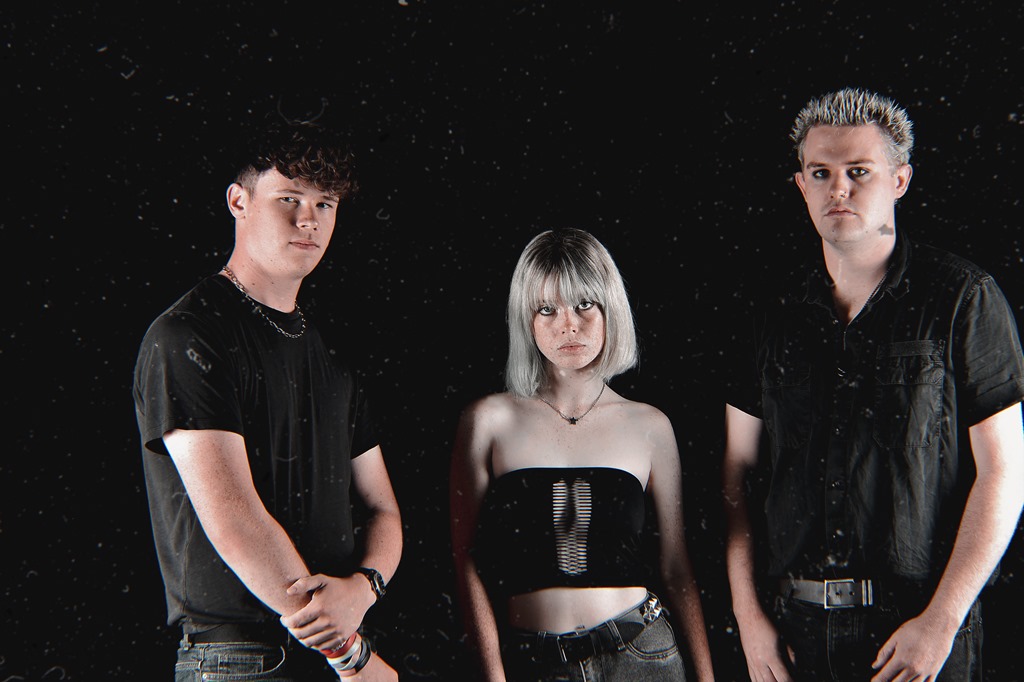
Eva Sheldrake has range, and a knack for delivering a hook, not to mention a monster riff, and in the company of Milo Hemsley (drums) and Billy Finneran (bass), the Brighton ‘brat-metal’ trio are a powerful unit. And as much as I’ve been digging the vogue for duos lately – a setup often born as much out of necessity as choice – and hearing how far it’s possible to push the most minimal format it’s possible to have and still be a band – there is something so classic about a trio. It’s because while maintaining all of the component parts, there has to be absolute focus, there’s no room for a weak element like an iffy rhythm guitarist, and no-one has anywhere to hide, but everyone has to deliver optimally. And when they do, the sum is greater than the parts.

“I hope listeners take as much from it as I did by relating through experience with inner

conflict and toxic situations that are hard to escape,” says Eva.

She certainly channels it, and hard, here. Eville are clearly no suckers, and ‘Leech’ is a killer tune that says this is a band with much promise.

AA

IMG_8878

1st September 2023

Christopher Nosnibor

Since I was first introduced to Salvation Jayne, back in 2017, I’ve admired their energy, their punchy, punky rock tunes (unashamedly not ‘alt’ and straight-up kicking arse). But what happens when a band loses a pivotal member, particularly under rather messy circumstances? It’s nothing new, of course: Fleetwood Mac’s career after Peter Green was both longer and more commercially successful, and the same is true Pink Floyd after Syd Barrett’s departure and post-Gabriel Genesis. Roxy Music lost Brian Eno early on, and Marillion enjoyed a lengthy career post-Fish… and so on, from Iron Maiden to, er, Queen. Arguably, some of these lineup shifts have marked changes for the better. Others… maybe not so.

As far as many were concerned, myself included, Salvation Jayne was Chess Smith. Clearly, Salvation Jayne, releasing their first new music since her departure, would disagree, and they’ve forged on and are now clearly facing forwards and evolving. The arrival of Estelle Mey on vocals is swept over briefly in the band bio which announced a change in sound with the new lineup, describing it as ‘intense, dark and dynamic post-punk’.

It crunches in with warping electronics trilling over a murky bass noise that sounds like a bulldozer before slamming in with some serious force, the nagging guitar reminiscent of post-millennium Pitch Shifter and some vaguely nu-metal vibes, but still retaining the powerful pop elements which defined their sound, and it’s certainly a meatier and more aggressive sound they’re showcasing here. Contrasting shouty verses with a more melodic chorus, it’s a tried and tested structural formula, and they really work that dynamic, and it works well.

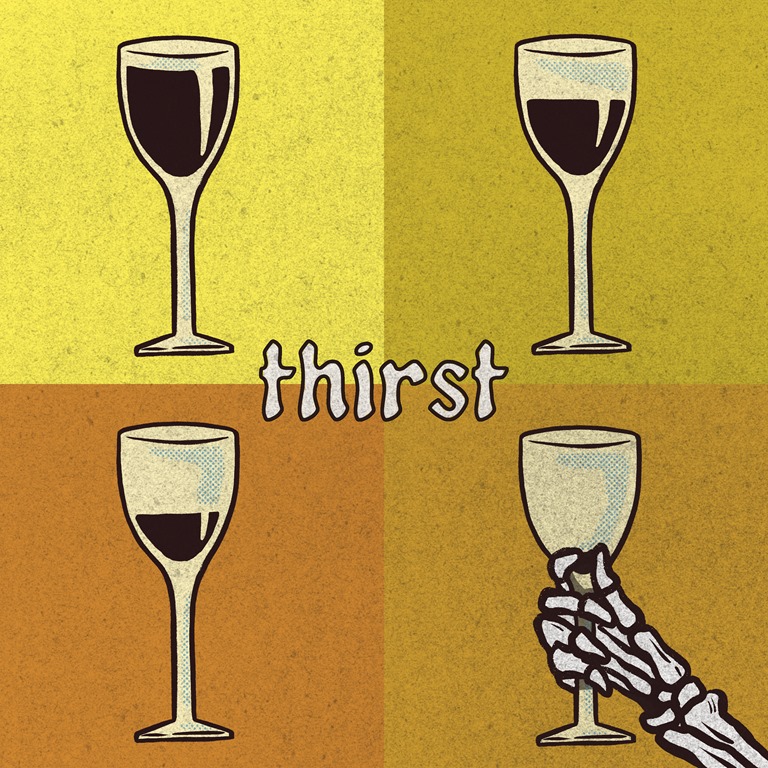
The layered vocals add unexpected depths and dimensions, and if there are moments where ‘Thirst’ feels crowded, the level of detail means there’s more to explore and it’s an adventure to unravel with subsequent plays and following the initial impact. Yes, Salvation Jayne are back, and they’ve got a big tune here.

AA

Salvation Jayne artwork

26th June 2023

Christopher Nosnibor

‘Industrial’ is a definition that’s shifted significantly over the years. The shift seems to have come some time in the late eighties or early nineties, when the likes of Ministry and Pitch Shifter were breaking into a much more mass-market audience: the former smashed MTV with the singles from Psalm 69, with even Beavis and Butthead getting down to ‘NWO’ and proclaiming ‘even the old dude is cool’ in reference to William Burroughs’ appearance in the video to ‘Just One Fix’. It seems hard to reconcile the enormity of that album with the face of music in the media now, but the early 90s really were something. You’ll read endlessly about how Nirvana smashed open the doors and so on, and perhaps to an extent that’s true, but they were simply a part of the zeitgeist in an era when MTV focused on ‘M’, and you would find bands like Soundgarden and Butthole Surfers and Rage Against the Machine being played alongside ‘Sabotage’ by The Beastie Boys, and it didn’t seem incongruous with all the mediocre pap because, well, that was what people were listening to. I even picked up a Therapy? live bootleg CD in a record shop while on holiday in Venice in the summer of ’94. I was excited, but it didn’t seem particularly strange at the time. Pitchshifter, meanwhile, had named their debut album Industrial, and it was fucking heavy, but it wasn’t until they changed their sound and rode the wave of sports metal around the turn of the millennium that they got popular, doubtless aided by their intersection with The Prodigy.

But because of the bracketing of these bands as ‘industrial’ in the 90s, the original characteristics of what had previously been deemed ‘industrial’ became buried, and forgotten. It’s hard to really find a connection between Ministry and the likes of Throbbing Gristle and Cabaret Voltaire (at least musically: they all loved Burroughs, but Jourgensen’s fascination was more about the junkie guru legend, whereas TG and The Cabs were into exploring ways of applying the cut-ups and Burroughs’ tape experiments of the late 50s and early 60s to music.

Binary Order sit firmly in the bracket of contemporary industrial, or what many refer to as Industrial Metal, and with this release they really show their influences and wear them with pride.

Now, I do get somewhat twitchy when the running order of a review stream or download differs from the Bandcamp stream or whatever, because the flow of a release is important – at least to me, and I tend to consider the overall flow of a release in my appraisal of its success.

So we’re going with the Bandcamp sequence here, which kicks off with lead single and title track, ‘Thrown Away’, a cover of the song by the oft-maligned nineties nu-metal act Papa Roach, who, remarkably, are still going and releasing albums at a steady rate. Are people really still buying this shit? Rap Metal was surely one of the worst things to have happened to music… but here it is. They blast off the four-track EP with a chunky riff-dense rendition of ‘Thrown Away’, and with that out the way, be can finally turn to the rest of the EP.

The remaining three tracks are remixes of songs from their debut album, Songs from the Deep, released in November of last year. The ‘Bleeding Mix’ of ‘Parasite’ is a gut-churning gurgle of stuttering electronica, that starts with a pumping, shuddering beat and a quivering synth groove which provides a stark backdrop to the raw vocals… but then it gets a bit ravey and autotune and straddles the uncomfortable intersection between dancefloor and sonic assault.

The Arcadmix Remix of ‘A Good Death’ is altogether more atmospheric and moody, and works well, largely because it’s neither overtly dancey nor Industrial / Nu-Metal. The six-and-a-half-minute ‘Irreversible Mix’ of ‘Hands of Time’ manifests as a long, oppressive, darkly ambient drone that’s a real departure from the rest of the EP.

The diversity is the key strength of this release, paired with the fact that it shows a band wanting to push their limits and aren’t especially precious about how their material is reshaped or adhering rigidly too their chosen genre.

AA

812429

Christopher Nosnibor

The best local bands tends not to stay local, so for RSJ to play a one-off reunion show seven years after calling it a day and singer Dan Cook replacing John Loughlin in Raging Speedhorn in their hometown is a big deal. Precisely what prompted this return isn’t clear, but it’s extremely welcome, as the near-sellout crowd indicates.

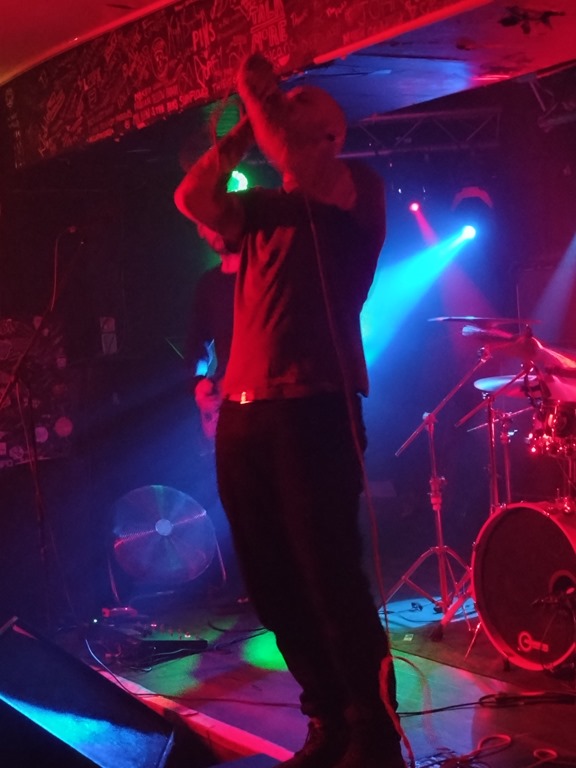
It’s busy early doors, and those who are present are rewarded with a killer set from York / Leeds metal act Disnfo. They’re young, loud, attacking and abrasive, pissed off and raging -against the government, society, the world. And too fucking right: there’s much to rage against, and it’s uplifting to see a band channelling that rage creatively, especially via thick, chunky low end riffs powered by some five—string bass action. The singer makes the most use of the floor in front of the stage. They lob in a Deftones cover about two-thirds of the way through the set, which gets progressively more melodic and overtly nu-metal toward the end of the set, but it’s supremely executed, and the interplay between the dual vocals is really strong and tightly woven.

DSC_5972

Disinfo

Beyond All Reason are also tight and proficient, but also quite cringeworthy in their straight-faced and immensely earnest performance of some epic but highly predictable hair metal with all the fretwork. They’ve been going for almost twenty years now and clearly have a substantial fanbase, meaning that I’m in the minority when I say I just can’t get onto it. Combining the po-faced thrash of Metallica with the vocal histrionics of Rob Halford, they’re every inch the band who did the ‘Shepherd’s piiiiiiiiieeeee!!!!’ Oxo ad from 2004. There is, however, something amusing about a support act playing a 350-capacity venue like they’re headlining Knebworth.

DSC_5978

Beyond All Reason

RSJ don’t look or sound like a band who haven’t played a gig together in donkeys and it’s full-throttle high-octane stuff from the second they hit the stage. There’s a lot of love for RSJ, and rightly so. Active between 2002 and 2017, they garnered significant acclaim in Kerrang and elsewhere, and knocked out four albums, while playing festivals such as Bloodstock and Sonisphere, as well as playing support slots for Slayer, Funeral for a Friend, Raging Speedhorn and Orange Goblin.

The band took their name from the construction term Rolled Steel Joist, and yes, they play some ultra-solid metalcore with no letup, whipping up a mega moshpit, but one that’s friendly – shaved heads and long beards hugging.

DSC_5997

RSJ

Leaning forward, bass dragging on the floor, the bassist hits all the lows and underpins a harsh, heavy guitar assault that just keeps on coming.

They switch to their original drummer halfway through the set for a handful of songs, and things get even heavier and more brutal: ‘Gordon’s Alive’ is a hundred-mile-an-hour frenzy.

DSC_6008DSC_5988

RSJ

It’s probably about half a dozen songs in that Dan announces that the next song is the last, which seems unfeasible. But if he announces it once, he announces it a dozen times over the next half hour, and it feels like a running joke in a good-natured set which reminds me why metal gigs are so often the best and the more brutal the music, the more docile and community-minded the band and crowd alike. The songs are all-out, but in between, the rapport between the band and their fans is heart-warming and a truly life-affirming scene.

In times of deep social division and shit on shit, we need more of this. And we certainly need more RSJ. Let’s hope this reunion isn’t the last.

Rude Records – 17th February 2023

Christopher Nosnibor

I’m somewhat conflicted here. Broadly speaking, my view is that there is good music and bad music, and it’s not a question of genre: there are good songs in all styles, even if they’re the exceptions to the rule. I’m not a rabid fan of many genres – hip-hop and jazz to name but two – but really rate some songs from each of them. Apart from pop-punk, that is. That’s just the worst kind of music, period. Oh, and folk-punk can fuck off, too. Even worse than the music are the fans, especially at the end of the night at a festival. Anyway. Nu-metal. I can’t say I was ever a fan. I mean, it was a bit shit, right? At its worst, it was juvenile, dumb, and not even that heavy. But then, I was listening to Swans and Godflesh and early Pitch Shifter, bands I still point towards when offering examples of truly heavy music. I even went off Pitch Shifter when they transitioned to nu-metal. But then, I can’t say I hated all of it, and in some respects, I kinda miss it now. Is that simply nostalgia for shit because time? Or is it that there really does feel like there is no specific trend now, and everything is so fragmented there is no real sense of there being any cohesive culture or subculture?

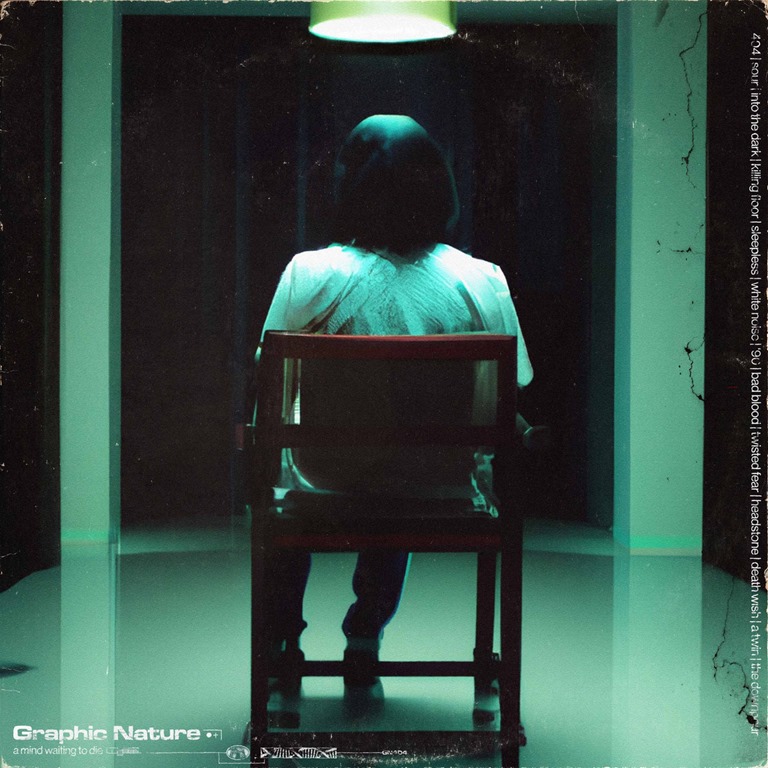
Kent metallers Graphic Nature took their name from a track on Deftones’ Koi No Yokan album and cite Slipknot, but also Nine Inch Nails as key influences on their sound. And having formed in 2019, it’s fair to say that the band represent a new wave of nu-metal (which sounds a bit daft, but not as daft as The New Wave of New Wave that happened briefly in the early 90s, and it wasn’t only shit, but didn’t even really sound especially much like new wave). The point is that while lyrically, the subject matter is pretty obvious – death and decay, but mostly anxiety, people being fucked up, the world being fucked up – the anger and angst is channelled with a focus and force that is rather more sophisticated than some of the turn-of-the-millennium hits. There are no shit rap breaks or scratching, and pitched as an album designed to ‘start a dialogue about the issues that matter’, there’s a seriousness about A Mind Waiting To Die. ‘Rollin’’ or ‘A.D.I.D.A.S’ it is not. Thank fuck.

Halfway through the album, there’s a minute-long drum ‘n’ bass instrumental interlude. I’m not convinced it’s the most comfortable break, but it’s a necessary one, because there’s not much respite for the rest of the album’s thirteen-track duration – although the slower, sparser ‘A Twin’ which pitches the NIN influence to the fore – is a different kind of powerful.

For the most part, they combine their various influences into a dense, murky mess of fast-paced, high-octane racket, and as is the case with a fair bit of metalcore and nu-metal, the song structures tend not to focus too much on the conventions of verse/chorus, instead leaping to and from between tempos and riffs with brutal slabs of guitar, overdriven to the point that chords are compacted and become lumps of noise. There aren’t many easy inroads here, but in terms of an album that relentlessly blasts raging catharsis, well, job done. A Mind Waiting To Die simply isn’t a ‘tunes’ album: it’s gut-spilling nihilism, a mess of entrails and frayed nerves laid bare. It’s not exactly fun, but it’s harsh and heavy and they mean it.

AA

a3556939295_10