Posts Tagged ‘Lawrence English’

ROOM40 – 9th August 2025

Christopher Nosnibor

It’s been some time since I’ve sat down to listen to a work created using prepared piano. It’s been even longer since I spent time with Erik Griswold’s work. Perhaps the two are related, as Griswold’s accompanying notes recount how it’s been a while for him, too:

Under the house again, just me and my very old piano. Have we got anything more to say to each other? Will some new toys spice things up a bit? The creative process seems to swing like a (Foucoult’s?) pendulum, always returning to the same spot again and again, eventually. When I last made short form prepared piano pieces in 2015 (Pain Avoidance Machine) I was “feeling stifled by the negativity of the Australian political discourse, the narcissistic excess of social media, and facing a long summer of migraine-inducing heat.” If only I had known how far we had to go.

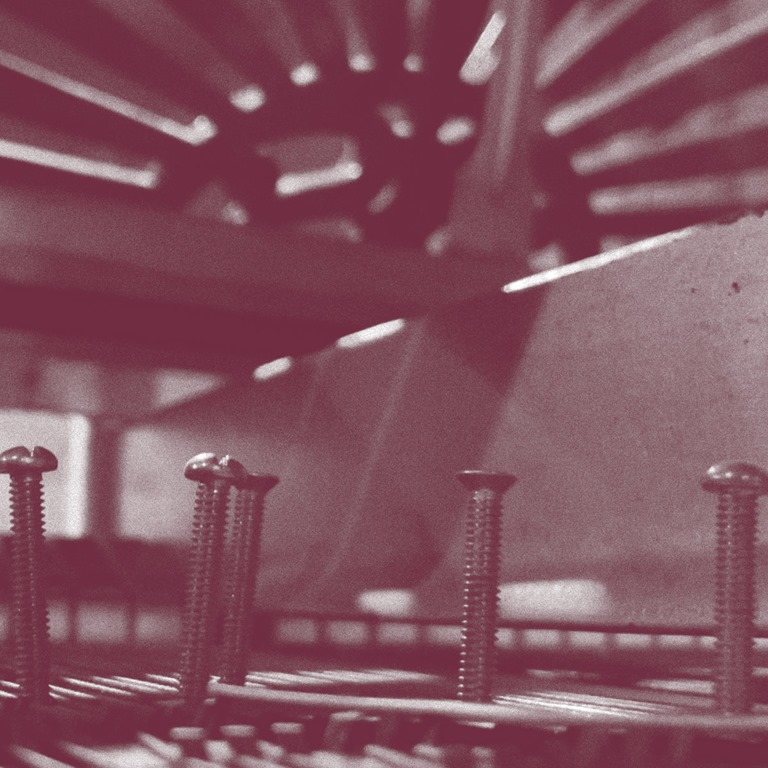
To the sounds of my 1885 Lipp and Sohn, prepared with brass bolts, strips of paper and rubber, I’ve added an analogue synthesizer, extending the exploration into the electronic. The tactile quality of both instruments is central to my approach, with small inconsistencies of sound, attack, decay, filtering all foregrounded. It’s a very intimate setting with just two C414 microphones at close distance to capture the granular details of sonic materials. The addition of “frames,” “windows,” and “sonic mirrors” produce a ritualistic aura hovering above and around the music.

I take a moment to reflect on reading this, before I can even bring myself to listen, reflecting on the title. Putting things off is… well, it’s a way of dealing, but it’s not really coping, is it? Not that Griswold hasn’t been making music: he’s maintained a steady flow of releases over the last few years, even during the COVID years – but to return to the piano is a significant step.

The title track raises the curtain here, and at times the tinkling tones are achingly beautiful, graceful, delicate, the most magnificent invocations of neoclassical perfection – albeit alternating with plinking, plonkling randomness which flips between low-end thunder and what, to the untrained ear or anyone unfamiliar with the instrumentation, sounds like clumsy stumbling.

‘Wild West’ isn’t a twanging country tune, and says nothing of the wiki-wiki-wah-wah we know, but a rolling piano piece with the prepared element adding a taut, almost electronic-sounding aspect – like the plucking of an egg-slicer – but also abstract, and strangely evocative. Meanwhile, the gentle, somewhat vague, and perhaps rather progressive-leaning ‘Ghost in the Middle’ radiates a hypnotic beauty.

The album’s mid-section takes on a dreamy, drifting, hazy quality, floating from here to there, with scratches and scrapes, forward and backward providing texture to these ponderous sonic expanses.

‘Uncertainty’ again balances neoclassical magnificence with angular irregularities and some jarring alternative tuning which continues into the trickling ‘Poly cascade’, a stack that’s subtle and in some way grounding.

‘Colours of Summer’ lands as a surprise and completely rips out those roots in an instant, being a throbbing techno track which completely goes against the grain of the album. In complete contrast, ‘Ghost of Ravel’ returns to classical territories, and is nothing short of beautiful, although as the album inches towards its close – the atmospheric bubbler that is ‘X-Mode’ which calls to mind the Krautrock bubbling of Tangerine Dream, and, more contemporaneously perhaps Pye Corner Audio’, find ourselves floating, drifting, unsure of where we are. Next Level Avoidance is full of surprises, and is in essence representative of the prepared piano, in that it’s unpredictable, unstable. Dim the lights, breathe and feel the flow.

AA

a0361562758_10

9th May 2025 – Room40

Christopher Nosnibor

Souvenirs are unusual things, in that they’re intensely personal, and imbued with a resonance which is often difficult to articulate.

I will revisit an anecdote I relayed no so long ago: my dad gave me £15 spending money when I went on a Cub camp in Yorkshire when I was probably fourteen. We had a day trip to York, where I discovered an independent record shop, the now gone and sadly-missed Track Records. I blew most of my £15 on 12” singles by The Sisters of Mercy: Alice, Temple of Love, and The Reptile House EP. On returning home, my father was not happy: he’d given me the money for real souvenirs – fridge magnets, mugs, erasers… but the fact that I still have those records and tale to tell says these were the best souvenirs I could have ever purchased. Would I still have an I Heart York mug or a tea towel thirty years later?

But one thing that’s become apparent is that for fringe, niche, and unestablished acts like Sadie Powers, even when released by labels like Room40, physical releases are becoming less of a thing. It’s a sad reflection on the state of the world and how the arts in general are suffering. People don’t want to pay for stuff, or they can’t afford to pay for stuff, and the end result is the same.

Souvenir is a sad album, based on a premise which resonates on a personal level. I’ve written extensively of late on both the impact of the pandemic, and of losing my wife, and Souvenir is a work which explores grief, with a particular focus on the pandemic. Powers explains the album, its context, and its musical limitations and development in terms of instrumentation, in a fashion which warrants quotation in full:

‘Between 2020 and 2022, a significant number of friends and family passed away. Due to the pandemic, funerals became impossible to travel to or just didn’t happen. How does one grieve alone? What is that language? What is that movement? What do I do with my hands, with the muscle memory of care weaving phantom thread? What is the shape of the shelter one makes to bear this loss? If I’m not holding, will I sink to the bottom?

‘What is my last memory with them? Almost always, it is of embrace.

‘I’ve had a relationship with fretless bass for about 20 years. It’s an unforgiving instrument. It exposes everything. Like porcelain: elastic, pliable, detailed, expressive. Suggestive to subtle touches. It shows the hand of the player. I began recording improvisations with silence, thinking of those I’d lost, their embraces, those moments of stillness and when time folds in on itself, then cutting the tracks up processing and layering them, a sound collage. Programmable music box bells, sheet metal, cardboard box, and field recordings from the same spot on the back patio of my former home color the shape. Like a bird collecting items to create a nest of memory. Sounds drifting in and out like recollections, like ghosts. The practice became a life raft, or a grieving raft.

‘Is the souvenir the embrace? Souvenirs originated from pilgrimages in the Middle Ages, as a remembrance of a journey.’

The four compositions which make up Souvenirs are each approximately ten minutes in duration, and this would have made for a magnificent vinyl LP, particularly given the texture and detail of the works.

The first track, ‘Right After’ is exemplary: it begins so quietly as to be beyond range, before the crackle of a slow fade-in becomes discernible. And against this, and some rumbling dark ambience, there is the strolling fretless bass work. I can’t help but think – however fleetingly – of Duran Duran, not because it actually sounds like Duran Duran, but because that fretless bass has such a distinctive sound – thick, bulbous, rounded, warm.

‘Soft Materials: Permanent Rose’ is move overtly ambient, and ripples its way along in an understated fashion, and ‘Rabbit Hour, too, hovers and hums, clatters and clinks, plunging deeper into abstraction, drifting cloud-like and formless, hovering, while occasional scrapes and nails-down-a-blackboard feedback sounds cut through the soft waves.

‘Princess Moo Bear’ may sound soft, but the clanking chines are pitches against thick helicopter sounds and dark abstraction, before finally expanding and drifting to nothing.

Souvenir is not an easy or instant album. Quite the contrary is true. But it is detailed, layered, and has much going on.

AA

a0102366993_10

Room40 – 9th May 2025

Christopher Nosnibor

Merzbow is an artist who requires little to no introduction, and one with a catalogue so immense – with in excess of five hundred releases credited – it’s beyond daunting for not only a beginner, but even a keen noise-lover. This is the reasons I personally own very few releases, and have only picked up a few incidentally along the way.

As Masami Akita approaches seventy, and Merzbow marks forty-five years of noise, this output shows little sign of abating, but it does seem an appropriate time to reflect on some previous releases which may be considered either ‘classic’ or ‘pivotal’. 1994s Venereology has been receiving some retrospective coverage of late, revered largely on account of its reputation for being the loudest, harshest thing ever, ever.

But here we have a reissue of The Prosperity Of Vice, The Misfortune Of Virtue, released a couple of years later, a much lesser-known work, but still during what’s broadly considered to be the golden era of the 90s, and, as the accompanying notes suggest, it’s ‘one of a series of unique editions from his vast catalogue that reveals a side of his practice often under represented.’

During the late 1980s and into the 1990s, Masami Akita was sometimes working on film and theatre music. In this space he created a series of recordings that capture the full scope of his sound worlds.

Given the nature of these settings, his compositional approaches were varied, seeking to create both intensely crushing walls of sound and more spatial, and at times rhythmic, pieces that plot out an approach to sound making which atomises his universe of sound, and uncovered the singular detail that is often consumed in the whole.

The Prosperity Of Vice, The Misfortune Of Virtue is the soundtrack to the theatre piece Akutoku no Sakae/Bitoku no Fuko by Romantica. Based on Marquis de Sades’s Historie de Juliette ou les Prosperités du vice & Les Infortunes de la vertu, this recording was originally released with limited distribution and remains one of the lesser available Merzbow recordings.

Completely remastered and contains an additional cut from those original sessions, this reissue of The Prosperity Of Vice, The Misfortune Of Virtue presents nineteen blasts of noise and rumbling and shrieking, scraping discord and dissonance. Many of the pieces are brief – a couple of minutes or so – and there is so much texture and tonal rage here, its sonic vision is remarkable. To many, of course, it will just ne noise – horrible, nasty, uncoordinated noise. But listen closer, and there is a lot happening here. The noise is, indeed, nasty, and the output is, brain-blasting chaos, for sure. But what these untitled pieces showcase is an intense focus and an attention to detail which is so much more than brutal noise. The Prosperity Of Vice, The Misfortune Of Virtue is, comparatively speaking, not that harsh – although when it is harsh, it’s absolutely next-level brutal with shards of treble exploding in walls of ear-shredding punishment. It contains a lot of clattering and crashing, like bin lids being dropped, and cyclical, thrumming rhythmic pulsations. There are tweets and flutters, bird-like chirrups flittering above cement-mixer churning grind with gnawing low-end and splintering treble, overloading grind and would oscillations.

The Prosperity Of Vice, The Misfortune Of Virtue is the sound of a man pushing all the buttons and turning all the dials at once and seeing just how far he can tweak them. There are moments of minimalism, of slow, stuttering beats, of mere crackles, passages one might even describe as ambient – a word not commonly associated with Merzbow. But the way in which The Prosperity Of Vice, The Misfortune Of Virtue explores these dynamics, and contains quieter more delicate segments, not to mention some bleepy electronica that borders on beat-free dance in places, is remarkable: while so much noise is simply repellent to anyone who isn’t attuned to it, The Prosperity Of Vice, The Misfortune Of Virtue offers engagement and offers openings to listeners with a broader interest in experimental music.

Eclectic is the word: we hear a chamver orchestra at the same time we hear strings being bent out of shape and what sounds like a Theremin in distress. While a fire alarm squawks in the background. This is everything including the kitchen sink. Imaginative and experimental, it’s noise with infinite dimensions.

AA

RM4195 front

Room40 – 31st January 2024

Christopher Nosnibor

It begins with a rumbling roar, like a persistent strong wind rushing over moorland, before ripples of piano delicately drift over it to altogether calmer effect – although the roar continues beneath. The juxtaposition brings a balance of sorts.

Just a few days ago, I wrote on Circuits From Soft Frequencies by Jamie Lee, which was recorded among the sound mirrors at RAF Denge, in Kent, and touched on the fascinating nature of these structures, and opined that ‘often, the most alien and seemingly otherworldly creations are, in fact, man-made’.

Lawrence English’s latest work seems to contribute to this dialogue, albeit approaching from a different perspective.

‘I like to think that sound haunts architecture,’ he writes, and goes on to remark, ‘It’s one of the truly magical interactions afforded by sound’s immateriality. It’s also something that has captivated us from the earliest times. It’s not difficult to imagine the exhilaration of our early ancestors calling to one another in the dark cathedral like caves which held wonder, and security, for them.’

English also writes of the relationship between space and place, and how ‘Spaces hold the opportunity for place, which we create moment to moment, shaped by our ways of sense-making… Whilst the architectural and material features of space might remain somewhat constant, the people, objects, atmospheres, and encounters that fill them are forever collapsing into memory.’

The album comprises eight numbered segments, ETHKIB I – VIII, all formed using fundamentally the same sound palette, and which flow into one another seamlessly to create a single, continuous piece, which is best experienced without interruption.

The piano and the undercurrents, which evolve from that initial roar to altogether softer drones which drift, mist-like, develop an interplay whereby the dominant sound switches, sometimes with one or the other fading out completely – but this happens almost imperceptibly… It isn’t that you don’t listen to the music, but the preoccupation of the listening experience is absorbing the atmosphere, and it possesses almost a physicality. By ‘ETHKIB V’ the sounds has built such a density that the sensation is like being buffeted. Amidst the deep drones, there are, in the distant, whirring hums and elongated scrapes which evoke images of disused mills and abandoned factories. Perhaps there’s an element of the power of suggestion, but it’s difficult to contemplate purely abstract visualisations, or nature without some human aspect somewhere in the frame.

The soundscapes English creates are evocative, and in parts, at least, haunting – although ultimately, what haunts us is our own experience, our thoughts, our memories. And in this way, from space, we create our own sense of place, and tie things to them in an attempt to make sense of the world as we experience it.

By ‘ETHKIB VIII’, it’s the piano alone which rings out, in a reversal of the opening, and some of the mid-sections, ending on a single, low note, repeated, held, reverberating, leaving, ultimately silence, and a pause for reflection.

AA

RM4245 front

Room40 – 20th September 2024

Christopher Nosnibor

Autumn is something of a difficult season to assimilate. As much as it can be filled with beautiful shades as the leaves turn and the sunlight takes on a softer hue, there can often be a hint of melancholy in the cooler air and darker evenings. Some may yearn for the heat of summer, but more than that is the reminder that we’re on a transition toward winter, and the passing of another year. The passing of time is something which creeps up on all of us with an inexorable inevitability, and while you’re busy living life – or, likely, battling just to keep on going through it – time slips by, and your twenties slide into your thirties slide into your forties… people, places, jobs all come and go. Go where? And what have you got to show for it?

As one of the most dismal summers in a long time – not to mention the coldest in six years – draws a close to the wettest eighteen months or so since records began here in the UK, where it’s felt like eighteen months of October, the arrival of the 15th Anniversary Edition of A Colour For Autumn is nothing if not timely. Anniversaries inevitably give pause for thought, inspiring reflecting on the time of the actual event, and the intervening period. And with in his reflections on A Colour For Autumn, and its context, Lawrence English makes some powerful observations:

‘Climate change, as a lived experience and not merely as a ‘possibility’, suddenly came into focus with reports flooding in about the climatic dynamics since the turn of the century and events like the Black Saturday fires here in Australia. It felt like, and continues to feel like, seasonality as some predictable measure of our world is relegated to the ‘before’ times. This record is not about these climatic shifts however, more a recognition of how we have used patterns and predictability to guide us over the centuries and perhaps a realisation that the way forward is not the path we have known historically.

‘Listening back to the record with fresh ears, a process made completely delightful by Stephan Mathieu who has carefully remastered it, I am struck by how minimal some of the structures were. There are moments that strike me as uncharacteristically patient and even generous, allowing one element to hold without interference. I’m grateful to still feel a deep connection to this edition and to the people and places that helped shape it.’

‘Droplet’ seems to start midway through: there is no intro, no fade-in, no slow-build. We find ourselves landing in the midst of a long swell of ethereal sound, a chorus of spectral voices drifting in vapour and carried on clouds. Sometimes, ambience carries something of greater depth than is readily apparent. More than a medium to meditation, a conduit to contemplation, seemingly formless, abstract sound resonates on a subconscious level with and unexpected force. Over the course of almost seven minutes, the track drifts and twists and a squall of dissonance and a whistle of feedback builds in the background.

Just as the pieces merge into one another, so the titles of some of the tracks link together to form phrases, albeit with only vague meanings: ‘The Prelude To’ leads into ‘The Surface of Everything’. Elsewhere, English departs the surface and transports the listener high above the atmosphere in ‘Galaxies of Dust’. You almost feel as if you’re floating, detached from everything, even time, hanging in suspension.

Much of the sound on A Colour For Autumn takes the form of hums and drones, and while gentle and delicate, there’s an ever-present discomfort, something just beyond perception, on the edge of the senses, which unsettles, nags and gnaws. It’s this uncertainty, this element of disquiet, which makes A Colour For Autumn such an enthralling and evocative listening experience.

AA

a2415743988_10

Room40 – 30th June 2023

Christopher Nosnibor

There is no quick way to consider this album. And for many reasons – the first being that it needs to be heard in its entirety before being able to summarise and pass critical comment. The second being that after hearing it, one needs to drag themselves from the wreckage of their psyche and process an experience that is likely akin to a week being subjected to psychological experiments at the hands of the CIA under MK Ultra. Brace yourself…

As his bio points out, ‘Tony Buck is no stranger to the realm of durational performance and composition. As a part of Australian unit The Necks he has been central to defining a reductive, but rich sound language that equally interrogates timbre and time…[and] with Environmental Studies he moves even further into these longitudinal pursuits.’

Longitudinal is one word to describe this album. It’s a single, continuous piece, some two hours in duration, and while there are a couple of five-minute excerpts designed to give potential listeners an indication of what it’s like, it’s simply impossible to convey the experience in snippets. The snippets are lifted from the album’s lighter moments: that doesn’t mean they’re mellow, melodic, but the multi-layered clattering percussion that’s evocative of some kind of space-jungle and brief segment of avant-jazz feedback is nothing in the wider context. And – as I always say – context counts.

While chart music – geared toward snappy three-minute cuts which are 90% chorus – and the inclusion of streams when compiling charts, has effectively killed the album in the mainstream, further afield (and to be fair, you can’t get much further afield than this), the album is still very much a cherished format for both artists and listeners alike. In fact, it’s interesting to observe the rise of the really long album. I will often harp on about Swans releases from the last decade, but they’re not isolated. Frank Rothkkaramm released an album as a 24-hour CD box set – which couldn’t be much more different from Throbbing Gristle’s 24 hours box – as he explored sounds which helped with his tinnitus. Numerous doom, drone, and ambient albums in recent years have really pushed the parameters of an album thanks to digital releases not being subject to the same limitations of physical formats – or the same production costs. Is the medium the message? Perhaps, at least to an extent.

The recorded medium was always an issue: even going back to the height of the classical era, once recording became possible, the media limited what could be released, meaning to hear a full performance of, say, Handel’s Messiah, you had to be there, since even a recording which required a box-set album release required truncation. It also, of course, required the turning of records and the segmentation of the work.

In its day, Earth’s groundbreaking Earth 2 challenged the conventional notion the ‘the album’ – more even than any monster prog releases like Yes’ eighty-one minute Tales from Topographic Oceans and the two-hour plus, sprawling triple YesSongs. Because what differentiates these is the fact that Yes was a lot of noodling wank, while Earth did something different, with a specific desired effect intended, and its duration was in fact integral to its cumulative effect, namely that of a sonic blanket of suffocation. Anyway: the point is that Environmental Studies is an absolutely immense album, and it’s a work that needs to be heard as an album. You may find yourself drifting in and out, but it feels as if this is part of the experience: better to drift than experience in fragments.

The accompanying notes describe Environmental Studies as ‘An incredibly dense matrix of interwoven voices and layers, each occupying and exploiting a unique space within the fabric of the sound-environment, co-existing to slowly reveal themselves in multiple interconnected relationships.’

Immediately from the start, the listener is assailed by a deluge of discord and dissonance and streams of noise. It gradually drifts through an ever-evolving, eternally-shifting journey, where mellow jazz piano and slow-melting notes emerge and drip slowly over cascading cymbals and an infinite array of extraneous sounds which wash in and out. There are passages of supple, strummed acoustic guitar – which get harder and more challenging at times but also explore mellow passages –– and gurgling extraneous nose, straining, clattering. There are sections which so tense, straining and submerged by noise that as feedback twists and turns and groans and hums, that the enormity of Environmental Studies finally hits.

There are infinite layers of percussion rattling shakes and clangerous curiousness, with errant twangs and all kinds of shades of strange, with dingy distortion crashing in heavy amidst the a maelstrom of noise that sounds like a hundred pianos being thrown down a hundred flights of stairs at the same time while someone in the top floor flat blasts a Sunn O))) album at wall-cracking volume and there’s a fire broken out in the basement and it’s rapidly escalating upwards.

An hour in, we’re in sonic purgatory – and it’s absolutely magnificent. The polytonal percussion builds and builds; industrial, tribal, everything all at once, with sonorous drones and crushing distortion and noise and wailing feedback whistling and screaming all the while, it’s a relentless barrage of sound – but not noise, and that’s an important distinction here. There are noises, and they’re collaged into something immense, with the rattling of cages and furious beating of skins.

When it does simmer down, some time further in, we find ourselves in an alien landscape, that’s strangely spacey and tense before the next round of percussion barrels in. Environmental Studies is big on beats, but not all of the beats are big: insectoid skittering and scratchy flickers are as integral to the complex interweaving as the thunderous floor toms and reverberating timpanis, and everything melts together to weave a thick sonic tapestry.

While there is nothing about Environmental Studies which is overtly heavy in the conventional sense, to immerse yourself in the album is an exhausting experience, both physically and mentally. But if art doesn’t challenge, what is it for? It’s merely entertainment. This is not entertainment. But it is an incredible work of art.

AA

a1038790420_10

Room40 – 2nd September 2022

Christopher Nosnibor

It’s a sign of the times that this is being released only as a download: labels – especially niche labels like Room 40 – know their audience and know their budget. The time has now passed when a connection with a label with ensure a physical release, and theres something sad about this. Still, better a virtual release with a label’s backing than no release and / or no label backing, and ROOM40 have some respect in their field.

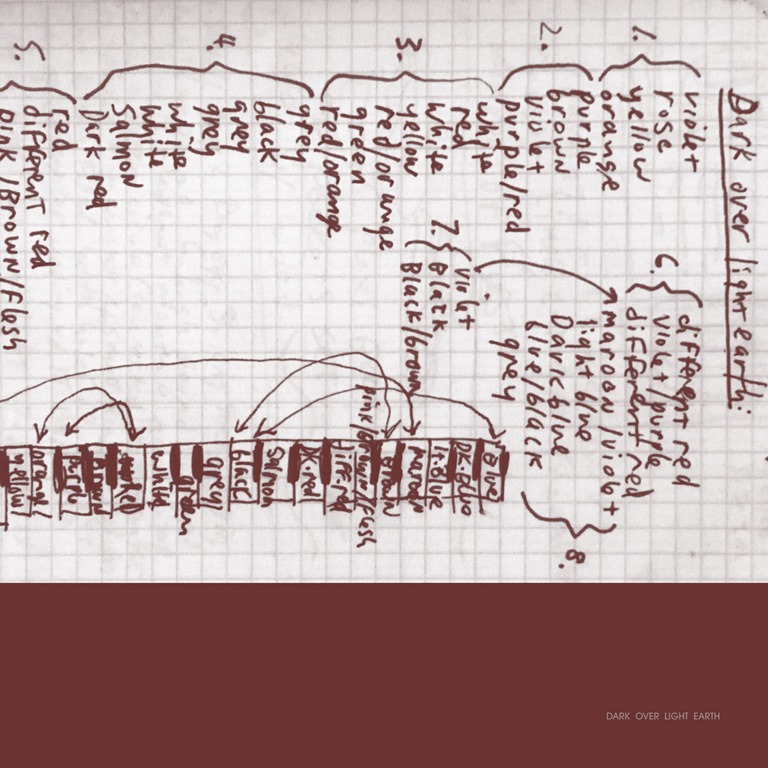
Dark Over Light Earth is very much a release that highlights the intersection of different media, specifically visual art and music. As Steve Roden explains of the album’s origins, ‘dark over light earth was created for the final weekend of the exhibition moca’s mark rothko, which featured 8 rothko paintings from the museum of contemporary art los angeles’s permanent collection… i initially made a list of every color in each of the 8 paintings, to generate a score. i recorded myself playing the score on harmonium and glockenspiel – the notes and their order pre-determined by my color notations; and the tempo, duration, and overall feel, improvised. some of these recordings were then processed electronically with filters.’

It’s fair to say, then, that this is a quite specific, technical, and theory-based work, and it’s not immensely accessible either. Granted, it features violin and amorphous synth drone, both of which are fairly familiar aspects of contemporary experimental music, and there are moments which are genuinely magical, and musical, as they skip from here to there with a lightness and ease that’s magnificent.

But so much of the album – which consists of a single track with a running time of nearly thirty-five minutes – is discordant, difficult, atonal, and it’s hard to get a handle on. The individual elements are comparatively tuneful, but when placed together… Picked dissonance flits over dolorous droning synths and mournful strings – the violin so often sounds sad, but all the sadder when it scrapes sinuously, against the note, against the grain.

The sparser passages are minimal to the max; stuttering scrapes and picked notes forge tension against not drones, but tense scrapes and scratches while notes drape in fatigue across the rough and barren soundscapes.

Listening to Dark Over Light Earth prompts me to revisit not only Rothko’s catalogue, but his biography, which reminds me that he committed suicide at the age of 66. So much is made of the ‘27’ club, that the suicide rate among older people, particularly artists, tends to be overlooked. Hunter S. Thompson, age 67; Ernest Hemingway, age 61; Robin Williams, age 63; Tony Hancock, age 44: it’s all to easy to bracket the psychology of suicide as an affliction oof young males, but this masks the broader issue.

Just as there is nothing in Rothko’s work which indicated darker underlying issues, so Dark Over Light Earth isn’t anywhere near as dark as all that; it’s simply a work of quiet, but troubled, contemplation.

It is, unquestionably, a fitting soundtrack to accompany the viewing of Mark Rothko’s work abstract, overheated, yet austere, simple yet confrontational in their stark minimalism, and in that capacity, it’s magnificently realised.

AA

a3413973115_10

ROOM40 – June 2022

Christopher Nosnibor

I feel like I’ m forever playing catchup. The simple fact is, there are more new releases – and remarkably good ones at that – than there are hours in the day to listen to them all. I can’t bee the only one who sees friends on FaceBook posting about how they’re loving the new album by X, Y. and Z, and who gets asked if they’ve head / what they think to this, that, or the other and wonder ‘how the hell do you actually listen to all this?’ These people must listen to music 24/7 and possess three pairs of ears by which to listen to all of this music simultaneously, or something.

Admittedly, it doesn’t help that my dayjob doesn’t really afford much opportunity for listening while I work, so I really only have a spell while cooking dinner, and evening, which, after everything else, tend to start around 10pm.

And so, presented with anything up to thirty new releases a day in my inbox, I simply can’t listen to everything, and I deeply envy those who can, and seemingly do.

One particular source of guilt, for wont of a better word, is my inability to keep up with ROOM40 releases. They may only be number three or four a months, but they’re invariably interesting, exploratory, intriguing. And tend to warrant for more detailed analysis than I can reasonably offer. Hence a summarising catch-up for the label’s June releases, on the day July’s have just landed with me.

Alberto Boccardi’s Petra (released on tape) is a comparatively short album of intense electronic drones: consisting of just five tracks spanning around thirty-two minutes, is sparse, ominous, sonorous, predominantly mid-range but with some stealthy bass and sonorous, trilling organs. Recorded over several years and partly inspired and assembled while Boccardi was resident in Cairo, it’s both chilling and soporific, it’s an intriguing minimal work.

RM4165_front

Blue Waves, Green Waves by Alexandra Spence isn’t receiving a physical release, and is an altogether different proposition. As the tile suggests, the ocean provides the primary inspiration, and sure enough, it begins with the sound of crashing waves, but this soon recedes to the background, while analogue organ sounds ebb and flow as the backdrop to low-key spoken word pieces. Noters drip and drop and hover in suspension like droplets of water hanging from leaves before their inevitable yielding to gravity, sliding off and into a puddle. ‘Air Pockets’ sloshes and sploshes, reverberating against empty plastic pipes. The flatness of sound and the shifting of tones as they bubble and sploosh is the aural equivalent of close reading, interrogating a source to microcosmic levels.

DRM4143_art

‘All intensive purposes’ is one of those (many) misspeaks that drive me fucking crackers. And this release by there inexplicably—monikered ‘Pinkcourtesyphone’ is an album likely to frustrate and bend the brain, albeit for different reasons. With the exception of the final mid-album interlude, ‘Out of an Abundance’, these are darkly mellifluous drones that stretch well beyond the five-minute mark, and ebb and flow slowly amidst rumbles and reverberating snippets of conversation and radio. The mood is tense, unsettling; not creepy, so much as just uncomfortable, spine-tingling, ominous, and at times, other-wordly.

BW RM#4188_pinkcourtesyphone_sleeve_final

Some will likely find something in one or another of these, while others will doubtless find all three of these releases to be of interest and collectively, they do very much provide a broad, wide-ranging view of matters experimental and ambient, presenting different perspectives of found sound and field recording. It’s credit to ROOM40 for giving space to these artists, and showcasing such a range of music from within what may, on the surface, appear a narrow field, and demonstrating otherwise.

Hallow Ground – 10th September 2021

Christopher Nosnibor

Breathing is important. If this sounds flippant or facetious, well, perhaps it is a little, but there is a more serious undertone. It’s something we do subconsciously, and something we take for granted will just happen as our brain keeps the bellows pumping. We only really notice breathing when something disrupts it, it becomes laboured, or we’ve exercised hard.

And yet the importance and benefits of controlled breathing as part of meditation, for managing anxiety, and for dealing with panic attacks is widely documented and promoted. But even for those who have been taught the techniques, how often do we remember to deploy them at moments of peak crisis? Moreover, beyond those specific settings, breathing properly is something that’s chronically neglected as we slouch over our keyboards, taking short, shallow breaths that fail to fully expand the lungs and oxygenate the blood stream.

The ever-innovative and ever-intriguing Lawrence English’s Hallow Ground debut finds the composer working ‘exclusively with an organ for four compositions that are exercises in »maximal minimalism,« as their creator himself notes in a nod to Charlemagne Palestine, who coined this term.’ The liner notes explain further that ‘While it seems somewhat fitting that those four pieces based on a steady flow of air were conceived and recorded in a situation of accelerated standstill caused by a respiratory disease, the Room40 founder is not so much concerned with capturing the zeitgeist than rather incorporating the spirit of time itself. »It is a record about presence and patience,«’.

Patience is indeed required when listening to Observation of Breath. It stands to reason that there is a concerted focus on elongated, quivering drones, and the first of the four pieces, the ten-minute ‘The Torso’, with its dank, dark rumblings and extraneous interference carries sinister allusions, particularly when reflected upon in context of the album’s cover art. The torso may well house the lungs, the system of breathing, but all too often finds reference in stories of murder and dismemberment, and we’ve all wanted to strip off our own skin at some point, right?

The theme continues its trajectory in the titles of ‘A Binding’ and ‘A Twist’ which follow. These are short pieces, both sparse, droning works that are overtly organ, with the latter in particular taking the form of a gloomy funereal church recital. There’s nothing like a funeral to make you contemplate your breaths, and to consider how many you may have left in your body. Perhaps this is one of the reasons we ignore and avoid thinking about breathing: the moment we notice it, be it short or irregular, we worry, in the same way as we panic about palpitations. To become cognisant is likely to observe an irregularity, a difficulty, in a most fundamental function, and rightly or wrongly, doing so reminds us of our mortality. We hate to be reminded of our mortality: it terrifies us half to death. The irony.

In context, the album’s finale, the twenty-minute title track, which occupies the entirety of the album’s second side, on which all elements of the previous three compositions coalesce and distil into something monumental and epic. Not a lot happens: it’s simply a quavering continuum of sound that undulates and eddies slowly, unfalteringly, less like a stream than a crawling flow of larva. But to go with the flow is to fully engage with the album and its slow-shifting textures. It’s perhaps around halfway through ‘Observation of Breath’ that I finally realise I am becoming aware of my breathing at last. Conscious, I slow it, inhale to full expansion through the nose, hold, then equally slowly release out through the mouth.

Observation of Breath is a well-realised exploration of expansive territory in altogether smaller detail, and one that offers more the more you allow it to become a backdrop.

AA

HG2103_Cover_English_Final_def_def.indd

Room40 – 3rd September 2021

Christopher Nosnibor

This is a work that connects the event with the memory of the event, and exists in the space in between the actual and the recollection – and specifically, those things forgotten .

The material was recorded when David Toop and Akio Suzuki visited Australia, where Lawrence English resides, back in 2013. The pair engaged in creating a site-specific work during a residency on Tamborine Mountain, and were joined by Lawrence during the project. The release is accompanied by a book containing text written by Toop at the time documenting the visit.

And English writers, ‘Going back to listen again to these recordings of which I was a part with David and Akio, I was surprised by what elements had stayed with me and what others had slipped into the eternal greying of my mind. I have vivid recollections of listening to a Lyre bird before recording the pieces together at Witches Falls. I remember both Akio and David finding musicality in decaying palm fronds. I remember Akio’s voice, amplified through his Analpos, bouncing off the stones and trees. I remember David’s flute, so quiet in the pitch black of the night forest as to appear like a hushed tone of wind or a distant animal calling. I also remember trying to match my modest hand held electronics with the pulsing and pitching of the insects around me.’

Memory fades and distorts over time; but then again, is Toop’s contemporaneous document entirely factual and without bias? Nothing here now but the recordings… surely we can at least trust the recordings to be pure in their capturing of the event? Of course not: there are no facts, only representations, fragments. Everything is subject to some form of filter, and eyewitness accounts to crimes are notoriously unreliable, even immediately after the fact.

The album contains six tracks, each one a collage of sounds captured in and extracted from their environment to exist in distilled detachment in recording. Context counts, and while the drips and trickles, gurgles and chirps all sound familiar in a ‘natural’ setting, when set apart, things become less clear. You see, with the sounds of othjer / unidentifianblee origin blended in, it’s difficult to determine the origins of any of the individual sounds and they twist and blur together.

It sounds like running rivers and splashing waterfalls, merged with extraneous sounds doused in heavy echo. It sounds like finger-drums. It sounds like chattering primates, agitated parakeets. It sounds like barks and grunts and yammers, reverberating into the humidity. Amidst the drift of the breeze on ‘Night Drive’ a springing sound arrives as if from nowhere. It’s one of those cartoonish, novelty spring sounds. Surely it wasn’t in the original recording? There are strains of awkward, infiltered feedback, notes of a flute trilling and warbling without musical focus, as the notes yodel and wobble, or otherwise simply waver as quavering notes trailing in the air.

Ominous drones hover and hum, tweets hover and howl out into the air. There are extensive passages where there is little of note – that is to say, not lonely little remarkable, but few notes to speak of – and sparse sounds buzz and drawl seemingly endlessly, like the agitated bee sound that vibrates hard during ‘Small Holes in the Sky’. ‘Leaving No Trace’ again sounds like running water and returns to the sounds of wildlife and the jungle.

Set adrift, and with only the sounds to interact with, the listener finds their own memory triggered, perhaps first and foremost by sound association, having no likely connection with the location where the recordings took place. Just as distance in time leads to a slow decay, so layering if interpretation and association also diminish the link to the actual event, leaving only thoughts on thoughts.

A handful or sharp, trilling noises penetrate the bibbling babble, and then there is a stillness, and having awoken in Autumn, as night has fallen, it is indeed Winter already. Breathing Spirit Forms is a quite remarkable document – not of the actual event, but of something approximating it.

AA

a0762176011_10