Posts Tagged ‘Improvisation’

12th November 2025

Christopher Nosnibor

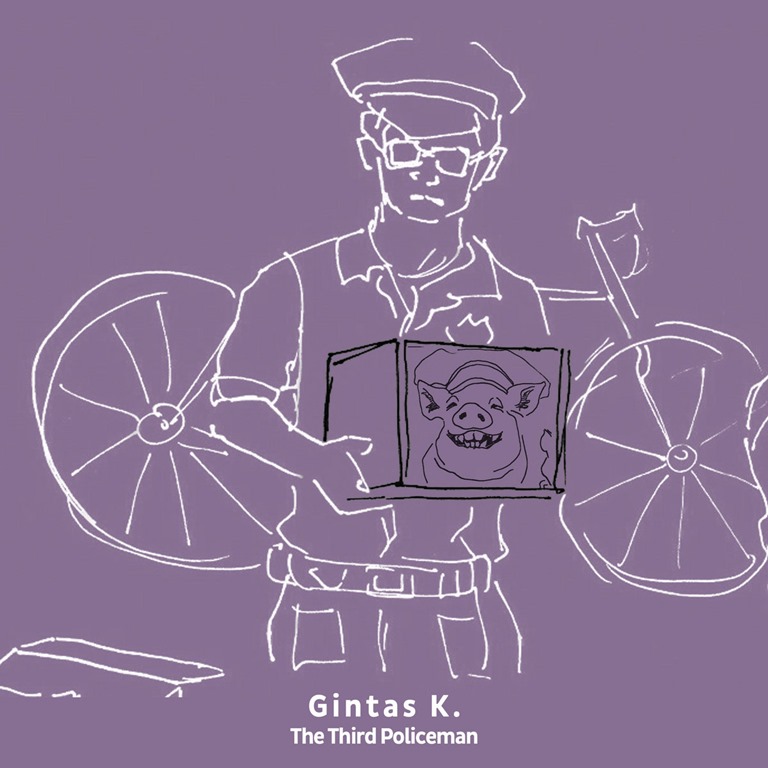
While the approach to recording his latest album is pretty much standard for Lithuanian sound artist Gintas K – that is to say, ‘recorded live, without any overdubs, using computer, MIDI keyboard, and controller’, the inspiration and overall concept is a little different this time around, with Gintas explaining that ‘The album is a subtle allusion to Flann O’Brien’s absurdist novel The Third Policeman, reflecting its surreal and enigmatic atmosphere through sound. In itself, this is quite ambitious – not quite the musical equivalent of interpretive dance, but nevertheless.

And, in contrast with many of his other albums, which tend to be relatively concise and often contain some shorter, almost fragmentary pieces, this one is a whopper, with thirty-one tracks and a running time of over two hours.

Initially, it’s display of K at his most manic, with ‘black box#1’leading the first four-track suite more frenzied and kinetic than ever, the sound of an angry hornet the size of a cat trapped in a giant Tupperware container. There aren’t always discernible spaces between the individual pieces, and after just the first eight minutes of wild bleeps and buzzes, I’m already feeling giddy. ‘black box#1 – 4’ is a quintessential Gintas K blizzard of noise which starts out like trickling digital water tinkling over the rim of a virtual glass bottle and rapidly evolves into an effervescent froth of immolating circuitry.

The second suite of pieces, ‘black box inside#2 Dog Hoots’ is made up of eight chapters – compositions feels like a bit of a stretch – and while there are a couple of sub-two-minute blasts, the fifth is a colossal nine minutes and forty in duration. This marks distinct segment of the album, in that it sounds a little more structured, like the sounds of a toy keyboard or a mellotron, rewired and then tortured mercilessly. It grinds and drones, hums and yawns, it bubbles and glitches and whirrs and it fucking screams. Before long, your brain will be, too.

The third segment, a set of six pieces labelled ‘black box inside… Calmness’ is anything but calm: in fact, it’s more likely to induce a seizure, being more of the same, only with more mid-range and muffled, grainy-sounding murk. There are more saw-like buzzes and crackles and pops and lasers misfiring in all directions. It’s not quite the soundtrack which played in my head as I read the book, but the joy of any art is that it affords room for the audience to engage and interpret on a personal, individual level.

The nine-part ‘rolling’ (or, to give it’s full title ‘black box iside#4 Rolling’ is more fragmented, more distorted, more fucked-up and broken. The pace is slower, the tones are lower, and it’s the sound of a protracted digital collapse. It’s unexpected to feel any kind of emotional reaction to messy noise, but this conveys a sense of sadness. By ‘Rolling – 4’ it feels like the machine is dying, a breathless wheeze of a thick, low-end drone, an attempts to refire the energy after this are reminiscent to trying to start a car with a flat battery. It’d messy and increasingly uncomfortable and wrong-sounding as it descends into gnarly distorted mess. ‘Rolling 7’ is creaking bleats, woodpecker-like rattles. and warping distortion, with additional hum and twang. The last of these is no more than roiling, lurching distortion, without shape or form.

Arriving at the four pieces tagged as ‘omnium – The Fourth Policeman’, its feels like you’re surrounded by collapsing buildings and the exhaustion is not just physical. Gintas K has really pushed the limits with this one. The is an arc, a trajectory here, which can be summarised as ‘gets messier and more horrible as it progresses’. Artistically, this is a huge work, a work of patience, and a work of commitment and focus. As a listening experience, it’s intense, and will likely leave even the most adventurous listener feeling like their head’s been used as a cocktail shaker and that their brain has been churned to a pulp. Outstanding.

AA

a3200436950_10

17th October 2025

Christopher Nosnibor

…and still, the COVID pandemic continues to yield new offerings, even if some are repackaged, or otherwise documents of events which took place during that strange, strange time. Real live music events were, during those dark days, simply things of memory, which we could only dream of happening again – because, for a while which felt like an eternity, there was no end in sight. Live streaming events were as close as we got. I watched a few, participated in a handful, too, but like having beers on Zoom, as much as they went some way towards filling the gaping chasm that was social life, these things were countered by a certain pang of sadness and consternation, reminding us as they did of what we were being deprived of, highlighting the fact that there is truly no substitute for the experience of live music. I write this as a fairly ardent misanthrope who will sometimes go to quite exceptional lengths to avoid other people. But sharing a room with musicians and people who seek to become one with the sound and the experience is something altogether different. Unless it’s one of those gigs where casuals turn up and yack at one another in loud voices for the duration, of course. I find that this happens less in proportion to the obscurity – and / or extremity – of the music. The more difficult, the more abrasive, the further from the mainstream the artist, the cooler the audience. In this context, Orphax’s audience must be bordering on godlike.

Embraced Imperfections features ‘two live performances recorded during a live video streaming event during the early covid-19 pandemic’, originally released as Embraced Imperfections and Live in your living room, now, remastered, they come as a two-disc release. The title reflects the nature of the recordings – both performances were improvised ‘with various synths, organs, and effects’, and as such are inevitably imperfect. But… how would we know? Artists – musicians in particular – are commonly their own harshest critics. They kick themselves for the most minor flaws that simply no-one else on the planet would notice in a million lifetimes. But still, making peace with and embracing imperfections is a significant step.

The first disc – Embraced Imperfections I – offers forty-one minutes of slow-sweeping organ drone which subtly undulates and quivers, humming on, ebbing and flowing, but in the minutest of microtonal shifts. Above all, it’s a continuous sonic flow, and the shifts in its sounds and structure are made at an evolutionary pace. You don’t listen to music like this to be affected, to feel impact, but instead to be carried along, to feel it envelop you, to wash over you, to experience full immersion. It isn’t that nothing happens… so much as very little happens, and does so incredibly slowly. If listening requires patience, so does the making. It is not easy to hold a single note for long minutes at a time without feeling a certain pressure to ‘do’ something. As this performance evidences, Orphax possesses the Zen-like ability to resist any urge to increase the pace of movement – so much so that time itself seems to stall and sit in suspension here. Even the first fifteen minutes feels like a lifetime, and the secret to appreciating this is to stop listening and simply let it become the backdrop as you slow our breathing and allow yourself to relax. Remember what it is to relax?

The shorter Embraced Imperfections II, which clocks in at just over thirty-six minutes, is less overtly organ-driven and more constructed around an electronic hum, and it’s dark, claustrophobic. It also feels more low-key, and more ominous. It’s still another extended dronework, the sound of which is absolutely the immersive dronescape, the hovering hum that feels like nights drawing in and claustrophobic depression descending on the dense darkness. It’s a dense, scraping, soporific endless polytone that scratches and hums for what feels like all eternity. While far from accessible or easy listening, it does make for an immersive journey. And cat pics always win… embracing impurrfection.

AA

AA

a0536185753_10

Constellation – 3rd October 2025

Christopher Nosnibor

The third album by The Dwarfs Of East Agouza (Maurice Louca (Lehkfa), Alan Bishop (Sun City Girls, Sublime Frequencies), and Sam Shalabi (Land Of Kush) promises ‘a focussed set of rhythmic psych-trance free/improv’.

As their moniker and the album’s title suggests, they demonstrate a collective interest in urban myths, the strange, the embroidered and embellished tale, perhaps spun with a twist of esoteric mysticism, but at the same time, aren’t entirely serious about it all. That is by no means to imply they’re not serious about the music they make, even when the pieces have titles like ‘Goldfish Molasses’, ‘Saber Tooth Millipede’, and ‘Swollen Thankles’. Because it is possible to be intense and serious and at the same time retain a capacity for humour, a sense of the absurd.

Sasquatch Landslide is an album that’s knowingly ‘out there’, but at the same time, it’s clearly the work of a collective who are completely immersed in the world they’re creating through a conglomeration of sounds which border on the transcendental. Elongated, quavering drones and an array of percussion merge in a haze to forge loose, yet curiously intense grooves. The aforementioned ‘Sabre Tooth Millipede’ is a full-on wig-out jazz frenzy played with the psychedelic loopiness of Gong as their most far-out, and at the same time, amidst the twanging and clattering, there’s something of the spirit of The Master Musicians of Joujouka about it. For an added addling bonus, there are tempo changes galore, and some parts where there are multiple tempos crossing one another simultaneously as the players seemingly detach from this physical realm into different plains of consciousness, separate from one another yet still connected by some kind of telepathy. Because however weird and disjointed it gets, somehow it works.

‘Double Mothers’ goes spaced-out, haunting, and atmospheric. On the one hand, it’s one of the most overtly jazz pieces on the album, but the wandering, reverb-soaked saxophone weaves its way through a nagging twang of a distinctly Eastern influence, while a pulsing heartbeat rhythm creates an underlying tension.

Single cut ‘Titular’ is busy and adds an easy listening, lunge-like organ trill which is completely at odds with the hectic hand drums and frenzied fretwork. They really cut loose on the ten-minute ‘A Body to Match’, stretching things out in all directions – tempo, texture, detail, serving up a pan-cultural smorgasbord of noodlesome improvisation. There, they slowly pick apart the component elements, a slow-motion explosion or deconstruction of the composition, each part slowly moving further from the rest. ‘Goldfish Molasses’ slowly melts, a plodding beat reminiscent of ‘What A Day’ by Throbbing Gristle provides the spine for this slow, pulsating Industrial thudder, where a woozy bassline undulates in the background, and incidental noises and chattering yelps fill the space behind some indecipherable vocal.

Sasquatch Landslide is big on warped, looping drones and layers of intricacy upon layers of intricacy, which weave a shimmering sonic cloth that ripples and shifts before the eyes – and ears. Time itself bends and stretches, taking on an almost elastic quality as the threads unravel to reveal new layers and dimensions. One can feel the instrumentation expanding outwards into infinity – and infinite reverb – in the same way that the universe is continually expanding, only in an accelerated timeframe. For all of its abstraction, Sasquatch Landslide provokes quite visual interpretations of the sounds emanating from the speakers. I expect to have very strange dreams tonight after this.

AA

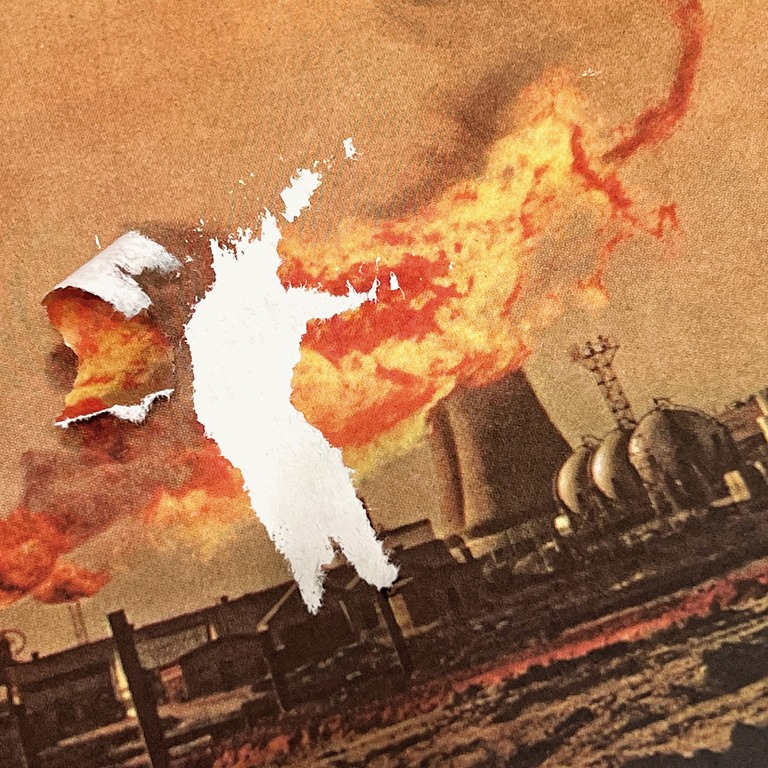
08 - The Dwarfs Of East Agouza cover art

This October, the indefatigably enigmatic trio The Necks will release Disquiet, their 20th full-length release, a triple disc via Northern Spy. It’s an absolutely intoxicating listen, over three hours of incredible music.

The band has shared the mesmerizing 26-minute ‘Causeway,’ as a first listen. Hear it here:

AA

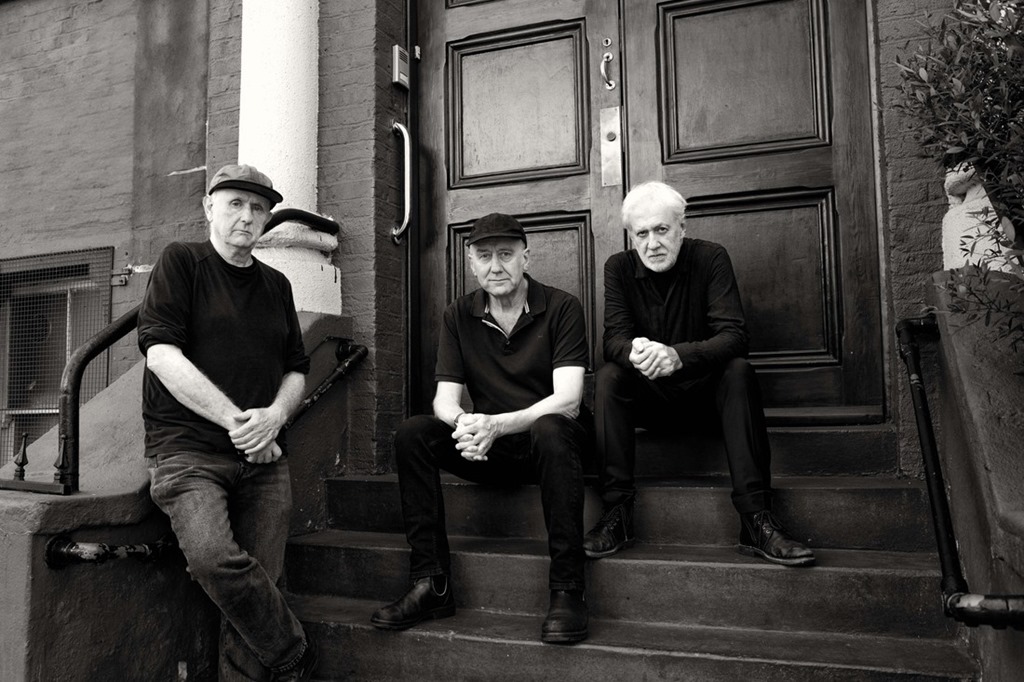
Necks

Photo credit: Dawid Laskowski

28th July 2025

Christopher Nosnibor

Beauty, as they say, is in the eye of the beholder. Certainly, it requires a fairly specific subjective standpoint to hear the beauty in a bleeping rush of effervescent electronic froth, but there is something in it – and yes, it is intense – to the extend that it’s like a fizzing chemical reaction, like vinegar and bicarbonate of soda, exploding in your brain. And it’s quite a high.

Intense Beauty finds Gintas Kraptavičius (Gintas K) in his most common setting, with the album being fully improvised, ‘recorded live, using computer, midi keyboard & controller’. Recorded in June 2025 of this year, by the power of the Internet and micro-labels, it was released as a limited cassette on Tokyo-based label Static Disc just weeks later on 10th July, before also becoming available on Gintas’ own Bandcamp page.

As is common to many of Gintas K’s works recorded in this manner and with this – seemingly unique setup, there’s something playful, even joyful and uplifting about the sound. It is chaotic, but it’s also carefree, and it’s not remotely dark or heavy: there’s nothing harsh or abrasive to be heard here. ‘intense’ is skittery and skittish, off-key electric piano thumps and stomps erratically, glitching in and out throughout, while cellular sounds fly around all over like plankton in a storm before gradually slowing, tinkling and flitting at a more sedate pace until grinding to a halt.

‘harmony’ isn’t particularly harmonious, instead merging static and drone with groaning whirrs before yielding to discordant bent notes playing across one another. One thing that is a constant throughout Intense Beauty is a sense of movement. There isn’t a moment is stillness, as sounds and ideas flit from one place to another with no discernible flow, and th9is is nowhere more apparent than on the shifting sonic collage of ‘gal bet’. It’s hyperactive, and should be exhausting, but the sheer energy is contagious and uplifting.

Watching the accompanying video of Gintas recording for the album is illuminating, particularly the vigour with which he plays, simultaneously striking keys on the keyboard with hands, wrists, forearm, seemingly at random, but with remarkable speed and dexterity, while cranking knobs hard and fast: the camera and table shake under his frenetic kinetic activity. K isn’t one of those who creates sound simply by pushing buttons here and there: this is a full-body physical performance. This, too, is an example of intensity, and the artist pours it into the act of artistic creation.

There are a lot of experimental electronic artists around, but no-one else sounds quite like Gintas K.

AA

AA

a3925363230_10

Sonic Pieces – 30th May 2025

Christopher Nosnibor

Five years is quite some time, and a lot has happened in the last five, that’s for certain. Although the fact so much has happened means that the last five years have been something of a void for many. And so it is that Reverie, recorded in October of 2024, sees Otto A Totland (piano) and Erik K Skodvin (guitar, cello, electronics, and processing) reunited in concert for the first time since 2019.

It’s pitched as ‘a follow up to 2014’s Recount, which saw two pieces of music created around their live-sets in different periods. This time, we are treated with a contemporary, raw live performance from October 2024 in Rabih Beaini’s studio, Morphine Raum in Berlin, during the 15th anniversary celebration of Sonic Pieces.’

The two longform pieces which make up Reverie were recorded live, and as if to prove the point, there’s the sound of a light cough just as the first piano note hits, then hangs in the air. They could have dubbed it out, I’m sure, but to have done so would be against the spirit of this work – spontaneous, improvised, in the moment. The recording is not only about capturing the music, but the moment itself.

The seventeen-minute ‘Rev’ is delicate, built primarily around Totland’s graceful, nuanced piano work, and considerable reverb, which may well be natural from the room, but however the sound is achieved, the sense of space is integral to the atmosphere. Skodvin’s contribution is magnificently understated: the slow scrapes of strings and subtle sonic details may seem secondary or additional because they’re not the focal point, but without them, the effect would be diminished by more than half. A great musician is not necessarily the one who dominates or demonstrates virtuosic talents, but the one who understands their contribution to the work as a whole, and appreciates that less is more. And so it is that elongated notes quiver and quail, wailing tones and sonorous drones swirl about and bring so much depth and texture, an as the piece progresses, the piano and extraneous incidentals achieve an equilibrium, and it’s utterly mesmerising.

‘Erie’ turns the tables, and it’s Skodvin’s strings which take the lead initially, before trepidatious piano creeps in. Trilling tones hang hauntingly like distant memories and displaced ghosts, and there’s a melancholia to this piece which is difficult to define, but lingers amidst the brooding lower notes. The slow piano is soft, and sad, while tremulous strings evoke a sense of something lost, somehow.

Without words, Reverie paints a picture, and hints that memories and reveries are inherently tinged with sadness. For even to recall a happy time is to remember a moment which has passed, and will be relived. However many times one may return to a particular place which is imbued with fond memories, however many times one may listen to that favourite song which carries such joyous connotations, that moment, that time will forever continue to recede into the past, never to be experienced again. The past is forever past, and will become further past with each day that goes by. Summers will never be as long, or as carefree as in childhood. The exhilaration of new experiences will never provide the same buzz, however hard you chase it. And with this realisation comes the slow fade, and a sense of acceptance. Bask in the reverie, and hold those times dear as the years slip away.

AA

ReveriePATTERN013 front

Photo: Alex Kozobolis

Ni Vu Ni Connu – 2nd November 2023

Christopher Nosnibor

While the late 80s and early 90s saw the absolute peak in format-driven consumer exploitation, with the major labels finding evermore extravagant and ostentatious ways pf presenting a single or an album to boost its chart position by milking hardcore fans who would buy every format for the sake of a bonus track, a remix, or a poster, there’s been a strong return for physical releases in recent years. Admittedly, the days of CD singles packaged in tri-fold 12” sleeves, cassette singles in album-sized boxes, 12” boxes in which to house a series of CD singles, albums released in boxes as six 7” singles, and the like are well over, the fetishisation of the object is very much enjoying a renaissance, most likely as a reaction to the years when everything became so minimal and so digitised that no-one actually owned anything.

This was a bleak period. As someone who had spent a lifetime accumulating books, records, CDs, even tapes, I found it difficult to process. I had grown up aspiring to own a library and a wall of records, and found myself foundering, drifting in a world where entire lives were condensed to a playlist on a phone and a few kindle picks. I’d walk into houses – admittedly, not often, since I’m not the most sociable of people – and think ‘where’s the stuff?’ Stuff, to my mind, is character. It’s life. People would endlessly wave their Kindles and tell me ‘it’s just like a book!’ and rejoice at their Apple playlists on their iPods because they had their entire collections in their pocket and no clutter. I suggesting I should clear out my ‘stuff’, these techno-celebrants were missing the point, and continue to do so. Rifling through a collection, finding lost gems, engaging in the tactility, remembering when and where certain items were purchased is an integral part of the experience. My collection isn’t simply a library of books and music, it’s a library of memories.

In more underground circles, the existence of the artefact remained more consistent, perhaps because more niche artists and labels always understood the relationship between the artist and the consumer as conducted via the medium of the object. The release of this epic retrospective as a 4-LP box set is, therefore, less a case of getting on board with the Record Store Day vinyl hype in the way that HMV are now carrying more vinyl – at £35 a pop for reissues of 70s and 80s albums you can find in charity shops and at car boot sales for a fiver (and you used to be able to pick up in second-hand record shops until they died because no-one was buying vinyl), and more a case of business as usual.
a2289573057_10

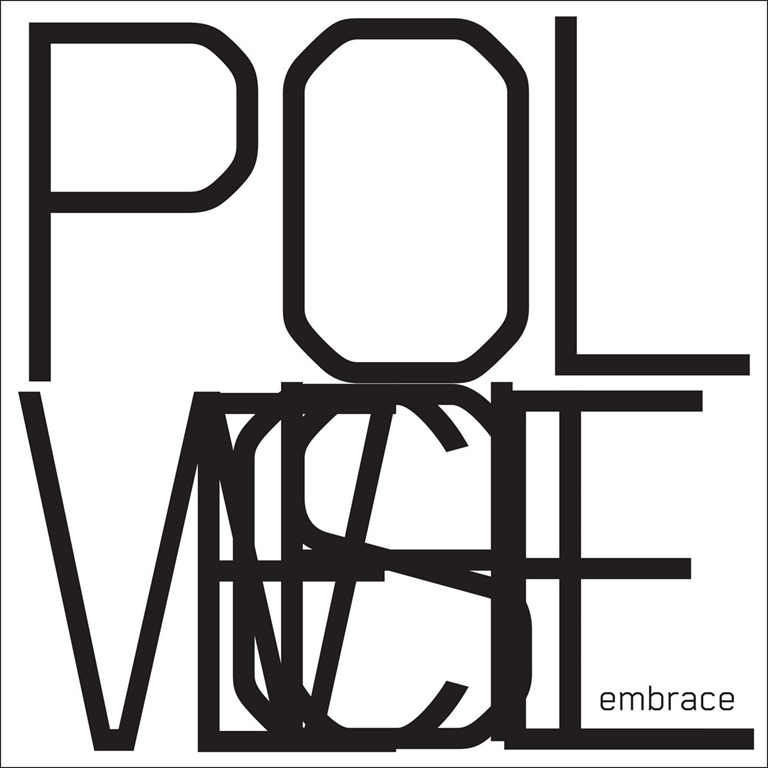
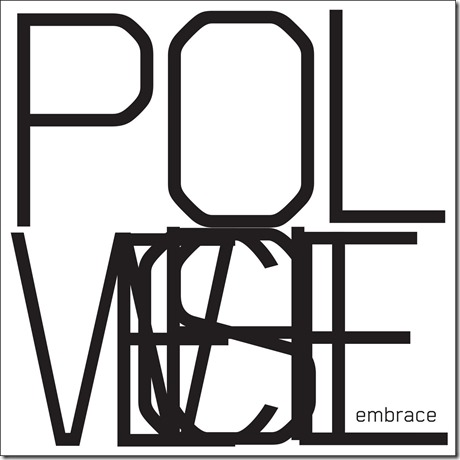
Vienna- and Berlin-based ensemble Polwechsel have a thirty-year career to reflect upon, and with a substantial back-catalogue to their name, and it’s a landmark that truly warrants a box-set retrospective. Although it’s not a retrospective in the conventional sense: this is a work created in collaboration with a selection of instrumentalists and improvisers who share their exploratory mindset. Traditional compilations feel somewhat lazy, and are ultimately cash-ins which offer little or nothing new to the longstanding fan. And so this set serves to capture the essence and style of their extensive catalogue, rather than compile from it.

There’s a lot of ground to cover, too. As the accompanying notes detail, ‘Vienna- and Berlin-based ensemble Polwechsel have been making music at the interface of collective improvisation and contemporary composition. With their changing cast, the group have been at the forefront of musical experimentation, from style-defining works in reductionism in the 1990s, which concentrated on silence, background noises and disruptions, to a change in direction in the 2000s, which saw the introduction of traditional musical aspects such as tonal relationships, harmony and rhythm. Through varying constellations, instrumentations and collaborations, Polwechsel have developed a unique body of work that has firmly established them as one of the driving forces in contemporary music-making… Their music has mostly straddled a line between contemporary music and free improvisation, and is characterized by quiet volume, sustained drones, and slowly developing structures.”

And so it is that for EMBRACE, Werner Dafeldecker, Michael Moser, Martin Brandlmayr and Burkhard Beins are ‘joined by a roster of likeminded guest musicians and former band members to perform a series of new pieces reflecting the whole breadth of their musical investigations.’

‘Jupiter Storm’ is spacious, spatial, strange and yet also playful, an assemblage of sounds that lurch from serious and atmospheric to sleeve-snickering toots and farts, and everything in between over the course of its eighteen minutes, with slow—resonating gongs and trilling shrills of woodwind and plonking random piano all bouncing off one another, while the bass wanders in and out of the various scenes in a most nonchalant manner. On ‘Partial Intersect’, drones and hesitant drones occasionally yield to moments of jazzification, parps and hoots and squawks rising from the thick, murky sonic mist which drifts ominously about for the track’s twenty-minute duration.

Sides C and D contains ‘Chains and Grain’ 1 and 2, again, longform pieces almost twenty minutes long, comfortably occupying the side of an album, are the order of the day. Clanking, clattering, chiming, bells and miniature cymbals ring out against a minimal drone which twists and takes darker turns.
cover

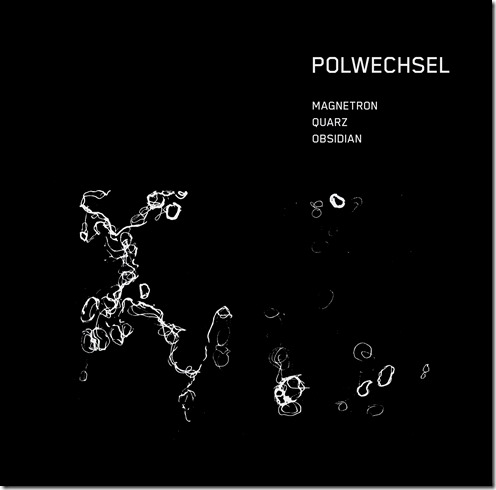
The tracks with Andrea Neumann are eerie and desolate, and occupy the third album. These pieces are different again, with the two ‘Magnetron’ pieces building from sparse, moody atmospherics to some piercing feedback undulations. The shrill squalls of treble, against grating extraneous noise, make for some tense listening. The second in particular needles at the more sensitive edges of the nerves. ‘Quartz’ and ‘Obsidian’, are more overtly strong-based works, but again with scratches and scrapes and skittering twangs like elastic bands stretched over a Tupperware container. The fourth and final album contains two longform pieces, with ‘Orakelstücke’ occupying nineteen and a half minutes with creaking hinges, ominous tones, and a thud like a haunted basketball thwacking onto a bare floorboard. There are lighter moments of discordantly bowed strings, but there’s an underlying awkwardness with crackles and scratches, muttered conversation in German. The fifteen-minute ‘Aquin’ is sparse, yet again ominous and uneasy, majestic swells of organ rising from strained drones and desolate woodwind sinking into empty space.

The set comes with a thirty-two page booklet containing essays Stuart Broomer, Reinhard Kager and Nina Polaschegg (in both German and English) and some nice images which are the perfect visual accompaniment to the music, and while it’s doubtless best appreciated in luxurious print, a digital version is included with the download.

EMBRACE is a quite remarkable release – diverse and exploratory to the point that while it does feel like an immense statement reflecting on a career, it also feels like four albums in their own right. It’s a bold release, and an expansive work that certainly doesn’t have mass appeal – but in its field, its exemplary on every level.
Northern Spy – 24th February 2023

Christopher Nosnibor

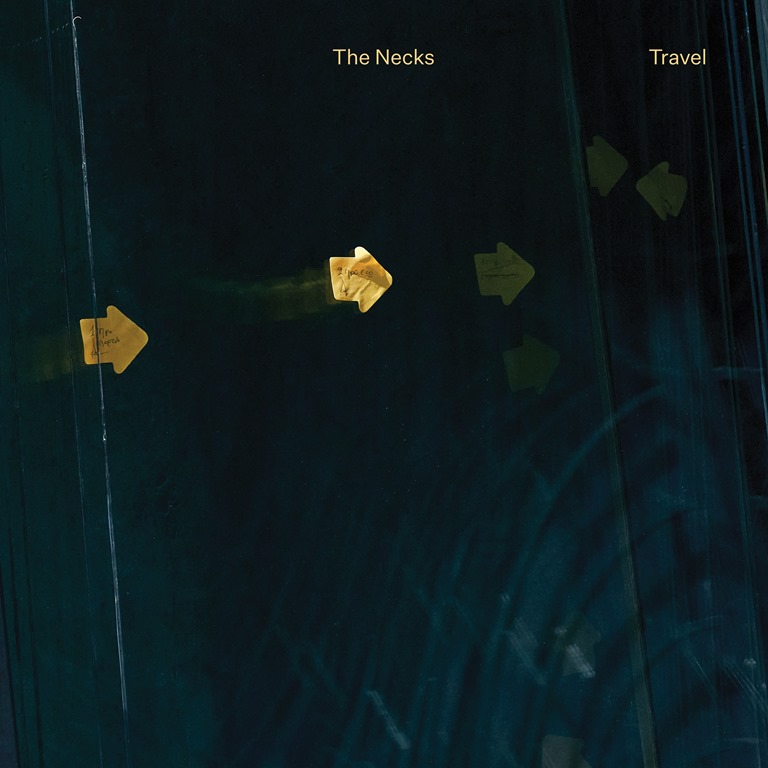
The Necks are never dull: an act that can be depended upon to deliver something different, which is no small feat for a band who’ve been going for more than thirty years. Travel sees them revisit the fundamental methodologies of Unfold, released in 2017 on Stephen O’Malley’s Ideologic Organ label. Admittedly, it’s not an album I’ve revisited all that many times since I wrote about it, but then, that’s true of many records I’ve appreciated. Some of it’s a time thing, but some of it’s an instrumental / jazz thing. I prefer to engage in the moment – and then the moment passes, and I too move on.

Where this album different from the majority of their others is that the format was integral to the form of the content, as the accompanying blurb points out, proving ‘four sub-20-minute pieces – instead of the typical 60+ minute arc for which the band is known – along with an obfuscated track list which leaves play order to the listener’s hand.’

Travel isn’t quite a straight live improv set, but does, they feel, come closest to recreating the live experience, and was recorded – save for some light overdubs and post- production – primarily live. And it’s very much oriented towards slow grooves and rhythmic repetitions. It’s hazy, mellow, almost sultry.

Side one is occupied by the twenty-one-minute ‘Signal’, built around a repetitive bass cycle and some rolling piano that brings with it a classical element, and, propelled by some busy hand drumming which transports the composition some way from what one would ordinarily expect off jazz-orientated works and into the realms of ‘world’ music (a term I try to avoid, with its connotations of western superiority and self-centredness, but sometimes short-cuts are necessary).

On side two, ‘Forming’, which again stretches languorously past the twenty-minute mark, is led by ripping piano, underpinned by some crunching bass stutters and rumbling groans. It’s jazzy in a psychedelic, Doorsy sort of a way. In this sense, it feels more like an extended mid-song workout than a piece in its own right, but it’s both pleasant and tense at the same time as it builds to a crescendo that never fully materialises.

‘Imprinting’, the album’s shortest cut at just over seventeen minutes, brings the multi-layered percussion to a more prominent position, and clanks and trembles along with almost hesitant-sounding keys and twanging strings drift in and out. It’s also perhaps the most overtly ‘jazz’ piece on the album, although it feels stretched out, the pieces pulled apart and as three instruments drift along together on a steady way, the sensation is quite hypnotic.

Organs always create a sense of grand scale and space, and the heavy drone and trill of ‘Bloodstream’ is utterly mesmerising. The piano is soft and ripples along atop the sustained mid-range drone as ethereal notes drift in and out. Part,

The album feels like a moment in time, somehow transient, and yet also something more. Travel may not really go anywhere, but it very much captures a mood – which is, for the most part, whatever mood you project onto it.

AA

Print

Thanatosis – 7th May 2022

Christopher Nosnibor

Within Reach of Eventuality is the debut album by Swedish duo David Bennet & Vilhelm Bromander. Their notes on the album state that ‘Following a semi-open score, the duo is treating elements such as complex textures, non-pitched sounds, microtonality, beatings and intense pauses in an improvisatory and careful manner’.

I’m not entirely sure what that means, and I’m not certain of the meaning of the album’s title, either. It feels like it almost carries a sense of significant import, but then is equally so vague as to be almost abstract. And in a way, it’s representative of the four pieces on the album. There’s a grainy scratching flicker of extraneous noise running along in the background during ‘Part I’, like a waterfall in the distance, while in the foreground, elongated drones – atonal strings or wavering feedback – hover around the pitch of nails down a blackboard. Occasionally, more conventionally ‘orchestral’ sounds – emerge fleetingly – gentle, soberly-paced percussion, string strikes and soft woodwind, and it comes together to create a somewhat ominous atmosphere.

It’s a hushed, minimal ambience that fades out towards more sonorous drones that ebb and flow across ‘Part II’, and as the album progresses, the interplay between the tones – and indeed, atones – becomes more pronounced, and also more dissonant and consequently more challenging, as long, quivering, quavering drones rub against one another.

The structures – such as they are – become increasingly fragmented, stopping and starting, weaving and pausing. There is a sense of a certain musical intuition between the players, the rests coming at distances that have a sense of co-ordination, if only as much to confound expectation as to sit comfortably within it. In other words, Within Reach of Eventuality feels like a semi-organised chaos, and as it slowly slides towards the conclusion of the sixteen-minute fourth part, the sound thickens, the volume increases, and the atmosphere intensifies, become more uncomfortable in the process. And in this time, the meaning becomes clearer when it comes to understanding their approaching the sonic elements in a ‘careful manner’. There’s nothing remotely rushed about Within Reach of Eventuality. The notes are given space and separation, room to breathe. It all feels very considered, very restrained: it’s no improv free-for-all, there are no frenzied climaxes or blasting crescendos. Instead, they demonstrate a sharp focus on a fairly limited range of sounds and spaces, and the result is an album that has a strong cohesion.

AA

a4211091835_10

Limited Noise – 29th April 2022

Christopher Nosnibor

With a CV that lists near-multitudinous membership and participation in bands (notably his regular gigs with Snack Family and World Sanguine report, but also contributing to Sly ands the Family Drone and countless others), renowned experimentally-minded jazz drummer and percussionist Will Glaser has taken some time out to continue his solo album sequence with the fourth instalment of Climbing in Circles.

Over the course of three previous releases, Glaser has explored jazz, folk, and beyond, through an experimental prism and with a methodology that’s very much about improvisation. This outing features long-time collaborator, Matthew Herd, on saxophones and piano, alongside trumpeter, electronic artist and producer, Alex Bonney, and was assembled over the course of five day. While the album is loosely constructed around two overarching ‘acts’, they consist of eleven separate and distinct pieces, and bookended by ‘Beginnings’ and ‘Endings’, there’s a narrative arc of sorts, here.

It begins with crawing birds and a gentle piano playing what one could readily describe as a charming melody with a quite conventional structure, and ends with a genuinely pleasant lilting piano tune – and yes, I mean tune in that it has all the conventional features of one.

In between, there is slow decay and infinite space. Rumbling, echoes, notes reverberate off one another at distance. Sax and trumpet trill and drone, sometimes at one, at others as if duelling. The percussion rolls and crashes, but more often than not, at distance, and creating texture and atmosphere and colouring the pieces with expression rather than maintaining rhythm.

The combination of instruments is relatively conventional in jazz, and, similarly, there’s nothing particularly radical about the way they’re played and interact on here. But there’s considerable joy to be had in simply listening to the musicianship and the way the musicians themselves interplay on the pieces. ‘Spiral Dance’ is a hypnotic serpentine spin, while ‘Bad Dream Machines’ is a drifting mass of fragmentation, dissonant, discordant, and above all, a work that exists in the spaces between the notes and in the reverb and echoes as in the notes themselves.

There will be some – perhaps many – who are deterred by the very mention of jazz, and there is a perception of there being a certain elitism about jazz – the idea that random notes and borderline unlistenable chaos is somehow a superior art form, and anyone who doesn’t ‘get’ it is clearly a philistine. But Glaser is a remarkably positive showcase for jazz, with a focus on the listener rather than purely the musicianship. Climbing in Circles Pt 4 is about atmosphere, about vibe, rather than indulgent wanking: this is jazz you don’t need to be an aficionado to appreciate. It’s listenable, and it’s varied, too.

On ‘Dead Fly Disco’, he and his collaborators play completely straight, a song with structure and swing, something you could even dance to, or at least nod a long to its toe-tapping groove in a basement bar late at night. ‘Ballad in the Jazz Style’ almost feels like they’re playing with and working within the tropes as an example of discipline, and it’s highly restrained and wonderfully moody in that sad, smoky jazz melancholy way.

There’s plenty going on, and enough to maintain interest, but not so much as to be chaotic or to lose the listener. Whether these things make it a good access point to jazz, it’s hard to say, but what it does mean is that Climbing In Circles pt.4 is a jazz album that’s accessible and enjoyable simply as a musical work.

AA

Climbing In Circles cover 1000px CMYK