Posts Tagged ‘feedback’

17th October 2025

Christopher Nosnibor

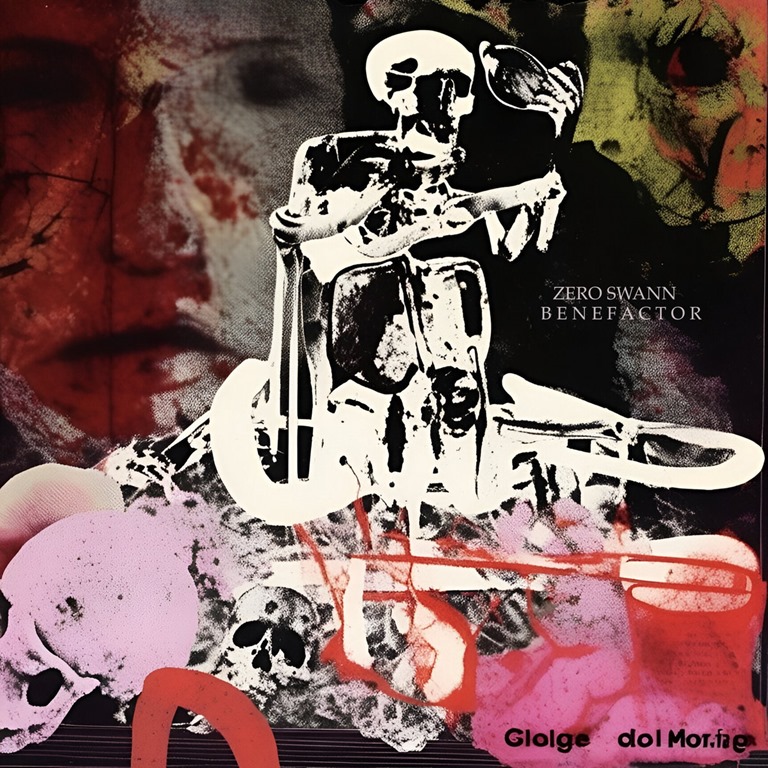
From the very outset, this is not easy on the ear. Sometimes, something leaps out about an album in the opening minutes, and here it’s the production – or lack of. The title track heralds the arrival of Benefactor, the first album by Washington D.C. improvisational psychedelic outfit Zero Swann in two years. And it’s a swampy, reverby, dingy mess. It’s integral to the experience, but it’s also likely to be a deterrent for some – but screw them, it’s their loss, right?

Although straddling heavy psychedelic and the dramatic gothic style, it’s the sludgy, feedback-riven outtakes of The Jesus And Mary Chains’s Barbed Wire Kisses which first come to mind when listening to this.

Benefactor is the follow up to 2023’s Amon Zonaris, which, at the time, was a one-off collaborative release with Scott “Wino” Weinrich. This time around, bandleader and Saccharine Underground label curator Jeremy Moore is flying solo, handling guitars, fretless bass, drums and noise assault. And there’s no shortage of the noise assault on this punishing no-wave behemoth. As they tell it, ‘From the noise rock / no wave snarl of Ritual Tension and early Sonic Youth, to the shoegaze sounds of My Bloody Valentine, to doom and free jazz chaos over a backdrop of pure lo-fi abrasion, Moore’s latest outing is a true crosspollination of styles’. It is, and what’s more, many of those styles are melted together to form a dark, disturbing sonic sludge.

‘Grave Wax Horticulture’ is a skull-splitting mesh of noise, equal parts The Jesus and Mary Chain and Christian Death. It’s theatrically gothy, in the vein of The Horrors, but primitively noisy – which is a fair summary of the album as a whole. It’s experimental, overloading in its racketaciousness – and while is a psychedelic album, it’s a full-on assault album, too, which draws parallels with Head of David’s first album, LP, and simply summarises a noise ethos which eschews convention in every sense.

Moore’s commanding baritone brings a sense of drama, not to mention a certain theatricality to the chaotic, palpating grind, and there’s an edge to his delivery which is both world-weary and tense, a voice emerging from the desolation of a society collapsing, a world in flames. This is surely the sound of the apocalypse, the sound of everything ending. Everything is overloading, murky, blown-out, blasted with distortion and reverb, resulting in a discordant thunderous attack which fires in all directions at once. It’s a primal roar reverberating from buildings collapsed to rubble, a brain-bleeding blitzkrieg of ruinous proportions, as mechanised drum sounds fire like machine guns and missile explosions, cutting through the wildest, densest racket. The absence of overt structures only compounds the sense of things falling apart. It’s the sound of unravelling, of societal threads pulling apart in real-time, a descent into mayhem, anarchy, barbarity.

‘Anagrams for Agnosia’ is perhaps jazz, but jazz in the loosest sense: it’s exploratory, experimental, freeform, but more than anything, it’s the sound of fracture, or fragmentation, instruments churning and burning, and pulling in different directions like splinters of an object in the wake of a detonation. As the screams die down, there is the thud of a panicked heartbeat, before the final track, ‘Phaneron’ obliterates with a squalling wall of howling guitar, stuttering drums and raw, ruinous noise.

Benefactor is an album without let-up, which provides no breathing space, and is thoroughly relentless in its intensity from beginning to end. Recommended, but approach with caution, and a stiff drink. It sounds like the cover looks.

AA

a0986994420_10

Mind Altering Records – 13th November 2023

Christopher Nosnibor

Back at the start of 2021, I penned a pretty positive review of the solarminds album Her Spirit Cracked the Sky. The combination of ambience and extreme weight was a thrilling proposition. And it was – and still is – monumentally epic. It feels a long time ago already, and much has happened in the interim. If emerging from the pandemic was trailed for a long time by the release of myriad ‘lockdown’ projects, we’ve subsequently trickled into a ‘world’s turned to shit’ phase, and like the pandemic, it feels like there’s no end in sight. Trump may be out of office, but he still looms large and continues to pose a threat in the arena of world politics, and it’s a world at war, and a world where alternately wild fires and floods decimate swathes of land. Slowly but surely, the planet is becoming less inhabitable. And yet, still, people jet off on skiing holidays and bemoan the lack of snow despite being the cause of the lack of snow, and whenever it rains, people take to their cars to make five-minute journeys to avoid getting wet, thus ensuring it will rain an awful lot more in the time to come.

And since the release of Her Spirit Cracked the Sky, after more than a decade, Chris Miner has put the project to bed. But, like the proverbial phoenix rising from the ashes, he now returns with Sun Colour Sound, and the first in a projected trilogy of releases. On the evidence of this first one, it will be something special.

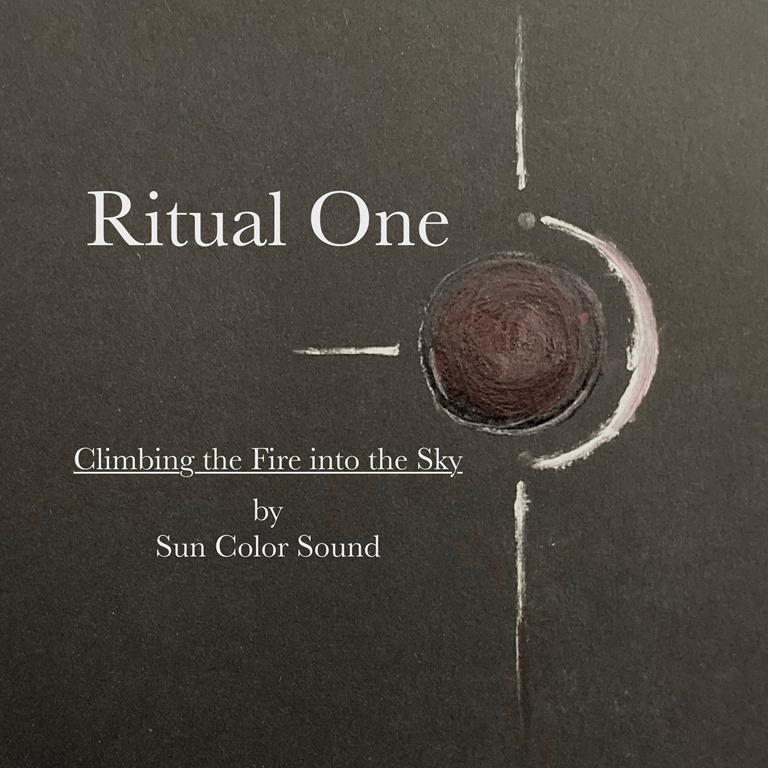
Ritual One (Climbing the Fire into the Sky) consists of a single piece, which runs just short of half an hour, and it shares many elements with solarminds – namely a fair bit of noise, some hefty guitars and punishing percussion, at least in the first two thirds, and it’s heavy, harsh, noisy, and it crashes straight in with some grating, heavy drone, twisting feedback and thudding drums.

This is one of those tracks which stars like the end of many sets, and it feels like it’s winding down from the offing. This is by no means a criticism, simply an observation that what in the context of many works is a climactic, tempestuous crescendo finale, is simply the start of a ferocious sonic storm. It does very much call to mind Sunn O))) and the epic, swirling instrumental passages of contemporary Swans, although the guitars are very much geared towards generating howling feedback rather than crushing, clashing chords that sound like buildings being demolished. Therte’s something of a psychedelic twist in the spacey delivery, too. As whining, whistling notes ring out, the percussion builds from the occasional roll to a relentless thunder. The combination is immensely powerful, and assails the senses with a real physicality. Buy around the thirteen-minute mark, it’s reached wall-of-sound levels, a dense, shimmering sonic force which shimmers and ripples while coming on like a bulldozer, at the same time as hand drums fly at a frantic pace and evoking something spiritual in the midst of a hypnotic frenzy. And still, it goes on, surging forwards.

The shift in the final third occurs subtly: the percussion continues to clatter away, but the guitar abrasion tapers away, to be replaced by altogether softer strings.

Ritual One (Climbing the Fire into the Sky) is more than just a really long piece of music: it’s an ambitious piece in every way, and its scope and scale are immense. There is so much depth and detail here, and it takes repeated listens to really appreciate just how much is happening, especially given that the first reaction is simply to bow to its sheer sonic force.

But the last ten minutes belong to a different world from the first portion. Hypnotic, soothing, graceful, the tension dissipates and Eastern vibes radiate through the gauze-like layers which drift and float over the busy but altogether more subdued percussion.

So while it is an ambitious work, it also delvers far above any expectations, and it’s both unique and special.

AA

Version 3

Human Worth – 13th October 2023

Christopher Nosnibor

From the moment Modern Technology blasted in with their eponymous debut EP, simultaneously launching the Human Worth label, it was clear that they were special. The duo made the most fucking incredible, low-slung, dense mean-ass noise going. The lyrics were social, political, and sharp, paired down to stark one-line declarations dissecting with absolute precision the fucked-up situation in which we find ourselves. And with a percentage of proceeds of every Human Worth release going to charity, they’ve put their money where their mouth is. It’s not done in some crass, virtue-signalling way: this is their model, and they just get on and do it. And through Human Worth they’ve released some – no, many – absolutely incredible records, rapidly establishing HW as purveyors of quality product with a keen ear for quality noise. In an increasingly fragmented and challenging musical market, the trick for any label is to find a niche and excel within it. And that’s precisely what these guys have done.

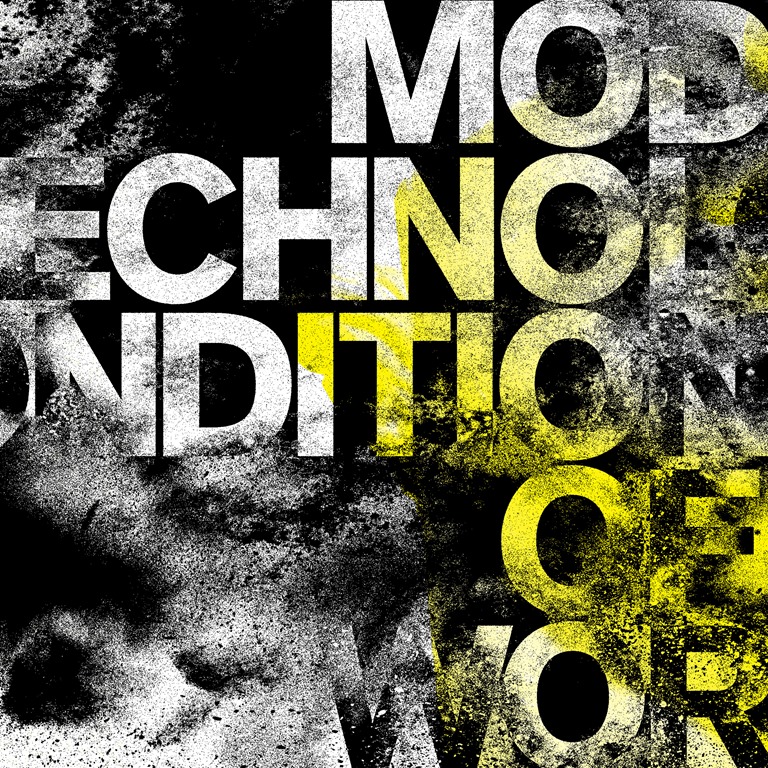
And all the while, as a band, Modern Technology just get better and better. Any concerns that they had said all they had to say following the EP and debut album Service Provider (as if there ever were any!) are allayed with the arrival of Conditions of Worth.

Lead single ‘Dead Air’ opens it up with dense, grinding anguish. Chris Clarke’s bass and vocals seem to have got heavier. Then again, so does Owen Gildersleeve’s drumming. But it’s more than just brutal abrasion. In the mid-track breakdown, things go clean and the tension in that picked bass note is enough to spasm the muscles and clench the brain. It’s brutal start to a brutal album.

‘Lurid Machines’ begins in a squall of feedback and wracked, anguished vocals, and it’s harrowing, the sound of pain. The lyrics are comparatively abstract, and all the more powerful for it. Written out in all block caps, they’re in your face but wide open to interpretation and elicit the conjuring of mental images:

WHY ARE THEY SO ALONE?

THE LIES THEY ALL SHARE

LET GO

INSIDE NOTHING GLOWS

BENEATH A SHADOWED PHONE

The drums and bass crawl in and grind out a low, slow dirge, Clarke’s vocals are down in the mix and you feel yourself being dragged into a chasm of darkness.

These are harrowing times, and if the pandemic seemed like a living nightmare, it seems it was only the preface. The ‘new normal’ is not the utopia some commentators suggested it may be. For a moment, it looked as though we would achieve the golden goal of the work/life balance, that we may abandon the commute and save hours a week for ourselves and slash our carbon emissions in the process. But no. Fuck that. Get back to the office, tough shit that fuel prices are rocketing and bollocks to the anxiety you developed in lockdown and bollocks to the environment because power trumps everything. Government power, corporate power, media power… we are all fucked and have no hope of breaking this. And this is the backdrop to Conditions of Worth.

They pick up the pace and start ‘Salvation’ with an uncharacteristically uptempo stoner rock vibe, but around the midpoint they flip things, slowing the pace and opening up towering cathedrals of sound as a backdrop to painting a stark depiction of life on earth.

WIDESPREAD

FAMINE

WIDESPREAD

CONFLICT

WIDESPREAD

PANIC

WIDESPREAD

SHADOW

The song ends with just a spare, fragile but earthy bass that calls to mind Neurosis and Kowloon walled City. It’s this loamy, organic texture which defines the altogether more minimal ‘The Space Between’, the first of the album’s two longer pieces, with the second being the ten-minute title track. It’s here that their evolution is perhaps most evident, as they stretch the parameters of their compositions to forge such megalithic works and really push the limits of their two-piece arrangement. In contrast, there’s the super-concise ‘Fully Detached’, , and the last track, ‘ Believieer’, which are absolute hardcore ragers, clocking in with short running times, the former just making a minute and fourteen seconds. And the variety on display here only adds to the album’s impact. While each track hits hard, the overall impact is obliterating.

They crank up the volume and the shades of distortion in the explosive choruses of ‘Lane Control’ – because you can never have too many effects when it comes to bass played like guitar and blasting screaming noise to articulate feelings, and as for the title track… it’s an absolute beast, with heavy hints of latter-day Killing Joke in the mix as they flay mercilessly at a pulverising riff. The noise builds and the vocals sink beneath it all and you’re left feeling dazed.

But more than that, there’s something about the production on Conditions of Worth that’s deeply affecting. There’s a skull-crushing sonic density, but also simultaneously, remarkable separation and sonic clarity. These elements only make it his harder.

Conditions of Worth is more than just heavy. It leaves you feeling hollowed out, drained, weak. This is life, and this album is the perfect articulation.

AA

HW031_ModernTechnology_ConditionsOfWorth_CoverArtwork

Sacred Bones – 19th May 2023

Christopher Nosnibor

It’s been fourteen years since there was new music from Khanate, the experimental doom outfit featuring members of Sunn O))), OLD, and Blind Idiot God. It’s perhaps not surprising that my social media feeds have been bursting with the news of the surprise arrival of their fifth album on digital platforms ahead of a physical release next month– and because it landed from nowhere overnight, you couldn’t say it was eagerly anticipated, but it’s got a lot of people excited.

As you would expect, given the members’ main projects, and the previous Khanate releases, To Be Cruel is an absolute monster, with just three tracks spanning a full hour. You don’t tune in to Khanate for snappy pop tunes.

The first chord hits like an atomic bomb, blasting from the speakers with such force it’s almost enough to floor you, and rising from the sustain, crackling synth notes, then another sonic detonation that’s so hard and loud it hurts. Many of the tones and tropes of To Be Cruel are heavily redolent of the crushing doom drone of Sunn O))), but as the first piece, ‘Like a Poisoned Dog’ abundantly evidences, Khanate are different. This difference may be less apparent to the casual listener, but the stop/start power chords and skewed, sinewy shards of feedback are cut from a different sonic cloth, and if Sunn O))) are renowned for their indebtedness to Earth, there are elements woven in here which seem to owe more to early Swans, and while I wouldn’t necessarily want to speculate on whether the album’s title is some kind of response to Swans’ 2014 album To Be Kind, there is some kind of contextual interface here, in that both acts are pushing parameters within a longform song format.

And then there are the vocals: it’s a good seven minutes before Alan Dubin makes his first contribution: the song takes another swerve, the blistering blast simmers down and as he howls and roars, the feel is a cross between the darkest of mangled metal and brutal hardcore. And his manic screams are powerful and affecting. He sounds troubled, but in a way that conveys the kind of tortured mental suffering that’s common to many: it’s a primal howl of rage ad anguish that we struggle to unleash, and so to hear this is to feel emotions channelled by proxy, and as much as it hurts, it’s a release.

‘It Wants to Fly’ takes it to the next level, presenting almost twenty-two minutes of pain. The guitar is slow, crushing, punishing. What can you say? It hurts. It’s also minimal in arrangement but maximal in volume: this is first-gear BPM, with decimating feedback between the crushing chords. At the same time, it’s doomy and ominous as well as raging, making for a powerful cocktail of weight and raw emotion. There is no question that Khanate bring both.

And so it is that the album’s third and final track, the twenty-minute title track, is twenty minutes of low drone and tortured screaming that sounds like a breakdown captured on tape as Dubin yelps and screams about spiders against a sparse backing of a distant rumble and clanging guitar. ‘Look! In the closet!’ he shrieks in what sounds like abject terror. You dare not look. You don’t even want to hide under the bed: you just want to leave the house. The composition takes its time, it hums and drones, and in time, it hits and it hurts, and in some way you wish you could be Dublin, you want this release to have a channel into the unhinged. But you’re stuck on the outside, an observer to what sounds like either the ultimate catharsis or mental disintegration.

Ground down to nothing beyond and anguished screams and squalling feedback, this is bare bones, the sound of desperation. It isn’t pleasant, and there is simply no room to breathe: this is dark, dense torturous, and it’s exactly what fans have been waiting fourteen years for.

AA

a3411741448_10

2nd September 2022

Christopher Nosnibor

UK duo Thraa consists of Sally Mason and Andi Jackson, whose bio states that ‘Working without the constrictions of a traditionally structured song, this duo improvise around meditative drones, combining Sunn 0))) influenced guitars with soaring vocals. Making single take recordings, they capture an organic sense of sound that has cavernous textures with minimalism at heart.’

In some respects, this debut EP brings us full-circle in terms of drone evolution, and it’s fitting in the most appropriate, and planetary sense. The most successful and celebrated purveyors of drone, Sunn O))) famously took their moniker as a reference to drone/ doom progenitors Earth, who will, in certain circles, be forever remembered for the tectonic grind of their epic second album, Earth 2, from 1993, which contains just three tracks spanning some seventy-three minutes, with nothing but guitar and bass feedback stretching out, crunching along at a glacial pace and carrying the weight of entire continents. It’s hard to believe that this release will ever be surpassed for all that it is, with two of the three tracks stretching out around the half-hour mark with no shape or form, only an endless, grating, grumbling grind. Into Earth connotes a return to base material, a slow collapse, even a decay into compost form, but also hints at a sonic slide toward this territory carved out by the original and definitive drone act some twenty-nine years ago.

Thraa intimidated at the shape of things to come in June with the release of ‘Move Among Them’, which is the first of the EP’s four tracks. It’s swampy, sparse, beginning with an awkward, gurgling, wheezing, a kind of tentative snuffling grunt in the bass region before soaring, sculpted feedback howls and churns metallic—tinged clouds of scraping ambience. It probably sounds like a contradiction on paper, but hear me out: the screeding layers blur into a whirl without definition and tumble into a vortex of abstraction, and in doing so, create the sound closest to that early Earth whorling wall I’ve heard from any other band.

The title track lacks even more overt form, spurs of guitar feedback screeching as it breaks loose from the dense, rippling wall of undifferentiated noise. There are strong elements of Metal Machine Music here, but it’s around the midpoint that a slow, rhythmic piano emerges, along with a haunting understated vocal from Sally that’s half-buried beneath the noise of explosions and / or tidal waves. It’s both dolorous and ethereal, and BIG | BRAVE comparisons aren’t out of place here, either.

Everything coalesces after the subdued scrape and low-end rumblings of ‘Elgon’ on the seventeen-minute finale ‘Over Warm Stones’. Nothing different happens as such: there is only more, in terms of duration, and in terms of atmosphere. The snaking, rattling notes that swell and shimmer provide a sparse, textured backdrop to a quivering, evocative vocal performance.

Into Earth may not offer anything new, per se, but does provide a strong contribution to the canon of emotive, evocative ambient drone / doom which features vocal, which in this instance are essential to the experience, and it’s an experience which is compelling, immersive, heavy as hell and at the same time heavenly, before it collapses into a landslide of feedback that stretches out to the horizon.

aa

a3764076389_10

Dedstrange Records – 4th February 2022

Christopher Nosnibor

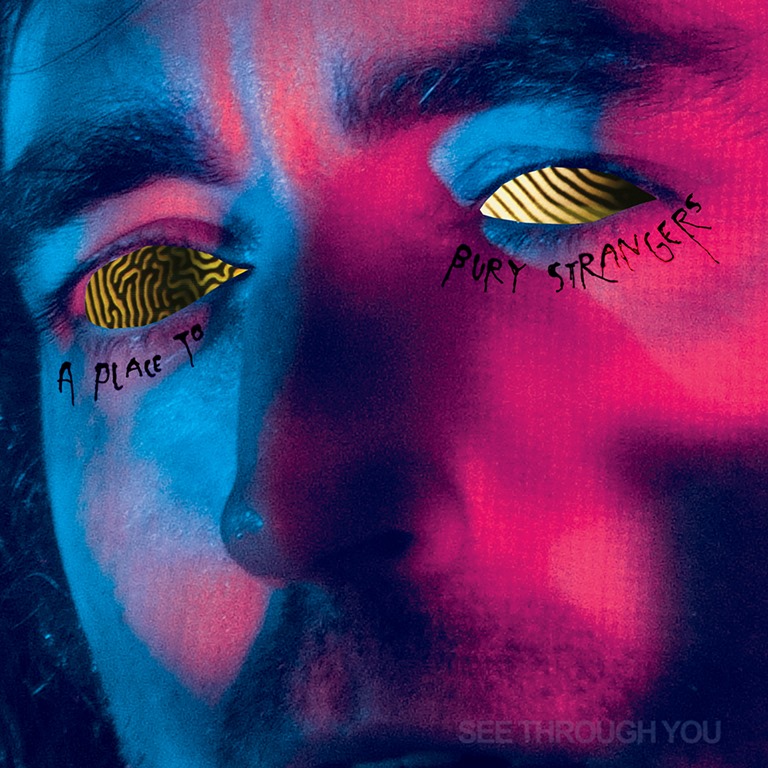
A Place To Bury Strangers have been pigeonholed variously in the brackets of noise-rock, shoegaze, indie, space-rock, and psychedelic rock. All of these are fair and accurate, but fail to represent the band’s expansions of these genres, and the fact that for all the noise, there is nuance. Listening to their catalogue of ear-bleeding sonic squalls reveals far more depth and range than this reductive characterisation implies.

The last few albums have tracked quite a journey, and See Through You resumes the trajectory of Worship and Transfixiation, whereby the production became evermore wayward and unconventional ahead of the rather safer-sounding pop-orientated Pinned (these things are relative, and it was hardly R1 mainstream pop). With each release, they’ve stepped further and further away from the accepted conventions of production and mixing, not only going evermore lo-fi, but also shunning by stages the conventions of balance, of tone. The vocals are way down, the drums are way up, and the EQ is utterly fucked as everything wallows in a murky midrange. It’s not an easy listen, and the song structures are far from obvious or clear either

So while recent single release ‘I’m Hurt’ leans heavily on The Jesus And Mary Chain’s ‘The Living End’ (and it’s by no means the first time they’ve taken cues from JAMC), the reverb echoes into a cavern of murk, as if a mudslide has slipped into said cavern. The chaotic crescendo that explodes by way of a finale still splinters the eardrums, but it’s not in the kind of blistering wall of treble that defined their sound up to Worship.

This evolution was necessary: they’d taken the limits of blistering psychedelic shoegaze wall of noise to – and beyond – its limits, with Worship standing as something of an apogee. But this was the album that also saw them recognise their limits while pushing beyond them. They have returned to more overtly structured songs for this outing in comparison to Transfixiation, while testing boundaries once more after the comparative retreat of Pinned. In short, it’s A Place to Bury Strangers at their best. That’s to say, it’s a squalling, blistering racket and it hurts, and there’s a fait bit going on, and beneath the crazed noise, there are some tunes. In fact, there are a fair few tunes, and some good ones at that.

The first track, ‘Nice of You to be There for Me’ feels like sarcasm and the guitars sound like melting cheese, the sonic equivalent of Dali’s clocks, a warping, dripping mess. And fucking yes. It’s as exhilarating as it is fucked up. ‘So Low’ does return to the spiralling explosive bass-driven racket of Worship and Transfixiation, but then things start to get really fucked up on ‘Dragged into a Hole’ as the frenetic disco beats are all but buries beneath a driving wall of obliterative bass and screaming guitar feedback. The distorted vocals only add to the head-smashing experience.

‘I Disappear (When You’re Near)’ is another bass-driven doomer, the pairing of a metronomic mechanised drum beat and throbbing bass that’s booming, grainy, distorted, and swathed in reverb is powerful. The guitars merely add texture, screams of feedback occasionally breaking through, while the vocals float in the swamp of noise. If It’s not already apparent, this is a noisy album. ‘My Head is Bleeding’ is kinda subdued, kinda electro, kinda pop, but in a Suicide sort pf way, and when the guitars explode in a fizzy mess, it’s an absolute rush, and everything that’s good about APTBS.

Closer ‘Love Reaches Out’ is essentially ‘Everything’s Gone Green’ merged with ‘Ceremony’: it’s the closest they get to commercial pop on this crazy roller-coaster of post-punk noise – and there is certainly a lot of noise.

So what to make of See Through You overall? It’s a solid album and quite daring, on many levels. When a band of this statute releases an album half their fans probably won’t like, you have to give respect to their prioritisation of their artistic vision.

AA

920817

Room40 – EDRM419 – 30th November 2018

Christopher Nosnibor

Despite having released about a thousand albums since first emerging in 1979 (Wikipedia states ‘over 400 recordings’, which still makes for a completists impossible dream), a new Merzbow album still instils a certain glimmer of excitement and anticipation. Perhaps it’s the fact that while Masami Akita’s work sits squarely in the domain of ‘noise’ and the element of surprise is limited when it comes to a new release – there’s no dropping of a sudden and unexpected pop or country album, for example – his capacity to push the parameters of a genre he almost singlehandedly defined means that there’s always something to warrant interest.

Writing on MONOAkuma, a live recording made in Brisbane in 2012 at the Institute Of Modern Art, Lawrence English, the man behind the ROOM40 label, recalls ‘this was the second time I had the pleasure to present him live in Australia. To me, this performance epitomises the physiology of Merzbow’s sound work. He creates in absolutes; sonically he generates a tidal wave of frequency that sweeps across the spectra with tireless frenzy. Merzbow’s capacity to conjure a massive swirling mesh of analog and digital sources is without comparison. His work is one of physiological and psychological intensity; a seething, psychedelic and utterly visceral noise-ocean.’

English continues by noting that ‘2019 marks the 40th anniversary of the commencement of Merzbow. This recording, which epitomises Merzbow’s 40 years as arguably the most important noise musicians of our time, demonstrates the intense and complex audio world Merzbow has created. It’s the perfect starting point from which to wade into the noise ocean that is Merzbow’s vast output.’

Sidestepping the fact Merzbow has been in existence almost as long as I’ve been alive, I’d be inclined to agree: MONOAkuma is quintessential Merzbow and encapsulates all of the defining features of said vast output.

I’ve personally only witnessed Merzbow once, performing in Glasgow in 2004 – a set which saw him split the signal between the PA and a massive – and I mean immense stack of Marshall cabs. Akita was barely visible, perched atop a wall of speakers that made the combined backline of both Sunn O))) and the Quo look like they’re travelling light. The sound he produced through this set-up was a face-melting, brain-bending, tone-shifting wall of noise. I’m not sure I’ve ever been quite the same since.

MONOAkuma, then, contains 50 minutes of classic Merzbow. It begins with s few seconds of scratchy feedback. It tweaks at the nerve-endings. And then the levee breaks and the sonic deluge explodes. All the frequencies, all the tones, all the textures erupt simultaneously and blister and burn and fire in all directions. It’s so dense, so immense, so all-encompassing and immersive: the experience is overwhelming. There is noise, and then there is Merzbow. There is so much detail here… although it’s almost impossible to absorb even a fraction of it with so much, and delivered at such volume. Everything is tossed and churned in a barrelling tempest of relentless abrasion that scours the skull’s interior – select cement mixer / blender / washing machine / oil drill / swirling vortex / apocalypse simile of choice here. Whiplash blasts of funnelling distortion howl and scream in a churning tunnel of overloading distortion, and within six minutes it’s hitting the lower levels of pain and by 21 minutes aural and psychological ruination is achieved. The power lies in the ever-changing textures and tones: there isn’t a second were the sound doesn’t change, and it’s this constant shift that makes it so powerfully challenging, with layer upon layer of howling racket tearing the air to the point of atomization.

Few artists – if any – have the capacity to inflict brain-pulping anguish like Merzbow. This isn’t just nose: it’s all the noise. All at once. Amplified to the power of ten to create screeding, screaming, multi-tonal, multi-faceted blitzkrieg. There is no respite, no space to make shelter. It hurts. And until you’ve experienced Merzbow in full effect, you really haven’t experienced noise. And MONOAkuma is relentless in its assault. This is total noise, relentless, obliterative, devastating.

But as punishing and oppressive as it is, there’s something cleansing and cathartic about it. And herein lies the pleasure of the pain and the ultimate joy of Merzbow.

Please note: All proceeds from MONOAkuma will be used to fund research and preservation attempts for the Tasmanian Devil, which in recent years has suffered greatly due to effects of a transmissible facial cancer.

Merzbow - Mono