Posts Tagged ‘Experimental’

Cherry Red Records – 29th September 2017

Christopher Nosnibor

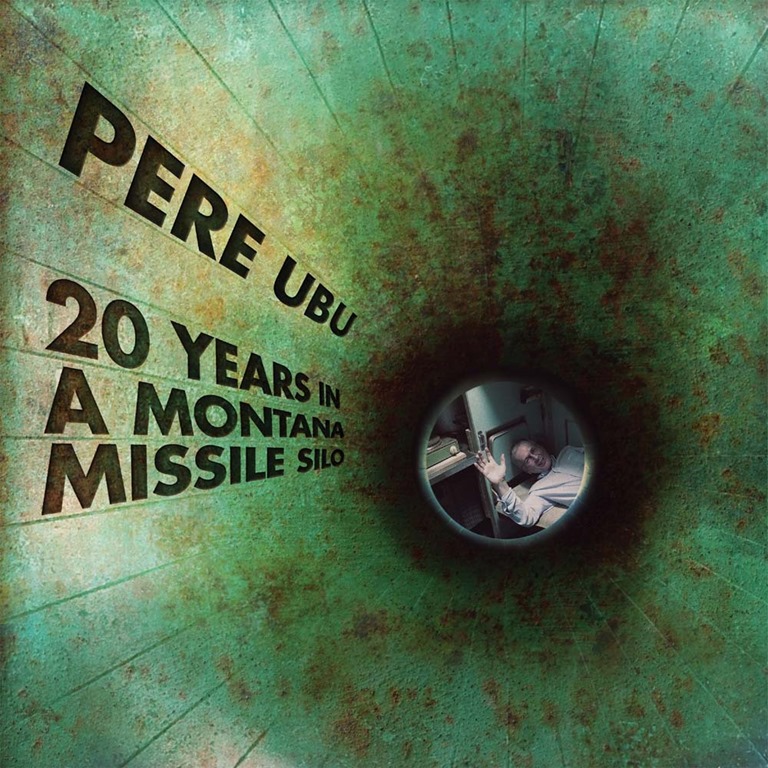
Forty-two years on from their inception and David Thomas’ Pere Ubu are still cranking them out. Significantly, they’ve continued to push parameters and stubbornly refused to bow to commercial concerns, pursuing the production of art over commerce. On this outing, Thomas has assembled quite an impressive ensemble, for ‘a three-guitar revision [which] sees Keith Moliné, Gary Siperko and Kristof Hahn (Swans) expand the established orchestra of analog and digital synths (Wheeler, Gagarin), clarinet (Boon), drums (Mehlman) and Thomas’ unique vocals.

For the most part, 20 Years In A Montana Missile Silo is a set of swampy, snaking blues-based workouts, although it certainly explores the full expanse of the core aspects – and explore is the operative word here. Experimentalism has always been a defining feature of Pere Ubu’s output, and 20 Years is no exception. But there’s nothing indulgent about it: in fact, it packs more than its share of driving garage rock, and half he songs clock in at under two and a half-minutes.

If the slow and meandering ‘Cold Sweat’, which borders on romantic post-rock, seems like an odd choice of opener, its simply testament to Thomas’ perverse will and fans should know what to expect by now. So, the melody is off and the quavering croon is vaguely uncomfortable, but the payoff hits immediately afterwards with the locked-in blues jam of ‘Funk 49’, which finds Pere Ubu come on like The John Giorno band, with a real swagger. It’s entirely out of step with anything contemporary, but then, even echoing 80s beat poetry, it doesn’t actually sit comfortably anywhere.

‘Howl’ isn’t a reference to Allen Ginsberg’s celebrated poem, however, but does find Thomas swing between Jim Morrison and Howlin’ Wolf as he lurches through some murky psychedelic blues. From the stealthy, woozy atmospherics of ‘I Can Still See’, to the uptempo rock ‘n’ roll attack of ‘Monkey Bizness’, with its warped lyrics and off-kilter splurges of synth, 20 Years has a range and dynamism which contrive to shape a rounded and exciting album. The slurred blur of ‘Walking Again’ closes the album with a drawling, dark derangement.

The brevity of the tracks doesn’t feel like they’re sketchy or incomplete, but imbued the album with a punchy directness. Similarly, even the more freeform compositions aren’t indulgently long, with none of the pieces stretching beyond five minutes, meaning that the experimentalism is very much kept in check and the focus on songs retained. And ultimately, songs are important. There’s no waste on 20 Years In A Montana Missile Silo, and there’s no chaff, either: for all its experimentalism, it’s a tight, taut and lean album overall. It’s also really rather good, and an album that shows that even after more than four decades, Pere Ubu can produce music that’s more thrilling than the majority of contemporary acts.
Pere-Ubu-20-Years-Front-Cover

A

Room40 – 1st September 2017

Christopher Nosnibor

In certain circles at least, Tony Buck requires little to no introduction as the percussionist of longstanding Australia purveyors of avant-jazz trio The Necks.

Unearth is an immense departure in many respects, not least of all in that it not a percussion-led composition. His first solo work, recorded over a number of years, is an expansive, long-form piece spanning some fifty-one and a half minutes.

It’s a quiet, unsettling composition, with layered sounds building and overlapping, dark rumbles and drones juxtaposing with vague clattering incidentals, hisses, scrapes, hums, drips, plops and thuds.

Around the fifteen-minute mark, conventional instrumentation emerge, with ratting percussion, sonorous bass notes and picked guitar strings drifting across sampled voices and fragmented field recordings. However, it’s clear that the tension isn’t about to break any time soon, and nor is Buck about to unleash a square slice of rock tunage. Plinks, plonks and rattles shade across creaks and yawning ultra-low bass which hangs dense and heavy in the air.

There is a transitory moment of graceful musicality around the half-hour point, where chiming guitars and irregular, delicate percussion combine to create a subtle passage that’s ethereal, atmospheric and pure post-rock. And here comes the build: cymbals clatter and crash in a rising crescendo; gongs boom, and a tempest of sound rises as if from nowhere, as the treble of electronic bleeps cut through the evolving cacophony.

Things to settle into a less disturbing, less abrasive roll of swirling ambience thereafter, with chanks and chinks trembling over skittering sinews of sound stretched over weary, low-end drones which crawl and scratch.

Nothing about Unearth is easy or accessible, although Buck’s grasp on the slow-evolving dynamic of the longform composition is abundantly clear as the gradual transitions flow s effortlessly as to be unnoticeable.

A

Tony Buck -Unearth

Christopher Nosnibor

This is one of those lineups that has cult appeal written all over it. It’s also wall-to-wall quality. So while The Crescent may not be rammed – it was always going to be challenge to fill a 350-capacity venue in York on a Tuesday night in August with a lineup specialising in experimental and Kratuy workouts – those present are enthusiastic and know they’re in for a treat.

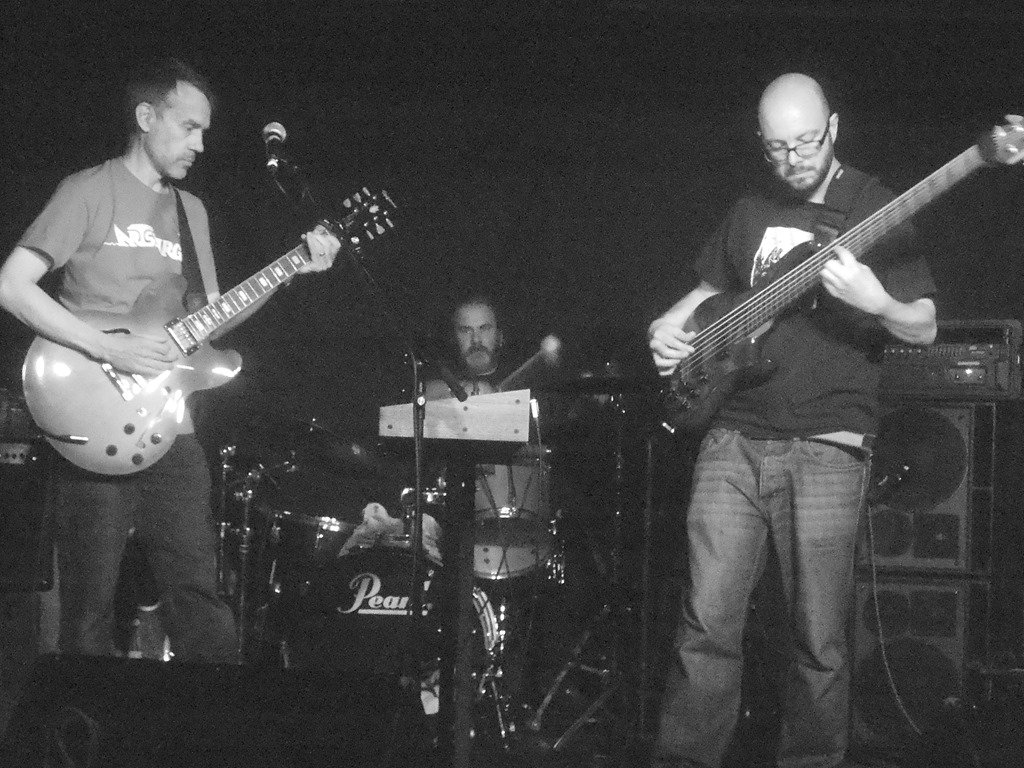
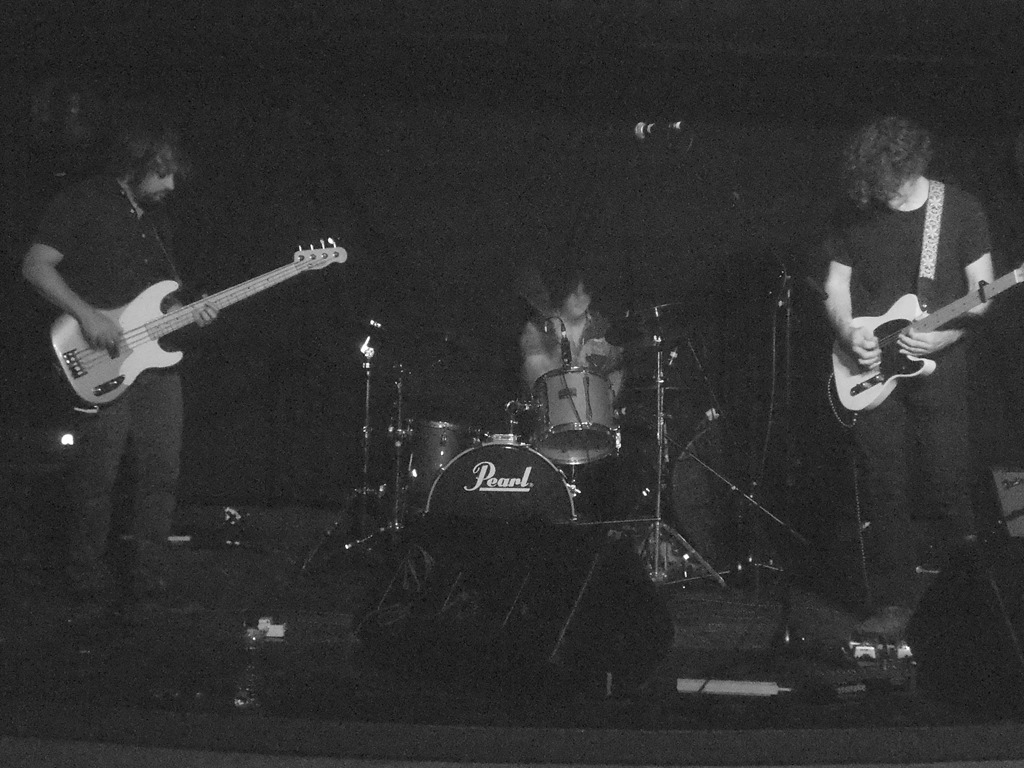
As I absorb Neuschlaufen’s immersive set, I’m increasingly aware of how much they sound – and even look like – so many of the improv-led experimental rock acts from mainland Europe I hear, courtesy of one Berlin-based PR in particular. These bands have substantial but ultimately underground and disparate cult followings, and release their albums on microlabels in batches of numbered editions of 300 or so, and perform in cool but nice venues around Germany and The Netherlands. Neuschlaufen are as good as any of them, and watching the trio manipulate sound – sometimes intuitively, sleekly, and sometimes by using electrical tape to pin keys on a synth down to sustain a note for ten minutes uninterrupted – is a real treat. An extended two-chord workout around the set’s mid-point – and the whole thing is magnificently and intuitively structured – is pinned together with piercing synth and clanging metallic guitar forging serpentine shapes Ash Sagar weaving a strolling six-string bassline. At times they mine a seam that brings together Bauhaus, PiL and The Fall, with shuddering bass grooves underpinning clanging, repetitive guitar-lines which are so angular as to cause flesh wounds.

DSCF0748

Neuschlaufen

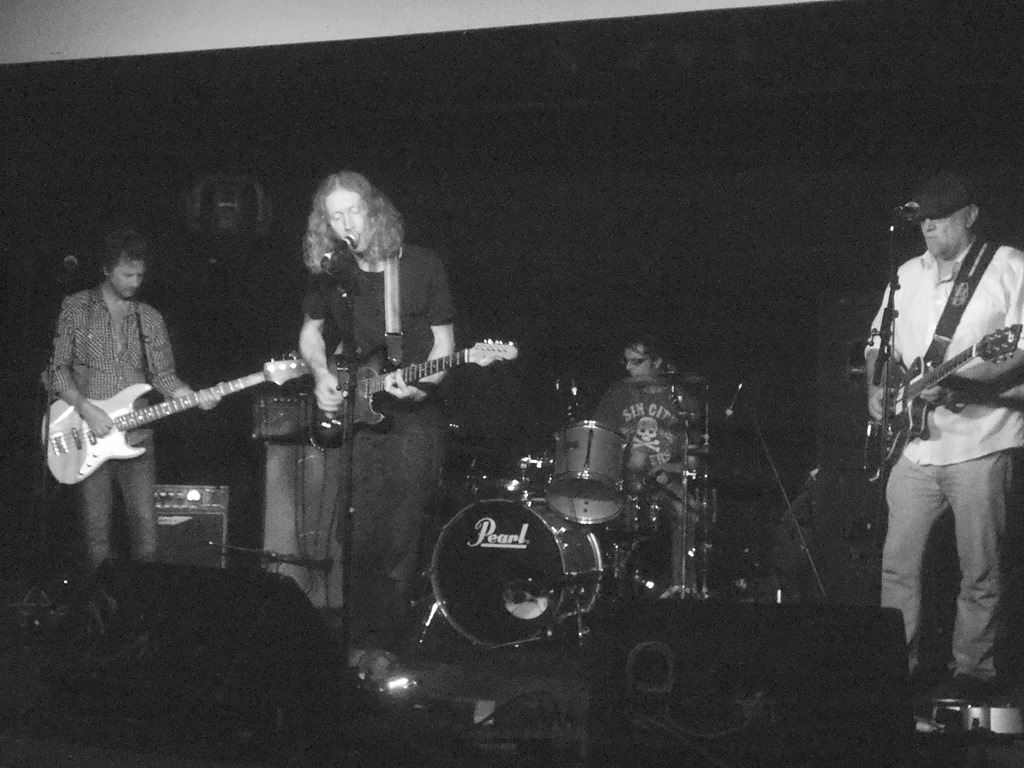
It seems that every time I review Soma Crew, I comment on how they’re better with every outing. It’s not just my ears, or forgetfulness: it’s a fact. It’s been a long and slow ascent, but everything about them is totally cohesive, and tonight they spin their hypnotic brand of pulsating psychedelic rock in the tightest, most mesmerising style I’ve yet witnessed. The sound is rich, dense textured, and they’re brighter, clearer, groovier and trippier than ever.

DSCF0761

Soma Crew

Dave Keegan, standing in on bass, does a fantastic job: he holds the rhythm down perfectly with a heavy tone, pinned to Nick Barker’s insistent drumming, and the occasional nifty run for variety. The drumming is a defining feature, and I’m not the only one to note that Nick has, seemingly, one T-shirt and one rhythm. It’s this consistency and his complete lack of drumming ego which places him as one of my all-time drumming heroes.

On ‘Danger Zone’, they amalgamate Joy Division, The Back Angels, and The Doors to forge a unique sonic compound that encapsulates the brilliance of Soma Crew, and closer ‘Celluloid’ builds to a full-throttle sonic attack.

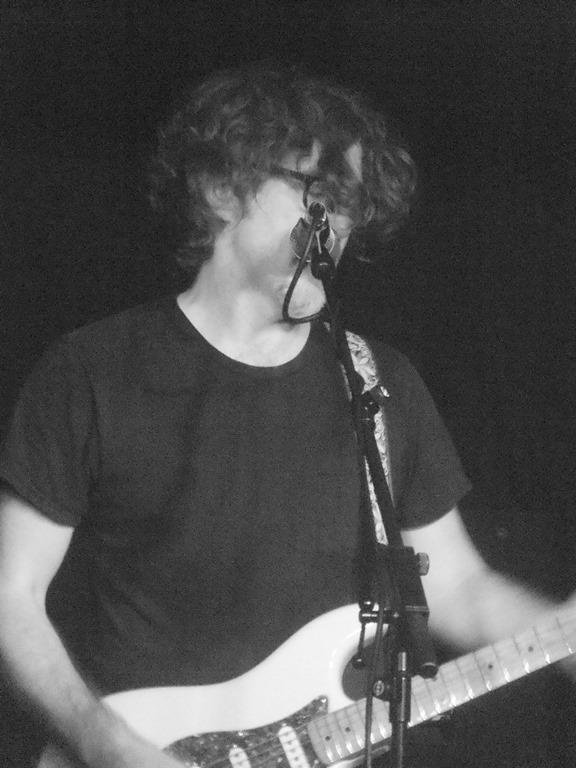
I can barely read a word of the notes I took during Chris Forsyth & The Solar Motel Band’s set, and there aren’t many. I was too busy standing, absorbed, by the trio’s seamless and utterly compelling performance. With elements of psych and prog and 70s rock and out and out rhythm-driven jamming, and songs like ‘The First Ren Minutes of “Cocksucker Blues”’ to groove out on, there’s a lot to get lost in.

They have a simple setup: drums, bass, guitar, a single amp apiece. Nothing fancy. And yes, there are epic guitar solos comparable to Neil Young and Dinosaur Jr (one track even bears more than a passing resemblance to ‘Like a Hurricane’ in its chord sequence, and the emotion Forsyth wrings from those six strings is almost tear-jerking in places). But – and here’s the important point of note – nothing is overdone. However exemplary the musicianship – these guys can’t just play, thy can fucking play – at no point during the set do things ever descend into self-indulgence. This is a major, and extremely rare, feat. But not a bar passes without an ear to structure, and a remembrance of the importance of the audience’s entertainment.

DSCF0799DSCF0791

Chris Forsyth & The Solar Motel Band

At no point to these guys go too far out on a limb, lose the crowd with tangents or indulgence. They’re well-rehearsed and tight as hell, but equally, they’re not so slick as to feel like they’re going through the motions, and this is when wigging out is at its best. Chris Forsyth & The Solar Motel Band define intuition, and play with an understated showmanship that’s something special.

Christopher Nosnibor

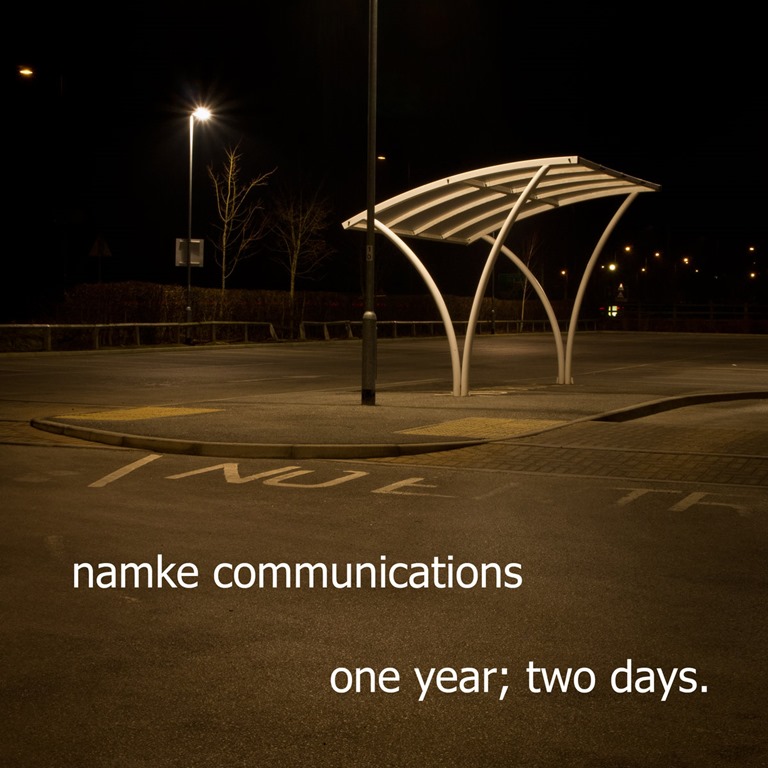
I know very little about this release, at least in terms of specifics. I do know that it’s the work of the prodigious John Tuffen, who also performs as part of Neuschlaufen and Wharf Street Galaxy Band amongst others. I know its physical edition is in a hand-numbered run of 50 CD-R, housed in a paper foldover sleeve in a PVC wallet, with an appropriately blank image by way of cover art. There’s a bleak, quasi-modernist feel to the night-shot photograph of a structure constructed as some kind of shelter. But a shelter without people and a car-park without car is simply dead space. One Year, Two Days is a night-time work. Recorded at night (we’ll return to that shortly), it’s the soundtrack to empty spaces and time without people. And abstract as the sound sequence are on One Year; Two Days, it’s reasonable to summarise the project as a work about time and space and a certain absence.

I do know that John likes his kit, and to fiddle with it, and that a lot of his works are ‘project’ based, centred around either a piece of equipment (e.g. 808 // Whammy (2016) and Field Memory Recorder (2017) recorded exclusively with a novation circuit) or specific times / locations. I also know that John has been working under the Namke Communications moniker for some seventeen years now, and has built quite a body of experimental work in this guise.

The track titles are simply dates and times, and show that the four pieces were recorded over two days in 2016 – as the EP’s title suggests. In some ways, it marks a continuation of the 365/2015 project, which saw Tuffen record – and release – a track a day for the entirety of 2015.

This project and its predecessor provide a considerable insight into Tuffen’s creative modus operandi, which could equally be described as a work ethic. It’s one I can personally relate to, as I strive to produce and publish at least one review a day. This does, of course, raise the inevitable question about quality control, but there are two very different positions on creativity: the first suggests creativity is something which cannot be controlled, is spontaneous. It says you have to wait or the moment, the idea, the impulse. To wait and to go with the flow. The second says that creativity is like a muscle: the more you do, the more you’re able. In time, quantity begets quality as a committed, systematic approach to making art.

‘2016-08-08-2202’ sets the tone, a distorting oscillation provides the backdrop to creeping notes which gradually rise majestically before bleeding into ‘2016-08-08-2318’. It may be growing later, but the mood grows marginally lighter. The sequencing of the tracks is a major factor in the listening experience here, as there is an overall arc from beginning to end. The mid-section, as represented by ‘2016-08-10-1909’ transitions into hushed ambience, before fragmenting into darker territory with fractured distortion and dislocation taking hold. Eventually, it spins into hovering metallic drones, the frequencies touching on the teeth-jangling.

The final track, ‘2016-08-08-2256’ forges a cloud of amorphous sonic drift, a sonic cloud without tangible form. It’s immersive, but at the same time entirely engaging, as the oscillations and quavering notes which fade in and out of the rumbling thunder slowly dissipate in a drifting mist.

While locked in time and space in terms of their creation, in terms of reception, the four tracks on One Year; Two Days transport the listener beyond both time and space. And herein lies the power of this release, in that it both freezes time, and stretches it out over a frame which has no fixed limits.

HHHHH

Namke Communications – One Year Two Days

24th August 2017

Christopher Nosnibor

Although he’s released two solo albums under the guise of Wiekie, Adam Weikert is perhaps best known as the drummer of Her Name is Calla. This first release under his own name marks something of a departure, and given its inspiration and evolution, it’s perhaps not unreasonable to say that Weikert’s decision to release an album as ‘himself’ represents a stripping away of the layers of artistry to reveal a work which is more directly personal.

The blurbage contextualises the release as follows: ‘Born years ago as response to cope with a traumatic event of his youth, and revived years later after ill health forced Adam to temporarily stop singing – USIDOH showcases the scattered fragments of poems alongside happenstantial Neoclassically themed works, creating a unique and personal experience.’

Attempts to unravel the meaning of the album’s title, which I take to be more of an initialism than an acronym, during the writing of this review bore little fruit of use. The poems – which are contained in an 80-pagebook which accompany the physical release – are considerably more instructive as to the true meaning of the project. That isn’t to say they’re in alignment with the album’s eleven (instrumental) tracks, because the poems – plural – essentially blur into a single, drifting longform work which has its own shape and tempo, as well as illustrations which augment rather than impinge on the experience. That is to say, the two elements of the project are complimentary rather than directly parallel. Nevertheless, the poems are absolutely integral to the overall experience, rendering USIDOH more of a multimedia work than simply a musical piece.

The words are weighty and the presentation is not only highly visual but intrinsic to the execution. Just as the music on USIDOH draws on aspects of the postmodern and the avant-garde within its broadly neoclassical framework – Wiekert conjures a vast array of atmospheres and emotions through the use of abstraction and semi-ambient field recordings and found snippets in conjunction with mewling saw, sweeping strings, brooding piano and nagging banjo – so the poems pull on high modernism, postmodernism and concrete poetry to further accentuate the lines, disparate and abstract yet unified by virtue of emanating from the same mind, over a period spanning the six years from 2005 to 2011.

‘Die Puppe’ weaves in and out of experimental atmospherics, before ‘Vardøhus Festning’ forges an imposing, imperious mood. ‘Sloth’ is a simply beautiful piano composition, which rolls and drifts mellifluously. There’s almost a playfulness about ‘A Constant Repose’, which first aired via YouTube aired a couple of months ago, the nimble piano work affecting a lightness of mood. But beneath it lies a subtle undercurrent of nostalgic melancholy. And if anything, it’s this emotional layering and the depth of nuance and detail which makes USIDOH such an appealing and compelling work, musically.

As a complete package, there’s a lot to unravel. USIDOH is very much art: Wiekert has poured everything into this, and it shows. There are times when it’s not easy to penetrate, but that in itself is reason to set aside some time to explore a work that multifaceted, deep and resonant, and achieves this without slipping into pretentiousness. There’s no question that USIDOH is ambitious, but Wiekert succeeds in delivering something which conveys the vision.

USIDOH

Christopher Nosnibor

It seems as if this release is designed to cause maximum confusion. It’s called 2014 and is being released here in 2017. It was ‘originally’ released by German label Attenuation Circuit on 8th August 2017, and has been – so far as I can make out – independently released by the artist himself, with the subtitle of Attenuation Circuit 2017. Given the album’s contents, it sort of works.

The accompanying blurb – which is in fact culled from a review published on August 12th (is this chronology messing with your orientation yet?) is a curious mix of hyperbole, unusual metaphors and theoretical reference points:

‘Gintas K will shower the ears with a whole lot of incredible data streams, all clustering electronica bits and bytes that drop down in a wild way. As if data communications had been flushed through the shower head, tumble down and ending up together in the drain. Strangely when the tap is closed and these electrodes have calmed down in their dripping ways, they actually form beautiful sounding music… well, music might not be the word for all to say, but it does feel like there is a lot of beauty to be discovered in these busy data dada streams.’

As much as the quirkily playful application of abstract digitalism does clearly it comfortably within the framework of Dadaism, it’s also a work which readily aligns itself to the postmodern, in the way that it effectively recreates the experience of information overload, and does so in a fashion which is both nostalgic and retro (the sparking circuits are more dial-up than fibre optic) and executed with a certain hint of parodic pastiche. At the pace of progress as it stands, even 2014 feels like a point of nostalgia on the cultural timeline: a year which predates the vote for Brexit and the accession to power of Donald Trump, it may be a year with little going for it and which has little to mark it as memorable, but many would likely concur that 2014 stands in a period which is better than the present.

2014 is certainly one of Gintas K’s noisier and more challenging releases. While Slow was a subtle and quite quiet, delicate work, 2014 is far more up-front and attacking in every respect. It’s also more difficult to position, in that it absolutely does not conform to simple genre categories like ‘ambient’, instead straddling vague brackets like ‘electionica’, ‘industrial’, and ‘experimental’.

Hurtling from the speakers from the get go streams a barrage of gloopy digital extranea, a glissando of chiming binaries and a dizzying digital wash that flickers and flies in all directions, an aural Brownian motion of beeps and bleeps.

The eight-minute ‘max’ starts very much as ‘min’, with a full three minute’s silence, before a brief crashing facsimile of some metallic kind of percussion makes a fleeting appearance. There are sporadic clunks and scrapes and minute glimmers of higher-end frequencies, but for the most part, the silence of space dominates the clutter of sound.

‘5 zemu ir max2’ sounds like R2D2 having a seizure, with occasional blasts of distortion and random thuds punctuating the frenzied stream of bleeps. It’s ten minutes long. And I have no idea what the title – or indeed any of the titles attached to the individual pieces – stands a s reference to, just as the overarching 2014 has no obvious connection to the seven tracks it contains.

Crackled a gloops and bloops and whiplash blasts of static, crashes like cars impacting at speed and jangling rings all congeal into a digital mush which bewilders and disrupts the temporal flow. 2014 is disorientating, and not just in the immediate moment, but in terms of a wider placement and sense of time / space.

Gintas K - 2014

Unsounds – 57u – 10th February 2017

Christopher Nosnibor

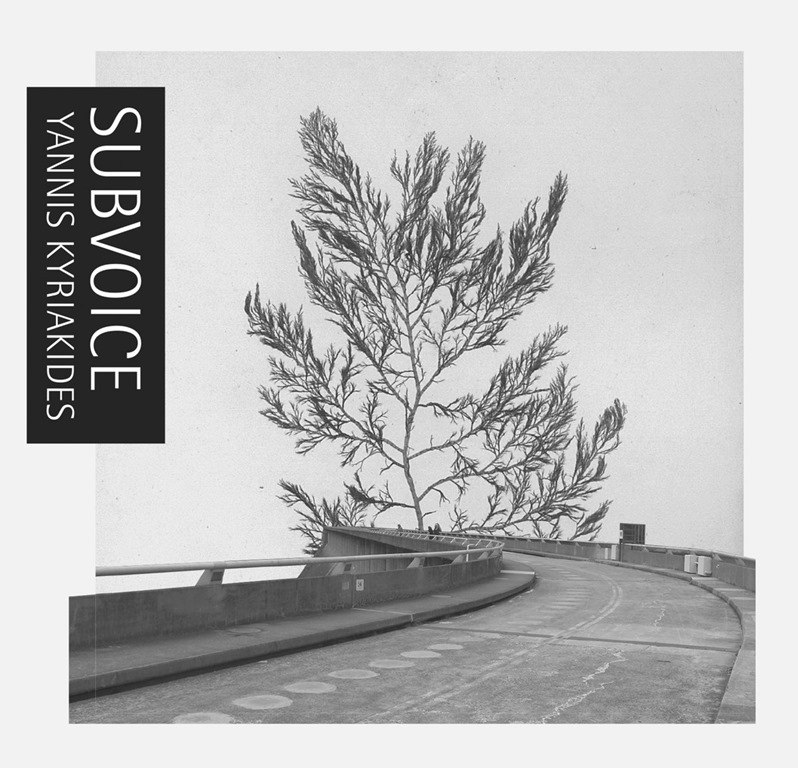
Unsounds have a history of releasing magnificently-packaged albums, and Subvoice by Yannis Kyriakides is up there with the best of them. The double CD is housed in a chunky hardcover book binding, which contains an actual book, some forty pages in span.

My introduction to the concept of the subvoice came via William Burroughs, who, around the time he was exploring the myriad potentials of the cut-up technique, made innumerable audio experiments. While most of these involved tape splicing, dropping in and cutting out, some investigated the subvoice in a most literal fashion. Some of these barely audible and even more barely listenable recordings appeared on Nothing Here Now But the Recrdings on Industrial records, with the liner notes describing ‘Throat Microphone Experiment’ – if memory serves – as a not entirely successful attempt to capture subvocal speech.

The definition of ‘subvocal’ is ‘relating to or denoting an unarticulated level of speech comparable to thought’. Kyriakides describes the works in the collection as ‘an investigation into ideas of voice and language [which] range from works in which text is directly encoded into music… to ones in which the voice is examined, dissected and pulled apart’. He explains that ‘in both approaches the underlying idea is to explore what happens when material has a clear semantic form, whether communicated in text or speech, is translated into musical structure’.

While thematically and theoretically linked, the nine pieces – which have a combined running time of almost two and a half hours – are from quite distinct and separate collaborative projects Kyriakides was involved in between 2010 and 2015.

The first piece on disc one, ‘Words and Song Without Words’ is the shortest work, being a couple of seconds under ten minutes, but appropriately introduces the kind of sonic palette Kyriakides and his collaborators – in this instance, Francesco Dillon, who contributes cello – work from. ‘Paramyth’ is eerie, disconsolate, the cracked ramblings splayed in all directions over tense piano and uncomfortable strings, but ultimately peters out into something softer. Skittering strings scurry busily in brief and disjointed flurries, hectically flying here and there, on ‘Toponymy’. Muffed voices bring a discomforting sense of the unheimlich, a sense of the intangible and of something just out of the reach of understanding.

Ominous notes hover and ring on the last piece on the first disc, ‘Circadian Surveillance,’ a twenty-five minute exercise in haunting atmospherics, where distant voices are barely audible under a rumble of turning static and hovering notes which resonate into dead air.

Onto disc two, ‘Der Komponist’ – a composition for orchestra and computer – begins quietly, ominously, with protracted near-silences between delicate, low, slow builds, before horns begin to add cinematic drama. It’s very filmic, very – for wont of a better word – soundtracky, and is reminiscent of some of JG Thirlwell’s more recent orchestral works. The climax is a slow, swelling succession of surging brass, underscored by a rippling digital churn.

‘Politicus (Dawn in the Giardini’ is perhaps the lightest and most playful composition of the nine, and utilises the variability and versatility of the prepared disklavier. The original work was a twelve-hour sound installation. The booklet explains the technical aspects in great detail, and Kyriakides outlines the way in which algorithms based on speech drive the formulation of the piece, here in an abridged fourteen-minute segment. The immense complexities behind the composition are completely hidden from the listener, with the surface completely masking the mechanical depths.

The final piece, ‘Oneiricon’ is a work for ensemble and computers. It’s an exploration of dreams, and is often subtle to the point of subliminality. And because Subvoice is very much a ‘background’ work, while it often drifts for significant stretches without really pulling particularly hard on the attention, it does mean that its immense duration is not an issue. Equally, because Subvoice is a collection rather than a work conceived as a single continuous whole, it’s possible to listen and appreciate in segments, without absolute commitment. And it is an album to listen to and appreciate: Kyriakides’ compositions are varied and textured and demonstrate an attention to form and sonic detail which extends far beyond the basic premise of ‘the voice.’

a0933203676_10

‘Gravity’ is the first video from the debut of New York-based Ω▽ (OHMSLICE)’s debut album Conduit. One interesting aspect of the video is that it uses footage  from well-known experimental film maker Mark Street’s films with Street’s wholehearted approval. The album was recorded at Ft.Lb Studios in Brooklyn, produced by the outfit’s premium mobile multi-instrumentalist and instrument inventor Bradford Reed (King Missile III, creator of the electric board zither he calls the “pencilina”). The album is being released September 8 by Imaginator Records.

Ohmslice formed around Reed’s experiments in processing percussion  through a modular synth. Layered over a sonic framework of double-drummed syncopated rhythms  and analog pulses and drones are the sultry vocals and driving, often abstract lyrics of poet Jane LeCroy (Sister Spit, Poetry Brothel).  Joined by a rotating crew of collaborators including Josh Matthews (Drumhead, Blue Man Group) on drums, the legendary and ubiquitous Daniel Carter (Thurston Moore, Yo La Tengo) on trumpet and saxophones and Bill Bronson (Swans, The Spitters, The Gunga Den, Congo Norvell) on guitar. The album combines formal structures and heavy grooves with a sonic meditation on the nature of human-electronic improvisation.

OHMSLICE-duo

Conduit was recorded live over a two-year period. The album is an organized documentation of spontaneous creation and exploration and moves from the fuzzed-out psychedelic of “Crying on a Train” to the meditative ambient cycles of “Broken Phase Candy” and beyond.  Within this realm, the listener is meticulously guided through beautiful harmonic and rhythmic phase mosaics and held captive by an innovative and violently unquantized approach to groove based electronic music. Combined with LeCroy’s visionary mixture of philosophy, reflection, language and song Conduit illuminates a path to a rare and alluring space that reveals endless layers with each new listen.

‘Gravity’ is a brain-bending piece of jazz-infused experimentalsim, and coupled with the cut-up visuals, the promo makes for quite the multisensory experience.  You can check out the video here:

Crónica – CRÓNICA 126-2017

Christopher Nosnibor

The title of the latest album by the super-prolific experimental composer and student of film and musique concrete, Emmanuel Mieville, comes from the Japanese translation of the Sanskrit word and alludes to a chapter of the Lotus Sutra, a renowned text from Māhāyana Buddhism. Apparently. It’s hardly my field of expertise. And so the inevitable question arises: what’s my point of entry?

Juryo is by no means an accessible album and its four longform tracks, which span between nine and eighteen minutes don’t readily lend themselves to lengthy debates about Buddhism and the path to enlightenment. Similarly, that the album consists of four compositions shows no obvious correlation with the twenty-eight chapters of the Lotus Sutra. As such, it’s fair to surmise that the allusion which connects the title to the contents is in largely an oblique one, beyond the fact that the album features field recordings captured in Asia.

This is swampy, abstract, murky noise. On the surface, it’s a formless conglomeration of noise, grating, grinding scrapes and bumps. Woozy rippling bubbles flit and floom over tidal waves of surging extranea, which may or may not be the swash of actual water rippling over rocks: it could equally be an aural illusion, or an intentional simulacrum.

Top-end whistles sustain for an eternity and aggravate not only the aural receptors but the mind on ‘Nyorai’, although in the mix are recordings of Tibetan nuns and FM radio from Hong Kong. These manifests as chants and clattering chimes and finger cymbals which emerge around the midpoint of the seventeen-minute sonic journey. According to the liner notes, ‘Murasaki’ means ‘purple’ in Japanese, but the spinning, swirling sonic discombobulations which eddy and swirl present a kaleidoscopic vista.

In the sleeve notes, Mieville explains that ‘Taisi Funeral’ (the fourth and final track) is a ‘recording of Buddhist chanting for a deceased person recorded in a small village in Taiwan, mingled with my own synthetic sounds. Tanit Astarté is a quotation from Antonin Artaud’s book Héliogabale and refers to the moon goddess, as described in Phoenician myths’. It’s certainly the most overtly musical and rhythmic of the four compositions, but as a rising surge of amorphous sound rises to wash away the voices and the rhythm peters out, it transforms to an altogether more ambient soundscape. Morever, while still linking back to the overarching theme of the Lotus Sutra, we can see that Meiville’s sphere of reference is considerably broader than may first appear.

Juryo is subtly complex and had both range and depth. It doesn’t readily conform to any one genre, but to lazily slot it into the broad space occupied by ‘experimental / avant-garde’ is to fail to recognise the spectrum of stylistic elements it incorporates.

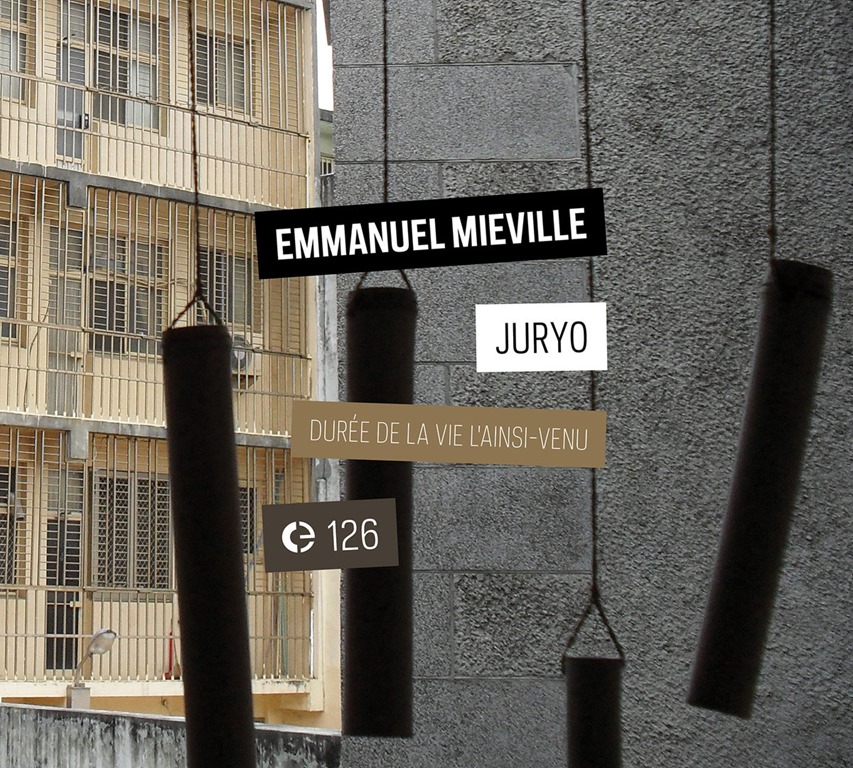
Emmanuel Mieville – Juryo

Hallow Ground – HG1703 – June 2017

Christopher Nosnibor

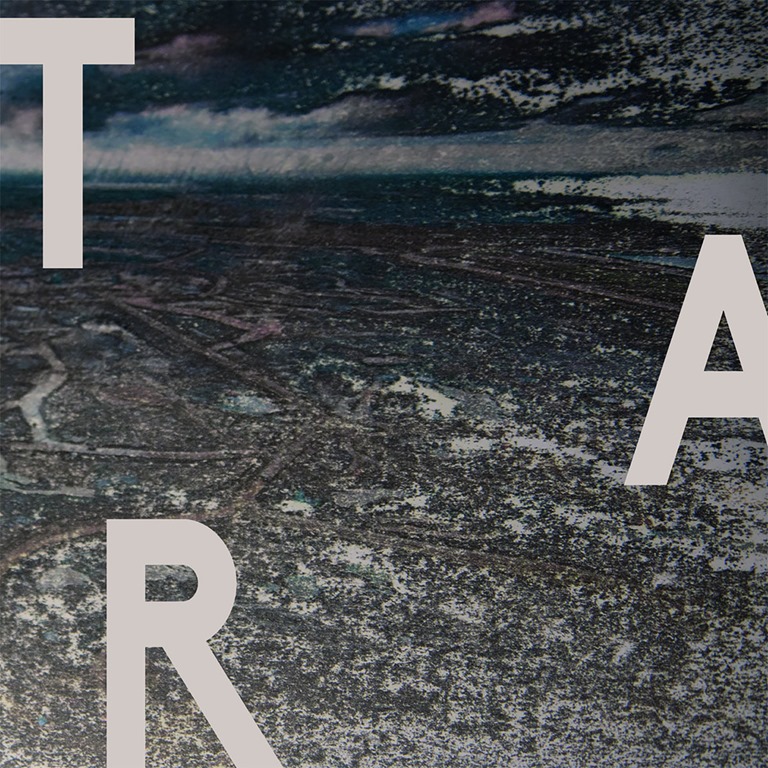
TAR is the fourth solo album by Tehran-based composer Siavash Amini, although he’s joined by Pouya Pour-Amin on electric double bass and Nima Aghiani on violin. Not that the individual instruments are readily recognisable in the thick sonic swirls which combine to forge the ever-shifting soundscapes of TAR at least in the main. But when Aghiani’s violin weeps and bleeds emotive from amidst the amorphous aural clouds which turn and taper, billowing and rolling, throbbing and pulsating.

‘A Dream’s Frozen Reflection’ begins droney but gentle, but inside the first two minutes breaks into a serrated sonic tempest. Music that sounds for all the world like a circular saw accompanied by a saw played more conventionally (does anyone play the saw any more? Or has it more or less gone the way of the comb and the washboard?) isn’t an easy sell, but Amini creates an intense aural experience that immerses the senses. But for all the harsh tones, there are contrasts in abundance, and through forging a shifting soundscape, the atmosphere changes, sometimes almost subliminally over the course of the piece.

‘Rivers of Tar’ plunges into murky, dark territory, but crystalline glissandos cascade through the eddying clouds of sulphur, while graceful strings rise and sweep expansively. It’s hard to determine whether or not it really carries an emotional resonance, but as a listening experience, it’s got more than enough range and features some passages which do have that vital drag.

At times, ‘The Dust We Breathe’ is barely there, delicate contrails of soft ambience washing in and out. There are periods dominated high-volume undulations of grating, snarling noise early on, but over the course of its fourteen-minute duration, the track drifts quietly and softly into the background.

It’s Amini’s ability to manoeuvre, effortlessly and almost untraceably, the trajectory of the four compositions from head-crushing abrasion to lulling calmness which is the greatest achievement of TAR. It’s an ambient album which carries a sting in the tail sharp enough to hurt, while equally massaging the mental receptors with its delicate tones.

The extent to which TAR translates Amini’s desire to explore ‘the fragile tensions between and individual and collective subconscious’ is largely irrelevant: TAR is an unexpectedly dynamic work, brimming with texture and contrast.

Siavash Amini – TAR