Posts Tagged ‘electronica’

ChristopherNosnibor

The split album seems to be in vogue again, and it’s a format which perhaps offers more scope for artists who don’t trade in punchy little tunes than the split single or EP. Shine on you Crazy Diagram may only contain four tracks and have a running time of just over thirty minutes, but it allows both contributing acts to showcase the range of their sound by presenting expanded, developed musical works.

The two tracks by Splitter Orchestra explore and examine weird digital percussion: the ever-shifting pitch creates the illusion of ever-shifting tempo (or does it? Perhaps the tempo does shift albeit subtly) beneath whistling contrails of feedback. They sputter and scrape and drone and hum. ‘Diagram 1’, at under four and a half minutes, is but a prelude to its counterpart, ‘Diagram 2’ which hums and wheezes for almost eleven minutes. There are rhythms in the mix, but they’re pinned back in the mix and bounce around against a shimmering backdrop of feedback and extraneous noise.

Kubin’s compositions are altogether less overtly structured, or at least rhythmic, as swampy swashes and thumps rumble and eddy before – from seemingly out of nowhere – faceripping blasts of distortion roar and blast. ‘Lückenschere’ is constructed around a clattering, shifting rhythm.

‘Lichtsplitter’ clatters and moans and hums and drones for an eternity, before stepping up about ten gars. By the end, one has a fair idea of what it just be like to stand within two feet of a Boeing 474 taking off.

This is, without doubt, one of those releases which lends itself perfectly to vinyl: it is, after all, an album of two halves. They compliment and contrast, and showcase two quite different sides of the experimental digital coin.

There’s a digital bonus track from the Splitter Orchester. ‘Diagram 3’ is a ten-minute extravaganza of thick, impenetrable hums and drones. It might not exactly change the complexion of the release, but it does unquestionably fill out and round off the intangible, non-physical format nicely.

Splitter Orchestra   Felix Kubin

Consouling Sounds – 23rd June 2017

IIVII – pronounced ‘ivy’ as it so happens – is the musical vehicle for visual artist, multi-instrumentalist and composer Josh Graham. It’s actually quite fitting to the creeping ambience and gradually-expanding soundscapes which develop almost imperceptibly on Invasion. The bio bigs it up as being his ‘enigmatic inter-galactic solo project’, which focuses on ‘sonically engulfing and moody soundscapes, layered with a science-fiction edge.’

Graham has quite a resume: having worked as a designer and director, he has also collaborated with a variety of bands including Mastodon, Neurosis, Jesu, Shrinebuilder, ISIS and The Dillinger Escape Plan.

Invasion is pitched as a work which ‘traverses genre and explores elements of drone, classical, ambient, electronica, and vaporwave’, and it’s very much an album of tonal variety and texture, not to mention compositional and stylistic range – to the extent that sometimes one might wonder if the playlist has moved onto something else entirely.

Invasion is less a collection of individual pieces but a single set which forms an ever0shifting whole; from the lonely piano which echoes across the expansive atmospherics of ‘We Came Here from a Dying World’ through the creeping bassline and fear notes which hang hauntingly on ‘Unclouded by Conscience’, with its distant, rolling drum and post-rock intimations, and through the more overtly beat-driven.

There are extended minimalist moments, like the slow-pule hum which introduces ‘Hidden Inside’ to stark and chilling effect; the glitchy bass and glacial overtones do little to soften the icy bleakness of the funeral bells and amorphous sonic drifts which carry a chilly edge over the occasional bursts of subsonic thunder. Melodic arabesques rise from eddying pools of resonant bass hums and twirling contrails.

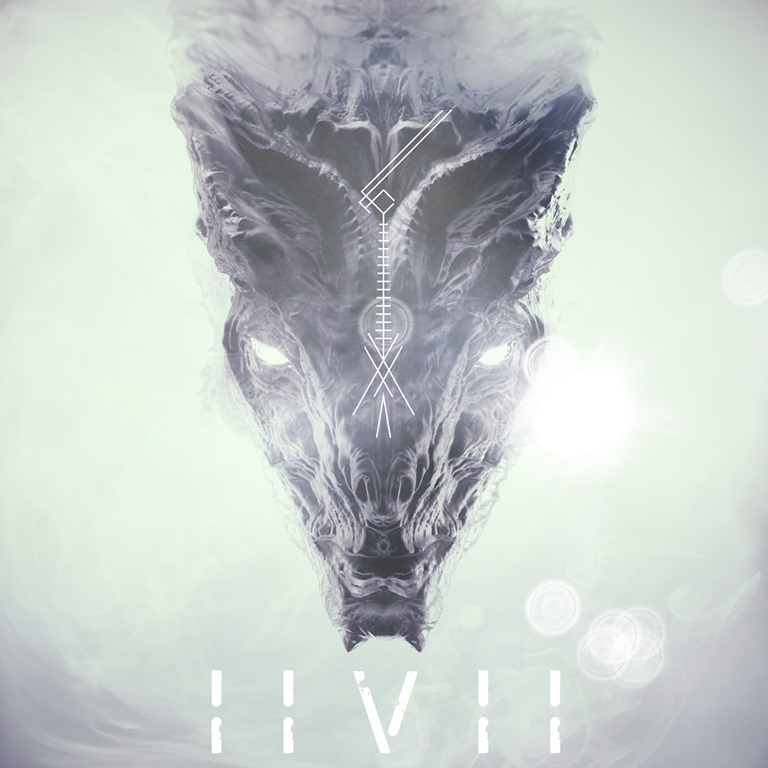
The tribal beats and throbbing synthesized bass, draped with icy synth notes, which define the dynamic drive of ‘No More Enemies’ call to mind Movement era New Order: it’s dark, detached, otherworldly, and corresponds with the album’s artwork, which depicts an invading species of alien origin (also completed by Graham, who, poignantly, served as Soundgarden’s art director at the time of the press release).

Nuanced has become one of those words, but there’s a rich detail and infinite texture to be found on Invasion that demands its application. This is an articulate, considered and meticulously-realised work which operates on multiple levels.


IIVII_INVASION_Cover_1500

Oracle Rouge – 28th April 2017

Christopher Nosnibor

French cyberpunk / dark-wave project Fixions are, they say, influenced by ‘classic movies such as Blade Runner, Akira, Ghost in the Shell, the extreme metal scene from the 90s, Amiga video games, Fixions evolves in a style mixing dark and surrealistic elements, bombastic, powerful production, and a solid 80/90s dystopic science-fiction aura.’ With this, their fourth album, they threaten ‘the most extreme and deep release they ever produced’ in the form of ‘a concept album inspired by classic cyberpunk fiction tales, where every track depicts one of the thousand dangers the “Edgerunners” will encounter when visiting the city at night [and] sees Fixions merging futuristic urban ambiances with dark epic elements and heavy, abrasive sounds’.

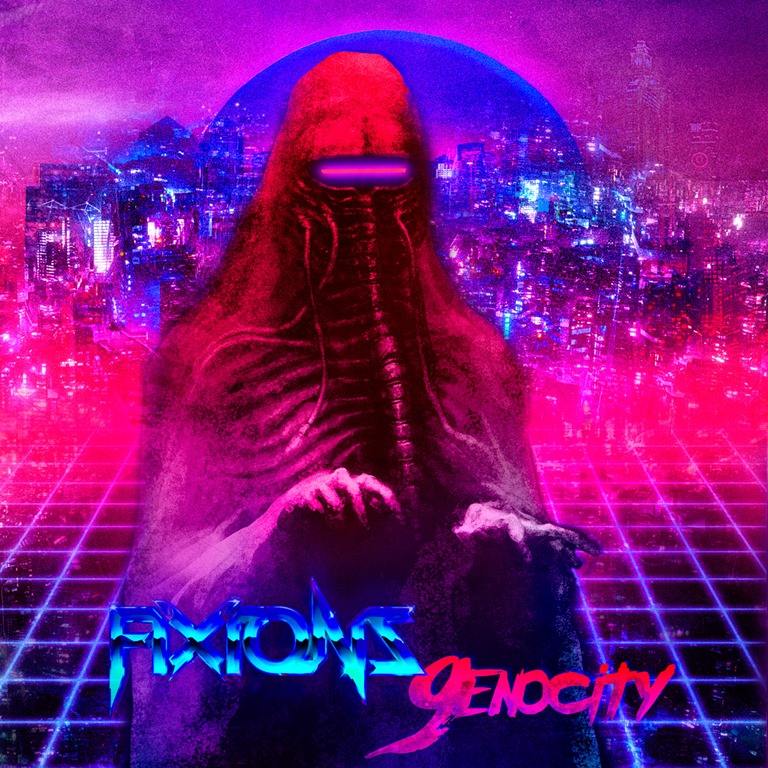
While the concept might not be rendered entirely explicit through the album’s 16 instrumental tracks, but themes emerge both from the audio content and the titles (not to mention the cover art) applied to the compositions: ‘Crimeware’; ‘Terrorwave’; ‘Black Chrome Riot’ all contrive to summarise the intent of Genocity, which to all intents and purposes does come across as a sort of reimagining of Neuromancer in audio form.

Jittery, skittery, interloping lead lines weave their way over thumping basslines that wow and drag, melded to stomping, insistent, industrial-strength disco beats. It’s all about the imposing soundscapes and minor chords, the tension and the relentlessly restive digital flittering. There are grooves aplenty – hard, driving eurodisco grooves packed back to back, interspersed with more contemplative Kraftwerk-inspired tracks.

Does it sound futuristic? Not really. The ‘80/90s dystopic science-fiction aura’ is all-encompassing. The sonic elements are all tried and tested, well-worn tropes which evoke the spirit of ‘the future’ as it looked in those line-green neon-hued imaginings from the 1980s. As such, it’s possible – and indeed hard to resist – viewing Genocity as a sort of nostalgia piece, in which the time and space being yearned for is a golden age in which the future – a future which ultimately failed to become the reality in the present in which we now find ourselves – offered exciting and near-infinite potentials. Perhaps the realisation of that failure is the thread which ties the fictional technological dystopias of the 80s and 90s to the bleak cyberreality of the Internet and the digital age as we now experience it. At least the dystopian digital futures depicted in fiction were, and are, just that – fiction. Artificial Intelligence and automation, a reality in which everyone carries a computer which pinpoints their precise location 24/7 have not given us more leisure time, or more freedom, but has instead overtaken and occupied every inch of everyone’s lives and resulted in the erosion of freedoms at a pace which perhaps even outstrips the technological advances themselves.

When faced with incalculable progress and its effects on the psyche, it’s only natural to regress to safe times. There is, beneath the tension and amidst the dark currents which flow through Genocity, a certain sense of a regressive channelling. And so while it may not be the sound of the future, it does provide a perfectly serviceable recreation of futures past.

fixions_genocity

Spezialmaterial / Staubgold – SM052 – 6th June 2017

Christopher Nosnibor

You’d expect an act as boldly named as The Immersive Project to make music which is nothing short of completely immersive and engaging from the outset. Even if you wouldn’t, I certainly would, and did, and so was a shade perplexed when my initial reaction wasn’t ‘wow’, but ‘what?’ Snaking bossa nova beats and strutting strings conjure an exotic vibe on the album’s first track, ‘Middle Class Massage’. Is the medium the massage? Am I missing something?

The Immersive Project is a collaborative work, the product of the shared endeavours of musical percussionist Holger Mertin based in Cologne, and electro musician Michael ‘Koko’ Eberli from Zurich. As such, it’s one of those works which could only exist in the modern age, in which distance is no object and geography is a state of mind. The pieces contained herein are what can emerge when collaborators bounce ideas off one another’s ideas, rather than one another, with producer Marco Riedener’s contribution being such that he is named on the cover as the Project’s third member.

‘Pizzifikato’ begins with soft, finger percussion and trilling strings before a trudging march and swampy bassline stroll in to create a dense atmosphere oozing with a sense of esoteric mysticism. Elsewhere, ‘Hilo’ (which features Eberhardt Kraneman of Kraftwerk / Neu renown) hurls a whole heap of stuff together, with bits and pieces of post-punk disco, wibbly synthtronica, bulbous bass and jittery grooves criss-crossing one another all over the shop. What indeed?

It’s certainly varied in its scope, with ambient and semi-ambient explorations interspersing the various forays into experimental dance. At times eerie, often playful, this is a work that defies ready categorisation. It’s not mood music, it’s not dance music: as on ‘Zwerchfell Schwingt’, the clattering, booming thuds are distant and contribute more to the creation of atmosphere than groove. And while the majority of the compositions are strongly orientated toward the rhythmic aspect, it’s by no means a beat-driven album.

‘Regenmann’ brings some chilled, swampy, vibes, and the attention to detail, both within each piece and the overall flow of the album becomes increasingly apparent with each listen. Textures and tones compliment and juxtapose alternately, often confounding expectations from one moment to the next. Such focus on variance and nuance requires a huge create commitment: an immersion on behalf of the creators. It does take a little bit more effort on the listener’s part to fully engage and to appreciate this, but ultimately, the rewards are there for the taking.


SM_TheImmersiveProject_Vinyl.indd

March 2017

Christopher Nosnibor

I’m not actually a fan of physical violence. The sight of blood – particularly my own – is enough to make me nauseous or even pass out, and I struggle with pain. And yet I’m also strangely, perversely drawn to violence. I consider the Marquis de Sade’s 120 Days of Sodom to be a comic masterwork. Why? Because violence at that level becomes absurd, as real as Tom and Jerry. It’s also perhaps important to distinguish art and life. So much brutal music and art is an outlet of the darker psychic states channelled by some of the mildest, sanest people you’re likely to meet. I haven’t met Tristan Shone so can’t vouch for his character, but his work under the Author and Punisher moniker is pretty brutal, and appeals precisely because of it.

The Pressure Mine EP, which finds Shone bring everything in-house to deliver five new tracks, all written, recorded, mixed and self-released by Shone himself balances brutality and beauty. What’s more, there’s a definite trajectory which runs over the course of the EP: something of a downward spiral, if you will, which sees each successive track prove darker, bleaker, heavier and more fucked-up than the one before. It may not be quite as gnarly and doomy s some of its predecessors, but that hardly makes this a stroll in the park and if anything, the absence of eardrum-shredding lasts of noise only accentuates the uncomfortable tension Author and Punisher is capable of creating.

First track ‘Enter This’ is a magnificent, mechanised droning industrial trudge, synths interlacing to forge a dark atmosphere over a battering mid-tempo rhythm. It’s all a backdrop to Shone’s vocals, which balance disconsolation and anguish. While reminiscent of Prettty Hate Machine Nine Inch Nails, it’s also rather more emotionally nuanced. ‘Pressure Lover’ lunges deeper into a woozy, nightmarish fugue, a dense, rumbling bassline and clanking percussion dominating.

‘New World’ warps and grinds, a dislocated discord emerging from the echoes and twisted vocals, and the last track, ‘Black Wand’ comes on like Depeche Mode on a cocktail of Ketamine and LSD. It’s not entirely pleasant, but it is unsettlingly awesome.


Author and Punisher - Pressure Mine

kranky – 17th February 2017

Christopher Nosnibor

It’s pitched as a ‘compelling synthesis of shadowy rhythms and opaque atmospherics, drawing on the most potent qualities of melancholic ambient and dub techno’. An Act of Love is very much an album which possesses a haunting atmosphere, with a supple, soft, subaquatic sound dragging the listener into a warm, hushed place of dark stillness where movement is slowed.

The album’s first track, ‘The Present Mist’, sets the tone, and its title is an appropriate summary of the vague, amorphous drifting soundscapes which encapsulate the overall feel of a set the fabric of which is woven from intangibles.

‘About that Time’ builds a hypnotic groove with an overtly dance-orientated beat – that is to say, an insistent bass drum in square four-four time at around 120bpm – while soft waves of sound drift like mist to form obfuscating layers which envelop the senses. A piano rings out into the warm aural webbing and hangs in the air. But the drums rattle and reverberate, echoing across one another: it’s not nearly as ambient or understated as may first appear. And so, while the album does often drift, making minimal demands on concentration, it is not without dynamic or the capacity to withstand a degree of attentiveness. It’s well-constructed and has a flow about it which works well. That flow creates, magically, a certain temporal suspension as time evaporates like vapour over the distance of successive tracks.

Jittering beats, like a palpitating heart, thump through ‘Exuberant Burning’. This is no up-front dance work, but nevertheless, there is a tension, and an excitement which emanates from its dark, cellular landscape. The flickering, pulsing beats muffled and bear a certain resemblance to sounds heard through a stethoscope.

An Act of Love is an album which slowly, subtly, almost subliminally, evolves and unfurls.


KRANK208_5x5_300dpi

The Helen Scarsdale Agency – HMS040 – 2nd December 2016

Christopher Nosnibor

My first encounter with the work of Jim Haynes (the musician, not the writer who rose to a degree of cult prominence in the 1960s) came when The Decline Effect landed with me in 2011. Haynes’ territory is the dark, the ambient, the subterranean, but Throttle and Calibration is an altogether harsher work, which emerged from Haynes’ 2015 residency at MoKS in Estonia, where he would collaborate with and contribute to Simon Whetham’s Active Crossover series.

As the blub accompanying the release on the label’s website explains, ‘Throttle and Calibration is the first in a series of albums that find Haynes digging through the Active Crossover archive and grotesquely exaggerating the details into exploded compositions of volatile dynamics, nerve-exposed dissonance, caustic shortwave signal abuse, and a considerable amount of scarred metal. Marked as one of the more discordant works to date in Haynes’ career, Throttle and Calibration finds company near the atonal compositions from Hermann Nitsch and the sour, industrial collages that pock the Nurse With Wound catalogue. Previously released digitally on Crónica, Throttle & Calibration is fleshed out with an additional 20 minutes of material.’ This time around, the augmented digital release is also accompanied by a cassette edition. But, sadly, no vinyl, and no CD. Sadly because

As the blurb which accompanies the release intimates, discordant is it, and Throttle and Calibration does, most certainly, slot into the space where industrial and avant-garde intersect, and this reissue, expanded to eight tracks from the original five, is an essential work within its field. The album finds Haynes in exploratory mode, and he delves deep into the granular elements of sound over the course of this challenging work.

A long, buffeting rumble, like a distant train or the sound of wind on a mountain-top (if there is no-one there to hear it, does the wind still roar around the rocks?) is the first sound. The harrowing bleakness is but short-lived. Explosive blasts of noise rip and tear like detonations, atmosphere and ear-shredding eruptions. Small sonic ruptures are rendered at such volume and intensity as to inflict sensory and psychological.

What exactly is this? The Arctic wind ripping through an empty water tower? Or the apocalypse? It could be either, and may be both. It’s disorientating as well as full-on. Throttle & Calibration is an album which places sound under the microscope, so to speak. It’s not microtonal, but it is microcosmic, at least on the one hand. But in placing its focus on a small corner of the scene, Haynes then blows it up to A3 and zooms in 500%. The effect is terrifying, bewildering, intense, and the results are immense. In Haynes’ hands, mundane sounds are reforged and take on sinister dimensions. His addressing them from alternative perspectives – up close, amplified – is the key to building a new understanding.

A quiet rattle is annihilated by a roar which melts all definition into a whirling multitextural aural vortex in ‘Tabula Rasa’, and over the course of the album, Haynes repeatedly drags the listener through a succession of vertiginous sonic sinkholes. Single impacts – origins unknown and undisclosed – resonate and decay slowly n heavy atmosphere. The spoken word introduction to ‘It Doesn’t Matter’ sets an eerie tone, but this again is devastated in a tinnitus-inducing wall of screeding noise worthy of Merzbow at his most brutal.

It takes time and focus to peer through the harsh noise to discern the textures. Like stepping into the dark from a brightly-illuminated interior space, it takes time to recalibrate the senses. There are quieter passages, but they’re no less intense and no lighter in tone. Ominous monotone drones and hums hang for aeons; time is suspended in space.

Neither the full-throttle abrasion nor the shady, moody spells of dank mental torture offer anything by way of respite or levity: Jim Haynes is an artist who dwells in darkness and creates work that ranges from the darkest greys to the pitchest of blacks. Throttle & Calibration stands at the darker, more violent end of the spectrum. Uncomfortable unpleasant, and unforgiving, it’s a well-realised plunge into the bowels of a new shade of, rendered from the terrains of the everyday.
 

Jim Haynes – Throttle and Calibration

Cat Werk Imprint – CW11 – 8th February 2017

Christopher Nosnibor

The inspiration for Olivia Louvel’s latest album (fantastically presented, like its predecessor, in a DVD size digipak) casts an arc way back into history. Louvel, it transpires, was fascinated by the lives of Mary Queen of Scots and Elizabeth I – two queens who existed simultaneously on the same island, during the 16th Century – a period dominated by men. Two queens who, powerful and celebrated in their own lifetimes as well as posthumously, would never meet. And so, on Data Regina, Olivia Louvel sets herself the challenge of addressing their simultaneous yet entirely separate, disparate narratives of these two bitter rivals, and presenting distinct voices as she charts their adversarial relationship.

The twenty years during which the two queens reigned simultaneously were fraught, tempestuous ones, punctuated by battles on the Anglo-Scottish borders, disputes and reconciliations, and ultimately saw Mary Tudor sentenced to death and executed.

Effectively two works intertwined – ‘The Antechamber; and ‘Battles’, with the latter comprising a sequence of relatively short instrumental pieces positioned between the longer ‘songs’ – Data Regina is no polite period drama in musical form. It most certainly doesn’t correspond with the popular Elizabeth-slanted syllabus readings of the period, or correspond with the backdrop generally presented on degree-level modules taught on ‘Elizabethan’ and ‘Renaissance’ Literature (the Renaissance was late to reach Britain in relation to the rest of Europe). Herein lies an immense problem, of course: how can we learn from history when so much of the past is unknown, shrouded in layer of mystery and obfuscation as the result of political (self)interest? Would the present be as fucked as it is if we all had a better knowledge and understanding of history? Maybe, maybe not. The age of Elizabeth I, of Shakespeare, of – my preferred man of letters, Christopher Marlowe – is a long way in the past.

Data Regina an album of dark, haunting electronica, which stands in a league of its own: it has no obvious reference points in music, history or elsewhere. It’s a bold project, for sure, and Louvel admirably achieved her ambitions with a work which conveys its intent without becoming overly mired in explication and cumbersome narrative segments which disrupt the flow.

Louvel sets the tone – both musically and in terms of narrative – with the dark swell of ‘Battlefield’. Vaporous in its atmospherics, the track combines echoey beats which clatter and rattle around between resonant, woozy basslines and sparse, drifting notes. ‘My Crown’ weaves a haunting spell, slow pulsating electronics and mournful strings first float and then rise to a tense climax. At times, juddering electronics and stuttering, glitchy rhythms spasm and render scenes of claustrophobic intensity, Louvel’s detached, icy vocals eerily menacing. The pieces – they don’t follow clear or conventional song structures – are intense sonic explorations of character and voice.

‘Langside, 1568’, is a dark, dolorous interlude, the fractured vocalisations preface the marching drums which dominate the barren landscapes of ‘Deploy’ and ‘Battle’. It’s uncomfortable, queasy listening, the elegance and grace of the sparse compositions and Louvel’s voice countered by a discomforting undercurrent that runs throughout. It’s by no means an easy, accessible work: in fact, Data Regina is dark and turbulent and often uncomfortable, but it is deeply compelling.


Olivia Louvel - Data Regina

ELaB Records – 10th February 2017

Christopher Nosnibor

Being a teen of the late 80s and early 90s, I discovered curve through the pages of the music press as was, and absolutely bloody loved them. It’s perhaps hard to appreciate now, in these jaded, music-saturated ties, just how exciting it all was back then. I’m not disparaging the current music scene: far from it. I find new bands which excite me on a weekly basis. But that’s part of the problem: it’s all there, streams and links shared by friends and reviews rippling across social media within hours of posting by a single person of note. And said person of note can be anyone with a high media profile. Back then, it was all about the ability of a critic to capture the imagination, and then for the music fan to seek it out. If you were lucky, John Peel would be spinning something by the act in question. If not… well, you’d got legwork to do. If it sounds arduous, think again: it was fun. It was rewarding.

Anyway. Post-Curve, Dean Garcia formed SPC ECO with his daughter, Rose Berlin. The parallels between this current vehicle and Curve are abundant, to the extent that they require no comment: you can likely find those observations elsewhere all over the internet, and such duplication is such a bore.

What you want – need – to know is that this EP which features five tracks which break the mould: instead of bursting with compressed guitar and mechanised drum-machine led shimmering walls of sound, these are hushed sedate and understated works. Restrained and dreamily subdued as they are, they’re rich in atmosphere depth.

Instrumentally, ‘Under My Skin’ has hints of Moby and The XX about it.. It begins quietly, Rose’s voice close to the mic singing quietly and backed by only a brooding piano. But there are layers building beneath, with tapering synths and delicate reverb filling the space and the space between.

‘Creep in the Shadows’ is a weird one: the bloopy autotuned vocals are so heavily processed as to be essentially robotic, detached, unhuman, and they drift over a backing so minimal as to be barely there: a sparse beat clacks away way back in the distance as a super-low, dubby synthesised bass wanders at will. There’s practically nothing to get a hold of, and it’s so produced it’s hard to position. Contrast that with the lo-mo tri-hop dub of ‘Lt it Be Always’: murky beats and swampy bass conjure dark atmospherics while Berlin comes on like Beth Gibbons at her most hauntingly ethereal.

In its pursuit of the fragile and the paired-back, this EP is by no means SPC ECO’s most immediate release, and doesn’t offer the dynamics of some of their previous releases, but it does follow their recent trajectory which has seen the duo create music of an increasingly claustrophobic, hushed intensity.


SPC ECO - Under My Skin

Village Green – 13th January 2017

Christopher Nosnibor

For those who aren’t down with technospeak, a ‘soft error’ is computer language for a faulty occurrence in a digital memory system that changes an instruction in a program or a data value. And so it is that the duo – known simply as Tim and Rupert, both of whom have musical backgrounds in dance music/DJ culture and composition for film, theatre and TV respectively – who make up Soft Error, strove to evoke the idea of happenstance and serendipity in the naming of their collective output.

I’ll not squander space scoffing at the middle-class connotations of a hipster electro duo called Tim and Rupert, and shall instead concentrate on the fact that Mechanism is very much an album born out of experimentalism and improvisation, and balances organisation with random, contemporary with vintage as it folds together modern electronica with classic Krautrock.

While delicate piano notes hang in the air to create a serious, ponderous air at the start of the albums first track, ‘Silberblik’, the introduction of cinematic synths, with tightly modulated oscillations and soaring sweeping expansive notes spreading to forge a richly-coloured panorama, the tone soon changes.

Mechanism demonstrates a preoccupation with contrast and evolution. Gloopy synths bibble and bubble in looping motifs to create a muzzy atmosphere. Synthetic strings sweep and slide over the busy electronic sequences, and it’s this juxtaposition of the (ersaz) organic and mechanical which defines the album’s sound. But Soft Error are by no means content to tie themselves to any one genre. Propelled by a classically 80s drum machine beat, and as such a much sturdier, straight- ahead groove than the album’s other tracks, ‘You Caught Up’ is a post-punk electro stormer with gothy shadows around the corners.

‘Turncoat’ brings some sturdy beats against a monotonous, undulating bass groove, and contrasts with the hypnotic sway of the desert electronica of ‘Motorbath’, which has a smooth spaceyness about it.

Surging, swelling synth abound, building rich layers of sound over interlooping, shivering shimmering rhythmic backdrops, but the tracks ae neatly clipped, trimmed and pinned back to exist within remarkably concise time-frames. And this is good: when a track locks into a grove, sometimes it’s fun to get carried away, but often, it can become tiresome. Soft Error don’t flog a groove indefinitely or push it past the six-minute mark and there’s never a sense that they’re looking to simply fill air here.

That doesn’t mean every track’s a gem: the closer, ‘Everybody Run’s is a bit of a standard, smug analogue-tweaker Krautrock dance effort, but that’s more a criticism of the soft-edged sounds used to render an accessible and rather hipsterish looping motif than the overall shape of the tune. And across the album, Soft Error show they’ve got a knack for decent tunes, as well as for textures and subtle melodies. Smarter than your average, and a whole lot less indulgent.


Soft Error