Posts Tagged ‘Eamon the Destroyer’

Bearsuit Records – 5th September 2025

Christopher Nosnibor

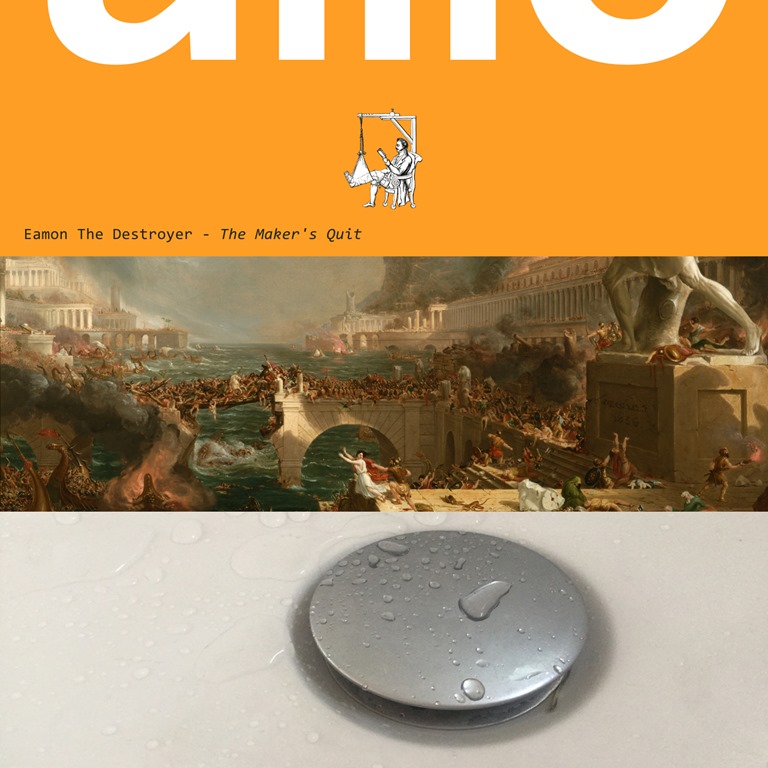
The thing with Eamon the Destroyer is that you never know what you’re going to get. The Maker’s Quit is different again from We’ll Be Piranhas, which in turn was quite unlike Small Blue Car (which remains a personal favourite, even if it does make me feel impossibly heavy on the inside). If We’ll be Piranhas marked a step forward in terms of experimentalism and optimism, The Maker’s Quit sees a greater emphasis on songwriting and structure – but don’t for a second think it’s in any way straightforward, and that the experimentalism has taken a back seat – it’s still very much a copilot here, and with the accent on the mentalism.

Here, the title track commences what is an incredibly varied set with a song that has the theatricality of Alex Harvey crossed with 1990s Leonard Cohen, before ‘Silverback’ confounds all expectation by bringing some shuffling funk-infused jazziness. In contrast to the fairly minimal arrangements common to previous ETD releases, this is pretty busy, then is settles into a mellow groove that’s almost loungey – bar the mid-section, which is rent with a protracted burst of extraneous sound. It’s almost as if he purposefully weaves around the line between genius and self-sabotage simply to tests us as listeners. There are some nice, light, poppy moments on here, and – albeit fleetingly – some captivating grooves. But it wouldn’t be Eamon the Destroyer without a huge helping of straight-up weird shit mashups, and The Maker’s Quit brings the lot, from frenzied jazz and post-grunge, wonky vaudeville waltzes and whistling, via electropop and slices of pan-culturally inspired melody.

More often than not, the verses and choruses are so contrasting as to seem to have been spliced from different songs – that’s when there are verses and choruses. ‘Three Wheels’ is a veritable patchwork, which compresses segments of what sounds like half a dozen songs into five minutes as it spins from grandiose heavy country dirgery by way of an intro, which even hints vaguely at recent Swans, before swerving into Europop with a hint of Sparks, through a off-kilter but gentle soundscaping that slides into laid-back salsa before winding up with a segment of jaunty indie rock. But rather than feel like an identity crisis, the effect is more that of a multi-faceted artist showing all his facets simultaneously. It’s hard to keep up, but one can only imagine what it must be like to live in his head.

The lyrics are equally fragmented, between stream of conscious and cut-ups, producing a Burroughsian, dream-like quality. This snippet from ‘The Maker’s Quit’ exemplary: ‘Saturn kid – spins and reels – in a city / Little Feet – lost in a wave – out to sea / A grandmother – nods – to a space in the crowd / Cap gun assassin – emerges – from a conjurers cloud…’ Beyond oceans and waves, it’s impossible to pin down any notion of themes or meanings. The images float up and fade out instantaneously.

‘The Ocean’ begins dramatically, a swelling, surging drone that halts abruptly, yielding to one of the most typically Eamon the Destroyer passages – lo-fi folktronica with a low croon reminiscent of Mark Lanegan, which slowly tilts its face upwards from scuffed boot-tips towards the sun…. and then all mayhem happens in a brief but explosive interlude, and your head’s suddenly spinning because wherethehellhasthiscomefrom? It’s this wild unpredictability and unapologetic perversity which is – strange to say – a substantial part of the appeal of Eamon the Destroyer.

When Eamon the Destroyer goes downtempo, as on the mournful, string-soaked introductory segment of ‘Captive’, you can actually feel your heart growing heavier by the bar, but then it twists onto some semi-ambient avant-jazz, and the sensation transitions to bewilderment.

The final track, ‘The Buffalo Sings’, is a twelve-minute behemoth is s slow, surging lo-fi electronic exploration. Face the strange? It embraces it, hard, then absorbs it by ghostly osmosis. If ever a song was less country, less ‘Buffalo’… maybe some of the western themed electrogoth songs by James Ray and the Performance are on a par on that score, but this wanders into a sonic desert without even a hat for protection from the punishing sun, and slowly, everything melts in the heat. Circuits bend and warp, and the weirdness rises like a heat haze… and it’s wonderful to be immersed in a work which celebrates creative freedom with no sense of constraint or obligation.

On reflection, with Eamon the Destroyer, you know exactly what you’re going to get: visionary hybridity, moments of aching sadness and fractured beauty, shards of melancholic memory , unbridled inventiveness and fevered creativity, and music like nothing anyone else is making. In a world where meaning seems to have all but evaporated and it’s increasingly difficult to make sense of any of it, The Maker’s Quit feels like a fitting soundtrack. It exists purely in its own space, and it’s the perfect space to escape to in these most dismal of times.

AA

Eamon-TD-3_Cover

Bearsuit Records – 31st January 2025

Christopher Nosnibor

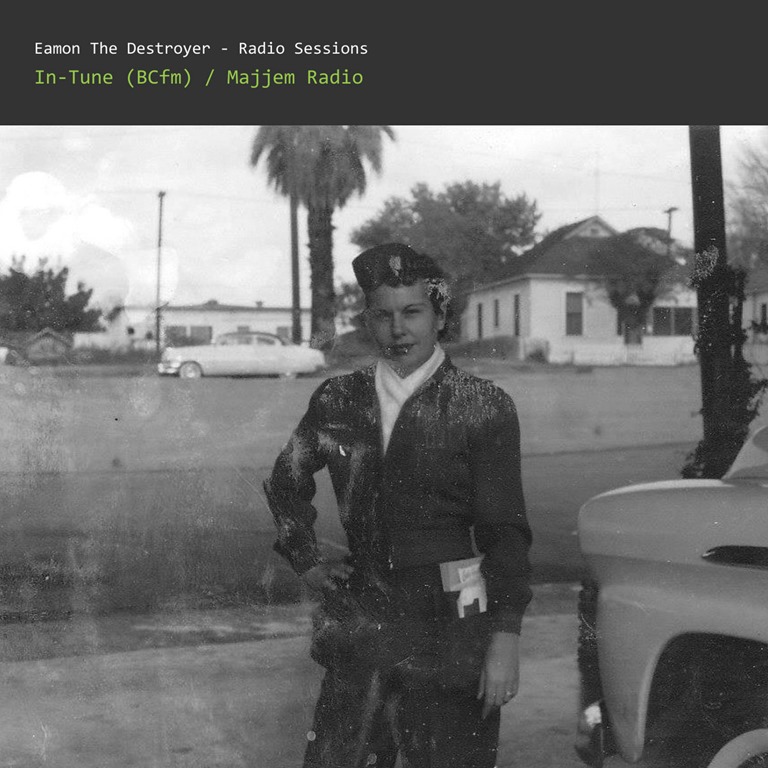
It’s been a while since we’ve heard form Bearsuit Records, and from Eamon The Destroyer, too, with Harold Nono’s The Death of Barra slipping out quietly in October, and the last ETD release being the Alternate Piranhas EP last April. Ok, so it’s not so long in the scheme of things, but in recent months, while the world has spun into new realms of insanity, the wonderful wibbly weirdness this label specialises in has been sorely missed.

As the factual, functional title suggests, this release features tracks recorded for radio sessions, recorded for In-Tune (BCfm 93.2 FM), broadcast in September of 2024, and Majjem Radio, broadcast at the tail end of the year. And if another release with no new material seems like overkill, since the last ETD was a set of remixes from second album We’ll Be Piranhas, which came out in October 2023, then it’s pleasing to be able to report that, no, while this may well be something of a stop-gap release, it’s a worthy addition to the catalogue. It not only provides some insight into what one may call the ‘promo cycle’ of an album, particularly for a DIY act, but also casts a different light on the songs, being stripped-back acoustic guitar-based renditions of the songs – which are a 50/50 split of choice cuts from We’ll Be Piranhas and its predecessor, A Small Blue Car.

The original versions may be sparse and lo-fi in their production, but that production, and the prominence of droning, wheezing synths is what really defines them. That’s not to detract from the songwriting or performance at all, but the downtempo, downcast mood is heightened significantly by the execution, and that thick, hazy sound is integral to that.

However, hearing these songs played straight, as it were, is something of a revelation. The parts are essentially unchanged, but apart from a bit of reverb, and some vocal layering, these takes are more live-sounding, as could be performed by one man with a guitar and a pedalboard or synth with a few loops.

A far shorter rendition of ‘Underscoring the Blues’ still packs in the magnificent oddness that encapsulates everything that’s special about both Eamon and the whole Bearsuit aesthetic, suddenly spinning off from a sparse picked folksy guitar into a fantastical fairground of whirling, waltzing organ.

I’ve written previously that Eamon The Destroyer’s songs have a certain quality which casts a long, bleak shadow of lugubriousness over the soul, and how the effect is, for me, at least, similar to listening to Leonard Cohen’s Songs of Love and Hate. It’s an outstanding album, but it’s dark in a way which goes beyond the crushing lyrics of ‘Avalanche’, ‘Dress Rehearsal Rag’, and ‘Famous Blue Raincoat’. What I’m trying to articulate here is that there’s a special place for sad songs, songs which have a mood-altering effect, and this is Eamon The Destroyer’s strength. The lyrics are largely abstract and often difficult to decipher, but the feel is inescapable.

The ‘Avalanche’ on here, which first appeared on A Small Blue Car isn’t a cover of the Leonard Cohen song, but the stark atmosphere hits just as hard. It’s all about the minor chords, and the monotone croon. ETD adds layers of extraneous noise way down in the mix which adds tension to an already tense soundtrack.

Not because it sounds in any way similar, but ‘The Choirmaster’ calls to mind Chris Rea’s ‘On the Beach’ with its wistful tones and twisted hints of flamenco, and wraps the release with a vibe that’s almost uptempo, despite the heavy undercurrents of melancholy.

It’s the end of one of the longest, darkest, bleakest Januaries in living memory: we’ve been battered by storms, by global politics, by relentlessly traumatic news of war, of.. of… you name it. If you’re looking for a lift, steer clear of Eamon the Destroyer. But The Radio Sessions is nevertheless essential listening, showcasing the quality of the songwriting which lies beneath that fuzzing haze and reverb, and remember: it’s ok not to be ok.

AA

a4026067221_10

Bearsuit Records – 31st May 2024

Christopher Nosnibor

There was a time – not so long ago – when I would come home from work and struggle to nudge the front door open with my shoulder for the mountain of CDs that had been dropped through my letterbox, along with the occasional ‘sorry we missed you’ card telling me I had a parcel at the depot awaiting collection or to arrange redelivery, and more often than not it would be some vinyl, and all of it promo material for review. I had a box – which was initially a shoebox, but later replaced with something larger – which was my ‘to-review’ box, after the pile kept falling over once it reached an unsustainable height. It was a storage nightmare, and I still have boxes containing quite literally thousands of promo CDs with press releases folded up with them, in boxes in the walk-in cupboard and the end of my office, which is, in truth, too stuffed with boxes of CDs to squeeze more than a toe into, rather than actually walk in.

Working in an office as I did then – rather than at home – I would take a bundle of CDs in a jiffy in my bag, and sit and listen to them as I worked. It beat enduring the often moronic drone of the people around me, and I’d tap out notes which I’d email home to myself to flesh out into full reviews in the evening.

My working method has changed rather since then, and while still working the dayjob, I’ve barely set foot in an office other than the one in the back bedroom of my house since lockdown. I haven’t received stacks of CDs in the post for a similar length of time, if not longer. For all of practical issues around the stacks of CDs, I do kinda miss it, and this is one of the reasons I always get a thrill at the arrival of a disc in the mail from Dave Hillary, who runs Bearsuit Records. The other, and not insignificant reason I always get a thrill at the arrival of a disc in the mail from Dave is that I’m eager to discover what mad genius work the label’s releasing next. I enjoy slipping the disc in the external CD drive I have attached to my laptop and soaking in the strangeness that spills from my speakers: I’m never disappointed.

I love the fact that I still get CDs in the mail, with promo cards and handwritten notes and so on, from Bearsuit, not just because of the joy of the physicality and the personal touch, but because it’s emblematic of the label as an entity. It does what it does, regardless of whatever else is happening, and it releases music the likes of which you simply won’t find anywhere else.

Eamon the Destroyer is a classic case in point. Another typically enigmatic artist in the Bearsuit tradition, Eamon the Destroyer has enjoyed a great run of releases to date. Debut album A Small Blue Car was a work of fuzzy, minimalist , downtempo brilliance. A sad, introspective work, it was unexpectedly touching for something so overtly odd, and follow-up We’ll Be Piranhas pushed further into forging songs that straddled the dreamlike and the nightmarish, a disorientating, discombobulating work that delved deep into the psyche in a way that felt like invisible fingers creeping inside the cranium and directly massaging the brain.

And now we come to the more or less obligatory counterpart release. Instead of the standard and expected remix EP, Alternative Piranhas gives us outtakes alternative takes of tracks from the album. A cynical voice might ask why they didn’t make the album cut, but there are myriad valid reasons: an album need to cohere and sometimes even the best tunes don’t fit with the flow, and similarly, the mood of one take or mix may in fact be better objectively, but not quite sit with the context.

And so it is with the five tracks here. All five appeared on We’ll Be Piranhas. While exactly the same length as its album counterpart, ‘A Pewter Wolf’ presents a quite different mix: the organ is much more boomy, more ‘churchy’ than on the album version, while the guitar sounds, almost buried on the album blurred and hazed out low in the mix, are more up-front and gritty here.

The version of ‘Rope’ on Alternate Piranhas seems to be in a different key, and is much grainer, murkier and messier than the more polished album take, and it’s more abrasive, more aggressive, with the vocals more up-front, and the result is that I found myself hearing thee song anew and soaking in the anger which permeates it, less obviously on the other version, tempered by the more mellow mix.

Overall, the versions on Alternate Piranhas are rougher, less ‘produced’, and it’s not difficult to discern why the versions chosen for the album were the ones they were. The album worked as a cohesive set, with an even, smoothed-out sound – well, in context – but Alternative Piranhas provides an insight into the process, which is never more apparent than on ‘The Choirmaster’. It’s not radically different… but it is different, while the alternative take of ‘My Stars’ is half the length of thee album and feels like a sketched-out demo. But again, it possesses qualities absent from the album version, just as the album version has elements which are absent here, including another five minutes of sound.

Alternate Piranhas feels more overtly rock than its progenitor, and perhaps it is, but above all, it’s a source of enjoyment to revisit these songs from a different perspective.

AA

a4099667252_10

Bearsuit Records – 31st October 2023

Christopher Nosnibor

Just a little over two years since the idiosyncratically-monikered Eamon the Destroyer arrived with his debut single ‘My Drive’, he’s gone from strength to strength – to the extent that his output has erupted, Godzilla-like, expanding and flexing immense musical muscles. Sort of. Because Eamon the Destroyer’s work is, despite the connotations of a raging beast laying waste to entire civilizations with a single roar, incredibly intimate, with tension building from the introspective minimalism of the songs. With the release of the debut album A Small Blue Car and a remix / reworking of said album landing in quick succession, the arrival of We’ll be Piranhas seems swift.

We’ll be Piranhas finds Eamon the Destroyer (any truncation of the name feels wrong: Eamon too casual and to cuddly; the Destroyer simply unrepresentative) pushing the parameters of experimentalism, conjuring the sonic equivalent of the surreal oddness of the album’s cover, which looks like a three-way split-screen of medievalism, Anglo-Saxon fable, and a deranged reimagining of some of Captain Cook’s sketches of newly-discovered species with what appears to be a polar bear resting its chin on a narwhal, while gulls look on and rabbits look away. Or something.

‘The Choirmaster’ is both droney and playful, quirky, and mellow, until it spins off its axis and into a whole other world of spiralling prog and doodling daftness. It certainly packs a lot into five strange and disorientating minutes. Single ‘Rope’ is glitchy, awkward, and feels like it doesn’t belong to anything, and suddenly, it lurches too life with a loping rhythm and fuzzy synths which provide a backdrop to tense, almost strangled vocals, hushed, strained, and gravelly. Not for the first time, I long for a lyric sheet as the scratchy vocals render the words difficult to decipher, but this is perhaps his most vitriolic piece to date; more often than not, Eamon the Destroyer croaks melancholy: here, there’s a fire, and it carried through into the wheezing clatter of ‘Sonny Said’. There’s a moment around the mid-point I get a pang of Seventeen Seconds-era Cure. But it’s fleeting, and nothing is pinpointable, particularly in this swirling maelstrom of a piece.

When it comes to Bearsuit releases, I often find myself using and reusing the word ‘weird’ as a descriptor – mostly because it’s the thing that really defines the label. While the likes of Harrold Nono spin Eastern hues into spirals and spin drifts of experimentalism, We’ll be Piranhas finds ETD really going all-out to try stuff. And the result is brain-bending.

‘Underscoring the Blues’ somehow manages to melt fairground oddness with The Doors and prog and, well, all sorts, to blur into a curious cocktail.

It’s difficult – if not impossible –to listen to this album and feel ‘normal’. It feels like the soundtrack to a dream: one of those weird dreams where familiar places aren’t quite right – the walls of familiar rooms are different, doors and windows are in the wrong place, and continually moving, and you look to make your way out and suddenly the door has vanished. The floor is moving and familiar faces warp and acquire new, alien aspects. You don’t know who you are or what’s going on, but you know that this isn’t what you expected as the sights and sounds of the familiar melt into one another. You feel your sense of time and space begin to crumble. Where am I? What even is this?

It feels like isolation. It feels like… like… like numbness, confusion. You feel your body tense, the backs of the legs growing taut. The title tracks sends everything spinning and whirling every whichway, and there is no easy way to assimilate this, and the same is true of the woozy glitchings of the desolate ‘A Call is Coming’. Ignore the call; decline it. Look inwards. Woah, something isn’t quite right.

We’ll be Piranhas leaves you feeling detached, askance, apart, removed, not quite right. It’s an introspective work delivered from on the cusp. On the cusp of what? It’s hard to say. Perhaps it’s best not to.

AA

a3572746252_10

Bearsuit Records – 21st October 2022

Christopher Nosnibor

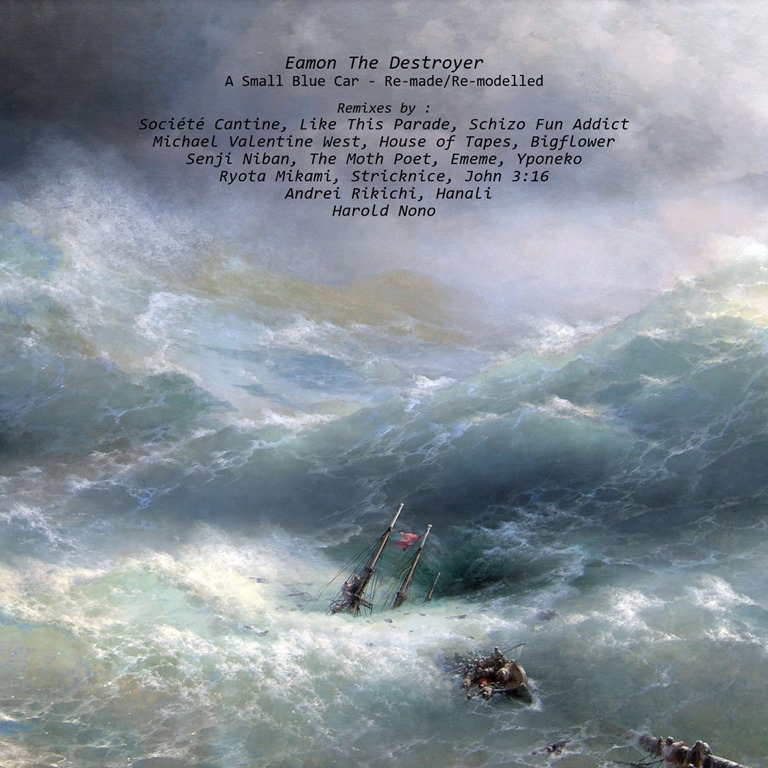
To recap on a long and often retold tale of mine: I love weird shit, but I’m not quite so mad keen on remixes – unless they’re inventive and interesting. So what to make of a remix album of Eamon the Destroyer’s A Small Blue Car?

When I reviewed the album on its release back in November of last year – which barely feels like three months ago, let Alone the best part of a year – I was perhaps ambiguous in my appreciation, describing it as ‘downbeat’, gloomy’, and ‘soporific’. It is very much all of these things, but these are reasons to appreciate this understated collection of songs, with their lo-fi bedroom production style being integral to the Eamon the Destroyer listening experience as he rasps away darkly to aa droning backdrop in a crackle of distortion

One frequent niggle with remix sets is the repetition, but here, only a handful of tracks appear twice, with three interpretations of ‘My Drive’, which is fair enough having been the lead single, and dispersed among sixteen tracks in total, it doesn’t feel like overkill.

The reimaginations of the original songs certainly capture their spirit and essence, from the stop/start glitchy gloopiness of the wandering Like this Parade remix of ‘Nothing Like Anything’ to the longer, more abstract reworkings, like the six-and-a-half-minute festival or reverb and cavernous slow-mo, downturned echo that is Société Cantine remix of ‘Tomahjawk Den’ that’s as experimental as you like and quite disturbing in places, to Michael Valentine West’s seven minute spin on ‘My Drive’, A Small Blue Car – Re-Made / Remodelled is the definition of eclecticism. There’s low-level pulsating electronica and swerves into electronic chamber pop, against ambient electro and scraping industrial noise.

Yponeko brings swirling synths and grating distortion together in a drowning space-rock drift, while MVW deconstructs ‘My Drive’ to a junkyard of spare parts that’s somehow elegant and delicate as well as a wheezing, droning hum that wheezes and groans.

There are no obvious rehashings here, no lazy no-effort remixes that do the usual thing of whacking a booming beat behind the original. In fact, there are absolutely no stonking beats, techno or disco remixes here: these are all most sensitive to the original intent. Sometimes there are beats – as on the thrumming Ememe remix of ‘Avalanche’, but it’s a stuttering wall of drilling noise, ploughing into a mess of glitching loops, a mangled cut-up collage of sound – and often there are not: The Moth Poet’s take on ‘Slow Motion Fade’ is nightmarishly dark, a whirling churn of sound, which drifts into sepulchral opera at the end

Across the course of the album, there’s a lot of cut-and-paste splicing galore, resulting in an ever-shifting sonic collage, and John 3:16 brings gloomy, stark industrial to ‘Humanity id Coming’. House of Tapes turn ‘My Drive’ into a throbbing grunge beast, with additional helium. It’s hard to imagine anything further removed from the original, and that includes Halai’s twisted tribal techno take on the same song.

Alongside one another, it should all amount to a horrible mess, but is, in fact, an absolute triumph, because this is exactly how it should be: Eamon the Destroyer’s original work was a kaleidoscope of darkly disorientating oddity, and this revisitation is more of the same, only different. It’s unlikely to land any spins in nightclubs across the land, and even less likely to find any of the tracks landing Radio 1 playlisting, and it’s even unlikely to win many new fans – but then again, Eamon’s acquired some admirably influential fans, and moreover, that’s not really the ambition for any artist releasing work through Bearsuit. And it’s so refreshing when so much emphasis is placed on not just sakes, but airplay, streams on Spotify, and likes and followers on various platforms, that there are still those who value artistic freedom and exploration above all else.

A Small Blue Car – Re-Made / Remodelled is a source of pleasure, not only because it’s genuinely interesting, but simply because it exists.

AA

a0817555736_10

Bearsuit Records – 12th November 2021

Christopher Nosnibor

It’s unusual to open an album with a B-side from the lead single, but there’s nothing usual about Eamon the Destroyer or Bearsuit Records, and the scratchy soporific drone and distorted / filtered vocals of ‘Silver Shadow’ – which reference the ‘small blue car’ to which the album owes its name – makes for a worthy introduction by means of introverted minimalism. It’s largely representative of an album that’s slow sparse, minimal and somewhat lugubrious.

I take the nom de guerre Eamon the Destroyer ironically. That may be wrong, it may be some unpleasant prejudice, and if so, I do apologise. This isn’t a PC matter or issue. But names come with certain associations, and the connotations of Eamon aren’t particularly warlord, at least to my mind. No diss to any Eamons, but the name is about as warlord as Gavin, Kevin, or Craig. No doubt there are some brutal twats by the name of Kevin, but, well, y’know, it doesn’t evince fear. The concept of ‘the destroyer’ is one of something harsh, brutal, obliterative, too, but that also isn’t the case here. Consider Ah Puch the Destroyer, Mayan god of death and disaster whose coming would mark the end of days. There is nothing explosive or devastating about A Small Blue Car – it is not a violent sonic blast of earth-shattering, annihilative proportions, yet it does, strangely, evoke a sense of near-finality. There is an all-pervading sadness that hangs over the album’s entirety, a sadness that’s slow-creeping and heavy, like a weight that pulls you down, bending your back with the effort

‘Humanity is Coming’ is downbeat, gloomy, and things get particularly dark and dense on the short instrumental ‘The Conjuring Stops’, with a heavily phased synth yielding a pulsating throb in the style of Suicide. ‘The Avalanche’ also brings some weight, with lots of granular sounds and bolds bursts of sweeping synths in the choruses that contrast with the woozy drone and is perhaps how Leonard Cohen might have sounded in the early years of his career if he’s chosen Moods instead of an acoustic guitar. The end result, musically, is like Stereolab on Ketamine.

The slow rasp of single cut ‘My Drive’, with its whistle of feedback and detuned radio in the distance while the picked guitar – spacious and delicate – curls like smoke into the darkness, and it piles on the melancholy.

‘Uledaro’ follows, a dolorous jumble of discord. ‘Nothing Like Anything’ is conspicuous by its near-cheeriness ‘wake up / the sun is out / we’re almost home’, Eamon intones in a rare glimmer of optimism. There’s whistling and levity, and it’s almost, almost a pop song. But of course, it’s not. And perhaps it’s more me feeling autumnal, but the happiness only accentuates the sadness, as if the jollity is a mask to sorrow so inexplicably deep that it has to be covered up. The nights are dark, the world feels a very long way off and a long time ago. It’s time to hibernate, with A Small Blue Car for company.

AA

a2830016479_10

Bearsuit Records – 25th June 2021

Christopher Nosnibor

Home of all things odd from Edinburgh and Japan, Bearsuit Records, has a new signing, in the form of Edinburgh-based singer/songwriter Eamon the Destroyer. Eamon also records as Annie & The Station Orchestra, and is one half of Edinburgh purveyors of noise Ageing Children, both of whom have received mentions here. If his name has the hallmarks of a mythical war deity or some evil comic book character, his music is altogether less megalomaniacally threatening. The press blub describes it as ‘lo-fi miserablism with a side order of noise / mumbling & whispering – or something’ – and on hearing these two tracks, which serve as a lead-in to Eamon’s debut album, A Small Blue Car – this vagueness makes perfect sense. And, of course, like most Bearsuit releases, it’s about the only thing that does.

It’s rather welcome to see a release that resembles a conventional A-side / B-side single release in 2021, and what’s noteworthy about this one is that the two tracks are actually quite similar, sonically and stylistically, leaving no confusion as to what the Destroyer’s sound is.

Against a minimalist backdrop of quite country guitars, the Destroyer croaks flatly about, well, what, I’m not entirely sure – every line seems to turn on a contradiction or some bathetic construction, like ‘Nobody knows it / well nobody ought to’. Instrumentally, it’s sparse and scratchy, and the vocals sound like they’re coming from a CB radio that’s only just tuned to the edge of the channel. But in the mix there’s a scrape and chatter of extraneous background noise and some cronky feedback, and around the mid-point of ‘My Drive’ it takes a massive left turn into altogether louder territory.

The whole vibe is downbeat and melancholy, and driving emerges as a theme in ‘Silver Shadow’, alongside some vague but wistful images that drift around in a wash of sad, Cure-esque synth and a crashing tide of distortion. It’s more mood-affecting than you would likely expect, and while very much appreciating the unusual mix, it left me feeling downcast and slightly sad, which is a clear indication that either I’m heading for a mood slump, or there’s more craftsmanship to Eamon’s songs than the surface suggests.

AA

a2426643261_16