Posts Tagged ‘Dystopia’

German electro-industrial band, NEON INSECT has just unveiled their ambitious, & highly-anticipated album, LIBERTY FLOWERS.

LIBERTY FLOWERS sheds some light into different aspects of life in New Moscow, in times where unrest slowly settles in, even though everything is done to oppress its citizens. The ever-recurring concept of NEON INSECT’s music features the only habitable place in North America. It’s a dystopian version of New York in an alternative timeline, serving as a experimental playground for implants, cyborgs and indoctrination.

With this album, NEON INSECT also takes you on a trip sonically, with noises sounding like they’ve been taken straight from a dystopian nightclub, combined with analogue madness. The goal with this record was to rephrase the grit of old-school, early 90s electronic-industrial music, while not shying away to cross some boundaries. LIBERTY FLOWERS is a love letter to this era of music.

LIBERTY FLOWERS is currently available on CD and cassette formats as well as Bandcamp, digitally. It will be available on most major streaming services on August 30th.

Watch the video for ‘There is Beauty in Noise’ here:

NEON INSECT (Nils Sinatsch) is a dystopian storyteller, telling tales from New Moscow – New York in an alternative reality, where the cold war went hot and the soviets won.
As a normal citizen somewhere in Germany by day and a rebel by night, NEON INSECT fetches the stories through the cyber web from his contacts in New Moscow. – he only habitable city in a nuked America, where cyborgs rule the streets, where lower Manhattan is a prison and the last bastion of the local rebellion.

The stories are told in an old-school industrial fashion, the sound of the cold war, enhanced with stutters and glitches, the sound of the cyber web – a soundtrack George Orwell would approve of.

Bring Your Own Gasmask.

e66ddad5-9c6d-e914-70d2-c108fc4f03d5

Transcending Obscurity Records – 19th January 2024

Christopher Nosnibor

Every day, every week, the world descends further into a pit of shit of human making. I feel as if I’m continually circling back to this same premise to frame almost every discussion, not just when writing about music, but any conversation I have about pretty much anything. The sad fact is that there is simply no escaping the fact that it’s not just me personally, but the whole of our existence which hangs under a cloud of gloom.

Only this afternoon, my mother texted me in her usual cack-handed typo-filled fashion bemoaning the succession of storms which has battered the country this week, commenting on how she can’t get over it and asking what we’ve done to deserve such crap weather. I simply couldn’t face pointing out that things have been heading in a bad direction since the industrial revolution and that we’re pretty much driven off a cliff at full speed in the last fifty years thanks to capitalism, and what we’ve done to deserve is fucked the planet with greed. She probably wasn’t really looking for an explanation, and likely wouldn’t have appreciated or even understood if I’d given one. Meanwhile, wars are raging around the globe, and escalating on a daily basis. And because we don’t have quite enough death and destruction, the state of Alabama has seen fit to pilot slow and painful executions by nitrogen gas. What the fuck is wrong with the world? And is it any wonder we’re experiencing a massive mental health crisis?

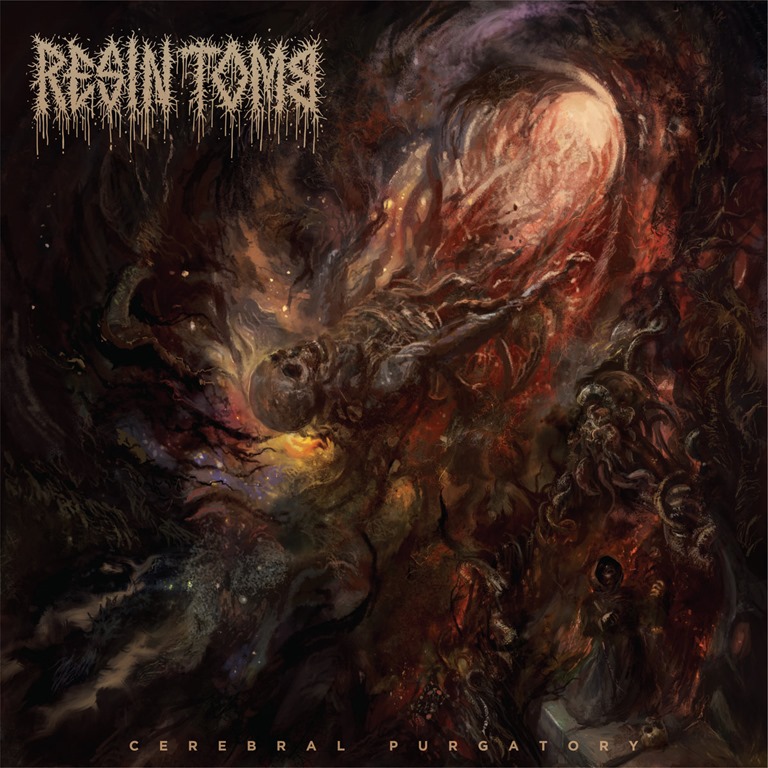
In the face of all of this, you do what you can to get by, and while many will advocate meditation and calming music as an alternative, or supplement, to medication, catharsis can also provide a much-needed means of release. And after releasing a couple of well-received EPs, Australian band Resin Tomb have dropped their debut album, Cerebral Purgatory. It’s a title which pretty much encapsulates the condition of living under the conditions I’ve outlined above – and purgatory is the word, because there is no escape and it feels neverending. The first track, ‘Dysphoria’ perfectly articulates the existential anguish of life in these troubled times. Again, the title is spot on: I frequently see – and have likely made my own – mentions of how we are seemingly living in an amalgamation of every dystopia ever imagined. But what is the psychological response to this? Dysphoria: ‘a profound state of unease or dissatisfaction’, the antonym of euphoria. Much as I do sometimes feel like cheering humanity to the finish line in the race toward self-extinction, for the most part, I feel not simply gloomy or pessimistic, but a deep sense of anguish and anxiety, not to mention powerlessness. And I am by no means alone – although it’s more apparent from time spent on line than conversations with friends, family, or colleagues, perhaps because people tend to shy away from heavy topics for the most part, and instead prefer to shoot the breeze about the weather. But ‘Dysphoria’ is a brief, brutal blast, gnarly mess of difficult emotions articulated through the medium of full-throttle guitar noise and vocals spat venomously in a powerful purge.

As their bio puts it, ‘They’ve forged their own sound which is a remarkably cohesive mix of dissonant death metal, gravelly grind and somehow even thick, blackened sludge.’ And yes, yes they have. And it’s a dense, powerful, racket they blast out. There’s little point in drawing on references or comparisons: there are simply too many, and they all tumble over one another in this cacophony of monstrous metal noise, a flaming tempest of gut-ripping heaviosity.

‘Flesh Brock’ packs tempo changes and transitions galore, packing more into three minutes and eight seconds than seems feasible. And in packing it all in, the density reaches a critical mass which hits with the force of an atomic blast.

Four minutes and twenty seems to be Resin Tomb’s sweet spot, with four of the album’s eight tracks clocking in at precisely that. And when they do condense so much energy and weight into every second, four minutes and twenty seconds affords a lot of room.

The title track comes on with hunts of Melvins, a mess of overloading guitars and a bass so fucking nasty and so forceful it could shatter bones, melding to deliver a colossal bastard of a riff. ‘Human Confetti’ comes on heavier still, pounding away with a pulverising force and playing with elements of discord and dissonance in the picked guitar line – and while the lyrics may be indecipherable, the title alone conjures a gruesome image.

If ‘Purge Fluid’ and ‘Concrete Crypt’ again convey their fundamental essences in the titles alone – and these are absolutely brutal, punishing pieces – the album’s final track, ‘Putrefaction’ absolutely towers over the murky swamp of black metal and grindcore with a dramatic, nagging picked guitar and a cranium-crushing wall of noise. Holy fuck. It hurts. And good. Angry is good, and better to channel that anger into art than knifing people in town on a Friday night. That’s one for another time, perhaps. At this particular moment, we have this – an album so heavy, so violent, it’s an exorcism.

AA

719914

Christopher Nosnibor

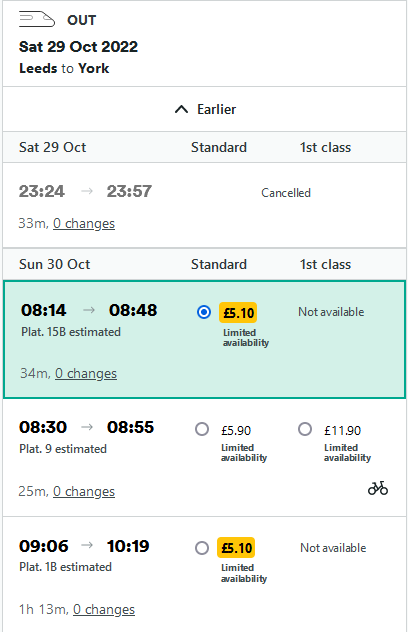
I am not happy. I was supposed to be at a gig in Sheffield this evening – a gig that had super-early doors – 18:30 – and a super—early finish (22:00). When booking the ticket for the gig, I checked the trains, and there was a 23:05 that got me home some time a little after midnight. Now, the last train home is at 21:22. I could split the journey, and make the 22:25 train to Doncaster, arriving into Doncaster at 22:49. But it only connects with the 23:50 out, which thanks to a lengthy wait in the arse-end of nowhere, takes 9 hours and 58 minutes, arriving into York at 08:48. Getting a train to Leeds is marginally, better, but not really: the sole train that goes via Leeds instead of Doncaster arrives in Leeds at 23:27, missing the 23:25 by 2 minutes, and so getting into York at, or there’s the 23:05 from Sheffield to Doncaster, which then connects to the 23:50 to Leeds, which, having missed the cancelled 23:24 means waiting for the first train out on Sunday at 08:14. No thanks.

This is not a criticism of striking rail staff: there are no strikes involved here. The reduced timetables are companies, heavily subsidised by the government, cutting services to maintain maximum profit. When I say cutting services, it’s not really a service when you can’t get anywhere when you need to.

They may not have sufficient staff to run the services, but why is that? The mantra that ‘no-one wants to work anymore’ is quite simply bollocks. It’s just that no-one wants to work to the detriment of their health and wellbeing, no-one wants to work two or three jobs to then have to still find time between shifts to queue at the local foodbank. No-one wants to work themselves to an early grave without spending any time with their families. People work to live, they don’t live to work, unless they’re deranged.

At a time when the economy is on its knees, the government claim to be supporting both people and businesses. But what gig venues need is for people from beyond the immediate catchment to be able to attend live music shows.

Back in 2014, I published a collection of essays entitled The Changing Face of Consumerism, which focused largely on the demise of the high-street record store and the like. Things felt pretty bleak then, but these were positively halcyon times compared to now, where we’re living in an amalgamation of every dystopian future ever written or dramatized.

Time was when travel was considered a luxury – but that related to air travel, not domestic rail. It simply should not cost more to travel domestically than to travel overseas. And in looking to book tickets for non-existent return to tickets from York to Sheffield, I noticed the price was around £28. Given that it’s approximately 50 miles between the two cities, that’s around 25p a mile, around 5p per mile more than the average vehicle, be it petrol or diesel. It wasn’t so long that it was perhaps £17. Similarly, pre-pandemic, a return to Leeds was around £12. Not it’s about £18. This cannot all be put down to rising fuel prices, and however much the government insist it’s all down to ‘Putin’s war on Ukraine;, this was escalating long before the tensions did.

But with crippling inflation and real-time wages crashing, like many people, I don’t have the same disposable income I had before, and so I choose the events I attend with a no small amount of consideration. To now not be able to attend because it’s simply not possible to travel isn’t only frustrating for me: the rail providers have lost a ticket sale, and the music venue has lost the sale of maybe three or four pints, and the band potentially, say a T-shirt or CD sale, in a climate when bands only survive by the skin of their teeth by selling merchandise on tour because everyone’s streaming music nowadays and the only people who make off that are the streaming platforms and major labels.

It’s a domino sequence, and what should be clear from this real-life example is that by cutting public services, or running what should be public services privately, for profit and the benefit of shareholders, is that the people who actually require the service are the ones who suffer, but it also has a knock-on effect to many other areas of the economy. The venue sells fewer pints, so they buy in less beer; the breweries sales decline, especially in the face of rising production costs and small breweries fold, large ones cut staff to reduce costs against declining sales. The staff who’ve been laid off don’t have an income, let alone disposable income to go to gigs, to go to pubs and bars, to go to coffee shops, to have meals out.

We no longer manufacture or have any industry to speak of: we’re dependent on people dining and drinking out, on going to the cinema, on going bowling, attending sporting events, on watching live music.

So when these tertiary industries are crushed, so is the nation as a whole, because there is nothing else. How does this stack up against the aim for growth and a high-skilled, high salary economy? This is, of course, a rhetorical question.

Call it trickle-down economics, call it what you like: the fact is that giving money to the rich, be it by tax breaks, or allowing major corporations to siphon off immense profits to divvy out to shareholders and top-flight executives does absolutely nothing for the majority of people, be they working people, laid-off people, or zero-hours contracts people who are statistically in work but in reality earning nothing.

One can’t help but feel that capitalism is slowly suffocating itself, and at an accelerating rate. Before long, the top 5% will own everything while the rest are dying in the gutter, at which point the elite will have no-one left to milk anything from. But until that day, they’re just going to keep on draining every last drop.

Fuck’s sake. I just wanted a night off with beer and live music over the county border.

image

Front & Follow and the Gated Canal Community – 25th June 2021

Christopher Nosnibor

Independent cassette label Front & Follow disbanded a bit back, some time before the pandemic hit. Said pandemic changed a lot of things for a lot of people, and certainly not just those immediately affected by the virus itself, through either contracting it themselves or friends or family. This is, after all the first time in history where governments have quarantined the healthy, and even during the world wars, while artistic activity was curtailed, society did not completely grind to a halt for any sustained period of time.

Having un-mothballed the label in order to release a series of compilations under the title Isolation & Rejection, which gathered tracks submitted and rejected for compilations on other labels, showcasing not only a wealth of amazing material over the course of five releases, but also creating a sense of community a month the rejected during the isolation of lockdown (a simple but effective premise that was a different kind of novel from the one everyone was talking about on the news).

Then, the label fell dormant again – for a few months, before this, pitched as ‘One final final FINAL project from F&F’. It may be a statement akin to Kiss announcing another farewell tour, but I know I’m by no means the only one who’s happy about the arrival of another release on the label, whose exceptional knack for curation has been a distinguishing feature of a thoroughly outstanding catalogue, and this, their sixty-firth release is no exception.

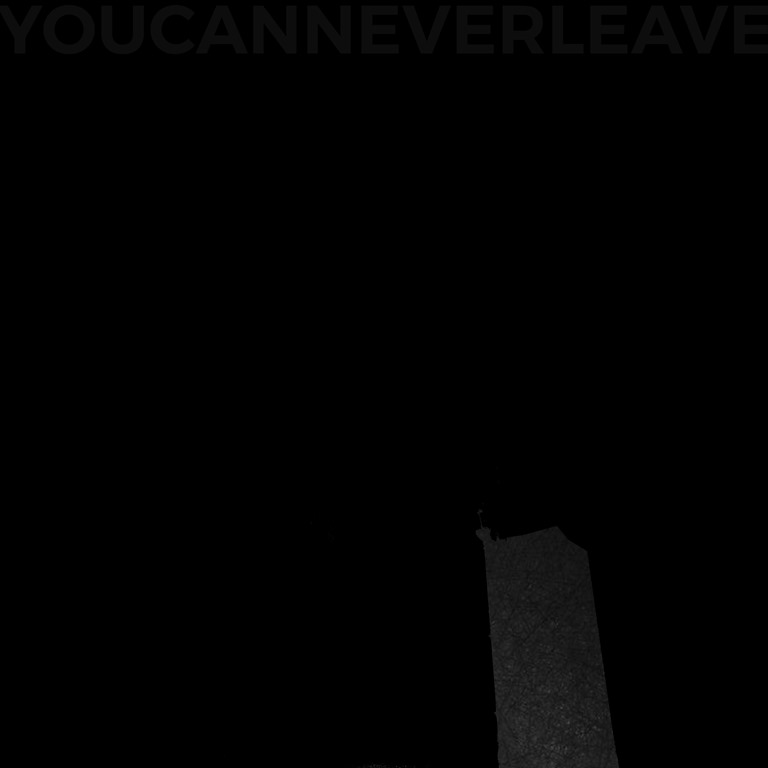
As label founder writes, ‘Another not planned but a nice thing happened so we went for it’. You Can Never Leave offers ‘alternative soundtracks to a luxury apartments advert’ taking its cue from an ad for Deansgate Square, Manchester, ‘comprising elegant spacious apartments across four carefully designed towers’ which ‘delivers a new level of city centre living’. With its slick visuals and sterile technoambient soundtrack, it’s a contemporary image of hell, JG Ballard’s High Rise for the 2020s. I’ve suggested previously that postmodernism is dead, and theorised that the post-postmodern age is marked by the end of irony. The fact this video exists, unironically, is surely proof of my hypothesis.

For their sign-off, F&F have assembled an immense thirty-one artists, many of who have featured on previous releases, including Field Lines Cartographer, Kieper Widow, and Polypores.

So, all of the tracks are around the 2:15-2:20 mark, and are intended to be played simultaneously with the video, and it’s perhaps unsurprising that each presents a different perspective on dystopian horror, from the sterile dark ambience of Bone Music’s ‘Reality Will No Longer Burden You’ with it’s clipped, android voiceover, via the tense trance-inducing electronica of Field Lines Cartographer’s ‘Consume and Prosper’, which is an outstanding piece of marketing sloganeering that we can imagine being a part of the UK government’s post-lockdown reinvigoration promo push (it’s snappier than ‘Eat out to help out’, and is a succinct summary of the late capitalist agenda they’ve espoused over the last decade), and the eerie waves of aural otherness that drift through courtesy of Von Heuser who give us ‘Pass Through The Tear’.

F-Lithium’s take is a cold Kraftwekian analogue rumble that ripples and churns around the solar plexus, while Guerrilla Biscuits’ ‘Manchester, So Much to Answer For’ dismantles the city’s musical and architectural heritage in one fell swoop with its space-age bleepery. WELTALTER bring some pulverising black metal to the party, and its bleak, dingy gloom that pounds insistently paves the way for more gnarly darkness in the form of the industrial ambience of ‘The Assimilation’ by The Metamorphe. Acid Wilhelm’s ‘The Changing’ is particularly unsettling, as rolling piano gradually evolves into a dense rumble of thunder, with ghostly voices muttering, while the cut-up / found-sound collage of Her Majesty’s Coroner for Wirral’ also pursues a haunting vibe, with ‘Contemporary City Living’ sounding like ‘Carmina Burana’ performed by a spectral clamour wailing to break through from the other side. With ‘Find Your Epic’, Friends, Business Colleagues or Family present the most torturous two and a bit minutes going, a howling shriek of purgatorial pain during which every demon rises from the flames to wreak havoc for all eternity on the living.

As is typical for a F&F compilation, You Can Never Leave is eclectic and yet for all its stylistic divergencies, fits together very nicely indeed, and collectively create a document which presents a multifaceted aural interpretation of the next level of gentrified hell, spanning epic prog and industrial. Oftentimes, it’s spooky, unsettling, and the album presents a powerful and ultimately terrifying vision. But is it any more terrifying than the original promo clip? Probably not, no.

Here’s the video that inspired all of this….

Deansgate

As an aside, for the record, the project is not affiliated with Deansgate Square in any way – the video was our inspiration for this project, and for each artist’s soundtrack.

All sales from this release will go to Coffee4Craig, which provides vital support for Manchester’s homeless and people in crisis. Find out more here – coffee4craig.com.

AA

F&F065 - YOU CAN NEVER LEAVE - cover

generate and test – gt49 – 23rd October 2020

Christopher Nosnibor

I don’t even know what day it is most days. I’m vaguely keeping track of the months and weeks, but a mostly existing day-to-day. Turn on the laptop, check my calendar, dial into the meetings I’m booked into. It’s just mechanical, I’m not really living. I know it’s 2020, by virtue of the fact I don’t know much else: confusion reigns. Time’s meaning has evaporated over the last seven or eight months.

I was drawn by the title, as the two component parts both feel relevant. That may be a personal thing, it may be a more general thing. We’re living every moment of every dystopia ever written, ever filmed, ever imagined, and I’m deeply nostalgic for all things right now, ranging from human interaction to simply feeling as if I have a life. I know I’m not alone in being alone.

I’ve long had an acute sense of nostalgia, but loathe the way nostalgia has become an industry, capitalising in the way the ageing process rose-tints the past. Anniversary edition albums and movie reissues don’t only cash in on that sense of past times, but lock people into a cycle of nostalgia, provoking reminiscences of ‘the good old days.’ Admittedly, the future has never looked so barren and the past more appealing, but generally speaking… we always yearn for the past because things were simpler when we were younger and less burdened with responsibility and emotional baggage.

It looks like this release has been languishing in the vaults for a long time, if my reading of the liner notes is right, they state that this was ‘written, produced, performed, and recorded by Matthew Thomas 1997… mastered by Matthew Thomas 2020’ Apparently, ‘2020 demanded we revisit a 1990s vision of a dystopic future’ – and yes, maybe it did. Or maybe it didn’t. Do we need to be heaped with more dystopian anguish given the pain of living in the every day?

nostalgia:dystopia promises ‘four tracks of dystobeats, placing the human voice within a context of fractured systems’, and delivers something that may be something close, I don’t know. I’m not entirely sure what dystobeats are, but I feel that we’re all living in a nexus of systems all of which are fractured and fragmenting, much to the psychological detriment of many. If lockdown was hard, the fact we’re still living in such uncertain times and under such restrictions and at distance from our fellow human beings is taking its toll. And this… it’s electronic, it’s overloading. Layers of sound collide against one another to forge challenging sound and forms.

There’s a sense of excessive volume and colliding sonic intents on the first track, ‘Pranayama’, where yawning drones like mechanical digeridoos hum and hover amid static blasts and feedback that ruptures from the simmering sonic surface like solar flares. Pulsing rhythms merge from the layers of sound.

In contrast, ‘Within in Orange Sodium Glow’ is thick, deep, and mellow for the most, with squelchy electro vibes coming to the fore: but there’s an eerie undercurrent that’s hard to ignore as lumpy beats lurch and thump amid undulating analogue oscillations, while ‘Sheering Force’ is stark, mechanoid, depersonalised, bleak and ‘Insect’ is a scratchy, buzzing mess of distorted beats and murky gyrations that emanates detachment and dislocation.

Having languished some twenty-three years in the vaults, it does seem as if Thomas had a certain sense of gloomy premonition about the future that’s now here. But then, every year of present feels bleaker than those which preceded, and since the turn of the millennium, it’s felt as though while global warming has been melting the ice caps at an exponential rate, life has been inching closer to a perpetual winter of the soul. With nostalgia:dystopia, Matthew Thomas has created a suitably claustrophobic soundtrack.

AA

gt49_front

Oracle Rouge – 28th April 2017

Christopher Nosnibor

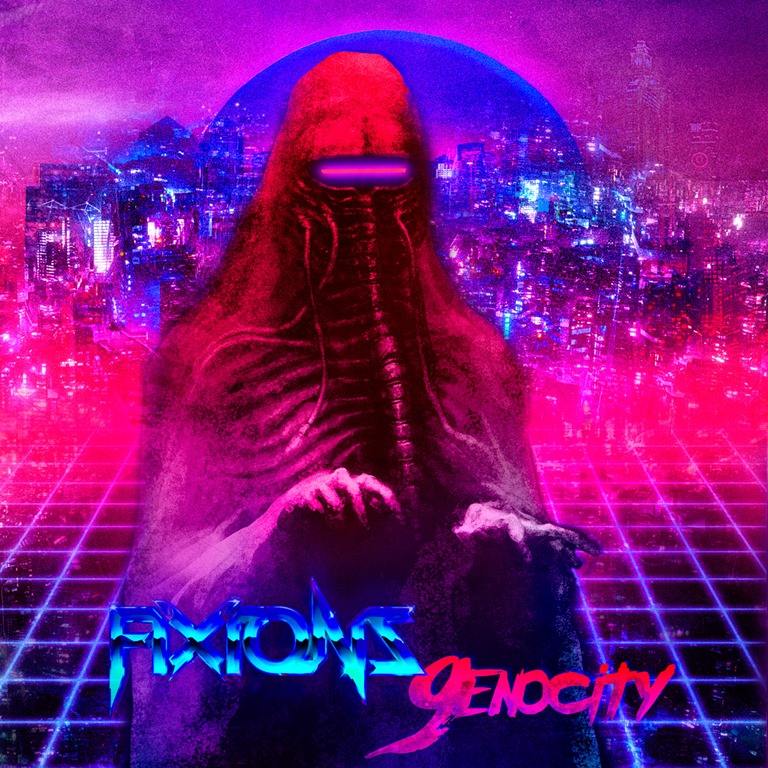
French cyberpunk / dark-wave project Fixions are, they say, influenced by ‘classic movies such as Blade Runner, Akira, Ghost in the Shell, the extreme metal scene from the 90s, Amiga video games, Fixions evolves in a style mixing dark and surrealistic elements, bombastic, powerful production, and a solid 80/90s dystopic science-fiction aura.’ With this, their fourth album, they threaten ‘the most extreme and deep release they ever produced’ in the form of ‘a concept album inspired by classic cyberpunk fiction tales, where every track depicts one of the thousand dangers the “Edgerunners” will encounter when visiting the city at night [and] sees Fixions merging futuristic urban ambiances with dark epic elements and heavy, abrasive sounds’.

While the concept might not be rendered entirely explicit through the album’s 16 instrumental tracks, but themes emerge both from the audio content and the titles (not to mention the cover art) applied to the compositions: ‘Crimeware’; ‘Terrorwave’; ‘Black Chrome Riot’ all contrive to summarise the intent of Genocity, which to all intents and purposes does come across as a sort of reimagining of Neuromancer in audio form.

Jittery, skittery, interloping lead lines weave their way over thumping basslines that wow and drag, melded to stomping, insistent, industrial-strength disco beats. It’s all about the imposing soundscapes and minor chords, the tension and the relentlessly restive digital flittering. There are grooves aplenty – hard, driving eurodisco grooves packed back to back, interspersed with more contemplative Kraftwerk-inspired tracks.

Does it sound futuristic? Not really. The ‘80/90s dystopic science-fiction aura’ is all-encompassing. The sonic elements are all tried and tested, well-worn tropes which evoke the spirit of ‘the future’ as it looked in those line-green neon-hued imaginings from the 1980s. As such, it’s possible – and indeed hard to resist – viewing Genocity as a sort of nostalgia piece, in which the time and space being yearned for is a golden age in which the future – a future which ultimately failed to become the reality in the present in which we now find ourselves – offered exciting and near-infinite potentials. Perhaps the realisation of that failure is the thread which ties the fictional technological dystopias of the 80s and 90s to the bleak cyberreality of the Internet and the digital age as we now experience it. At least the dystopian digital futures depicted in fiction were, and are, just that – fiction. Artificial Intelligence and automation, a reality in which everyone carries a computer which pinpoints their precise location 24/7 have not given us more leisure time, or more freedom, but has instead overtaken and occupied every inch of everyone’s lives and resulted in the erosion of freedoms at a pace which perhaps even outstrips the technological advances themselves.

When faced with incalculable progress and its effects on the psyche, it’s only natural to regress to safe times. There is, beneath the tension and amidst the dark currents which flow through Genocity, a certain sense of a regressive channelling. And so while it may not be the sound of the future, it does provide a perfectly serviceable recreation of futures past.

fixions_genocity

Verlag System – VS011 – 29th April 2016

Christopher Nosnibor

As the title reasonably implies, this is a soundtrack to a bleak landscape. The expansive instrumentals may hint at the potential for travel and movement, but they’re pinned to insistent motoric rhythms. The effect is at once spacious and claustrophobic. The stark synths call to mind New Order’s Movement, but they’re balanced by warmer, fuzzy-edged analogue sounds, which creates a different kind of feel, less morosely bereft and more abstract than figurative in form. Building some dense thrumming throbs and deep grooves, it’s eminently danceable for the most part. That said, there are some deep, sombre pieces which are less percussive: instead, the rhythms emerge from the regular pulsations which form a nebulous sonic body.

Single ‘The Possibility of an Island’, here remixed by GMR and Montxo Burgess is a sedate and rather grand piece, with hints of Visage’s ‘Fade to Grey’. Built around a simple chord sequence and heartbeat bass rhythm, it carries intimations both of 80s vintage and a certain sense futurism. Taking its title (presumably) from Michel Houellebecq’s 2005 science-fiction novel set in a dystopian future bereft of emotion and human contact, it echoes with isolation.

‘Ziggurat’ creates a vast, rippling desert of sound that undulates and pulses toward the whooshing gusts of air that encircle ‘Saturn Radio Waves,’ with fragmentary sounds of human voices drifting in and out.

Thrumming, looping motifs evoke a robotic, dehumanised world of synthesis and desolation. And yet through it all shine bright shafts of light, brave and optimistic, like the rising of a sun over a newly discovered world.

Dystopia