Posts Tagged ‘Drone’

Inverted Grim-Mill Recordings – 4th December 2025

Christopher Nosnibor

Before we arrive at the present, let’s rewind a bit. Everyone likes some backstory, a hint of prequel, right? So we’re going back to 2018, and the arrival of the Crusts EP by Pak40, a band named after a German 75 millimetre anti-tank gun, and a review which I started by saying that ‘I practically creamed my pants over Pak40’s live show in York, just up the road from my house, a few months back. I didn’t exactly know what to make of them, which was part of the appeal – they didn’t conform to any one style, but they were bloody good.’ 2021 brought the arrival of debut album Bunker, a heavy slugger by any standards.

They’ve always been a band devoted to sonic impact, and since guitarist Leo Hancill paired up with Cat Redfern to form Teleost and then relocated to Glasgow, Pak40 have been resting – but not giving up or growing tame. And more than anything, that time out has been spent in contemplation over intensifying their sound.

It may be that production plays a part, but Superfortress goes far beyond anything previous in terms of density and intensity. This is not to diminish the potent stoner riffery of Bunker, which contained some mammoth tracks with some mammoth riffs, but Superfortress is a major step up. Sure, Bunker was all the bass, but here, they elevate the volume and intensity in a way which replicates the thunderous, ribcage-blasting, ear-flapping force of the live show.

Four years on from Bunker, Superfortress very much solidifies the Sabbath-influenced aspect of their hefty doom / drone sound with the reverb-laden vocals, but also ratchets up the monstrous weight of previous releases by some way.

The first track, the ten-minute megalith that is ‘Old Nomad’ is as heavy as it gets. The drumming is relentless in its weight and thunderous force, but the bass… Hell, the bass. It lands like a double-footed kick to the chest, even through comparatively small speakers, replicating the impact of the live sound on the current tour. ‘Crushing’ may be a cliché but Pak40 deliver a density of sound that just may smash your ribs and smash your lungs. The title track begins tentatively, the riff only forming at first, before the drums and distortion kick in and from then on it’s massive, even before the vocals, bathed in a cavernous reverb arrive. Its low and it’s slow and it’s doomy, but it’s also earthy and rich in that vintage folk horror doom vibe, and it’s the slowed-down Black Sabbath inspired riffing that dominates the third and final cut, the feedback-squalling instrumental ‘Ascend’.

There’s something wonderfully old-school about this – but at the same time, it pushes things further in terms of weight and volume. And in those terms, Superfortress sees Pak40 push those things to an extreme. This is a monster.

AA

AA

a4105998785_10

12th November 2025

Christopher Nosnibor

While the approach to recording his latest album is pretty much standard for Lithuanian sound artist Gintas K – that is to say, ‘recorded live, without any overdubs, using computer, MIDI keyboard, and controller’, the inspiration and overall concept is a little different this time around, with Gintas explaining that ‘The album is a subtle allusion to Flann O’Brien’s absurdist novel The Third Policeman, reflecting its surreal and enigmatic atmosphere through sound. In itself, this is quite ambitious – not quite the musical equivalent of interpretive dance, but nevertheless.

And, in contrast with many of his other albums, which tend to be relatively concise and often contain some shorter, almost fragmentary pieces, this one is a whopper, with thirty-one tracks and a running time of over two hours.

Initially, it’s display of K at his most manic, with ‘black box#1’leading the first four-track suite more frenzied and kinetic than ever, the sound of an angry hornet the size of a cat trapped in a giant Tupperware container. There aren’t always discernible spaces between the individual pieces, and after just the first eight minutes of wild bleeps and buzzes, I’m already feeling giddy. ‘black box#1 – 4’ is a quintessential Gintas K blizzard of noise which starts out like trickling digital water tinkling over the rim of a virtual glass bottle and rapidly evolves into an effervescent froth of immolating circuitry.

The second suite of pieces, ‘black box inside#2 Dog Hoots’ is made up of eight chapters – compositions feels like a bit of a stretch – and while there are a couple of sub-two-minute blasts, the fifth is a colossal nine minutes and forty in duration. This marks distinct segment of the album, in that it sounds a little more structured, like the sounds of a toy keyboard or a mellotron, rewired and then tortured mercilessly. It grinds and drones, hums and yawns, it bubbles and glitches and whirrs and it fucking screams. Before long, your brain will be, too.

The third segment, a set of six pieces labelled ‘black box inside… Calmness’ is anything but calm: in fact, it’s more likely to induce a seizure, being more of the same, only with more mid-range and muffled, grainy-sounding murk. There are more saw-like buzzes and crackles and pops and lasers misfiring in all directions. It’s not quite the soundtrack which played in my head as I read the book, but the joy of any art is that it affords room for the audience to engage and interpret on a personal, individual level.

The nine-part ‘rolling’ (or, to give it’s full title ‘black box iside#4 Rolling’ is more fragmented, more distorted, more fucked-up and broken. The pace is slower, the tones are lower, and it’s the sound of a protracted digital collapse. It’s unexpected to feel any kind of emotional reaction to messy noise, but this conveys a sense of sadness. By ‘Rolling – 4’ it feels like the machine is dying, a breathless wheeze of a thick, low-end drone, an attempts to refire the energy after this are reminiscent to trying to start a car with a flat battery. It’d messy and increasingly uncomfortable and wrong-sounding as it descends into gnarly distorted mess. ‘Rolling 7’ is creaking bleats, woodpecker-like rattles. and warping distortion, with additional hum and twang. The last of these is no more than roiling, lurching distortion, without shape or form.

Arriving at the four pieces tagged as ‘omnium – The Fourth Policeman’, its feels like you’re surrounded by collapsing buildings and the exhaustion is not just physical. Gintas K has really pushed the limits with this one. The is an arc, a trajectory here, which can be summarised as ‘gets messier and more horrible as it progresses’. Artistically, this is a huge work, a work of patience, and a work of commitment and focus. As a listening experience, it’s intense, and will likely leave even the most adventurous listener feeling like their head’s been used as a cocktail shaker and that their brain has been churned to a pulp. Outstanding.

AA

a3200436950_10

1st December 2025

Christopher Nosnibor

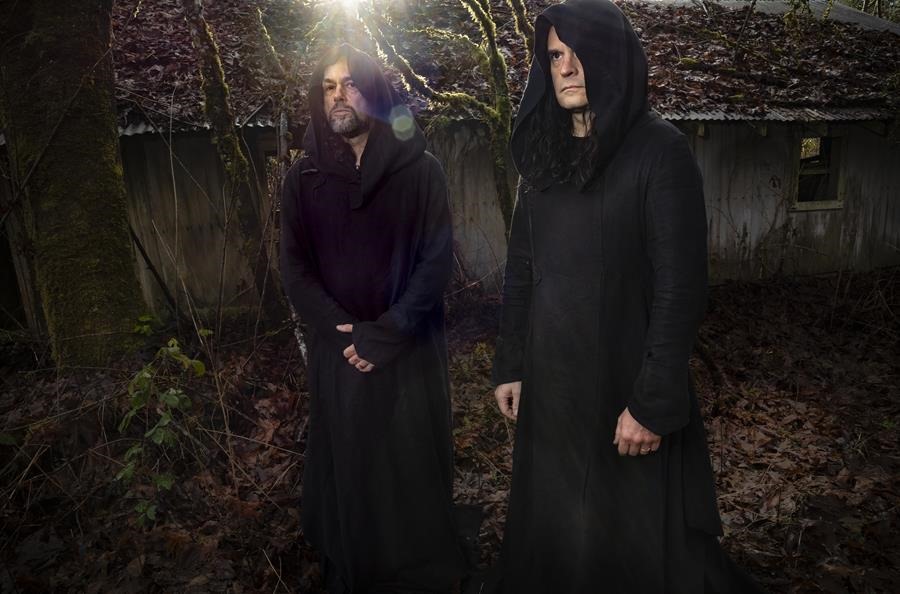
Since relocating to Glasgow, Teleost have been forging ahead, first with the release of the Three Originals EP at the start of the year, and now, bookending 2025 – which has seen the duo venturing out live more often – with their full-length debut. And it’s definitely got length: five tracks spanning a full fifty minutes. But it’s got girth, too. Atavism is everything they promised from their early shows – amplified. In every way. With five tracks, and a running time of some fifty minutes, Teleost have really explored the epic space they conjure with their monolithic, crawling riffery, pushing out further than ever before – and with more gear than ever before.

Despite there only being two of them, you have to wonder how they fit all that kit into a studio, let alone a van. They’re not quite at the point of Stephen O’Malley – who had to play to the edge of the stage at the Brudenell when playing solo in Leeds some years ago because the backline barely fit – but at the rate they’re amassing equipment, it’s probably only a matter of time. But this isn’t the accumulation of stuff for the sake of it: this is a band obsessed with perfecting its sound, and then going beyond and taking it to the next level. Volume is integral to that, in the way that it is for Sunn O))) and Swans – and again, not for its own sake, but for the purpose of rendering the sound a physical, multisensory experience. And also because volume facilitates the creation of tones and frequencies simply not possible at lower volumes.

The challenge for any band who rely on these quite specific conditions live is to recreate not only the sound, but the sensory experience, the full impact, when recorded. Recording compresses, diminishes, boxes in and packages something immense, compacting it to something… contained, confined, in a way that a live show simply isn’t. Live, there is movement, there is the air displaced from the speakers, there are vibrations, there is an immediacy and margin for error, all of which are absent from that ‘definitive’ documented version.

‘Volcano’ conjures atmosphere in spades, a whistling wind and tinkling cymbals delicately hover around a softly-picked intro, before a minute or so in, BAM! The pedals go on and the riff lands, and hard – as do the drums. Slow, deliberate, atomic detonations which punctuate the laval sludge of the guitar, which brings enough low-end distortion to bury an entire empire. The vocals are way down in the mix and bathed in reverb, becoming another instrument rather than a focal point. The pulverizing weight suddenly takes an explosive turn for the heavier around the mid-point, and you begin to fear for your speakers. How is this even possible? They do pair it back in the final minutes, and venture into the earthy, atmospheric, timbre-led meanderings of Neurosis. By way of an opening, this twelve minute track is beyond monumental.

They may have accelerated their work rate, but certainly not the tempos of their tunes: ‘Bari’ – which may or may not hark back to the band’s genesis, when they performed as Uncle Bari – rides in on a wall of feedback and then grinds low and slow. They really take their time here, with ten full minutes of jarring, jolting riffery that’s as dense as osmium. Turn it u and you can feel the hairs in your ears quiver and your cells begin to vibrate.

Where Teleost stand apart from other purveyors of slow, droning doom is in their attention to those textures which are grainy, thick, and each chord stroke hits like a tsunami making land reach, a full body blow that almost knocks you off your feet.

But for all of the annihilative volume and organ-bursting weight, Atavism is not an angry or remotely violent record: these are compositions concerned with a transcendent escape, and this is nowhere more apparent than on the mid-album mellow-out, ‘Life’, which offers strong parallels to more recent Earth releases. A slow, hypnotic guitar motif is carried by rolling cymbal-dominated drums. I find myself yawning, not through boredom, but relaxation – until four and a half minutes in when they bring the noise once more, and do so with the most devastating force.

AA

Penultimate track, ‘Djinn’ is contemplative, reflective at first and then goes on an all-out blow-out, seemingly more intense and more explosive than anything before it. While growling droning rumbling is the album’s defining feature, there does very much feel like there’s an arc of growing intensity over its course. Here, the vocals feel more skywardly-tilted, more uplifting in their aim to escape from the planet, and closer, ‘Canyon’ returns to the mesmeric, slow-creeping Earth-like explorations before slamming all the needles into the red. The result is twelve minutes of magnificent calm juxtaposed with earth-shattering riff heaven.

The fidelity is fantastic, the perfect realisation of their head-blastingly huge live sound captured. The chug and trudge cuts through with a ribcage-rattling density, and there is nothing else but this in your head. You mind is empty, all other thought blown away. It’s a perfect escape. And this is – at least in its field – a perfect album.

AA

a0002754035_10

Dret Skivor – 7th November 2025

Christopher Nosnibor

Dave Procter is / has been involved in more musical projects than your mum’s had hot dinners. Having left Leeds for Sweden, not least of all on account of Brexit, he’s currently paying the UK a visit with a tour which features performances by no fewer than five of them – last night’s set in York was one of two halves, featuring the polite extreme electronica of Trowser Carrier and the whacked-out post-punk infused racket that is Loaf of Beard. So about these ‘Brexit benefits’… and the fear of taxing the rich for fear they’ll leave the country. Since they’re not paying much tax anyway, where’s the loss there? Meanwhile, we’re losing migrant workers who keep the NHS operating, who harvest crops, and flip burgers, AND we’re killing creative industries by making it harder for artists to tour here. A few years ago, there was considerable coverage given in the media about the country’s so-called ‘brain-drain’; there’s been rather less coverage given to the slow murder of the arts. The Guardian and The Independent have raised their hands in quite anguish over the killing off of arts degrees, degrees which are being targeted as not providing a route to a well-paying career, but in the main, this is happening quietly. What’s painful is that there’s so much raving about ‘small boats’, hardly anyone is noticing, and even fewer care because they’re too busy buzzing over the Oasis reunion or Taylor Swift. I’ve got no specific beef with Taylor Swift and her sonic wallpaper, but the point is that there is so much life and art and creativity beyond the mainstream. There is an extremely diverse array of subcultures, an underground that’s as big as the overground, only more diverse, eclectic, fragmented, and this is what’s suffering.

To return to topic, somehow, amidst all this activity and while in transit, Procter’s managed to launch both a new release and a new project via his Dret Skivor label, in the form of OSC, the debut – and likely one-off – album by the imaginatively titled oscillator.

The accompanying notes are unusually explanatory for a Dret release, forewarning of ‘Glitch, ambient and toy keyboard experiments. Play through decent speakers and headphones, the lows are LOW!!!’ The tracks were created during some free studio time in Copenhagen in October 2024, and, as ever, the CD run is minuscule, with just 6 copies. This, of course, is typical of the DIY cottage industry labels, particularly around noise circles. It’s not only a sign of an awareness of just how niche the work is – and it very much is that: no point doing 50 CDs or tapes when it’ll probably take a year to sell four – but also indicative of a certain pride in wilful obscurity. Just think, if the bigtime ever did beckon, those spare copies sitting under the bed may actually acquire some value. Just look at how much early Whitehouse albums go for, for example.

OSC is very much an overtly experimental work, featuring six numbered pieces – the significance of said numbers remains unclear, if there even any significance, although notably, they’re all zeros and ones, or binary – which range from a minute and twenty seconds to just over eight and a half minutes.

‘01’ is a trilling electronic organ sound skittering over long drone notes, and abruptly stops before the bouncing primitive disco of ‘10’ brings six and a half minutes of minimal techno delivered in the style of Chris and Cosey. It’s monotonous as hell, but it’s intended to be, hypnotic and trance-inducing. Zoning out isn’t only acceptable, but a desirable response. ‘100’ is seven and a half minutes of dense, wavering low-end drone, the kind which slows the heart rate and the brain waves. As the piece progresses, the rumbling oscillations become lower and slower and begin to tickle the lower intestines, while at the same time some fizzy treble troubles the eardrums. Nice? Not especially, but it’s not supposed to be. Sonically, it’s simple, but effective.

‘101’ is so low as to be barely audible: not Sunn O))) territory, so much as the point at which the sun has sunk below the horizon and the blackness takes on new dimensions of near-subliminal torture. The final track, the eight and a half minute ‘110’ is a classic example of primitive early industrial in the vein of Throbbing Gristle, with surging oscillations which crackle and fizz, a thrumming low-end pulsation. It ain’t easy, but it’s magnificent.

Procter loves his frequencies, just as he loves to be eternally droney, and at times Kraut-rocky. OSC reaches straight back to the late 70s and early 80s. OSC is unpredictable, and tends not to do the same thing twice. It’s in this context that OSC works. Embrace the experimental.

AA

a2917884968_10

Human Worth – 14th November 2025

Christopher Nosnibor

Human Worth seems like a comfortable place for the latest album by sludge behemoths GHOLD. The band has forged a remarkable career to date, with each album showing development and progression, building on previous works – and as they’ve been going for some thirteen years now, that’s some significant expansion. PYR (2016) saw the duo expand to a trio, and Stoic explored the potentials of the three-way interplay in much greater depth. INPUT>CHAOS took the band in a rather different direction, fully embracing the avenues of straight-up noise while bringing, at times, almost accessible shades to the monstrous riffery that defines the GHOLD sound. So many bands spend their entire career recreating their first and second albums because they’re so desperate to appease their fanbase, and while that might be alright for acts who’ve sold their soul and their lives to major labels and likely have no say in the matter, any act who has artistic freedom who peruses such a creatively limiting course is likely doing it for the wrong reasons.

GHOLD’s unpredictability, then, is a strong positive. And Bludgeoning Simulations is bursting with surprises, and none greater than the tremulous piano opening on the first track, ‘Cauterise’. It’s tense and dissonant, but at the same time, soft, reflective… and then the monstrous, churning riff crashes in and lays waste to everything which stands before it. The guitar and bass are welded together tight to forge a solid wall of sound, and it’s delivered with attack., a raw, barrelling intensity. You don’t just hear the volume from the speakers: you feel it.

Without a moment’s pause, a thick, lumbering bass riff crashes in hard, and leads ‘Lowest’ into spectacularly Sabbath territory – it’s hard and heavy, but also captures both raw contemporary feel and that vintage 70s sound. Sabbath as played through a filter of Melvins goes some way to explaining where they’re at. It sound like abrasive hardcore played slow.

The ridiculously long and sludgy single cut, ‘Place to Bless a Shadow’ s a beautiful slow-burner, expanding everything they’ve ever done to a new and remarkable breadth. There’s detail here, and deep, dark, whispering atmosphere, before ultimately, after some sparse, slow-building tribal beats and simmering tension, not to mention vocals that start gently but gradually come to resemble the rage of Trent Reznor on The Downward Spiral, they finally go full Melvins sludge mania just after seven and a half minutes. It’s heavy, and it’s wild. And – alright, sit down and take it – it’s solid GHOLD.

‘Fallen Debris’ is a fast-paced, buzz driven blast, and a contrast in every way – hard, driving, it’s a tabid blast of a punk / gunge / metal hybrid that hits like a kick in the stomach. Whipping up a stomach-churning maelstrom in the last couple of minutes, we find GHOLD hitting peak energy, before the slow-churning Sunn O))) ‘inspired ‘Leaves’ drifts in and drives hard. It’d s heavy as fuck. And it hurts.

There are no simulations here: this real bludgeoning, from beginning to end. Bludgeoning Simulations is heavy, and make no mistake, there are no simulations here: this is fucking REAL. The album’s second monumental beast of a track is the groaning, droning, nine-minute monster that is ‘Leaves’, and it’s nine minutes of sepulchral doom fully worthy of Sunn O))). It’s heavy shit, alright, but the reason it hits so hard is because of the context: Bludgeoning Simulations is remarkably nuanced, inventive, a questing work that seeks new pathways, new avenues, and shows no interest in genre boundaries of conformity. ‘Rude, Awaken’ brings the dingy riffs that will satisfy thirsty ears, but again, there’s a stylistic twist that’s truly unique, in a way that’s not even easy to pinpoint. It’s simply something different.

Bludgeoning Simulations is inspired, and inspiring, and finds GHOLD conjuring sonic alchemy with a visionary take on all things doomy, sludgy, low, slow, and heavy.

AA

a0166716374_10

17th October 2025

Christopher Nosnibor

…and still, the COVID pandemic continues to yield new offerings, even if some are repackaged, or otherwise documents of events which took place during that strange, strange time. Real live music events were, during those dark days, simply things of memory, which we could only dream of happening again – because, for a while which felt like an eternity, there was no end in sight. Live streaming events were as close as we got. I watched a few, participated in a handful, too, but like having beers on Zoom, as much as they went some way towards filling the gaping chasm that was social life, these things were countered by a certain pang of sadness and consternation, reminding us as they did of what we were being deprived of, highlighting the fact that there is truly no substitute for the experience of live music. I write this as a fairly ardent misanthrope who will sometimes go to quite exceptional lengths to avoid other people. But sharing a room with musicians and people who seek to become one with the sound and the experience is something altogether different. Unless it’s one of those gigs where casuals turn up and yack at one another in loud voices for the duration, of course. I find that this happens less in proportion to the obscurity – and / or extremity – of the music. The more difficult, the more abrasive, the further from the mainstream the artist, the cooler the audience. In this context, Orphax’s audience must be bordering on godlike.

Embraced Imperfections features ‘two live performances recorded during a live video streaming event during the early covid-19 pandemic’, originally released as Embraced Imperfections and Live in your living room, now, remastered, they come as a two-disc release. The title reflects the nature of the recordings – both performances were improvised ‘with various synths, organs, and effects’, and as such are inevitably imperfect. But… how would we know? Artists – musicians in particular – are commonly their own harshest critics. They kick themselves for the most minor flaws that simply no-one else on the planet would notice in a million lifetimes. But still, making peace with and embracing imperfections is a significant step.

The first disc – Embraced Imperfections I – offers forty-one minutes of slow-sweeping organ drone which subtly undulates and quivers, humming on, ebbing and flowing, but in the minutest of microtonal shifts. Above all, it’s a continuous sonic flow, and the shifts in its sounds and structure are made at an evolutionary pace. You don’t listen to music like this to be affected, to feel impact, but instead to be carried along, to feel it envelop you, to wash over you, to experience full immersion. It isn’t that nothing happens… so much as very little happens, and does so incredibly slowly. If listening requires patience, so does the making. It is not easy to hold a single note for long minutes at a time without feeling a certain pressure to ‘do’ something. As this performance evidences, Orphax possesses the Zen-like ability to resist any urge to increase the pace of movement – so much so that time itself seems to stall and sit in suspension here. Even the first fifteen minutes feels like a lifetime, and the secret to appreciating this is to stop listening and simply let it become the backdrop as you slow our breathing and allow yourself to relax. Remember what it is to relax?

The shorter Embraced Imperfections II, which clocks in at just over thirty-six minutes, is less overtly organ-driven and more constructed around an electronic hum, and it’s dark, claustrophobic. It also feels more low-key, and more ominous. It’s still another extended dronework, the sound of which is absolutely the immersive dronescape, the hovering hum that feels like nights drawing in and claustrophobic depression descending on the dense darkness. It’s a dense, scraping, soporific endless polytone that scratches and hums for what feels like all eternity. While far from accessible or easy listening, it does make for an immersive journey. And cat pics always win… embracing impurrfection.

AA

AA

a0536185753_10

Sub Pop – 14th October 2025

This one has seemingly come out of nowhere. And it’s on Sub Pop. And they’re calling it a Maxi 12”, as was the term for a 12” EP back in the 80s and 90s. And I suppose it does actually quality, given that the old-school Maxis tended to feature either two tracks per side, or an extended version of the single, plus B-sides, and that’s then case here. But with this being a sunn O))) release, the lead track is just shy of fourteen minutes in duration, and the tracks on the flip are eight and seven-and-a-half-minutes long respectively. Back then, a maxi would cost maybe £3.50, or £3.99 (I’m talking about the ‘90s: it was a couple of quid in the 80s… I can’t actually remember the price of an LP in the 80s, but have receipts sitting inside sleeves that verify that in 1994, a new LP on vinyl cost around £7 and a CD £11… so the fact that this ‘maxi’ is $25 tells you all you need to now about inflation and capitalism and how times have changed.

Anyway. The three tracks on this release, with a total running time of almost half an hour are notable as ‘first official sunn O))) studio recordings to feature only the original core duo on heavily saturated electric guitars and synthesis.’ It’s also introduced with a sense of elevation that’s typical sunn O))), when they inform us that ‘sunn O))) gave extreme focus and care to each step and aspect of the recording, each tone and level of saturation, each gain stage and speaker, each arrangement and harmonic. The Pacific Northwest forest is our guide.’

‘Eternity’s Pillars’ is a raging behemoth of feedback and sustain, every chord struck a billowing beast that punches through the endless drone, and while it is unquestionably classic sunn O))), it also brings together the defining elements of early Earth, in particular Earth 2, an album which effectively created the blueprint for the entirety of sunn O)))’s existence. Not a lot happens: that’s never the point. Downtuned guitars churn the bowels, scraping and snarling their way to monumental, megalithic sustain, though a continuous whine of feedback, each strike hanging in the air for what feels like an eternity. The pace is a crawl. Time stalls. It’s absolutely punishing. New shapes emerge, fleetingly, toward the end, notes rising like monuments from a cloud of smoke – by no means a melody, but it’s a progression, a change in mood.

‘Raise the Chalice’ is named ‘for a rallying cry often uttered by Northwest legend Ron Guardipee throughout the mid-1990’ – making it their second composition in his honour (the other being 2023’s ‘Ron G Warrior’, which was also released on Sub Pop), and opens with a full growl like a giant engine slowly revving , but instead of revving up, it gradually revs down into a slow-churning sonic abyss. It doesn’t sound, or feel much like a rallying cry. With the density of dark matter, the enormity of the sound engulfs the senses. By the arrival of ‘Reverential’, there’s a feeling of exhaustion, as if all the light and oxygen has been extracted, and yet still the sound continues to apply a crushing pressure.

While it’s difficult to really rank or compare sunn O))) releases as to what constitutes their ‘best’ or ‘heaviest’ work, this is certainly classic, quintessential sunn O))), and it’s very, very heavy indeed.

AA

a3585267222_10

It’s been two years since Deep Cross delivered Royal Water, and now they return with the enigmatically-titled Scaffolded Dawn.

As the accompanying notes outline, ‘Utilizing treated vocal drones, tape, modular synth and an array of found sounds, on the new album, Deep Cross delivers seven tracks of heavy Devotional Electronics. Blistering and crude yet ecstatic and sacred, Scaffolded Dawn focuses on transition points where tempers blur beyond ideas of convention. In each track discomfort, overcoming, decay, lure, attraction and beauty inhabit an axis of equal reign where multitudes thrive.’

As a taster for Scaffolded Dawn, they’ve landed a video for the track ‘Ranine Copper’. With hints of The Walking Dead, it’s suspenseful, disturbing, and very, very dark.

We love dark here at Aural Aggravation, so we are immensely proud to premiere this video. Brace yourselves.

AA

a2598828774_10