Posts Tagged ‘Detail’

Christopher Nosnibor

Being restricted to live shows within walking distance of one’s house really does change one’s perspective and selections. As much as it also significantly limits my options, I’m fortunate to have no fewer than three venues within this range, and spotting that The Royal Ritual – a band I’ve long been aware of but have never witnessed live – were playing at one of them provided more than enough of a poke to get out.

It’s not exactly heaving. That is to say, come 8:15, it’s still pretty quiet, even for a Wednesday night. But then, I noticed that York was conspicuously quiet all day today: driving almost empty roads to a near-dead Tesco was as welcome as it was strange earlier in the day. The first week of the school summer holidays, and it seems everyone has buggered off – apart from the tourists clogging the town centre, which was far from quiet in the afternoon. But tourists tend not to seek out relatively unknown alternative bands playing a mile or two out of town. They should. Live music is as integral to a city’s nightlife as its pubs and bars and so on. I once ditched a conference dinner in favour of a gig when visiting Stirling, having clocked that maybeshewill were playing, and in the process, discovered And So I Watch You from Afar, who absolutely blew me away, plus I got to explore a new venue. It was a memorable event, and one which has stuck with me. It’s unlikely the alternative would have had quite the same impact – and while I’ll never know, as someone who’s uncomfortable dining with strangers and making small talk, I’m as comfortable with my choice now as then.

Comfortable isn’t really my default, and caving crawled out of my bunker, this is an evening I’m quite content to hide in a dark corner with a pint and observe.

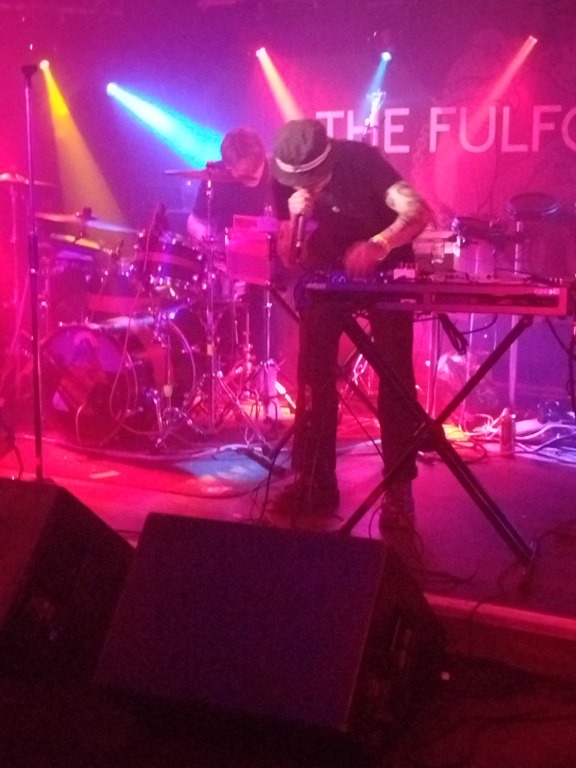
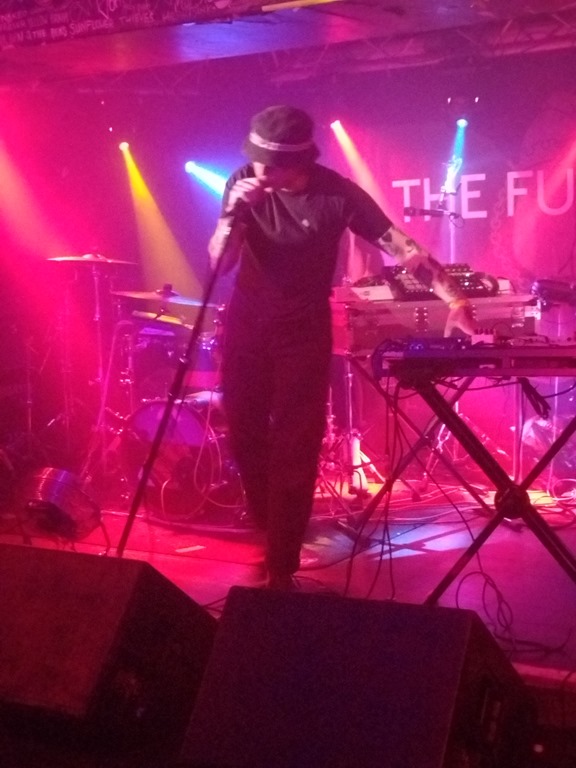
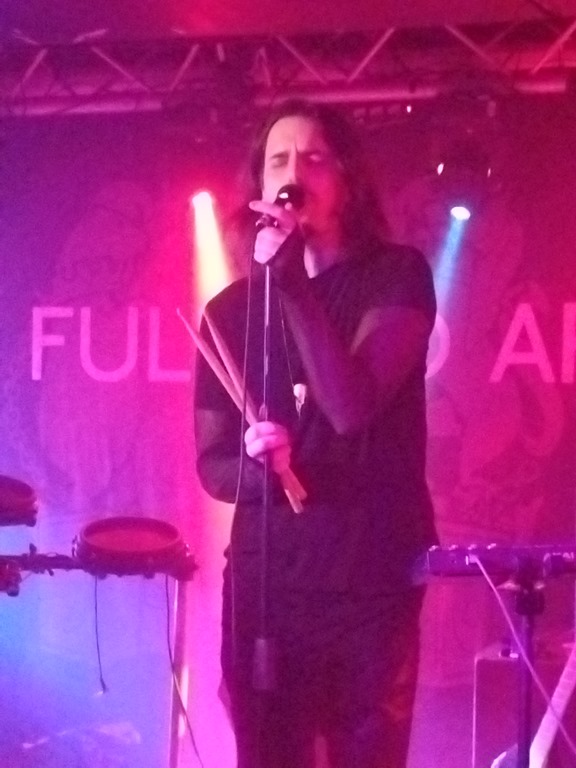
Material Goods are a last-minute replacement for Dramalove. It’s a solid, blank name which suits the duo’s style, which comprises some heavy, complex synth work paired with live percussion – and quite outstanding live percussion at that. The processed vocals are a bit muffled, but overall, the sound is dark and dense and the drums really cut through it with energy and force. Essentially, their palette is 90s alt rock, a bit NIN but with a vague dash of nu metal, and a bit Filter, too. Multitasking and a vast amount of gear affords the singer limited scope for movement on stage, but the sound has a really good, strong energy, despite the songs being pretty downtempo and downbeat.

IMG_20240724_200808IMG_20240724_200818

Material Goods

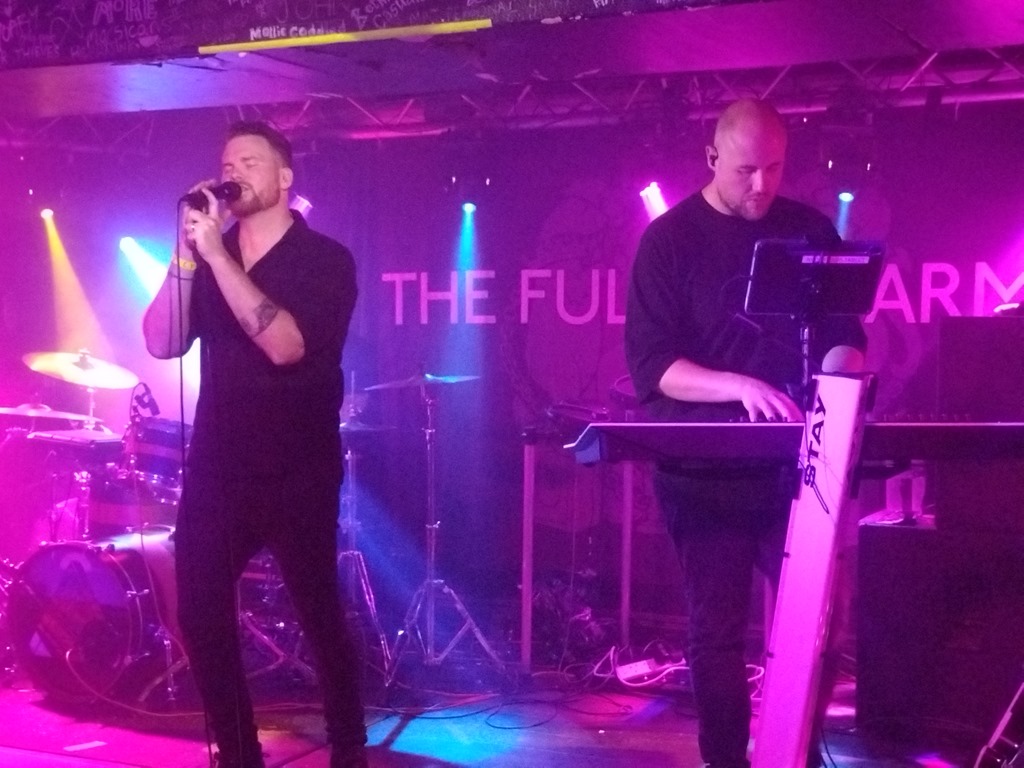
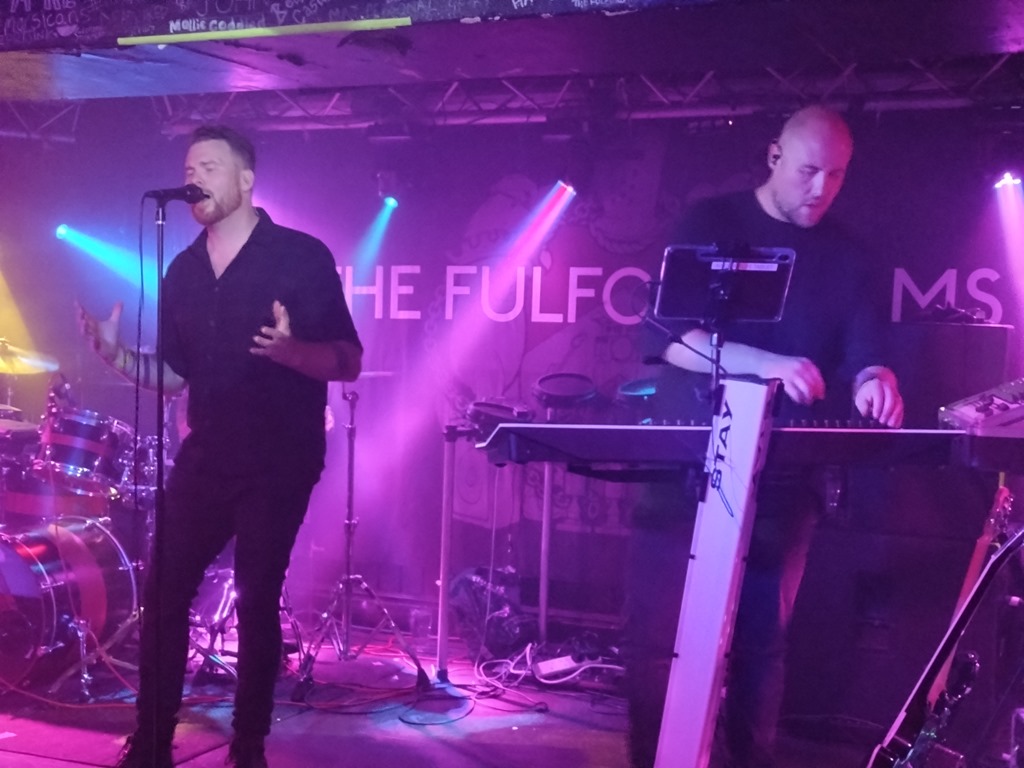
With Material Goods overrunning and Neon Fields also possessing an immense amount of flash-looking tech which needed setting up, we’re fifteen minutes behind time when they take to the stage. Sonically, they’re astonishing. Playing a hundred-and-twenty-five-capacity pub venue, they sound like half a million quid’s worth of gear in an arena. And the songs match it. They sound like they look: black clad, tattoo bands, neatly-trimmed beards, big, soaring emotional outpourings… And completely lacking in soul. Christ, this guy’s level of emotional trauma is enough to raise the blood pressure to induce a heart attack. Wracked with anguish and all of the pain of the lovelorn, the love-torn… And yet it’s all articulated so blandly, everything is so slick, and so one-level. The theatre soon wears thin, and I start to forget I’m listening to it while I’m listening to it. It doesn’t help that there’s a group of four people bang in front of me gabbing on and pricking around, pulling faces, play-fighting, the guys trying to impress the birds by demonstrating their strength by lifting one another up… they get shushed by a fan but even the absence of their distraction doesn’t really improve the experience. There’s some earnest, meaningful falsetto, and the penultimate song had some cliché tribal drumming, and they wrapped up their bombastic set ten minutes after the headliner was due on.

IMG_20240724_21083420240724_210849

Neon Fields

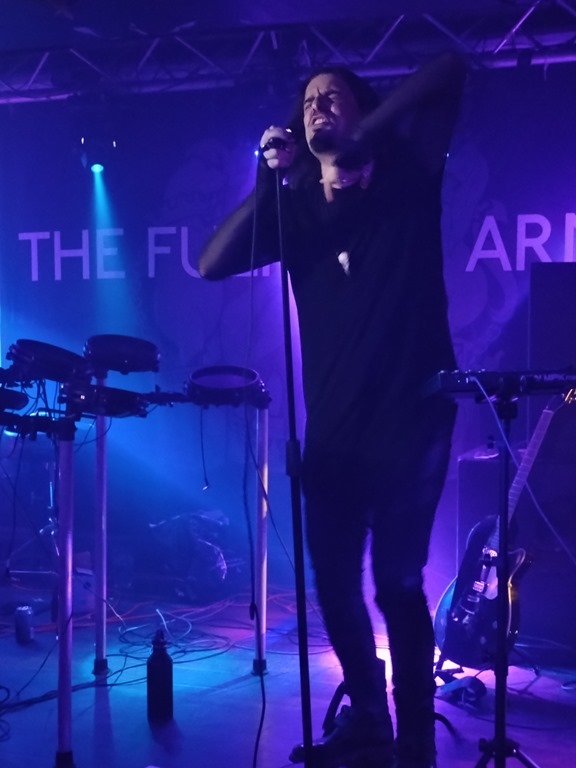
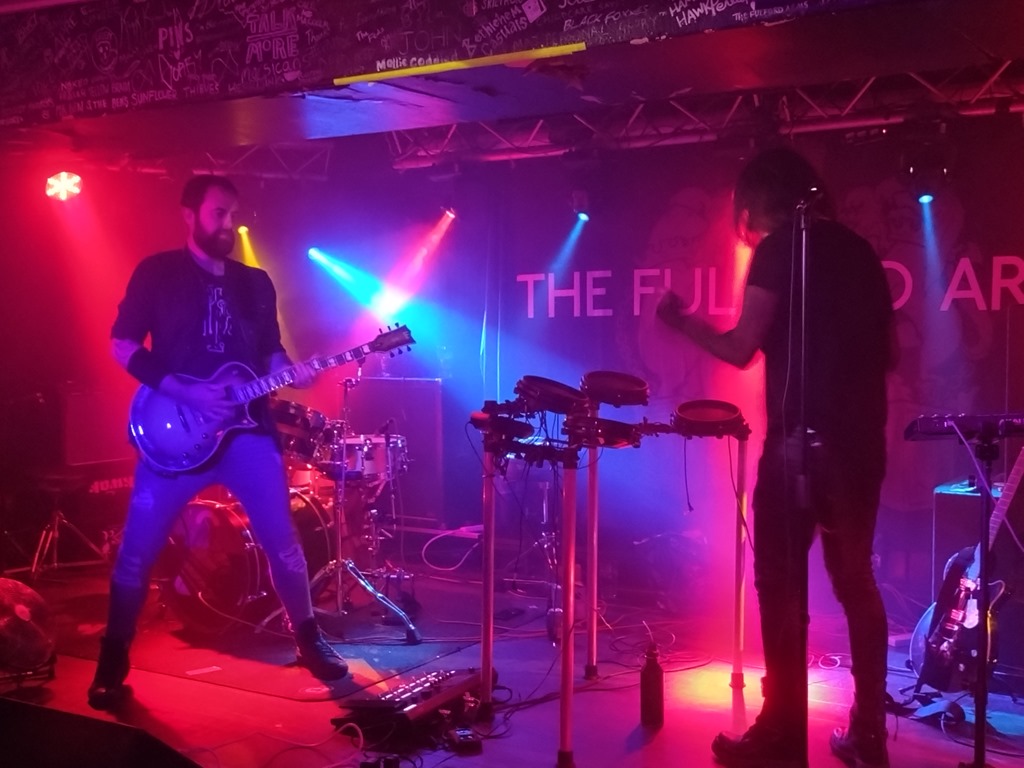
The Royal Ritual are also a duo who have an extremely ‘produced’ sound. But their approach to production owes more to the methods of Trent Reznor as pioneered in the early 90s on Broken and The Downward Spiral, balancing gritty live guitars with synths and fucked-up distortion and harnessing their tempestuousness in a way that creates a balanced yet abrasive sound. David Lawrie plays live electronic drum pads in addition to the sequenced beats, adding dynamics and live energy to proceedings, and flitting between the drum pads, synths, and mic stand, he’s incredibly busy throughout the set. But something about Lawrie’s delivery highlights everything that was absent on Neon Fields, and just carries so much more weight: the whole package brings a rush of adrenaline propelled by that emotional heft and solid force.

Objectively, the feel is very Stabbing Westward, and goes hard NIN at times in its combination of guitar, synths, and sequenced and live electronic drums. The Royal Ritual are strong on dynamics and atmosphere, and Lawrie is an intense and compelling performer.

IMG_20240724_22045120240724_22154320240724_220550

The Royal Ritual

He does break out of the moody persona to thank other bands and plug merch, but what do you do? In the current climate, bands sadly need to plug the stall. The fact that David steps out of broody tortured soul for two minutes of affable chap may seem hard to reconcile, but then, this perhaps speaks more of the human condition than remaining ‘in character’; people are complex and conflicted, multifaceted and inconsistent. And this is what truly lies as the heart of tonight’s performance by The Royal Ritual. Digging deep into the complexities of the psyche, there’s something about the duo’s performance that gouges into the flesh and demands contemplation.

Editions Mego – 24th March 2023

Christopher Nosnibor

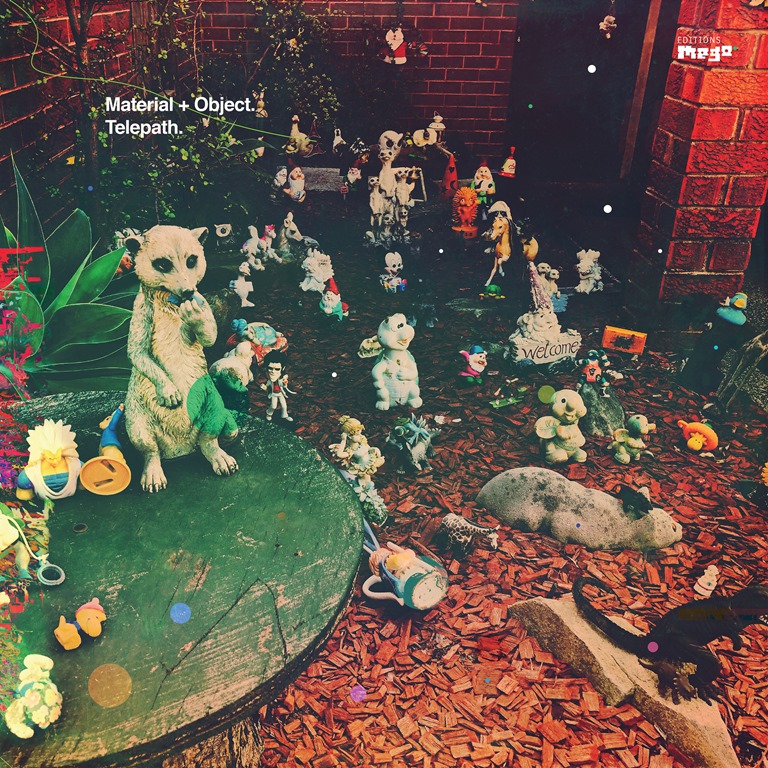
Editions Mego have since forever released ultra-niche but eternally-fascinating exploratory works. Since their inception in 1994 as MEGO, before transforming into Editions Mego, bearing eMEGO catalogue numbers, the label has given home to pretty much every significant and emerging artist working in the field of electronica given to abstraction, minimalism, glitch, and the more experimental side of things. As such, this release is a very comfortable fit in the catalogue.

As the bio details, ‘Dismantling the acoustic to feed the electronic, Editions Mego presents Telepath, the new album by Material Object. Born out of a single improvised recording session with a lone Violinist, Telepath is a startling album of future electronic music, resulting in an LP of unique and timeless tracks that reimagine a classic sound for an endless future.’

Nothing about Telepath sounds remotely like a violin in any recognisable sense. Even the long, soaring tones and strong-scrapes which sound like a violin sound, in context, processed, abstract.

It’s all about the process, of course, and it’s the literal processing and manipulation of sound which renders the output so far from the initial input. The results are interesting, to say the least.

To return to the bio for context, Telepath is presented as ‘Boldly departing from his previous canon of largely ‘ambient’ work, Material Object’s Telepath renders itself out as something much stranger, something more spacious, more subtle and gradual. Moments of bouncing minimalism meet moirés of delayed pure tones phasing in and out of resolution, giving way to a series of strobing foreground gestures arranged and offset in disorienting landscapes which scatter themselves asymmetrically amongst crystal pools of reverb.

There are moments of deep, rumbling ambience to be found here, but it’s certainly not the album’s dominant feature.

‘Enter’ isn’t quite microtonal in its focus, but does very much narrow down to an extremely small sonic spectrum in order to interrogate minor changes and the relationship between notes as they resonate and bounce off one another – and that focus is intensely concentrated, remaining fixed for some nine and a half minutes. It sets the stall for Telepath overall: the fifteen-minute ‘Hyphae’ flickers and clicks as sounds bat back and forth at a rate of rapidity that’s tension-inducing, particularly as the click-clack becomes overwhelmed by a bubbling cloud of dense sound yet remains persistently audible.

Structurally, the album alternates between longer works and shorter interludes of a couple of minutes or so: these serve, I suppose, as the sonic equivalent of palate-cleansers, and they’re necessary in breaking up the vast sonic swaths of hyper-focussed detail as interrogated over five minutes or more.

It may seem a contradiction, but while focusing microscopically on the most minute details, Telepath also covers a lot of ground. It’s all about contrast and contradictions, and arguably these are the foundations of this intriguing and often quirky work.

Following the twitchy, processed pings of ‘Thermo’, the eleven-and-a-half-minute ‘Exit’ is the perfect bookend to stand opposite ‘Enter’. And as the album leaves us reflecting the whisps of mist left in its trails, there is a hanging sense that there is something yet to come. From among the shadows, Telepath presents us with an unexpected sense of insight, both outside and in.

AA

eMego299V_front

Crónica – 26th April 20222

Christopher Nosnibor

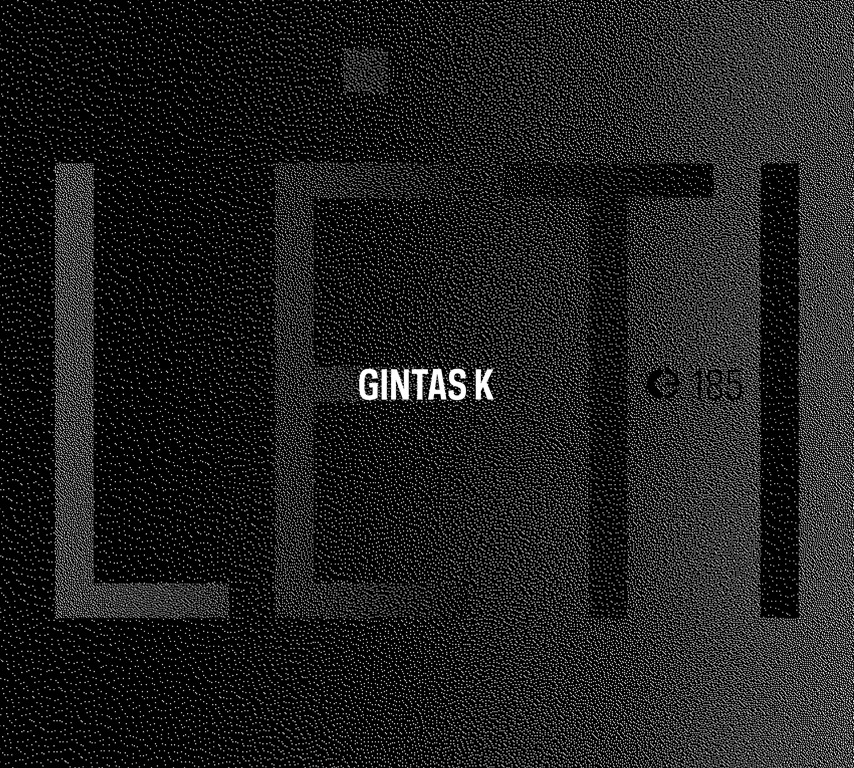
Having seen various videos of Gintas K’s improvisations, involving a keyboard and a dusty old Lenovo ThinkPad running some custom software, it’s apparent that his approach to composition is nothing if not unusual, and it’s matched by the results.

His Crónica debut, Lengvai / 60 x one minute audio colours of 2kHz sound was sixteen years ago, and his return to the label is a very different offering, although as has been a common factor throughout his career, Lėti – Lithuanian for slow – consists of comparatively short pieces – and here, the majority are four minutes long or less. Less is more, and what’s more, Gintas K invariably manages to pack more into a couple of minutes than many artists do in half an hour. Here, we have a set of eleven short pieces ‘created from recording and improvising in studio followed by extensive mixing and editing using software.’ There’s no more detail than that: some artists accompany their releases with essays explaining the creative process and the algorithms of the software and so on, but Gintas K simply leaves the music for the listener to engage with and to ponder.

Where Lėti is something of a departure is in the emphasis on the editing and mixing of the material and the fact that, as the title suggests, the arrangements are a little more sedate. The signature crackles and pops, chines and static are all present and correct, but there’s a sense of deliberation as we’re led through ethereal planes of delicate chimes and tinkling tones that resonate and hang in the air, drifting in open expanses, with time and space to reverberate and slowly decay. With this more measured feel, melodies become more apparent, with simple motifs, repeated, giving ‘Hallucination’ a sense of structure and, I suppose you might actually say ‘tune’.

It isn’t that Gintas’ works lack tunefulness as such, but that any tune is surrounded by froth and extranea, and so much is going on it’s often hard to miss. Listening to Lėti is a fairly calm, even soothing experience, at least for the most part, conjuring a mood of reflection, of contemplation. The album’s longest piece, the seven-minute ‘Various’ brings a dense wave of sound that surges and swells slowly like a turning tide. There’s almost a stately grandeur to it, but then, there’s a rattling kind of a buzz that’s something of a distraction, and a glitch that nags away and seems to accelerate. These little headfucks are quintessential Gintas K, and Lėti isn’t all soft and sweet: ‘Savage’ brings thick, fuzzing distortion and discomfort.

The flurries of sound, the babble of bubbling bleeps and bloops that are his standard fare are slowed to sparse, irregular drips in a cave on ‘Variation’, and the application of reverb is impressively nuanced, to the point that the reverbs almost become music in their own right. ‘Atmosphere’ and ‘Ambient’ are appropriately titled, while ‘Nice Pomp’ would comfortably serve as a soundtrack to a slow-motion film of a moon landing or somesuch, and again none of the pieces are without depth or detail, as the layers and slivers of sound that intersect create so much more than mere surface.

Lėti is a genuinely pleasant and pleasurable listening experience, but is most certainly isn’t straightforward or simple in what it delivers. There are many sonic nuggets to unearth, and so many tones and textures along the way, that what is, superficially ‘less’ is, in actual fact, a whole lot more.

AA

Crónica185_front

Anticipating Nowhere Records – 24th September 2021

Christopher Nosnibor

With the colossal five-volume ‘Isolation and Rejection’ lockdown compilation series and the one-off final final FINAL Front&Follow project, the compilation You Can Never Leave released in June, the eternally restless Justin Watson can put his label to bed and resume work with his current musical vehicle, the collective who operate as The Incidental Crack to deliver album number two. After all, it has been more than three months since second album Municipal Music.

The three – Justin Watson, Rob Spencer and Simon Proffitt – are still yet to meet, and their third album, like its predecessors, took form with ‘them exchanging field recordings, samples and random noise between Manchester, Wigan and North Wales’.

As the liner notes recount, ‘Detail contains within three new long-form pieces and a couple of shorter ones filling in the gaps. The adage goes that the devil is in the detail, and Detail brings exactly what the title promises, with the first composition, ‘We Might Bump Into each Other’ beginning with some muffled dialogue and an ominous hum, then hums, bubbles and slurps against a backdrop of echoic reverberations, before ‘Fish Dance Tank Track’ marks a shift in style, with more defined beats – an insistent bass bump occupies a different space from the glitchy fluttering woodpecker-type stammers and stuttering hi-hats which all make for something quite complex beneath the drifting drones and quavering hums. It’s an interesting and complex composition that brings together elements of ambient and minimal techno, and as birdsong flutters in toward the end, the piece takes on new aspects that juxtapose nature and artifice.

That the grating looping throb of the six-and-a-half minute ‘Waterfalls Per Capita’ should be considered a gap-filler is a matter of context, and it comes after the harrowing dark ambient collage of ‘I Lost It’, that is by no means a comfortable or easy listen.

The seventeen-minute ‘Morning Tram’ combines field recordings where the original source remains clear, but with subtle but insistent beats, and it’s perhaps there – the finale – that everything comes together. Fragmented samples and snippets of dialogue collide with tumbling trees and slow-turning washes of ambience to create remarkable depth. Passengers pass on and off, engines rumble past, there is endless chatter and a wall of extraneous sound. Assimilating it all may be difficult, but it’s rewarding. The beat is almost subliminal, but it’s relentlessly insistent and registers almost subliminally as the sound swells and voiced clamour and congeal among a rising tide of horns and other momentous sounds. And then it stops, abruptly.

It may be short in terms of tracks, but Detail has substantial depth – and much detail, all of which is very much worth exploring.

The Incidental Crack - Detail (cover)