Posts Tagged ‘dark’

Dio Drone – 9th December 2016

Christopher Nosnibor

OvO’s evolution over the last couple of albums has been substantial: the brutal, demonic mania of Cor Cordium was utterly terrifying in terms of just how dark and full-on it was. Not that Abisso was exactly a stroll in the park – in fact, it was truly petrifying – but some of the unbridled power of its predecessor was exchanged for a greater range, and a closer attention to nuance with the incorporation of texture and depth-bringing electronics.

Creatura marks another shift, and yet again, they’ve come up with something that sounds like it is not of this world. Pushing hard through the loud / quiet dynamic – with major emphasis on the loud, of course – the sound is has a dense, industrial quality. Combining live and programmed drums, with the bass and percussion tracks being first recorded live and then looped, sampled, overdubbed, overlayed and generally embellished, mangled and fucked with, it incorporates elements of black and industrial metal, but it’s so much more. And so much more spine-shakingly scary. This is beyond the realms of horror. It’s extreme, for sure. It’s an album that will smash your psyche.

The stop / start drums and snarling bass calls to mind early Pitch Shifter. Above all, it’s the percussion that dominates. The mechanised double-pedal bass drum sound pounds like fury while Stefano shrieks and howls through shards of feedback on opener ‘Satanam’. ‘Eternal Freak’ explodes with drums on drums, the snare sound approximating planets exploding, and guitars like jet engines roar with cranium-cracking intensity. The deep, snarling vocal on the title track is from beyond the bowels of hell and cannot possibly have emerged from the throat of anything with even a strand of human DNA. What kind of creatura is this? It’s a mutant beast from the deepest netherworld, and that’s for sure.

While the bulk of the material is driving and muscular, the sample-strewn experimental breakdown of ‘Matiarcale’ strips things back to a kind of mutant hip-hop. The fear chords which swim around the pulverizing drum track introduce another layer of disturbance.

The appropriately-titled ‘Zombie Stomp’ reveals a hitherto unseen facet of the band, manifesting as a glam rock boogie – OvO style, of course. It’s still loud, hard and heavy, but there’s even an approximation of a vocal melody, albeit one as performed by Alvin Stardust’s reanimated corpse after it’s been possessed by the spirit of Zuul.

‘Buco Nero’ continues in this vein, a post-punk track at heart, with a tune and everything, but churned to a gut-wrenching doom-filled sludge. Counerpart ‘Buco Bianco’ is a techno-disco behemoth, along the lines of Chris and Cosey collaborating with Bathory. It would be a danceable pop tune if it wasn’t so utterly fucked up. The same can’t be said of ‘Bell’s Hells’, which is a minute and a half of thunderous savagery. Closer ‘March of the Freaks’ has hints of Nine Inch Nails about it but the stuttering beats and gnarled vocals make even Broken sound like Soft Cell.

It’s the fact that Creatura so often hints at accessibility which never emerges in actuality which renders it such a fearsome and disturbing work. Whereas Cor Cordium and Abisso were truly other-wordly, Creatura inches close enough to recogniseable forms to offer a warped reimagining of the world we know and as such, is deeply uncanny, in the Freudian sense. Weird, dark and intense, it’s an album only OvO could spew out: it’s also eye-poppingly awesome.


OvO cover

Southern Lord – 25th November 2016

Christopher Nosnibor

Anyone who’s been awaiting Martyrdöd’s pop covers album is going to be immensely disappointed by List. However, anyone else who’s on the market for a proper gnarly Martyrdöd album is likely to be happy enough with List. That said, it does mark a clear progression from previous outings. List is very much a more refined work, but of course, these things are relative. Every song still hits at three hundred miles an hour. The drums are still relentless, pounding. The bass is still a snarling throb, partly submerged beneath a messy mas of treble. It’s still as brutal as hell. But there’s a greater sense of focus, and the sound is clearer.

The title track introduces an almost Celtic lead guitar motif and a huge sense of bombast to the full-throttle thrashabout that lies beneath It’s a remarkably structured, and, even more remarkably, melody-focused track, but the demonic vocal snarl is still ever-present and ever terrifying.

‘Över på ett stick’ slows things down and takes on an amost anthemic, stadium rock quality, before ‘Harmagedon’ brings things back to familiar, snarling, dark crust territory. ‘Drömtid’ goes all folk / Metallica by way of an interlude, but it is just an interlude: the barrage that is ‘Intervention’ proves once again that they’ve not got soft, but have simply developed their appreciation of dynamics, texture and range, and it’s reflected in ‘Intervention’, which exploits, if not loud / quiet dynamics, then loud / louder / punishing dynamics and with a degree of intricacy and detail that’s impressive on a technical scale. Rather than diminish the impact, it heightens it.

Martyrdod - List

Ritual Productions – 11th November 2016

Christopher Nosnibor

You might expect that the tracks on an album containing just six songs would consist of long, dawn-out affairs. But not Thralldom’s latest offering: there are a couple that extend beyond the six-minute mark, but in the main, these are short pieces, under four minutes in duration. But in terms of dark intensity, they’re immense.

The introductory instrumental, ‘Cosmic Chains’ is a disturbing vocal cacophony from the bowels of hell which paves the way for the blackened trudge of ‘Chronovisions’, which truly sets the tone for the album as a whole. It’s seriously fucking dark, tangled gothic guitar lines weaving tapestries which depict unspeakable events of demonic torture and pain.

It may be that Thralldom have been silent for over a decade, but is seems that the intervening years since their last release have been spent crawling through subterranean passages by candlelight, stooped, starved and rabid, and battling with marauding demons every step of the way. And so as what’s billed as ‘Thralldom 3.0’ emerge, screaming and agonised into the light, it’s hard to tell if they’ve slain those demons or become partly consumed by them: Time Will Bend Into Horror forges a netherworld of tempestuous torment. The title is fitting in that it reflects the ancient evils which claw their way through the spaces between the crooked notes and mangled power chords which form the fabric of an album which soundtracks a walk through purgatory. In the hands of Thraldom, a four-minute composition feels like ten or more as they grind out the darkest, most oppressive noise.

The angry grey surges of noise which crash and thrash over a violent percussive assault on ‘The Corpse of the Radar Towers Over All’ collides against the churning discord of ‘Dark Grey Mist’, a track which brings elements of Swans’ Cop into a metal maelstrom that’s as black as the canal of Satan’s sphincter. It’s gnarly, alright – and then some – and brings horror in spades.

Thralldom - Time Will Bend

Peaceville – 21st October 2016

Christopher Nosnibor

Christ, this is fucking dark. The video which accompanies ‘Abysmal Channelling’ (the album’s bonus track, perversely enough), depicts scenes of an occult ritual, complete with burning incense, singing bowls, self-mutilation, frenzied bell-ringing, pools of blood, all against a backdrop of murky, mangled industrial noise.

Describing themselves as ‘blackened noise occultists’ US act T.O.M.B. (that’s Total Mechanical Occultic Blasphemy) have been going for 18 years now, and have, not surprisingly, remained deep, deep underground. Positively chthonic, in fact.

Fury Nocturnus is their thirteenth release, and while containing thirteen tracks (plus the aforementioned bonus cut), it contains no tunes, and the truth is, it’s very difficult to really establish what the hell’s going on amidst the dense sonic fog. Yes, they’ve fully embraced the

production values of early black metal classics – and it’s perhaps worth noting that Hellhammer, drummer of infamous Norwegian black metal trailblazers Mayhem is a key contributor to this album. This does mean, of course, that the guitars, drums, vocals and dark ambience which pervades every corner of the album is obfuscated by a thick, grainy coating of dinginess. A number of the tracks end abruptly, and there’s a distinctly low-budget, ‘cassette’ feel to this release. But then of course there is. And while occasionally grinding riffs seep through, there are no tunes, no overt structures and for the most part, it’s a seething morass of dark, dark noise cut through with tribal percussion.

Sometimes, there’s a very fine line between portentous and pretentious, grand art and derangement that borders on the dangerously deviant. It’s not entirely clear where T.O.M.B. sit, other than on a throne of bones in a temple hewn into some inaccessible rock face. They’re very much keeping it real in their approach to the music-making process: when creating the field recording soundscapes which feature on Fury Nocturnus, they report that certain necromantic instrumentation was used: human and animal bone, cemetery crypt doors, tombstones and coffins, and audio EVP equipment. I’m inclined to take them seriously if only because I don’t fancy the idea of being the next sacrificial offering, and crucifixion is, I understand, quite a painful way to go. I’m certainly not about to snort with derision about the cliché of the snarling vocals ranting about Christianity on ‘Hoards Rise Now, or any of the album’s many demonic invocations.

It’s not a fun or pleasurable experience, and protracted exposure to this dank, demonic, deviant, and deeply sinister noise feels like an act of self-flagellation. Needless to say, I’d take it over Justin Bieber, Kanye or Katy Perry any day.


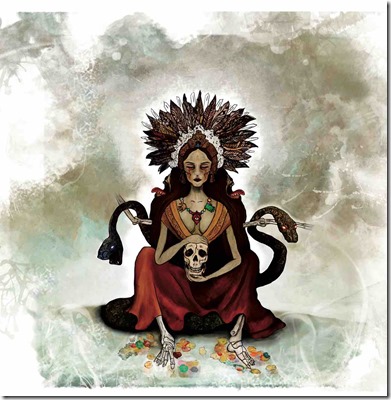
T.O.M.B.-artwork-websize

Crippled Black Phoenix have revealed the second track from their forthcoming album Bronze. The UK dark progressive rockers will release their stunning new full-length on November 4th.

New track  ‘Winning A Losing Battle’ can be streamed here:


Justin Greaves comments: “Some songs depart from my mind into reality without consent. ‘Winning A Losing Battle’ is one of those. The track just barged itself into the world. It is also one of the musically unconventional Crippled Black Phoenix style of songs that keep appearing on our albums. The title says it all. We have been through a lot of adversity as a band in these past two years and even though it seemed that all is doomed at times – I/we never gave up or gave in. We just say ‘screw you’ to the people and forces that tried to bring us down. Crippled Black Phoenix win, and always will.”

Christopher Nosnibor

For a Sunday night it York, it’s not a bad turnout, and while I’m not often a fan of seated shows, this bill of laid-back electronic-based music lends itself perfectly to adopting a less upright position for optimal enjoyment. Plus, it makes a welcome change to be able to put my beer on a table in front of me, rather than have to clutch it and thus warm it with increasingly condensation-dampened hands, or to concern myself with wearing a jacket with adequately capacious pockets that facilitate free hands for taking notes, taking photographs.

Two of tonight’s acts I saw only a few weeks ago, and when Mayshe Mayshe opened up for Living Body (for whom Shield Patterns were the main support) at the Brudenell in Leeds, I was charmed by her lo-fi minimalist pop tunes. Tonight’s set confirms that the bells, whistles, mini-pianos and hair-dryers aren’t gimmicky features of a novelty act, but genuinely useful features of a sound that’s spurred by innovation. Her songs are beautifully crafted examples of quirky bedroom elecro-pop. But for all the sparseness, there are some dense bass tones.

Mayshe Mayshe

Mayshe Mayshe

Having been less than enthused by the performance of hipster laptop DJ Game Program supporting Silver Apples recently, I’m even less enthused by Jakoby’s noodlings. In fairness, he has a lot of ideas. Some of them are good, and some are very good. But many of them are not, and his compositions have a tendency to throw everything at every track, often simultaneously. There were at least a dozen points that would have made a tidy ending to the set, but he kept bringing it back up and what’s likely intended as a brain-bending sonic overload ends up being an overlong exercise in onanism.

Jakoby

Jakoby

What a contrast, then, Elsa Hewitt. Same format in principle: a solo performer with a laptop and a mix desk, she’s understated as a performer, but it very soon becomes clear she has an immense talent and is doing something genuinely different. In this line of work, even the inventive and the radical can pale against the sheer volume of acts trying to carve a niche by virtue of their supposed uniqueness. But with some thunderous trip-hop beats – which are in places contrasted with minimalist, flickering glitch beats – and washes of amorphous sound over low, throbbing, scrotum-vibrating bass, topped with ethereal vocals and looped self-harmonies, Else forges a sound unlike anyone else. Building some slow-burning, hypnotic grooves, the gap in the market for Urban Ambient is hers for the taking.

Elsa Hewitt

Elsa Hewitt

It’s Claire Brentnall’s birthday, and having launched the second Shield Patterns album with a hometown launch show in Manchester the night before, she celebrates with a superlative performance tonight. The duo’s layered, detailed music is well-suited to the intimate atmosphere of the darkened Crescent, and the PA does it justice. The tonal separation and sonic depth is magnificent, the vocals crisp yet still shrouded in reverb: effectively recreating the sound of their considered studio recordings, it’s easy to get lost in the space between the layers of sound. Brentnall’s haunting vocals are enveloped in extraneous noise and a gauze-like blend of synths and field sounds, while Richard Knox hammers out thunderous, rolling drum sounds on an impressive drum pad setup. With the minimal lighting, it all makes for a compelling show, and a magnificent way to end a weekend.

Shield Patterns

Shield Patterns

Guide to Saints – SNT016

Christopher Nosnibor

The opposite of contrast. Absolute sameness. White on White, as a concept in visual terms, suggests invisibility. A white object in a white room, or a white brushstroke on a white background is ultimately camouflaged. However Dulux may sell it, white is an absolute. How does this translate to a sonic palette? An Infinity Room (AIR) is the vehicle – or durational sound project, if you will, of Australian artist and composer Julian Day. White on White collects three pieces

‘Intercessions’ takes the form of a continuous mid-range drone. It has a duration of 45 minutes. Three quarters of an hour. Listen to the tone… marvel at how it remains the same. Or does it? Just as the mind struggles to process images passed by the eyes when starring at a vast expanse of nothing – of white on white, or the imperceptible changes in colour as paint dries – so the messages from the ear become subject to the introduction of aural mirages when presented with a single, unchanging sound, or a sound which changes so gradually as to effect unchangingness. The pitch does, indeed, change, and additional layers are gradually phased in to bring new depths and dimensions, as skipping back and forth along the track at random renders clearly apparent. But being so, so gradual and so, so slight and subtle, the changes are imperceptible in real-time. The album’s shortest track at a mere seven minutes, ‘Rhetoric’ is also the most overtly rhythmic, the intertwining piped notes interweaving to render a dainty melody. But it’s more about the interplay between the notes and the way they interact in the air and in the ear than about making musical entertainment.

‘Void’, here in an edited form and with a running time cut down to twenty-seven minutes pulses gently for is duration a single note, throbbing for an eternity eventually graduates to a widescreen wavering drone, the texture and tone of which slowly changes, but again, slowly, so slowly.

White on White is an album which is likely to test the patience, and equally, the mental equilibrium. Focus on it too closely, it becomes tedious and frustrating. Focus on it too little, and it’s hard to appreciate its infinitely subtle progressions. Find that interzone and you’re in a place where its presentation of nuance upon nuance makes sense. Don’t force it, embrace it.

https://player.vimeo.com/video/102786092


Infiniy Room - White on White

Gizeh Records – GZH68 – 2nd September 2016

Christopher Nosnibor

Richard Knox’s musical career is marked by works which are ponderous and atmospheric. Howeevr, his latest venture in colaboration with Claire Brentnall, is distinguished by a leaning toward material which feels more focused, compositionally, and more direct. It’s all relative, of course, and Mirror Breathing is, as the title implies, a work which is hazy, misty, the songs grasping, just for a second, at the ephemeral and reflecting the moments back, refracted and rarefied. Following on from debut album Contour Lines (2014) and 2015’s Violet EP, Mirror Breathing marks a step further into dark pop territory, although dark is indeed the operative word here, and it’s clear that in Brentnall he’s found the perfect collaborator: a person with not only an amazing voice, but an equal understanding of what it takes to forge ponderous, nuanced, atmospheric music. It’s not a matter of drawing out which each brings to each composition: Shield Patterns are built on collaboration and intuition, more of a case of a creative space emerging from a collective ‘third mind’ than the simple coming together to two musicians. 

The musical backing the pair create is atmospheric, and captures elements of light and shade which contrast magnificently; dark, rumbling low-end and industrial scrapes are tempered by ethereal ambient sounds of indeterminate origin. Claire Brentnall’s breathy vocal hangs, spine-shiveringly, over the drifting soundscape. The whole production is draped in a soft-focus feel, a mist which partially obscures the shapes and forms and renders them vague, unfamiliar and ambiguous. This ambiguity and unfamiliarity is an unsettling sensation, and while the graceful vocals superficially soothe, the emotional tension and overall sonic disquiet ultimately leave the listener pulled in different directions, peering into the shadows and wondering what lies just out of view. Arrhythmic percussion echoes in the dark, detonations which send shuddering vibrations through the ground. There’s a stark beauty to ‘This Temporary Place’ that calls to mind Zola Jesus, and elsewhere, dark industrial grumbling tremors contrast with the dreamy, otherworldly atmosphere of ‘Cerulean’.

Julia Kent is an artist who has a tendency to crop up in all sorts of places and with remarkable frequency: a respected solo artist in her own right, she is also a one-time member of Black Tape for a Blue Girl, as well as performing as a member of Rasputina and Anthony and the Johnson, he cello work on three of the tracks here adds further texture to the arrangements. Ultimately, though, it’s the balance of the instrumentation which really makes the album work: there’s a lot going on, with many incidental sounds blended in, but it’s seamless and no one aspect or sound dominates at any point.

Again returning to the connotations of the title, if the image of a steamed mirror can be read as a twist on the ‘smoke and mirrors’ metaphor, then there is an element of deception in the way the compositions seem sparse, but are in fact constructed from manifold layers which form strata of remarkable sonic depth and density. The drums may be distant-sounding and low in the mix, but they roll like thunder. In Claire’s vocals, you don’t hear every word, but you feel them. Sometimes she soars so high as to be barely audible to the human ear. Sometimes, it’s less about the actual lyrical content than the delivery, and her voice as of and in itself conveys more than mere words ever could. There’s a quality in Claire Brentnall’s voice which communicates on a subconscious, subliminal level. Her voice echoes in the recesses between the beats, drifts along, enveloped in the gauze-like textures, and occupies invisible spaces between the notes. Hers is a voice which is delicate, but by no means weak; yet the strength of her delivery lies in her ability to convey vulnerability.

From the alluring ‘Dusk’ to the dolorous chimes of ‘Blue Shutters’ and the sinister depths of ‘Balance & Scatter’ with its dark jazz intimations, via the tranquil and sedate(d)‘Sleepdrunk’, the songs conjure scenes of both anguish and ecstasy and often explore the pull of existing in both states simultaneously. Haunting, hypnotic and disquieting, Mirror Breathing is an impressive work that warrants time for thought and reflection.

Shield Patterns - Mirror Breathing

Entertaining Violence

Christopher Nosnibor

I am often drawn to duality of interpretation or meaning, particularly when that interpretation hinges merely on emphasis. As such, I think ‘Entertaining Violence’ is a great name for a publisher / label, and looking over their small but select catalogue to date suggests it’s highly appropriate. Essentially, Entertaining Violence is concerned with art, and the principle functions of art should be both to entertain and to educate, or, perhaps more accurately, to provoke thought. Art and entertainment are by no means mutually exclusive, and nor should it be considered untenable for art to both entertain and provoke. Their latest release achieves this, although it does very much depend on one’s perspective as to just how much entertainment it provides.

To provide some context from the press info: in the summer of 2015, Sergio Calderón – founding member of London-based avant-garde band 無 (MU) – was invited to participate in the exhibition Not a State, But an Artists’ Colony at Intelligentsia Gallery 智先画廊, Beijing. Sergio conceived STEREO as a transcendental and meditative experience compromising a Two Channel-Video and Sound Installation. As such, STEREO is a soundtrack piece, which was recorded as a live improvisational work of guitar sound and texture recorded at Entertaining Violence Gallery, London the 15th August 2015.

It is not a work which builds at any point: there are no crescendos or bursts of sound, but there are infinite textures. STEREO is a work which explores tonality, in the subtlest of ways. The track drifts on, concentrating on the ebb and flow, the wash and drift as notes struck rise and fall, decay and reverberate in the space in which they’re created. It doesn’t ‘go’ anywhere: that is not its purpose or aim.

What this 47-minute piece really conveys is the tonal range of the electric guitar, when played minimally and given room to breathe. Some may call this drone, ambient; and certainly, the notes and chords stuck are left to hang in the air for an eternity. The tones, the sounds are in themselves muddy, hazy, murky; this is no crisp digital replication of a guitar’s sound, but a fading analogue sound, fuzzed and degraded by environment, by space, by recording technology. It reminds that the listener is never truly ‘in the moment’ when listening to a recording, they are not ‘present’ and the recording is just that; a captured version of events; a recording is not the event itself. A recording may accurately convey the sound, or at least he sonic experience, but it can never fully convey the environment in which the recording was made, it can never capture and convey the experience of being present in the moment the audio was captured. It will never incorporate the experience of whatever may be going on around simultaneously, it can never capture the emotion or the mental processes contemporaneous to and triggered by, the moment.

For all of this, however great the listener’s separation from the moment, a work like STEREO, or, indeed, specifically STEREO affords almost infinite space for the listener to lose, and find, themselves.

https://player.vimeo.com/video/165013545?color=ffffff&title=0&byline=0&portrait=0

STEREO — 無 (Excerpt) from Sergio Calderon on Vimeo.


mu01_stereo1

MU at Entertaining Violence Online