Posts Tagged ‘Dark-Ambient’

Sweden-based industrial/dark ambient artist ULVTHARM has released his second opus “7 Uthras” on May 3rd via Cyclic Law. The album is available as digisleeve CD (limited to 300 copies), black vinyl (limited to 200 copies), and red & black marbled vinyl (100 copies).

An official video has been released for the song ‘Sinners Will Inherit The Earth’. The video displays a female character – interpreted by the actress Emelina Rosenstielke (Feed) – sitting in a colorless room and in the center of a target painted on the floor. The character, who embodies modern civilization, is apparently afraid of the risks she may incur. Ulvtharm’s arrival on the scene and the subsequent initiation of a ritual reveal the true identity of the character, as well as of our civilization – thirsty for blood and personal success. We are all sinners on this Earth.

Watch it here:

“7 Uthras” is the second release from MZ 412 co-founder Jouni Ollila. Ulvtharm is painting his world as a sprawling, post-apocalyptic industrial wasteland, where humanity clings to survival in the shadows of monolithic factories and decaying cities. Skies choked with ash, and a sun that seldom breaks through the omnipresent smog. Within this landscape, the Seven Uthras exist not as beings of benevolence, but as ancient, god-like entities that emanate from the darkest depths of the earth, commanding forces beyond human comprehension. 7Uthras serves as a sonic gateway to otherworldly realms, offering a glimpse into the abyss that challenges and expands the listener’s perception of the known universe.

The artist masterfully blends the essence of dark industrial soundscapes with layers of mystical ambiance, creating an immersive experience that is both deeply unsettling and profoundly enlightening. This new album is not just an exploration of sound but a journey into the soul of its creator, exploring the chaos and darkness within his imagination. ULVTHARM’s deeper vocal experimentations are weaving a narrative that is both personal and universal. The album’s blend of dark, martial, pulsating rhythms and ambient organic soundscapes invites us to confront the death and ruins of our world. As each track unfolds, we will be drawn deeper into a narrative of chaos and transformation, where the end of one world signifies the birth of another. “7 Uthras” is not just an album; it is a ritualistic journey that seeks to unlock the ancient doors of perception and embrace the darkness as a path to enlightenment. All hail the Serpents, all hail the Seven Uthras!

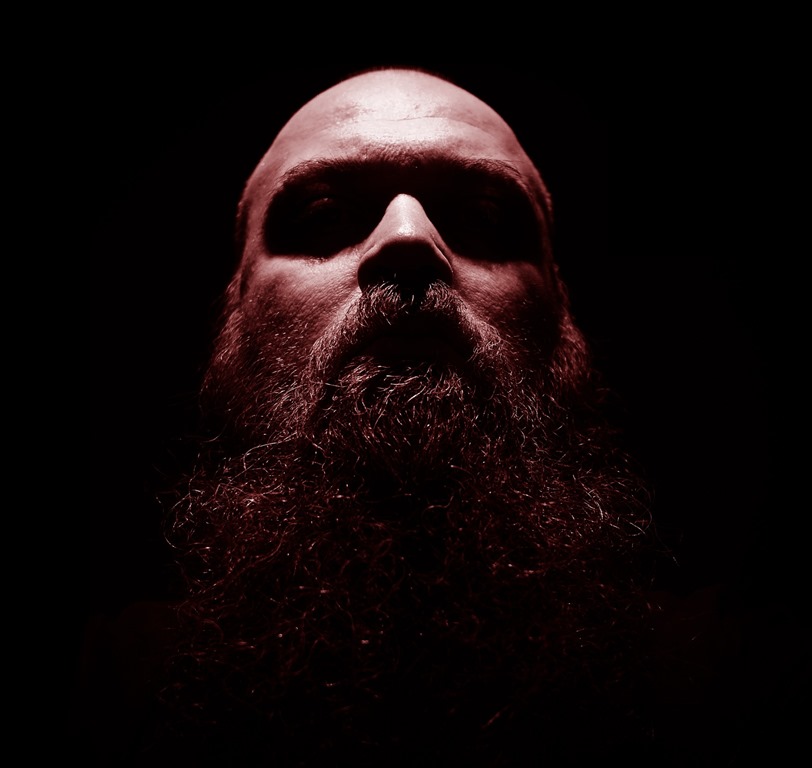
thumbnail_Ulvtharm Photo

22nd March 2024

Christopher Nosnibor

Everyone has a different way of processing, everyone’s cognition operates differently. It’s all a matter of experience and perception. The broader one’s experience, and also one’s exploration of art – in all media, be it books, music, visual art – the broader the network of intertext and references available. Formative experiences and interactions are also a significant factor in the way we come to shape and comprehend our world. And so it s that the moment I encounter the words ‘Black Maria’, my mind immediately leaps to ‘Afterhours’ by The Sisters of Mercy – my first encounter with the term, long before I would understand that it was a term for a police van. Attrition’s latest release certainly doesn’t elicit images of dark vehicles, but does hint at the seedy backstreet scenes that the Sisters song brings to mind, with its sense of disconnection, of being outside yourself, .the paranoid twitch of sleep deprivation

The album’s brief intro track, ‘The Promise’ is a murky ambient piece with hushed spoken-word vocals which is build a mood, a sense of dark atmosphere and foreboding. This intro track thins has really become a vogue in recent years, to the point that it’s becoming predictable and even frustrating to be presented with an atmospheric opening piece which probably isn’t particularly representative of the album it prefaces.

In the case of The Black Maria, it’s a fair primer for the wildly varied, even cacophonous blend of musicality which follows. ‘The Great Derailer’ brings operatic vocals and some bold technoindustrial grooves, before ‘The Switch’ gives us some techno-heavy goth with strong hints of Twitch-era Ministry woven into the mix. But once again, against the busy backdrop that alludes to the likes of PIG and KMFDM, there are ethereal moans and wails which drape themselves hauntingly. I’ve loosely reminded of some of the contributions Gitane DeMone made to Christian Death around the time of Ashes, or maybe Jarboe on Swans’ Children of God, but this is somehow different, and if anything, more difficult to assimilate.

Attrition bring a vast array of styles to the table for a start. ‘The Pillar II’ is exemplary: a low industrial throb brings a heavy tension, an unsettling uncertainty, which manifests as a discomfiture in the lower regions of the gut. But the wailing wordless vocals evoke tortured souls, wandering in purgatory. There are tense strings swelling and holding a tight grip, you find your chest tightening and it’s hard to swallow for this clench of tension. It evokes physical response: I feel my jaw clench and my breathing growing more laboured as the track builds layers of sound: there’s a hum that tortures the ears, and when it falls away, the sensation is strange, empty.

Music box melancholy prefaces more ultra-tense violins on ‘The Alibi’, which really takes a turn for the disturbing. The dual vocals grate against one another, dark sinister, deranged, almost schizophrenic in their whispers. The layers are busy and there are serpentine instrumental intrusions amidst the strolling piano and skittering strings and the wild cacophony of backing vocals: the effect is absolutely dizzying. The title track draws the album to a close with warping, time-bending synth dissonance and pulsating bass which contrasts with operatic quailing providing the backdrop to a growled, menacing spoken word vocal – and then it goes large near the end, with industrial-strength percussion cutting through the melee.

‘Spooky’ feels like such a weak, tame adjective in the main, but it’s the best I’ve got when it comes to summarising the otherworldly discomfit of the experience that is The Black Maria. But throughout The Black Maria, Attrition channel all of the dissociation and disconnection, and I’d challenge anyone to listen to this and keep their feet completely on the ground.

AA

a0847003042_10

Sonoscopia sonos – 15th September 2023

Christopher Nosnibor

Trobollowitsch is certainly a name that sticks in the mind, and so it was that back in 2016, I penned a piece on Roha by the Austrian Sound artist. At the time, I struggled to really connect with his conceptual compositions.

This latest offering finds him working with Thomas Rohrer, a Swiss musician, who ‘plays the rabeca, (a Brazilian fiddle), and soprano saxophone’, and whose work ‘is largely based on free improvisation, but also engages in a dialogue with traditional Brazilian music.’

The collaboration between the pair actually began in 2017, but they didn’t begin work on any recording until January 2021, when, according to the bio, ‘they embarked on a duo project combining Trobollowitsch’s rotating mechanical turntables equipped with branches, wood and dried leaves with Rohrer’s soprano saxophone, small objects and rabeca… During their collaborative recording process, renowned singer Sainkho Namtchylak from the Tuva region contributed her captivating, versatile voice, which she has used to great effect in a variety of musical genres, including jazz and electronic music.’

Given their diverse background and different modes off operation, this collaboration was always going to be not only eclectic, but a collision of diversity, and the question would always be to what extent do they compliment one another, or otherwise pull in such different directions as to render the work more of a competition than a collaboration? Given that both Trobollowitsch and Rohrer are credited with ‘recomposition’ of several tracks, there’s a sense that this effort is defined, if not by friction as such, then by differences, and a working method which entails dissecting and reconstructing, a restlessness and dissatisfaction.

Crackling static and an electrical hum are the key elements of the title track. It’s somehow both spacious and claustrophobic, and as the sounds rumble and echo around, you feel like your shut right in a small room – more like a walk-in cupboard – as the serrated buzzes and grinding drilling sounds fizz and fret all around, gradually warping and twisting, sometimes ballooning and others shrivelling. Suddenly, I jump. Is that my phone vibrating? No, it’s not, it’s a vibration puncturing the third wall, something that sounds like it’s in the room rather than coming from the speakers, which are by now emanating shrill blasts of feedback.

The sound collaging on this album is something else, leaping into the three-dimensional at the most unexpected moments, and the sounds and textures constantly shifting to forge a work which is more than music, more than sound: this is something you feel, not emotionally or cerebrally, but physically: it makes your fingers tingle and move in a quest to grapple with the details. Sometimes those details are dark and demonic, as on the unsettling ‘Ovaa’. The vocals are rasping, gasping subterranean, subhuman grunts and gasps, strangled cackles that cark and bleat and croak and claw up from the sewers. It’s pure horror.

There are undulating, stuttering low-end bumps, there are hornets the size of buzzards as your car breaks down and your skull slowly crumbles as your brain struggles to process everything… anything. This is a soundtrack to something that simply shouldn’t exist; it’s aa soundtrack to your worst nightmares, as yet unimagined.

The production, the panning, the listening experience of interacting with this in the way it’s intended is terrifying and surprising in equal measure, as tweets and twitters occupy the same space as thunderous thumps and insectoid skitters and metallic scrapes and… there’s a lot going on, and it all makes for in accumulate and intense and really rather difficult sort set – not really of compositions, but largely incoherent audio processes. The accumulations and stacking of the sounds is by no means truly random or haphazard, but their assemblage creates as experience which feels altogether more happenstance. It’s a scrappy, scratchy, stop-start mangling of noise, and at times, it’s scary and strange, at other’s it’s ominous and eerie. It’s unsettling, and difficult to absorb. It’s incredible.

sonos#26A_front

illereye / Eyeless Records – 28th July 2023

Christopher Nosnibor

Lee Riley’s works include only minimal information about their inspiration or methodology, often coming only with the advice of ‘loudspeakers or headphones’. This is sound advice – if you’ll pardon the pun – not least of all because try as I might, I have never yet succeeded in listening to anything telepathically. This no doubt sounds incredibly facetious, but I’m only partly joking. With my inbox bursting with more new music than I could ever listen to in ten lifetimes, and that’s assuming a lifetime is a couple of centuries, I often find myself lamenting my inability to simply absorb all of the music by some kind of cerebral osmosis. I have sat and visualised a method whereby I place electrodes to my temples and the files simply transfer, or even a large syringe by which the music could be injected into me. I have similar visualisations about writing. Speech to text dictation programmes simply aren’t enough, it’s not practical for the most part. Since I compose most of what I write in my mind while walking along or doing other things, what I need is thought to text, by which the ideas simply appear on the screen. Way more useful than the AI shit that’s supposedly taking over.

With no detail to contextualise the title, or the sound contained therein, From Here We are Nowhere leaves us to interpret for ourselves, and before I hit play, I feel a sense of pessimism descend upon me from the inference of the phrase. The future is bleak… we are nowhere… lost, adrift, or worse, the connotations are there of ceasing to exist. Perhaps it’s my habit of having news channels on in the background while I go about my day, while I work my dayjob, while I cook on an evening, on mute but with subtitles, and the last week or two have elicited a sense of impending apocalypse. And I ask myself, why has it taken till now, when half the world is either melting or on fire to take climate change seriously. So where do we go from here? Probably nowhere.

The six pieces on this album take the form of dense, suffocating drones: the title track thrums and throbs like a thick, acrid smoke that engulfs your entire being, five-and-a-half minutes of muffled tones that grow in tension. Shards start to scrape and funnel near the end, but then it’s gone, just beyond reach. There is something illusive about this album. It feels as though there are forms to be found, but they’re submerged. ‘Lifting Undertow’ is ominous, and the scrunching scrapes and rattles are menacing, reminiscent of a sensation I experienced in a recurring dream as a child, perhaps most easily described as the visual disturbance of a migraine manifesting in an aural form. It’s all very quiet and low-key, making you feel quite detached from the plane on which the sound is playing out, and this is true of the album as a whole. ‘Undoing These Knotted Times’ is a long, low, sonorous undulating buzz that’s sedative and soporific, but also uncomfortable and queasy, as bleary and blurry as the cover art suggests. As that final note hovers and fades, a desolation grips harder: is there really any scope to undo these knotted times? Or is this simply a painful paradox?

The idea of ‘Staring Through Lit Skies’ feels optimistic, evoking perhaps a sunrise, but the reality is that the serrated drone and scrapes of feedback are more like looking at the searing sun through the smoke of a wildfire. It’s painful, and damaging, and it saps your strength as the only dawning is the realisation that we are all doomed.

I feel in my limbs and in my lungs and in my heart as the final trails of ‘No One Knows What’s Inside’ dissipate into the thick, claggy atmosphere following a crackling hum of distortion and grumbling, and then, there is nothing. And here we are, as we find ourselves… nowhere.

AA

cover

Cruel Nature Records – 16th June 2023

Christopher Nosnibor

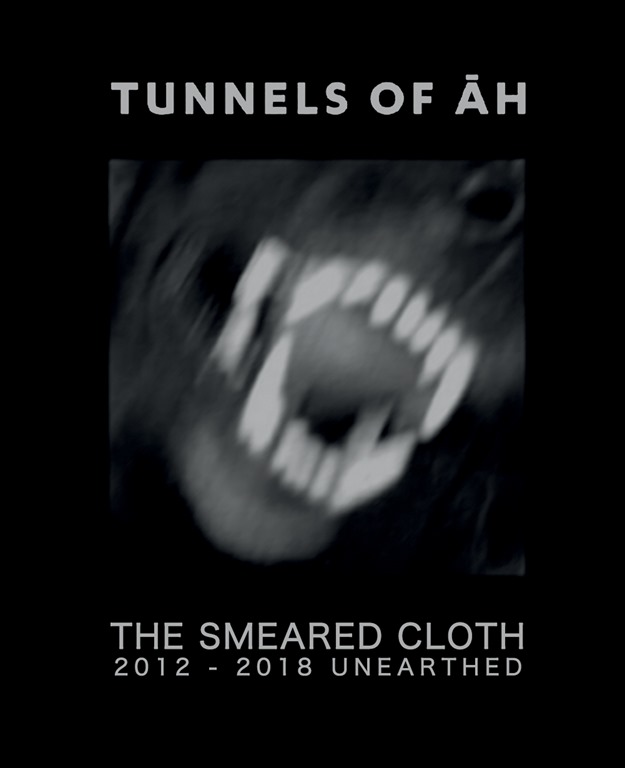
After calling time on Head of David in 1991, Stephen R. Burroughs re-emerged in 2013 as Stephen Ah Burroughs with recording as TUNNELS OF ĀH, and offering a dark ambient focus. Since the first TUNNELS OF ĀH album, Lost Corridors, Burroughs has maintained a steady output through the years, also working under the FRAG moniker (although this project was conceived in the ‘90s, it wasn’t until much later that recordings would begin to be released).

THE SMEARED CLOTH (2012 – 2018 UNEARTHED), as the title suggests, collects unreleased recordings made between 2012 and 2018 and more recently excavated. You couldn’t exactly call this a cash-in: this is ultra-niche and it is, however, a valuable dredging of the archives.

The cassette release is a double, with volume 1 spanning 2012-2015, and volume 2 spanning 2016-2018, and while an album conceived as an end-to-end listening experience would suffer from the enforced breaks, the (cruel) nature of this release means this isn’t an issue.

Oftentimes, with dark ambient works it feels as if the sounds are drifting out of the air rather than being forged by any kind of instruments, but the warping drones of the first composition, ‘Aceldama’, twist and grind and there’s quite analogue synth feel to it, with distant vocals adding an intriguing depth. In contrast, ‘Garlic Blades’ feels as if it something that has come not from instruments, but from a pair of bellows wheezing in a dank underworld. The two sonic facets come together on the third track, the heavy, stark ‘Brute World’ where drifting drones and creeping atmospherics filter over tense, brooding strings, and this all provides the backdrop to barely-audible incantations in a mystical tongue.

These contrasting elements highlight the range of the recordings featured on THE SMEARED CLOTH – and with twenty-one tracks, the majority of which are over six minutes in length, it’s a substantial document. But despite the contrasts – and the span of time over which the recordings were made – there is a certain cohesion to this collection, and the tracks run from one to the next without there being any jarring leaps.

Repetition is a common feature of the compositions; ‘Keys King at the Womb Again’ is centred around a short loop of a heavy industrial scraping, which equally sounds like a pained bark – or a pained barf, for that matter. Because Burroughs does venture into harsher territories at times, there’s some uncomfortable listening to be had among the drones and hums, scrapes and chants, and there are extended passages of quiet, ominous ambience, sounds without definition or any indication of origin ebb, flow, and eddy, to unsettling effect. The mid-section in particular is given to these more abstract forms, the sounds muted and creeping slowly, stealthily. ‘The Cloth is Smeared’ is exemplary: the words, spoken in an even, ritualistic tone, echo amidst creaking, creeping hums and clattering , and while stylistically worlds away, it harks back to themes that go back to early Head of David: the viscerality of ‘Smears’ (it’s a word which carries so much power and evokes a real revulsion, and religion, as represented by cuts like ‘Newly Shaven Saint’. Somewhat annoyingly and inappropriately because my brain is not my friend, the phrase ‘touching cloth’ insists on thrusting itself into my mind – and my mind wanders as it finds itself led through the dark, metal-edged passages of ‘Great Darkness’ with churning noise and what sounds like the clank of metal against railings, as if in protest or otherwise or trapped inside a prison cell. ‘Metallic Shoes and a Sword’ is particularly sharp-edged in the abrasive edges that saw through the swampiness of the damp gloaming, before ‘Gnosis of Self Loathing’ and ‘Amorphophallus’ drive us deep into some gruesomely dark spaces, suffocating, strangling, asphyxiating in their density: these are the sounds of slow punishment.

While the pieces themselves are (essentially) instrumental, the titles convey a great deal and ‘Circumcision (Hunter Christ)’ and ‘The Castrate Became An Angel’ largely speak for themselves. The latter is minimal, jittery, tense, like listening to the sounds in the walls at night and wondering if you have some kind in infestation. And perhaps. perhaps you do, but it’s in your body, inside your skull. There’s nothing here to calm that anxiety, only crackling distortion and drones and groans, grumbling, gut-shaking rumbles.

THE SMEARED CLOTH hangs dark, damp, and heavy, and rather than sounding like a bunch of straggly offcuts, it showcases the depth and breadth of Burroughs’ work, that the works in progress and outtakes and otherwise cast off and forgotten recordings are enough to make two full-length albums of consistent quality.

AA

cover

Room40 – 2nd June 2023

Christopher Nosnibor

I’ve been engrossed by Lawrence English’s works for some years now, and my appreciation of him and his methods were only enhanced when I conducted an interview with him about ten years ago for a now-defunct site (so many are now: the idea that once online it’s there forever has been proven false, and we’re all sitting, bewildered by as rapidly-vanishing archive of the recent past), where we touched on cut-ups and William Burroughs and I was struck by the depth of his knowledge and references.

But I have grave concerns around future history, or the future of history. While the move to digital was hailed as a move toward permanence, incorruptibility, the opposite has proved true. No-one writes anything down anymore, no-one produces additional. tape copies. If your hard-drive gets fucked, so does your entire library. The Cloud? Do you even know where it is? Does it even exist?

While we reflect on this, let us also consider this album and its slow gestation. David Toop is another artist I’ve spent some time listening to, and writing about, including his Breathing Spirit Forms three-way collaboration with Akio Suzuki and Lawrence English, but this is the first time just the pair of them have worked together, and Lawrence explains its evolution as follows: ‘Over the years, David and I have shared an interest in both the material and immaterial implications of sound (amongst other things). Moreover we’ve connected many times on matters which lies at the fringes of how we might choose to think about audition, our interests seeking in the affective realm that haunts, rather than describes, experience. The Shell That Speaks The Sea very much resonates from this shared fascination… I’m not exactly sure when we first mooted this duet, but I sense its initial trace is now more than a decade ago. I tend to live by the motto of ‘right place, right time’ and I believe David likely also subscribes to this methodology. A couple of years ago, David and I reignited the duet conversation and began exchanging materials. As a jumping off point, I explored a series of field recordings that, for me at least, captured something of this affective haunting that I mentioned previously’.

And haunting it is: ghosts of memories and fragments of half-recollections lurk and loom amidst the thick, dark shadows forged by the unsettling sounds. The title suggests an album of soft ambient washes, a gentle tidal swash, a soothing, tranquil work. It is not.

‘Abyssal Tracker’ is remarkably atmospheric in a sparse, gloomy, sense, and provides a fitting introduction to the duo’s idiosyncratic work, compiling sighs and vocal rasps over elongated strains of feedback and a suffocating atmosphere. Shrill shrieks echo out over eerie notes and a scratching insectoid clamour in the trebly range. Thuds ripple beneath the surface: there is so much texture and detail here, you find yourself looking about nervously, seeking the various sources and to see what’s over your shoulder, or hovering above your head.

Clanks and clatters and clanks and thuds are the dominant features of this album, and is lasers fire into the abyss of emptiness on the dense and disturbing ‘Reading Bones’, which scratches and scrapes, while there are earth-churning low-range disturbances – and words, but they’re indecipherable, spoken in low, whispering grunts, and it’s impossible to decipher even the language, sounding as it does like an ancient incantation.

It’s not all quite so skin-pricklingly tense, but much of it is: ‘Mouth Cave’ is dark, dank, low and rumbling, but has textures and what sounds like the trickle of running water spattering in the background amidst the cavernous gloom, and if ‘Whistling in the Dark’ sounds like a simplistic description, it’s accurate – but also suspenseful, scary and bordering on horror tropes; the whistling is deranged and floats through a heavy, crackling doomy drone. There are more ominous mutterings amidst the creeping darkness of ‘The Chair’s Story’, which feels like casting a look back through the ages through a thick fog at scenes of torture and pain and great sorrow and forward, to a laser-bleeping future.

As I seem to be prone to lately, I found myself nodding through fatigue but also, simultaneously, tense and alert during The Shell That Speaks The Sea, an album which possesses vast sonic expanses and a bleak, oppressive atmosphere. Each track offers something different, and this only accentuates the ‘otherness’ of the music this album contains; it’s like walking through a series of disturbing dreams, whereby each scene presents a new unfamiliar setting, and there are hints of BBC Radiophonic Workshop and vintage sci-fi about this incredibly imaginative work.

It may have taken a long time to piece together, but the results make the labour more than worthwhile.

AA

RM4205_front

23rd March 2023

Christopher Nosnibor

It’s been a while since I’ve seen it, but the title of Eric Angelo Bessel’s new single reminded me of the Jack Black ‘buddy comedy-drama’ (as Wikipedia would have it) from 2008, which reminds us that nostalgia for VHS and film rentals hit pretty swiftly after their demise, in real terms. In fact, here in the UK, Blockbuster creaked on with DVD rentals and secondhand sales into 2013. But as an article in The Independent in January 2013 reported, ‘While the North Finchley store had a poor selection of DVDs, the big surprise was that it was charging £5 to £8 for second-hand films to buy, so I bought brand new ones at HMV instead.’ As such, it was clear that times had changed and the world had moved on long before the last rental stores closed their doors.

But the idea of rewinding – something intrinsically connected to the age of the cassette, be it audio or video – is one which is an instant cut to nostalgia, and one which reminds us that thee one thing you can’t rewind is life: there is no rewind on time, and the past is past.

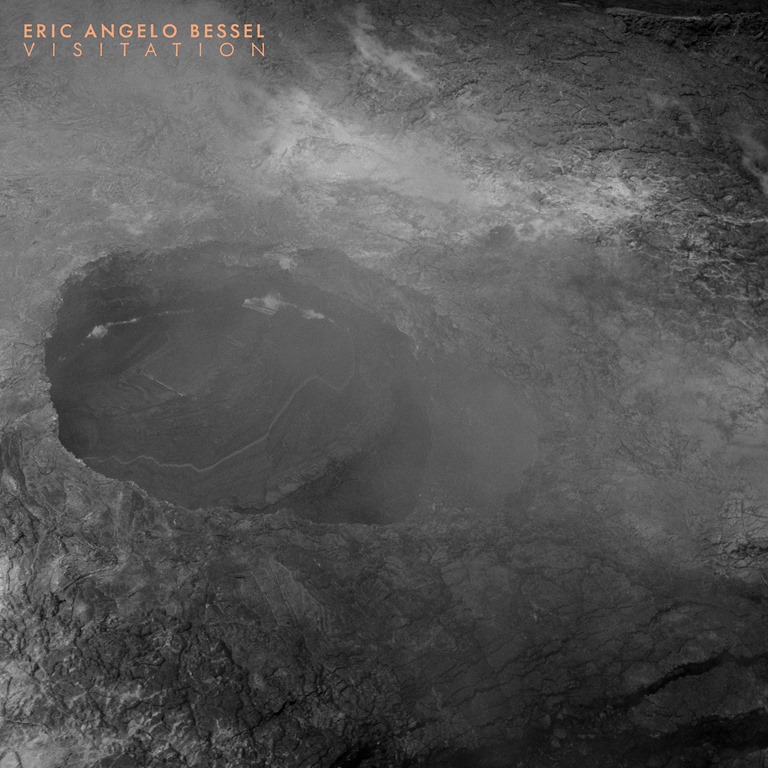
‘Kindly Rewind’ is a slow-swelling deep ambient piece that isn’t about nostalgia for the 80s or 90s, but instead drills deeper, venturing back to prehistoric oceans as its backward surges evoking images of slow evolution and microcosmic growth beneath the oceans. Sedate and supple, this is delicate and spacious and slightly disorientating. It’s also measured, musically articulate, and resonates unexpectedly. It’s a work of quality.

AA

Eric Angelo Bessel - Visitation

Dret Skivor – 3rd March 2023

Christopher Nosnibor

Fern’s Deformed is appropriately titled: this some mangled shit. From the slow, deliberate, rolling grooves that boom and bow through snarled up noise, while against it, crisp, crunching beats thump and stutter, Fern keeps things interesting and innovative, but more than anything, keeps it uncomfortable.

Deformed sits within that bracket of dark ambient that’s deeply dark, but not entirely ambient, and doesn’t for a second let you settle into it, instead twisting and squirming awkwardly, refusing to solidify or confirm to any one fork of style.

‘Intro’, the minute-long splurge of wibbly dissonance set the scene nicely for the following twenty-five minutes of oddball electronica. The liner notes offer ‘Respect to Portishead, aphex twin, faster katt and Mindacid for inspiration (samples)’.

The majority of the album’s ten tracks are brief sonic snippets, most being well under three minutes in duration, and in many respects, Deformed feels more like a palette sampler than a fully realised work – although that is by no means a failing, as it gives the album an immediacy that further evolution would likely dilute.

It’s four tracks in that Deformed really starts to take (strange, twisted, unexpected and indefinable) shape: ‘Greyhats’, a live recording – it’s unclear if it’s live in the studio or soundboard, but there’s no crowd noise and it fades at the end – is aggressive, dark, and difficult.

Immediately after, ‘Heaven in my hands’ is a murky mangled mess of distortion and mid-range, drums overloaded and crackling in a grey blurry sonic haze, and ‘Give Your Soul Away’ is a skull-pounding beat-driven assault, and the samples pile in thick and fast. ‘Porthole’ is dense, robotic, repetitive, and while dance elements are a defining feature of the album’s style, this is by no means a dance album: it’s stark, it’s bleak, detached, and in places, unsettling.

Deformed is many things: easy, predictable, comfortable, are not among them.

AA

a0661217700_10

Christopher Nosnibor

Coldwell’s own notes which accompany this – truly epic – album explains and articulates it best, when he writes ‘This new retrospective is certainly not your typical album. Each track is almost an album in its own right! The material sees CC at his most experimental, stripped back, noisy and immersive. Following on from last year’s Music for Documentary Film, this collection gathers together some of Michael C Coldwell’s sound art work and music written for exhibition and gallery contexts.’

This is very much one of the benefits of the digital format: there is no restriction of duration on account of data capacity. Time was when physical formats restricted the running time of a release, with a vinyl LP optimally running for around forty-five minutes but having the capacity to squeeze in about an hour, with CDs being able to hold seventy-two minutes and while a cassette could – precariously – take two hours, no-one released a two-hour single cassette.

Conflux Coldwell’s collection of installation works is immense, and with a running time of around two-and-a-quarter hours, it’s in the realms of recent Swans albums. While it’s by no means a brag, I’ve endured longer, notably Frank Rothkamm’s twenty-four-disc, twenty-four-hour Werner Process, and am also aware of Throbbing Gristle’s legendary 24 Hours cassette box set, but the point is, Coldwell has really made the most of the space available to him here.

I sometimes differentiate albums as being foreground or background, and Music for Installation is very much background, the very definition of ambient. That isn’t to say it’s uninteresting or unengaging. It’s simply a vast set of field recordings and sound collages that make you feel as if you’re in a certain environment. Unlike the aforementioned Swans albums, which I find are difficult to listen to because they require a commitment of time to sit with them and focus, to actively listen, Music for Installation is a very different beast which works while rumbling on while you’re doing other things. And as an experience, this very much works.

The fifty-five minutes excerpt (!) of Remote Viewer is exemplary. Passing cars, scrapes, drones, the sound of metal on metal, clanking, indistinguishable muttered dialogue, and extraneous sounds that range from – possibly – the rush of wind to the sound of feet gently passing on creaking timbers, all sit side by side and overlap in various shapes to create a latticework of real-life founds the likes of which you probably would ignore if you even noticed them at all under normal circumstances. Of course, if this is an excerpt, where’s the rest? It’s the kind of immersive soundwork that could run for hours and that would be perfectly fine.

The live performance of ‘Dead Air’, which runs for an album-length headline performance is superb. It’s testing, but it’s also magnificently executed. The sounds and textures are balanced, but the overall sound is gloopy. The result is a piece that’s creepy, evocative, and dissonant, and built around wailing whistles and pulsating drones that coalesce intro their own organic rhythms, drawing together elements of Kraftwerk and Throbbing Gristle to conjure a dark, dingy soundscape.

‘Dismantle the Sun’, running for fourteen minutes feels concise in comparison. It’s barely there for the most part, the most ambient of field recordings. It’s hard to identify any of the individual sources, but again, there are rhythms that emerge from the rumble off passing cars and the whisper of the wind, and the piece transitions both sonically and spatially as it progresses, at times evolving from a whisper to a howl. One feels a sense of movement, which in turn creates a sense of disorientation, although the voiceover detailing ‘solar oscillations’ in the closing minutes provides a certain grounding.

The final brace of compositions, ‘Alternating Current’ and ‘The Specious Present (How Long is Now?), which have a combined time of around ten minutes feel like barely snippets or sketches in comparison to the other three immense pieces, but what they lack in duration, they compensate in depth, being richly textured and showcasing some interesting beats and conjuring some dark, confined spaces. And for all its vastness, Music for Installation is quite a dense, claustrophobic experience at times – and it’s a quite remarkable experience, too.

AA

cover

Midira Records – 25th November 2022

Christopher Nosnibor

This album is, as the title suggests, a soundtrack work. Although released under the moniker Houses of Worship, it’s essentially the second album by Thisquietarmy x Hellenica.

The summer of 2020 saw Eric Quach (thisquietarmy) and Jim Demos (Hellenica) come together to record a collaborative album, which emerged as Houses of Worship, described as ‘an epic work of experimental industrial ambient, is an ode to dying buildings and the unwelcome gentrification of neighborhoods’.

This, the follow-up, came about after they ‘played their first concerts in the streets of Montreal from inside of a cube truck. These performances were filmed and recorded to produce "TQAXHLNKA: MIGRATION,” a twenty-two-minute experimental art documentary and an accompanying soundtrack. The film simulated the cautionary tale of what the Montreal arts and music scene could look like in a post-pandemic world. As the title suggests, it reflects the highly concerning exodus of artists constantly being divided and pushed out further from their community.’

At twenty-two minutes in duration, it’s a minute short of the magic spot, but this is a magnificently atmospheric work that goes beyond dark ambience and ventures into the vastly cinematic, space-drifting expansiveness that transports the listener beyond the terrestrial domain.

The album contains more audio than the film’s running time, and drags the listener through a bleak journey which articulates via the medium of sound the themes and scenes which preoccupy the duo, who explain, ‘With the current struggles linked to the pandemic restrictions, we have seen the acceleration of the gentrification process in neighborhoods where the heart of these activities takes place. As a result, a multitude of venues, studios and artistic spaces – places used for exchanging ideas with our peers and building communities meant to inspire and nurture our souls had to shut down.’

The tone is dark, the textures industrial, yet tinged with echo-heavy melancholy, a combination of anger, emptiness, and sadness. The soaring drones inspire a certain elevation, while the gritty grind is the sound of construction, regeneration. Gentrification is the face of capitalism eating itself; having run out of new ideas, it’s simply fallen into a cycle of recreation and rehashing. Upscaling, upwhatevering, it’s all about selling the new version of the same od shit at a higher price to the same saturated market. When will enough ever be enough?

Meanwhile, capitalism follows the former tropes of the avant-garde, destroying to rebuild, and Migration is the soundtrack to that.

There are lots of drones, lots of dolorous tones, lots of scraping, sinewy mid-range and gravel-grabbing, churning lower spectrum sounds, as well a haunting piano and infinite empty space. The titles paint the picture in themselves, and it’s dark, smoggy, sulphurous. ‘Total Waste Management’; ‘Polytethylene Terephthalate’; ‘Oil Terminal Tank Farm’ are all evocative of stark industrial scenes.

‘Industrial Estate Bird’s-Eye’ is a haunting wail, presumably of a theremin – over a low, throbbing drone that’s reminiscent of Suicide, and elsewhere, the duo conjure thick, billowing clouds of doom that sound like Sunn O))) behind a power station, as dense rumbles ripple forth. The twelve-and-a-half-minute finale, ‘Throbbing Magnetics’ fulfils the promise of its title, a bucking beast of claustrophobic, crushing gloom, and you feel yourself dragged into the sludge of that relentless, interminable cycle of collapse and construct.

It’s an accomplished work, but a depressing one, and listening places to the fore the abject nature of late capitalism, and the fact that any attempt to save the planet is futile in the face of the onslaught of bulldozers. Redevelopment has nothing to do with environment, only profit, and hard as you might rebel, as strongly as you may protest, you’re powerless against the big money. It’s not a conspiracy, it’s the sad truth. Houses of Worship recognise this. They may hope for better, but Migration is not a protest record, but the sound of grim acceptance.

AA

a3486628679_10