Posts Tagged ‘Cruel Nature Records’

Cruel Nature Records – 16th June 2023

Christopher Nosnibor

After calling time on Head of David in 1991, Stephen R. Burroughs re-emerged in 2013 as Stephen Ah Burroughs with recording as TUNNELS OF ĀH, and offering a dark ambient focus. Since the first TUNNELS OF ĀH album, Lost Corridors, Burroughs has maintained a steady output through the years, also working under the FRAG moniker (although this project was conceived in the ‘90s, it wasn’t until much later that recordings would begin to be released).

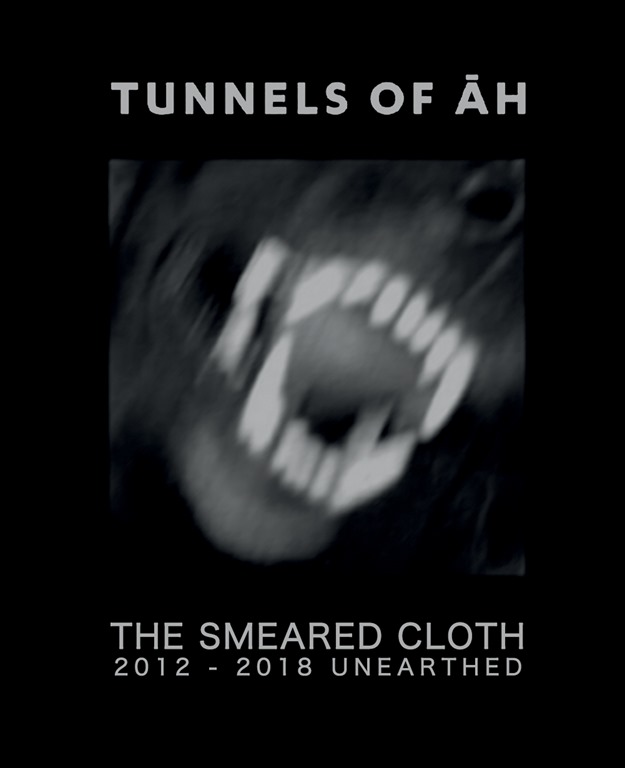
THE SMEARED CLOTH (2012 – 2018 UNEARTHED), as the title suggests, collects unreleased recordings made between 2012 and 2018 and more recently excavated. You couldn’t exactly call this a cash-in: this is ultra-niche and it is, however, a valuable dredging of the archives.

The cassette release is a double, with volume 1 spanning 2012-2015, and volume 2 spanning 2016-2018, and while an album conceived as an end-to-end listening experience would suffer from the enforced breaks, the (cruel) nature of this release means this isn’t an issue.

Oftentimes, with dark ambient works it feels as if the sounds are drifting out of the air rather than being forged by any kind of instruments, but the warping drones of the first composition, ‘Aceldama’, twist and grind and there’s quite analogue synth feel to it, with distant vocals adding an intriguing depth. In contrast, ‘Garlic Blades’ feels as if it something that has come not from instruments, but from a pair of bellows wheezing in a dank underworld. The two sonic facets come together on the third track, the heavy, stark ‘Brute World’ where drifting drones and creeping atmospherics filter over tense, brooding strings, and this all provides the backdrop to barely-audible incantations in a mystical tongue.

These contrasting elements highlight the range of the recordings featured on THE SMEARED CLOTH – and with twenty-one tracks, the majority of which are over six minutes in length, it’s a substantial document. But despite the contrasts – and the span of time over which the recordings were made – there is a certain cohesion to this collection, and the tracks run from one to the next without there being any jarring leaps.

Repetition is a common feature of the compositions; ‘Keys King at the Womb Again’ is centred around a short loop of a heavy industrial scraping, which equally sounds like a pained bark – or a pained barf, for that matter. Because Burroughs does venture into harsher territories at times, there’s some uncomfortable listening to be had among the drones and hums, scrapes and chants, and there are extended passages of quiet, ominous ambience, sounds without definition or any indication of origin ebb, flow, and eddy, to unsettling effect. The mid-section in particular is given to these more abstract forms, the sounds muted and creeping slowly, stealthily. ‘The Cloth is Smeared’ is exemplary: the words, spoken in an even, ritualistic tone, echo amidst creaking, creeping hums and clattering , and while stylistically worlds away, it harks back to themes that go back to early Head of David: the viscerality of ‘Smears’ (it’s a word which carries so much power and evokes a real revulsion, and religion, as represented by cuts like ‘Newly Shaven Saint’. Somewhat annoyingly and inappropriately because my brain is not my friend, the phrase ‘touching cloth’ insists on thrusting itself into my mind – and my mind wanders as it finds itself led through the dark, metal-edged passages of ‘Great Darkness’ with churning noise and what sounds like the clank of metal against railings, as if in protest or otherwise or trapped inside a prison cell. ‘Metallic Shoes and a Sword’ is particularly sharp-edged in the abrasive edges that saw through the swampiness of the damp gloaming, before ‘Gnosis of Self Loathing’ and ‘Amorphophallus’ drive us deep into some gruesomely dark spaces, suffocating, strangling, asphyxiating in their density: these are the sounds of slow punishment.

While the pieces themselves are (essentially) instrumental, the titles convey a great deal and ‘Circumcision (Hunter Christ)’ and ‘The Castrate Became An Angel’ largely speak for themselves. The latter is minimal, jittery, tense, like listening to the sounds in the walls at night and wondering if you have some kind in infestation. And perhaps. perhaps you do, but it’s in your body, inside your skull. There’s nothing here to calm that anxiety, only crackling distortion and drones and groans, grumbling, gut-shaking rumbles.

THE SMEARED CLOTH hangs dark, damp, and heavy, and rather than sounding like a bunch of straggly offcuts, it showcases the depth and breadth of Burroughs’ work, that the works in progress and outtakes and otherwise cast off and forgotten recordings are enough to make two full-length albums of consistent quality.

AA
cover

‘Sirhan Sirhan’ is the first track unveiled from the new Repo Man album Me Pop Now recorded at Giant Wafer Studios in Mid-Wales by Wayne Adams (Bear Bites Horse) in June 2022.

Me Pop Now is coming out July 24th. Me Pop Now will be physically released through Cruel Nature Records and Totality on a limited run of cassettes and CDs respectively.

‘Sirhan Sirhan’ is jazzy and proggy and groovy AF and a whole lot more besides. Check it here:

AA

a1000141308_10

Cruel Nature Records – 26th May 2023

Christopher Nosnibor

Having recently celebrated a decade of diversity, Cruel Nature Records continue to release a broad range of non-mainstream music – and the range couldn’t be more pronounced than placing two of May’s releases side-by-side: Gvantsa Narim’s latest offering, Apotheosis Animæ exists on another sonic plane form the grating industrial noise of Omnibadger’s Famous Guitar Licks Vol. III. They’re a sort of Yin and Yang: the world definitely needs both, and I personally need both, too, and it’s testament to Steve Strode’s singular commitment to releasing music of quality regardless of style or genre that they can both find a home on the same label.

Apotheosis Animæ, we learn, takes ‘inspiration from religion, esotericism and Georgian polyphonic music’, and that ‘her latest work was written in late 2022 / early 2023 and tells the dark and cold story of winter’.

It seems very much that winter now is not like the winters of twenty or thirty years ago: instead of two feet of snow, we get seven feet of flash flooding here in the UK. And now, despite it being the middle of May, it’s impossible to predict from one hour to the next, let alone from one day to the next if it will feel more like October or February. But despite this, winter not only has timeless connotations, but also, whether it’s sub-zero or only just a bit chilly, the cold winds and long dark nights do have a profound effect on human activity and our lives as individuals. It’s not only psychological; it’s biological and metabolic, and some of this is genetically coded into us from our prehistoric existence all the way through to as recently as just before electric lighting and mains power. There’s a case that says this is where we went wrong, as a species, and for the planet, in evolving beyond lives in tune with nature.

We each have our own unique relationship with winter, and our own associations and reminiscence. While I’m prone to Seasonal Affective Disorder, presenting as low mood and low energy, my wife would invariably suffer a low ebb in health from late October through the February, often suffering back-to-back colds that would drag on for weeks, the lack of daylight dragging down her levels of vitamin D and her immune system struggling to fend off the endless barrage of bugs and viruses that thrive in the cold months, especially when being breathed around in close-packed environments like offices. I fully acknowledge, then, and actually embrace, the fact that I am coming to this album fully loaded with my own baggage which will colour my experience and interpretation. This is a healthy, a function of music, something which can exist as a vessel for us to pour our thoughts, feelings, memories, and traumas into.

The compositions ‘Apotheosis’ and ‘Animæ’ bookend the album, and as the former lifts the curtain, it’s a slow, simple piano that evokes a slowing, a darkening which paves the way for mournful strings and distant echoes of bass and percussion on ‘Sicut Mortuss’ (which I believe translates as ‘like death’ or similar) conveys that paralysing sensation which descends with the darkness; while on the woozy, disorientating ‘Amnesia’, snippets of speech drift in and out, but instead of giving a sense of human connection, as they echo into the droning hum, there is only distance and detachment. Stretching out past the tend-and-a-half-minute mark, it’s hypnotic and unsettling, a little like the point at which you realise you’ve gone a little too far into your own head and need to drag yourself back to life, if only because it’s scary in there and you’ve got to work and at least appear normal.

There are moments of grand, sweeping ambience, soft and gentle, which convey the comforting experience of watching large flakes fall, heavy and silent, settling thick and deep in a silent white blanket; there are also moments of gritty disturbance, swirling glacial winds and shards of ice. ‘Born in the Mist’ is dark and brooding, shapeless, formless, ominous, impenetrable, the howling scrapes that ebb and flow are unsettling and uncomfortable, and it’s evocative; personally, I’m reminded of slogging across mountain tops in the Lake Diastrict in dense cloud and storm-force wind, and no doubt anyone else would being different mental visuals along.

This is where instrumental, abstract music really does come into its own: listener response simply cannot be prescribed, and has to come from within, and for this reason, we will all hear and experience something different. Following on, ‘Stopwatch’ sounds like the clouds lifting and waking up from a daze to remember that you do know how to live, that sense that perhaps hibernation is over and there’s a world outside, and this applies not only to the winter which is determined by the meteorological and astronomical seasonal changes, but the winter of the soul which can chill even deeper.

It’s soft and soporific: ‘Train’ glances and glides with crisp, crystalline tones into the – sadly missed, proverbial – sunset. The fifteen-minute ‘Codex’ is a big, brooding, bruising storm building in the form of a rumbling drone that’s dark as oppressive. Crackles, bleeps and bubbles rise cautiously on the edges of this mass of dense, dark atmosphere. Over time, it throbs lower and slower, and rippling details emerge and float along on the surface – but that darkness, that threat, is always present. At some point, you find yourself lost in the drift, and a slow thumping beat emerges behind a locked loop of synthesised notes… and then it shifts again, reminding us that nothing is ever static, however much it may seem that nothing changes, however much we may yearn to remain in a moment forever.

There are some truly beautiful passages; but they’re tempered by sadness and tension, which conveys the sense of coldness, darkness, isolation, longing that the long dark nights bring – a yearning for warmth, for comfort, for hot, hearty food, the primitive craving to sit beside a roaring fire.

AA

cover

Cruel Nature Records – 26th May 2023

Christopher Nosnibor

If ever a band could be defined by constant flux and evolution it’s this Derby duo, who began life as Omnibael before becoming the more frivolous-sounding Omnibadger. Working their way through doom-grunge riffery to all-out industrial electronic noise, theirs has been an interesting journey thus far, and one that it would seem is by no means over yet.

So many acts set themselves into a mould and stick to its form for the duration of their career. Some may find a market and thrive in it, but for many, it becomes a trajectory of diminishing returns as they plough the same rut over the course of successive albums, as things become evermore predictable and wearisome, and people lose interest. But then, so many acts make a radical shift and lose a substantial part of their audience in the process. You simply cannot win.

Only, Omnibadger have done things differently: they have spent their career trying to decide who they are, meaning each release has been different, with one release often landing leagues apart from its predecessor. To say that they’ve spent their career deciding may suggest that search is now complete, but that would be a wrong conclusion: that quest continues, and likely will: Omnibager exist to eternally push the boundaries, to seek, to progress, to evolve. There is no linear progression, only expansion.

It all kicks off from the outset with ‘Lick One’, and it gives little away in many respects: it’s a semi-ambient collage of rumbling noise which gives way to tribal percussion, and it’s a confusion of collage that’s difficult to find a hold in. But that’s no criticism: it’s tedious knowing what you’re going got get for the entirety of an album from the first four bars. And this isn’t a ’bars’ album: it’s a hotch-potch sonic soup where rhythm really is not a dominant element, and at times isn’t even present at all.

‘Speeding Ground (Part 1)’ is an epic electronic exploration, stun lasers and gleeps and glops and trilling top-end drones shrill and challenging, like a Star wars scene – and then it goes hypno-prog, a thumping rhythm backing a screeding sheet of noise. And on it goes, thumping and thundering a relentless beat. At Nearly fourteen minutes, it’s a monster.

‘F.I.X.’ slams in some gnarly electro stylings, with undulating synths and insistent, fretful beats twitching away as a backdrop to howling vocals. It’s as if Gnaw Their Tongues and Cabaret Voltaire had bit in a head on collision. There’s no winner here, just a mangled, smoking mess. And as if to reinforce the point, ‘You Never Tell Me What You Think’ crashes in with a nagging bass groove and aa shedload of aggro, and battering away at a simple monotonous grind while the vocals are mixed low in a ton of reverb with the treble cranked to the max, it sound like early Revolting Cocks. Elsewhere, ‘But What I Want Is Not the Most Important Thing Right Now’ spins like an outtake from Pretty Hate Machine, all mangles electronics and gritty guitar.

Clocking in at over ten minutes, final track ‘Equations for a Falling Body’ is the album’s second monolithic piece, and it grinds and scrapes and sheers and saws it way through its duration. Within a couple of minutes, it’s built to a full-throttle racket of discordant electronic chaos, a tempest of noise.

That’s ultimately a reasonable description of Famous Guitar Licks Vol. III (their second album, which is largely guitar-free) overall: audacious, like Throbbing Gristle ironically calling their first (and second) release ‘best of’ and their second album First Annual Report.

By way of a ‘difficult’ second album, with Famous Guitar Licks Vol. III, the only difficulty is for the listener, who is faced with a harsh and challenging listen. But for all of its racket and unpredictable nature, the experience is rewarding, and even enjoyable in a perverse way.

AA

cover

Cruel Nature – 6th January 2023

Christopher Nosnibor

The blurb prepares us for what to expect by explaining that ‘Finish Line is the debut EP from Seattle ex-pat Eugene Dubon’ and promising ‘Seven tracks of rhythmic bass-heavy post-punk fuzz atmospherics, with Eugene’s musings on subjects such as the goldrush and clocks drolly delivered in a dead-pan style. Unapologetic and upfront.’

Only, it doesn’t fully prepare us, because Finish Line is quite extraordinary. In amongst the morass of post-punk-inspired bands and tunes, Finish Line stands out for actually living up to any hype.

The title track smashes it all together: a nonchalant, level spoken word piece is pitched against some layered guitar and swirling noise, but it’s the relentless hammer of the drum machine that defines the sound and sets the parameters for the EP’s six tracks.

‘Last Page’ has a different energy, with a piston-pumping mechanised drum – more Big Black than anything else – keeping things tight against a swirling array of guitar chimes and Dubon narrates from a point of clinical detachment, with ‘Cruising’ proving particularly punchy and percussion-led. And thinking as the album progresses, Dubon’s monotone vocal is more Steve Albini than anyone else: croaking, cool, sardonic, detached.

Dubon’s deadpan delivery renders this as much a set of spoken word backed by music, but it’s not easy to pitch anything overtly literary or spoken word. You kind of lose yourself to the point that the words drift away, the vocals becoming another instrument, and that’s largely on account of the sameness of the delivery, the flat, evenness of it all, his dry baritone isn’t given to variety of tone or pitch, but it very much works with his material.

Halfway through ‘State’, while revelling in the fractal guitars, it occurs to me just how much this calls to mind Kompromat, the most recent album by I Like Trains, and ‘Signpost’ built around a repetitive loop of programmed bass and drum sounds like Sleaford Mods on heavy tranquillisers., with haunting Cure-esque echoes drifting in and out to provide accent and detail.

Rounding off with the slow, gloomy, ‘Conversation With Jean Claude Batois’, we find Dubon wandering into territory that sits somewhere between The Doors and Beat Generation jazz-infused spoken word poetry. It’s not a race to the finish line, but a slow, smoky and soporific meandering towards it. But the change of tempo is well-times, after six back-to-back bangers propelled by piston-pumping beats and snaking chorus-coated basslines. And while Finish Line clearly does belong within that post-punk bracket, it also sets Eugene Dubon apart as having an individual take on the template.

AA

a1915223150_10

Cruel Nature – 6th January 2023

Christopher Nosnibor

It’s something of a relief to discover that Score’s seventh long player for Cruel Nature isn’t some gentle exercise in self-help and mental health wellbeing, or otherwise the soundtrack to some existential post-pandemic breakdown – because the former are utterly fucking nauseating, and the latter, while I’m all for those primal screams of anguish, which I often find relatable, at least to an extent, variety isn’t only the spice of life but the key to staying within the marginal parameters of sane in an insane world. No, COPE, recorded in six weeks at the end of 2022, which somehow feels like a long time ago now already, takes its title from Julian Cope.

As the blurb explains, ‘the album was directly inspired by the musical descriptions to be found in the autobiographies of Julian Cope: Head On and Repossessed. Using Cope’s impassioned words as instructional starting points for each track, COPE references Mott the Hoople, Patti Smith, CAN, Duane Eddy, The Doors, Suicide, Dr John, Sly & The Family Stone and more.’

Julian Cope of one of those people who I’ve long been somewhat perplexed by, and, truth be told, haven’t spent too much time investigating, either musically or biographically. He has always struck me as having a career less centred around his relatively low-key musical output following a degree of commercial success with The Teardrop Explodes, and more around the fact that he’s Julian Cope. Some may want to set me straight on this, but right now, I don’t need to hear it, and a familiarity with the source material shouldn’t be a prerequisite of my ability to critique the work at hand, which interestingly, in drawing on his biographies, only serves to further indicate that Julian Cope spends more time writing about being Julian Cope than making music I need to hear.

COPE is a document to creativity under intense circumstances. To quote from the accompanying notes, COPE was ‘recorded as it was written, in one or two takes in a tiny garage and drawing on an old quote from the arch-druid himself as a creative manifesto: “It had to be very cheap, very fast, very loose. I needed to be an ambassador of looseness”’… ‘COPE is an exercise in embracing limitations and existing in the moment, a lyric-less love letter to Rock ‘n’ Roll itself, and a one-word command to the fried modern human.’

Containing nine instrumental compositions, COPE is a pretty demented journey, an absolute rollercoaster of a ride, that swings between psychedelia and krautrock, twangy desert rock, swampy jazz, with the six-minute ‘Brick’ bringing it all together with a Doorsy kind of trip with the added bonus of some woozy brass in the mix. ‘On The One’ goes deep into a funk workout that grooves hard, but ‘Old Prick’ stands out for its darker post-punk feel that suggests it could almost be a Psychedelic Furs or The Sisters of Mercy demo. The twelve-and-a-half-minute ‘Softgraundt’ is more than just expansive in terms of duration, and is a multi-faceted musical exploration that wanders hither and thither, shifting, evolving, a dozen or more songs in one. And perhaps this is the key to COPE – both the album, and the man. It’s everything all at once, and it’s more than you can really keep up with. It’s a challenge, and one I’m not entirely sure I’m up to, but there’s never a dull or predictable moment here.

a1384536327_10

Cruel Nature Records – 2nd December 2022

Christopher Nosnibor

Seems I’ve blinked and missed a while slew of releases from Ontario experimentalist Clara Engel since writing about Hatching Under the Stars in the spring of 2020. Then again, the spring of 2020 doesn’t so much feel like a lifetime ago, as much as it does another life. Released on 5th April 2020, we were only just over a week into the first lockdown here in England, and we had no sense of what was to come.

As the blurb outlines, the album was ‘recorded entirely at home / solo’ and ‘Their Invisible Hands presents 13 tracks of subtle dream-like beauty… A mystical work, mixing classical and dark folk wanderings with misty soundscapes, which creates an abstract, new world atmosphere.’ Self-released in April digitally and on CD, Cruel Nature are giving it a cassette release.

In a way, returning to Clara’s work now is a powerful, and grounding experience. What has happened in the space between? Everything…and nothing. As they explain in the accompanying text, replicated on their Bandcamp, “I’m not writing the same song over and over so much as writing one long continuous song that will end when I die.”

If the last couple of years or so have reminded us of anything, it’s our mortality. And the sound of Their Invisible Hands is both spiritual and earthy. To unpack that, the sparse instrumentation, which consists predominantly of creening woodwind, chiming, picked strings, and hand percussion, has a simple, primitive aspect to it, and the slow, rhythmic undulations are attuned to elements of nature, as grounded as the act of breathing. ‘Dead Tree March’ is exemplary, a long, expansive drone that pulses in and out, repetitively, hypnotically, a sparse guide to a meditation.

Engel’s vocals, meanwhile, are ethereal and other-worldly, with a primal folk leaning that moves effortlessly between narrative and incantation, both of which tap into that subconscious part of the mind that it seems only music and nature can reach.

These themes of nature and of the ancient, of thoughts and tales lost in time, are constants in Engel’s work, giving credence to their comment about writing one long continuous song. In this context, it’s easy to see their entire catalogue as an interrogation and exploration of a quite specific field. Engel’s world is one full of magic and mystery, cryptids and magic beans and magnificent birds which sing. These songs are steeped in atmosphere and wonderment.

‘Ginko’s Blues’ is perhaps the most overtly classical piece on the album, a sparse composition led by picked acoustic guitar that calls to mind a stretched, dispersed rendition of Beethoven’s ‘Ode to Joy’, as it’s slowly dragged into a sea of scratched strings and gauze-like reverb.

Dissecting Their Invisible Hands too hard is to misunderstand its nature. It’s not an album to pick apart for the various elements, or even to comprehend its structures, origins, or meanings: any attempt to do so is to demystify its resonance. ‘It’s all fun and games ‘till somebody shows you their heart.. on a platter on a stake on a riverbed rusted…’ they sing on ‘High Alien Priest’. The metaphorical and the literal blur unsettlingly.

You shiver and find yourself mute as Engel leads you through an array of evocative soundscapes. All you can do is let go, and to explore them.

AA

a0799919546_10

After a lengthy hiatus from 2013 to making a return to the fray this summer, Benjamin Heal’s Cowman alter ego is back with a vengeance: hot on the heels of the Crunch’ EP, which was essentially the salvage from an aborted album project, we have a full-length album proper in the form of Slaughter.

The title may or may not be a fairly off-the-cuff and easy reference to its being recorded at a studio by the name of The Slaughterhouse – evidently not the one in Driffield, favoured by Earache acts back in the day, since it was destroyed by a fire in the 90s – but it equally seems appropriate to the tense, tortured atmosphere that pervades this release.

Kicking off energetically with ‘Hydrant’, this is the sound of Cowman reinvigorated. It’s still gloriously lo-fi, and still warrants Pavement comparisons I effortlessly tossed at its predecessor, but this carries the unbridled excitement of those early EPs which preceded Slanted. But moreover, it’s fuller, scuzzier, dirtier, somehow more adrenalized, and also more frenetic, more angular, as if Trumans Water had witnessed the apocalypse. In this sense, it’s very much a return to the gnarly grind of 2013’s Artificial Dissemination and Palpating the Rumen (2009).

AA

This tension carries on into ‘Rinka’, two and a quarter minutes of multi-layered mumbling vocals largely submerged beneath a hefty chug of rhythm guitar and a lead guitar that just about carries a motif, but wanders and around as if half-blinded and disoriented by a spinning compass on a map that’s missing bits.

‘Blackstock’ is a full-on wall of sound, the mangled vocals echoing impenetrably in a churning cyclical riff, and it’s not until ‘Kissing the Rock with Eyes’ that we get something approximating a groove, but even then, it’s impossible to settle into it for long. The beat may be vaguely baggy, but it’s urgent, thwacked out at a hundred miles an hour while the guitars are cracked up, overdriven and grungy. Something has happened here, and perhaps perusing the 2010 Cowvers album, which includes rough-as-fuck renditions of songs by Big Black, The Fall, yes, Trumans Water gives a clue of the roots to which Cowman is returning to here, but there’s also a newfound sense of purpose here, as if there’s a real need to channel some post-pandemic angst into big, bad, noise.

‘Itch’, clocking in at a minute and forty-one is pure Big Black, with a squall of treble-to-the-max guitar clanging over a pummelling blast of drum machine, before the dark, dank mass of the lumbering closer, ‘Wichita Black Sun’ rolls in and mines a mid-tempo motoric groove for over a quarter of an hour. The nagging monotony is integral to the experience, like a feedback-strewn reimagination of Lard’s ‘Time to Melt’ and the entire back catalogue of Terminal Cheesecake pulped into a single document.

While ‘Crunch’ was fun, Slaughter feels like the real Cowman. It’s not an easy or accessible record; in fact, it probably requires four stomachs to fully digest, but it’s a magnificent set of dingy alt-rock noise with firm roots in the early 90s, the likes of which is rare these days, yet seems fitting for these challenging times.

Listen EXCLUSIVELY to album tracks ‘’Blackstock’ and ‘Sticks, Stones, Fingers and Bones’ here:

AA

a2206602401_10

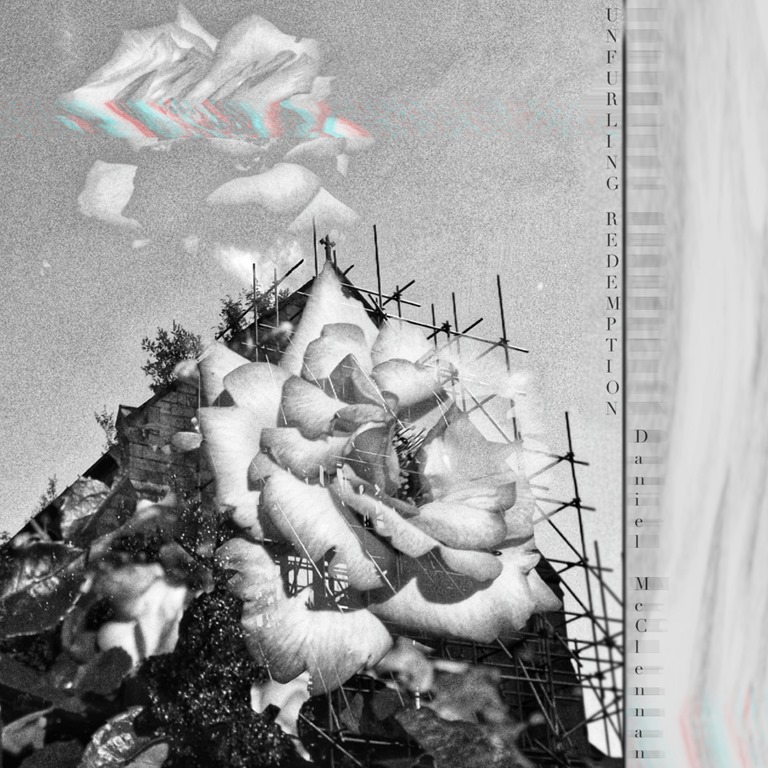
Aural Aggravation is immensely proud to present an exclusive video in the form of ‘Lifted by Marionette Strings (For Kleist)’ by Dan McClennan.

Taken from the album Unfurling Redemption released by Cruel Nature Records on 2nd September, ‘Lifted by Marionette Strings (For Kleist)’ is an unusual hybrid of neoclassical and experimentalism, balancing ominous synths and graceful piano with elements of noise to create a multi-faceted journey brimming with drama and tension.

Known for his energetic furling beats with noise-rock experimentalists Warren Schoenbright and Why Patterns, this solo release sees Daniel McClennan draw on classical and avant-garde influences such as Giacinto Scelsi; Svarte Greiner; Valentin Silvestrov; William Basinski; along with sound-artists such as Jacob Kirkegaard and The Caretaker .

Unfurling Redemption is a collection of eight assemblages comprised of synthesised instruments and freely available/stock sound samples. These assemblages explore the widely observed and seemingly inherent desire for overcoming in humankind, a dangerous proclivity for dreaming the transcendent. Particularly, the tracks pull at the problem of what we can do when these efforts inevitably drop us short of paradise, miss the mark or leave us as pyrrhic victors. Taking the form of empathetic or imagined inward reflections, they are inspired by characters in both fiction and critical discourse and take the form of unpredictable, spectral or melancholy audio ruminations. What must be done when transcendence is forever thwarted? Where then, must we seek redemption?

Watch the video here:

AA

a1220833455_10

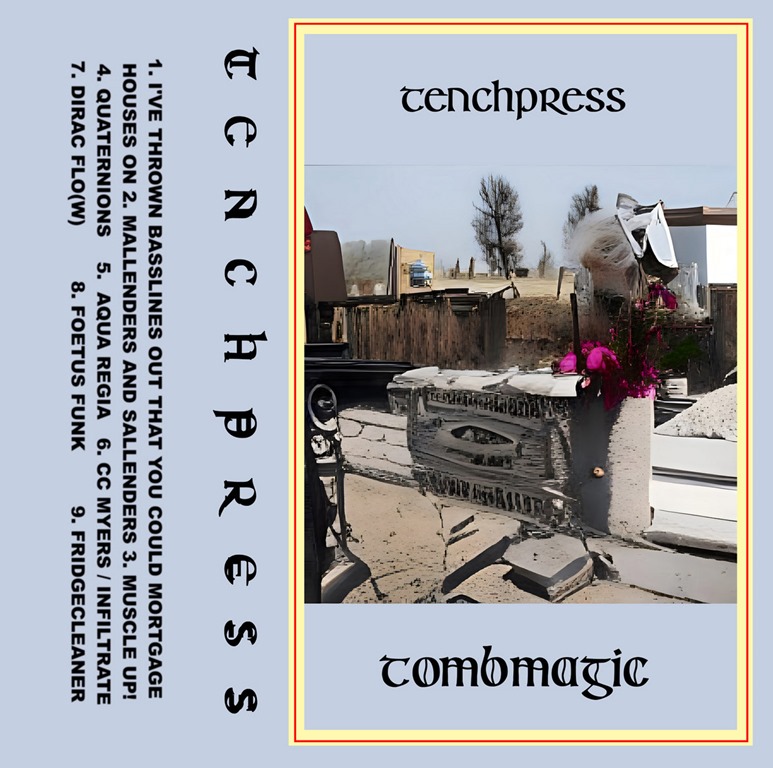
Tenchpress’ bio reads ‘6-string guitar, 12-string guitar, keys (for doors, not the instrument), keys (the instrument, not for doors), concertina, trumpet, a friend’s electric bass, sturm, und drang, 1x LA Galaxy-branded drum stick, free soft synths, A Very Old Snare Drum.’ Which ultimately translates as rather wonky weird shit, judging by their forthcoming album, Tombmagic, released through Cruel Nature in September 5th.

As a taster, they’ve released a video for the track ‘Quaternions’, which bears the distinctive emerging style of Jason Kester.

Check it here:

AA

a2641475574_10