Posts Tagged ‘Concept’

Nocturnal Rainbow Recordings – 5th September 2025

Christopher Nosnibor

One significant downside to digital music formats is that is reduces the dimensions of the experience. With a record, and even a CD, there is a physicality which is in many ways integral to the experience. I’m not here to sell the whole multi-sensory experience and tactility of vinyl line: yes, I grew up with vinyl, and in the 90s, a new LP was maybe £7.50 while a CD was £11, so I would often buy vinyl simply because I could get more music for my money. And records do scratch, sleeves get bent, and generally, vinyl requires more care than a CD, so I’m as much a fan of 5” silver discs as I am 12” black ones. And now, vinyl has become something of a fetishised luxury item: as much as there’s still pleasure to be had from sliding a thick chunk of wax cast in whatever hues from a glossy, heavy card sleeve, there’s sometimes a sense that they’re all trying too hard, and the £30 price tag takes some of the shine off the experience. There are a few exceptions – recent Swans releases have been works of art in every sense, and the physical formats have added essential dimensions to music which is something more than just some songs, recorded.

Had Ran Slavin’s latest offering been given a vinyl release, it would have been a triple LP, containing as it does thirty tracks, with a running time of almost two hours. It would have been epic. But despite having released previous albums on esteemed labels including Mille Plateaux, Cronica, and Sub Rosa, it’s unlikely that Ran Slavin has the kind of fan base that could justify, from a label perspective, a triple-vinyl release. But what Nocturnal Rainbow Recordings have done here is interesting, and utilises the digital format in a novel way, by offering alternative artwork in recognition of the album’s multi-faceted nature. Yes, it’s been done by major artists who’ve released physical albums with variant covers, with a view to enticing hardcore fans to buy multiple copies and thus increase sales and enhance the chart position (The Rolling Stones’ Hackney Diamonds probably wins the award for the pinnacle of pisstake on this score), but the idea of buying an alternative digital cover for a nominal price isn’t something I’ve seen before.

As the notes on the Bandcamp page explain, ‘Just as the music migrates across genres, the visuals migrate across states of being, extending the album into a network of parallel identities. Together, they construct a fragmented yet coherent cosmos, where each image is both an entrance and a deviation, multiplying the ways Neon Swans can be seen, heard, and inhabited.’

Appropriately, Neon Swan doesn’t quite sound like anything I’ve heard before, either. To unpack that, it contains many elements which are common and familiar. There’s sparse techno, minimal dance cuts with sped-up vocals and swathes of space between low-key beats and glitchy grooves, as represented by single release and album opener ‘tell///me///now’ – one of many titles which reflect the sense of fragmentation and juxtaposition which define the album (‘s4dert1ac’ and ‘d3xr3rity’ provide other examples, but then there are the likes of which also disrupt the conventions of language in the same way Slavin disrupts the language of genre tropes).

‘audio ease my pain’ plunges into darker territory, while introducing rap vocals atop heavy hip-hop beats (although there’s an instrumental version as well further on, which offers a different perspective again on the same material). Elsewhere, ‘c-r-i-m-s-o-n-schema’ brings spacey, spaced-out bleeps, heavy percussion that has a late 90s feel, a blend of The Judgement Night soundtrack’s melding of rap and rock, and the Wu-Tang Clan.

For all of the space, the reverb, the minimalism, something about tracks like ‘searching_heart’ is quite claustrophobic: the intense repetition and synthetic feel, paired with crackling fizz, brain-melting glitches and some grinding bass tones. It may be constructed using the fundamental elements of dance music, but this is not dance music. Electronic music to induce uncontrolled spasms and twitches isn’t a genre, but if it was, Ran Slavin would be a leading exponent.

It’s a long album, with a lot to digest, and as it thumps and wobbles and glitches away, snippets and fragments collaged across one another, there are times it all feels a but much, a bit bewildering. At times it’s draining, exhausting, at times you simply zone out, and often, I find myself questioning the wisdom of persisting with it. The vibe is that of the kind of underground clubs I never got on with in the 90s and early 00s, and I’m particularly reminded of the time Whitehouse played an Optimo night in Glasgow in 2003: I was there for Whitehouse, who played for forty minutes starting around midnight, and the music being played was rather in the vein of the more groove-centric cuts on here. The people there for the DJs weren’t happy for the low-key electro pulsations to be paused for the noise and antics of Bennett and Best, but for my part, I struggled to get into the low-key electro pulsations. But the other reason I recount this experience, challenging in its incongruousness, is that in places, Neon Swans feels incongruous with itself, an album riven with unreconciled contradictions.

The execution of Neon Swans is hard to fault, and it does cover considerable ground, with range, over its expansive duration. But it is sprawling in its scope, its focus is variable, and it is very long. And it’s maybe better with drugs.

AA

NRR38 art 1

1st August 2025

Christopher Nosnibor

The other day, while riffling through my record collection, I found a few LPs and 12” I had quite forgotten owning, including a promo copy of ‘Chance’ by Red Lorry Yellow Lorry. Stapled to the plain black die-cut cover of this white-label record with the title hand-written in biro, is a press release which simply reads ‘I know this is what you’ve all been waiting for….. Yep. The new Red Lorry Yellow Lorry single It’s called “Chance” and as usual it’s on Red Rhino Records. It’s very good’ and is signed ‘Yours condescendingly’.

You just don’t get press releases like that any more – especially not typed in all block caps and photocopied.

I appreciate the effort that goes into a good press release, and a solid band bio, because it does help me as a reviewer get a sense of context, of what a band’s about, what an album’s about. But the counterpoint to that is that there’s so much detail being spoon-fed, there’s less room for creative interpretation. The fact of the music industry has changed radically since the 80s and 90s, the days of the weekly inkies, the time before the Internet.

There simply was no way of ‘doing research’. And writers had tight deadlines. And so they just riffed to fill the column inches. Facts were hazy, critiques were often based on first impressions and knocked out in an hour after an extended liquid lunch. Names, dates, titles weren’t always accurate. And fans scoffed at the errors – and still do when clippings are posted online – but that was the nature of the beast.

Now, misspell the name of the bassist or give the wrong year for their debut EP, or somesuch and PRs, labels, and bands are onto you straight away asking for corrections. In a competitive market – I often report that on average, I receive around fifty submissions a day – simply getting coverage is a massive feat. This is certainly not to say that those times past were better – simply different, and I simply navigate my way to this release via this route to demonstrate the ways in which things have changed in the years since I started out writing about music in the 90s. It’s also altogether rarer now to find negative reviews, and while a part of this is due to the overwhelming amount of music being released meaning that reviewers are generally more inclined to spend what time they have promoting music they like, there’s also a certain element of fear of there being a social media pile-on, or having their supply of gratis music cut off. But artists and their labels and PR really need to accept that they’re not going to please all the people all the time, and sometimes, it’s necessary to call out an act with dodgy politics or whatever, or to simply call a turd a turd.

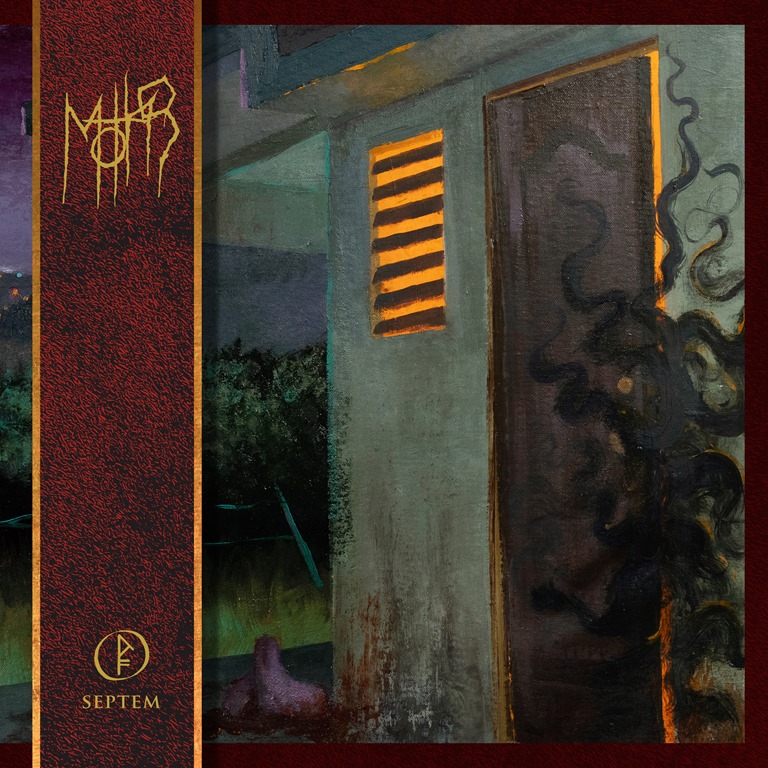
Anyway. Before I’ve even hit play, I’ve learned that this release by MOTHS is ‘a visceral journey through the Seven Deadly Sins, with each track embodying a facet of indulgence, obsession, and self-destruction — from the corrosive jealousy of “Envy” to the insatiable hunger of “Gluttony” and the rage of “Wrath”. The album plunges listeners into a dark, immersive experience where desire spirals into chaos’, and that ‘Diving deeper into heavier territory, MOTHS fuse elements of death and black metal with their signature blend of progressive, psychedelic, doom, and stoner metal, crafting a sound that’s both aggressive and atmospheric. With every step forward, MOTHS continues to explore new sounds and challenge genre boundaries, proving that music has no limits when driven by passion and innovation.’

I feel as if my work is already done. I can pour myself a large vodka and kick back, right? Well, I could. But that’s not my style. At least not the kicking back part. Large vodka in hand, I brace myself for the sonic onslaught… to be faced with some tinkering banjo or acoustic guitar giving country licks that are pure blues / Americana. And it gets jazzier and groovier as it goes on. What the fuck is this?

‘Sloth’ slides into ‘Envy’, a slippery, sultry alt-rock cut where the vocals are bathed in reverb, and the lo-fi production belies the fact that this is a vaguely jazzed-up take on grungy emo, at times coming on like Paramore recorded on a 90s cassette four-track. The haziness of the recording is actually something of a positive, but these are songs which require a slicker, fuller production. As a consequence, these takes sound more like demos than final versions.

The murky rawness works better on ‘Greed’, which brings rabid, raw-throated, growling black metal elements to the vaguely gothic metal compositions. It segues into ‘Pride’ which goes full-throttle skin-peeling abrasion before suddenly going commercial rock with fancy licks at the midpoint. I like ZZ Top, as it happens. I just wasn’t expecting a riff from Eliminator here.

‘Pride’ does take things full heavy, a prime slice of sludgy doom, and ‘Lust’ is, without question, a slugging slab of doominess, with some fancy fretwork thrown in on top. There’s certainly a lot going on here, and most of it works. MOTHS certainly bring some megalithic riffs and a lot of fire to an album that may be unpredictable in places, but is, overall, solid and with no shortfall of gutsy, guitar-driven heft.

AA

MOTHS - cover

FÏX8:SËD8 present the hard-hitting track ‘New Eden’ as the first single taken from the forthcoming sixth album of the German dark electro act: Octagram has been scheduled for October 3, 2025.

AA

AA

FÏX8:SËD8 comment: “The song ‘New Eden’ comes with an epic buildup that is almost reminiscent of 70s progressive rock – just executed with electronic means”, mastermind Martin Sane explains. “I am particularly happy how the lyrics turned out and also with my vocals that change style several times over the course of those 8:45 minutes until it all culminates in an epic finale. The length of ‘New Eden’ is also not accidental but rooted in an ambitious concept that structures the whole album. Each of the 8 songs on Octagram consists of several different parts and is 8 minutes long. They were not created as ‘extended editions’ of shorter tracks, but every song follows a meaningful dramatic composition, with huge introductions, changing drum patterns and time signatures. I went to great lengths to ensure that nothing appears just stitched together but rather comes seamlessly fused into one complete piece – and admittedly to even my surprise: it finally worked out!”

AA

2cf86648-7336-d8d3-f864-758216ca4d1a

Futura Resistenza –16th June 2025

Christopher Nosnibor

Much of Felix Kubin’s work since the turn of the millennium has involved radio, although film and theatre and other soundtrack works have also been a feature. Der Tanz Aller is one such soundtrack work, which was ‘created for the performance of the same title by the experimental arts collective LIGNA. The group specialized in site-specific, participatory works. Der Tanz Aller is based on Rudolf von Laban’s radical 1920s concept of ‘Bewegungschöre’ (movement choirs), collective dances in public space that aimed to reimagine social order through shared movement.’

The context and objective behind the composition are particularly useful to be aware of when listening to this album in isolation, as Kubin sets out: ‘When the performance group LIGNA approached me in 2012 to compose music for a play based on Rudolf von Laban’s revolutionary kinetic theories and so-called ‘Bewegungschöre’ (movement choirs), I thought of a soundtrack that would be both rhythmically engaging, abstract and mechanical. I knew there would be pre-recorded voices talking about his philosophy and guiding the audience via headphones. So, I had to leave some “air” in the arrangements, allowing the visitors to concentrate on the spoken words, while simultaneously becoming dancers. In LIGNA’s conceptual works – just like Laban’s idea of the movement choirs – the audience members become the performers.’

I shan’t dwell too long on the conceptual aspects here, beyond noting that this predates John Cage’s 4’33” by more than two decades, and while Cage’s silent work was on many levels a quite different proposition, the way in which any sound made by the audience – be it a cough or the shuffling of feet or the creaking of a chair – immediately becomes part of the performance indicates clear common ground. Likewise, William Burroughs’ cut-ups, which invited ‘creative reading’ whereby the engagement of the reader and their experience and perception was integral to their success, arrived some thirty years later. As such, ‘Bewegungschöre’ represent the cutting edge of avant-gardism, belonging to the era which brought us Duchamps’ readymades and – perhaps more pertinently – Tristan Tzara’s directions to make a Dadaist poem.

For the most part, the ‘air’ in the arrangements is apparent: there is space, separation, and while we can only imagine the prerecorded voices talking about Laban’s philosophy through headphones, it’s possible to get a sense of how it would work. But then, occasionally, Kubin’s compositions get father more busy, as on ‘Dämonen der Zerstreuung’, with big band percussion and noodlesome orchestration that’s of a strong jazz persuasion, but has a whole lot happening, and often simultaneously. There’s drama with orchestral strikes, and creeping, urgent glockenspiels that bring a noirish, detective movie feel – not a chase scene, but a cat-and-mouse scenario.

There are some spoken-word passages, in German, as on ‘Raumstunde Vera Skoronel’, accompanied by evolving sonic backdrops, the likes of which I find hard to imagine inspire dancing, but spasmodic twitching and erratic lurching, while the title track is a slice of jerky, and quite insular and intense, Kraftwerkian synth bleepery, and ‘Rotes Lied’ is a perfect exemplar of sparse, spaced-out, glooping, blooping, reverby weirdery with occasional chimes and stuttering shot of snare. There is plenty of air here, as you sit and wonder what exactly is going on?

Who knows? And does it even matter at this point? The percussion builds from all sides, and the nagging away – until suddenly it doesn’t.

The unpredictability of Raumstunde Vera Skoronel is its strength. It is weird, unexplained in many respects, beyond simply the initial onboarding awkwardness. We should probably celebrate this weirdness, this sense of separation. Raumstunde Vera Skoronel is never dull, but always strange and alien – and these are reasons to appreciate it.

AA

AA

RESLP040 front

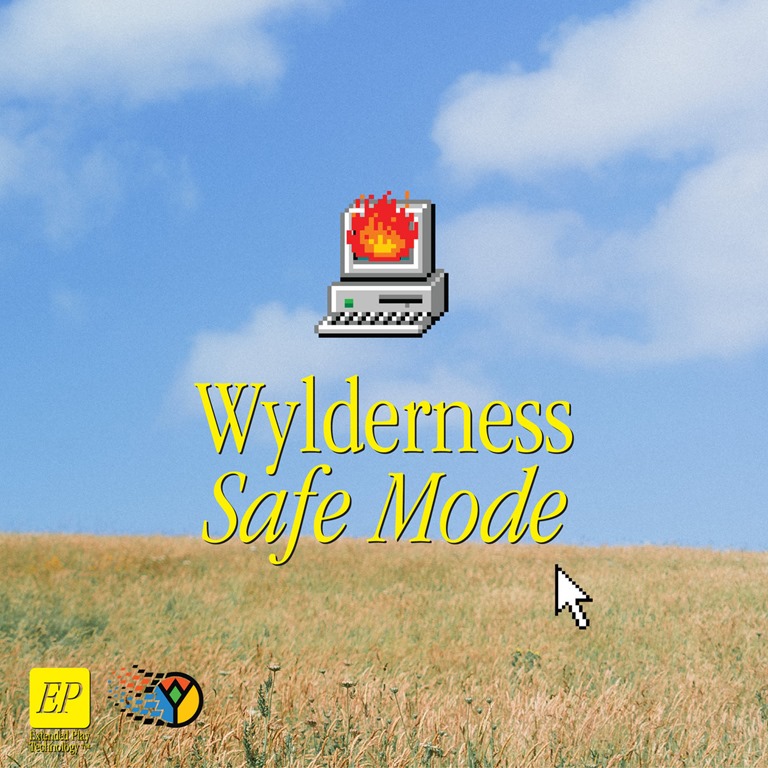
Cardiff Indie-gaze band Wylderness release their brand new and highly anticipated EP Safe Mode via digital streaming platforms.

The concept for this EP is reimagining the software and tech boom of the 90s. But instead of being centred on the west coast of America, it takes place in the south coast of Wales.

About ‘What Happens To The Rain’ single:

This is the closer to the EP and really it’s another two songs in one. The title could be a question or a statement. The first half has a Real Estate vibe and the second half goes in a more trippy Brian Jonestown direction.

It’s a song about going back to where you grew up, retracing memories and finding that they don’t quite add up to how you remember them (“Seeing faces you had forgotten / Crying for no-one / Recollections made of concrete / Fade in the sun”).

Woozy sun-drenched pop wrapped in a wall of stabbing fuzzy guitars and mesmerising shoegaze, echoing the sounds of Ride, DIIV, Sonic Youth and Yo La Tengo. Wylderness’ eponymous debut album, released in 2018, was championed by SteveLamacq (BBC 6 Music), Huw Stephens (BBC Radio 1) and was part of Radio 1’s Best of BBC Music Introducing.

It garnered critical acclaim from Clash, DIY and Drowned inSound, with the song On a Dais being featured on the US version of the TV show Shameless.

Wylderness have played shows for Huw Stephens, Sonic Cathedral, Swn Festival and support with Acid Mothers Temple.

The Cardiff band’s second album, Big Plans for a Blue World (2022), was recorded with an expanded line up and featured added layers of vintage synths and clarinet. It placed no.28 in Far Out Magazine’s Best Albums of 2022 and charted in the North American College & Community Radio Chart.

2025 will see the release of their much anticipated new Safe Mode EP recorded with producers Andrew Sanders and long time collaborator Rory Attwell.

Wylderness are: Ian (guitars/vox), Jim (bass/guitars), Ben (drums/percussion), Dan(guitars/vox), and Harri (clarinet/keys)

AA

a3691174443_10

Eiga – 11th April 2025

Christopher Nosnibor

Bound To Never Rest follows 2022’s The Fall of Europe and for this, their second release as RAMM (formerly know as Il Radioamatore), core member Valerio Camporini F. and Roberta D’Angelohe are joined by Filippo De Laura who brings percussion and cello, and Caroline Enghoff, who provides voice and lyrics on ‘Hanging Rock’

Here, they promise to takes us ‘to a very contemporary feeling scape – of being constantly on the verge of seeing your world collapse – but it does so through very a unfamiliar sonic landscape, so different that we struggle to put a label on it… The core of this work is to represent this ‘permanent state of flux’, a paradoxical condition we’re all experiencing now, when being unsettled is the constant in our lives.’

They go on to explain that ‘To achieve this purpose RAMM started with a scribbled set of compositional rules, with the idea of building a living organism, in constant evolution, some rules were abandoned along the way, some were retained.What comes through at the end is the sensation of being swept away by meandering, random, river. Trying to hold on to something, only to have to adjust to a new setting. It’s a compass with its needle forever trying to find its north.’

This, it seems, is like life itself. Even periods of apparent monotony, where it seems that life has been consumed by the treadmill of working, eating, and sleeping, and running just to stay still, the likelihood is that it’s your ability to see beyond the blinkers that’s been stolen rather than it being the case that there’s nothing else happening. In fact, the world about us is an eternal maelstrom. However, the last few years have witnessed the turbulence increase to a roar that’s beyond deafening, and it’s little wonder that there’s a mental health crisis assailing western society, and people are immersing themselves in more or less anything mindless in order to avoid news.

The title ‘Disturbed Tea Time’ somehow captures the way we often crave normality and routine in our lives as a means of having a sense of grounding, a sense of control over our lives. But when those familiar routines are disturbed, it can often feel catastrophic. And the more precariously balanced our safety is, the harder it becomes to deal with those disruptions calmly and objectively. Many of us experienced the destabilising effect of a rapidly-changing situation and contradictory guidance and (mis)information during the pandemic, and the ’shock and awe’ strategy being employed by the Trump administration right now is a perfect – and terrifying – example. People become more fragile, more sensitive, more susceptible, more fearful and less able to cope even with small changes when the entire world around them ceases to provide the comfort of familiarity. Sonically, this first track it’s a deft, almost soothing, minimal electronic composition at first, before doomy, overloading guitars rupture the tranquillity. And so it continues, smooth, airy vistas of serenity float in an easy, linear fashion, unexpectedly dashed and smashed by roiling distortion. The metaphor may be fairly straightforward in terms of concept, but it’s executed in such a way that when the blasts of noise to explode, you feel the tension through your whole body.

‘Permanent State Of Flux’ washes in on delicate strings, subsequently joined by piano, and a persistent pulsation, and as the piece progresses, the layers, textures – and moments of dissonance – build, while ‘Good Morning Ansa’ takes the form of a more darkwave synth piece with a flickering beat in the background. But this, too, changes midway through, with both the instrumentation and mood making a shift.

The only piece with lyrics and vocals, ‘Hanging Rock’ is tense, dark, and discordant. But none of the works are any one thing for their duration, and in this way, the structure of not only the individual pieces and the album as a whole come to represent the overarching theme.

There is a perfect restlessness about this album, and while for the most part volume, harsher textures, and discord are used only sparingly, rendering it a comparatively subtle work, the fact that any emerging flows are swiftly disrupted make it something that holds the focus and keeps the listener alert and just that bit on edge for its duration.

AA

a1036422041_16

Self-released – 14th February 2025

Christopher Nosnibor

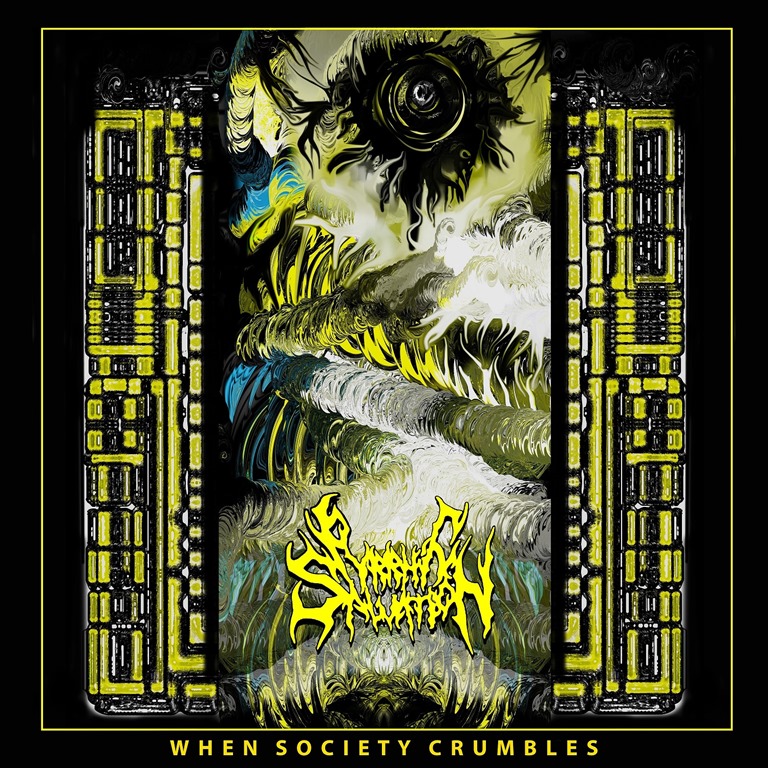
Yes, it’s ‘when’, not if, and since January 20th this year, it feels as if that crumbling which has been slowly emerging, first as a series of cracks, is now accelerating, to the point that we’re well on the way to almost certain collapse as Trump ‘the peacemaker’ puts his foot to the floor and hurtles us headlong toward self-extinction, one way or another. So after the ‘when’, the only question remaining is ‘how?’

While we ponder that, US interstate internet-based technical / experimental death metal act have delivered – after quite some time – their second EP. Having formed in 2015, it took them until 2022 to birth Manifestum I, following which singer Chrisom Infernium departed, being replaced by Shawn Ferrell. In the overall scheme of their career to date, When Society Crumbles has come together pretty quickly.

It’s overtly a concept work, centred around a fifteen-minute suite of three pieces which each address component aspects of ‘When Society Crumbles’ – ‘Infrastructure’, ‘Insight’, and ‘Inferiority Complex’. Well, ok.

The guitar parts alone contain about three hundred notes per minute, a frantic blanket of fretwork bursting from the very first bars. The vocals switch from growls to barks to howls to the squeals of wounded pigs, sometimes layered to occur simultaneously, while the drums blast away at a manic pace.

One thing that stands out from the first track alone is the production. Perhaps it’s the technical angle, perhaps it’s the circumstance of the recording, since being in a room and making noise is a very different experience from bouncing audio files around via Dropbox or whatever and adding to them in isolation. It’s not the clarity or separation per se, but the way the different instruments reverb – or don’t so much – in different ways. It isn’t that it sounds or feels cobbled together – it doesn’t – it just sounds different. But in a world where so much music is uniform, conformist, even if to supposedly alternative values, different stands out, and we need different. But the way that snare drum and the tom rolls cut through… they dominate in a way that’s rare, but it works: all too often with death – and black – metal – the drum dominate live, but are submerged on the recordings, reduced to a rattling clatter that’s more like the hyperfast clicking of a knitting machine than the thunderous blast of a drum kit being hammered hard. In places, it’s so technical as to border on the jazzy, although it’s clear they’re not just about technical prowess.

Not quite so different is the relentless fury the trio bring with the pounding percussion and frenzied picking: these elements are very much of the genre – death metal played with a real attention to technical detail. There are some well-considered tempo changes, and even some gentler, almost folk-inspired moments on ‘Insight’, where it drops down to some soft picking.

The three movements of ‘When Society Crumbles’ lurch into rabid dark territory on the third and final segment, where heavily processed vocals rip across a full-throttle all-out metal assault. The final track, the standalone ‘Every Last Soul Unmade’ is the longest by some margin, extending to almost six minutes and slamming down a tumultuous broadside of wildly noodling lead guitar over a bass that lands like a knee to the stomach. These guys know what they’re doing. I hope they keep doing it when civil war breaks out. I mean if, if…

AA

228618

French atmospheric doom collective IXION has just revealed their latest video for the song ‘The Advent,’ directed by Hugo Le Beller and featuring performances by Raphaël Mars and Irène Bonnot.

The track is off the band’s newest EP ‘Restriction,’ and marks another exciting prelude to their highly anticipated fifth studio album, Evolution, set to be released in late October via Finisterian Dead End/Season of Mist.

“We are so excited to share with you this video for ‘The Advent’!” says the band. “The song is about androids working to replicate emotions, and the first of them to finally experience feelings. We tried to create a short story around this theme, playing with characters and surroundings…”

‘The Advent’ offers a visually stunning and thought-provoking glimpse into a world where androids strive to understand and emulate human emotions. The narrative weaves a short story that aligns perfectly with the overarching concept of their upcoming album, Evolution.

Don’t miss the captivating new video for ‘The Advent’ here:

Following the critically acclaimed L’Adieu aux Etoiles, Evolution is divided into three parts, each delving into different aspects of the human-android relationship. The album is an enthralling blend of progressive metal, melancholic, and atmospheric doom, showcasing IXION’s unique sound.

The first part of the album, ‘Extinction,’ was released on April 16 and explores humanity’s struggle with mortality amidst rapidly advancing android technology. The second part, ‘Restriction,’ released on June 14, takes listeners on a sci-fi, electronic, and ambient doom-metal journey, depicting androids’ quest for emancipation and a closer connection to human emotions.

Originally formed in 2004 as a solo project by main composer and multi-instrumentalist Julien Prat, IXION has established a distinctive presence in the doom metal scene. Their innovative fusion of ambient/electronic music with atmospheric doom metal draws inspiration from science fiction, creating a unique and immersive auditory experience.

8a1ef33e-a177-1b75-841b-6a577f8a6e72

Atmospheric doom-metal collective The Answer Lies In The Black Void featuring members of Thy Catafalque and Celestial Season have just revealed a music video for a new song titled ‘Virgin Fire’, which is taken from the band’s forthcoming second album Thou Shalt, scheduled for release next week, October 13th via Burning World Records.

The band comments: “’The Virgin Fire’ was created using the GEN-2 AI software, modelling the dream-like surreal and occult images that visualise The Answer Lies In The Black Void’s universe. Our second album Thou Shalt is inspired by the concept of Carl Jung’s shadow and ‘Virgin Fire’ deals with the concept of the dream state according to these works of Jung : “The dream is the small hidden door in the deepest and most intimate sanctum of the soul”.

Watch the video here:

AA

The Answer Lies In The Black Void is a collaboration between Martina Horváth from avant-garde metal project Thy Catafalque and Jason Köhnen from Celestial Season, The Lovecraft Sextet, Bong-Ra, ex-The Kilimanjaro Darkjazz Ensemble, the duo also work together in the transcendental music project Mansur that releases on Denovali Records.
Horváth and Köhnen joined forces through their passion for all things doom, presenting their personal take on the genre with all its beautiful darkness and from all possible angles. Bringing their own mix of atmospheric laden avant-doom.

After their immensely well received debut album ‘Forlorn’, The Answer Lies In The Black Void now returns with their second album titled ‘Thou Shalt’. Inspired by Carl Jung’s ‘shadow work’ this new album is scheduled for release on October 13th via Burning World Records and will followed by the bands first ever live performances with a full line-up in a small tour throughout The Netherlands and Germany. The Answer Lies In The Black Void will be performing live as a 5 piece, with Botond Fogl (guitar), Attila Kovacs (guitar) and Mark Potkovacz (drums) being part of the full line-up. Confirmed dates are below:

22 October – A38 Hajó, Budapest. HU [Album try-out show]
23 October – Klub Močvara, Zagreb. HR [Album try-out show]
03 November – Simplon, Groningen. NL
04 November – De Helling, Utrecht. NL
05 November – Dutch Doom Days, Baroeg, Rotterdam. NL
18 November – Hammer of Doom Festival, Posthalle, Würzbürg. DE

AA

672cf7f8-e82e-5d94-a470-dbfb0c58809b

1st May 2023

Christopher Nosnibor

Argonaut are a band who have certainly embraced the potentials of the Internet, making the most of the ability to take ownership of their release schedule and optimising the possibilities for their DIY aesthetic, not limited to home recordings released within a week via Bandcamp and no-fi videos posted to YouTube.

Nathan and Lorna kept things flowing through lockdown with their homespun ‘Videostore’ project, and now they’ve reconvened, the band are making the absolute most of the limitless options of streaming formats.

Historically, an album had to be no more than around forty-five minutes to fit on a 33rpm record: CDs expanded it to seventy-two minutes, which was probably the length of most double albums, only much cheaper. Tapes provided greater duration but less durability, especially over longer formats: the old C120s were dangerously fine, meaning double-play cassettes were things to be handled with care (as the three copies of The Cure’s Concert and Curiosity I lost proved, although however carefully you might handle a cassette, the heads on your tape deck just stropped and chewed stuff out of spite). More recently, CD capacity has expanded to eighty minutes. Every medium has its limitations: digital streaming has limits to quality and you never know if a track or site will remain, and streaming when your Internet connection drops every three minutes is a massive pain the fucking arse. And it perhaps goes without saying that downloading a track just doesn’t have the same buzz as owning something physical like a 7” or even a CD. That’s something that’s difficult to explain to anyone under thirty, who considers physical ‘stuff’ just so much clutter and the prospect of going to a shop an inconvenience. I get it, but I guess it’s hard to feel you’re missing out on something you’ve never experienced.

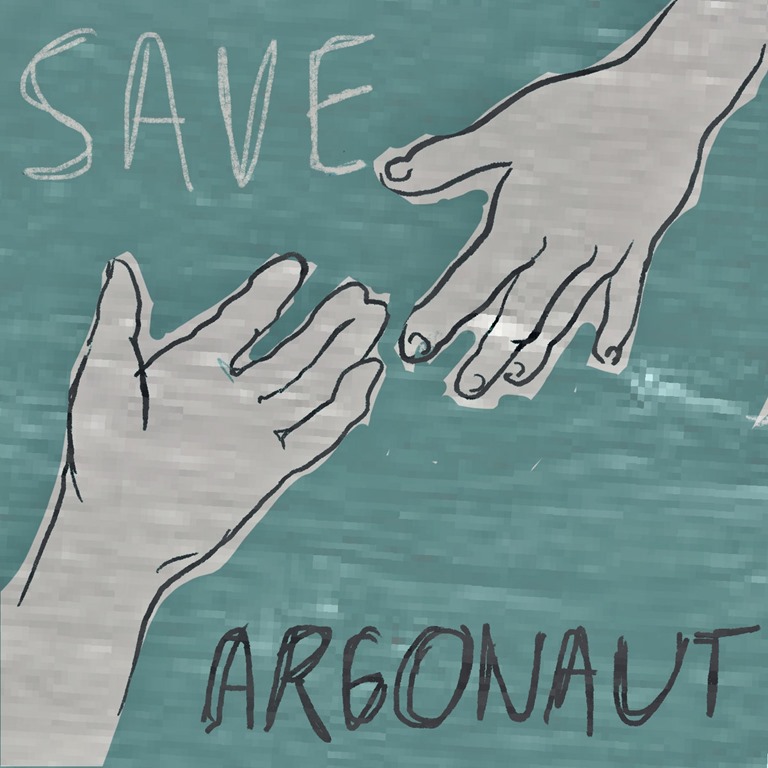
But what Argonaut have realised is that an album doesn’t have to be a completed article on release, and this is where their latest project is really interesting. Songs from the Black Hat is probably the first ‘open-ended’ album, whereby they just keep adding songs to it with a new song released on the first of each month. Whereas The Wedding Present’s ‘Hit Parade’ project also saw the release of a new single each month, it had a fixed end, on the premise of there being a 7” single released each month – the album, a compilation, was seemingly an afterthought and its parameters were always going to be finite. Songs from the Black Hat as it stands has no parameters, and ‘Save’ is the sixth song and something of a departure, not just in terms of the album, but for Argonaut more broadly.

They’ve built a career on punchy post-punk tunes which are often concise to the sub-three-minute mark. But as they write of ‘Save’, ‘Clocking in at six and a half minutes, ‘Save’ is Argonaut chanelling [sic] nineties indie anthem 12 inch remixes a la MBV and the Telescopes.’ And it is indeed a beast. As they also explain, ‘The lyrics were inspired by the Thai cave rescue and a genuine primary school comprehension test answer to the question ‘why didn’t Grace Darling save everyone at the same time?’

It’s a reverb-soaked behemoth where the echoing drums soon become overtaken by a chubby bass and a yawning synth drone, with multi-layered bubble-gum pop vocals, reminding us that ‘You can’t save everyone’. No doubt our government will be playing this at the airport in Sudan as they turn away citizens with work visas and the like but no physical passport. But facetiousness aside, this is a beautiful and sad song that also bursts with fuzz and reverb, and spins vintage and contemporary together with a rare deftness of craft.

Let’s see what they pull out of the hat next month…

AA

a0955958083_10