Mortality Tables – 8th May 2026
Christopher Nosnibor
So much music, and only one pair of ears with which to listen to it… and similarly, one pair of hands to write about it. For years, I yearned – albeit half-jokingly – to clone myself, but now realise that doing so would likely only compound my problem, creating a situation where more availability would create more demand, and this would be very much a concession to the commodification of art – in all forms – whereby everything is considered merely ‘content’ and that a conveyor-belt churn of new content is the route to ‘engagement’. And this is absolutely fucking horrible. It’s dehumanising.
Shortly before I quit my dayjob as a complaints auditor for a multinational financial corporation earlier this year, we had been directed to use CoPilot to write our segments of the monthly report we produced to circulate amongst management. The directive was to get AI to write it, and then ‘sense check’ it against out audit results for the month. My colleagues were raring to go, and raced to embrace this: they didn’t enjoy writing up the monthly report on PowerPoint. I can’t say I loved it either, but I have degrees in English and had eight years’ experience in complaint auditing. The report was the one thing in the role where I had scope to not only flex my linguistic skills to pitch the tone of the report, but also to use my brain to analyse and comment on the otherwise fairly tick-box exercise of auditing. This is a circuitous route to my denouncing AI, and the reason why, when doubtless many ‘content creators’ would deploy AI to help crank out reviews at a far faster rate, I steadfastly refuse, and will always write my own reviews – albeit sometimes a bit rushed, a bit rambling, and with more typos than I’m anywhere near comfortable.
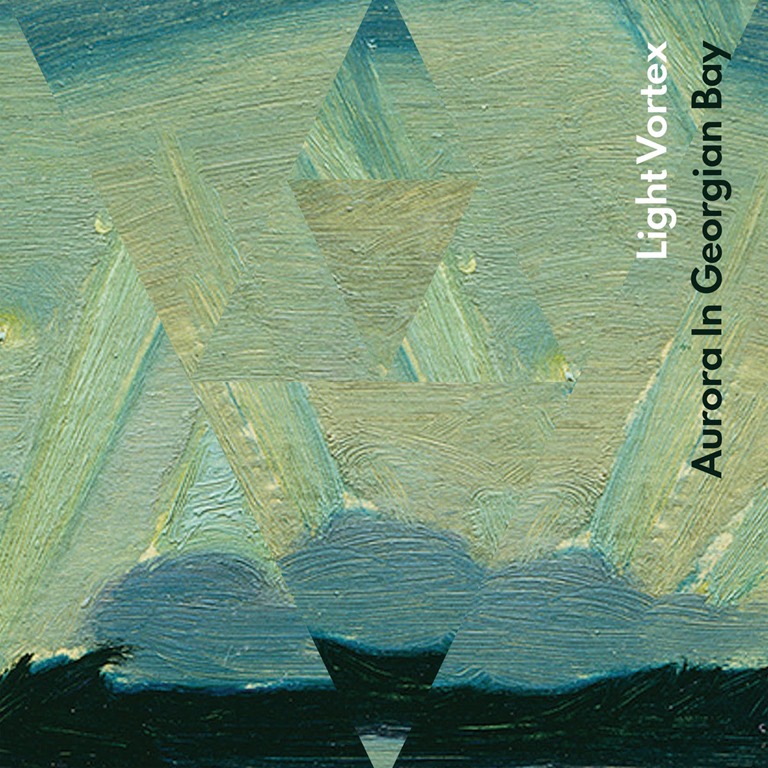
Reading the loner notes while listening to Aurora In Georgian Bay by Light Vortex reminds me precisely why this is.
The album’s title ‘was sourced from a 1931 painting by English-Canadian artist J.E.H. MacDonald (1873-1932)’, and we learn that ‘With thick and evocative brushstrokes, MacDonald’s painting depicted a view across Georgian Bay from Pointe au Baril in Ontario. Framed by wavering trees, the focal point of MacDonald’s painting was the phenomenon of fleeting, undulating shapes in the sky above the bay, illuminating the scene with an alien green-blue-grey hue.’
The notes go on to explain, ‘We hear a parallel to this in the eleven pieces of electronic music collated by Chris Moore on this album. Each track feels like it is vividly capturing the same refracted light that caught MacDonald’s attention, where sounds, sequences and subtle rhythms are encouraged to collide inquisitively with each other… Moore’s nuanced and detailed approach to electronic composition mirrors MacDonald’s abstraction of the natural world.’
These are connections of the type which can only be made by the human mind – instinctively, intuitively, by subconscious associations, by joining dots which exist through experience and knowledge. In short, life, in all of its organic richness, strangeness, and diversity.
To my eye, MacDonald’s painting evokes a soundscape that’s loose in structure and borders on ambience. Not so for Chris Moore on the strength of these compositions, which straddle the realms of early synth works in the vein of Kraftwerk and Tangerine Dream, and later – but still comparatively old-school in the timeline of music – electronic work from the 1970s, like Mike Oldfield’s Tubular Bells and Oxygene by Jean Michelle Jarre. In short, it’s emblematic of the juncture where wibbling analogue ambience evolves beyond experimentation centred around what the instruments could do. But of course, my response to this is based entirely on my personal experience and musical exposure. My knowledge is incomplete, and spontaneous. But it is my own.
This is also very much true of Moore’s compositions here. The man and the machine. The man manipulating the machine – and not vice versa, or the man replaced by the machine.
I very much get why there was – and remains – a fear of technological evolution, and why, in the 80s and 90s, Thee Musician’s Union were so opposed to drum machines: they felt the machines would render drummers obsolete. They didn’t, just as home taping didn’t kill music. Streaming, on the other hand, just may. And similarly, previous technological advances have been about the artist using the technology to create something new – whereas AI sidelines the artist to plagiarise from the entire history of creative work. To create is human: it’s the very essence of the human condition – to convey something through the process of creation, for fellow humans to respond to on an emotional level, a human level.
Aurora In Georgian Bay is far from emotionally direct: instead, what it conveys, obliquely, is a partially abstract sonic response to a partially abstract painterly work: both are deeply immersed in tone and texture, albeit in widely disparate media. It’s through such creative interaction and intermedia dialogues that we come to make sense of the world around us, and to make sense of ourselves, our thought processes. You simply cannot substitute or recreate that.
For the most part, Aurora In Georgian Bay is gentle, supple, rippling, and ultimately soothing. But it’s rich in nuance and detail and range. And it tells you nothing specific: it’s all there for you to decipher, to interpret, to project, to experience on a unique creative level. The door is open…
AA
AA