Posts Tagged ‘Ambient’

Scott Morgan (aka loscil) and Mark Bridges have together produced their debut album as High Plains, taking to the high altitudes of mountainous Wyoming to create a record faithful to both the grand landscapes extending below them and the rich contemporary electronic pedigree of the respective members. Titled Cinderland, the LP will be coming out via kranky in March, and ahead of its release, you can hear the track ‘Black Shimmer’, which we like very much indeed.


Christopher Nosnibor

Life is stressful, and life is strange. Our understanding of the world is built on a web of infinite lies, distortions, misrepresentations, and, essentially, a version of history which is skewed. This was an angle pushed by Willian Burroughs as far back as the early 1960s, and which subsequently came to be a key aspect of postmodern theory: amidst the blizzard of information, historians sift through the ‘facts’ and ascribe them narrative significance and superiority over one another, while at the same time forging a linear version of events which necessarily frames them in a position of cause and effect.

Tony Curtis’ Hypernormalisation documentary presents an alternative perspective of those events, and rationalises the semi-fictionalised version of events which has become accepted as the narrative of historical fact, in the name of simplification, and primarily for political end. The music of Manchester-based duo worriedaboutsatan features on the soundtrack to this epic documentary and, indeed, many other projects for film and television. Hypernormalisation is one of those works which makes you feel tense and uncomfortable. On the other hand, the music of worriedaboutsatan, while built on what on the surface may appear to be jarring incongruences, offers a conduit to escape the horrors of the modern world in some small but precious way.

Tonight’s event is the fifth and final date of a mini-package tour which serves as something of a platform for the type of music favoured by the label, This is it Forever, run by Gavin Miller and Thomas Ragsdale, aka worriedaboutsatan (and also for a time, Ghosting Season), with Sunset Graves – the brainchild of Andy Fosberry, who also happens to run microlabel 3rd and Debut providing a complimentary yet subtly contrasting coalition.

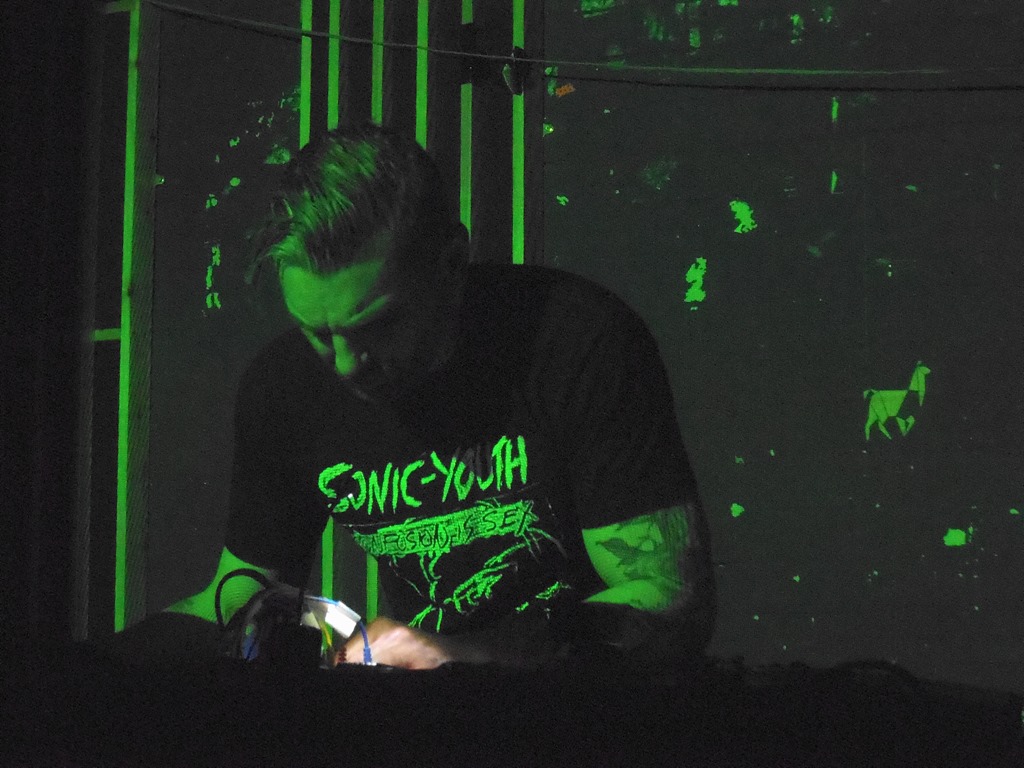
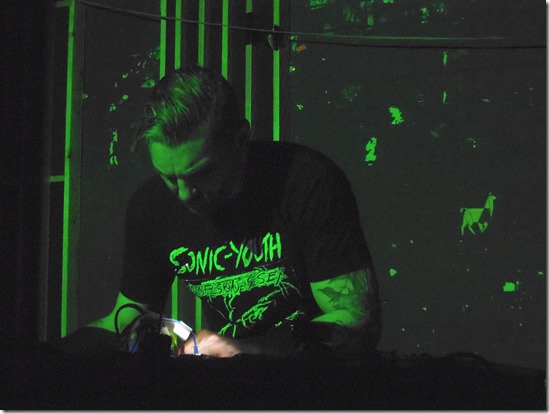
Sunset Graves’ material could reasonably be lodged into the brackets to techno and electro. And while it would be just to praise the swirling ambience which eddies around the set, and the meticulous architecture of progressive beats which defines the sound, any objective appraisal of the performance will inevitably fall short. And herein lies the magic of Sunset Graves: the carefully-considered and yet equally intuitive structures and the attention to texture and detail disappears in the enrapturing experience of simply experiencing it in the moment. Playing in near-darkness, the man with the short back and sides and the Sonic Youth ‘Confusion is Sex’ T-shirt makes musical alchemy.
DSCF7423

Sunset Graves

The same is true in many respects of worriedaboutsatan, an act who have evolved immensely over the course of the last decade. Without doubt, while they continue to exist on the fringes, the word of music is all the richer for their presence. Way back, they could be described as post rock with glitchy beats. In fact, I probably did describe them as precisely that. In fact, my first review of them in 2009 contained the following: ‘The scratchy click and pop beats give way to thunderous pounding rhythms, and Tom, arched over the Mac, looks like an alien hardwired into the mains as he twitches spasmodically. Meanwhile, lurking in the gloom, Gavin adds depth and texture with drones by means of guitar played with a violin bow.’

And so, in many respects, little has changed. Gavin still conjures layers of vaporously-textured guitar sound, occasionally with the use of a bow to the strings and Thomas still launches salvoes of thumping beats and deep, resonant basslines. Yet, by the same token, so much has changed. The pounding beats are there from the start, making for a more direct and immediate impact, and the sonic and textural contrasts are more prominent than ever.
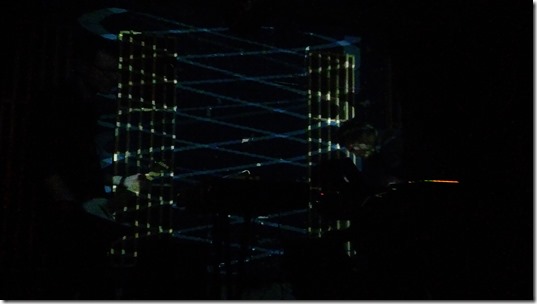
20170217_215210

worriedaboutsatan

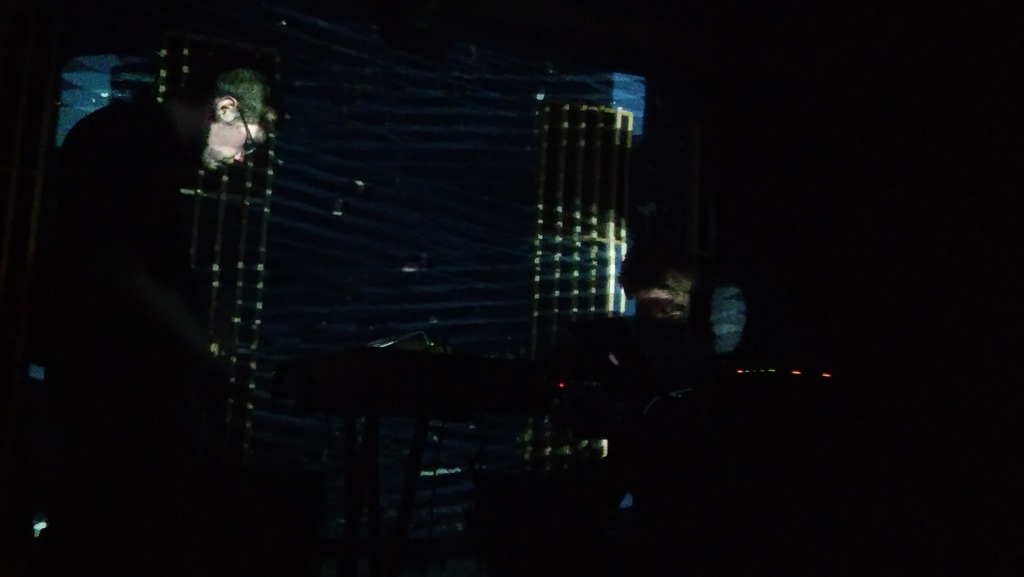
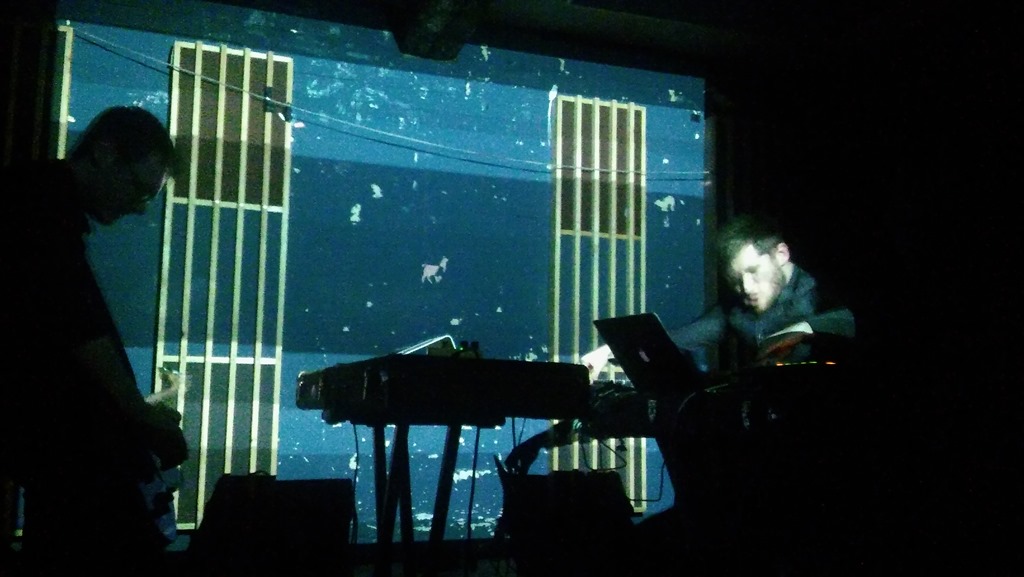
Having performed independently of one another during their hiatus, Gavin and Thomas’ contrasting styles have become more pronounced, and now, as Gavin cascades cinematic post-rock textures from his fretboard, Thomas cranks out evermore dense, thumping rhythms and woozy basslines which resonate around the solar plexus. They play facing one another, and if you put a line down the middle of the stage, or split the screen, you would likely be convinced you were watching two separate shows: Miller rocks silently back and forth, his guitar so drenched in effects as to not sound remotely like a guitar, while Ragsdale is a man possessed, savagely attacking his electronic gear and channelling every last drop of power from its circuitry through his veins and into the PA. But it’s the contrasts which ultimately render worriedaboutsatan such an exciting and unique proposition, both sonically and in a performance setting.
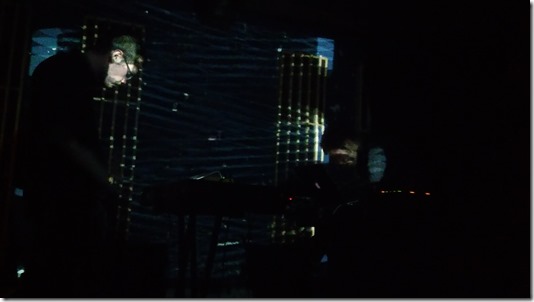
20170217_220325

worriedaboutsatan

It’s in the coming together of these seemingly dichotomous forces that worriedaboutsatan create their unique and utterly immersive space. There are vast expanses of sound which wash over the listener, and as the tracks often segue together, the set feels like a deftly-navigated sonic journey. It’s clear that I’m by no means the only one in the room who’s completely engaged: the minimal visuals – on this outing, relatively simple changes of light, and not a lot of it, as they still favour playing in near-darkness – mean that it’s the music which stands well to the fore, and this s music capable of inducing an almost trance-like state. There’s a guy in front of me who’s flailing his arms and pounding the air in time with the big beat drops, and there’s no question that he’s utterly lost in the moment; the majority of the rest of us simply stand stationery, transfixed.
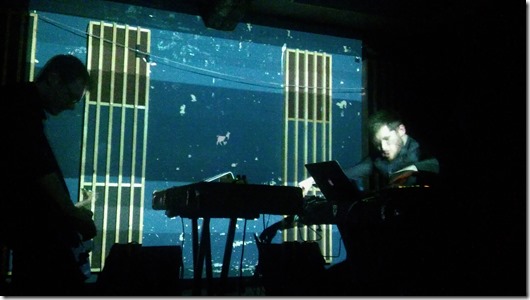
20170217_220843

worriedaboutsatan

More than a decade into their career, and worriedaboutsatan are stronger than ever. If there was any doubt following the release of Blank Tape last year, they’re an act who are going far beyond fulfilling their early promise and are now well into the realms of forging a niche that’s entirely their own.
kranky – 17th February 2017

Christopher Nosnibor

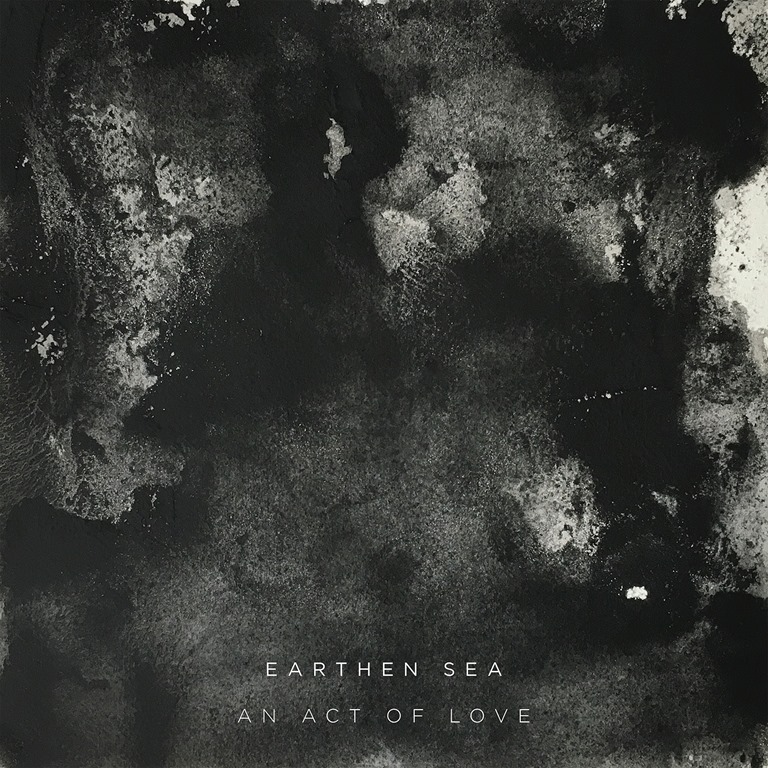
It’s pitched as a ‘compelling synthesis of shadowy rhythms and opaque atmospherics, drawing on the most potent qualities of melancholic ambient and dub techno’. An Act of Love is very much an album which possesses a haunting atmosphere, with a supple, soft, subaquatic sound dragging the listener into a warm, hushed place of dark stillness where movement is slowed.

The album’s first track, ‘The Present Mist’, sets the tone, and its title is an appropriate summary of the vague, amorphous drifting soundscapes which encapsulate the overall feel of a set the fabric of which is woven from intangibles.

‘About that Time’ builds a hypnotic groove with an overtly dance-orientated beat – that is to say, an insistent bass drum in square four-four time at around 120bpm – while soft waves of sound drift like mist to form obfuscating layers which envelop the senses. A piano rings out into the warm aural webbing and hangs in the air. But the drums rattle and reverberate, echoing across one another: it’s not nearly as ambient or understated as may first appear. And so, while the album does often drift, making minimal demands on concentration, it is not without dynamic or the capacity to withstand a degree of attentiveness. It’s well-constructed and has a flow about it which works well. That flow creates, magically, a certain temporal suspension as time evaporates like vapour over the distance of successive tracks.

Jittering beats, like a palpitating heart, thump through ‘Exuberant Burning’. This is no up-front dance work, but nevertheless, there is a tension, and an excitement which emanates from its dark, cellular landscape. The flickering, pulsing beats muffled and bear a certain resemblance to sounds heard through a stethoscope.

An Act of Love is an album which slowly, subtly, almost subliminally, evolves and unfurls.


KRANK208_5x5_300dpi

The Helen Scarsdale Agency – HMS040 – 2nd December 2016

Christopher Nosnibor

My first encounter with the work of Jim Haynes (the musician, not the writer who rose to a degree of cult prominence in the 1960s) came when The Decline Effect landed with me in 2011. Haynes’ territory is the dark, the ambient, the subterranean, but Throttle and Calibration is an altogether harsher work, which emerged from Haynes’ 2015 residency at MoKS in Estonia, where he would collaborate with and contribute to Simon Whetham’s Active Crossover series.

As the blub accompanying the release on the label’s website explains, ‘Throttle and Calibration is the first in a series of albums that find Haynes digging through the Active Crossover archive and grotesquely exaggerating the details into exploded compositions of volatile dynamics, nerve-exposed dissonance, caustic shortwave signal abuse, and a considerable amount of scarred metal. Marked as one of the more discordant works to date in Haynes’ career, Throttle and Calibration finds company near the atonal compositions from Hermann Nitsch and the sour, industrial collages that pock the Nurse With Wound catalogue. Previously released digitally on Crónica, Throttle & Calibration is fleshed out with an additional 20 minutes of material.’ This time around, the augmented digital release is also accompanied by a cassette edition. But, sadly, no vinyl, and no CD. Sadly because

As the blurb which accompanies the release intimates, discordant is it, and Throttle and Calibration does, most certainly, slot into the space where industrial and avant-garde intersect, and this reissue, expanded to eight tracks from the original five, is an essential work within its field. The album finds Haynes in exploratory mode, and he delves deep into the granular elements of sound over the course of this challenging work.

A long, buffeting rumble, like a distant train or the sound of wind on a mountain-top (if there is no-one there to hear it, does the wind still roar around the rocks?) is the first sound. The harrowing bleakness is but short-lived. Explosive blasts of noise rip and tear like detonations, atmosphere and ear-shredding eruptions. Small sonic ruptures are rendered at such volume and intensity as to inflict sensory and psychological.

What exactly is this? The Arctic wind ripping through an empty water tower? Or the apocalypse? It could be either, and may be both. It’s disorientating as well as full-on. Throttle & Calibration is an album which places sound under the microscope, so to speak. It’s not microtonal, but it is microcosmic, at least on the one hand. But in placing its focus on a small corner of the scene, Haynes then blows it up to A3 and zooms in 500%. The effect is terrifying, bewildering, intense, and the results are immense. In Haynes’ hands, mundane sounds are reforged and take on sinister dimensions. His addressing them from alternative perspectives – up close, amplified – is the key to building a new understanding.

A quiet rattle is annihilated by a roar which melts all definition into a whirling multitextural aural vortex in ‘Tabula Rasa’, and over the course of the album, Haynes repeatedly drags the listener through a succession of vertiginous sonic sinkholes. Single impacts – origins unknown and undisclosed – resonate and decay slowly n heavy atmosphere. The spoken word introduction to ‘It Doesn’t Matter’ sets an eerie tone, but this again is devastated in a tinnitus-inducing wall of screeding noise worthy of Merzbow at his most brutal.

It takes time and focus to peer through the harsh noise to discern the textures. Like stepping into the dark from a brightly-illuminated interior space, it takes time to recalibrate the senses. There are quieter passages, but they’re no less intense and no lighter in tone. Ominous monotone drones and hums hang for aeons; time is suspended in space.

Neither the full-throttle abrasion nor the shady, moody spells of dank mental torture offer anything by way of respite or levity: Jim Haynes is an artist who dwells in darkness and creates work that ranges from the darkest greys to the pitchest of blacks. Throttle & Calibration stands at the darker, more violent end of the spectrum. Uncomfortable unpleasant, and unforgiving, it’s a well-realised plunge into the bowels of a new shade of, rendered from the terrains of the everyday.


Jim Haynes – Throttle and Calibration

Gizeh Records – 17th February 2017

Christopher Nosnibor

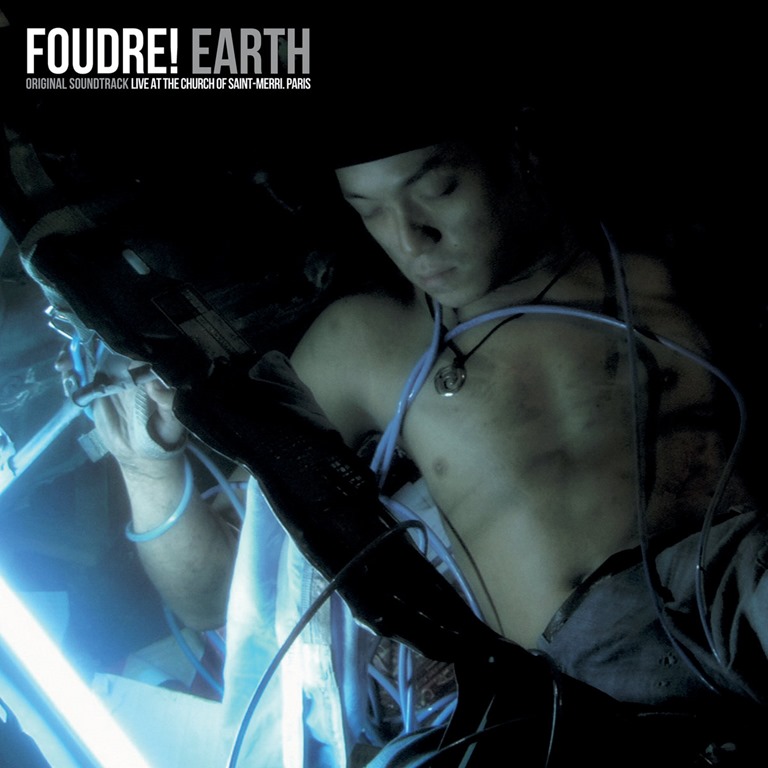
FOUDRE! describe themselves as ‘a telluric drone quartet’. Composed of Frédéric D. Oberland (Oiseaux-Tempête, The Rustle Of The Stars, FareWell Poetry), Romain Barbot (Saåad, I Pilot Dæmon), Grégory Buffier (Saåad, Autrenoir), Paul Régimbeau (Mondkopf, Extreme Precautions, Autrenoir), and featuring ‘electric chimeras’ by Christine Ott on ondes martenot, they’re effectively an avant-garde drone supergroup. And EARTH is their third album.

Said album is in fact a soundtrack, scored as a live audio accompaniment to the motion picture of the same title, an experimental film directed by Singaporean artist Ho Tzu Nyen. Of the film, Ho Tzu Nyen explains, “We see the site of an unknown disaster, the debris of history that constitutes the story of Earth. Upon the site, lay fifty humans oscillating between consciousness and unconsciousness, life and death. Sometimes, one of them emerges into the foreground – clutching a fist, batting an eyelid, or weeping for his neighbor. At other times, these figures recede from the light, losing their individual shapes to form a gigantic organism, breathing in unison, pulsating like a jellyfish, though their journey across Earth.”

The concept is strange, alien, and the soundscapes forged by FOUDRE! are very much within the realms of the eerie: dark, ominous, tense, essentially preoccupied with conveying a sense of the unknown, the unknowable; the unseen and the unseeable. As Mark Fisher discusses in The Weird and the Eerie, what renders a work ‘eerie’ is the tension, the fear of the unknown. The revelation or the breaking of the tension is the moment at which eeriness ends. There is no end on EARTH beyond the end of the sound. There is no resolution, and the creeping strangeness simply hangs in the air as the silence encroaches.

The creeping fog of the ten-minute ‘Still Life’ opens the album by opening a portal to a strange, dark landscape. Precisely how strange and alien is indeterminable by sound alone, but the mind’s eye conjures shadows, half-light, a dense, sulphuric atmosphere. Willingly or otherwise, you are transported, and are now in the moment, and elsewhere. Geography is, after all, a state of mind. On ‘Goliath’ shrieking, ghoulish notes, disembodied and strange howl and hum as rapidly oscillating synths simmer to a jittery edginess beneath.

An ambient soundtrack, detached from its visuals, becomes a vessel into which the listener, by a certain sense of necessity, pours in their own meaning. Abstractions take on meaning simply by virtue of the way certain sounds and frequencies resonate in the lister’s mind, stirring subconscious recollections and sensations which lack clear definition. The elongated drones gradually turn, vaporous and ethereal, twisted and thick inspire reflection and projection: you empty yourself, casting your uncertainties into the sonic vortex, to find your emotional fragilities offered back in return. This is a film soundrack – and one performed and recorded live, as the rapturous applause at the end reminds us – but in the space between, this becomes your soundtrack. Immerse yourself. And see the film if you can.


Foudre - Earth

Room40 – 17th February 2017

Christopher Nosnibor

The title carries an implicit connotation of juxtaposition. It’s also a direct reference to the 2011 text by Lauren Berlant, which explores power and the ‘cruel optimism that has prevailed since the 1980s, as the social-democratic promise of the postwar period in the United States and Europe has retracted’ and the collapse of the liberal-capitalist dream.

English explains the album’s context as follows: ‘Over the course of creating the record, we collectively bore witness to a new wave of humanitarian and refugee crisis (captured so succinctly in the photograph of Alan Kurdi’s tiny body motionless on the shore), the black lives matter movement, the widespread use of sonic weapons on civilians, increased drone strikes in Waziristan, Syria and elsewhere, and record low numbers of voting around Brexit and the US election cycle, suggesting a wider sense of disillusionment and powerlessness. Acutely for me and other Australians, we’ve faced dire intolerance concerning race and continued inequalities related to gender and sexuality. The storm has broken and feels utterly visceral. Cruel Optimism is a meditation on these challenges and an encouragement to press forward towards more profound futures.’

For Cruel Optimism, English has enlisted, amongst others, Swans contributors Norman Westberg and Thor Harris. As their recent excursions outside Swans demonstrate, they are both musicians capable of magnificently nuanced sound – a stark contrast to the shuddering power of Swans in full force. They bring subtle, understated performances to the pieces on which they feature here. Tony Buck and Chris Abrahams of The Necks are also featured, although again, their input is suitably muted and the line-up is far from overplayed in the promotional materials which accompany the album.

A sense of contrast and contradiction is woven into the fabric of the soundscapes which combine to form Cruel Optimism, as soft layers drift down over coarser, grainer sonic terrains beneath. There are moments of darkness, shadowy, vaguely unsettling but not overtly eeriy or horrific, tempered equally by moments of tranquillity and light ‘Hammering a Screw’, as its title suggests, is an awkward, jarring piece. Sinister chords jam and jolt abrasively, rupturing the soft tissue of sound which hangs almost invisibly in the air while fluttering heartbeats pulse erratically way down in the mix. ‘Negative Drone’ rumbles ominously, a formless, amorphous cloud of sound which bleeds into the must-like atmospherics of ‘The Somnambulist’. The album ends with the entwined drones of ‘Moribund Territories’, which offers a tone of bleakness which intimates the dissipation of optimism in the face of a chilling future.

Writing in October 2016, English described the album as an album of ‘protest against the immediate threat of abhorrent possible futures’. Depressingly, those futures have arrived, and we are now living in dark, dark times. But for all of the turbulence which motivated the compositions and the underlying anxiety poured into their realisation, Cruel Optimism is a beautifully calm album, in the main – or at least, it maintains a calm exterior. As such it’s a work of peaceful protest, which succeeds in making itself heard in a loud, violent, and ugly world.


RM470_Lawrence_English_Cruel_Optimism

Oktaf – OKTAF#13

Christopher Nosnibor

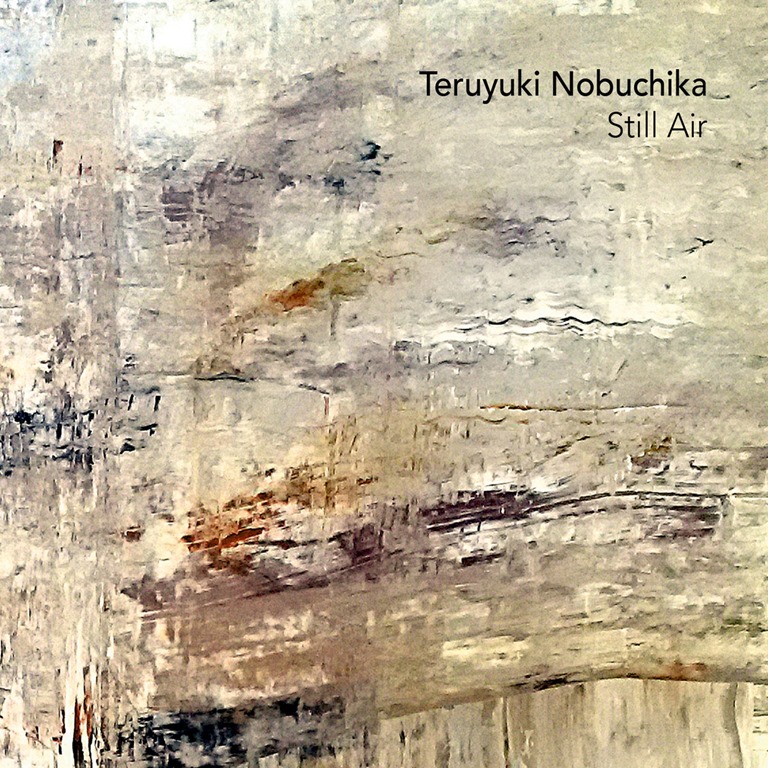
Still Air is the third solo album by Japanese electronic musician and soundtrack composer Teruyuki Nobuchika. Promising ‘electronic abstractions and classic sensitivity’ with ‘influences in a minimal ambient music context’, Still Air is very much about the atmospheric background, in the most fundamental of terms. Nobuchika creates ambient music which is subdued, toned down, quiet, devoid of beats and overt structures. Still Air is an album which, first and foremost, drifts.

Microglitches, the soft hiss of a vinyl groove, a barely discernible click disturb the almost pure ambience of the title track, and introduce Nobuchika as a musician with a keenly attenuated ear for subtlety and nuance. Across the album elongated drones, backwards hums and soft, supple strings create delicately atmospheric background compositions. What renders them interesting is the way in which Nobuchika filters in tiny incidentals, brief brushstrokes which add layering and depth. Rays of light filter through swirling fogs, chimes and tinkling notes ripple mellifluously amidst soothing washes of cloud-like sound.

The measure of any music is what kind of response it engenders in the listener. More often than not, ambient works evoke a sense of vague, relaxed enjoyment, but little more, as a tranquil boredom slowly takes hold. Still Air achieves something similar, but without the boredom. It’s a pleasurable experience, and one which offers an unconventionally three-dimensional ambient experience.


Teruyuki Nobuchika – Still Air

Hidden Seer – HDSR001 – 25th November 2016

Christopher Nosnibor

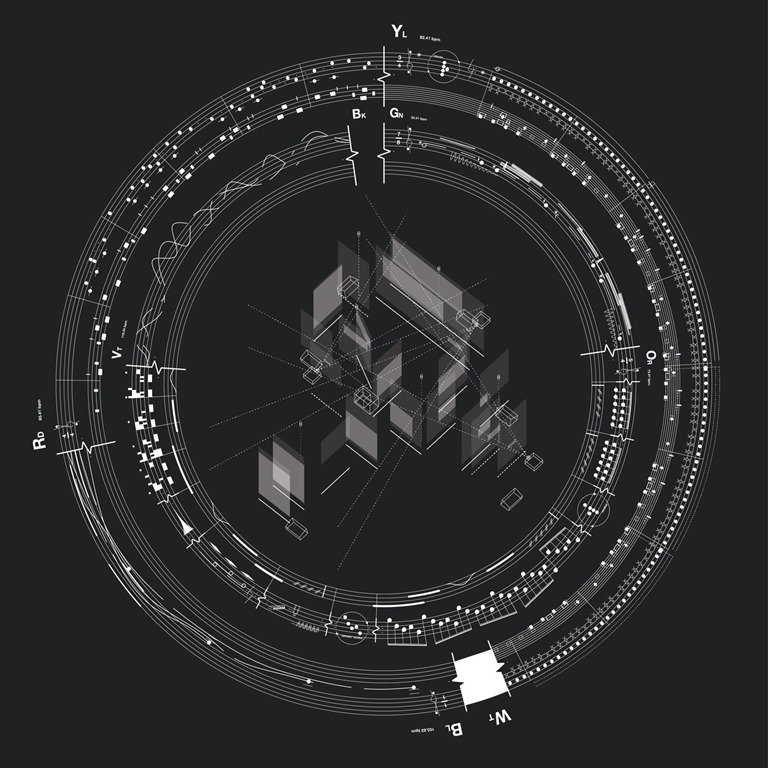
Aside from being a member of Leeds-based good-time festival-favourite indie band and all-round musical entertainers Hope and Social for some six years, Simon Goff’s list of collaborators is impressive, featuring among their number Aidan Baker and Pere Simonelli of Enablers. He’s an artist who can seemingly turn his hand, adeptly, to myriad musical forms. And on HUE – an album which couldn’t be further from the jaunty fun of H&S – he explores forms in the vaguest, most mutable, shifting, fleeting sense. Glitchy beats flicker through rippling strings. Tempos and counter-tempos criss-cross subtly, creating the impression of different currents running together but at different depths. It all happens beneath the surface.

Each of the album’s six colour-coded tracks is sculpted meticulously from layers of sound, the arrangements marrying electronic and conventional acoustic instruments to compelling effect. Percussion of a palpating heartbeat, glitchy crackles and mournful strings drift over low-end scrapes and rumbles. Eventually, the dark atmosphere gives way to light, blossoming brightness beams like the sun’s rays breaking through cloud. Yet there are shadowy currents which still flow beneath. After a rather grand opening, there’s a retreat into more minimal, drone-orientated sonic territories. Soft contrails are calligraphed in subtle, supple string arrangements. The space between the beats and notes is integral to the compositions: the echo, the decay. The overlap. A single note, plucked with varying weight.

Elsewhere, as on ‘Blue’, Goff creates a rarefied atmosphere through the exploration of the most minimal arrangements. Elongated, tapering drones which shift almost imperceptibly, with broad sweeps of sound like steely grey clouds turning, moving.

Picked notes and irregular rhythms combine to create somewhat disorientating sonic spaces; the shimmering oscillations of tr6 are trance-inducing hypnotic, but the erratically-cut and irregularly lopped sample snippets rupture the gentle surface with dislocation. The tracks drift into one another, creating a natural-feeling flow that, while not narrative, does possess a certain subtle linearity.


simon-goff-hue

Monotype Rec – MONOLP018 – 14th November 2016

Christopher Nosnibor

However broad one’s mind and tastes, there will inevitably be some artists who will baffle, bewilder and leave one somewhat dazed. Carp’s Head, a collaboration between Ghédalia Tazartès, Pawel Romanczuk, and Andrzej Zaleski is one of those releases. So much so, that my first reaction was one of borderline horror, a recoiling, an internal cry of ‘what the hell is this?’

‘Danse Inverse’ begins with a bleep. Minimal electro? Nope. A grizzled yet semi-operatic yellering starts up, almost simultaneous with a strolling bass, wonkily-played and a woozy accordion. Tazartès whoops and grunts, growls and emotes wildly like a drunken French opera singer impersonating Tom Waits, while the cacophonous musical backing veers and weaves all over. The weirdness only continues and as the album progresses, taking the listener on a bizarre journey around the globe and as observed through the eyes of three madmen. ‘You’ll Be Wise’ comes on like Scott Walker on acid, while the quietly crooning ‘Zither Song’ is sparse and eerily haunting in a mystical, dream-like way. ‘Orient Calling’ marks a continental shift in terms of the musical inspirations and influences, a droning sitar accompanies Tazartès’ yodelling ululations and low, chesty quaverings.

The album’s centrepiece is the nine-minute epic ‘Wolves and Birds’, a bleak and disorientating expanse of dark ambience. The wordless vocalisations convey a sense of lack, of absence, as they float, wailing and disembodied through the sonic wastelands. There’s plenty of weirdness on the other side of the bridge, too, with tweeting, trilling pipe notes and scratchy layers of sound by turns tickling and teasing the listener’s senses.

Jazz percussion breaks out unexpectedly at various points, bringing an odd and somewhat incongruous swing to proceedings. With its ‘Trout Mask’ connotations and overt otherness, Carp’s Head is many things: it is, in fact, remarkably focused and feels extremely cohesive in its order, less experimental and more built on musical intuition between the players. I’m not sure I recommend it, or if so, to whom, but there’s no question that it’s interesting or different.


Carps Head

This Is It Forever – TIIF031 – 25th November 2016

Christopher Nosnibor

I’ve long been a fan of worriedaboutsatan: on their emergence in 2006, their, a hybrid of ambient and low-key dance music, fused with a rare focus on dynamics, positioned them as purveyors of some kind of electronic post-rock. No-one else was doing anything quite like it. With couple of EPs and an album under their belts, the duo – Gavin Miler and Thomas Ragsdale – morphed into the more overtly techno Ghosting Season. Returning but briefly with a single in 2010, it wasn’t until last year’s second album proper that they really made their return. Now it seems that while marking their tenth anniversary, they’re making up for lost time. And still no one else is doing anything quite like what they’re doing.

Opener ‘A Way Out’ immediately trips against expectations, beginning with tweeting birdsong n chiming piano notes which build anticipation of a slow-building piece that blossoms as layers emerge fluidly. Instead, it ends swiftly an abruptly, with the beat-driven trancey electronica of ‘The Violent Sequence’ taking things in a radically different direction. It’s anything but violent, at least on the surface, but as is often the case with worriedabotsatan’s layered, nuanced arrangements, there’s something menacing hiding beneath the surface.

‘This Restless Wing’ introduces vocals to the mix, courtesy of the gliding falsetto of Vincent Cavanagh of Anathema. If the idea of the wilfully low-key duo going all-out for the big-name collaboration as a lure to the album seems incongruous, it’d worth bearing in mind they’ve previously been featured on various TV shows, and, more recently, the immensely acclaimed Adam Curtis documentary, HyperNormalisation. In other words, nothing is beyond the realms of worriedaboutsatan. And nor should it be: these guys are masters of stealth, and Blank Tape is an album which wears many cloaks.

‘Forward into Night’ approaches almost invisibly, building a dense, murky atmosphere. The ticking cymbals create a tension, while the sparse beats are subdued, and ‘Lament’, a collaboration with Bristol electro duo Face+Heel, is haunting, ethereal. The album’s second track to feature vocals, it’s sparse and understated, and Sinead McMillan brings something unique to the song’s dynamics. The filmic qualities of the piano-led title track are undeniable and it’s a compelling piece which contrasts with the bubbling synths of the closer, ‘From a Dead Man… Part 2’ which plays out the album and drives it home with a return to pulsing beats, undulating sub-bass and rippling synth motifs.

Blank Tape is still distinctly worriedaboutsatan, but also marks quite something of a departure from its predecessor, Even Temper. It’s a lot less beaty, for a start, and a lot less bassy. The samples are virtually non-existent. Moreover, while it’s still richly textured, the textures here are smoother, the frequencies less geared toward eliciting an unprovoked physical reaction. It’s perhaps the sparsest and most minimal work they’ve created to date, but it’s highly detailed and if anything, its subtlety represents a new advancement and refinement of their approach to music-making.

Blank Tape is by no means an immediate album. It’s an album to absorb, ponder and reflect on, and which yields more with repeat listens. It’s certainly not an album made for TV, but these are strange times. This is the instrumental soundtrack to those times, and the next few years will surely see TV being made for this music. Blank Tape will likely see the band achieve the world domination they deserve by subliminal means.


ALBUM COVER