Posts Tagged ‘Album Review’

Dret Skivor – 1st April 2022

Christopher Nosnibor

Another month, another Dret release, and this one, their fifteenth, is from Dormir, a sound artist who lives on the island of Bornholm, near the Stavehøl Vandfald. It’s no April fool.

‘Under isen’ translates as ‘Under the ice’, and consists of two side-long tracks: ‘under isen ligger noget, du ikke kan lide’ (‘under the ice is something you do not like’, apparently) and ‘min indblanding er din afhængighed’ (‘my interference is your addiction’, according to Google translate. It sounds a little clunky, and is perhaps left in its native form,

‘under isen ligger noget’ is a suitably dark, dense blast sound that arrives on an arctic gust, scouring and scourging the bleakness of a whiteout landscape with a roar that strips away the senses with an elongated scrape of treble and a low, resonant booming like a ship’s horn, the sound lost adrift in a blizzard of impenetrable static. It’s disorientating, bewildering. You do, truly, feel surrounded, encased in sound, and if anything has ever recreated the harrowing experience of the time I was caught in a blizzard on top of a mountain in the Lake District and unable to gain any sense of my location in order to navigate down, it’s this. It was one of the most terrifying and traumatic experiences of my life, so suffice it to say, listening to this is something of a challenge on a personal level. It never ends, and you fear there is absolutely no way out. The tone and pitch has barely any variation over the duration; just additional elements thrown into the blistering vortex. It’s not strictly Harsh Noise Wall, but it is a wall of harsh noise that leaves you feeling buffeted, pulverised, punished.

If you’re hoping for something more gentle on the flipside, ‘min indblanding er din afhængighed’ is likely to disappoint: it’s more noise, only this time louder and denser and dirtier, not so much the sound of a blizzard but a washing machine on a spin cycle as it slowly breaks down, as recorded using a microphone thrown into the drum. It grinds and churns, thrums and throbs and swirls, it clatters, clanks and gurgles and swashes along, everything overloaded and distorted. In contrast to side one, it’s a more overtly rhythmic piece that positively pulsates, a dark heart pulsing beneath the eye-wavering curtain of static that crackles and fizzes. But there’s nothing soothing about this rythmicality, and you sure as hell can’t dance to it: it’s like having a wire connected to a battery prod your temple twice a second for almost twenty minutes; it leaves you feeling absolutely fucking fried. But it’s worth it.

AA

a4134837373_10

Muzamuza – 8th April 2022

Christopher Nosnibor

Eighteen months on from Alms of Guilt and the prodigious Newcastle sound artist Kevin Wilkinson, aka brb>voicecoil returns with Dissolve into the Now. Active for over a quarter of a century, his field remains staunchly experimental and underground.

Forged from founds sounds subsequently manipulated and mauled beyond recognition, the majority of the seven compositions on Dissolve into the Now are briefer than on its predecessor, with more than half compressed into under five minutes. But what that compression of time also translates to is a compression of density. Wilkinson describes the album as the ‘audio equivalent of a bag of cats’. If only it had even one cuddly feature. Dissolve into the Now is pretty bloody difficult for the most part.

Understanding the title of the first piece, ‘The Great Antagnoiser’ as a play on ‘The Great Annihilator’ (not only a Swans album, but, perhaps more significantly, the name of a microquasar surrounding a black hole in the Milky Way), it seems appropriate for this springing, glitching, fragmentary spray of sound collapsing into atomic particles. It’s like an entire library of samples splintering as they’re dragged along a conveyor belt before being sucked to their doom. It paves the way for increasingly murky, and increasingly fractured, pieces constructed from later upon later of darkness and dissonance.

‘Assimilate 5.1’ is bleak, ominous, dark; sounds that evoke flames and the screams of animals as they flee a forest fire are half-audible amidst a mid-range thrum. Shifting, scratching, rumbling… there’s much by way of atmosphere, and none of it’s pleasant of comfortable, but at the same time, there’s nothing tangible to take hold of through this ever-shifting work. Frequencies sweep in and out, bubble and burst, fizz and fade in the blink of an eye, everything fermenting in a soup of miscellanea. It’s like a neurological explosion. Time and tapes run backwards at his speed in the erasural ‘The Fact it was Removed Doesn’t Mean it Never Existed’. By this point, everything’s really starting to fuck with your head, and that’s before the dubby-bass barrage of ‘Nod to the Mu’, which might be a dance track if it wasn’t subject to being mixed by a strimmer and mastered by a wood chipper and spat out as dust and pulp.

The first of the album’s two longer tracks (running over eight minutes), ‘Sycophant They Are – Watch Them’ is a frothing, foaming, fizzing mess of flickering circuitry spasms which shares common ground with Gintas K’s work. The second of the longer pieces is the closer, ‘Assimilate 5.2’, and it’s here everything is incinerated under the roar of a jet engine, leaving nothing but scorched earth. Obliterated, dissolved, we’re left with nothing but air and the roar of silence.

AA

a0405806990_10

Cool Thing Records – 1st April 2022

Christopher Nosnibor

BAIT exists as a side-project for Asylums’ Michael Webster and Luke Branch, and they couldn’t be much different, with Webster using this vehicle as an outlet by which to channel all his angst and anger through sharp-eyed and sharp-tongued social observation and critique.

This debut long-player has been a long time in coming. Their eponymous mini-album landed back in March 2017, and apart from the standalone single release of ‘DLP’ in the spring of 2019, they’ve seemingly been dormant, at least in the public domain. But despite the obstacles of geography during lockdown, they’ve been busy, and the last couple of years have provided an abundance of grist to their mill.

The band describe it as ‘a digital post-punk lockdown docu-record which watches the clock, gets the jitters & lashes out just like the rest of us. It’s an internal monologue that accounts the anxiety, the struggles, the pressures experienced living by the sea during an international pandemic’.

Most struggled in one way or another during the pandemic, some unspeakably, and for a great many, the lasting effects of the trauma of lockdown and isolation are every bit as bad as those of the virus itself. Many lost loved ones, but were unable to gain closure or grieve with friends and relatives due to restrictions – while, it turns out, the government of ‘Great’ Britain partied on. It was often hard to know what to make of anything: conspiracy theories abounded, but over time, some of those theories began to look rather less far-fetched, and under such close surveillance, people could be forgiven for getting paranoid, for being angry.

Sea Change is one angry record. But to describe it as such is to overlook the emotional range it articulates: it’s an album that gives voice to anxiety, panic, fear, trauma. Perhaps it’s the ‘internal monologue’ aspect of its evolution is why it really speaks. As is so often the case, in the personal lies the universal, and it conveys the rapid changes in mood and general state of confusion, questioning, and self-doubt that defined the lockdown experience for so many of us. And just because we’ve left lockdown doesn’t mean that we’ve left lockdown behind, psychologically, meaning that Sea Change’s resonance goes far beyond that defined period in time which spawned it (‘inspired probably isn’t the word).

The mood is tense and dark throughout, and the production has that mid- to late-80s Wax Trax! Industrial feel to it: the guitars are gritty, but everything is condensed into a dense lump of sound that batters rather than saws at the senses. ‘No Sleep for Light Sleepers’ is more minimal, haunting, but also ominous, the processed spoken word like the mutter in your ear that just won’t let you settle.

It’s not entirely without humour, either: if the frenzied, pounding ‘DRAMA DRAMA DRAMA DRAMA’ encapsulates the way in which a heightened state of anxiety is a shortcut to a loss of perspective, whereby the smallest, most trivial things give cause to great panic (things you know are irrational, like, say, getting twitchy when your phone battery drops below 49%), it also highlights just how self-obsessed and microfocussed we are as a society (that that incident at the Oscars totally engulfed the internet against a backdrop of war, a cost of living crisis, and rising Covid cases and hospitalisation is perhaps the definitive moment in our culture of self-absorption, and perhaps, in the wake of lockdown panic, the need to have something to fret and opine over obsessively just to fill the gap). It’s not all completely oppressive, either: ‘Electric Murder’ is a straight-up dark electropop tune that would comfortably sit in Depeche Mode’s catalogue.

‘The Weight of the Water’ finds them punching through a steely grey mesh of guitars, and it’s dense and tense; the jitters amp up tangibly on ‘Somewhere to Be’. ‘I’ve got somewhere to be… I’ve got somewhere to be’ Webster repeats as if a mantra, like the White Rabbit trapped in a postmodern world in which all holes have been concreted over and gentrified in the name of ‘progress’. ‘Sugarlumps’ leaps from a queasy, claustrophobic wheeze to a roaring metal blast reminiscent of Ministry’s Filth Pig, and the album ends with a ferocious finale with ‘We Will Learn to Bark’, the sound of pure catharsis.

It’s pretty much an instant grab, but Sea Change is definitely an album that offers up more over repeat plays.

AA

Sea Change

Christopher Nosnibor

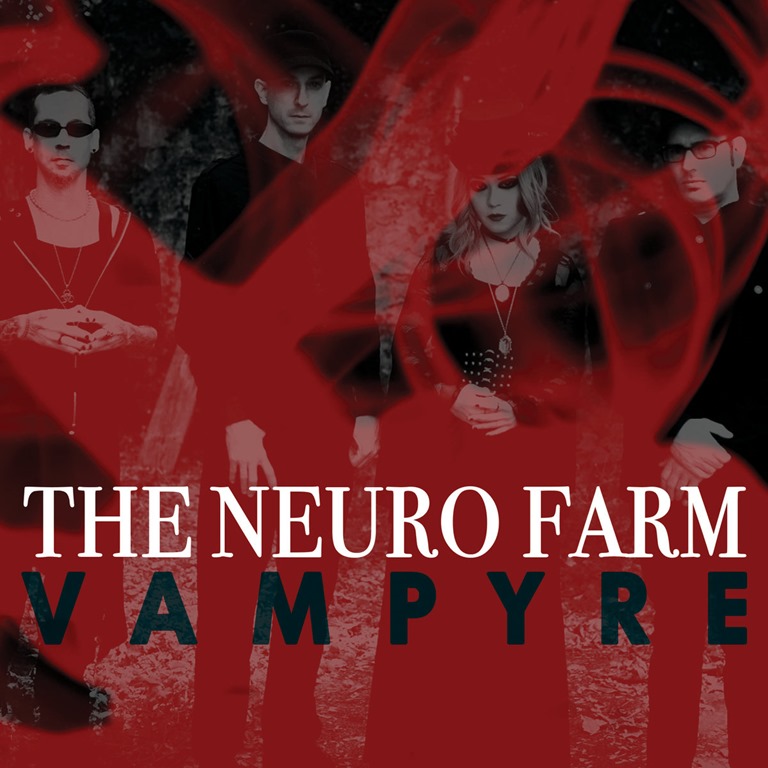
Vampyre is the third album from Washington DC’s The Neuro Farm, following The Descent (2019), and Ghosts (2014). If the album titles suggest dark and haunting, it’s fitting for a band who harvest influence from the field that contains Joy Division, Radiohead, Nine Inch Nails, Siouxsie and the Banshees, Sigur Ros, Chelsea Wolfe, Portishead, and Rammstein.

Comprising Brian Wolff (guitar, vocal), Rebekah Feng (violin, vocal), DreamrD (drums), and Tim Phillips (synth), the violin and synth contrive to bring rather less standard instrumental elements to the format, particularly with the absence of a live bass. That’s certainly no impedance (the only people who bleat about synth bass ironically seem to be fans of The Sisters of Mercy who haven’t move on from 1985 – because drum machine = cool, synth bass = not cool). Meh. They’re wrong.

Vampyre is a concept album, which they explain as follows: ‘Our titular heroine, lured by the promise of immortality, is given this curse by the egomaniacal leader of a vampyric cult. But within the cult there is a growing sense of disillusion, and she builds her own following. Eventually, she spurns her maker, rebelling against him and his decaying institution. She says a final farewell to her mortal husband, turning away from humanity and embracing her new nature. She slays her former master in the “midnight massacre” and declares herself queen.’

Now, as much as I’m an advocate of albums over random collections of songs, I do sometimes struggle with concept albums, in that following a narrative is often quite a strain. Too much narrative can be tedious; too little, and you’re lost, wondering what the fuck is going on. It’s a thorny territory to navigate under any circumstances.

‘Cain’ makes for a bold, theatrical introduction, the brooding drums that roll and roil providing a stoic backdrop to some theatrical, dramatic vocals. Feng isn‘t just operatic in her delivery, but she’s backed by a full choral arrangement, and then the violin sweeps in and the cinematic scale of the composition truly reveals itself in all its grand enormity.

It’s all going on with ‘Purity, a slow-builder that slithers through Rozz-era Christian Death gothness via trudging stoner rock to crescendo-blasting post-rock over the course of its six-and-a-half minutes.

‘Maker’ brings the bombast, to something on a part with Carl Orff’s ‘Carmina Burana’, and transitioning through various passages of grandeur. It’s a lot to take in. The spacey prog-rock of ‘Enthralled’, the gloopy electro industrial of single release ‘Confession’, the brass-laden brooding of the metallic ‘Decay’. The piano-led, echo-heavy title track is something of a gothic masterpiece, dark, shadowy, with soaring vocals and it’s brimming with epic qualities that touch the emotional centres as it blooms in a glorious cascading sunburst finish that’s peak goth and post-rock in perfect concordance. It feels like a finale, but the three remaining songs continue to cast forth rich and resonant atmospheres, with ‘Midnight Massacre’ landing a gloom-tinged glam-stomp unexpectedly near the end. This is proper gothic rock, perfectly realised.

More often than not, anything that proclaims to be ‘goth’ or ‘gothic’ and goes down the ‘vampire’ route’ tends to be awkward, corny, and cliché, but for all of its ‘conceptual’ leanings, Vampyre is none of these; instead, it’s like a darker, more gothic dip into the domain of early iLiKETRAiNS. But above all, it’s varied, imaginative, dramatic, and really quite spectacular.

AA

a2627279756_10

This is it Forever – 25th March 2022

Christopher Nosnibor

There are many artists who can boast bodies of work that are solid, and illuminated by outstanding gems along the way, but there are few artists with bosies of work as consistent as worriedaboutsatan. Fifteen years into the project’s existence, that’s a significant achievement. Some artists go off the boil or seem to struggle with maintaining that level once they achieve a certain degree of success, whether it’s simply through a perceived pressure to deliver something or create something that will replicate whatever it was that achieved that success, or simply diminishing returns, but worriedaboutsatan, despite having tracks featured on Coronation Street and Adam Curtis’ Hypernormalisation documentary, not to mention radio play on both 6Music and Radio 1, and the very vocal support of one Ian Rankin, remain unstinting in their path.

Operating solo since 2019, Gavin Miller has maintained a constant flow of output: so constant that since Providence last May, Miller’s slipped out a brace of album-length single track releases (Circles I and Circles II) and an EP Live from the Studio that entirely bypassed me while I was, well, I don’t know, what was I doing?

The thing about consistency is that it absolutely does not equate to sameness, and worriedaboutsatan’s output is defined by its evolution, incorporating wide-ranging stylistic elements from delicate post-rock to pounding beats within the overall sphere of haunting, reflective ambience of varying shades of darkness and light. And while satan’s sounds exist in a rarefied space all of their own, no-one lives in a complete bubble. We live in dark times, and not insensitive to this, this latest offering finds Gavin channelling that global turbulence through his work.

Bloodsport promises a departure, and it delivers. Miller describes it as ‘still very much a worriedaboutsatan album, albeit a fairly angry one.’ It’s a fair summary. The intro piece, ‘Je Suis Désolé’ is a classically ‘electronic’ composition with oscillating waves cutting across one another, but the treble tones sound like sharpening knives, and it has an edge that scrapes at the skull quite unexpectedly.

Making a linguistic and stylistic switch, ‘Bis Ich Komme’ is slow and dubby, a dense bass and backed-off beats holding the structure of a drifting ambience, before it solidifies and hardens around the mid-point. There’s a tension, a simmering aggression in the tone of the barbed synths, something uncomfortable and uncertain in the samples, before jungle beats hammer through the woozy, stomach-clenching undulations like machine gun fire

Released ahead of the album as an EP with three remixes, ‘Sigourney Weaver Fanclub President’ is the theoretical lead single, and it’s a brooding eight-and-a-half minutes of echoes guitar sustain and crashing sheet metal. It’s the sound of shattering destruction and trepidation. It’s classic ‘satan in that it’s all the layers, all the atmosphere, but it’s also steelier, with a certain bite previously unheard.

The two parts of the centrepiece, ‘An Absolute Living Hell’ are definitive and are a statement in themselves. Dark, dank, oppressive, bass-heavy and bursting with shards of extraneous noise, rippling in deep, deep echo, this diptych is the soundtrack to this bleak moment in time. ‘Part 2’ goes full industrial with a throbbing bass and crashing percussion worthy of Test Dept or Neubauten.

The stark robotix of the brief but claustrophobic ‘Perfekt’ makes for possibly the least WAS-like track of their career, before the metronomic thud of ‘Slur They Words’, dives headlong into the territory darkest hi-hop: the origins of the vocals are unclear, but they’re abrasive, and ‘Apex Redditor’ draws the curtain in a bleak fashion, but with a redemptive hint of a rippling piano and twitchy percussion that – I hope – alludes the prospect of a new dawn. Because surely, surely, there has to be a light at the end of this tunnel.

AA

a2575977490_10

BISOU Records/Beast Records – 18th March 2022

Christopher Nosnibor

Sometimes, there’s simply no escaping the fact that grooves and hooks are important. However wearying the conventions of rock and pop are so much of the time, there’s still a vital appeal. Sometimes you just need something to grab hold of, something to grip your short, feeble attention span. But what happens when you bring all the conventions together at once and then mash them, bash them, squash and smoosh them with joyful irreverence? It goes one of two ways: it’s a horrible hybrid mess with no cohesion, or it’s genius. Supersound is genius. It mines many aspects of those conventions to forge an album that’s got groove and hooks, while making unusual takes on country, rockabilly and post-punk, and wrapping them in an abundance of noise that’s pretty gnarly at times. It’s all in the mix – blues rock, alt-rock, grunge, even regular radio rock – but delivered in a twisted, mangled fashion that’s guaranteed to keep it off the airwaves.

The story of the creation of this masterwork is decidedly un-rock’n’roll as it involves Red (Olivier Lambin) suffering from presbyopia and purchasing a bass because it has ‘bigger frets and fewer strings’ and recruiting a collective who can actually see to play their instruments to realise his musical vision. It’s perhaps no wonder it’s a blurry haze of bits and bobs. Said lineup involves ‘two drummers, Néman (Zombie Zombie, Herman Düne) and DDDxie (The Shoes, Rocky, Gumm)’ who Red asked to create their own rhythms, plus Jex, aka Jérôme Excoffier, his lifelong accomplice, who still has excellent eyesight, who played all the guitars on the album.

A strolling bass and jagged guitar slew angular lines on ‘Normal’ that’s spineshaking swamp rock, sounding like a collision between the B52s and The Volcanoes. ‘Ready to Founce’ has all the groove and all the swagger, and has the glorious grittiness of Girls Against Boys at their scuzzy, sleaze-grind best, calling to mind ‘Rockets Are Red’. Then, ‘Shark’ sounds like Butthole Surfers covering an early Fall Song. ‘Screen Kills’ is altogether gothier, with acres of flange swathing the trebly guitar, and all paths lead to the tense, needling jabbing jangle of the final song of the album, ‘Carcrash Disasters’. It could have so easily been tempting fate, but while they veer wildly and screech around every corner on two wheels, DER remain on the road to the end of a crazy conglomeration of an album that buzzes from start to finish.

AA

BIS-020_front

Cruel Nature Records – 11th March 2022

Christopher Nosnibor

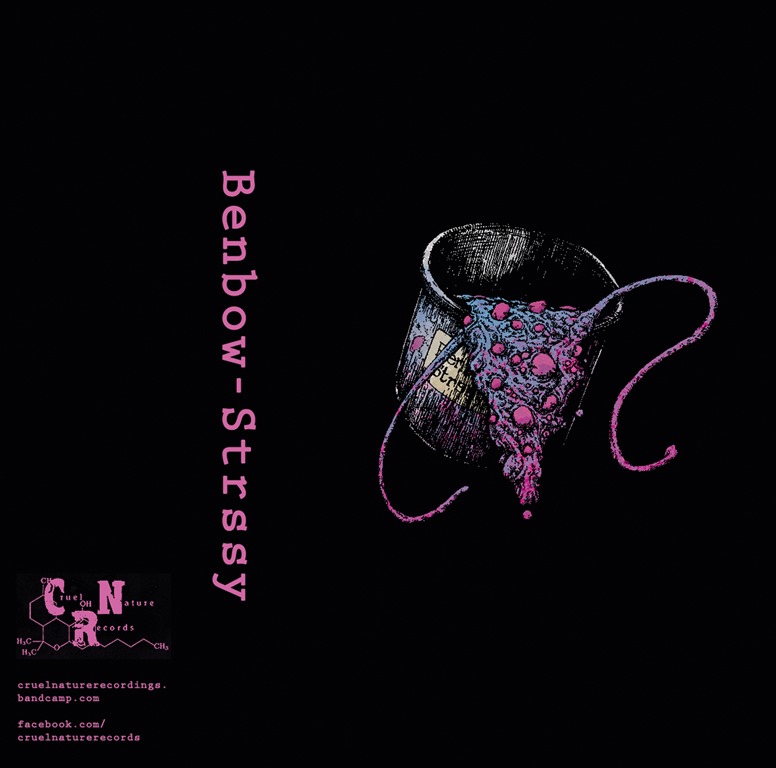
This is something that the CD or digital release simply cannot really do justice to as a full, multi-faceted, multi-sensory experience: the split LP. And while I’m more of a fan of vinyl and cassette, this most certainly does the job: you have to turn the thing over. It is truly an album of two halves. In this case, half Benbow, and half Strssy. And while some split releases simply stick two artists back to back – and there’s nothing wrong with that – Benbow and Strssy have history.

As the biographical notes detail, they first met ‘in a basement café in Lausanne, Switzerland just before the first sliced loaf was presented at the World’s Fair. Benbow had just finished a tour of the Alps with wandering trapeze troupe, NORMAL MAN while Strssy had taken a well-earned sabbatical from conjoined mime act, DIET PILLS. Over the following years they exchanged correspondence and encouragement as they independently began making experimental electronic music’. This split release, then, is pitched as ‘a celebration of this journey’.

Benbow’s eight cuts make for a hell of a journey in their own right. The tone is far from celebratory: it’s dark, claustrophobic, driven by dense beats and even denser atmosphere. Short, fragmentary snippets that straddle the space between sketched ideas and something more fully realised, all bar two are under three minutes in duration, but pack in a lot. Broadly, Benbow explores the tropes of minimalist, dark-hip hop, with thwacking solid beats and phat bass that gnaws at the gut with simple repetitive motifs or only three of four notes. It’s kinda heavy, and the effect is cumulative.

‘Slowly’ grinds, chugs, and churns away, the bass thick and gnarly amidst a swirl of reverberating synth oscillations that emulate the nagging call of a siren toward the end. Benbow’s final track, ‘Two’ marks quite a shift, with strings galore and an altogether lighter mood.

Strssy similarly trades in contrasts and juxtapositions. ‘Off a Watering Can’ starts out gentle, but when the beat kicks in, it’s pretty bloody heavy, and the mood changes significantly. It’s no longer chillout, ambience, but dense and tense, and layers of noise build exponentially to incorporate shrill whistles of modular synth abuse. ‘Deep Interior’ is all the twitch and bleep against dank, rumbling caverns of sound and then, from nowhere, it’s more rapid and relentless wails like a misfiring smoke alarm, only with a squeaky toy embedded in the circuitry. On a bad day, I’d likely find this seriously fucking annoying, but in a balanced and objective mood, it’s possible to give kudos to the way in which Strssy incorporates dance elements into a more freeform approach to electronic music which also incorporates industrial and ambient leanings. ‘Bath Night’ is a thumping industrial melting pot that’s more like drowning slowly than floating serenely, while ‘A Beautiful Brown Catalogue’ is all about the bowels with its booming bass frequencies, plus additional wild trumpet action. It’s got that late 80s wax Trax! vibe, but with a more experimental twist, and it pinches the brain.

Paired, Benbow and Strssy make for a formidable duo, a tag-team of hard-hitting genre-splicing, slow-groove bashing behemoths.

AA

Xcover

Mille Plateaux – MP40 – 11th March 2022

Christopher Nosnibor

The last time I engaged with the work of Cristian Vogel was when his double-disc compilation, the archly-titled Classics in 2016. This retrospective covered his 90s output, and traced his evolution as an innovator in underground techno and electronica. His catalogue has doubled in size since then, and it’s apparent that Vogel isn’t only prolific, but an artist who doesn’t like to retread old ground, constantly questing and striving to develop and explore new directions. 1Zhuayo explores many new directions, all at once.

Penning notes to accompany the release of this album, Lain Iwakura and Achim Szepanski wrote that ‘The new Cristian Vogel album 1Zhuayo sounds as if non-musicology & ultra-blackness is not an end or a destination to be arrived at, but as if it is the point of departure, much like tomorrow relates to the day after tomorrow. As if we have left the space of certainties and are moving instead into one of manifold possibilities. They are anticipated in the micro-structures of sound, which is the process of playing with and against the software.’

But then I start to get lost when they continue to explain how Vogel ‘creates a rhythmight that is constructed from the anticausality of Rhythm as counter-counted, the tracing of the rhythmicity of Rhythm in the creation-in-Rhythm. Rhythm is foreclosed to hearing. Non-music radicalizes this notion by subtracting hearing from the framework of experimental music, which claims that everything is heard from Rhythm. The material of music is the continious flow itself. Cristian Vogels method for this way of creating sound is called Rhythmics.’

I feel as if I’m wandering through Deleuze and Guatarri’s A Thousand Plateaus while drunk and on drugs. Words lose meaning – as does sound. It’s bewildering, disorientating. 1Zhuayo is, on most levels, a dance album. But it’s not an easy one, and it’s pretty dark and dense in the main.

The album starts as a churning roar, scraping feedback and industrial machinery grinding away like a tumble drier full of broken bricks, before ‘Hyphadelity’ plunges into booming bass groove-orientated dance. But it’s not comfortable or commercial: the vocals are menacing, half-submerged as they are amidst the busy layerings and the surges of extraneous noise. ‘Astrocumbia’ sees things turn nasty: dance music you can’t dance to, a frenzy of distorted beats exploding all over amidst a gruelling churn or super-low, super-hectic bass that pounds at the pit of the stomach and crushes the cranium. ‘Emanations’ slows it down with an almost dubby vibe.

Things unfold differently on ‘S18’. Again, the dance tropes are prominent, but they’re fractured, pulled apart, before a tsunami of solid sound crashes through on ‘1Zhuayo Express’, which swells to immense proportions, like Godzilla rising from the deep, flexing its muscles as a wall of sound, gloopy bass and grating mid-range pulsating in a monstrous behemoth of power electronics.

The Strom Stadt remix of ‘Transferenz’ is a brutal exercise in monster hardfloor techno that makes The Prodigy’s later works sound like bouncy chart pop, while the Disintegration Mix of ‘Angle Phase Life’ is a brutal mesh of noise with mangled beats partially submerged by the successive detonations of low-end. It sounds like an erupting volcano and missiles launching in slow motion. And amidst it all, electronics pop and squelch like fireworks.

‘Cables’ isn’t a cover of the Big Black song: in fact, it’s quite the opposite being stark and minimal, stuttering glitchy, with a crunching bass drum thudding mercilessly throughout, before the last piece, ‘Serpent Acid’, a splattering blast of jamming percussion and nagging, repetitive, cyclical synth motifs.

Less is more, and this is largely minimal, but at the same time, builds up later from unexpected angles to create something different. It leaves you feeling somewhat dazed – in a good way.

AA

a1006963432_10

Constellation – 11th March 2022

Christopher Nosnibor

Kee Avil isn’t an individual, and isn’t really a band, so much as a concept, a collective, a project, the brainchild of Montréal producer and guitarist Vicky Mettler. Debut album, Crease, is pitched as ‘a singular expression of fractured dream logic concretized in chiselled postpunk guitar, sinuous low-end electronics, a panoply of organic and digital micro-samples creating alternately twitchy and propulsive rhythm, and the anxious intimacy of her finely wrought lyricism and vocals’.

It all sounds pretty grand and sets expectations high. Thankfully, Crease doesn’t disappoint. To manage those high expectations, let’s get it established here and now that it’s not a conventional album, with easy songs with obvious or accessible verse/chorus structures.

‘See, my shadow’ starts out with hints of early PJ Harvey but swiftly spins into industrial post-punk with electro/hip-hop beats, more akin to Lydia Lunch fronting Coil remixed by Portishead. It’s a lot to happen in the space of under four minutes, but then, that’s par for the course here: Crease is as jam-packed with ideas as it is sonic strangeness. It’s not an easy album to get a grasp on, and Mettler comes across as quite otherly. Some may say crazy, unhinged, but it’s not that. It’s just apparent she exists on another plane, and Crease shuns conventional structures in favour of exploring avenues of songwriting that more closely reflect an alternative vision and concept of ‘songs’. I certainly don’t mean that as a criticism, but equally, don’t want to sound like a wanker by saying that this is art and therefor superior. I mean, it is superior, but not because of that. To unpack that a bit, Crease is clearly the product of a quite specific mindset, and a determination to find a means of articulating. And sometimes, to articulate is to go beyond language and beyond conventional musical structures. As such, what Crease articulates is a separation from the rest of the world, the turmoil of the mind, the duality of the internal monologue.

‘Drying’ is sparse, glitchy, a clicky clatter and pop of percussion providing an erratic framework for the incidental instrumentation and slowed-down, opiate-haze vocals that are at once sultry and threatening.

‘And I’ is a sparse, scratchy acoustic guitar-based song; the tense picking at times calls to mind early Leonard Cohen, and the atmosphere is muscle-tensingly taut. It’s a masterclass in how less is so much more, and as Mettler’s breathy vocal arcs over the spindly fretwork, a kind of magic happens in the way it draws you in with a hypnotic sensation. ‘Devil’s Sweet Tooth’ lunges and sways, violins teeter on the brink of a breakdown

It’s often difficult to make out the actual lyrics, so you lean in closer in an attempt to get your head and hands around them. You fail, but you’re drawn in closer to the dissonant strangeness that’s more than just music: it’s a world of disconnection and dislocation. It’s unnerving, alien, but likely better than this one right now.

AA

a2394473098_10