Posts Tagged ‘Album Review’

Young God Records – 23rd June 2023

Christopher Nosnibor

Swans are back – again. This is no surprise: they released – as has become standard form – a limited edition demos CD, Is There Really A Mind? through the website as a fundraiser to pay for the album’s recording and release. All ten of the songs which appeared there have made it to the finished album, but, more often than not, in aa rather different form. Unusually, though, the bare-bones demos didn’t all start life as brief acoustic sketches which expanded to twenty-minute sprawlers exploding with extended crescendos: the shapes of the songs were realised early on, and in several cases, the final versions are actually shorter than the drafts. And while Gira hinted at a seismic shift following the gargantuan blow-out of The Glowing Man, heralding the arrival of a new era with Leaving Meaning – and it’s true that the shape of the band has been very different, not least of all with mainstay Norman Westberg and Thor Harris both stepping back to being contributors rather than a core members, Kristof Hahn remains – Swans remains very much ultimately Gira’s vehicle. And so it is that for all of the changes, The Beggar is clearly very much a Swans album, and sits comfortably in the domain of their body of work.

There does very much seem to be an arc when it comes to Swans releases, rather than any rapid shifts, particularly since their 2010 comeback, My Father Will Guide Me up a Rope to the Sky, whereby the songs grew incrementally longer and more sprawling and the crescendos more drawn out, fewer, and further apart. And so it is that The Beggar follows the more minimal sound of Leaving Meaning, and, like its predecessor, it’s a comparatively succinct statement, at least by Swans standards in the last decade – at least, discounting ‘The Beggar Lover (Three)’, an album-length track which is absent from the album, and occupies the majority of disc two on the CD. This track is, in some ways, contentious: does it even belong on the album, or should it have been released as a standalone work? The album minus ‘The Beggar Lover (Three)’ is still an expansive work, but has a certain flow and sense of existing as a cohesive document. And so it feels like there are almost two different albums here:

As the album’s ‘taster’ tune, the twitchy, trippy, eternally-undulating ‘Paradise is Mine’ indicated, Gira’s compositions on The Beggar are constructed around heavy repetition. This is to be expected: it’s been Gira’s style since day one. The first song, ‘The Parasite’, strips right back to nothing around the mid-point to find Gira acappella, imploring ‘come to me, feed on me’ in a menacing low-throated rasp. And as Gira questions ‘is there really a mind?’ in the psychedelic droning loops of ‘Paradise is Mine’ the tension increases and you start to feel dizzy. and perhaps a little nauseous. This pit-of-the-stomach churn is something that Swans have long been masters of, although quite how it manifests has changed over time: back in the days of Filth, Cop, and Greed, it was sheer force. More recently, it was woozy, nagging repetitions that lurch like a boat on a bobbing tide.

‘Los Angeles: City of Death’ returns to the style and form of The Great Annihilator – a three-minutes hard-punching gloom folk song. After the previous incarnation’s ever-longer workouts, it’s an absolute revelation, and a joy to be reminded that despite the work of the last decade or so, Gira can still write tight songs that you can actually get a grip on and really get into. ‘Unforming’ is a soft country drone, which finds Gira crooning cavernously over slide guitar, and it’s reminiscent of some of the more tranquil moments of Children of God.

‘I’m a shithead unforgiven… I’m an insect in your bedclothes…’ Gira drones on the ten-minute title track. For all of the artistic progress and evolution over the decades, Gira is still chained to the tropes of self-loathing and the darkest, most self-destructive introspection, and this is dolorous, doomy, and bleak …and then about four minutes in, the drums crash in and the sound thickens and they plug into one of those nagging grooves that simply immerses you and carries you upwards on a surge of sound. ‘My love for you will never end’, Gira moans, ever the subjugate, before the vocals conclude with an anguished, wordless strangled gargle as the riff kicks back in and swells to a monumental scale seemingly from nowhere.

‘No More of This’ is mellow and almost uplifting, both sonically and in its message – at least until near the end, when Gira reels off a list of farewells, and as much as ‘Ebbing’ seems to be about drowning, it’s a sliver of sunny-sounding psychedelic folk. And then ‘The Memorious’ hits that dizzying swirl of repetition that feels like a kind of torture. It’s hard to really articulate just how there can be music that makes you want to puke because it’s so woozy, wibbly. It’s the sonic equivalent of watching Performance. You don’t need to take a trip to take a trip.

‘The Beggar Lover (Three)’ represents a massive detour that does and doesn’t sit within the flow of the album. It’s either the penultimate track, or an appendix, depending the format of your choice. However you approach it, this is drone on an epic scale. Five minutes into ‘The Beggar Lover (Three)’, which starts out a trickle, with a robotic female spoken word narrative, everything just goes off – mostly drums, but also noise. When this tapers away, we’re left with the sound of sirens, ominous drones, and then after some hypnotic droning, there’s another monster surge, a nagging guitar motif riding atop a thumping beat and heavy swell of drone. It soon crackles into a grand wheeze of electronica, And a detonating wall of noise, and at the end, it all collapses. Around the eighteen-minute mark it really hits a heavy groove and blows you away.

The Beggar is certainly not the kind of heavy of Swans early releases, but it’s still heavy. It may not possess the sledgehammer force of the original. It’s beyond strong.

Once again, Swans have produced an album that’s more than an album, more than anything.

AA

a3082583285_10

Dependent Records – 2nd June 2023

Christopher Nosnibor

Now in their twenty-seventh year, Girls Under Glass return after an extended break – of some seventeen years – with a new album that wasn’t wholly planned. As the bio notes, explain, when they started composing some new tracks for an EP to round off a planned boxset of their complete works, ‘The fire reignited and songs kept coming… [they] understood that their batteries had recharged to bursting point after a 17-year break and the projected EP turned into a full-length.

The trouble with being forerunners and progenitors is that time catches up. What was innovative at one time becomes assimilated, absorbed: ‘influential’ becomes commonplace, however much you keep moving. And while Backdraft shows that Girls Under Glass have progressed, it also shows how external elements have, too – even within the spheres of post-punk and goth, which on the face of things, haven’t evolved all that much. Emerging bands are still emulating The Cure and The Sisters of mercy circa 1985, and oftentimes if feels as if these are genres locked in time – but then, the same is also true of punk, and contemporary grunge acts.

At least Girls Under Glass can lay justified claim to being there at the time and laying the foundation stones for the sound that endures over thirty years on, and they’re fully accepting that this new outing draws on the sound and sensations of their previously active years in the 80s and 90s. ‘Night Kiss’ brings all the synth-goth vibes where early New Order and third-wave goth acts like Suspiria meet, but there’s much to chew on across the ten songs on Backdraft. ‘Tainted’ – which features Mortiis on guest vocals – has a more industrial feel – but that’s industrial in the way that Rosetta Stone drew on Nine Inch Nails for Tyranny of Inaction than Ministry. It’s got grit and magnetic bubbling synths and some hard grooves, but the aggression is fairly restrained.

Single cut ‘We Feel Alright’ has a vintage vibe and sits in the bracket of ‘uplifting goth’ – it may not bee recognised as a thing, but it sure is, and propelled by a pumping disco beat, it’s one of those songs that brims with an energy that makes you want to raise your arms and your face to the sky as you’re carried away on the driving rhythm and expansive synths and guitars.

The six-minute ‘No Hope No Fear’ blissfully ventures into Disintegration-era Cure stylings, with a bold, cinematic approach, while ‘Everything Will Die’ is a quintessential slab of Numanesque electrogoth It’s uptempo, even poppy, but it’s dark, and if the Hi-NRG pumping of ‘Endless Nights’ is a shade cliché, but they redeem the dip with the sparse six-minute ‘Heart on Fire’ with its sepulchral synths, before erupting into an epic climax that’s like a shoegaze / synthwave take of Fields of the Nephilim.

Ultimately, Backdraft is a solid album: its roots are deeply retro, and it’s not one hundred percent hit, but it’s a solid addition to the catalogue of a band whose longevity speaks for itself.

AA

077216

Sacred Bones – 19th May 2023

Christopher Nosnibor

It’s been fourteen years since there was new music from Khanate, the experimental doom outfit featuring members of Sunn O))), OLD, and Blind Idiot God. It’s perhaps not surprising that my social media feeds have been bursting with the news of the surprise arrival of their fifth album on digital platforms ahead of a physical release next month– and because it landed from nowhere overnight, you couldn’t say it was eagerly anticipated, but it’s got a lot of people excited.

As you would expect, given the members’ main projects, and the previous Khanate releases, To Be Cruel is an absolute monster, with just three tracks spanning a full hour. You don’t tune in to Khanate for snappy pop tunes.

The first chord hits like an atomic bomb, blasting from the speakers with such force it’s almost enough to floor you, and rising from the sustain, crackling synth notes, then another sonic detonation that’s so hard and loud it hurts. Many of the tones and tropes of To Be Cruel are heavily redolent of the crushing doom drone of Sunn O))), but as the first piece, ‘Like a Poisoned Dog’ abundantly evidences, Khanate are different. This difference may be less apparent to the casual listener, but the stop/start power chords and skewed, sinewy shards of feedback are cut from a different sonic cloth, and if Sunn O))) are renowned for their indebtedness to Earth, there are elements woven in here which seem to owe more to early Swans, and while I wouldn’t necessarily want to speculate on whether the album’s title is some kind of response to Swans’ 2014 album To Be Kind, there is some kind of contextual interface here, in that both acts are pushing parameters within a longform song format.

And then there are the vocals: it’s a good seven minutes before Alan Dubin makes his first contribution: the song takes another swerve, the blistering blast simmers down and as he howls and roars, the feel is a cross between the darkest of mangled metal and brutal hardcore. And his manic screams are powerful and affecting. He sounds troubled, but in a way that conveys the kind of tortured mental suffering that’s common to many: it’s a primal howl of rage ad anguish that we struggle to unleash, and so to hear this is to feel emotions channelled by proxy, and as much as it hurts, it’s a release.

‘It Wants to Fly’ takes it to the next level, presenting almost twenty-two minutes of pain. The guitar is slow, crushing, punishing. What can you say? It hurts. It’s also minimal in arrangement but maximal in volume: this is first-gear BPM, with decimating feedback between the crushing chords. At the same time, it’s doomy and ominous as well as raging, making for a powerful cocktail of weight and raw emotion. There is no question that Khanate bring both.

And so it is that the album’s third and final track, the twenty-minute title track, is twenty minutes of low drone and tortured screaming that sounds like a breakdown captured on tape as Dubin yelps and screams about spiders against a sparse backing of a distant rumble and clanging guitar. ‘Look! In the closet!’ he shrieks in what sounds like abject terror. You dare not look. You don’t even want to hide under the bed: you just want to leave the house. The composition takes its time, it hums and drones, and in time, it hits and it hurts, and in some way you wish you could be Dublin, you want this release to have a channel into the unhinged. But you’re stuck on the outside, an observer to what sounds like either the ultimate catharsis or mental disintegration.

Ground down to nothing beyond and anguished screams and squalling feedback, this is bare bones, the sound of desperation. It isn’t pleasant, and there is simply no room to breathe: this is dark, dense torturous, and it’s exactly what fans have been waiting fourteen years for.

AA

a3411741448_10

Dedestrange Records – 2nd June 2023

Christopher Nosnibor

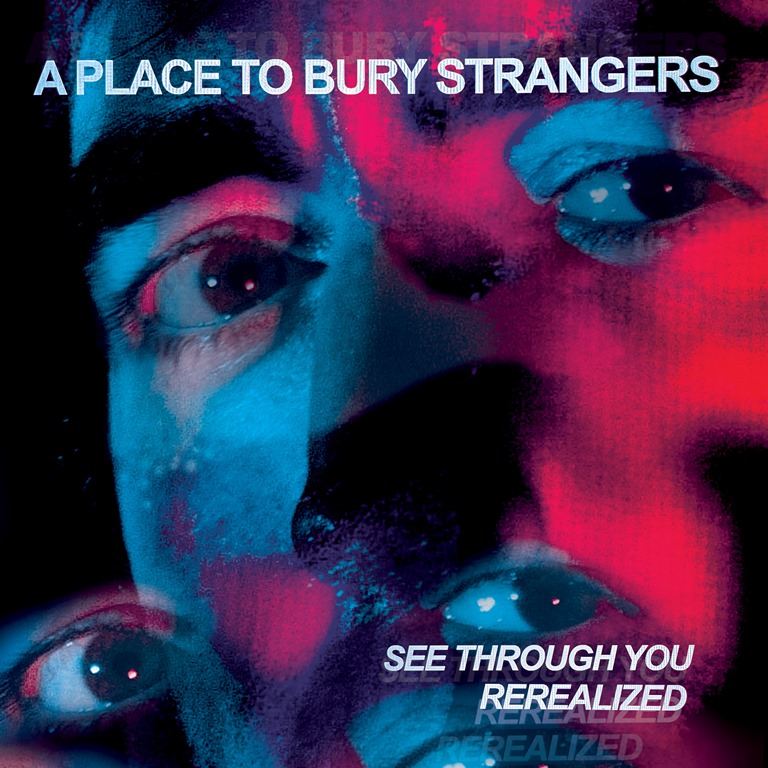
Initially released on vinyl for record store day, for the rest of the world who don’t own a record player or otherwise have spare cash to splash on records that cost as much as a week’s groceries, See Through You: Rerealized – containing twenty-one remixes of the songs from last year’s See Through You – is now getting a digital release.

Given just how twisted and fucked-up A Place to Bury Strangers’ records have got over the last few releases (Pinned notwithstanding), the prospect of the mangled messes that make up See Through You being remixed was a source of both curiosity and trepidation. Curious, because exactly what can you do with material this brain-bendingly off the wall, with so much noise and unconventional structures and production? And trepidation because just how fucked up is this going to be? After all, if you’ve ever witnessed A Place to Bury Strangers live, the chances are probably still haven’t recovered, and you know that things can get pretty insane without external help or interference.

There’s also the eternal question of just how many reworkings of any given song you want or need. There are no more than four versions off any one song on here, and the diversity of the remixers’ approaches means there doesn’t really feel like there’s significant duplication.

Trentmøller’s remix of ‘I’m Hurt’, which opens the album brings a glammy swagger to the song, and it feels cleaner, quite different from the original, and while the album version of ‘Love Reaches Out’ sounds like a demo version of a reimagined take on New Order’s ‘Ceremony’, in the hands of GIFT it becomes a winsome indie tune, at least to begin with, and the theme overall seems to be, contra to what normally happens with remixes, is that many of the remixers have straightened out and unfucked the songs to render them crisper, cleaner, more overtly ‘songy’. There are always exceptions, of course: Data Animal twists ‘Broken’ into a twisted dark synth effort, and as for Xiu Xiu and their take on ‘Love Reaches Out’, well. You’d expect nothing less, mind you. Ceremony East Coast revel in the racket with their murky electronic post-punk mangling of ‘So Low’, and it works well as a celebration of reverb and sonic fog.

Also notable and noteworthy are the reworkings by bdrmm and Sonic Boom: the former’s contribution, a ‘I Don’t Know How You Do It’ is a work with a sparse, minimal skeleton and misty layers overlaid to conjure a dreamy yet energetic cut that fades into rippling piano, while the latter’s immense ten-and-a-half-minute megalith is, well, a lot. It preserves the New Order vibe and polishes it up a bit, and seems to simply loop it forever. Indulgent? Well, yes, but then, it’s fitting.

It’s not until Lunacy’s ‘My Head Is Lunacy’ that were plunged into swampy hypnotic semi-ambient terrain, and it immediately precedes a reworking of ‘I’m Hurt’ this time by Ride’s Andy Bell under the Glok moniker, which is – rather unexpectedly – a work of dark, stark trance, with a thudding beat and a chunked-up bass.

‘Rerealized’ is the key to understanding this album, really. The songs find themselves not so much remixed or reimaged, but restore, to a state before all of the mess and noise and twisting and screwing and scrunching and all the rest. Despite its length, it works well. Does it improve on the original songs? No, but it definitely places them in an array of different lights.

AA

012270

A Place to Bury Strangers will bring their legendary live shows – a shamanistic experience that bathes listeners in glorious sound, crazed left turns, transcendent vibrations, real-time experiments, and brilliant breakthroughs – to the UK and Europe in May and June 2023 for the second leg of their Destroy Into The Future Tour. See full dates below:

DESTROY INTO THE FUTURE TOUR – TICKETS

19 May – Foul Weather Festival – Le Havre, France

20 May – Patterns – Brighton, UK *

21 May – The Lanes – Bristol, UK *

22 May – Furure Yard – Birkenhead, UK *

23 May – The White Hotel – Manchester, UK *

24 May – Belgrave Music Hall – Leeds, UK *

25 May – Broadcast – Glasgow, UK *

26 May – The Star and Shadow – Newcastle, UK *

27 May – Wide Awake Festival – London, UK

29 May – Wave Gotik Treffen – Leipzig, Germany

30 May – Futurum Music Bar – Prague, Czech #

31 May – Fluc – Wien, Austria #

01 Jun – Storm – Munich, Germany #

02 Jun – Vinile – Bassano del Grappa, Italy #

03 Jun – Freakout – Bologna, Italy #

04 Jun – Grabenhalle – St. Gallen, Switzerland *

05 Jun – L’Usine – Geneva, Switzerland *#

06 Jun – La Marché Gare – Lyon, France *#

07 Jun – Rockschool Barbey – Bourdeaux, France #

08 Jun – Festival Aucard De Tours – Tours, France

09 Jun – La Laiterie – Strasbourg, France #

10 Jun – Reklektor – Liege, Belgium #

* with Camilla Sparksss

# with Lunacy

Cruel Nature Records – 26th May 2023

Christopher Nosnibor

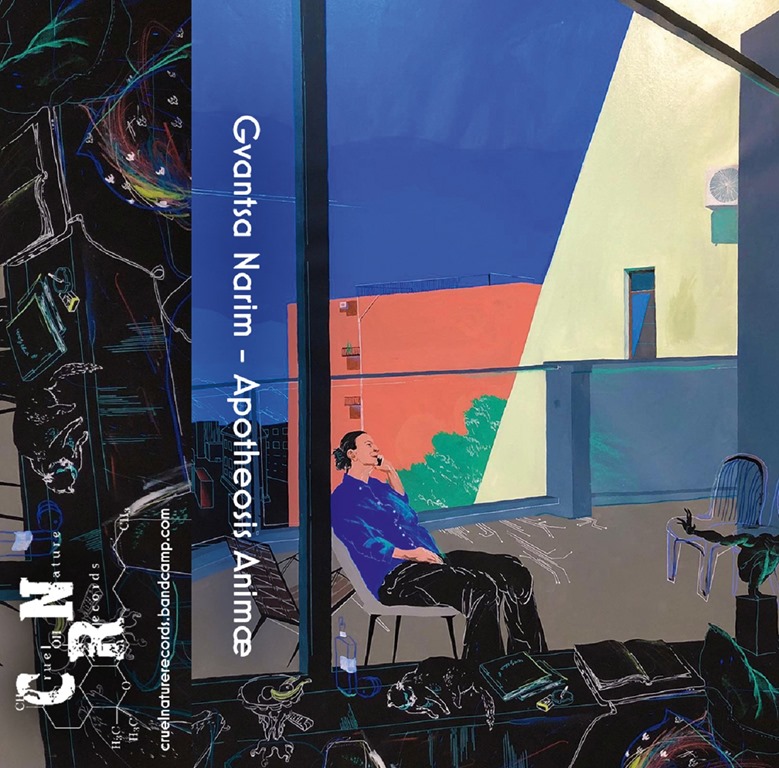
Having recently celebrated a decade of diversity, Cruel Nature Records continue to release a broad range of non-mainstream music – and the range couldn’t be more pronounced than placing two of May’s releases side-by-side: Gvantsa Narim’s latest offering, Apotheosis Animæ exists on another sonic plane form the grating industrial noise of Omnibadger’s Famous Guitar Licks Vol. III. They’re a sort of Yin and Yang: the world definitely needs both, and I personally need both, too, and it’s testament to Steve Strode’s singular commitment to releasing music of quality regardless of style or genre that they can both find a home on the same label.

Apotheosis Animæ, we learn, takes ‘inspiration from religion, esotericism and Georgian polyphonic music’, and that ‘her latest work was written in late 2022 / early 2023 and tells the dark and cold story of winter’.

It seems very much that winter now is not like the winters of twenty or thirty years ago: instead of two feet of snow, we get seven feet of flash flooding here in the UK. And now, despite it being the middle of May, it’s impossible to predict from one hour to the next, let alone from one day to the next if it will feel more like October or February. But despite this, winter not only has timeless connotations, but also, whether it’s sub-zero or only just a bit chilly, the cold winds and long dark nights do have a profound effect on human activity and our lives as individuals. It’s not only psychological; it’s biological and metabolic, and some of this is genetically coded into us from our prehistoric existence all the way through to as recently as just before electric lighting and mains power. There’s a case that says this is where we went wrong, as a species, and for the planet, in evolving beyond lives in tune with nature.

We each have our own unique relationship with winter, and our own associations and reminiscence. While I’m prone to Seasonal Affective Disorder, presenting as low mood and low energy, my wife would invariably suffer a low ebb in health from late October through the February, often suffering back-to-back colds that would drag on for weeks, the lack of daylight dragging down her levels of vitamin D and her immune system struggling to fend off the endless barrage of bugs and viruses that thrive in the cold months, especially when being breathed around in close-packed environments like offices. I fully acknowledge, then, and actually embrace, the fact that I am coming to this album fully loaded with my own baggage which will colour my experience and interpretation. This is a healthy, a function of music, something which can exist as a vessel for us to pour our thoughts, feelings, memories, and traumas into.

The compositions ‘Apotheosis’ and ‘Animæ’ bookend the album, and as the former lifts the curtain, it’s a slow, simple piano that evokes a slowing, a darkening which paves the way for mournful strings and distant echoes of bass and percussion on ‘Sicut Mortuss’ (which I believe translates as ‘like death’ or similar) conveys that paralysing sensation which descends with the darkness; while on the woozy, disorientating ‘Amnesia’, snippets of speech drift in and out, but instead of giving a sense of human connection, as they echo into the droning hum, there is only distance and detachment. Stretching out past the tend-and-a-half-minute mark, it’s hypnotic and unsettling, a little like the point at which you realise you’ve gone a little too far into your own head and need to drag yourself back to life, if only because it’s scary in there and you’ve got to work and at least appear normal.

There are moments of grand, sweeping ambience, soft and gentle, which convey the comforting experience of watching large flakes fall, heavy and silent, settling thick and deep in a silent white blanket; there are also moments of gritty disturbance, swirling glacial winds and shards of ice. ‘Born in the Mist’ is dark and brooding, shapeless, formless, ominous, impenetrable, the howling scrapes that ebb and flow are unsettling and uncomfortable, and it’s evocative; personally, I’m reminded of slogging across mountain tops in the Lake Diastrict in dense cloud and storm-force wind, and no doubt anyone else would being different mental visuals along.

This is where instrumental, abstract music really does come into its own: listener response simply cannot be prescribed, and has to come from within, and for this reason, we will all hear and experience something different. Following on, ‘Stopwatch’ sounds like the clouds lifting and waking up from a daze to remember that you do know how to live, that sense that perhaps hibernation is over and there’s a world outside, and this applies not only to the winter which is determined by the meteorological and astronomical seasonal changes, but the winter of the soul which can chill even deeper.

It’s soft and soporific: ‘Train’ glances and glides with crisp, crystalline tones into the – sadly missed, proverbial – sunset. The fifteen-minute ‘Codex’ is a big, brooding, bruising storm building in the form of a rumbling drone that’s dark as oppressive. Crackles, bleeps and bubbles rise cautiously on the edges of this mass of dense, dark atmosphere. Over time, it throbs lower and slower, and rippling details emerge and float along on the surface – but that darkness, that threat, is always present. At some point, you find yourself lost in the drift, and a slow thumping beat emerges behind a locked loop of synthesised notes… and then it shifts again, reminding us that nothing is ever static, however much it may seem that nothing changes, however much we may yearn to remain in a moment forever.

There are some truly beautiful passages; but they’re tempered by sadness and tension, which conveys the sense of coldness, darkness, isolation, longing that the long dark nights bring – a yearning for warmth, for comfort, for hot, hearty food, the primitive craving to sit beside a roaring fire.

AA

cover

Subsound Records – 10th March 2023

Christopher Nosnibor

It’s easy in the age of the Internet to conduct enough research behind the scenes to present oneself as having an extant k knowledge of a subject. It’s also a huge temptation to do this as a reviewer or critic, because there’s a certain expectation from audiences that if you’re going to proffer opinions on things, you ought to know what you’re talking about. It’s that knowledge and authority that ought to differentiate someone who presents insightful critiques from the boorish tosser down the pub – or, as is more common now, on social media who has an opinion on everything but talks out of their arse because they know nothing.

But life is an open-ended learning experience, and the day you stop learning, you’re effectively dead. And so it is that while I’m familiar with Malcolm McDowell, primarily for his role in A Clockwork Orange, and Massimo Pupillo of ZU, but not the Italian poet and essayist Gabriele Tinti – which is surprising given his prolific output and the immense reach of his work, especially considering that his career hasn’t been without controversy. Still, the fact he is prolific and has immense reach, as well as being a keen collaborator, explains the coming together of these three for a collaborative album, which finds McDowell reading Tinti’s works over music by Pupillo.

McDowell reads five pieces from the 2021 collection Ruins, dedicated to what he calls the “living sculpture of the actor”, ruminating on the distant past as it echoes through to the present. In keeping with the subject matter – where art and mythology of the ages provide evocative contemplation – there are weighty words, formulated with such syntax as to accentuate their gravity and import, and McDowell’s delivery does them admirable justice. As much as Tinti is given to elevated tone, there’s both a resonating sense of spirituality and an earthiness to his words, and McDowell reads with nuance, bringing the more visual aspects to the fore as he speaks of flesh and blood and bones wounds and exploding veins. There’s a physicality to the writing which possesses a rare potency, and as such, the words are well-suited to the context.

Pupillo’s atmospheric score, conjured using ‘a plethora of different sources, various synthesis, samples of eastern European choirs, processing McDowells’ voice,’ lends further layers of depth: at times choral and monastic voices rise and ring out against elongated drones, rich and organ-like, at others billows of sound creep like tendrils of fog.

Songs Of Stone may only be some twenty minutes in duration, with each side working nicely as a single, continuous soundwork punctuated by the spoken segments, but its grave intensity means that any longer would be difficult to digest. As it stands, Songs Of Stone feels perfectly formed.

AA

a3543316873_10

Thanatosis – THT23 – 12th May 2023

Christopher Nosnibor

I might have ordinarily made some quip about my own system and that of many being nervous, but then I read the accompanying notes and thought better of it, as this album, the debut full-length album by Swedish producer Autorhythm, aka Joakim Forsgren, a visual artist and former bassist of several punk and rock groups, comes from, if not from a dark place, then certainly a serious one.

As the notes explain, ‘Forsgren started to work on what was to become Songs for the Nervous System in 2015, after having been diagnosed with Parkinson’s disease. The album is a series of intuitive compositions drawing from the latest medical research on how light and sound at specific frequencies has a potential to affect bodily functions, down to the cellular level. The resulting contemporary but surprisingly human electronic music is a dynamic mix of driving rhythms and meditative soundscapes. While the polyrhythmic beats suggest a kinship to some contemporary club music, the work of Brian Eno would be a more obvious point of reference in its genreless amalgamation of music, life and conceptual art.

‘Except for mixing and minor adjustments computers were shunned, with Forsgren instead relying on an assortment of synthesizers, of roughly the same age as himself and thus all members of the pre-digital generation. Conventional sounds and solutions were avoided, as much out of incapacity as imagination. The name and the impetus for the music were born out of the question of what music his electronic devices and machines themselves would play if Forsgren were not able to play them himself.’

The album contains six tracks, most of which sit within the midrange of around four to seven minutes in length. The first, ‘Clairvoyance’ is seven minutes of squelch and pop dance music that has a real analogue vibe and a nagging insistence, as well as a hint of Factory Floor. The beat doesn’t alter, but the tones shift and layers build.

Sequencing matters here, and two shorter compositions, ‘Doom Variations’; and ‘Neuropathic Factors’ – complimentary pieces which perhaps render the album’s objective to present ‘intuitive compositions drawing from the latest medical research on how light and sound at specific frequencies has a potential to affect bodily functions, down to the cellular level’ most apparent: there are some unusual sounds here, and the interplay between them is unusual and not always easy to consume in comfort. It’s hard to explain just how these pieces are affecting – but they are. Perhaps a greater understanding of the theory and practise may help, but listening to Songs for the Nervous System leaves me feeling too drained to do anything much.

Opening side two, ‘Plasticity’ is a six-minute slow-trip-hop throb kicked along by a vintage drum machine. The bass groove is one you can nod along to, but there are rather more uncomfortable, discordant elements and a strange warping drag that makes time twist and stretch a little. It’s the time signatures: they don’t seem to match up and induce a deep dizziness and a sense of disorientation, of discombobulation. It’s an overload, too much too process. Around the midpoint, amidst laser snaps and synth bass pulations, it slopes down to a point where you feel very much like you’ve stopped for a break before grind an in to our infinite arrival at our, final destination. That final destination is the album’s longest track by far: ‘Intercelular Communication’ presents as an extended audio research piece, and it’s well-realised, but difficult.

Three times I’ve tried to write this review: three times I’ve listened to this album and it’s left me feeling tired and strange and my writing has stalled. Perhaps I’m tired, or perhaps this really does reach the most inaccessible parts, and perhaps it does speak on a very different level.

AA

THT23_front

Midira Records – 5th May 2023

Christopher Nosnibor

Aidan Baker is one of those artists whose output is almost impossible to keep pace with – but the more remarkable thing is that for all of this hyperproductivity, the standard of work is of an unstinting quality. Recorded between 2020 and 2022, Engenderine – a double CD – lands almost simultaneously with Trio Not Trio, the first in a series of five albums on Gizeh Records, and just as Baker is gearing up for a tour with Nadja, the ‘ambient doom / dreamsludge, / metalgaze’ duo he is one half of.

To pause for breath for a moment, it’s worth stepping back and running through the context of this, which is worth quoting:

‘The neologism ‘engenderine’ comes from Lydia Yuknavitch’s The Book of Joan, a futuristic/dystopian/cli-fi retelling of the Joan of Arc story, and describes beings partially composed of pure energy capable of manipulating matter who, amongst a largely devolved human population, might be considered post-gender and a new evolutionary step.

‘Other song titles come from phrases and images from Tricia Sullivan’s duology Double Vision and Sound Mind, surrealistic fantasies about the nature of reality and perception and, like The Book of Joan, the possibilities of manipulating those.

‘Musically, the songs on Engenderine began as a series of slowly evolving ambient guitar loops – a bed layer of reality, so to speak – over which were layered bass, drums, and organ parts. These instrumental additions – the trappings of perception, signifiers, metaphorically speaking, our attempts to codify perception – incorporate traditional rock structures and progressions but are stripped down to a sort of somnambulant minimalism that might encourage introspection, a meditative background, uneasy listening, as much as they demand attention.’

It really is extremely uneasy listening. It’s perhaps as well it is, for the larger part, ‘background’, because the two CDs, while only containing eight tracks in all, span almost ninety minutes. We’re not quite in Sunn O))) or latter-day Swans territory, but still…

The first track, ‘Baby Dragon Slaughter’ pitches a long, unchanging organ drone note against a growling doom guitar and stop-start percussion which crashes hard. It’s hypnotic, paralysing, and I can imagine some might toss in a Doors comparison, but that’s only on account of the organ and the slightly trippy vibe, because it’s not only nothing like The Doors, but infinitely better.

If you want comparisons – because pretty much everyone seems to work on the premise that everything sounds like something else and recommendations – mostly algorithmic and based on purchases or streams, depending on the platform, Engenderine sits in the low, slow, doom-drone bracket of Sunn O))) and Earth 2. And this is indeed some ultra-low frequency shit. The first track on Disc 2, ‘Resurrection of the Child Army’ features some melodic, trilling pipe sounds around seven minutes into its nine-and-three-quarter-minutes gloomy, thick humming drone, is something you feel as much as you hear, and it resonates through the intestines and vibrates eternally.

The bass on ‘Calabi Yau Manifestations’ is pure dub, floor-shakingly dense, dark, minimal but quiveringly heavy, and it dominates the erratic drum clatters and rumbling roar of a drone that sounds like a jet engine warming up several miles away. Having experienced jet engines nearby, trust me., this is a good thing, but the rumble is unsettling. And then there’s ‘Dorvay’, which seems to take its cues from The Cure circa Pornography, with its hefty percussion dominating the sound.

Engenderine isn’t an album for a track-by-track, blow-by-blow critique: the tracks melt into one another and it’s an album that needs to be experienced as an album – and in context, that’s a continuous droning hum of murky noise without any clear sense of shape or form.

The second disc feels lower, slower, darker and more difficult: the erratic jazz drum-work on ‘Fear Sculptures’ is difficult to digest and assimilate – but then again, so is Engenderine as a whole. It’s just so much dark and difficult droning to chew on that it leaves you feeling low on energy, sapped, physically and mentally. But this isn’t about entertainment, and artistically, Engenderine is an outstanding exploratory / concept work.

AA

MD136_front

Cruel Nature Records – 26th May 2023

Christopher Nosnibor

If ever a band could be defined by constant flux and evolution it’s this Derby duo, who began life as Omnibael before becoming the more frivolous-sounding Omnibadger. Working their way through doom-grunge riffery to all-out industrial electronic noise, theirs has been an interesting journey thus far, and one that it would seem is by no means over yet.

So many acts set themselves into a mould and stick to its form for the duration of their career. Some may find a market and thrive in it, but for many, it becomes a trajectory of diminishing returns as they plough the same rut over the course of successive albums, as things become evermore predictable and wearisome, and people lose interest. But then, so many acts make a radical shift and lose a substantial part of their audience in the process. You simply cannot win.

Only, Omnibadger have done things differently: they have spent their career trying to decide who they are, meaning each release has been different, with one release often landing leagues apart from its predecessor. To say that they’ve spent their career deciding may suggest that search is now complete, but that would be a wrong conclusion: that quest continues, and likely will: Omnibager exist to eternally push the boundaries, to seek, to progress, to evolve. There is no linear progression, only expansion.

It all kicks off from the outset with ‘Lick One’, and it gives little away in many respects: it’s a semi-ambient collage of rumbling noise which gives way to tribal percussion, and it’s a confusion of collage that’s difficult to find a hold in. But that’s no criticism: it’s tedious knowing what you’re going got get for the entirety of an album from the first four bars. And this isn’t a ’bars’ album: it’s a hotch-potch sonic soup where rhythm really is not a dominant element, and at times isn’t even present at all.

‘Speeding Ground (Part 1)’ is an epic electronic exploration, stun lasers and gleeps and glops and trilling top-end drones shrill and challenging, like a Star wars scene – and then it goes hypno-prog, a thumping rhythm backing a screeding sheet of noise. And on it goes, thumping and thundering a relentless beat. At Nearly fourteen minutes, it’s a monster.

‘F.I.X.’ slams in some gnarly electro stylings, with undulating synths and insistent, fretful beats twitching away as a backdrop to howling vocals. It’s as if Gnaw Their Tongues and Cabaret Voltaire had bit in a head on collision. There’s no winner here, just a mangled, smoking mess. And as if to reinforce the point, ‘You Never Tell Me What You Think’ crashes in with a nagging bass groove and aa shedload of aggro, and battering away at a simple monotonous grind while the vocals are mixed low in a ton of reverb with the treble cranked to the max, it sound like early Revolting Cocks. Elsewhere, ‘But What I Want Is Not the Most Important Thing Right Now’ spins like an outtake from Pretty Hate Machine, all mangles electronics and gritty guitar.

Clocking in at over ten minutes, final track ‘Equations for a Falling Body’ is the album’s second monolithic piece, and it grinds and scrapes and sheers and saws it way through its duration. Within a couple of minutes, it’s built to a full-throttle racket of discordant electronic chaos, a tempest of noise.

That’s ultimately a reasonable description of Famous Guitar Licks Vol. III (their second album, which is largely guitar-free) overall: audacious, like Throbbing Gristle ironically calling their first (and second) release ‘best of’ and their second album First Annual Report.

By way of a ‘difficult’ second album, with Famous Guitar Licks Vol. III, the only difficulty is for the listener, who is faced with a harsh and challenging listen. But for all of its racket and unpredictable nature, the experience is rewarding, and even enjoyable in a perverse way.

AA

cover