Posts Tagged ‘Album Review’

Telephone Records – 8th July 2016

Christopher Nosnibor

Wakefield-born and Glasgow-raised Martin Creed probably has a fair few detractors. The Turner Prize has a peculiar tendency to wind people up, art fans and critics and the general populace alike And so, while in art circles he’s known as a self-effacing, playfully provocative artist, to many, he is known as being the 2001 winner of the Turner Prize-Winner, who became infamous overnight for his installation piece, Work no. 227: the lights going on and off.

For many, such a work would be an unbearable albatross, but Creed is one of those people who’s always onto the next thing before the dust has settled around the thing before, and he’s a true polyartist, who has, seemingly, no fixed medium of choice, instead preferring to let his creative impulses flow through whatever medium he feels fits best. And throughout his career, the ever-idiosyncratic Creed has made music, with Thoughts Lined Up representing the latest in a long line of releases.

Judging by the cover image, and Creed’s spectacularly diffuse output, the title seems rather incredible. By which I mean, it’s hard to believe he could line up his thoughts in a queue for the checkout: this is a man who thrives on chaos, disorder, who eschews organisation and conformity in favour of free-flowing creativity, anarchy and all things random.

The title makes more sense in light of the artist’s own explanation of its meaning, which is refreshing in its simplicity: “It’s called Thoughts Lined Up because that is literally what it is,”, he says, “just all these bits – these thoughts – put in a row one after the other, trying not to worry about what they add up to. Most of it started as audio notes recorded on the Tube or in the street – just little everyday mantras that you say to yourself as you go along; things that come up in your head, and that help keep you going, or that sometimes you want to go away…”

And so, the end product is an album that in many respect is a one-stop compilation, a work which wouldn’t be much further from a concept album if it tried – unless that concept was a haphazard collection of songs thrown together and sequenced one to twenty-four out of conventional and commercial necessity. One kind of gets the impression that if all of the album’s songs could have been arranged to play simultaneously, then that’s how they would have been presented. The thoughts are lined up, in a sequence, but this isn’t a linear album or a collection of songs unified by anything beyond the mind from which they emerged.

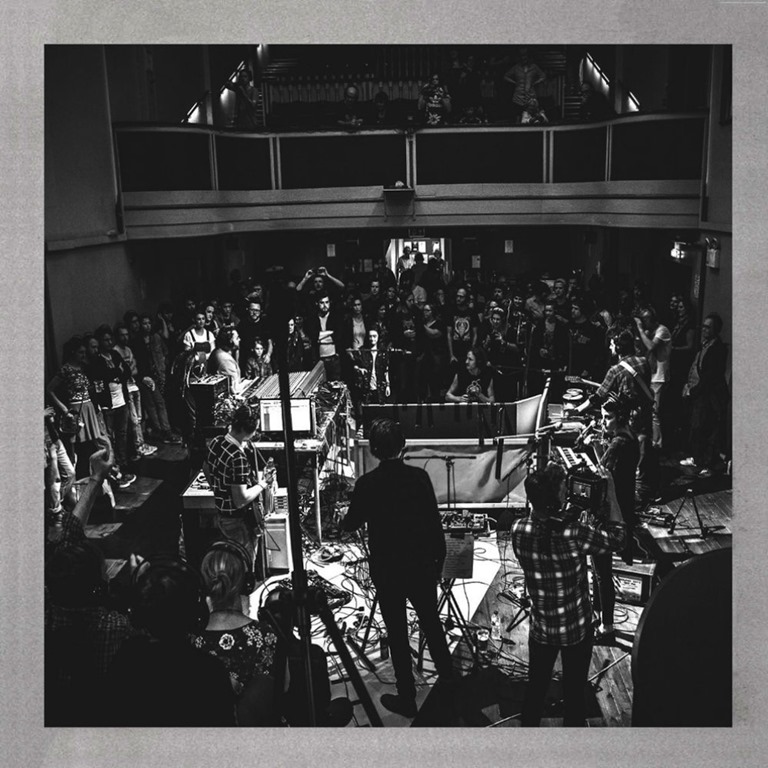
According to the blurb, the album was Recorded at ArtSpace, Brixton, and mixed by Liam Watson at Toe Rag Studios, the album was recorded to 1-inch tape in one week just before Christmas 2015, and mixed with sonic impresario Liam Watson, in glorious mono, on the ex-Abbey Road EMI desk at Hackney’s legendary, analogue-only Toe Rag Studios. Yes, mixed in glorious mono. On the one hand, given the audio technology we have now, however much one may adore the inimitable sound of analogue, to master an album in mono is simply perverse. On the other, it’s another manifestation of Creed’s rejection of convention, and at the same time can be seen as an observation on the way listeners actually hear music nowadays: just as everyone seems to be obsessed with shooting optimal quality photos with digital SLR cameras only for them to be viewed on piddly mobile phone screens via Facebook, so the idea of superior audio recordings to be consumed through shit iPod phones, laptop and mobile phone speakers seems absurd. And Martin Creed revels in those absurd contradictions, and does so with grace and humour, and not with one eye firmly set on the mass markets.

And so, the songs are amusing, entertaining, whimsical, wonky. Some sound half-finished, many evoke the spirit of the Bonzo Dog Band, while others call on psychedelic folk traditions, and other still call to mind the choppy sound of the early Fall albums, and Creed is unafraid of cumbersome or cliché rhymes. It’s a haphazard, hit-and-miss affair, but it’s zany and it’s fun and Creed’s singularity and disregard for marketability is admirable.

https://player.vimeo.com/video/167247762

MartinCreedAlbumArtworkSmall_1

Martin Creed Online

Southern Lord – 1st July 2016

James Wells

Christ. Everything louder and faster and more gnarly than everything else. The drums are so fast the individual beats blur to form a sound that resembles the whupping of a helicopter’s rotors. The guitars, a frenetic blizzard of movement, form a blanket of sound, but there are actual notes in there – lots of notes, tumbling over one another at such speed as to be almost inaudible individually to the human ear. Screaming solos rear up from the thunderous tempest, brief but shrill and completely wild.

It’s everything you’d expect from an album released on Southern Lord, and from a band who’ve tagged the album on Bandcamp with the terms ‘anarchist metal black metal blackened crust death metal metal punk victoria bc grindcore Victoria’. The lyrics are as unintelligible as the band’s logo, but the sentiment is clear.

It’s seriously black and it’s seriously crusty, and a gloriously angry and relentlessly bleak, venom-spewing example of dingy, dark metal. The title might refer nihilistically to the ruins of civilisation or of humanity, but could equally be a pointer to the ruins of your eardrums and psyche after hearing this savage album.


ISKRA - Ruins

Dronarivm – 18th July 2016

Christopher Nosnibor

Like most writers, and not just music journalists, I sustain myself financially with a demeaning, underpaid yet unduly stressful and arduous day-job in an office. The multinational firm who employ me, being fifteen years behind the times in terms of progressive thinking who have in the last year and a half decided halt the future is digital and that the place to pitch for market share in the coming years is on-line, have gone all blue-sky thinking and have fitted out a large rectangular room in each office with rising rows of seats, like some hideous postmodern parody of a colosseum in MDF. These ‘in the round’ meeting rooms, where the speakers stand in the middle (and consequently have their back to a quarter of the audience at any given time) have been preposterously named ‘agoras’. While throwing out quips about fluffy rabbits and jumpers, I’ve managed to decline all meetings in said room by claiming to be agoraphobic.

The reason for this preamble is that this album’s title is something of a play on words, a hybrid of ‘agoraphobia’ (a fear of public or open spaces) and the suffix ‘phone’, meaning sound. It only half works, in that phonia and phonic tend to refer specifically to speech. And, as anyone with access to a computer will likely know, ‘agora’ (in reference to either a space in an office or a word which simply means ‘public’ or ‘outdoor’) is a misnomer, in that the term ‘agoraphobia’, coined by the German psychiatrist Carl Friedrich Otto Westphal, was taken from the Greek ἀγορά, meaning ‘large public square/marketplace’ and -φοβία, -phobia, meaning ‘fear’. Still, based on the popular perception of the two terms, it makes an obvious punning sense which works in the context of what the album is about, in that it’s ‘a work which explores the relationships between people in given environments, and is specifically set in public spaces, namely the squares, or plazas’.

One might broadly classify this as a work of ‘ambient’ music, but in drawing together field recordings and manipulating the sounds and incorporating them into the rich sonic tapestry that constitutes samples and shimmering drones which form the material of Agoraphonia, Giannico and Aldinucci have gone far beyond the realms of background music and of atmospherics. Agoraphonia is a deeply evocative work, and one that requires a substantial degree of attention and focus.

Created using sounds submitted on-line, the album is a new kind of collaboration, and the end result is a work that requires attention and contemplation. Voices, passing cars and motorcycles and a low-level continuous chatter run through an indecipherable public speech seemingly made outdoors – at least judging by the trebly, tannoy echo – run through the first track, ‘Koutoubia’, as long, lingering drones simmer and eddy, building slowly in volume and intensity.

‘Plaza de Mayo’ finds the soft drones upscaled to vast, multitonal sonic washes which all but obliterate the voices audible at the start and end of the track. But this (im)balance is integral to the album’s purpose. In the world, the voice of man is not always dominant, and the relationship between human life and the environment it has created and inhabits is one which is infinitely variable and in constant flux.

There’s also the relationship between public and private, which at times is uneasy and for some extremely difficult and in some respects the recordings here are manifestations of that seemingly eternal fascination which surrounds the two states, which do not necessarily stand in diametric opposition or exist in binary formation. Giannico and Aldinucci do not offer answers here, but instead provoke thought as they lead the listener through the various locations.


agorophonia-500x500

Agoraphonia Online

15th July 2016

Christopher Nosnibor

Raging Speedhorn, with a name that was always guaranteed to see them eternally shunned by the mainstream and mass media (and a sound to match), seem to have been around forever. Emerging around the turn of the millennium in the tidal wave of nu-metal, they never really conformed to any genre stereotypes. Abrasive, aggressive and in-yer-face, the chances are they wouldn’t have been at the top of the list for one of the class of 2000 acts you’d have marked out as still being a going concern in 2016. And yet, here they are, one of those bands who won’t go away or die quietly. This is a good thing: after all, why should they? In fact, following their 2008 split and 2014 reformation, they’re as big and nasty and full of bile as ever, and after some heavy touring and some big festival appearances, including Sonosphere, Bloodstock and Damnation, they’re throwing down their first album in nine years. It’s also their first release to feature the first to feature original vocalist Frank Regan since 2005’s How the Great Have Fallen.

It’s got the backing of the fans: they funded it via PledgeMusic, and the band have justified their faith with an album that, however you look at it – or listen to it, which is what it’s designed for – absolutely slays. The density of the guitars is a defining element of the throbbing, chugging riffage which dominates the ten tracks. And the twin vocal assault is utterly ferocious.

If the cover art seems to suggest they’ve gone all mystical shit, well, you’d be half right: ‘Dogshit Blues’ and ‘Shit Outta Luck’ cover the excrement side of things, if not the mystical, and if the two lengthier workouts (‘Ten of Swords’ and ‘Unleash the Serpent’, both of which clock in well past the six-minute mark) hint at a more prog-influenced twist, it’s the kind of progressive metal in the vein of Neurosis, mingled with Sabbath-esque riffs filtered through the sludgy stylings of Melvins.

In the main, Lost Ritual is uptempo and sharply focused, with the snarling ‘Motorhead’ and pulverising ‘Dogshit Blues’ exploding with fury and ‘Comin’ Home’ a gnarly, brawling bastard of a song. It’s one hell of a comeback, and a purebred monster of an album.


Lost Ritual Artwork

Interstellar Records – INT039

Christopher Nosnibor

Perhaps it’s because I’m not a speaker of German that I find the language so fascinating. In particular, the way compound words create long strings of letters which evoke phlegm. The album’s title and the titles of the two tracks, ‘Ereignishorizont’ and ‘Zustandhorizont’ translate as ‘Event-Horizon’ and ‘State-Horizon’ respectively, according to the press release (penned by a fellow based in Berlin and whose translation I trust), and they stand as megalithic sonic sculptures, forged using sounds conjured from 300-year-old organs. Hose are church organs, of course – an instrument which has been a longstanding fascination for Stefan Fraunberger. He has devoted considerable time to travelling extensively through Transylvania and exploring abandoned churches in such of disused organs and capturing their sounds.

Transylvania contains a number of small villages, which have seen the majority of their population lost to migration following the fall of communism, leaving the fortress churches, built during the Ottoman Wars, abandoned, vacant and crumbling.

It’s perhaps because of these conditions that the organs which feature on this album’s two long-form tracks sound worn, rusted dilapidated forlorn. Conventionally, the organ yields a sound that is vast, bold, empowering, a sound which reaches to the skies and beyond, which fills the heart, the soul and the lungs, and which is rousing, and which is ultimately uplifting, spiritual.

But rather than the grand surges of sound commonly associated with church organs, Fraunberger’s compositions are delicate, gentle, long, reedy sighs which trill and quaver. Sad wheezes groan limply, a forlorn puff of a punctured bellows. The sounds cautiously teeter together, bend, hum and drone, ephemeral moments of accord and discord move seemingly at random. Gentle glides slide into cacophonous ruptures, key changes and chords disregarded.

The variety of tonalities and textures, atmospheres and moods is remarkable, and Fraunburger’s approach to transitions between these is ceaselessly inventive, with sudden changes bringing drama and more subtle shifts proving more calm and sedate. Impressively, the two pieces were recorded in single takes and are released here with no edits whatsoever, although the double vinyl release sees each track split into two pieces.

Given that the organ is, conventionally, a mighty and powerful instrument, to hear such dilapidated cases, puffing and droning creaking and fatigued, is strange and sad. The off-kilter and anticlimactic crescendos, the off-key climaxes and underpowered upsurges reveal a very different side of an instrument that carries undeniable connotations of a transcendental connection. And so what this album conveys, on many levels is a sense of diminishment, revealing as it does the fragility and ultimate humanity of the instruments. The organs recorded here are no more immortal, immutable or otherwise godly than anything else made by human hands, and as such, they’re prone to the same forces of nature and of ageing as anything else.

Fraunberger considers his work to be a form of ‘sonic archaeology,’ and it’s a fitting description. These recordings are based on instruments long forgotten, excavated after decades of decay. The moss and ivy grow as the timbers split and the tiles fall from the roofs. Nature always wins, and time is the only unstoppable force.


Stefan Fraunberger - Wurmloch

Room40 – RM469 – 20th May 2016

Christopher Nosnibor

The liner notes describe Memory Fragments as ‘a collection of compositions from sonic fragments recombines, thinned, edited, rejected, re-listened to, improvised, forgotten, filtered, slowed, remembered, reworked, erased, detuned, undone, layered, cut, compressed, trashed, moved, accelerated, pasted, composed, played and exported – undergoing a slowly evolving transience and sedimentation to arrive at this fairly constant state.’ In other words, it’s a collage of fragments which have been utterly fucked about with and manipulated so as to render them unrecognisable. The notes also draw attention to the fact that as integral to the ‘finished’ work (and one must question when a work is the result of such a convoluted succession of processes, to what extent it can ever be truly considered finished) the process is, the listener cannot, and will never hear the process, and the process is something which the artist will only recall through the filter of memory.

These are extremely spacious compositions. To begin, a single note resonates…. And then silence. The notes are some twenty seconds apart. The listener becomes attentive to the silence. Gradually, subtly, but so quietly, the sounds build. The build, the delay… are these notes backwards, or is there extraneous noise loitering in the silence, which then becomes shrinking semi-silence? You listen. You need to listen. And then, to pause for thought. It’s not music to get down to, but to contemplate. It requires focus.

Elongated notes expand as they’re dragged and stretched across time and space. Heavy sounds hang and linger. The track titles are evocative rather than literal, cumbersome but descriptive. Again, some refer to the process, while others carry allusions to how either the artist feels or the sensation. ‘Built on Folds and Braids’ builds a densely-layered wall of tonalities, fizzing and hissing static tears through an ominous low-end and arrhythmic globular beats. ‘Sparseness Gave Way to Infinite’ carries the closest approximation of a tune, but it’s slowed to the point that the output is little more than a protracted groan. The thick, burr-edged electronic sawing of ‘Broadsided by Sudden Swells’ is a dank, fear-inducing sonic experience, bleak and weighty.

But with the seed of awareness sown, it’s impossible not to hear these sounds without returning to the process, and I found myself contemplating the original fragments, the source materials. Specifically, I wanted to unpick the recordings, to examine the ‘original’ Warnecke had done to them. But thinking backwards through the process only provides so much food for thought: as noted in the liner notes, the released version only represents a moment in time, a point at which the artist has deemed the material satisfactory for release. But where could the sounds be taken in future? Is this a ‘definitive’ version? What would the result have been had the project been continued? Such questions are of course unanswerable, but provide fodder to chew on while Memory Fragments unravel from the speakers to form a sonic cloud that’s almost impossible not to get lost in.


Pierce Warnecke - Memory Fragments


Piere Warnecke Online

Ernest Jenning Record Co/Khannibalism – 15th July 2016

Edward S. Robinson

Fans of William S. Burroughs rejoice! An album containing new recordings of classic material gets to see the light of day, only fractionally short of 20 years after it was recorded.

If my proclamation appears tinged with sarcasm, it’s only slightly so. I am as enthused as any Burroughs enthusiast over the release of Let Me Hang You. How could I fail to be excited in the face of new audio work from the seminal author? On his death in August 1997, Burroughs left an immense gap beyond literature. Often imitated and even more often referenced and invoked, no-one else could really write like Burroughs. Despite his imploring other writers to adopt the cut-up method in the 1960s, Burroughs’ work remained distinctive because it was produced by Burroughs. To write like Burroughs required Burroughs’ mind, and if history has proven anything, it’s that Burroughs was unique a one-off.

Because this is Burroughs, an author whose biography subject to the same intense scrutiny as his major texts, the origin and evolution of this album is worth quoting from the official press release here:

‘Shortly before his death in 1997, William S. Burroughs was recorded reading some of the most shocking yet outrageously funny sections of Naked Lunch, his powerful fever dream of a novel.’

It’s perhaps not the place to comment here on the extent to which this feels exploitative or like an exercise in recycling, not least of all because Burroughs spent his career recycling material and it’s clear from the now legendary spoken word performances he gave in the 1980s when promoting his final trilogy that he was keenly aware of the enduring appeal of Naked Lunch, the book to which he essentially owed is subsequent career. As such, recordings of selected highlights from his career-defining (if not necessarily definitive) novel seem to provide a fitting sign-off, and its’s a shame we have all had to wait so long for them to surface.

The press release renders the account that producer Hal Willner (who has worked with Lou Reed and Marianne Faithfull, and perhaps more significantly, worked on Allen Ginsberg’s The Lion For Real and two previous Burroughs albums in the shape of Dead City Radio (1990) and Spare Ass Annie and Other Stories with The Disposable Heroes of Hiphoprisy (1996) and Burroughs’ manager James Grauerholz also recruited a team of world class musicians including Grammy winning guitarist Bill Frisell, pianist/keyboard player Wayne Horvitz and violist Eyvind Kang to add a touch of their experimental genius over the course of several sessions. Given his avant-garde credentials, Kang was, I would say, a particularly inspired choice.

The blurb continues: “Subsequently abandoned, these recordings collected dust on a musty shelf as forgotten as a piece of rancid ectoplasm on a peepshow floor. However, in 2015 Willner re-examined this unfinished masterpiece and sought additional help from King Khan, the eccentric Canadian punk/soul frontman that he and Lou Reed had befriended in 2010 following an incendiary performance by his The King Khan & BBQ Show at Sydney Opera House as part of a Lou Reed/Laurie Anderson curated festival. Willner sent Khan the recordings and asked him to add his gris gris to this already extremely perverted gumbo.

Khan in turn contacted vocalist/composer M Lamar (creator of the Negrogothic manifesto and the identical twin brother of transgender actress Laverne Cox) and Australian psych/punk act The Frowning Clouds for help with contributions that further heightened the unsettling mood of Burroughs’ narration.’”

Here we see new strands of the Burroughs legend in the making, and to what extent the recordings were subsequently adjusted is unclear (and indeed anyone’s guess. Perhaps in another 20 years’ time we’ll hear the ‘unmixed’ version, a Burroughs equivalent of Let it Be stripped of all of its Phil Spector intrusions). In many ways, the extent of any alteration made later matters little. After all, as the author himself said in an interview in 1974:

The past only exists in some record of it. There are no facts. We don’t know how much of history is completely fiction… There’s no record this conversation ever took place or what was said, except what is [recorded]. If the recordings were lost, or they got near a magnet and were wiped out, there would be no recordings whatever. So what are the actual facts? What was actually said here? There are no actual facts.

So, it’s 2016. There is nothing here now but the recordings. And, it must be acknowledged, these recordings are exceptional. The clarity is striking particularly against classic albums like Call Me Burroughs.

Anyone who has heard Burroughs reading before will know what I mean when I refer to that voice. Delicately picked strings drift in before that voice starts up. As ever, familiar yet alien, dry and detached. Given how late in the author’s life the recordings were made, and given how frail he became in his later years (although given that he survived decades of heroin addiction and a triple heart bypass in 1991), what’s most striking about these recordings is just how strong Burroughs sounds. Of course, frailty is relative, and Burroughs clearly had the constitution not of a proverbial ox, but something beyond human or even biological in origin. And so what’s perhaps most striking ‘They call me The Exterminator,’ he croaks as the album’s opening line. And it feels like some kind of homecoming.

Evaluating an album of this type is incredibly difficult, particularly on account of the level of personal investment so many Burroughs fans – myself included – have in is work. By this, I mean that everyone has their own version of Burroughs and their own personal appreciation of Burroughs and his work. Better just stick to the facts here.

The musical backing to ‘Manhattan Serenade’ (AJ’s Annual Party?) Purple-assed baboon… climbs up a woman…runs up and down the bar) evokes the Joujouka players and the exotic mysticism of Tangiers, where much of the manuscript that would ultimately become Naked Lunch was written. But this is intertwined with chimes and dissonant industrial drones. Burroughs’ ability to adopt high-pitched ‘shrieking posh woman’ voice is magnificently incongruous, and very funny indeed.

As much as he’s renowned as a satirist, Burroughs’ skills as an entertaining and extremely humourous spoken-word performer are often overlooked. On Let Me Hang You, Burroughs demonstrates a keen sense of delivery and timing.

‘This you gotta hear…’ is how the begins ‘This You Gotta Hear’, and proceeds to spin a yarn about a boy who follows his father’s instructions to ‘get a piece of ass’ literally. Because while the mosaic-nature of Naked Lunch and the cut-up method which would become his signature in the 60s and inform his subsequent work position Burroughs as one of the greatest innovators in narrative form of the 20th Century, he was also a master storyteller. ‘son, here’s $20… go get a good piece of ass.’ Against a skewed, barren country backdrop, Burroughs delivered a typical routine – brief, pithy, fantastical and darkly funny, and with a bone-dry delivery.

‘Disciplinary Procedure’, one of the album’s longest tracks, is a passage which represents the kind of horrors that Burroughs’ reputation was based, an expletive-filled scatological explosion, with the refrain ‘shit on the floor’ echoing out over one of the most overtly ‘rock’ backings I’ve heard Burroughs’ voice put to, sounding musically more like 80s John Giorno Band than Burroughs. For all that, it works well, and provides contrast, not least of all against the haunting experimentalism of ‘Lief the Unlucky’, on which Burroughs recounts the character’s misfortunes with ass-fuckings and Sani flush enemas galore.

‘AJ’s Annual Party’ stands, along with the Talking Asshole as one of Burroughs’ definitive and most notorious routines. Presented here as ‘Let Me Hang You’, it’s unquestionably one of the album’s high points. Discordant guitar scrapes and dissonant noise accompany a collage of endless hangings, jockstracks, spurting cocks and jissom. There are numerous other recordings of key passages from Naked Lunch, including those gathered on Disc One of the Best of Giorno Poetry Systems four-CD box set and the triple-CD audiobook of Naked Lunch, but this one arguably has the edge and could yet stand as a definitive recording.

There’s more skewed blues / country behind ‘Clem Snide’, and while it may not be the type of musical backdrop most commonly associated with Burroughs, it does work, and in truth the idea of Burroughs set to jazz or industrial tape loops has always seemed like a forced history. And so, in context… why not? Wouldn’t you?


Burroughs - Let Me Hang You

Makkum Records – MR18 – 11th June 2016

James Wells

Having existed in a number of variant forms since formation their formation over a decade ago, Kanipchen-Fit is currently Gloria (vocals), Empee Holwerda (guitar and vocals) and Frank Sloos (drums). Unfit For these Times Forever marks an evolution from their 2010 debut, not least of all because it features live drumming, which brings a very different dynamic to the sound.

But before we get to the sound, Unfit for These Times Forever is released on CD, DL and double 7”, and the physical formats come in a gatefold sleeve with a pop-up centre. It’s novel, and it’s also rather cool. The music’s pretty cool, too. Showcasing a dark post-punk infused indie rock sound. ‘How to Display a Flag’ is choppy, urgent, and is representative of the trio’s hefty sound with echoes of Husker Du and Gang of Four, combining ragged urgency and a funk edge. Holwerda’s guitar sounds like bass and guitar simultaneously.

Lyrical abstractions and oddness abounds, but these aspects are tempered by a personal and social sensibility. But then, Gloria’s background is in poetry and spoken word, and her background lies with New York performance collective Pussy Poets. ‘Residue’ finds Gloria unravelling her relationship with possessions that connect to people and the past in the context of peoples’ perceptions of others. ‘I wore my father’s jacket, it itched / I scratched, I got a rash / So I stopped wearing it,’ she recounts. There’s genius in the simplicity and the humanity of the words. Indeed, more than anything, what radiates from Unfit for These Times Forever is a sense of sincere humanity, and it’s paired with a quirky humour which isn’t only charming, but ensures the songs never move into the realm of po-faced politicking. Slanting guitars skew and jangle through the angular pop stylings of ‘Opening Ceremony’, and there’s even a hint of XTC and Pavement about closer ‘Unfit’, rounding off a record that balances unique and quirky with accessibility and depth. It has immediacy, but more than enough substance to give it durability. In other words, it’s got the lot, and is one of these rare beasts which functions – and succeeds – on every level.

Kanipchen-Fit  - Unfit


Kanipchen-Fit Online

Southern Lord – 15th July 2016

Christopher Nosnibor

With a name like Asschapel, they were never going to trouble the mainstream, although stranger things have of course happened. And producing the ferocious din that they did, regardless of their name, Asschapel were still never going to bother the mainstream. But during their lifespan, Asschapel made an impact, and are equally noteworthy for the fact that following their demise, various members moved on to the likes of Pelican, The Swan King, Tijuana Goat Ride, Hans Condor, amongst others, enhancing the band’s legacy retrospectively.

This legacy was given a boost last year with the reissue of their cassette-only Chapel of Ass demo cassette, and now Southern Lord (who else?) are putting out a mammoth compendium containing their entire catalogue. So here it is: a release (double vinyl and digital) containing a mighty 31 tracks of full-throttle, screaming, raging nihilism, on which the bulk of the song clocks in at under two minutes.

Hailing from Nashville, the output of the five guys who were Asschapel couldn’t have been less country in their leanings: as Total Destruction documents, they were prime purveyors of high-octane, uptempo thrash riffery, underpinned by brutal bass and ballistic drums. Their bio reads like a legend, recounting how ‘over the course of seven years [they] played all over the Western world, leaving in their wake crippled vans with wheels flying off, shattered heels, broken noses, torn out nipple rings, maxed out credit cards, on-stage arguments, collapsed house show ceilings, everyone’s clothes falling off at the show, and more, while impressively avoiding search and arrest from the authorities.’ Small wonder they imploded after seven years.

Still, they managed to release an album and three EPs during their career, and into each release distilled a violent, venomous fury paired with a kinetic energy that still sounds fierce over a decade later. The song titles give an indication of what Asschapel are about: ‘Carcass Bloody Carcass’; ‘The Sledgehammer Assault’; ‘Mutilated Black Carcass’; ‘Burn the Eyes’; ‘Let’s Kill’; Dismember the Memory’; ‘Rotting the Body’. Gore-fixated, violent and dark, the music is the perfect reflection of such bloody, brutal obsessions, and this is indeed gnarly. Primitive, uncompromising and brutal as fuck, Total Destruction reminds what thrash can be at its most uncompromising, undiluted and antagonistic best.


Asschapel-Total-Destruction-artwork

Sub Rosa – SR388

Christopher Nosnibor

As significant as the fact Cristian Vogel has worked with the likes of Radiohead, Maxïmo Park, Chicks on Speed, Thom Yorke, Jamie Lidell, Neil Landstrumm and Dave Tarrida is the fact that the CD and vinyl versions of this release have completely different track-listings, with only two tracks featured on both. That’ probably quite an expensive pain in the arse for hardcore fans, especially as the versions here are remastered, and the CD release features a previously unreleased version of ‘Around’.

So, as the title suggests, this compilation picks the best cuts from Vogel’s 90s output, and presents them, remastered in 2015 by the artist himself (indeed, he’s been systematically remastering the majority of his early work, offering tweaked versions of his extensive back catalogue through BandCamp).

In terms of sequencing, the CD (the focus of this review) makes more sense than the vinyl. With the exception of the very last track, the material is sequenced chronologically, with Disc One spanning 1993 to 1995, with tracks culled from Beginning to Understand and Absolute Time, and Disc Two spanning 1996 to 1998, from All Music Has Come to And End and culminating in Busca Invisibles. It may be an obvious point, but it’s significant, in that it does mark a clear linear evolution of Vogel’s music.

Repetition lies at the heart of the compositions, with looping motifs running end-on-end with shifting layers of instrumentation on top, and with explorations of tonal shifts providing the focus and points of interest over progression or changes of key or tempo. ‘Machine’ combines techno robotix and Krautrock with drifting ambient currents, while ‘Beginning to Understand’ contrasts echo-heavy metallic, treble tones with thumping bass frequencies. Minimalist beats and stark bass grooves define many of the tracks, particularly on Disc One.

The tracks from Absolute Time showcase denser sound, the dominant beats making for a harder feel, more driving and propulsive. On tracks like ‘In’ and ‘Absolute’, it’s all about the frequencies; the bottom-end tones sit in the frequency range that really batters the eardrum, while the higher frequencies are cosseted in dense aural cushions while stomping 4/4 beats bump and grind hard.

The output from the years ‘96-‘98 are given less extensive coverage, with, for example, only two tracks apiece from Specific Momentific, Bodymapping, and Busca Invisibles featured (in contrast to the six cuts from Absolute Time and five tracks culled from All Music Has Come to an End . Nevertheless, it more than gives a flavour of Vogel’s output, and Disc Two begins with ‘Absence of Fear’ which marks a rather different approach from the earlier works. With a much looser, less claustrophobic sound, it’s built around contrast and juxtaposition, and with complex rhythm patterns criss-crossing one another to quite disorientating effect. In many respects the twelve tracks on this second disc are the more interesting, in that they show Vogel’s experimentalism pushing to the fore. While firmly positioned within the parameters of techno, these recordings document a desire to expand the territory of the genre, and it’s not difficult to hear in these nuanced pieces why Cristian Vogel is so respected, both within is field and far beyond.

Vogel


Cristian Vogel on Bandcamp

Cristian Vogel – Classics at Sub Rosa (with audio)