Posts Tagged ‘Album Review’

LP/DL Rekem Records REKEM12/Fragment Factory FRAG45

Christopher Nosnibor

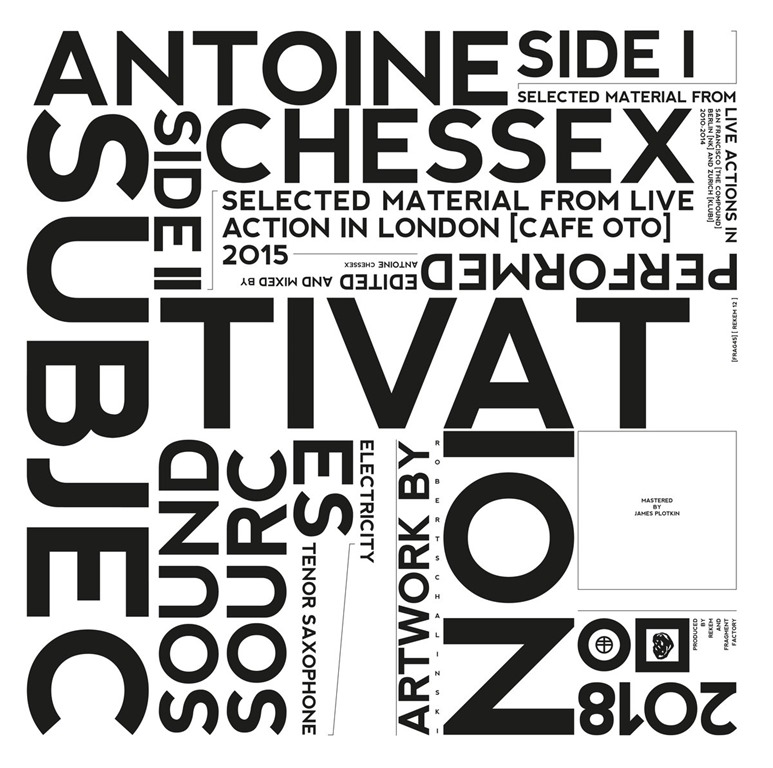
The music this album contains causes as much of a sense of overload as the cover art, with its perpendicular textual tessellations. Chessex has long pushed the tenor sax beyond the realms of conventional jazz or even overt compositional forms, and Subjectivation, a collection of live actions (a term also used by the notorious noisemakers Whitehouse). Side 1 takes pieces recorded in San Francisco, Berlin, and Zurich between 2010 and 2014, while Side 2 documents a performance at London’s Café Oto in 2015.

It’s all about the low frequencies at the front-end: the album begins with earth-moving, bowel churning bass tones that grind and snarl maliciously, and this, coupled with the conveyance of extreme volume places this in Sunn O))) territory, the atmosphere of creeping doom delivered at a pace and volume that punish slowly. And gradually – although not nearly so gradually – things intensify as additional layers of volume and frequency are added. The accompanying text describes it as a ‘field of distortion’, but it doesn’t come close. It seems unfeasible that such a raging sonic force could be sustained for any time, let alone increase, but increase it does, until there is nothing but a dense wall of obliterative noise. It’s impossible to discern there being any saxophone – or indeed any music instrument – in this vast, screaming whorl. I’m staring at the speakers in awe, wondering just how much sound they can actually carry, and moreover, how much sound could be created in pure physical terms. Seven minutes into the fourteen-minute sonic barrage – something akin to standing next to an RAF Vulcan preparing for take-off without earplugs or protective clothing, I’m wondering if my skull might not implode and my brain before the end. It’s a perverse pleasure the pain of this sonic assault provides.

The London side is less full-on, although it would surely be difficult to be more full-on. Nevertheless, it matches Side 1 in terms of intensity. It builds quickly from an irritated hornet buzz into an infinite echo, a thousand horns, honking in unison to create a rippling reverberation of sound. Some time around themed-point, the sustained crescendo fades, leaving eardrum-fluttering feedback notes, shrilly quivering on and on, before the air is rent with shards of scraping industrial noise, the grinding of metal on metal on a fast, rotational plane. It’s as if with each shift, Chessex introduces a pitch and tone more unbearable than the one before. The tiny sound that hangs where there should be silence mimics tinnitus, creating one final torture in the album’s closing seconds. There’s something cruel – and unquestionably uncompromising – about the way Chessex executes his sonic blitzkriegs, and for that, I admire him enormously.

AA
Chessex

Soundtracking the Void – 5th October 2018

Christopher Nosnibor

Collectively and individually, Gavin Miller and Thomas Ragsdale (worriedaboutsatan, Ghosting Season) have produced an impressive volume of work – although perhaps even more impressive than its quantity is the consistency of the quality. They’ve always been something of a yin/yang pairing, and the individual differences are integral to their collaborative works. So, while Ragsdale tends to bring the beats and beefy bass, Miller is the man who contributes wistful soundscapes and delicate atmospherics. The fact they’ve released solo efforts within a few short weeks of one another not only highlights their productivity, but affords the opportunity to compare and contrast the similarities and differences of their musical approaches.

Honley Civic Archives Volume 1 marks not only the first in a prospective series, but something of a departure, being almost entirely beat-free (there’s a distant clattering on ‘Pick Up Sticks’ but it’s almost buried by the sonar bass frequencies), and adopting from the outset a soft, piano-led sound and an elegiac tone.

In contrast to Gavin Miller’s near-simultaneous solo release, Shimmer, Honley Civic Archives Volume 1 is a much more overtly ambient work: the electroacoustic elements are filtered by synthesis, so while Miller’s ambience contains elements of shoegaze right at the fore, Ragsdale takes abstraction as his form, and runs with it. Many of his signature elements are in evidence: layered electronics, strings, and field recordings are all carefully interlaced to forge a sonic cloth as delicate and intricate as lace. However, the vocal samples lifted from film and radio which can be found in abundance on other recordings and in his live set, are as conspicuous by their absence as the beats.

In abstraction lies evocation: with so little overt or explicit signposting, the listener’s mind wanders free through the intangible forms. Without any temporal location in sonic terms, it’s left to the lister to fill in the gaps of space and time. But the titles of the compositions are referential, with several making direct reference to nursery rhymes – ‘Pick Up Sticks’ and ‘Four and Twenty’, for example. They remind us that so many of these rhymes have a darker undercurrent. Elsewhere, ‘Will You Still Love Me Tomorrow’ lifts its title directly from The Shirelles’ 1960s hit. Sonically, there’s no relation, but again, the sentiment of the title connotes a certain sadness, even anxiety: vintage pop lyrics, too, often cast shades of darkness when you scratch the surface and wipe away the bubblegum delivery. And it’s creeping darkness that pervades the slow, deliberate sonic expanses of the more dolorous passages of this album, of which there are many.

And so Honley Civic Archives Volume 1 provides the conduit for the listener to engage with their own interiority, exploring at leisure and from a distance, the images and scenes conjured by the mind’s eye in response to the sonic provocations. There’s something disquieting and disorientating about Honley Civic Archives Volume 1 – an album you feel first, and hear some time later.

AA

Thomas Ragsdale - Honley

Sound in Silence – 30th September 2018

Christopher Nosnibor

Collectively and individually, Gavin Miller and Thomas Ragsdale (worriedaboutsatan, Ghosting Season) have produced an impressive volume of work – although perhaps even more impressive than its quantity is the consistency of the quality. They’ve always been something of a yin/yang pairing, and the individual differences are integral to their collaborative works. So, while Ragsdale brings the beats and beefy bass, Miller is the man who contributes wistful soundscapes and delicate atmospherics. The fact they’ve released solo efforts within a few short weeks of one another not only highlights their productivity, but affords the opportunity to compare and contrast the similarities and differences of their musical approaches.

Shimmer comprises six tracks, simply titled parts one through six. The tones are soft, the textures deep. It begins with vaporous drones, soft-focused, broad in spectrum, providing a backdrop to delicately picked, reverby guitar and a hesitant bass, bringing hints of the instrumentation of Julee Cruise’s ‘Falling’.

Piano notes reverberate and organs trill and wheeze. There’s a lot of air and a lot of space: this is music which breathes, drifting, an organic ebb and flow providing the irregular patterns of ever-shifting form. The pieces don’t so much segue as melt into one another, while the individual instrumental sounds blur together, a gauzy halo surrounding each note which ultimately creates a sense of vaporousness.

With Shimmer, Miller trades in intangibles. That isn’t to say the pieces are without form or structure, but that the forms are ever-shifting and impossible to pin down, the structures possessed of an opacity which renders them indistinct. So while the successive passages are interesting in their own right, Miller doesn’t resort to repetition or motifs to hold them together, instead allowing them to flow freely. It’s the kind of ambience that fades in and out of the foreground of consciousness: as such, it’s not completely background, but it is ideal for after a mentally strenuous day at the office or equivalent.

AA

Gavin Miller - Shimmer

Kranky – 28th September 2018

Christopher Nosnibor

Total immersion. This is what I get from Tim Hecker, both recorded and live. Responding critically to such a sensation is a major challenge.

My first attempt to review Konoyo redefined ‘failure’, as I sat, vacant and staring for the duration without typing a word. Yes, other things happened around me: emails continued to ping into my inbox, text messages, Facebook notifications, and so on. So much peripheral shit. But while pushing all of this noise to the peripheries, I struggled – nay, found it impossible – to get a firm grasp on the drifting soundscapes of Hecker’s latest album. My second stab proved no different. I can no longer blame the distractions: I’m reminded of ‘seeing’ Hecker’s performance at the Belgrave Music Hall in Leeds a few years ag. Purple smoke filled the room. It was so dense I couldn’t see my friend standing next to me: I felt as if I was in an isolation tank or a sleeping bag. With my surroundings completely removed, I found myself alone with the music, and in an almost trance-like state, swaying on my feet, in my own world. When things like this happen, I immediately assume I must have drunk more than I should or that I’m tired or something. But music at its most potent is like a drug, and Hecker has the capacity to transform the mental state and one’s relationship with one’s surroundings. And this is certainly true of Konoyo.

Inspired by conversations with a recently-deceased friend about ‘negative space’ and the banal density of contemporary music, Konoyo was largely recorded in a temple on the outskirts of Tokyo with a view to creating something that has room to breathe, rather more cerebral than physical, drawing back from sonic force to invite a different kind of engagement.

The first composition, ‘This Life’ wails eerily, resonant low notes hanging ponderously beneath escalating layers of discord that bow and shriek, before oriental motifs chime a certain note of freshness and innocence… but the notes are bent, the underlying washes of sound begin to twist, scrapes of extraneous noise swell to shrieks of metallic feedback.

As is Hecker’s signature, Konoyo, is very much about shifting textures and juxtaposed tonalities, but more than anything, the incidentals, the way layers fade in and out, and extraneous knocks and clatters suddenly appear from nowhere, and then disappear just as quickly. There are murky pulsations and hazy echoes that resonate through spatial densities that range from the subaquatic to the zero-gravity. Hecker conjures space outside of space, spaces which transcend both time and space to exist in another realm entirely, suspending time in the process. It’s ambience with edge.

An abrupt halt in the soothe drones just 20 seconds into ‘Keyed Out’ provides the album’s first real indication of just how difficult Hecker can – and will – make this. Jolting discord and jarring dissonance rupture the smooth, vaporous backdrop as thigs become overtly challenging around three minutes into this ten-minute journey through dissonance and sonic difficulty, across which a lacey cloak of accessibility slowly settles. The fifteen-minute finale, ‘Across to Anoyo’ is a slow-evolving epic which mutates from quiet mellowness into a warped, woozy discord, which twists Japanese motifs into funnelling electronic abstractions.

Piano tones which should offer tranquillity and comfort are rendered with an edge of attack and amidst a metallic edge of reverb, and nothing is quite as it seems or should be on Konoyo. It bends the brain and pushes the listener to explore unexpected spatial experiences, challenging connections to concrete orientation. The physical world disappears, and time evaporates. Konoyo delivers a path to transcendence.

AA

Hecker

Consouling Sounds – 5th October 2018

Christopher Nosnibor

It’s been five years since A Storm of Light graced us with Nation To Flames, released via Southern Lord. Anthroscene has a very different mood, and isn’t exactly a Southern Lord type of album. It’s still very much a metal album at heart, and still has the sharp, snarling throb of latter-day Ministry at its molten core – but on this outing, they’ve opened things up a way – without losing any of the fire.

Josh Graham’s take on the album is that “Anthroscene ignores genre and freely combines a lot of our early influences. Christian Death, The Cure, Discharge, Lard, Fugazi, Big Black, Ministry, Pailhead, Melvins, Pink Floyd, Killing Joke, NIN, Tool, etc. Where Nations to Flames was a very a focused sonic assault, this record has more time to breathe, yet still keeps the intensity intact. We allowed the songs to venture into new territory and push our personal boundaries. It’s heavy and intense, but always focuses on interwoven melodies, song structure and dynamic.”

It’s a slow build by way of a start: the six-minute-trudger that is ‘Prime Time’ is constructed around a stocky riff, choppy, chunky. The guitar overdriven and compressed, chops out a sound reminiscent of post-millennial Killing Joke. The vocals are more metal, and then it breaks into a descending powerchord sequence that’s more grunge. The overall feel, then, is very much late 90s and into the first decade of the noughties, and lyrically, we’re very much in the socio-political terrain of Killing Joke. Indeed, the shift in focus is as much about the album’s heart as its soul, as ASOL turn to face the world in all its madness and corruption and pick through the pieces of this fucked-up, impossible mess. It’s practically impossible not to be angry; it’s practically impossible not to feel angry, defeated.

‘Blackout’ grinds in with some big chuggage, and ‘Life Will be Violent’ is remarkably expansive as it howls through a barrage of percussion that blasts like heavy artillery for eight and a half minutes. There are no short songs here: Anthroscene is the post-millennial cousin of Killing Joke’s Pandemonium. Only, whereas Pandemonium was pitched as prophetic and prescient, Anthroscene is clawing its way through the wreckage that is the future now present. Yes, the damage is done, and we’re standing, looking into the rubble as the dust drifts across a barren wasteland. But we’re too busy on social media and with faces buried in smartphones and tablets to even contemplate what we’ve done, and our children, heading inexorably toward an existence bereft of meaning as they too bury their faces in smartphones and tablets and Netflix on the 50” flatscreen, have no idea.

But this is no by-numbers template-based regurgitation: Anthroscene is sincere, and original. The squalling guitars of ‘Short Term Feedback’ sizzle and squirm over a barrage of drums and throat-ripping vocals as A Storm of Light revisit industrial metal territory, tugging at Ministry and early Pitch Shifter by way of touchstones. Elsewhere, the lugubrious ‘Slow Motion Apocalypse’ fulfils the promise of the title, but perhaps with more emotional resonance than you might expect.

Anthroscene is harsh, but evokes steely industrial greyness in its dense, claustrophobic atmosphere. A challenging album for challenging times.

AA

289671

CD/DL Fourth Dimension Records/Foolproof Projects FDCD107/PRJ049

7th September 2018

Christopher Nosnibor

The blurbage: Void Axis is Brighton duo Map 71’s fourth album. The previous one, Gloriosa, released on Fourth Dimension as both a limited edition cassette and, later, a CD featuring bonus material, saw them garnering more praise and attention than before. During the interim they have continued to play live regularly and have a few more shows planned around the UK in September and October, including an appearance at the Fourth Dimension Records’ label night at Cafe OTO on 19/10/2018, where they share the bill with Alternative TV, Richard Youngs and EXTNDDNTWRK (Andrew Fearn of Sleaford Mods’ solo endeavour). A 2×7” compilation will appear to coincide with this likewise featuring a track by them. Lisa Jayne (words and voice) and Andy Pyne (drums and electronics) are based in Brighton and became Map 71 in 2013.

The critique: This is glorious. It’s not accessible, easy, light. In fact, it’s anything but either. Atonal vocals and clattering motoric percussion dominate. We’ve moved a long way from The Fall and Kraftwerk, but at the same time, MAP 71 call to mind the sparse simplicity of Young Marble Giants, but synthier and dronier.

Blank, monotone narratives about nothing in particular drift out over repetitive synth oscillations and cyclical synthesised rhythms. For ever.

‘Nuclear Landscapes’ presents a thunderous, murky, barrelling noise by way of a backdrop. The rhythms are messed-up, sound bouncing against sound to build a dark mess of noise like tennis balls in a tumble dryer. Elsewhere, ‘The Future Edge’ goes murky and dips into Suicide territory with its dark, dank, throb which provides the sonic backdrop to Lisa’s expressionless spoken-word narrative.

‘Armour and Ecdysis’ goes spacious and eerie, with fear chords and heavy echo and infinite delay creating an unsettling atmosphere, while ’21:12’ goes dark and robotic in in its plundering of early 80s post-punk electronic works for inspiration. And it works Void Axis is tense and dark, and clinical and difficult in a stark analogue way.

Void Axis isn’t an album to engage with on an emotional level: there’s no engagement or resonance here.

Sonically, I’m reminded in some ways of Dr Mix and the Remix’s Wall Of Sound – the album released by Eric Debris post-Metal Urbain through Rough Trade in 1979 and which provide a blueprint for both The Jesus and Mary Chain and Big Black. Being one of my all-time favourite albums, this is a good thing: Void Axis is spectacularly primitive and claustrophobic and insular. And in its revisiting the technologies and production values of almost 40 years ago, Void Axis is also imbued with a certain sense of authenticity, despite its being spectacularly out of step with, well, pretty much any zeitgeist. Let’s face it, no-one else sounded like Dr Mix back then, and nor has anyone before or since, and the same is true of the drum-machine thump-led treble overload of Big Black.

But ultimately, what sells Void Axis is that is doesn’t sound like any other album. MAP 71 have found their niche.

AA

MAP 71 – Void Axis

7th September – Pelagic Records

Christopher Nosnibor

The absence of a question mark renders the album’s title a statement rather than a question. But there are no questions about Årabrot: 17 years and a substantial catalogue into their career, the Norwegian noise-rock act are still noisy, challenging, and kicking ass. But according to the blurb accompanying the release, ‘there is more than noise rock to Årabrot’s formula. “I’m interested in feelings, either the very silent or the extremely noisy”, band leader Kjetil Nernes comments. “I don’t care about what’s in between, the middle of the road isn’t my thing. The bible fits really well with that. I’m using it thematically all of the time.”

But mostly it’s noisy, and that’s a good thing. That said, Who Do You Love is very much an album of extremes – which is only fitting of a record that references transgressive French poet Comte de Lautréamont in its opening song, which crashes in with a heavy psych-hued riff – but the guitars are dominant and angular throughout. It’s loud, and it’s insistent. The guitars are choppy, the vocals whooping, sneery, and bathed in reverb and flange. It’s kinda punky, but equally kinda post punk, and kinda no-wave noisy.

With chunky, punky riffs carved out against solid rhythms that are by turn loping, square and stop/start, plus shouty vocals throughout the course of the album – ‘Warning’ is exemplary: Who Do You Love brings the attack in spadesful – but then again, it’s an album with textures, layers. ‘Sons and Daughters’ is a spacious country / shoegaze hybrid that’s both beautiful and captivating.

‘Pygmalion’ marks a real shift, it’s ethereal humming drones fittering like butterflies, while the sinewy ‘Simmerman’ is different again, a howling, roaring country rock stomp replete with anguished vocals that run ragged and pull Biblical anguish over devils and pain from the depths. It’s bold, theatrical, immense, but more importantly, it’s got a gut pull that’s emotionally engaging in its snarling delivery. Elsewhere ‘Look Daggers’ plunges deeper and darker still, meshing together the heavy grey nihilism and insistent throb of Killing Joke with a thicker, more metal delivery and hints of latter-day Swans in its insistent, throbbing groove that’s demolished in a roaring rage. ‘A Sacrifice’ begin with a heavy trudge, and the stop/start riffage, coupled with the blank monotone vocals – heavily treated – call to mind Foetus – before the buzzsaw riff breaks in after a couple of minutes.

Closer ‘Uniform of a Killer’ is all about the ebb and flow, the surge and fall, the climax and drop, not to mention all the drama. It again calls to mind later-day Swans, as well as pacing in hints of Bauhaus and myriad others, but compresses 15-minute builds to a minute or so, the track lasting only six and a half minutes. Never mind the length, check the density! ‘Uniform of a Killer’ certainly packs the density, and the intensity, too.

Who Do You Love is a BIG album. Not so much in duration (although it’s big enough) but in every other sense. It has depth, it has range. It has force. It has intensity, and it has tunes. Really, you couldn’t ask for more.

AA

Årabrot – Who Do You Love

SVS Records

Christopher Nosnibor

This one positively explodes in the opening moments: a swirling black hole of noise that eviscerates the senses and assaults the eardrums with such ferocious force and excruciating volume that it feels like the end. The actual, living end.

Yet again, I find myself scrabbling for the press release while questioning the benefit of being told about the origins, mechanics or methodology behind the work. And so I find myself research one-line, and discover the visuals which accompany the audio, and begin to develop a real appreciation of the multimedia vision of Lukas Rehm, operating as Lybes Dimem for the purpose of the Syncleft Chronem project, a work which celebrates error and explores the relationship between various input stimuli and cognitive frictions. It’s complex, but can be readily reduced to the experience itself.

The visuals intensify the experience, but the sonic experience alone is intense and brings a blistering sensory overload. Syncleft Chronem is loud, attacking. Uncomfortable. Placing the album isn’t easy but then, it’s not entirely necessary: as a barrage of electronic noise with beats, it’s a work which assaults the listener from the outset with its sonic intensity, a combination of dense walls of noise, abrasive textures and tones, and sheer volume. How do you feel? I’m feeling tense, but excited, exhilarated as this racket assails my ears. Rehm clearly isn’t making music to win friends or influence people. He’s generating sound to see what it sounds like and how it feels.

Sometimes, you simply don’t need words. On ‘Saas’, there are threats of dancefloor-friendly beats for an industrial night as booming 4/4 bass thumps start up – but they halt abruptly, and the whole thing fractures and fragments. Everything halts before it hits a stride, everything jolts and shudders. Everything is too loud to hear properly.

Syncleft Chronem is brutal, in the sense that it affords no respite, no pause for thought. And nor should there be an apology for this: as with the best art, its intensity sustains fever pitch, is uncomfortable, feeds tension to the point of perspiration and palpitation. It hurts.

AA

LYBES-DIMEM_SYNCLEFT-CHRONEM-front-cover-woskin

Neurot – 28th September 2018

Christopher Nosnibor

As you’d perhaps expect from an industrial collaboration between Neurosis’ Scott Kelly and Sanford Parker (Buried at Sea), Mirrors for Psychic Warfare’s second album is heavy on the atmospherics. It’s also simply heavy. The songs themselves are considerably more concise than on the eponymous debut – there are no sprawling ten-minuters here, but they pack an oppressive density. I’ve probably arrived at I See What I Became in the wrong frame of mind: it’s one of those days where the spirits are low and you now that listening to Joy Division or Faith by The Cure would be a bad idea.

I See What I Became isn’t a mopey album. It’s just bleak.

It’s a slow build to start: ‘Animal Coffins’ shifts incrementally from rumbling dark ambience through a slow pulsing beat to a swirling, rhythmic throb of noise with exotic, mystical voices. With processed beats that click and thud, ‘Tomb Puncher’ is a crawling dirge dragged from the techno end of industrial, and is highly reminiscent of PIG, while elsewhere there’s the heavy wheeze of JG Thirlwell at his more experimental. The mechanised rhythms are cold, clinical, but also distorted and decaying at the edges, adding a layer of dirt to a sound that’s encrusted in filth and dried viscera. A sense of the grand and the epic inform the delivery and the production.

There’s an eastern flavour to ‘Rats in the Alley’ with its snaking motifs and frenetic percussion, but it’s partly submerged in a swathe of extraneous noise. There’s a lot of extraneous noise on I See What I Became: the instrumentation melts together so as to render the individual sources indistinguishable. Everything congeals into a heavy-grained sonic wall. On ‘Crooked Teeth’, things crank up slowly, picking up pace, volume and claustrophobic intensity before collapsing into a synapse-flickering cacophony of discord.

What does this articulate, emotionally, psychologically? Far from the clarity of enlightenment the title may suggests, I See What I Became conveys a wallowing in darkness and a sense of resignation, hollowed out, nihilistic. It’s a heavy grind that wears you down, and by the end, I feel drained. I see nothing, and I feel numb.

AA

931335