Posts Tagged ‘Album’

Mortality Tables – 25th September 2025

Bryan Alka’s brief post on Facebook sharing the news of his new release, is revelatory: ‘Today we release my 5th full length on Mortality Tables. After a series of breakdowns… The Magnitude Weighs Heavy.’

The Magnitude Weighs Heavy is the third and final instalment of a of dark and brooding albums, the first two parts of which – The Colour Of Terrible Crystal and Regarding The Auguries – were released by Vince Clarke’s VeryRecords. Alka, and particularly Bryan Michael, has no small back story: ‘a Philadelphia-area artist who has collaborated with Vince Clarke (Depeche Mode / Erasure / Yazoo), Roger O’Donnell (The Cure), Christian Savill (Slowdive / Monster Movie) and Michael Textbeak (Cleopatra Records). alka was formed around 2000 as a return to his bedroom producing days, and as a cleansing of his disappointing experience within the Philadelphia indie rock scene.’

This thirteen-track album is epic, grand, expansive. It’s also an exercise is taut electropop with a decidedly early 80s bent. Because what goes around comes around, the whipcrack snare and noodly electronic drift which defines many of the tracks, despite being pure 1989, have a contemporary feel, too.

‘Soliloquiy’ drifts into dreamy electro shoegaze, mellow and atmospheric, rippling, and soaked with a certain sadness, however sturdy the beats remain. Elsewhere, as on ‘Creeps; its clearly an attempt to lock things down with pinging robotic beats

This feels like quite departure for Mortality Tables, given their learning toward abstraction an ambience, but they’ve always leaned toward the different, and this is a work which is unashamedly different. ‘Unravel’ is exemplary here: it’s got groove, and is ostensibly a bopping dance cut, and a far cry from the implications of the album title. But everyone deals with trauma, grief, and distress differently, and we all articulate our internal strifes by different means. ‘enchanté’ locks into a hypnotic groove, the likes of which I haven’t been so immersed in since I discovered The Dancing Wu Li Masters by 25 Men back in 2008.

For all that, there are large, ambient expanses, passages of stuttering electro which draw together elements of industrial alongside the layered dance beats. The ten-minute ‘an attempt to conjure quiet’ feels like it’s quite willing to delve deeper into noise, the very opposite of the quiet it claims to seek, and the duration of this album feels like a teetering on edge. I’m reminded of how my late wife would hassle an and harangue over details, over chores, and the tense, jittery tone which leads n this album at times tales me there. But if the dark mutter of ‘thee individual visions ov jhonn’ is dark with resonating melancholia, The Magnitude Weighs Heavy brings things back to the light. ‘Whatever Will Become’ is a hybrid of pop and bubbling electronica, busy but mesmerising in its concentric circles of sound, its abrupt ending jolting the listener back to the moment.

The magnitude may weigh heavy, but this album has a remarkable lightness, delivered with a deftness of touch.

AA

a2561728450_10

Maurice Louca, Alan Bishop, and Sam Shalabi expand on their telekinetic fusion of North African rhythm, heat-haze improvisation, shaabi rawness, free jazz, and psychedelic groove, following acclaimed albums on Sub Rosa, Akuphone, and Nawa Recordings.

Sasquatch Landslide overspills with the Cairo-based trio’s signature trance-inducing explorative  energies, anchored by Louca’s hypnotic beats and electronics, with  Shalabi and Bishop deploying guitar and alto saxophone in a variety of  signal-mashing modes. Comprising seven febrile jams across 42 minutes,  this is the most focused and twitchiest album in the DOEA  discography to date. Recorded by Emanuele Baratto (King Khan, Elder) and  mixed by Jace Lasek (Elephant Stone, Sunset Rubdown, The Besnard  Lakes), Sasquatch Landslide will be issued on 180gram vinyl and CD featuring artwork by Mark Sullo.

About ‘Titular’ Shalabi says; “This piece reminds me of the ‘after hours’ music I heard one night in a dark bunker-like jazz nightclub in Dakar many years ago… I’ve never heard that kind of music before or since.”

AA

images.disco

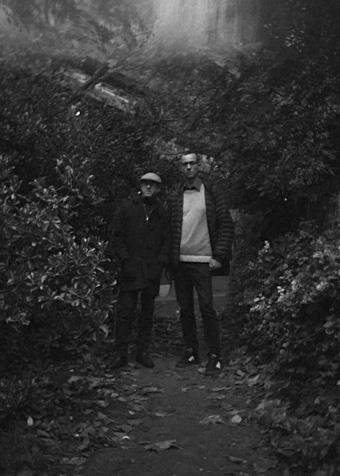
L to R: Alan Bishop, Maurice Louca, Sam Shalabi

The Dwarfs Of East Agouza by Hans Van Der Linden

Tartarus Records/Sweatlung – 29th August 2025

Christopher Nosnibor

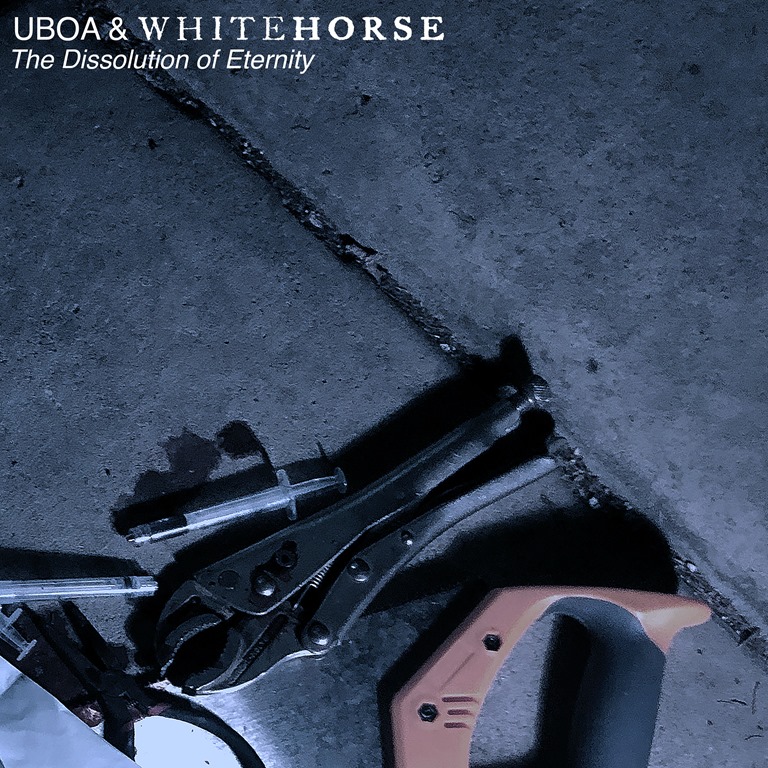
My appreciation of the split release is well documented among these virtual pages, and this colossus of a monstrous beast is exemplary of the perfect balance of the contrasting and the complimentary. It’s quite the face-off, pitched as a head-on crash where ‘Australia’s heaviest force of nature Whitehorse teams up with sonic chaos conjurer UBOA for a split album that crushes, scorches, and transcends. The Dissolution of Eternity is not just an album, it’s a seismic rupture’. Yes. ‘A seismic rupture’. It’s a bold statement, bit one that’s hard to argue with, and the fact that this is getting a proper physical release on vinyl, cassette, and CD is something to get hyped about, especially the vinyl and cassette. The contrasts make the act of getting up and flipping the object an integral part of the experience, like an interval between acts at the theatre, or… well, really, like turning over a record. There’s no substitute for it when it comes to the elements of engagement with a physical release.

There must be something about bands with ‘horse’; in their name that plugs into a direct line to the world of heavy. Horsebastard, and the late, great Palehorse are just two example of UK bands who hit heavy, hard. And as for Whitehorse – not to be confused with Whitehouse, purveyors of extreme electronic noise – they are indeed as heavy as fuck. I’ll take their ‘heaviest band in Australia’ claim on face value, on the basis that ‘Wringing Life’ is almost seventeen minutes of grating, crawling, growling riff assault. It’s a heavy, harrowing, low-BPM sludge trudge, with the most choked, rasping vocals, buried low in the mix, sucking the oxygen from the air in dying gasps. The drum solo in the middle is punishing – sparse, slow, the cathedral-like reverb enough to make your head swim – and then the guitar and bass return lower and slower than ever. It’s bowel-trembling, rectum-quivering stuff, the sound of a slow, zombified clawing out of the cold damp sods: it’s the darkest, doomiest sludge imaginable. By comparison, ‘The Wait’, a mere seven and a half minutes in duration is a pop song. But it’s another crawler, its dingy riff mess strewn with feedback. This shit is so heavy it weighs down on your shoulders, your back, your lungs, just sitting in a chair listening to it.

File together Godflesh and early Swans and Oil Seed Rape and Sunn O))) and your halfway to the sternum-crushing weight of this.

Uboa’s noise brings a different kind of weight, and it’s compressed into shorter songs. When I say compressed, ‘Petplay Polycule Open Fire’ is a mere minute and forty-nine seconds of brutal, raging, clanging fury. It’s tempestuous, savage, demonic, a ravaging, brutal assault, and it bleeds into the gut-gouging morass of plunging, churning, amorphous noise that is ‘Wasted Potential’. Holy hell, is this dark and harrowing. You feel your innards slowly slump under its weight.

The theatrical piano of ‘Deamwalker, Fuck I Miss You’ certainly provides contrast, bit in terms of form and mood, and there’s a gloomy sadness which hangs over it before the darkening shadows gather at pace over the gloomy, semi-ambient ‘Pareidolia Shadow’, which reaches a sustained tempestuous crescendo that marries industrial with dark ambient and post-metal. The last track, ‘The Apocalypse of True Love’ is nothing short of a monster: clocking it at over nine minutes, it begins gentle, expanding synth ripples and surges, providing an atmospheric swell of sound, and you find yourself swimming, drifting on currents and tides… and then it expands in every direction, a surging blast of ambience ad noise and culminating in the most immense sustained crescendo… The final minutes are a slow, sloping comedown from the most all-encompassing blast that hits hard.

This release is quite something. It’s certainly loud. And it’s harsh, brutal, and unforgiving too. In short, everything we like – so this comes recommended.

AA

404158

The most inspiring bands are the ones that can create a world around themselves that is about far more than just the music. The artwork, lyrics, sounds and ethos all merge together perfectly to create its own universe, a secret club. The Lovely Eggs are one such band. And against all the odds, 2025 sees them celebrate their 20th anniversary as a band! Stubbornly and heroically independent, The Lovely Eggs have forged their own path and have achieved mainstream success without ever compromising their DIY ethics.

To mark their 20th anniversary, The Lovely Eggs have announced a very special LTD release entitled Bin Juice – a collection of self-recorded outtakes from their last album Eggsistentialism, alongside rare B sides.

Released on their own label Egg Records, with eye watering artwork by Casey Raymond and hand packed in a black plastic bin bag on neon toxic slime green vinyl, this is yet another collectible release from a band who care as much about the art and ideas in their records as they do about the sound.

There will also be 300 copies exclusive to Rough Trade with alternative coloured sleeve and sticker art, on special edition transparent vinyl with toxic orange and slime green Bin Juice splatters.

“We had all these spare songs after we released our last album Eggsistentialism, and we didn’t really know what to do with them,” explained Holly. “They just didn’t seem to fit in with the vibe of Eggsistentialism, but we’d recorded them and wanted to get them out there.”

“They’re kind of a sketchbook of songs,” added David. “They’re not polished or laboured over but we thought it would be interesting to release them. It’s why we called the record Bin Juice. These were songs we had thrown away. But hopefully people like going through bins collecting trash.”

You can have a pre-release peak inside their bins with the just released track ‘The Grind’.

“Everybody wants an excuse to escape the 9-5 and day to day normality,” said Holly. “It’s our raison d’être for being in a band. ‘The Grind’ looks at all that stuff and is a bit of a paperback anthem for the disenfranchised and disillusioned."

AA

Catch The Lovely Eggs live on their 20th anniversary tour on the following dates in October. Tickets available HERE.

OCTOBER

Weds 22 – La Belle Angele, Edinburgh

Thur 23 – Òran Mór, Glasgow

Fri 24 – Newcastle University, Newcastle

Sat 25 – All day 20th Anniversary Party at The Brudenell, Leeds *SOLD OUT*

Sun 26 – Concorde 2, Brighton

Mon 27 – The Garage, London

Tues 28 – The Globe, Cardiff

Weds 29 – Castle and Falcon, Birmingham

Thur 30 – Academy 2, Manchester

Fri 31 – Metronome, Nottingham

NOVEMBER

Sat 1 – Trinity, Bristol

AA

Bin Juice Cover

12th August 2025

Christopher Nosnibor

Zabus have been on fire lately, as their recent EP, Shadow Genesis, released in June. It’s not only the prolific output which is noteworthy – some acts spunk out new material every other week, but the quality simply isn’t there – but we’re looking at a creative purple patch of innovation and ideas flowing in full spate. Whores of Holyrood is their fifth full-length album in less than two years, and while Zabus is ordinarily a collective centred around project founder Jeremy Moore, Whores of Holyrood is the first ostensibly solo release by Moore under the moniker, and it’s also pitched as ‘one of the most overtly political statements from Zabus to date.’

This matters. Anyone with an outlet, or a platform, right now, has, a duty to state their position. Silence is complicity. We know this from history. Individually, there is next to nothing we can do to stop Trump’s fascistic march, or halt the genocide in Gaza, or stop the wat in Sudan. But fucking hell, we are witnessing hell on earth right now. To take a line from William Burroughs’ Exterminator, ‘There are no innocent bystanders … what are they doing there in the first place?’ I don’t necessarily entirely agree with the stance, but it’s worth unpacking a bit, particularly in the context of 2025, when people are more likely to film the most horrific events on their phones and post them on social media than to intervene. I know, people are scared and all the rest, but… something is deeply wrong.

The title, Whores of Holyrood, immediately made me think of the Scottish parliament, but it would appear that there is no connection or implication intended. Instead, the album ‘explores the positive feedback loop between fascist authoritarian rule and societal inaction, apathy and resignation. Holyrood is a metaphor for the established classist hierarchy which derives its strength and influence from our subjugation.’

As an aside, ‘rood’ is a middle English term with its origins in Saxon for the cross, and a rood screen was a feature of medieval churches, a carved wooden partition depicting the crucifixion. Whores of Holyrood may not have any direct or specific connection to these historical roots, but they still seem somewhat relevant, albeit tangentially.

It’s ‘Shadow Genesis’, the lead track from the recent EP that launches the album with its reverb-heavy blues guitar and gothic stylings, and it’s dark, brooding, but it’s nothing to the snarling lo-fo post-punk goth epic that is ‘Burn to Your Own Destruction’: six and a half minutes of echo-soaked guitar swirling beneath bombastic baritone vocals, while the tile track is commanding, archly gothic, but with murky black metal production values. The same is true of ‘A-YA Bullet V’, which brings the driving funk groove of Bauhaus at their best, while also pushing the experimentalism to the fore.

‘Cremation Psalm’ is a murky swagger, equal parts Nick Cave and The Volcanoes, and every track on this album is pure gold. The muffled, echo-heavy production is not a detriment, but an asset, accentuating the old-school vibe which is s integral to the experience.

‘Sod Martyr’ is dark, dark, dark, and sparse, and something about it calls to mind The Honolulu Mountain Daffodils, while ‘Strangers of Non-Being’ brings together goth and heavy psychedelia with the addition of low, slow drone

If the Shadow Genesis EP showcased a keen experimentalism, and a broad range of stylistic touchstones, then Whores of Holyrood takes it all to the next level. Zabus keep pushing forward, outward, onward. Right now, it seems there is no stopping them.

AA

a1395699222_10

Sonic Pieces – 30th May 2025

Christopher Nosnibor

Five years is quite some time, and a lot has happened in the last five, that’s for certain. Although the fact so much has happened means that the last five years have been something of a void for many. And so it is that Reverie, recorded in October of 2024, sees Otto A Totland (piano) and Erik K Skodvin (guitar, cello, electronics, and processing) reunited in concert for the first time since 2019.

It’s pitched as ‘a follow up to 2014’s Recount, which saw two pieces of music created around their live-sets in different periods. This time, we are treated with a contemporary, raw live performance from October 2024 in Rabih Beaini’s studio, Morphine Raum in Berlin, during the 15th anniversary celebration of Sonic Pieces.’

The two longform pieces which make up Reverie were recorded live, and as if to prove the point, there’s the sound of a light cough just as the first piano note hits, then hangs in the air. They could have dubbed it out, I’m sure, but to have done so would be against the spirit of this work – spontaneous, improvised, in the moment. The recording is not only about capturing the music, but the moment itself.

The seventeen-minute ‘Rev’ is delicate, built primarily around Totland’s graceful, nuanced piano work, and considerable reverb, which may well be natural from the room, but however the sound is achieved, the sense of space is integral to the atmosphere. Skodvin’s contribution is magnificently understated: the slow scrapes of strings and subtle sonic details may seem secondary or additional because they’re not the focal point, but without them, the effect would be diminished by more than half. A great musician is not necessarily the one who dominates or demonstrates virtuosic talents, but the one who understands their contribution to the work as a whole, and appreciates that less is more. And so it is that elongated notes quiver and quail, wailing tones and sonorous drones swirl about and bring so much depth and texture, an as the piece progresses, the piano and extraneous incidentals achieve an equilibrium, and it’s utterly mesmerising.

‘Erie’ turns the tables, and it’s Skodvin’s strings which take the lead initially, before trepidatious piano creeps in. Trilling tones hang hauntingly like distant memories and displaced ghosts, and there’s a melancholia to this piece which is difficult to define, but lingers amidst the brooding lower notes. The slow piano is soft, and sad, while tremulous strings evoke a sense of something lost, somehow.

Without words, Reverie paints a picture, and hints that memories and reveries are inherently tinged with sadness. For even to recall a happy time is to remember a moment which has passed, and will be relived. However many times one may return to a particular place which is imbued with fond memories, however many times one may listen to that favourite song which carries such joyous connotations, that moment, that time will forever continue to recede into the past, never to be experienced again. The past is forever past, and will become further past with each day that goes by. Summers will never be as long, or as carefree as in childhood. The exhilaration of new experiences will never provide the same buzz, however hard you chase it. And with this realisation comes the slow fade, and a sense of acceptance. Bask in the reverie, and hold those times dear as the years slip away.

AA

ReveriePATTERN013 front

Photo: Alex Kozobolis

Mortality Tables – 20th June 2025

Christopher Nosnibor

Lunar Forms is Rupert lally’s second release on Milton Keynes label Mortality Tables, following his Interzones album, released in November last year, and forms part of the latest ongoing project by the label, dubbed The Impermanence Project (which so happened to feature a tense but lugubrious ambient work by some guy called Nosnibor a short while ago).

Sometimes, while I try to work through my review pile in a broadly systematic way, I have to reshuffle my priorities according to mood. And right now, my mood is jittery, jumpy, tense, unfocused, meaning that what I need is something fairly gentle, somewhat abstract, if not necessarily ambient. But also something which feels relevant, in some adjacent fashion. And so here we are: bombs are dropping and missiles are flying, and it’s maybe easy to dismiss it as taking place at a safe enough distance away…. But is any distance truly safe enough?

And so, it’s necessary to seek solace in distraction, solace in abstraction, something that offers layers and textures that draw you in, captivate the attention… but at the some time, offers something more to reflect on while listening to the glitches and echoes, woozy, skitty fragments of analogue pull my attention in different directions.

Impermanence… as polyartist and the innovator of the cut-up method, Brion Gysin said, ‘we’re all here to go’. And we are. We fear it, but it’s impossible to escape the inevitable. It’s not a question of if, but when.

Lunar Forms transitions between stuttering, glitching minimal techno and slowcore EDM, and more expensive, cinematic instrumental sounds which are overtly ambient. Electronic fuzzed and buzzes spark over swirling soundscapes, and at times we’re led into Tangerine Dream territory, while at others, we find ourselves adrift. The fact that, including bonus tracks, Lunar Forms features eighteen pieces, and has a running time of some seventy-four minutes, is significant. It’s a vast and expansive work, and one which is easy to get lost in, since the tracks are distinguished only numerically, ad those numerical titles are not tagged sequentially.

There is a lot of dark atmosphere, a lot of rumbling. There is much haunting reverb, considerable space, a great deal of bubbling, blipping, hovering. The deeper it plunges into spacious, cloud-like disturbance, the more immersive and simultaneously the more the power of this work increases. Breathe deep… and feel everything this represents. ‘313’ May be sparse, but it also edges its way into the space between dance music and the BBC Radiophonic Workshop, while ‘325’ pitches jittery microtonal beats against sonorous strong-like sound. It’s simultaneously tense and introverted, and outward-facing through cloud. The beats of ‘303’ are like the dripping of a tap amidst synthesizer drones and swirls. And it goes on. As such, Lunar Forms is more than varied: it straddles boundaries in a way which renders it almost impossible to place.

AA

cover

Panurus Productions – 20th June 2025

Christopher Nosnibor

You’d think that cassette labels would be not only niche, but few and far between, and in the main, they are, but Newcastle is home to not one, but two labels who provide a near-endless supply of releases to satiate the need for weird shit the world over, with Cruel Nature Records being one, and Panurus Productions being the other. The labels have a considerable amount in common, too, not least of all in that they both favour music that’s of a quality, rather than a style.

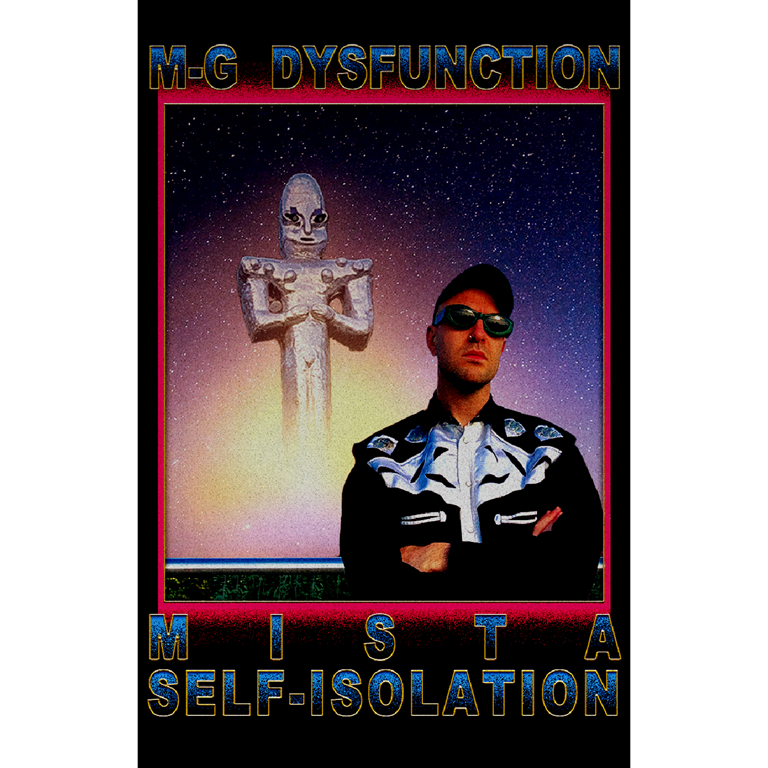
The latest Panurus release is a perfect case in point. The label’s previous offering, a split release from Belk and Casing was a raw blast of guitar overdrive. In contrast, the third album from M-G Dysfunction is of an altogether more experimental bent, leaning toward hip-hop and beat-driven electronics, but once again marking the close connection between the scenes in Leeds and Newcastle, both of which have become significant spawning grounds for the offbeat, the difficult, the wilfully obscure.

According to the blurb, ‘Mista Self-Isolation is the fullest realisation of the M-G Dysfunction project to date – a record of trepidation and humour, of lopsided passion and warped poetics. This album is about surveying the wreckage of monoculture and navigating the act of making music amidst a land-grab of rights, melodies and rhythms by people who never liked music in the first place. It’s about properly honest artistic expression – what “keeping it real” looks like, sounds like, feels like in 2024. It’s about getting some official beats and saying fly shit over them.’

That it’s quirky may be obvious, but it’s a necessary headline observation. On the one hand, it’s white rap, so there’s an awkwardness, but on the other, there’s some dirty experimental electronic noise layered over the beats, and this is an act that shared a stage with Benefits, a band who may have made their reputation by being angry, shouty, and noisy, but who aren’t without humour or an appreciation of nuance.

As tracks like ‘Roger Daltrey (Permanent Record)’ illustrate, M-G Dysfunction are multifaceted – something likely to leave many quite nonplussed. How can they do jokey, daft, a bit random and be serious at the same time? In truth, the answer is simple: because human beings are complex creatures, capable of a vast range of emotions and infinite ways of expressing them. It’s something we seem to have lost sight of in recent years, when everything has been boiled down to binaries, and everything is a conflict because the lines have been marked in such either / or terms. It’s no longer possible to be a woolly socialist: suggest that, I dunno, people on disability benefits are right to receive free prescriptions, and you’re labelled a left-wing extremist, a communist, and by the way, disabled people should get back into work or die. Something is severely fucking wrong with this picture.

Back in the early 90s, genre crossovers were all the rage, and the Judgement Night soundtrack was a real watershed moment that took the idea of rock / rap crossover, first witnessed in the mainstream when Run DMC and Aerosmith did ‘Walk This Way’ to the next level. At that time, it felt like a new future was emerging, and perhaps, even a future where boundaries and differences were dismantled. But here we are, and times are bleak.

But with Mista Self-Isolation – an album which is by no means an exercise in buoyant pop tunes – M-G Dysfunction show that in 2025, there is still scope to create something that speaks of what it is to be human.

The structured, beat-led songs are interspersed with self-reflective spoken word segments, spanning CBT meditation and contemplations on experiences and life in general. It is truly impossible to predict the twists and turns this album takes.

’50 Words for Blow’ comes on like a hip-hop-inspired barber’s shop quartet, while ‘John Wick’ is a critical memo, and the title track is abstract, minimal, dreamy but quietly intense. ‘Junglists Only’ is a perfectly executed pseudo-banger which knows it’s absurd and works because of it. The last song, ‘All that is Solid Melts into Deez Nuts’ evokes both humour and at the same time draws attention to M-G Dysfunction’s hip-hop credentials. If you know, you know, as cunts say, but for those who don’t, it’s a reference to Dr Dre’s ‘Deeez Nuuuts’ from The Chronic in 1992.

Postmodernism is alive and well after all, at least in some quarters, and it’s very well in the world of M-G Dysfunction. There is a lot going on on Mista Self-Isolation – and it’s all good.

AA

cover

Ideologic Organ – 20th June 2025

Christopher Nosnibor

In his liner notes, Robert Barry suggests that ‘Brace for Impact might just be the first album of post-internet organ music’, and goes on to explain that ‘it is a record weaned on networked processes and algorithmic thinking, a suite of tracks which build their own systems then push them to the point of collapse. Lindwall is not a programmer, but he will wield whatever technology is ready to hand much as Chopin made use of the richer, fuller sound of an Erard piano. From the software subtly weirding the interior textures of ‘Swerve’ and ‘Piping’ to the juddering, kernel panic of ‘AFK’ and ‘À bruit secret’, these are works of music unthinkable without the ubiquitous experience of life lived online. Imparting that hypermodern aesthetic sensibility through the austere sound of a baroque organ only heightens the anachronistic sense of temporal disjuncture characteristic of days spent rabbit-holing through ever-multiplying stacks of browser windows. The vernacular of Web 2.0 is here re-transcribed in the ornate script of a medieval illuminated manuscript.’

As Barry also suggests, the organ has been undergoing something of a renaissance in recent years, and cites a number of significant organs which have been recently restored, including the grand organs at the cathedrals of St John the Divine and Notre-Dame (New York and Paris respectively, and, not so much closer to home but on my very doorstep, York Minster, which ‘heralded a “once-in-a-century” refurbishment of its own 5,000-plus pipe instrument’.

It marks something of a shift from an album I reviewed around maybe fifteen years ago, the details of which elude me now, which was recorded on a series of broken-down and dilapidated organs from around Europe which wheezed and groaned as if gasping out the last breaths from their collapsed lungs.

Brace for Impact is an altogether more vibrant work, although as much as it celebrates the organ and the instrument’s sonic magnitude, it also reaches far further into exploratory sonic territories over the course of these five compositions.

The title track features ‘a highly saturated and distorted electric guitar, performed by collaborator and SUNN O))) founding member, Stephen O’Malley’ – and ranges from tectonic crunches, machine-gun rattles and alienated whines rising from the kind of dissonant dronescape only O’Malley can conjure. And so we brace… and then we swerve. The collision fails to materialise during the ten-minute dark ambient swirl of the second track, spreading ominous overtones and watery, echo-heavy plips and plops. The muffled beats are akin to listening to a minimal techno set overlayed with a piece from the BBC Radiophonic Workshop, performed in the Blue John Cavern, and it shimmers accordingly, slipping into off-kilter fairground trilling in the final minutes.

The final diptych of compositions rally ventures out: both ‘AFK’ and ‘Piping’ extend beyond twelve minutes. The former brings jolting discord and drama, lurching stabs that manage to bring a crazed dance feel to the sound of the organ before swinging into a circus-type jive. It stands out as perhaps the most playful track on the album. There is a playfulness to ‘Piping’, too, but it feels more like it belongs to a film soundtrack or theatre performance, and it whirls and winds and spins and pirouettes it way to a pretty but perhaps confused conclusion.

Brace For Impact is very much a non-linear work, and one which stands, uncertain of where it’s going next. But is it unquestionably interesting, not to mention disorientating, and it’s a work which seems to bend time as well as notes. It’s an album to lose yourself in.

AA

SOMA062_3mmCover

11th June 2025

Christopher Nosnibor

Some artists thrive on collaboration. Deborah Fialkiewicz is one of those. While she’s prolific as a solo artist, the volume of collaborative works in her discography is also noteworthy: when she’s not working as part of SPORE, she’s part of the ever-rotating lineup of BLOOM – and that’s before we touch on the frequent collaborations with (AN) EeL, the most recent of which was only released three weeks ago.

The Improvisation Sessions was recorded live May of this year, with a lineup of Dan Dolby, Deborah Fialkiewicz, and John Koser, marking an expansion from the duo which recorded the trilogy of Parallel Minor, Besides, and Hybrid in 2020. Fialkiewicz is without doubt an artist with range, but one who favours the dark end of the ambient spectrum more often than not, and this is very much the case here.

The Improvisation Sessions features two longform tracks which would quite nicely align with a vinyl release.

‘Chameleon Soul’, which spans a colossal continuous twenty minutes, begins with low, rumbling ominous drones, but soon escalates to a busy, buzzy criss-cross of sounds, interweaving and interlacing, leaving one’s head in a spin as if after trying to trace several flies flitting about the kitchen on a hot summer’s day for any period of time. It’s a morass of warping tones overlaying a ballast of churning noise, and any comparisons to Hull luminaries Throbbing Gristle or Merzbow are entirely justified.

The layers of distortion only grow denser and gnarlier as the track progresses, crashing waves of white noise blast in from one side and then the other as they really push to test the stamina. And then you realise we’re only six minutes in. This is a positive: plenty more left to enjoy… Enjoyment is of course subjective, and enjoyment of this requires being appreciative of a dizzying, disorientating assault simultaneous with a full-on white noise blizzard.

The momentary lulls, the spells where they pull back from the precipice of all-out aural obliteration, are far from mellow, as serrated spurs of hard-edged drones, wails of feedback and brain-melting extraneous noise conglomerate to seismic effect. There are some nasty high-end frequencies knocking about in the mix, moments were one has to check if the whistle is coming from the speakers of if it’s that troublesome tinnitus nagging again, and said frequencies rise from a battery of ugly distortion, bone-shattering blasts of which simple explode around the twelve-minute mark, and from hereon in, things only grow harsher, more corrupted, more intense, more difficult to withstand. We’d be inching into polythene bags on heads territory were it not for the variation, but the last three minutes or so are fractured, damaged, and agonizing – part power electronics, part circuit meltdown.

As the world becomes evermore and increasingly fucked up, I find words fail me more by the day. It’s harder to articulate, and this is where I’ve found that sound has come into its own. Sound as the capacity to convey something beyond words, something that lies in the most innermost parts, giving voice to the subconscious, even. On The Improvisation Sessions, BLOOM convey anxiety, gloom, pessimism.

‘The Dark Room’ is indeed dark, constructed primarily around a fixed but thick, distorted hum. Oscillators whine and whistle, and something about it calls to mind Whitehouse around the time of Never Forget Death, when they discovered low-end frequencies and restraint, the impact of a low undulating wave and subtle tweaks of reverb.

It rumbles and drones on, eddying and bouncing around in a shrilling mesh of dissonance. There isn’t a moment where this is an easy listen, and so often, it sounds as if the equipment is faulty, whether it’s a stuck loop or generating unexpected noise.

This set hangs on the edge of ambience, but be warned, it’s dark, and noisy at times, to the extend that it may shred your brain. For me personally, that’s my idea of fun, so it gets a two thumbs up, but for the more sensitive, this is a release to approach with caution.

AA

a3419622385_10