Archive for the ‘Albums’ Category

Cruel Nature Records – 24th September 2021

Christopher Nosnibor

The lights that burn brightest tend to be the ones that burn briefest, and it’s something of a conflicting pull on the gut that surrounds reflections on this. The idea that acts who quit and artists who died leaving a small but impactful legacy are somehow unfulfilled and that we’ve been deprived of whatever they may have done is counterbalanced by the contention that perhaps curtailing a career at its peak or even still in its ascendency is the best way, and fans will be forever divided on this topic.

What if Ian Curtis had lived, and Joy Division had mutated into New Order? They would have been just another band whose longevity overshadowed that early career, another Manic Street Preachers. Simple Minds should have called it a day in about ’84, and Kasabian’s early promise was spent after just one album.

ODF never lasted long enough to really break out of the locality of Gateshead. As the liner notes to this retrospective observe, they ‘blasted onto the North East’s harshcore scene in 1998 and were gone in a flash three years later; their 2001 split album with Newcastle’s Jazzfinger the only remaining recorded output’. Everything leans toward the attainment of immortal cult status here, and the changes are infinitely more people have heard of the band, or otherwise heard them posthumously than ever did during that brief but explosive career.

This limited cassette, Harshcore 98-00, documents two live shows, both recorded in Gatehead, with the first seven tracks recorded June 2000 at the Floating Cup, Gateshead, and tracks 8-14 recorded June 1998 at the Soundroom, Route 26 Centre, Gateshead.

It’s pretty fucking brutal. Most of the songs in both sets are around the two-minute mark, and it’s as abrasive as hell. The vocals! Rob Woodcock (Marzuraan; Tide Of Iron; Fret!; Platemaker et al) sounds like a zombie from The Walking Dead on amphetamines, snarling and rasping with the most ravaged-sounding voicebox. There’s a lot going on here: ‘Calisthenics’ brings all kinds of jazz and math elements alongside the full-on, balls-out wild thrasher, and the fifty-five second ‘Aggressive Lowbrow’ brings everything all at once in a racket that suits the title.

Despite the close proximity of the sets, there’s a clear evolution here, so it’s a little frustrating that they’re presented in reverse chronology on the release. The ’98 set is less evolved, less detailed, less jazz, less multi-faceted, and more of its time – brimming with samples and songs that are little short of whirling explosions of whiplash-inducing racket, with ‘O.D.F. Will Kick Your Lame Ass Motherfucker!’ being exemplary, but also marking the band’s first forays into different terrains, with hints of swagger emerging amongst the frenzied racket. It’s gnarly, it’s intense, and it’s fucking punishing. And it really makes you wish you had been there.

AA

a1380330890_16

Hallow Ground – 10th September 2021

Christopher Nosnibor

Breathing is important. If this sounds flippant or facetious, well, perhaps it is a little, but there is a more serious undertone. It’s something we do subconsciously, and something we take for granted will just happen as our brain keeps the bellows pumping. We only really notice breathing when something disrupts it, it becomes laboured, or we’ve exercised hard.

And yet the importance and benefits of controlled breathing as part of meditation, for managing anxiety, and for dealing with panic attacks is widely documented and promoted. But even for those who have been taught the techniques, how often do we remember to deploy them at moments of peak crisis? Moreover, beyond those specific settings, breathing properly is something that’s chronically neglected as we slouch over our keyboards, taking short, shallow breaths that fail to fully expand the lungs and oxygenate the blood stream.

The ever-innovative and ever-intriguing Lawrence English’s Hallow Ground debut finds the composer working ‘exclusively with an organ for four compositions that are exercises in »maximal minimalism,« as their creator himself notes in a nod to Charlemagne Palestine, who coined this term.’ The liner notes explain further that ‘While it seems somewhat fitting that those four pieces based on a steady flow of air were conceived and recorded in a situation of accelerated standstill caused by a respiratory disease, the Room40 founder is not so much concerned with capturing the zeitgeist than rather incorporating the spirit of time itself. »It is a record about presence and patience,«’.

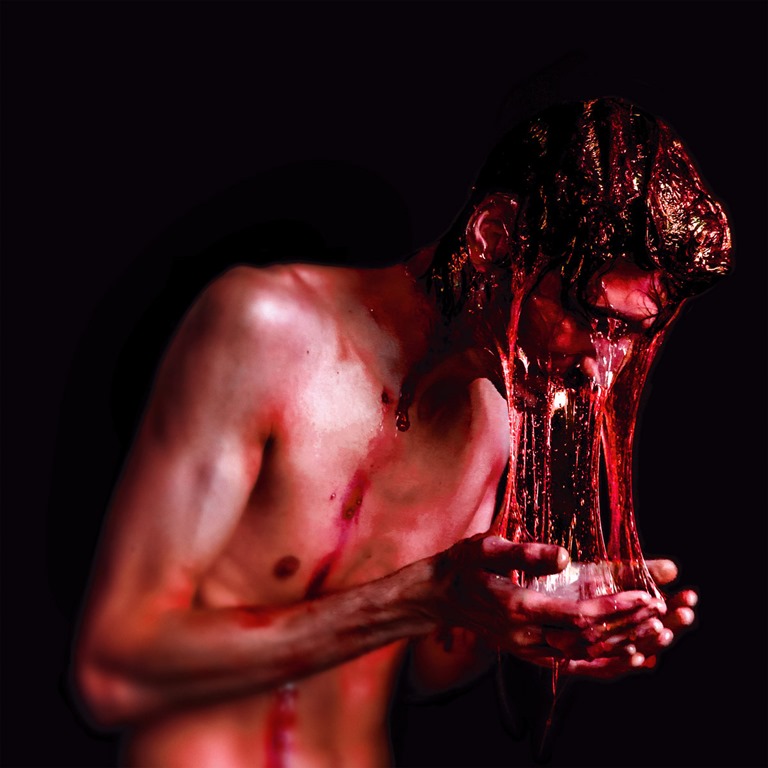
Patience is indeed required when listening to Observation of Breath. It stands to reason that there is a concerted focus on elongated, quivering drones, and the first of the four pieces, the ten-minute ‘The Torso’, with its dank, dark rumblings and extraneous interference carries sinister allusions, particularly when reflected upon in context of the album’s cover art. The torso may well house the lungs, the system of breathing, but all too often finds reference in stories of murder and dismemberment, and we’ve all wanted to strip off our own skin at some point, right?

The theme continues its trajectory in the titles of ‘A Binding’ and ‘A Twist’ which follow. These are short pieces, both sparse, droning works that are overtly organ, with the latter in particular taking the form of a gloomy funereal church recital. There’s nothing like a funeral to make you contemplate your breaths, and to consider how many you may have left in your body. Perhaps this is one of the reasons we ignore and avoid thinking about breathing: the moment we notice it, be it short or irregular, we worry, in the same way as we panic about palpitations. To become cognisant is likely to observe an irregularity, a difficulty, in a most fundamental function, and rightly or wrongly, doing so reminds us of our mortality. We hate to be reminded of our mortality: it terrifies us half to death. The irony.

In context, the album’s finale, the twenty-minute title track, which occupies the entirety of the album’s second side, on which all elements of the previous three compositions coalesce and distil into something monumental and epic. Not a lot happens: it’s simply a quavering continuum of sound that undulates and eddies slowly, unfalteringly, less like a stream than a crawling flow of larva. But to go with the flow is to fully engage with the album and its slow-shifting textures. It’s perhaps around halfway through ‘Observation of Breath’ that I finally realise I am becoming aware of my breathing at last. Conscious, I slow it, inhale to full expansion through the nose, hold, then equally slowly release out through the mouth.

Observation of Breath is a well-realised exploration of expansive territory in altogether smaller detail, and one that offers more the more you allow it to become a backdrop.

AA

HG2103_Cover_English_Final_def_def.indd

16th September 2021

Christopher Nosnibor

Instead of submitting to the endless flow of media panic and hunkering down in his house during the pandemic, Stuart Chalmers went rather more off-grid, spending the last year in a camper van, exploring the Pennines and North York Moors.

The Heart Of Nature is the last in the series of the Swarmandal-focused albums, a celebration of nature’s elements, inspired by this period of a closer proximity to nature. Stuart recounts how the experience brought him closer to ‘the natural world and its rhythms/cycles’, and given him ‘a sense that nature can be calm but also intense and full of violent energy’. He goes on to explain that ‘The making of this album through the autumn/winter with the change in weather along with my laptop dying, the heater failing and the van breaking down has been a tough experience,’, adding, ‘it’s been one of the hardest albums for me to finish’.

I’m no advocate of the training mantra ‘no pain, no gain’, but do often find – and I speak from experience here – that the art that emerges from the most challenging of conditions is not only the most satisfying to produce, but so often has the greatest impact and resonance. The heart and soul that goes into a work shines, amplified, in the output.

The six pieces on The Heart Of Nature are based on the elements and raw materials occurring in the natural world: earth, wood, metal, fire, water, air. The first of these, ‘Earth’, powerfully captures the turbulence and variability of nature, and is dominated by a grumbling, rumbling, the shuddering subterranean sound of tectonic displacement, that gradually fades as a slow-picked guitar emerges and a hesitant sun rises over a barren. Scene. Beneath the supple chimes and grating discord and scraping drones that lumber and lurch. It sounds, and feels, immense, something bigger than sound alone, than the artist alone, and it’s an intense and difficult seven minutes that introduces the landscape of the album.

‘Wood’ is more of a collection of found sounds, with animal calls and chattering birds, pattering feet, paired with extraneous sounds and a clattering, clanking beat that’s some way from nature. Things become quite tribal, the metallic chanking speaking more of humankind’s relationship with nature than of nature itself, while ‘Metal’ creeps into dark ambient / industrial territory, with ominous whisps drifting around and the clanking precision – but it’s on ‘Fire’ things intensify, with the crackle of flames yielding to the harsh clatter of industrial percussion. There are hissing surges of sound rushing like gas bursting from ruptured pipes, and it’s not until ‘Water’ that the album introduces some sense of calm following a long journey navigating troubled spaces.

This only highlights the idea behind the album, that of the violent energy of nature. We seem to have idealised nature as that idyllic country setting, as something that merely exists for our wellbeing or profit, and in doing so diminishing the forces of nature – typhoons, cyclones. tsunamis, earthquakes, blizzards, floods. We are in denial somehow over the extent to which we are at nature’s mercy. We build flood defences, structures to prevent longshore drift and the collapse of cliffs, but ultimately, we’re powerless against time and tide.

‘Nature doesn’t need us, but we need nature’, Chalmers remarks, and I can’t help but agree: nature would in fact be better off without us, and the acceleration of climate change is concrete evidence of this. If nature destroys us, it’s because we’ve brought it upon ourselves by fucking with nature – and if one thing is clear, nature will always win. Whatever damage we’ve wrought, it’s simply suicide. The planet will still exist long after we’ve vacated, long after it’s inhabitable by human life. Humanity will eventually go the way of the dinosaurs, but nature will still be here.

The emptiness of the final track, the seven-and-a-half-minute ‘Air’’ is the perfect summary. The wind buffets against everything in its way and sparse notes hang in post-rock drift. It’s a beautiful piece of music, but it’s also sparse and melancholy, and with a certain Western twang, it carries the bleakness of the wild frontiers, reminding us of the adversarial relationship between man and nature, and the need to respect the wonder.

AA

a0127569496_10

24th September 2021

Christopher Nosnibor

Pink Turns Blue have been around practically forever, having formed in 1985, and while they may not be widely regarded among the first wave of goth acts, they very much emerged from that milieu as a duo with a drum machine, and what they’ve achieved over so many of their peers while lingering on the peripheries is longevity. Having re-emerged in 2003 after an eight-year hiatus, they’ve continued to mine the classic post-punk seam that’s distinctively theirs, due in no small part to Mic Jogwer’s vocals. And of course, what goes around comes around. Their return in the early years of the new millennium was well-timed, coinciding with the point at which the post-punk renaissance bloomed with the likes of Editors and Interpol breaking through. There were of course countless also-rans, and bands who emerged but failed to fulfil their promise, but nevertheless, time has proven that the style has remained current, and the darker the times, the greater the craving for dark tunes, and this is where Pink Turns Blue really prove to be as contemporary and vital as ever.

Their eleventh album was written, recorded, mixed, and mastered during lockdown in their Berlin studio, and the first thing that strikes about Tainted is just how bleak it is. It’s achingly majestic, it’s magnificent, and possesses some wonderful hooks and choruses, but there’s an all-pervading atmosphere of sadness, of melancholy that’s draped over every beat and radiates from every note. Glimmers of positivity are dampened by an air of resignation, optimism doused with defeat. The next thing that soon becomes apparent is just how consistent the album is. It’s not only all killer, but had a remarkable cohesion. It’s true that that for cohesion you might interpret sameness, and they do operate with a fairly limited sonic palette. One suspect this is at least in part the result of the material being the product of three guys in a studio without any external input or interference.

But working within such limitations places the focus on the songwriting, on the tunes, on the delivery, instead of throwing in all sorts of fancy stuff.

The guitar to opener ‘Not Even Trying’ evokes the into to ‘Severina’ by ‘The Mission’, and it’s got that same solid four-four strike on every beat bassline that Craig Adams made his signature back in the early days of The Sisters of Mercy, and which has become something of a defining feature for so many gothy post-punk bands, and it makes the song an instant grab. ‘I’m not even trying’, Jowger admits blankly, as if admitting defeat from the outset, and setting the pessimistic tone that echoes through single cut ‘There Must Be So Much More’. It’s a song of yearning, of questing, and of determinism, and a song Editors would have likely killed to have penned for one of their first two albums.

This isn’t an album of depression, but the sound of downward-facing defeat, of staring at the ground and wondering where it all went wrong. ‘Never Give Up’ encapsulates the conflict, the inner turmoil of staring emptiness and defeat straight in the face and realising there are only two choices. But to never give up is not a positive thing, merely the stubbornness that comes from not knowing what else to do.

The bass and guitar are melded together in a tunnel of chorus and reverb, and tied to a relentless drum track, and it’s gripping and compelling. ‘Why Not Save the World’ has heavy echoes of mid-80s Depeche Mode and would sit comfortably on a She Wants Revenge album, while ‘I’m Gonna Hold You’ comes on like New Order as covered by A Place to Bury Strangers, with a nagging bass and brittle guitar that grips hard.

Just as Robert Smith can make a skippy pop song sound tear-jerkingly sad, so when Jowger sings of the joys of ‘a new day’, it’s with a wistful melancholy that aches deep and you feel something tug in your chest as you swallow it down, that inexplicable sadness. ‘Listen to the bumble bee’ he sings on ‘Summertime’, and it’s carried a way on a chiming jangle of guitars that are so wistful, while the tone is of deep nostalgia. A perfect sunny day can have its joy marred by the realisation that it isn’t quite as perfect as sunny days of a time gone by, happy, carefree times that will forever be trapped in the memory as magical, but now faded and never to be recreated.

The song structures are comparatively simple and straightforward, and built around repetitive chord sequences and guitar motifs, and there’s nothing fancy about any of the playing – which is absolutely key to the success.

Any fan of Interpol or Editors would do well to explore Tainted – but then again, so would any fan of not only post-punk, but anyone with ears and with a heart and soul. It’s a masterful work in music of the mood. The mood is low, the mood is sad, and this is an album of real depth that speaks and resonates beyond the immediate.

133936

Karlrecords – 27th August 2021

Christopher Nosnibor

Well this is an interesting one, and it was, admittedly, Thurston Moore’s name that compelled me to give it some ear time. While listening to the first pounding space-rock psychedelic jazz freakout, it dawns on me that this isn’t actually my first meeting with Turkish free form ensemble Konstrukt, and that I was blown away and bewildered by their 2018 collaboration with Keiji Haino, A Philosophy Warping, Little by Little That Way Ahead Lies a Quagmire (Live).

It’s hard to tell what’s going on and who’s doing what on this first piece, especially what Moore brings to the mess of noise that is, ‘Yapayalnız (Gezerler Sokaklarda)’, which sees a motoric rhythm hold steady amidst a vortex of punk-infused chaos until, ultimately, everything collapses. There are some shouted vocals, but they’re muffled and drenched in so much echo that it sounds more like a riot than a performance, and it makes for an eye-popping, headache-inducing ten minutes. The fact that this was recorded live makes you wonder what it must have been like to witness first-hand: on the one hand, it’s exciting, unpredictable, while on the other, it’s vaguely frustrating, because you don’t know where it’s going – or where it will end.

Turkish Belly is the fifth and latest entry in the ongoing series of collaborations between the four-piece ensemble and an array of guests, and it’s certainly experimental and freeform, to the point at which one could question whether there really is much form at all, and it’s extremely difficult to extrapolate precisely what Moore brings to the chaotic party. Perhaps it’s simply another layer of chaos.

‘Kurtadam’ in two parts is very much percussion-dominated and almost hints at the conventions of rock – but it’s only a hint, and more to do with the solid rhythm section than anything else. It does nail a groove, which is welcome, but everything else especially the horns, are all over and flying every whichway.

The final track, the eleven-and-a-half minute ‘Uğultular’ is a braying beast of a tune – if you can call it a tune as such. The deadened drum beats thwack out a damp rhythm amidst a serpentine sway of seeping discord and disarray. There’s murky bass and some wild, reverb-soaked guitar work, and the whole thing lumbers and lurches, bleats and brays blindly. Wordless vocals growl and grunt amidst a buzz and a howl that yawns and churns and crawls its way to conclusion.

The audience’s applause and cheers after jolt the listener back to reality, and the fact that this a document of a live performance. Maybe you had to be there to fully appreciate it, as it seems those present on the night very much did, but on record, it’s interesting, but at times a bit of a slog.

AA

KR084_front

Anticipating Nowhere Records – 24th September 2021

Christopher Nosnibor

With the colossal five-volume ‘Isolation and Rejection’ lockdown compilation series and the one-off final final FINAL Front&Follow project, the compilation You Can Never Leave released in June, the eternally restless Justin Watson can put his label to bed and resume work with his current musical vehicle, the collective who operate as The Incidental Crack to deliver album number two. After all, it has been more than three months since second album Municipal Music.

The three – Justin Watson, Rob Spencer and Simon Proffitt – are still yet to meet, and their third album, like its predecessors, took form with ‘them exchanging field recordings, samples and random noise between Manchester, Wigan and North Wales’.

As the liner notes recount, ‘Detail contains within three new long-form pieces and a couple of shorter ones filling in the gaps. The adage goes that the devil is in the detail, and Detail brings exactly what the title promises, with the first composition, ‘We Might Bump Into each Other’ beginning with some muffled dialogue and an ominous hum, then hums, bubbles and slurps against a backdrop of echoic reverberations, before ‘Fish Dance Tank Track’ marks a shift in style, with more defined beats – an insistent bass bump occupies a different space from the glitchy fluttering woodpecker-type stammers and stuttering hi-hats which all make for something quite complex beneath the drifting drones and quavering hums. It’s an interesting and complex composition that brings together elements of ambient and minimal techno, and as birdsong flutters in toward the end, the piece takes on new aspects that juxtapose nature and artifice.

That the grating looping throb of the six-and-a-half minute ‘Waterfalls Per Capita’ should be considered a gap-filler is a matter of context, and it comes after the harrowing dark ambient collage of ‘I Lost It’, that is by no means a comfortable or easy listen.

The seventeen-minute ‘Morning Tram’ combines field recordings where the original source remains clear, but with subtle but insistent beats, and it’s perhaps there – the finale – that everything comes together. Fragmented samples and snippets of dialogue collide with tumbling trees and slow-turning washes of ambience to create remarkable depth. Passengers pass on and off, engines rumble past, there is endless chatter and a wall of extraneous sound. Assimilating it all may be difficult, but it’s rewarding. The beat is almost subliminal, but it’s relentlessly insistent and registers almost subliminally as the sound swells and voiced clamour and congeal among a rising tide of horns and other momentous sounds. And then it stops, abruptly.

It may be short in terms of tracks, but Detail has substantial depth – and much detail, all of which is very much worth exploring.

The Incidental Crack - Detail (cover)

Dret Skivor – DRET 009 – 3rd September, 2021

Christopher Nosnibor

On the face of it, it’s a straightforward question. But chewing on it a little longer than is probably advisable, like a lump of gristle you can’t quite find an opportune moment to spit out discreetly at a family meal, it presents a range of different potential inflections, from the casual ‘how do you like your noise?’ delivered with the same intonation as ‘how do you like your steak / coffee / eggs?’ through to the rather more personal but interrogative ‘how do you like your noise?’

So while listening to the ten pieces on this short release, available digitally and as a C20 cassette, I gave this some consideration. It wasn’t necessary, but then, not a lot is, beyond the basic functions of eating, drinking, breathing, and sleeping. Then again, art has existed longer than civilisation, and perhaps it’s not so wild to think that giving an outlet to one’s thoughts and feelings which transcend verbalisation is also necessary in the most fundamental sense. Perhaps we need art to live. This act of consideration in itself made me realise that a lot of noise is something that’s possible to think alongside listening to. It isn’t that it’s necessarily undemanding: it’s often far from it. It’s just that noise has the capacity to free the mind in ways that more structured genres, and modes of music more geared towards beats and lyrics can often pull the brain waves into their structures instead of encouraging that certain mental drift. Of course, ‘noise’ can be subject to a host of interpretations, sometimes with an interchangeability with ‘sound’. Specifically, here, though, I’m talking about noise.

And ultimately, I can only conclude that I do like my noise harsh. For some reason, noise that makes me grit my teeth and chew the inside of my mouth while I’m listening is the noise that meets the needs of my inner workings. It excites me and sets me on edge. I suppose it’s because ultimately, when it comes to this shade of noise, all you can do is submit to it, and it’s a cathartic release to allow the sound to draw the stress from the mind and body.

How do you like your noise? is pitched as ‘a bunch of noises recorded live 2020 and gems from the archives’, and while it’s not always clear which represents which, there’s no shortage of nasty abrasion on offer here, and it’s clear that Pulsen ‘get’s noise – by which I mean, he has a handle on the effects of varying textures and frequencies, and how shifts between different ranges can trigger both physical and cerebral responses. The grating ‘metal massage’ and squalling electronic blitzkrieg of ‘urbanoise’ are exemplary of the kind of circuit-melting experimentation that many will find painful and torturous, and be grateful for their merciful brevity.

There’s range here: ‘dead man’ is a sparse and spacious guitar piece that borders on post rock, while ‘ringu’ does some glitchy warpy bendy note electronics tricks and teeters on the brink of some kind of electrojazz odyssey. There’s also some whimsical faffery, clattering and clanking around that’s more throwaway interlude than composition, with sub-minute snippets like ‘still haven’t found what i was looking for’.

And so, I changed my mind: I like my noise varied. On this release, Poulsen shows the full spectrum of his versatility, and the range of his noise. I like my noise, and I like this a lot.

AA

a3069066462_10

Cruel Nature Records – 27th August 2021

Christopher Nosnibor

Zero Gap is a truly international collaboration between Ryosuke Kiyasu (SETE STAR SEPT, Fushitsusha, Shrimp, etc, aka ‘the Japanese guy with a snare drum’ and WATTS (Lump Hammer, Plague Rider, Lovely Wife, aka that beardy growly bloke) that proves that location is a state of mind. Recorded oceans and continents apart, there is zero gap between the two artists as they hammer out half an hour of sonic abrasion, created, as the accompanying notes explain, ‘entirely from one snare and one delay drenched throat’.

If on the surface the snare drum seems to have only limited potential, then Kiyasu doesn’t exactly disprove that, in that it sounds like snare drum throughout. But the guy finds every conceivable way of rendering that snare sound, from rapidfire hits and rolls and crashes through clattering blasts and builds, and the still finds ways beyond conception to conjure yet more dynamic range from the simplest of instruments.

Against this clattering, clanking, thunderous barrage of percussion, Watts delivers a vocal performance that quite simply doesn’t sound like a vocal performance for the majority of the time. From a whispering moan like a distant solar wind, to a gurgling drain to a chthonic babble, he’s got immense range. It might not quite be Mike Patton’s Adult Themes for Voice, but it’s still impressive – and I mean eye-poppingly wide-ranging and weird. Best of all, Watts grasps when less is more, at times uttering little more than barely audible grunts and burps at long intervals. Snarling and snapping like a zombie in The Walking Dead, one moment, to barking like a rabid dog the next, Watts is wildly unpredictable, and often quite simply doesn’t sound human. Perhaps he isn’t. At times unsettling, unnerving, others plein scary, he snarls, growl and gargles his way through the creation of some quite strange soundscapes.

Everything works well in context, too: at times, Kiyasu pulls back on the battery of beats to taper down to some barely-there hints of sound, and the two not only are incredibly egalitarian in the distribution of the prominence of their contributions, but they seems to intuitively grasp the need for ebbs and flows, crescendos and decrescendos, making Zero Gap a work that feels like a journey, and even if it’s a journey without a clear end point, it’s a journey punctuated by events and variations.

Zero Gap isn’t abstract as such, but it does, most definitely stretch the boundaries of music. It is ultra-niche, but in the global village it’s the kind of thing that has the potential for significant cult reach. The pair deserve it: Zero Gap is far out in the best way. Crazy, inventive, innovative, not giving a fuck for convention, it’s an album that carves its own niche.

Captured as a single track spanning thirty-two minutes, it’s unusually a release that works best digitally (and dare I even say it, it, could make a nice CD), but then this is an unusual release. My advice? Dive into the dark stuff.

AA

cover

12th June 2021

Christopher Nosnibor

I wasn’t entirely sure what to expect from Cyborg Amok’s eponymous debut. Sure, there’s the press release, and no, it’s not lazy journalism to take cribs and pointers from press releases. This one forewarns that Cyborg Amok ‘resides somewhere between the brilliance of twilight and the apocalyptic darkness. Their gothic infused synth-rock sound delivers the listener to a panorama of synthetic waves, twisted organic tones and a slightly pop crust … the language angels speak in the darkness.’

I don’t entirely compute the implications of this, can’t even really unravel them, not least of all because I can’t always grasp what passes for ‘gothic’ these days having lost the thread some time in the mid to late 90s with the emergence of cybergoth, which sounded just like so much bad techno to me, and a million miles from the post-punk origins of the genre, and the subsequent ‘waves’ of goth which coincided with myriad hybrid mutant strains. Perhaps I am something of a pursuit in my personal tastes, but as a critic, I try to be more accommodating. But sometimes, you just have to accept that music is music and it’s either good or bad, because your audience are unlikely to share your prejudicial quirks.

Cyborg Amok is Greg Bullock (formerly the keyboardist with RealEyes and Shamen) and drummer Brydon Bullock (no relation as far as is obvious), and their debut album is in fact bringing together their first two (now deleted) EPs, so, if I’m being picky it’s not really a debut album but a compilation (which is also true of The March Violets’ Natural History among others. Not that it detracts from the force of these seven songs pulled together in one place. Oh no. Cyborg Amok kicks.

‘Burden Away’ brings bulldozing bass and stuttering mechanised drums. The rhythm guitar trudges and grinds, while Greg’s brooding baritone vocals registers in the ribcage – but while it’s so much industrial grind, the lead guitars are warped country, and there’s a twangy inflection in the vocals to match. It’s solid, but if you’re looking for a pigeonhole, you’re going to struggle. Things get even more complicated with ‘Still Too Far Out’, which straddles Nightbreed-flavoured second/third wave goth with its organ synth sounds evoking sepulchral gloom against guitars that fizz in a swathe of chorus and flange… and then there’s a fuck-off keyboard solo that’s B-Movie and Ultravox and it may be incongruous by 2020s standards, but perfectly in place in context of those precursors.

With its space-themed title and snarling, bulbous, electronics, ‘Dancing on the Floor of the Sea of Tranquillity’ provides more of the vibes the moniker and title perhaps evoke, and if it suggests extravagant prog enormity, it’s no criticism to say that after its dark, stark intro, it slips towards 80s electropop in the vein of A-Ha.

There are some Cure-esque moments scattered about the album, too, but then this is an album, that assimilated huge swathes of 80s that’s not exactly band-specific, but the zeitgeist.

There’s some overblown prog guitar that’s Yngwie Malmsteen overdone, but once they’re done with the moments of indulgence (‘Choice Not Taken’ is perhaps the greatest showcase of guilt), they deliver some impressive musical moments, where the ambition is equalled by the ability.

They’re at their best when they keep it minimal, sparse, nailed down: last track ‘Another Turn’ bears solid – and favourable – comparisons to Red Lorry Yellow Lorry, with its steely beats and grey, steely guitars backing a gruff, ragged vocal delivery. It’s a style that works well, and while this compilation must provide a point at which to assess the trajectory of their career, the evidence here is that they’re doing everything right and need to forge ahead and capitalise on their work so far, because this is a strong dark album.

AA

240381

6th August 2021

Christopher Nosnibor

It’s not always easy to remember – what you’ve said to whom, what you’ve written before, if you’ve really experienced something or simply dreamed it. You’d think it would have become easier with not really going anywhere or speaking to anyone for a year and a half, but in my experience, the opposite is true. Everything blurs. So if I’ve mentioned any off this before, if I’ve touched on how electrogoth releases often clump together, or how genre tropes can so often be so much meh, then I apologise, but only a little. Reviews are, after all, personal, a personal response to musical release, and objectivity only cuts so far., meaning that this personal response, well, it’s all spilling from a review-a-day brain, dayjob and parenting and the confusion of every day melting into the next. It’s been a relentless barrage of bad news in the media, as well as from friends and relatives. By no means has all of the anguish and suffering been attributable to the virus – more often than not it’s been collateral resulting from lockdowns and a sustained sense of panic. We’re biologically designed to experience fear in short bursts. Fight or flight. To be trapped, immobile, powerless, is beyond comprehension, and there is no space to process grief and trauma in a normal way.

It’s against this backdrop that Eric Kristoffer developed the new unitcode:machine album, Themes For A Collapsing Empire. It’s very much an example off utilising a creative outlet as a form of therapy, with the blurbage describing Themes For A Collapsing Empire as ‘a journey through the mind of Eric Kristoffer after a series of tragic events that 2020 brought. It explores a path of loss and regret, and struggling to cope with such stressful personal events while also trying to endure a global pandemic’.

Electro-industrial isn’t a genre one immediately associates with emotional resonance, but with Themes For A Collapsing Empire, unitcode:machine really strike a level that balances thumping beats and melodies that convey the human aspect of the lyrical content. That said, the stark, mechanised percussion and cold synths highlight the bleakness of it all – and by it all, I do mean it all. Step back and survey the scene: August 2021 versus two years ago. It’s a different world, and so many have lost so much – not just loves ones, but connections, livelihoods, sense of self and place in the world. Where is it all heading? Where will it end? Will it end? With climate change an inescapable backdrop to societies which have never been more divided, how do we return from here? Do we? Can we? It’s not just an empire that’s collapsing, but – not to be overly dramatic – human civilisation itself. Themes For A Collapsing Empire feels like an essential soundtrack to this existential anxiety. Stark and dark, it’s reflective, paranoid, gloomy, and it’s very much song-orientated, with kicking choruses being a defining feature.

‘Falling Down’ is a clear standout, but there are plenty of strong tracks and easy single selections alongside it: Themes For A Collapsing Empire packs in the hooks and solid choruses, but without being remotely lame or overtly commercial – and that’s a real skill. Everything just flows, while at the same time punching you in the face.

With nine tightly-structured songs all clocking in under four-and-a-half minutes, Themes For A Collapsing Empire feels like a concise statement, and an album with strongly-defined parameters and an intense focus, with the end result being all killer.

AA

035223