Archive for the ‘Albums’ Category

Room40 – 13th December 2024

Christopher Nosnibor

Nostalgia is a subject I’ve touched on on a number of occasions in recent pieces, because it’s become something of a preoccupation in contemporary culture. Arguably, this is the natural evolution of the postmodern, an epoch in which the new was primarily a fresh – or not so fresh – permutation of the old. The culture of the twenty-first century has been marked by an ever-increasing acceleration of more of less everything: the accelerated communications and technological innovations and ensuing blizzard of media Frederic Jameson wrote of when defining postmodernism has gone into overdrive, and we’re now moving at a pace whereby we’re nostalgic for breakfast by lunchtime.

Nostalgia is big, big business, and this has been no more evident than in the response to ABBA’s hologram shows and the Oasis reunion. This isn’t to overlook other huge musical events – Taylor Swift’s Eras tour, for example – but it’s fair to note that she’s been established for over a decade and a half now, and can’t be viewed as representing ‘newness’ in any way – especially given that four of her last six albums were rerecordings of previous albums. This encapsulates the way in which culture laps up endless recycling on account of its familiarity.

Comfort culture is rather like comfort food: you know what you’re going to get, there are no unpleasant surprises, there’s probably not a great deal of chewing involved, and it’s less scary than the unknown. The world’s gone to shit, and people feel a real and quite desperate need for that blanket of safety and reassurance that there are still at least some things you can rely on. The good old days have happened, they’re fixed and can’t be taken away. And nostalgia has a universal appeal, because it’s something we all feel for certain things at certain times. We tend to feel – and I accept this is a colossal generalisation – that our childhoods and teenage years took place in simpler, better times. They didn’t, but because we didn’t have the burden of adult responsibility, and were discovering things for the first time, they’re coloured with brighter hues.

This latest offering from Glim – a project by Vienna based musician and composer Andreas Berger – is steeped in nostalgia. Berger outlines the inspiration and creative methodology with enthusiasm:

I have a particular love for cassette tapes and how they can influence the character of sound – even just by the simple fact of being played on different quality sources. I like the way they can color audio material, especially when using lower-quality gear. It adds modulation, sometimes (a long time unwanted) degradation of sound, but also gives a certain nostalgic touch – at least for me.

I recorded (and played) most of the material on an old Walkman cassette player, and what I got in return were some faded sonic Polaroids which might trigger a hidden memory or at least evoke a vague feeling of nostalgia.

Perhaps somewhat ironically, Tape I is only available as a download, or to stream online. The tape revival remains some way behind vinyl, despite the format being considerably cheaper to produce. Perhaps it’s because tapes just don’t have the same effect on Instagram, or hung on your wall.

Having grown up in the cassette / tape era myself, I can vouch for the unique nature of the format. When I started making music, I would sketch stuff out with a condenser mic on a portable tape deck, later progressing to a four0-track portastudio, bouncing tracks down to create additional tracks. Each stage would erode the quality of the audio by some incremental degree, but what it lost in fidelity it would gain in character. You just don’t get those happy accidents with infinite digital tracks, just as you don’t get the same sense of the personal with a link to a playlist as one-off compilation tape with handwritten track-listing, smudges and misspellings and all. Don’t get me wrong: tapes were a massive pain in the arse, difficult to skip tracks, easily chewed, easily overrecorded – and for these and other reasons, I have not leaped aboard the tape renaissance train. I’m happy with my memories, thank you, and don’t feel the need to start spooling reels with a biro to remember the good old days of recording songs off the radio.

It’s the happy accidents, the whorling analogue fogs, the fuzzy edges and softened-off corners which define the eight pieces on Tape I, unnamed beyond sequential number. But while I feel richly textured, immersive atmosphere, and the pull of strains of sonic palimpsests filtering through the recordings like ghostly whispers, vague, elusory, like memories which linger in the hard-to-reach recesses of the mind, and with a somewhat grainy texture like an old photograph or a photocopy of a photocopy, akin to the kind of fanzines which used to circulate in the eighties, I don’t feel as if I am truly connected to Berger’s sense of nostalgia.

Herein lies the paradox of memory, and of nostalgia: as much as there is a unification to be experienced from reminiscing with friends about those good old days, we each harbour subtly different recollections of those experiences, and as such, our experiences all differ. It also highlights the scope for the disparity between intent and end product. ‘1_4’ is incredibly haunting, eerie, and a quite magnificent exercise in ethereal dissonance, and ‘1_6’ is at times barely there, thin streaks of aural contrails drifting through a big and darkening sky. I feel a certain melancholy, a creeping chill, perhaps, but not any real sense of nostalgia. And yet it’s apparent that his creative process has involved a quite intense and personal engagement with the source materials and the tools necessary to create this diaphanous gauze of slow-drifting ambience. This simply highlights, however, the way in which, while large social brackets have a collective appreciation and nostalgia for one thing or another, the detail, when boiled down to an individual level, looks very different when viewed from that specific individual perspective. It’s here where you realise that you are completely alone: not even your partner or your best friend sees that shade of green or purple the same as you do. No-one else’s perception is entirely aligned to yours, and no-one sees, or hears, the world in exactly the same way.

AA

DRM4201 art

Lamour Records – 16th December 2024

Christopher Nosnibor

When you read that someone is exploring metal, the likely response is to think it’s a metal album in terms of genre. But not Tomas Järmyr: his explorations into ‘the deep frequencies of metal’ are quite literal. ‘Using only cymbals’, the notes accompanying the release explain, ‘Järmyr creates a slowly rotating musical sphere that holds beauty, deep emotion, and fierce heaviness… Entrails is an album that shows the core of his artistic expression and serves as the perfect introduction to Tomas Järmyr as a solo artist.’

As titles go, Entrails is unquestionably visceral in its connotations – another thing which would, for many, suggest a ‘metal’ album rather than a ‘metal’ album. But here we have an album containing a single track, which runs for thirty-eight minutes, consisting of nothing but cymbal work.

Thomas J

Photo: Thor Egil Leirtrø

In the context of a full drum kit, cymbals provide expression, and also an amount of ‘fill’ to the overall sound, not only of the kit, but the band, creating a wash of resonance in between the notes of the instruments and the beats of bass drum, snare, toms, etc. How do cymbals stand up when separated from everything else?

In the hands of Tomas Järmyr, we come to appreciate the range and versatility of the cymbal. Size certainly matters, and Järmyr’s setup which spans small, light crashes to huge, resonant, bell-like peels, against a backdrop which builds from a delicate clatter to a clashing, splashing tempest, is educational.

There are passages where the clatters and chimes diminish, and make way for dank, atmospheric reverberations which evoke the gloom of subterranean caverns, dark ambience which bears no discernible resemblance to anything remotely percussive, at least to the average ear – or mine.

Sometimes, with experimental music, the mystery is an integral part of the appeal: I prefer not to know which instruments have been used to create which sounds, and similarly, knowing how certain synths or laptop-based programmes have been used to conjure alien sounds feels like something of a spoiler, because I find myself scrutinising the sound and seeking to pick apart its construction. On Entrails, the opposite is true, because most of the sounds simply do not correspond to the source. So on the one hand, Entrails does lay bare the guts of the instrumentation: on the other, as I sit in the swirling drone which fills the room around the eighteen-minute mark, I find myself perplexed and in absolute awe at the creativity of the musicianship. How does anyone come to discover that cymbals have the capacity to be this versatile, to create sounds like these? Who has both ready access to this many cymbals and the time to explore their sounds and the way they interact with one another in such detail?

Sometimes the crescendos are delicate, slow-building: others, they explode unexpectedly. At others still, the sensation is more like an outflow of molten lava from a volcano.

Järmyr’s metal album may be devoid of guitars and guttural vocals – or, indeed, any vocals – bit it is still, for the most part, a heavy album, issuing forth an immensely dense, dark atmosphere, not to mention some quite challenging frequencies, spiking at the top end while rumbling heavily around the lower sonic regions. Ominous, oppressive, Entrails is not a fist-forward punch to the guts, but instead prods and pokes. The effect is no less potent.

AA

a3439715063_10

Metropolis Records – 6th December 2024

Christopher Nosnibor

Heralding the arrival of their first new music since 2010 (discounting the 2012 remix album, Transfusion), Unit:187 slapped down ‘Dick’ by way of a single, and gave cause for me to prick up my ears.

Their bio explains the ad reason for the extended hiatus:

Founded in 1994, Vancouver’s Unit:187 forged a name for itself with a crushing mix of industrial and metal. After the passing of founding member Tod Law in 2015 & taking time to process the loss, Unit:187 now honours his legacy with KillCure – finishing the songs the band wrote with Tod before his death, as well as new music.

It’s a difficult – and seemingly all-too-common dilemma for bands: what to do when a founding member and key player dies? There is no right or wrong thing to do: for some, their passing equates to the death of the band, for others, pressing on is a way to honour their memory. And fans react to these decisions differently, too: the return of Linkin Park with Emily Armstrong fronting in place of the late Chester Bennington is a perfect example of how divisive these things can be.

Former backing singer Kerry Vink-Peterson has stepped up to front Unit:187, which feels like something of a natural move forward, and when they state that some songs on KillCure are ‘finishing the songs the band wrote with Tod before his death’, that means that his contributions remain intact, and he’s credited on the album. In bringing past and present together in this way, KillCure stands as a transitional album, and in some ways feels like the episodes of Dr Who where the Doctor regenerates.

It’s by no means some maudlin, sentiment-filled baton-passing effort, though. Oh no. KillCure is an album which blasts forth with fist-pumping energy to declare that Unit:187 are undefeated and as fierce as ever. ‘Glamhammer’ swings in with some toppy guitar harmonics, sirens blaring over a juddering synth grind and pumping industrial-strength beat, coming together for a groove-laden swagger, breaking out into a monster chorus with snarling vocals and big power chords. It’s one of those tunes that just grabs you by the throat, and it strongly reminiscent of PIG in the mid-nineties, circa Sinsation and Wrecked.

It sets the template for the album nicely. As much as KillCure is rooted in that milieu of Wax Trax! and KMFDM, Unit:187 dial down the hyperactive aggrotech aspects to deliver something that feels somehow more considered, perhaps owing to the favouring of lower, more conventional ‘rock’ tempos and the guitars having a less processed feel, but it’s dark and aggressive, and ‘Dick’ is exemplary, proving itself as a worthy choice of lead single.

Landing in the middle of the album or what would be the end of side one on an old-school vinyl album release, the brooding – and perhaps appropriately-titled – ‘New Beginning’ slows things down, but amps up the sleaze and grind with some scuzzed-out guitar ripping its way over a stomping beat amidst fizzing electronics.

The second half is straight-up solid: samples abound amidst dense guitars and everything meshes into a relentlessly gritty chug-driven industrial grind. But there’s a certain theatricality to it, a knowingness that’s unstated, understated, but unmistakeably present, and it’s nowhere more apparent than on the raging in-yer-face muscle-flexing of ‘Overrun’.

Concluding the album the title track, with a duel-vocal performance, feels like the perfect summary of where Unit:187 are at, and the perfect intersection between the Tod Law and Kerry Vink-Peterson eras.

AA

a2448606893_10

Sound In Silence – 5th December 2024

Christopher Nosnibor

Ludvig Cimbrelius has been around for some considerable time now, and the label bio outlines how the Swedish musician – now based in Turkey – has, for over a decade, been producing music ranging from ambient and modern classical to deep electronic and minimal dub techno, under his own name and many different aliases such as Eternell, Purl, Illuvia, and others. His latest offering incorporates sound sources such as ‘calm acoustic piano, ethereal vocal spheres, atmospheric electric guitars and field recordings’

Despite containing only six tracks, Here has a running time of almost fifty minutes. These are expansive, contemplative works, and offer more than a hint of neoclassical gentility. Hearing ‘Left But Never Left’ is a wonderfully calming experience. It’s true, of course, that any individual’s response to anything musical or otherwise creative is entirely personal, but Cimbrelius transcends the layers of atmosphere between floating adrift and arriving in layers of mist and haze. The notes flow with space in between, and this space provides a lull in which to exhale, and to reflect. This piece, at just under four minutes in length, is just a prelude to the immersive soundscapes which follow.

‘When Warm Tears Fell from the Sky’ is a composition of the kind of ambience which evokes the soft wash of diluted watercolours spreading on paper to conjure, as if by some form of magic, a sky, a sea, fields, with just a few simple brush strokes, whereby the effect is greater than the input, at least to the eye. This is the sound of currents in the air, of mist, of cloud drifting, evaporating, reforming, changing shape as it moves through the sky.

The fourteen-minute ‘These Flames I Gently Let’ encapsulates the essence of the album in its entirety within its parameters. It begins with lilting, light-as-air piano and gradually melts into a soft swash which includes what sounds like rainfall and wordless vocalisations which slowly run into the broad flow of non-specific sound which slowly slips from being the focus of your attention into the background. It is, in this sense ambient in its purest form, falling into the background. ‘Lost in the Mists at Dawn’ is the soundtrack to the narrative vignette contained in the title: haunting, evocative, it conjures the scene in your imagination without actually saying anything, and its power lies within the depths of its wispy vagueness.

The execution of Here is magnificent. The tracks trickle into one another imperceptibly, creating a seamless sonic flow. The layers are interwoven so as to meld into a finely-textured gauze, and everything is so smooth, so soothing and soporific.

AA

a2808403183_10

Trestle Records – 18th December 2024

Christopher Nosnibor

Tout isn’t a seedy guy flogging – or trying to buy, at a cut-price – tickets outside a gig, but a band which, on this, their fourth album (bet you never guessed that) brings together aspects of contemporary classical, jazz and ambient, in addition to the ‘folk and new age traditions’ which influence their previous works. It follows and extends the trajectory of their previous albums, sequentially numbered with the exception of their last Live, released in 2017.

It’s certainly a lot to toss in together, and with no fewer than ten musicians contributing to this release, the compositions certainly afford a considerable amount of layering and offer much to process. Even after a few listens, I’m still digesting and on the fence as to whether the combined elements are appealing or not.

Jazz comes in almost infinite flavours, and it’s not the ‘nice’ jazz to which the cliché of the listener sporting a goatee and cardigan applies which is the strain that tantalises my taste buds – but Tout do sit perilously close to this at times. At others… they’re truly sublime.

One of their habits is to title the tracks – instrumental pieces, all – in such a was as read in sequence, they form a poem, although on Fourth, it ends abruptly, despite the full stop making it clear that this is no accidental cliffhanger.

I rob the rich to feed the poor

Which hardly is a sin

A widow ne’er knocked at my door

But what I let her in

So blame me not for what I’ve done

I don’t deserve your curses

And if for any cause I’m hung.

‘I rob the rich to feed the poor’ makes for an expansive, atmospheric start to the album, slow-swelling cymbals and understated percussion hover in the background while delicate sonic waves rise and fall, while smooth saxophone echoes out atop it all, growing increasingly excited toward the climactic finish.

It’s broad-brushed, sweeping synths and soft strings which provide the backdrop to ‘Which hardly is a sin’, where a strolling bass stumbles and stutters from time to time. ‘A widow ne’er knocked at my door’ marks something of a change in tone, with sparse acoustic guitar mournful strings bringing an altogether folkier feel in contrast to the jazz vibes. At the same time, it’s reminiscent of some of the post-rock which was all the rage circa 2005.

‘So blame me not for what I’ve done’ is truly magnificent: a minimal, piano-centred piece, it’s haunting and melancholy and leaves you feeling somewhat hollowed and bereft, and it’s apparent that – to my ears, at least – the less overtly jazz works are the superior ones on the album. Admittedly, that’s a matter of taste, but, objectively, Tout seem at their most inventive and creatively enthused when venturing into these different territories.

The album ends as abruptly as the poem it spins: one moment, ‘And if for any cause I’m hung.’ after a subtle, sedate start, is jazzing along, the bass strolling and ambling – and then suddenly it isn’t, petering out, unresolved. Et c’est tout. It’s well played, both literally and figuratively.

AA

a3531274275_10

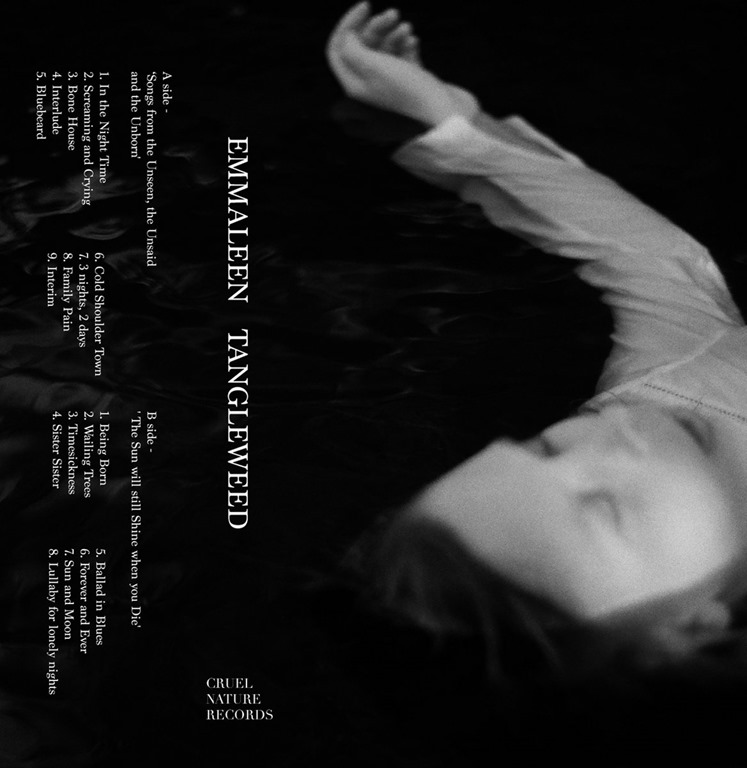
Cruel Nature Records – 6th December 2024

Christopher Nosnibor

The ever-prolific Aidan Baker has been a frequent and recurrent feature on the pages of Aural Aggravation since its inception in 2016, and I’ve been listening to, and covering, his works since a fair few years earlier. He’s an artist who never fails to intrigue, and his manifold collaborations see him revealing new aspects to his creativity.

This three-way collaboration was, according to the accompanying notes, ‘recorded live at Morphine Raum in Berlin, Germany on February 21, 2024 by Canadian guitarist Aidan Baker, Korean-American guitarist Han-earl Park, & German drummer/percussionist Katharina Schmidt. The group brings together their respective, disparate musical backgrounds to explore the intersections of ambient music, improvisational (free) jazz, and musique-concrète.’

It’s worth noting just how many live releases of collaborations there seem to have been released recently: in fact, only yesterday I was delving into the dynamics of the latest offering by CEL. This may be a ‘cost-of-living’ matter, in part: economic circumstances really aren’t favouring anyone who isn’t two-homes-and-at-least-one-cruise-a-year rich, and this is a global issue, whereby post-pandemic the disparity between the wealthy and the rest has increased exponentially (a word I’m mindful of tossing about being aware of its actual meaning), and it’s never been a tougher time to be a musician, unless you’re Taylor Swift, or Ed Shearan or Elton John or Coldplay… you get the idea. And it’s certainly not (only) because of the shit streaming revenues paid (or not) by Spotify. Studio time is expensive: getting together for intercontinental collaborations is expensive… and when it comes to it, it’s not always easy, or even possible, to recreate the energy, the frisson, the immediacy of a live performance in the studio.

And so here was have Thoughts Of Trio, which captures a set from the start of the year, mastered as eight segments, simply titled sequentially ‘TOTone’ to ‘TOTeight’. The arrangements are often sparse, and combine nagging, regular repetitions with erratic irreglularities: ‘TOTone’ sounds like a pulsating wave or a slow alarm simultaneous with a game of ping-pong and some urban foxes foraging through bin bags. I mean, it doesn’t really sound quite like that, but the different elements belong to different places, and while it does work, it does not feel like a composition in any conventional sense. And this is very much the form of the album: there are no overt structures, there is no sense of cohesion or linearity.

But where Thoughts Of Trio evades the pitfall of being a discordant disaster is in just how they somehow keep things together, with an absorbing, if loose, sense of rhythm, which is both absorbing and bewildering, but, however subtly, ever-present. ‘TOTthree’ features springing guitar twangs and lurching grumbles, but a distinct sense of almost abstract rhythm. Clanking rattles and slow-bending, woozy drones hover and slowly wilt, with scrapes and subterranean bumps and nudges unpredictably rising and falling.

There’s no obvious shape to any of this, but amidst a set of pieces which are five or six minutes long, the eighteen-and-a-half-minute ‘TOTseven’ stands out a dominant track on the album, although one suspects that for those who were actually there, it was difficult to differentiate the pieces, which tend to bleed into one another. It rumbles and hums, tense and dense, simmering, without ever breaking through the tension that holds down the surface.

There’s little to no audience noise, no applause in the interludes or intersections, which works well in terms of the overall listening experience, but means that this doesn’t sound or feel like a live album. That’s by no means a criticism, and again illustrates how live recordings can replace studio recordings for so artists. This simply doesn’t sound or feel like a live recording, and that’s not only due to the lack of audience noise, but the way everything flows.

For all of the discord, the twists and knots and disparities, Thoughts Of Trio comes together somehow. While it’s is by no means overtly, jazz, Thoughts Of Trio sits between jazz and ambient, with an experimental / avant-garde. Ultimately, it does its own thing.

AA

AA

a4098448952_10

Gagarin Records – 6th December 2024

Christopher Nosnibor

You might be hard-pressed to call CEL a supergroup, but Felix Kubin has been creating sound here, there, and everywhere for a long time now, and Five minutes to self-destruct is definitely a coming together of established creative forces, containing as it does five recordings of live tracks performed by longstanding Kubin and longstanding collaborator Hubert Zemler, remixed by Warsaw sound engineer Jan Wroński.

And the thing about creative collaborations is that they often rely on spontaneity, immediacy, the frisson between the individuals in proximity, feeding off one another in the moment. And so it is here, as the accompanying notes set out: ‘The expressiveness of these recordings is evident not only in their unbridled live energy, which can hardly be reproduced in the studio, but also in a musical nervousness that sets itself apart from the current wellness folklore of the modular community. The pieces gather in their DNA the paranoid plasma of cultural unease, chaos and upheaval.’

To make a small sidestep, we hear endless decrees that employees need to return to the office in order to foster the spirit of collaboration and all the rest. We know that this is bollocks, and is simply about working the instruments of control. Collaboration and the coalescence of energy for creative ends is not something which cannot be forced, and it happens, regardless of distance, time, and space, given the right connection and chemistry. Hearing the performances on Five minutes to self-destruct, it’s immediately apparent that this is not something that could ever be created by desire or will alone.

As the accompanying bio notes, ‘The expressiveness of these recordings is evident not only in their unbridled live energy, which can hardly be reproduced in the studio, but also in a musical nervousness that sets itself apart from the current wellness folklore of the modular community. The pieces gather in their DNA the paranoid plasma of cultural unease, chaos and upheaval.’

The title track ‘Five minutes to self-destruct’ is a quote from Michael Crichton’s sci-fi classic The Andromeda Strain, which describes a research team’s fight for survival against an accidentally triggered self-destruct mechanism, underpinned by trigger impulses and increasing panic.

My own experience of the modular community may not be on quite the same scale or the same higher circles as theirs, but it does feel primarily the domain of the middle-class, middle-aged white male these days, and there’s a certain air of ease and the satisfaction of hobbyism about it. Needless to say, not so here. There’s a tension that runs throughout the entirety of the release. ‘Krakenwaltz’ cartwheels and loops in jittery circles, head-spinning rhythmic cycles with no small degree of attack, with some sharp, aggressive snare sounds and a frenetic, frantic undercurrent which grows increasingly disorientating over its near-six-minute duration.

‘Eskalacja’ is dominated by hectic percussion and a whirl of fairground bleeps and toots running in ever-tighter concentric circles. It some respects, it calls to mind the frenzied looping and wild, vaguely manic excesses of early Foetus 12” singles, seeing just how far they can push the concept, and themselves in the creation of hyperactive sound.

The seven-minute ‘Blauer Dunst’ which sits as the album’s centrepiece marks a distinct shift in tone and texture, a rumbling dark ambient piece that invites comparisons to some of the more abstract works of Throbbing Gristle. It predates the rest of the set by almost four years, having been recorded in October 2020.

It’s back to more upbeat, stomping percussion-led synth work on the DAF-like ‘Neustart Generation’ – but don’t mistake upbeat for uplifting: it clatters and bangs with a clipped, regimented, Germanic feel, and the grooves are taut and tense, and it’s simmering tension which crackles beneath the lumping, shuffling, organic rhythms which underpin the sparse, tetchy title track. A couple of minutes in, a loping percussive cycle breaks out and the repetition of this and the dominant synth motif, amidst a swell of extraneous sounds – samples, sirens – makes this one of those tracks where you can feel your blood pressure increasing as it progresses and the pace quickens to a blur. It ends before reaching the point of inducing an aneurysm, and the assurance to the applauding audience, “We’re still alive, it’s ok,” at the fae injects some unexpected humour to proceedings.

AA

a1852422406_10

Dret Skivor – 6th December 2024

Christopher Nosnibor

Another Bandcamp Friday, and another release from Dret Skivor, Swedish microlabel specialising in noise and weird shit on super-limited cassettes. This time, they promise a ‘beast of a release with artwork by the manbear that is Christian Blandhoel’. Side A of this cassette is supposedly the ‘hard side’ and Side B the ‘soft side’, but these things are relative. Mellow it is not, and it really is a beast. I’d been forewarned that it was a long one, and landing the same day I received my copy of the new Swans live album, which clocks in at a solid two and a half hours, I kinda shrugged it off, thinking ‘yeah, it’s long, but it’s not that long…’ and while that’s true, I perhaps should have paid more heed. It’s not just about the length with this one. It’s about the intensity. For the records, Swans’ Live Rope is intense, and anyone who’s seen them live in the last couple of years will appreciate this. But the recordings simply do not capture the experience of being in the room, the decimating volume.

The thing is, there’s listening to music, and listening to music. I listen to music while I’m cooking, but it’s simply on, whereas listening to music with focus is a true commitment, and takes some energy. Listening to and knowing is half the battle takes a lot of energy.

Only a minute or two into ‘bad things keep happening’, the first of the album’s seventeen tracks, there’s some extreme panning that’s churning my guts and making me dizzy, and that’s without the feedback whistles that land just in the region of tinnitus. It’s a challenging six minutes, which culminates in a slugging blast of lung-rattling bass sludge.

‘Danger draws near to what you hold dear’ is an ominous piece of dark ambience with static and hum, crackles and horrific ruptures of noise. There’s a low-end mechanical thrum, low-end doom frequencies which flicker and throb, and nothing comfortable. Trilling feedback whistles for what feels like an age before more bass frequencies hit, and then static and distortion hums and hovers from left to right. This feels like an album designed to inflict optimal pain and anguish. ‘Loaded for bear what a nasty spectackle’ hums and drones and bursts distortion to a point at which is inflicts pain at first, before diminishing in its confrontational intensity.

Scraping strings and ominous drones and unsettling discord and dissonance are all the things one might expect from a track bearing the disturbing title ‘i always hope to find you fully dilated and bleeding’, and when it suddenly ruptures into a surge of fizzing distortion, the experience becomes quite overwhelming – and it only grows more intense and anguishing as it progresses.

‘rendering flesh’ is a horrible mess of buzzes and hums, feedback trills and screams, snarling whirls and blips and glitches. And the unpleasant frequencies, the serrated waves, the tension-building noise just keeps on coming, with the pieces packed back-to-back with no pause for decompression. At times it sounds like a bulldozer ploughing through the speakers, at others it’s more akin to the soundtrack to psychological torture or one of those anxiety dreams from which you wake, drenched in sweat, which fuck the entirety of your day.

Christian may be in pain, and and knowing is half the battle is his way of letting it out. Or perhaps he’s a sadist who derives pleasure from inflicting pain on others. Either way, and knowing is half the battle is likely to stand as an endurance test which many listeners will fail. Christian seems to have a knack for finding all the frequencies which resonate in the wrong way: every throb and click is a tension-building, gut-worrying microassault. ‘Abakan hyperburst’ again exploits both wild panning and distortion to distressing effect, before ‘the current trend of selective autism’ presents a sparse but challenging question. What is he trying to say here? Well, it does seem that a certain type of person will defend shitty behaviour by claiming that they may be on the spectrum – undiagnosed, of course – or have some other issue as a justification, which diminishes and undermines those who are truly autistic, in the same way as the people who shout loudest about their mental health and take time off work for mental health reasons aren’t necessarily those who are truly suffering. It is a minefield, and a topic which goes far beyond the reach of this review, but one that we shouldn’t ignore, since Christian has raised it.

Other titles are perhaps less provocative, and instead are more surreal – such as ‘mcdelivery plush trumpet’ and ‘the wonder of phosphorous burned eyeholes’, but ‘exploding heads in peacetime’ is a blistering trill of feedback worthy of Whitehouse, underlaid with billowing bass.

This would be a tortuous work regardless of duration, as Christian remorselessly pushes all the buttons for noise which is uncomfortable, distressing, but the fact this album seems to last a lifetime only heightens the tension. and knowing is half the battle is painful, horrible in every way – so needless to say, I love it, but I wouldn’t recommend it.

AA

a1827600571_10

Transylvanian Recordings – 31st October 2024

Christopher Nosnibor

The title is, sadly, true. Somehow, recent years have ‘normalised’ everything, but not least the worst and most cuntish behaviour. Men being sleazy shits is just so normal that ‘grab ‘em by the pussy’ is an election-winning slogan, and a majority – however slim – in the US is ok with electing a convicted felon to the most powerful political position in the world. Somehow, billionaires have been normalised. Genocide has been normalised. These things have just become the backdrop to the every day. Many of us simply reel at this realisation.

But instead of reeling, we need to react. And if we ourselves find ourselves unable, it’s at least something to find there are other out there who are able to articulate on our behalfs. Enter Killer Couture, with their third album.

Gothface celebrate Everything Is Normal as being ‘Not overproduced; just back-to-basics angry, editorial of society style late 80’s/early-90’s music; the kind of stuff you could expect from Skinny Puppy’s and Ministry’s DGAF approach in the 80’s’. The band themselves describe it as ‘a 40-minute violent outburst of pent-up energy, challenging the concept that there ever was a status quo to begin with, the people who feel the need to try and uphold the illusion, and exploring the psychic maelstrom of living in the true chaotic reality beneath the mask.’

From a muffled cacophony of discord and a patchwork of samples emerges the first pulsating beat and blasting riff, from which ruptures forth squalling guitar and the intensity builds as the collage of snippety bits layers up to an unbearable level… and then ‘Terrible Purpose’ barrels in, the guitars thick and fat and dirty, overloading but with that digitally crisp edge, and as much as Ministry and Skinny Puppy so come to mind, while the speaker cone-shredding distortion hits like a two-footed flying kick to the chest, I’m thrown into recollections of early Pitch Shifter, of the searing industrial metal abrasion of Godflesh. The bass snarls, the percussion is simply devastating, and this is proper, full-tilt. If you need more comparisons, and more contemporary ones, I’d be placing this alongside Uniform for its uncompromising, full-on raw industrial attack.

Hot on its heels, the title track is a relentless percussive blast which propels a mess of noise, guitars set to stun, vocals set to rabid punk rage.

The guitars on ‘Teeth’ come on like a wall of sheet metal. If the refrain ‘I’d like to break your teeth’ lack subtlety, it achieves the desired impact. Everything Is Normal is not about subtlety or nuance: it’s about expunging that raw, brutal rage, it’s about catharsis, it’s about venting the fury, and Killer Couture are simply splitting their skins and breaking open their craniums with it.

‘KCMF’ brings another level of overload, the bass crunching and guitars churning and squalling against a relentless mechanised beat, and this is some furious, high-octane adrenalized noise shit. ‘Bastards’ speaks – or rather hollers – for itself, and ‘Composite Opposite’ is as gnarly as hell.

Everything Is Normal is one of the few self-professed ‘industrial’ albums I’ve heard of late which isn’t some Pretty Hate Machine lift, and isn’t essentially an electropop album with a dash of distortion. Killer Couture deliver on their promises with an album that’s brutal and uncompromising, heavy, and properly noisy.

‘Bad Waves’ brings things to a close, combining a certain shoegaze element with the hypnotic throb of suicide, and calls to mind The Sisters of |Mercy’s legendary live renditions of ‘Ghostrider’ circa 1984, often segued into ‘Sister Ray’ and / or ‘Louie Louie’ with the same relentless beat. And yes, my only complaint is that at 4’59”, it simply isn’t long enough by half. But then, the best songs always leave you wanting more, and despite Everything Is Normal being truly punishing album, a little more wouldn’t hurt that much… probably.

It’s important – and now sadly necessary – to distinguish between the red-faced outrage of those perpetuating hate and raging against all things supposedly ‘woke’ and those who are calling out the injustices, who are willing to stand up and point out that we need to be woke, that if you have an issue with antifa, you’re pro-fa, and you’re the problem.

Killer Couture are the voice of anger, the conduit of rage, and Everything Is Normal is precisely the album we need right now.

AA

a2402686568_10