Archive for the ‘Albums’ Category

Constellation Records – 21st February 2020

Christopher Nosnibor

The moon has possessed a mystical power as long as it has a physical one, the pull of the tides and the regularity of the lunar months forces mankind has never and will never assert control over. The waxing moon, when the moon is growing larger in the sky, is considered by some to be a phase of new beginnings. But new beginnings are equally the reverse aspect of endings: if the moon shows us anything, it’s that everything is cyclical. Time is not linear, and linearity is but a construct that facilitates an accessible narrative.

Rebecca Foon’s Waxing Moon is an album that shimmers and glows an ethereal hue: enigmatic, mysterious, and conjuring a sense of otherness, it’s possessed of a magic that’s difficult to pinpoint.

Rebecca Foon is the composer and musician behind Saltland and Esmerine, as well as having enjoyed a lengthy spell with Thee Silver Mt. Zion Memorial Orchestra. She’s best known for her cello work, but it’s her skills as a pianist and singer that are placed to the fore on Waxing Moon. For Waxing Moon, she’s joined by an impressive array of contributors, including Richard Reed Parry (Arcade Fire) and Mishka Stein (Patrick Watson) on acoustic and electric basses, Sophie Trudeau (Godspeed You Black Emperor) on violin, Jace Lasek (The Besnard Lakes) on electric guitar, and Patrick Watson as co-vocalist on ‘Vessels’.

But understatement is the key here, and the composition very much favour the sparse, low-key and minimal, demonstrating with aplomb the truth of the adage ‘less is more’. Instead of pushing the sound outward, she focuses in and goes deep into the heart of the feelings of each song.

The instrumental ‘New World’ get the album off to an affecting start, and sometimes in a world full of ceaseless noise and endless words babbled without thought, it’s easy to forget just how strongly simple notes played softly can be so richly imbued with emotion that they cam be more moving than any lyrical articulations.

When Foon sings, it’s in breathy, low tones, a sultry croon, as on ‘Pour’, which, with its brooding piano, subtly layered harmonies and haunting guitar, or the ominous, string-led ‘Another Realm’, it calls to mind some of Jarboe’s most evocative work. There’s something vaguely Leonard Cohen that goes beyond vague evocations of ‘Famous Blue Raincoat’ in the deep melancholy splendour of ‘Ocean Song’, while there’s something of a folksy feel to ‘Dreams to be Born.’ It’s semi-sad, entirely captivating.

The instrumentation and mood are focused on low-key, low tempo, for the most part exploring subtle shifts and microcosmic variations, although landing around the middle of the album, ‘Wide Open Eyes’ steps up both tempo and key to venture into folk-infused indie territory driven by an insistent rhythm and repetitive motif to hypnotic effect.

Waxing Moon is subtle, and has a slow pull that’s almost subliminal. It’s this soft-focus partial abstraction that renders the album so powerful: it’s by no means direct, but nevertheless conveys a deep underlying strength.

AA

cover Rebecca Foon - Waxing Moon

Drag City – 21st February 2020

Christopher Nosnibor

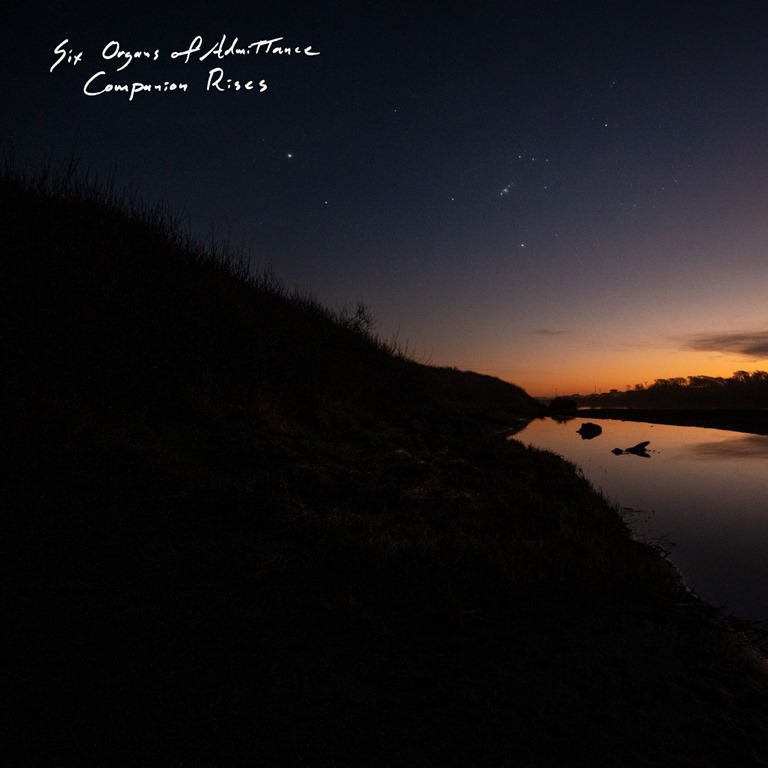
One thing you can never criticise Ben Chasny for is a lack of ideas, and over the course of twenty-two years, he’s pursued a line of technical and theoretical experimentation that’s yielded some remarkable results, perhaps most keenly exemplified by the recent Hexadic trilogy which spanned three years of deep and intensely focused and highly structured theory/practice-based work. The sequence was punctuated by Burning the Threshold in 2017, and is now finally broken with Companion Rises, which the single release of ‘Haunted and Known’ hinted at the form of.

According to the blurbage, ‘methodologically, Companion Rises sometimes recalls the early-mid lo-fi Six Organs records, with digital processes substituting for the analog techniques of yore and, instead of Ben Chasny’s hand percussion overdubs, algorithmic programs generating rhythms’. We also learn that Chasny ‘created all sounds and programs, all the recording and mixed the entire record, also like some earlier ones’, but the emphasis is less on revisiting the past than it is expanding on those early principles and practises to forge something altogether new and quite different.

From the surging synth organ swell of the intro, ‘Pacific’, it’s immediately apparent that Companion Rises is a different kind of beast: too ruptured, fractured and dissonant to be ambient, too vague in form to be conventionally categorizable as a ‘song’ even as an instrumental, it twists and squirms around and creates a certain sense of disturbance, and while it sits apart from the rest of the album in almost every sense, it also reflects the spirit of experimentalism.

Stylistically, it’s a curious hybrid of wonky folk and indie, played rough and loose and recorded cheap. ‘Two Forms Moving’ is a hypnotic, looping affair, that builds layers, and the zany lead guitar work is magnificently at odds with the hypnotically repetitive strum that forms the song’s basis, and it’s as if the two forms are moving in different directions yet somehow collide perfectly.

This is a large part of what makes Six Organs such an enduringly interesting proposition: as much driven by theory and experimentation conducted within set parameters, Chasny makes music that doesn’t quite sound like anyone else’s. Those defined parameters or specific methodologies, often a feature of John Cage’s compositions, are more commonly the domain of electronic or electroacoustic artists, and are more usually found in the domain of the avant-garde, while ‘rock’ music is – broadly speaking – more concerned with concepts than technical executions where compositions are concerned. Companion Rises chucks it all in the blender and whirls up something novel, but without it being novelty: songs are still very much the focus.

Those songs are diverse and tend not to place too much priority on conventions of verse and chorus, but there are hooks, nagging motifs, dainty, dreamy folky atmospherics and lilting melodies, and wrapped up in a lo-fi buzz that’s definitely not Dolby and all the more immediate because of it.

AA

cover Six Organs of Admittance - Companion Rises

Christopher Nosnibor

My appreciation of Man of Moon is well-documented: so well so, in fact, that a link to my review of their last show in Leeds, where they supported The Twilight Sad at The Brudenell; featured in their sponsored ad for tonight, which is bang in the middle of the UK leg of a significant European tour, that also coincides with independent venue week.

Oporto isn’t a venue I visit often, other than when it’s Live at Leeds, but I have fond memories of thrashing a few chords at the chaotic end of an Arrows of Love gig here some years ago, and the fact it’s still going and housing shows like this is cause for celebration.

Touring the UK not once, but twice with the Sad has served them well, in many ways: they’ve reached a bigger audience, their songwriting has evolved remarkably, and they’ve followed the lead in inviting artists they believe in to be their touring support.

And so it is that Wuh Oh – the musical project of fellow Scot Peter Ferguson – opens tonight’s show with some thumping electronica: he’s dressed in a superhero cloak and has a bionic arm, and it’s all delivered with high theatre and elements of interpretive dance.

DSC_3304[1]DSC_3305[1]

Wuh Oh

There’s a lot going on, with deep, quivering bass and monster percussion driving it all. Sampled vocals, heavily processed feature prominently in a set of all-out euphoric dance. It’s as commercial as it gets in a club context and this is never going to be to my taste musically. But the execution is outstanding, and besides, it takes some serious guts to pull this kind of DJ / mime karaoke shit off, and it’s a stunning performance with all the energy.

As they did at the Brudenell in October, Man of Moon om take the stage to Suicide’s ‘Ghostrider’, and they’re straight in with driving cyclical chords and propellant drumming on ‘Sign’, before debut single ‘The Road’ from back in 2015 goes full motorik psych.

Despite being only two in number, the sound is full and by no means lacking in depth, with the guitar signal split between a pair of two-by-twelve-inch amps, with the speakers placed facing back to the rear of the stage, resulting in the majority of the sound coming from the PA rather than a blast of backline.

DSC_3311[1]

Man of Moon

The set isn’t much different from their last visit, and is primarily constructed with material from their forthcoming album, but they’re tighter and more solid than ever, and the new songs have had time to bed in and take some proper road-testing.

‘Ride the Wave’ brings some thunderous bass, hefty vocal reverb and an insistent rhythm, and elsewhere. samples drift in by way of an intro, and there’s sonorous sequenced bas that churns the guts and an abundance of spaciously atmospheric guitars. ‘Rust’ brings classic vintage 80s electro with heavy Cure filtered through Twilight Sad influence with smoggy guitars and all the emotion. Dynamic and layered, it reaches the parts other songs can’t reach. And it’s this emotional intensity and increasing maturity that’s one of the most striking things about Man of Moon now in contrast to Man of Moon just 18 months ago.

DSC_3317[1]

Man of Moon

‘Skin’, the penultimate track and which featured on the Chemicals EP is a clear standout: while the studio version is smoothed out and leans toward Depeche Mode, live it’s a sharp, tense, uptempo groove and with a massive nagging bass line carry hints of Placebo, and the only criticism is that it could never be long enough. Throbbing dance grooves and cowbell drive closer ‘Stranger’, which threatens to veer off on an extended ace-rock workout, but instead, stops short leaving us wanting more. The album can’t land soon enough.

24th February 2020

Christopher Nosnibor

Kemper Norton’s kept a steady trickle of releases coming for some time now, and while the last couple – Hungan (2017) and Brunton Calciner (2019) – had bypassed me until now, the consistency of previous works, from Cam (2013), Loor (2014), and Toll (2016) was more than enough to ensure my immediate interest on the arrival of Oxland Cylinder. His music always has an intrinsic sense of place, however elliptical, and if on the face of it Oxland Cylinder appears to break this trend, the accompanying text is informative:

‘In the late nineteenth century and early twentieth century the majority of the world’s arsenic was created in Cornwall and Devon. The “Oxland Cylinder” was one of the methods used and was a revolving iron tube used to process and vapourise arsenic pyrites. None of these devices remain intact.’

Immediately, we’re transported to England’s south coast over a century ago, and not only to a bygone era but a practise essentially lost to history. And in this context, Oxland Cylinder takes on layers of meaning and caries a certain historical weight.

If the first piece, ‘halan 5’, which introduces the album with discontiguous electronic scrapes and buzzes, and a swell of bleeps and bloops, an analogue bubblebath that slowly eddies and swells, feels like so many other post-Tangerine Dream ambient electronic drifts, it’s also an evocation of a process akin to alchemy, only instead of turning lead into gold, it turns minerals into alloys, including lead.

Oxland Cylinder forges temporal spaces through the medium of sound, slow-spun ambience that conjures a certain mental blankness into which the listener is free to project their own sense of alternating coastal countryside and industrial production. Some will likely visualise Poldark, although the ruins that remain today tell little of the intense labour, heavy mining and vast engines involved in the extraction of ores and pyrites and their conversion to various alloys as lined the south coast at this time.

‘Dark as a Dungeon’ finds the first occurrence of vocals: it’s a sparse shanty with ringing electronics building a glistening, metallic backdrop to the lilting vocal melody. Singing about mining against funeral echo-laden rings feels like a sad thing.

Oxland Cylinder is as rich in evocative depth and subtlety as the south coast is in social and industrial history, and an absorbing album irrespective of context or intent.

AA

Kemper Norton – Oxland Cylinder

Cat Werk Imprint – 7th February 2020

Christopher Nosnibor

‘Walk away… walk around it.’ On the page, the words are devoid of threat or menace. But delivered in a fractured, disembodied voice that carries a strange sense of madness, it takes on altogether different shades of unsettling uncanniness. Amidst creeping fear chords, clicking insectoid flickers and scrapes and scratches, the voice, childlike and compressed warps and twists, as through refracted through a temporal veil or a spiritual force-field of some description. It feels like a communiqué from the other side. The voice is that of celebrated modernist sculptor and Henry Moore contemporary Barbara Hepworth, and this is one of the early moments on Olivia Louvel’s latest release, a work which forms the basis of the artist’s Masters degree, in which she investigates the voice ‘from preservation to resounding, while taking further the voice of Hepworth into the physical space as a multi-speaker diffusion’.

The source material is a 1961 recording of Barbara Hepworth’s voice, recorded by Hepworth herself in her studio in St Ives, the tape’s initial purpose was for a recorded talk with slides for the British Council, with an original duration of thirty-two minutes. Louvel’s resounding is of a similar duration, but instead of a linear narration which details the artist’s working methods, we get scrambled cut-up snippets which strangely still give a semblance of sense, reducing the extrapolations to the barest bones to give a sense of Hepworth’s creative processes and focus. But them, Willian Burroughs suggested that cutting up text (and for the purpose of this discussion, we’ll consider audio a form of text) reveals the truth, and while Hepworth’s talk isn’t brimming with political rhetoric and doublespeak, one feels that Louvel’s cut-up of her words does perhaps bring us closer to the heart of her meaning.

‘Must Carve a Stone’ loops and layers a breathy whisper of the word ‘carve’, which becomes an unsettling mantra. Minimal glitchtronica and hovering, echoing notes provide a ponderous, stammering backdrop to the looping, multi-tracked vocal layerings of ‘I Draw What I Feel in My Body’, and the sparse arrangement creates an uneasy backdrop to the words.

There isn’t a moment that’s comfortable or easy here, and Louvel’s ‘resounding’ of Hepworth is relentlessly challenging as an auditory and sensory experience. But it’s also impressive in the way that it provokes the listener to awaken those senses and absorb a multi-faceted presentation of what it is to be an artist.

AACW14_front

SPV / NoCut and ADA / Entertainment One

24th January 2020

Christopher Nosnibor

And we’re back once again in the divergent and varied field of what’s come to be goth in the 21st century, and it’s a very far cry from its post-punk roots. The late 70s and early 80s saw the emergence of Siouxsie and the Banshees, Bauhaus, The Cure, The Sisters of Mercy, The March Violets, Christian Death and a slew of bands who would subsequently be labelled as ‘goth’, and who were subsequently joined by the likes of Red Lorry Yellow Lorry, The Cult, Fields of the Nephilim, The Mission, etc., etc. The fact of the matter is, there was little commonality between these acts, and that goth was something of a media fabrication. What about the fans? Let’s not confuse the fans and the artists, or a subculture with its icons. So what was a scene that never was morphed into an evermore diffuse group of subcultures, with an ever-broader range of bands who had little or nothing in common beyond their shared fanbase. After metal, there can be few labels that provide an umbrella for a greater range of styles.

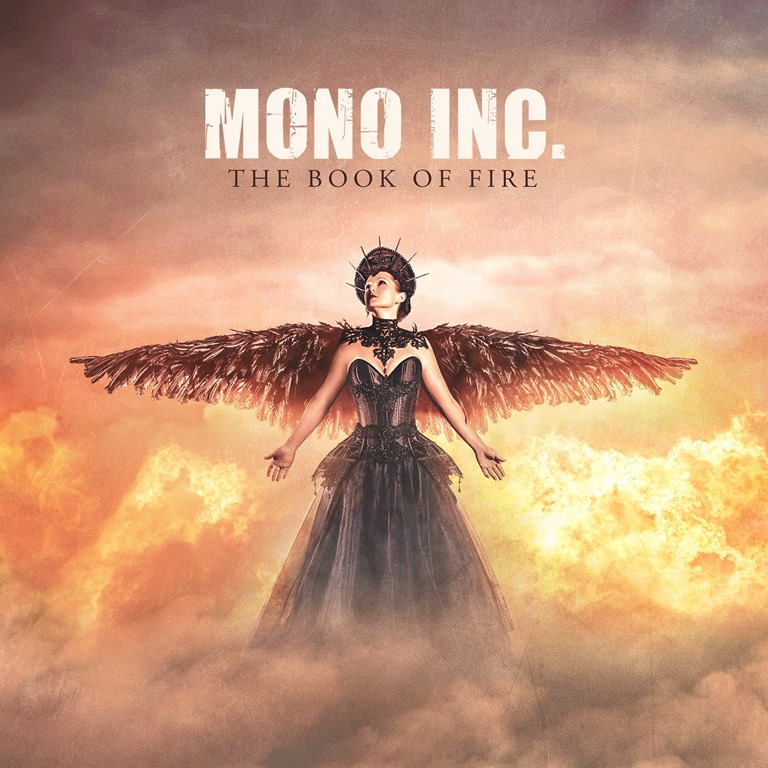
So here we are, presented with The Book of Fire, the eleventh album by German goth-metal act MONO INC. And while it’s goth, it’s not really my kinda goth, and couldn’t be further from the dark post-punk or art-rock stylings of the first wave of bands. Is this evolution, or dilution, cross-pollination and contamination? I suppose that’s a matter of perspective.

The album’s first song, the title track, is over seven and a half minutes long. It begins with a slick guitar that almost manages to sound like a harpsichord, and then it glides into some kind of Celtic folk metal and it very soon starts to become uncomfortable. Uncomfortable because such buoyant energy is more the domain of the hoedown knees-up. The folk-hued power-metal of ‘Louder Than Hell’ brims with positivity about strength and stuff, and explodes with crisp synths and choral backing vocals and it’s fun enough, but it’s also pretty cringy: it’s the kind of thing Germany might enter into Eurovision.

Then again, ‘Shining Light’ has such a massive chorus and a hook so strong that it’s hard to resist even when you’re hating it: it has that uplifting surge that lifts you and carries you away on the tide from the inside.

The euphoria swiftly dissipates with the next song, ‘Where the Raven Flies’, which is the definition of theatrical cliché melodrama. And herein lies the problem, which I accept is entirely personal, at least on a primary level. In short, I think it’s cheesy and naff.

On a secondary level, and one which is more objective, what The Book of Fire represents is very much a commercial take on the genre; theatre and drama don’t necessarily equate to an absence of depth, but this is good-time party goth, and any emotional sincerity is polished away under a slick veneer of pomp and overblown production. In this way, it’s as credible as examples of either folk or goth as Ed Sheeran’s ‘Galway Girl’ or Doctor and the Medics’ rendition of ‘Spirit in the Sky’. It displays all the trappings, but none of the authenticity. For all the theatre, there’s a woeful absence of substance, the brooding is third-rate thespianism rather than the anguish of tortured souls.

Elsewhere, ‘The Last Crusade’ is riven with choral bombast, but is little more than an obvious ‘This Corrosion’ rip-off, that once again leans heavily on Germanic folk tropes, and ‘The Gods of Love’ similarly brings together Floodland-era Sisters with Rammstein. I’m sure plenty will view this as a good thing, but they’d be wrong, so wrong. ‘What have we done?’ they ask repeatedly on the final and suitably epic finale track ‘What have We Done’, and it’s a fair question: whatever it is, it’s not good.

In fairness, it’s not quite ‘Rocky Horror’ bad on the spectrum of play-goth, but it’s not far off, and while it’s sonically ambitious, creatively, it’s depressingly derivative.

AA

MONO-INC.-The-Book-Of-Fire-1500x1500px

Tensheds Music – 6th December 2019

Christopher Nosnibor

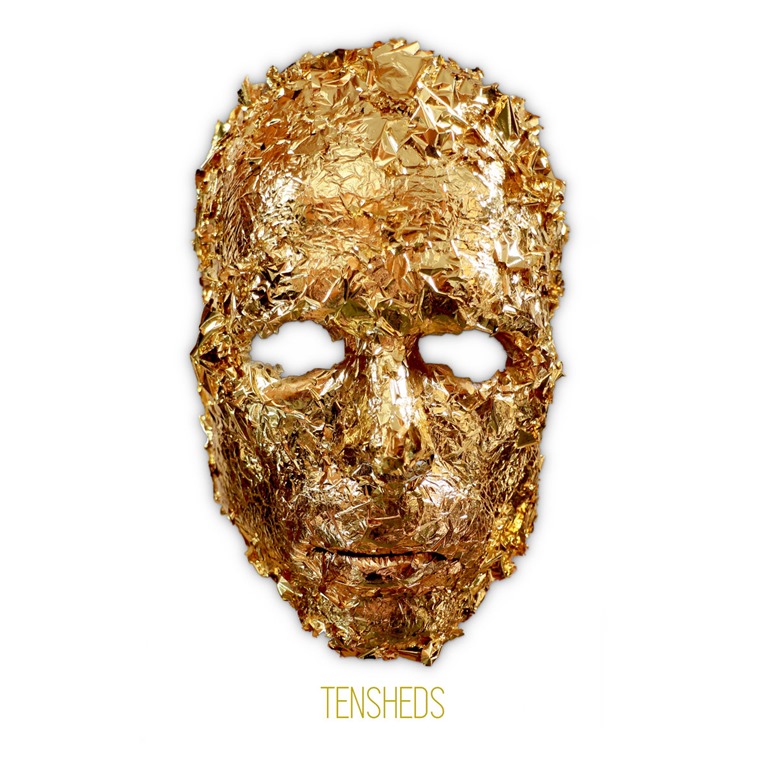
Having caught Tensheds live back in 2018 and been impressed by their gritty yet flamboyant sound, the arrival of an album in the form of Deathrow Disco promised to be good news. And it really is.

No guitars. No synths. No bass. Just a Rhodes organ. And some drums. Written in three days and recorded in three more, Deathrow Disco packs an immediacy without being lo-fi in a way that’s detrimental. However, everything is upfront and direct and cranked up, delivering maximum impact with a sense of urgency.

Everything fits together perfectly, and it all serves to showcase Matt Millership’s distinctive voice. The guy’s got more gravel than Jewson’s. And while that sand-blasted larynx is used to growl out mangled blued-based songs, he’s no predictable Tom Waits rip-off like so any others. Lead single and opening track ‘Youngbloods’ packs some flamboyant keys of a grandeur worthy of Muse or Yes, but pins the trilling tones go a stomping rhythm.

Second single cut ‘Gold Tooth’ is a grainy glammy blues boogie, but sonically, it’s a collision of The Doors at their swaggering badass baddest with Suicide, mining a relentless groove with a swirling Hammond that’s been mangled and

Then again, ‘Slag’ is more like a synth Mötörhead, only with some piano thrown into the mix. ‘Deathrow Disco’ combines immense theatricality with full-blooded rock ‘n’ roll, and elsewhere, ‘Black Blood’ goes prog and at the same times reveals a softer, more sensitive side, and ‘Troubleshooter’ inches toward lighter-waving anthem territory, or maybe would without the bitter heartbreak lyrics.

Deathrow Disco is varied, and largely uptempo and big on boppable grooves, but make no mistake, Tensheds have a highly distinctive style that works well, and makes optimal use of minimal kit.

AA

Tensheds - Deathrow Disco

Sound In Silence – 9th January 2020

Christopher Nosnibor

Fifteen years on from initiating worriedaboutsatan, Gavin Miller resumes work under the moniker as a solo performer once more. During that time, there have been lengthy breaks, solo releases and side projects, and five albums along the way, all of which featured Thomas Ragsdale. As a duo, it was always apparent that each of them brought something very different to the table, and on paper, the differences probably just shouldn’t work, with Ragsdale’s more beat-centric style seemingly at odds with Miller’s introspective post-rock / ambient stylings. But work it did, and incredibly well. The sound evolved over time, too, from the stuttering microbeats that characterised Arrivals to the up-front booming dance grooves particularly prominent in their later live sets, worriedaboutsatan developed, but remained distinctive.

So what impact Ragsdale’s departure to focus on his solo endeavours?

Pleasingly, Crystalline still has that je ne sais quoi that’s uniquely worriedaboutsatan, despite the contrasts being less pronounced, as Miller pursues the more ambient direction that defined Revenant and Blank Tape. The eight pieces coalesce as a whole to create an album that’s mellow and subtle, with reverby guitar notes chiming out into soft washes of ambient synth. It is predominantly background in its positioning: Crystalline isn’t an album where anything leaps out and grabs the attention, there are no peaks or troughs, and the whole thing more or les drifts by on a certain level that registers low on the concentration meter. That’s not a criticism, but a personal observation on its function as a musical work: it supplements the mood and occupies a space in an understated fashion, and is something that can be played while you’re working or reading. By the same token, that doesn’t make it ‘forgettable’ or mean it isn’t worthy of attentive listening: Miller has constructed some magnificently layered compositions, and while the overall sensation emanates from broad washes of sound that could be described as impressionistic, there is considerable detail beneath the surface.

The forms are vague and vaporous, the individual instruments indistinct, but this changes on penultimate track, ‘Secretly’, where the guitar becomes clearer and more ‘guitary’, and judders as the echoes take over the notes, creating a doubling effect as the picked strings stop and stutter against a heartbeat pulse of a beat.

The album closes with the mournful drones of ‘Switching Off’: sparse, spaced out, blank in their connotations before a swell of overloaded feedback begins to rise in the loudest, most abrasive moment on the album, before it’s suddenly cut dead. Thank you, and good night.

The suddenness of this ending is unexpected, and breaks the suspension of time that the preceding half hour of amorphous sound punctuated by barely-there beats has created. It’s a jolt, and you’re back in the room.

AA

worriedaboutsatan – Crystalline

Christopher Nosnibor

Two Acorns – 2A16 – DL release date: Out Now / CD release date: 6th March 2019

Celer’s Future Predictions is a vast and ambitious work: spanning four discs, it’s an ambient exploration on a truly grand scale. Each disc contains a single longform track, each running at around half an hour, with the shortest, ‘No Sleep in Medan’ clocking in at 27’30”, and the longest, ‘Nothing Will Change’ 42’36”.

According to the write-up, the compositions are made with ‘tape loops, from digital and acoustic instruments, field recordings and foley sounds’, and ‘with a focus on introspection and imagination, each piece begins with all layers playing, with minimal additional long-term structural development in order to maintain a state’. There’s a conceptual lineage here, if not an auditory one: Future Predictions is the follow-up to 2018’s Memory Repetitions which was based on memory and the interpretation of it over time. Future Predictions, we learn, ‘is instead based on the idea of future situations, and should be seen as a meditation on future events’.

While the various elements of tape loops and various instruments are indistinguishable, combining in their simultaneity to create soft, supple sonic washes, hovering drones interweaving interminably, the overall effect is incredibly immersive.

The first of the four, ‘Merita’ is light, drifting like mist over dewy expanses of grassland at sunrise, and while I initially find myself waiting for some progression, expecting some transitional shift, after a time the stasis becomes the end in itself.

‘No Sleep’ inches into darker territory, with deeper, rumbling low notes but after a few minutes this sense of difference dissipates in the drift of elongated notes that have no clear definition, no forward trajectory, no overt sense of movement, but instead hover and hang in the air for all time. ‘Quaraous’ brings new layers, new tones, new, shades, a shimmering light and swell of organ to the proceedings, and for aa time it again feels different, but again, that difference fades over the course of half an hour of sameness.

The effects of Future Predictions are cumulative. It’s true that on a purely practical level, few, if any, are likely to listen to all four discs or digital files in succession, although it’s in this context of continuous play that it works best. Admittedly, this is not music to listen to, but to allow to drift by. You don’t listen: you feel it and on a subconscious level as you drift, and you let life happen and continue as normal. I read and replied to texts and emails, while the sound swelled and hummed in eternal undulations. They didn’t transport me anywhere, they didn’t ‘do’ anything. And yet, inducing a certain sense of sedation, of slowness, of tranquillity, they achieved everything.

AA

Celer

OUS – OUS027 – 7th February 2020

Christopher Nosnibor

The accompanying text reports that Bit-Tuner’s seventh album, EXO ‘marks a milestone in his work’ and tells of how this ‘widescreen and beatless opus focusses on musical storytelling and atmospheric depth’.

EXO is unquestionably cinematic, with synth washes that are simultaneously soft and cloud-like, but achieve a density by their layering, and they conjure a breadth of sound, too, that evokes vast vistas that stretch from horizon to horizon. This isn’t ambient in the conventional sense, and while ‘beatless’ is a largely accurate description, it’s by no means formless, without rhythm, or without a certain sense of sensory attack. There’s a deceptive amount going on across the album’s eight pieces, and EXO is an album that doesn’t simply require attention, but demands it. This is not all wimpy, wispy sonic contrails that hang in the air: EXO has a certain solidity, depth, force that renders it anything but background. You can’t settle down and chill out to this, and while the musical storytelling may not be immediately apparent, the atmospheric depth is all-encompassing.

The prefatory single ‘Passage’ very much sets the tone, and on revisiting the piece here, it’s apparent just how much the mewling top-line, that semi-resembles a lost, plaintive seagull lost in the sweeping swathes provides a contrast and focus: this is an ambient work with intense focus, and, despite the absence of beats, a strong focus on rhythm. Then, ‘Valve’ pulses and throbs and crackles with distortion and decay around the edges and while it’s expansive, it’s also probing inwards toward the depths of the listener’s psyche. This isn’t music you can just leave running in the background: it continually grabs you and draws you in, demanding attention. And at times, it’s downright difficult and edgy.

‘Disbander’ pulses and grinds, low-end hums undulate and swoop into subsonics while mid-range interference collides against thumps and crackles and upper-frequency skitters and flits. There’s a lot going on, and while it’s anything but dark, it is incredibly tense: if you equate ambient with gentle, soft, and soothing, think again. ‘Ghost Light’ hits something of a Tangerine Dream stride, and electronic blips approximating beats coalesce to create a rhythmic structure that pulsates and throbs.

So is this ambient? It certainly doesn’t conform to the notion that it’s unobtrusive, or in an way calming, or soothing, and any contemplation encouraged here is rent with challenges. How does it make you feel? Ambience is so often geared toward the cerebral, but there’s a physicality to EXO, however subtle and subliminal: there are textures that make your skin crawl, tonalities than make you twitch, tense, and tingle.

AA

OUS027_front