Superpang – 17th July 2026
Christopher Nosnibor
Jana Irmert’s catalogue is a body of work defined by ever-shifting focus, and her capacity to do so makes her an ideal choice for soundtrack work. Her bio features credits for receiving the German Documentary Film Music Award in 2019, and in 2021 she was nominated for an Edda Award for her sound design on Jóhann Jóhannsson’s film Last and First Men. She also created the soundtrack to Henrike Meyer’s auto-fictional hybrid documentary To Be an Extra, and this work in turn was respun to make When I Dissolve.
Portals, released last year, was an entirely different kind of soundtrack: produced entirely from field recordings made in the Amazon rainforest, it soundtracked a lived experience and captured the artist in nature, in the purest sense.
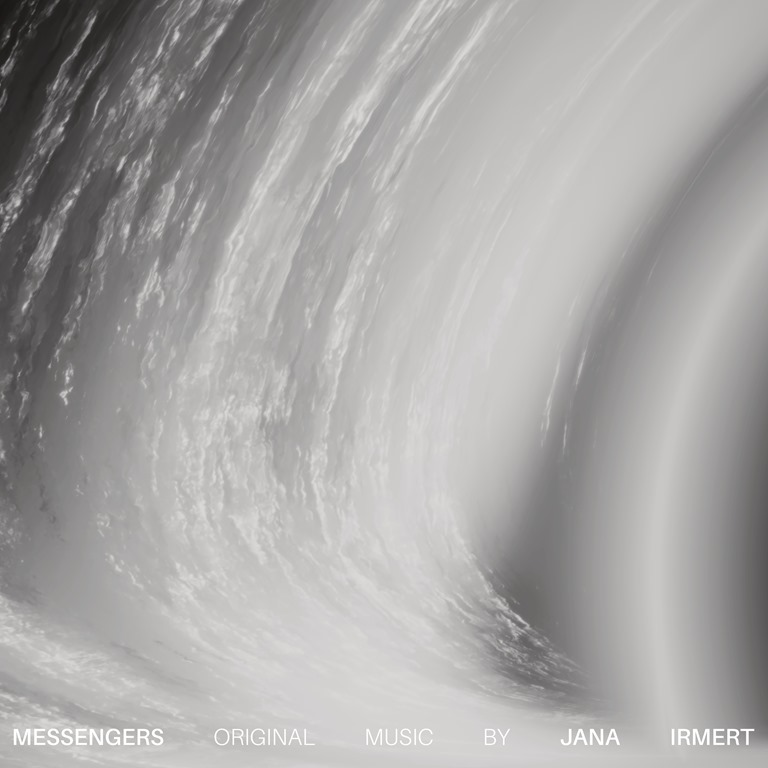
Her score for Jeffrey Zablotny’s film Messengers is different again, although does very much draw on elements of the natural world – albeit far removed from the rainforest, with the film being ‘a poetic exploration of three subterranean observatories hidden deep beneath Canada, Japan, and Antarctica’.
Sometimes, I wonder if reviewing a score independent of the film it soundtracks, and without having seen said film, is a good idea. But I would contend that the measure of any score is its ability to stand up without the visuals. And the Messengers soundtrack very much does – so much so that I find myself questioning whether to picture could possibly convey the quiet intensity of Irmirt’s score, which is designed around a vintage Yamaha Electone organ.
There’s depth and detail to the compositions here, with slow-moving analogue drones providing an earthy, organic feel throughout. ‘Dream Cabin’ shifts between atmospheres and brings together elements of light and dark, serenity and tension, playing them against and across one another. ‘Subatomic Collisions’ brings ominous echoes, unseen movements in the dark. Yes: there is something powerfully visual and sensory about this work. In places it’s dank, claustrophobic. I find myself holding my breath in suspense. With nothing to look at to guide or illustrate, the mind fills the spaces in interpreting the sound. And the imagination is always capable of inspiring a deeper fear, a deeper dread, than anything in life. I’m not talking about monsters or skeletons, although the mind will inevitably prey on your own worst fears. And largely, this is why we’re so often scared of the dark. The probability of there being a predator of some sort, or falling into a bottomless chasm are slim compared to, say, stubbing your toe or banging your head. But fumbling in the dark, perhaps along a narrow tunnel with damp walls, no-one fears a bruised toe or scraped skull. Darkness, and isolation, play into our biggest, deepest, most primal fears, because alone, in the dark, we’re at our most vulnerable.
The way Irmirt weaves the details into these pieces is incredibly subtle. There are no horror-like fear chords, no overt sense of impending doom or danger exists within the fabric of these compositions. And yet, with pieces like ‘Something is Listening’ with its reverberating clicks and shuffles and sonar-like droning pulsations, the sounds set you on edge. Note that it’s not someone, but something that’s listening. What is listening? We don’t know, because we can’t see: all we can do is sense it, and feel our paranoia swell.
There’s something almost David Attenborourgh about ‘Ultrapure’, a piece which would feel quite natural as an accompaniment to footage of jellyfish and angler fish and deep aquatic creatures moving in slow suspension – although equally it could be the slow-motion backdrop to scenes from a deep-space telescope with its tranquil images of nebulae drifting millions of light years from here and now – a sensation only accentuated by the slow tones of ‘Sleeping, Listening to the Stars in Darkness.’ Note, listening. Because as much as we think of space as silent, everything has sound. The stars are not static, but in constant flux, until they fizzle and fade or otherwise implode or swallow everything. There is both stillness and movement here: that is to say, listen closely to the stillness, and the movement will reveal itself.
Messengers is evocative, and inspires contemplation, a reflection of the contrasts between confined space and infinite space – and the similarities, in that both are dark and you will find yourself alone in that darkness with nothing but your thoughts and fears. Weaving through infinite passageways of ponderance, Irmert finally brings us to ‘Monuments to Our Questions’, and it feels as if this should offer some form of solidification to all of the abstraction which has preceded it. But like a shadow, like mist, it leaves us feeling that answers are illusory, things we tell ourselves to still the anguish rather than because we have attained conclusive knowledge. Ultimately, we know nothing, and are, and will be, forever fumbling blindly in darkness.
AA