Archive for August, 2024

Having founded the industrial-electro act genCAB in 2006, David Dutton put the group on hold following the release of their debut album II transMuter two years later. A forward thinking record in the genre, it had blended elements of EBM and synth-pop into song arrangements perfectly suited for aggressive rock.

genCAB eventually returned in 2022 with a long-awaited follow-up entitled ‘Thoughts Beyond Words’, as well as the genre-bending ‘Everything You See Is Mine’ EP. These were promoted on a US tour with Aesthetic Perfection, for whom both Dutton and genCAB drummer Tim Van Horn had spent the intervening years playing live.
2023 saw genCAB sign to Metropolis Records, with the album ‘Signature Flaws’ appearing in the autumn. A meditation on one’s own demise, it introduced elements of shoegaze and post-hardcore to an already dense melting pot of disparate sounds.

‘Let It Rip’ is a new EP that precedes the cryptically entitled album III I II (THIRD EYE GEMINI), due out in late September 2024. Half of the full-length record is a modern day update of the best material contained on their 2008 debut, with the remainder consisting of brand new songs inspired by the re-recordings.

An improvement in the genCAB sound was already apparent via a recent rework of the 2008 track ‘Perish The Thought’ released as a single in 2023, but everything else is also now amped up to 11. Although retaining a raw and fresh feel that is faithful to the original renditions, the songs have been completely restructured and are sung with more confidence and conviction than ever by Dutton.

Listen to the EP in full here:

AA

dc9e59041d5c5569664aa9d47e80df8ac7908c5b

As the follow-up to the instant classic that was their debut single, ‘Never Say Forever’, we’ll just let this one speak for itself…

AA

a1609635372_10

Metropolis Records – 23rd August 2024

Christopher Nosnibor

Even at their commercial peak, PIG releases weren’t all that easy to come by, at least here in the UK, despite some of them being on big labels with big distribution. PIG – the project of London-born Raymond Watts – is an act which can legitimately claim to be big in Japan while largely unknown at home.

My own first encounter was seeing them support Nine Inch Nails on The Downward Spiral Tour in Wolverhampton in 1994. I was in the middle of my A-level exams, but no way was I going to miss NIN. I didn’t even know who the support were, but witnessing the heavy grind of PIG, with pigs’ heads on poles at the sides of the stage, as their lanky singer writhed his way through a gritty set was an absolute revelation. The set’s opening song stuck with me, but it was some years before I would actually source a copy of Red Raw and Sore, on this new site called eBay. The debut album, A Poke in the Eye…. With a Sharp Stick and the ‘Sick City’ 12” were fairly easy to find at record fairs around 1994, as Wax Trax! vinyl was available in abundance, and often cheaply, too, but anything else? Pretty much impossible to find. And so it was that PIG felt like a near-mythical act, and despite having played these big shows with NIN, still no-one was really aware of them.

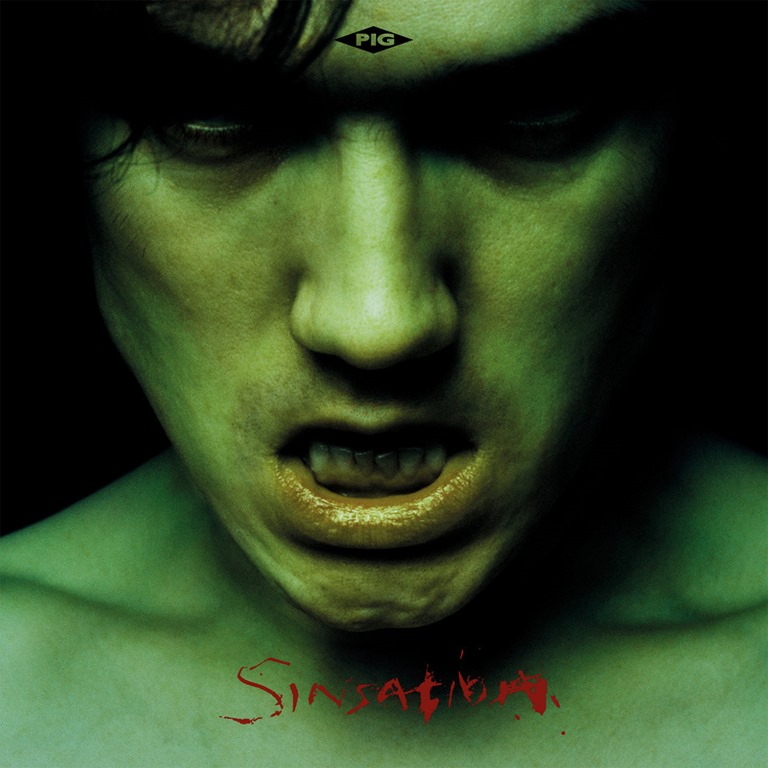
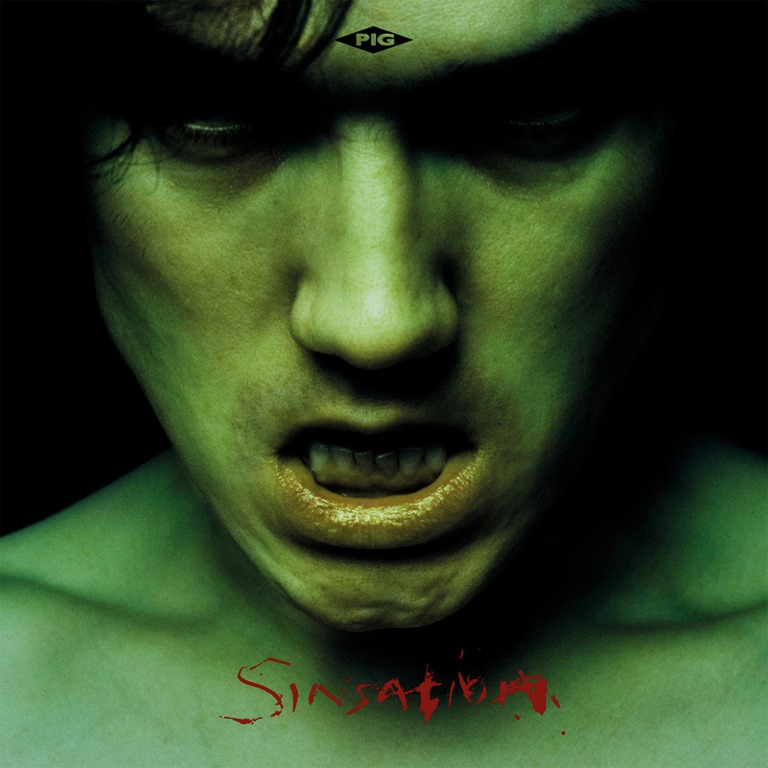
Sinsation was released first in Japan in 1995, and a year later in the US, and on learning of its existence, I got my local record shop to order it in, but had to wait literally months for it to arrive on import. Oh, but it was worth the wait. It delivered all of the theatrical pomp that defined A Stroll in the Pork, but cranked up the dirty industrial guitars and found Raymond Watts in top form with his extravagant wordplay. In short, it reset the bar, not just for PIG, but for what ‘industrial’ music could be. This wasn’t just hard and heavy, but also playful, witty, intelligent, and still dark, seething.

The cover alone is striking. Watts’ image is a standard feature on all PIG releases, but whereas more often than not he is depicted looking buff or brooding, the sickly green hue is unsettling – and slamming in with a series of orchestral strikes and a low, grumbling bass before hitting full-on industrial anthem mode on the first track, the six-minute ‘Serial Killer Thriller’ (the chorus of which provides the album’s title), it’s immediately apparent that Sinsation is something special (and not something sad…).

Admittedly, despite this being an album I’ve played to death over the last thirty years, apart from a few tracks being a few seconds different in their duration, I can’t discern any huge differences between this remastered version and the original: there are, perhaps, more details revealed in the mix, but then, the production on the original was impressive, and again, I’ll come back to that word, ‘detail’. There’s a lot happening; samples, snippets of bits and bobs, strings, multi-layered vocals… A touring member of Foetus early in his career, with JG Thirlwell involved in the early singles and debut album, Watts clearly learned much from Thirlwell, as well as his early involvement with KMFDM. Sinsation felt like the point at which he brought these two aspects together in perfect balance while simultaneously realising his own unique sonic vision. The result was a set of hefty, driving songs, exploding with ideas and noise, and so many layers, so much going off all over the place. It was bold, audacious, and while it’s easy enough to say that it’s a bit Foetus, a bit KMFDM, it goers so far beyond these points that comparisons are a diminishment of Watt’s achievements here.

Sinsation is certainly the first PIG album to showcase the full range of styles and compositional aspects Watts has in his locker, and as such, represents something of a creative peak.

While nominal single ‘Painiac’ (an early version of which was the lead track on a Japanese-only EP, and a video for which got a few spins on MTV on the album’s release) is a throbbing industrial beast of a tune, ‘Golgotha’ is a dark, semi-ambient interlude which sits between the driving snarl of ‘Hamstring on the Highway’ and the swaggering industrial-strength glam-tinged gospel-infused dark pop of ‘The Sick’, which would provide the blueprint for the PIG renaissance which started with The Gospel in 2016. ‘Analgesia’ is a magnificently atmospheric piano-led instrumental which incorporates elements of ambient and electronica and extraneous noise ‘Volcano’ is serpentine and sleazy, with some audacious orchestral work in the mid-section which take the bombast of Foetus’ Nail to another level, while ‘Hot Hole’ drives hard and heavy with pulsating electronics colliding with hefty chugging guitars and ferocious beats.

For the many who likely missed this the first time, this re-release provides the opportunity to make acquaintance with one of the definitive PIG albums, and for those already familiar, it’s a timely reminder of the incredible journey that has been PIG’s career to date, while offering the first chance to get it on vinyl. Almost thirty years on from its first release, Sinsation still sounds phenomenal – insanely ambitious, utterly deranged, and in a league of its own, quite unlike anything else before or since, even within the PIG catalogue.

AA
a2059987689_10

Buñuel return with Mansuetude, the band’s first release outside of their outlandish trilogy of albums (comprising A Resting Place for Strangers, The Easy Way Out and Killers Like Us). A co-release between SKiN GRAFT and Overdrive, arriving 25th October 2024.

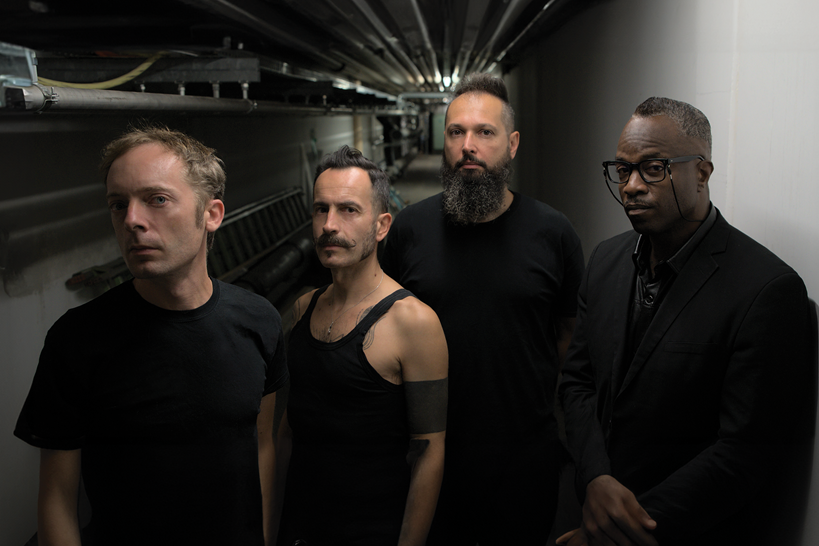
BUÑUEL boasts the singular vocals and razor sharp lyrics of Eugene S. Robinson (ex-Oxbow) and a powerhouse Italian trio comprised of guitarist Xabier Iriondo (Afterhours, A Short Apnea), bassist Andrea Lombardini (The Framers) and drummer Franz Valente (Il Teatro Degli Orrori). Mansuetude was produced by Timo Ellis, and features guests including Jacob Bannon (lead singer of Converge), guitarist Duane Denison (the Jesus Lizard, Tomahawk,The Denison Kimball Trio), vocalist Megan Osztrosits (Couch Slut), cellist Andrea Beninati and David Binney on alto saxophone and vocals.

The music on Mansuetude warps and buckles with complexity, freedom, tenderness and primaeval energy all at once. A prime example is the lead single "Drug Burn," crunchy, melodic and harder than a lot of hardcore. About the track the band comments;

“One of the steadfast rules the Hells Angels used to tout to members, NO DRUG BURNS. Which just goes to show, there really IS honour among, well you know. Following a wayward path to an even more wayward song, BUÑUEL’s rendering of said BURN will make your ears (and eyes, if you’re lucky enough to see the video) burn.”

Listen here:

AA

The title, Mansuetude – meaning “meekness” or “gentleness” – might seem like a juxtaposition when listening to the record that is, in Eugene’s words, “extreme but articulate”, however the record aims to convey a balancing of different forces and shades of being which make up the human experience. Throughout Mansuetude, Buñuel take every given opportunity to stretch out their musical tendrils towards discomfort, surrealism, and the deconstruction of tradition, as they reach absolute abandon. They go well beyond the realm of noise rock, encompassing many moods from post-hardcore to avant-noise, hard-blues to post-industrial, symphonic to trash metal and even free-jazz.

Drummer Franz comments that “Buñuel is a name that embodies a certain cultural and literary reference, which evokes an entire world. Like his films, our Buñuel is surrealism. We take the listeners into a place that’s suspended between dream and reality.”

“What we’re doing with Buñuel is to carve out a very specific glimpse… partly into hearts of darkness, but more specifically into the depth of our secrets,” says Eugene. “Secrets we keep from each other, ourselves and whatever futures we’ve imagined for ourselves. We are ultimately trying to communicate something direct and deadly about the human condition.”

Buñuel makes music for those of us willing to take a closer, unflinching look at the depths of human instinct, and on Mansuetude the band extend their reach farther than before, creating an album that is akin to a powerful impulse, or perhaps even an exorcism.

AA

BUNUEL_MANSUETUDE_RECORD-99079e051404513c

(BUÑUEL, L-R: Franz Valente, Xabier Iriondo, Andrea Lombardini, Eugene S. Robinson | By Annapaola Martin

23rd August 2024

Christopher Nosnibor

I’ve been enthusing over Eville for a while now. This is no small thing: in the main, I’m not really big into Nu-Metal. Back in the late 90s, the emergence of Limp Bizkit and KORN didn’t so much leave me cold as cause me to wilt inside, and as time progressed, the emergence of more, ever lamer and more cliché exponents of the genre pushed me deeper into the realms of despondency. Anyone who’s read anything I’ve written over the last decade will know that I’m not one of those middle-aged sad-sacks who bemoans the fact that there hasn’t been any new music worth listening to released since I turned 30. I’m not frozen in time, and I don’t believe that any genre is completely and irredeemably shit. Even Nu-Metal.

Eville are a case in point. One reason Nu-Metal was shit back in the day is because it was so overtly the domain of white blokes. So the prospect of a female-fronted Nu-Metal band changes things for a start, and having seen this ad recently, I have witnessed first-hand their capacity to whip up a frenzy.

And ‘Blood’ sure whips up a frenzy alright. It captures Eville at their absolute best: massive, slugging guitar riffs that punish, and hard, on every level, paired with poppy autotuned vocals and keen, earworm melodies. ‘Blood’ strikes the perfect balance between gut-punching riffage and strong melodic tunage. It does not get better than this, and you really need Eville in your life.

aa

eblR0q3w

Room40 – 6th September 2024

Christopher Nosnibor

For an album that’s based solely on the sounds of the guitar, Dust Resonance sounds distinctly unlike a guitar album. As the title, Dust Resonance, suggests, this is a work of extended, drifting drones, a set that’s predominantly ambient in nature.

But as Norman Westberg’s recent solo releases – also released on ROOM40 – have demonstrated, it is quite possible to take the guitar into this territory, and to create expansive, subterranean drones with just six strings and some distortion pedals, and perhaps some reverb thrown in.

As Zimoun himself explains, he was interested in the guitar as a sound source for some time and have explored it on previous editions including Guitar Studies I-III. “On this work,” he says, “I’ve experimented with different methods and materials, specifically a Magnatone tube amplifier from the 1960s, and various speaker membranes covered with dust, soil, or small stones. The friction of these materials on the vibrating speaker membranes produced slight distortions and irregularities in the sounds, alongside the warm tube tones of the vintage amp.”

As such, the dust is rather more literal than metaphorical here, but the title and the substance of the sound presents a work that functions on multiple levels, with the connotations of dust settling as time elapses and the idea of dust and drones hazing together working alongside the physical interference of organic material with the mechanics of the recording process.

Zimoun’s approach, then, like Westberg’s, is similarly simple and sparse, but at the same time, adds an edge of experimentalism which is quite unique. The addition of materials to create friction and alter the texture of his guitar may take its cues from the ‘prepared piano’ pioneered by John Cage and taken forward as a career choice by Reinhold Friedl. I can’t think of so many examples of the guitar being twisted and mangled in such a way, or an artist taking such an organic, earthy approach to breaking down the fundamentals of the sound of their instrument of choice. It does, however, create the context for an album which features nine dronescapes which creep into one another to forge a continuous hum, scratching, scraping, quite literal earthworks. The thought of earthworks draws me to a place where I find myself reflecting on hut circles, tumuli, and the landscape of the iron age, something I was fascinated by in my early teens and have once again become drawn to having resumed, after a lengthy period, walking moorlands and studying the details of OS maps. And so it’s purple-hued heather-covered moors and outdoor expanses which occupy my mind as I listen to this, a work which evokes similarly vast and barren spaces.

The album contains nine numbered pieces, which hover low and heavy and segue into one another to create one single, monolithic work, and one of immense density. The colossal ‘DR Part 2’, which grinds on for almost nine minutes is exemplary.

I recently wrote on the experience of listening to the instrumental ambient release Ambient Short Stories by Bistro Boy, which slotted firmly into the ‘background’ ambient slot: soft, gentle, undemanding. This is most definitely not background: the dense, buzzing tones and uncomfortable frequencies of Dust Resonance place it firmly in the foreground. It’s impossible to settle back and let this drift over as you yawn and slowly relax into a space of tranquillity. Dust Resonance makes you squirm, sends tension down your spine. Throughout, there is a sense of unease, discomfort, of wrong, which rumbles in the guts.

Dust Resonance is a work which, beneath its smooth surface ambience, is grinding, rough-hewn, slow, and dragging, with billows of cloud accompanying the low-level churn. Something about this, paired with the slow-building spin, starts to feel a shade disorienting. You might sleep, but you may not sleep comfortably.

AA

a0068423991_10

Following hot on the heels of his new album ‘Red Room’ (released in May 2024), industrial rock mainstay Raymond Watts aka PIG has today reissued a fully remastered version of his seminal mid-‘90s album ‘Sinsation’ via

Following hot on the heels of his new album ‘Red Room’ (released in May 2024), industrial rock mainstay Raymond Watts aka PIG has today reissued a fully remastered version of his seminal mid-‘90s album ‘Sinsation’ via Metropolis Records (CD, digital) and Armalyte Industries (deluxe 2xLP vinyl). Out of print for almost three decades, it makes a timely reappearance just ahead of a North American tour.

‘Sinsation’ was originally released in 1995 on Nothing Records, the label established by Nine Inch Nails kingpin Trent Reznor, and not long after PIG had opened for NIN at a number of shows. Nothing was an influential and commercially successful label with a cult underground following that also issued records by Marilyn Manson, Squarepusher, Autechre, Meat Beat Manifesto, Pop Will Eat Itself, Einstürzende Neubauten and Plaid, as well as NIN themselves.

(CD, digital) and Armalyte Industries (deluxe 2xLP vinyl). Out of print for almost three decades, it makes a timely reappearance just ahead of a North American tour.

‘Sinsation’ was originally released in 1995 on Nothing Records, the label established by Nine Inch Nails kingpin Trent Reznor, and not long after PIG had opened for NIN at a number of shows. Nothing was an influential and commercially successful label with a cult underground following that also issued records by Marilyn Manson, Squarepusher, Autechre, Meat Beat Manifesto, Pop Will Eat Itself, Einstürzende Neubauten and Plaid, as well as NIN themselves.

Check the video here…. Album review to follow….

AA

9af61b6130ce938e2fa6f1d2fbf2db35b6784588

The collective of renowned musicians from Norway’s west coast known as WHISPERING VOID is releasing the single ‘Vinden vier’ (‘The Wind Sanctifies’) that features ABBATH guitarist Ole André Farstad. The track is taken from their forthcoming debut album At the Sound of the Heart, which has been chalked up for release on October 18, 2024.

Hear ‘Vinden Vier’ here:

AA

WHISPERING VOID comment: “This song began to form when I repeated the words ‘Vinden vier’, which is kind of a play on words”, vocalist Kristian Espedal explains. “This can mean ‘The Wind Sanctifies’ but it can also be read as: ‘The Wind Unites’. As the lyrical loop goes on, it also becomes ‘Vi er vinden’, which means ‘We Are the Wind’. Then Lindy added her wonderful vocals in a 70s or even 60s style. At first, she just sang the ghost vocals, but once we had set the lyrics for the song, she also gave her voice to them. We all felt that this song also needed more of an Eastern energy, which is the very reason as to why we invited Ole André Farstad to play guzheng and Indian slide-guitar. This has added even more of that late 60s vibe to the song and I really like the result.”

AA

4e490e66-5245-adb3-6f07-95b056af9369 21

Self-released – 23rd August 2024

Christopher Nosnibor

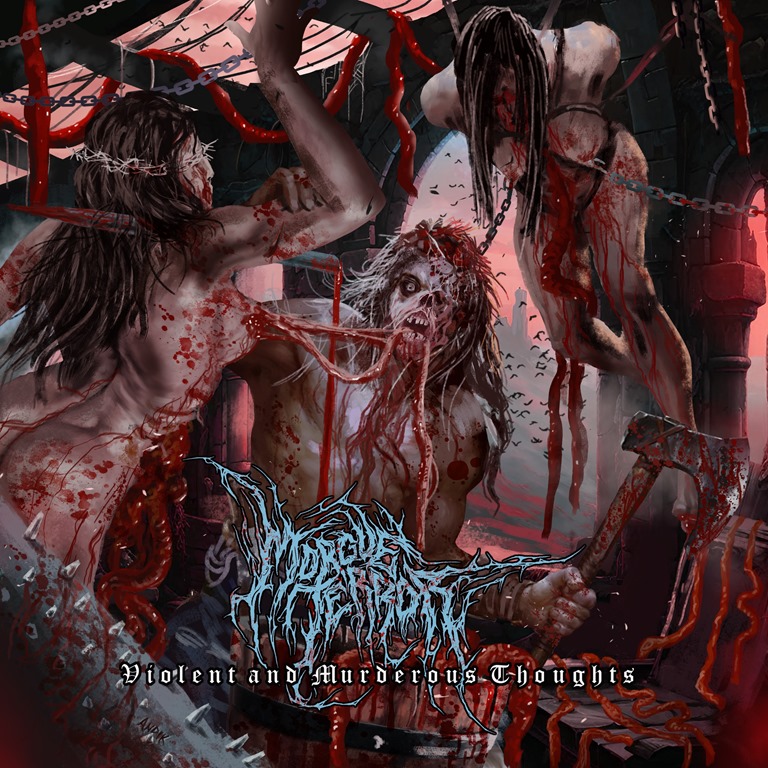
Violent and Murderous Thoughts is the second EP from ‘Horror-themed death metal act Morgue Terror’, and this one is all about ‘chronicling the atrocities of four sadistic serial killers and a debauched, abusive sect’ across its five tracks. In this sense, it broadly represents a thematic continuation of its predecessor, their eponymous debut, which was ‘all about the murders and characters in the Terrifier movies’. Nerds. However, it also marks something of a departure, being their first release ‘to have an actual drummer, with Dustin Klimek (ex-Full of Hell) behind the kit’.

His presence has certainly brought a new dynamic to the sound, with (full of) hell-for-leather pedalwork bringing relentlessly powerful beats to propel the furious fret frenzy and guttural grunting vocals. I mean, it’s impossible to determine by ear who any of the sadistic serial killers might be, and serial killers really have been done to death – if you’ll pardon the pun – and have, thanks to Channel 5 and Netflix, become completely mainstream. Still, in terms of revelling in gore and death metal tropes, Morgue Terror deliver everything they promise, and this EP sounds exactly the way you’d expect it to based on the bloody, gruesome cover art. Sure, it’s puerile and way over the top – the cover and the music – but it works.

‘Chessmaster’ (inspired by Claude Bloodgood, perhaps?) showcases some well-conceived dynamics, with tempo changes and breakdowns aplenty and some interesting chord progressions, packing a lot of action into only a little more than three minutes. ‘Bludgeoned_Brutalized’, the longest of the songs and running past four minutes conveys the sentiment of the title as an aural manifestation, relentlessly battering the listener with punishing force. The vocals sound as if they’re being coughed through a cascade of blood while the guy’s entrails are being torn out through his abdomen. Make no mistake, this is nasty, and single cut ‘Neanderthal’, which features guest vocalist Cheney Crabb is punishing from beginning to end, three devastating minutes of raw intensity.

There is simply no let-up across the duration of Violent and Murderous Thoughts, and while the whole EP may only have a duration of around eighteen minutes, it’s a blunt forced trauma in musical form: hard-hitting and harrowing, it leaves you feeling battered, bruised and borderline concussed.

AA

397796

Möller Records – 9th September 2024

Ambient Short Stories is the tenth album by Frosti Jonsson, who records as Bistro Boy. As selected monikers go, this isn’t one of the best in terms of what it connotes, at least for me. While I accept that there’s an element of personal perception involved here, there’s little escaping the fact that there’s a strong whiff of middle-class superiority in the mix here, a late-nineties / turn of the millennium snobbery with a hint of contemporaneous IKEA-tinged cool.

Cut back to 1997, my then girlfriend and I bought our first flat, a cardboardy newbuild with magnolia walls and magnolia carpets, which we stuffed with pine units and furnished the dining part of the open-plan kitchen-dining space with a trendy bistro-style circular table and chairs. On the other side of the same room, we’d sit on the IKEA sofa and watch Friends. I’ve actually got no beef with Friends, but fuck me, talk about cliché. We actually thought we were cool, and our friends did, too.

Ambient Short Stories contains eleven instrumental – and as the title suggests – ambient works, which are pleasant, mellow, easy on the ear. Fair enough. The compositions aren’t the sort of thing you’d actually hear in a bistro, or any other social setting for that matter, although the style is very much background when it comes to the level of attention the album demands. From amidst the generally gentle drifts and rippling waves pipe up some unexpected incidental bits and bobs, and these interjections – whether they’re woodwind or some dominant lead synth or something else – feel a bit out of place, a fraction loud in the mix, a bit wrong, and also a bit dated, a bit post-Tubular Bells 80s / 90s New Age.

Ambient Short Stories isn’t bad, by any stretch: in fact, as a gentle ambient work, it brings almost exactly what you’d probably want: it’s slow, supple, soothing, spacious, and quite soporific, to the point that it almost feels like AI has conjured the perfect balance of light and dark. It isn’t particularly gripping, but I don’t think it’s intended to be, instead sowing seeds of ponderousness.

AA

Ambient Short Stories - Ambient Short Stories - Bistro Boy