Archive for November, 2020

Southern Lord – 4th December 2020

Christopher Nosnibor

High Command’s new release on Southern Lord drags me back to a point of debate I’ve covered variously over the twelve years I’ve been doing this reviewing thing: what distinguishes a single from an EP, an EP from an album? And aren’t EPs and mini-album’s the same thing? It may be so much hair-splitting and semantics, and about as important as genre boundaries in the scheme of things, but… well, High Command, being a crossover of thrash metal, punk, and hardcore, are a cause of consternation on that front too.

The two tracks on this digital single, which prefaces the 7” EP release due early next year via Triple B records, are fast, furious, gnarly, and there’s no question over their thrashiness.

‘Everlasting Torment’ may not be literal in its title, being a short, sharp four-minute attack of overdrive, but it does pack all the melodic fretwork, thunderous drums and mega-fast plectrum flashing of something purgatorially thrashy, while counterpart – or B-side, if you will – ‘Sword of Wisdom’ penetrated with a raft of sudden tempo changes and pierces with the lunge into a monster guitar solo.

It’s a whole lot less sludgy and perhaps less Ministry and a lot less industrial than its predecessor, although the key trappings are all in place.

However you position it, this release brings a full-range display of some pretty frenzied fretwork which is driven – hard, and fast – by a strong, dynamic rhythm section that packs all the power, and if any of it threatens to slide toward cliché, the execution and sheer brute force are more than enough.

338308

Constellation Records share the eighth entry in their Corona Borealis Longplay Singles Series. "Je Vois / Non-Dit" by Montreal based avant-electronic artist Joni Void and featuring vocals by poet/singer and frequent collaborator N NAO, with an experimental film by Sonya Stefan.

"Je Vois / Non-Dit" combines live recordings by the duo into a single track longform where N NAO’s vocals are given unearthly yet organic treatments through Void’s warped manipulations, sampling, atmospheric textures and deconstructed beats – joined by Eddie Wagner on flute about halfway through the track’s 21-minute running time.

Listen to ‘Je Vois / Non-Dit’ here:

…and stream the video here.

thumbnail_JoniVoidimagebyThomasBoucherSonyaStefan2018lores

Photo by Thomas Boucher & Sonya Stefan, 2018

Christopher Nosnibor

Lorin Forster certainly isn’t lacking in ambition, or ideas. Her work-rate, be it new music, a tour, artwork, merchandise a side-project of some sort, has been quite remarkable in recent years, and since Weekend Recovery formed around five years ago to say she’s been keeping busy would be an understatement.

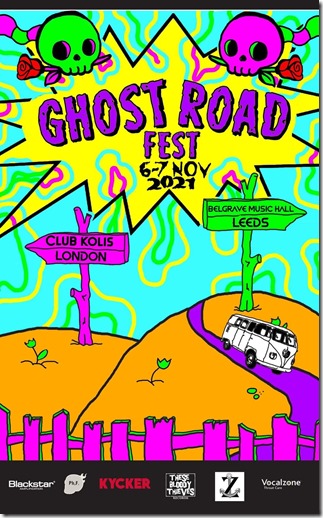
As a restless and energetic soul who’s accustomed to being constantly on the move, she’s not someone who waits for luck to happen, or who’s particularly well-suited to lockdown life, so I wasn’t surprised to learn she’s made busy with by far her biggest project to date in the form of a festival. It felt like something we should discuss properly. So that’s what we did.

AA: Let’s get straight to the headline here: you’re organising a festival across two major cities – London and Leeds – over two days in November 2021. What inspired Ghost Road Fest?

LF: Yes, so last year we played crocro land festival which was put together my bugeye’s Angela Martin and it was such an amazing experience.

Then during lockdown I saw This Feeling released a festival-esque lineup I think called Rewired. I’ve lost a lot of passion for music during lockdown, and thought do you know what, if we all sit here like I am feeling sorry for myself then nothing will happen, I’m not gonna retrain, I’m gonna be a creative and get creative!

That’s a really positive thing to have come out of a less than positive place, and it’s interesting you should mention losing your passion and feeling sorry for yourself. You’ve been a keen advocate of mental health, so what have you ben doing to manage, and is there any advice or experience you’d like to share about coping with lockdown, especially for musicians and artists like yourself?

You know I had this conversation with someone today doing this sort of thing is what has helped me cope with lockdown. To start with I was like, great this is the time off of gigging and stuff I’ve needed but very quickly I realised gigging is a big part of what attributes towards my happiness. So I needed to do stuff that distracts me – I work a full time job as well, but the minute I stop I feel a lot more doom and gloom so keep my mind busy and excited toward achieving something is what has kept me going.

The provisional lineup is impressive, and also features a fair few acts you’ve played with / alongside in recent years with Weekend Recovery. What were your selection criteria, and how easy was it to get the acts you wanted on board?

Thank you! I wanted to play with bands I look up to and respect, the hardest part was making that long list a short list, each venue has 9 acts, that’s it! The scene is so full of amazing bands, talent and wicked awesome people, it was harder to work out who didn’t quite fit than who I wanted, and that’s what it came down too, who fit best together for the line up, without it sounding too samey. There’s only been a couple of bands I couldn’t get on board, and that was more to do with super organised agents having sorted our tour schedules than anything else.

How did you go about selecting the venues?

I went to see Rifffest – presented by Brooders at the start of the year and Belgrave Music Hall and absolutely fell in love with the venue – I love the vibe, the cocktails and the food they serve. The staff are lovely – Joe from Superfriendz has been nothing but helpful – and that aside the stage is amazing!

London I went with Kolis – a good friend of mine Arno owns the venue – we’ve gigged there a few times and again has such a cool vibe – it’s really quirky and stylish – also it located right next to a tube station so super convenient for anyone wanting to come to the event.

You’ll be the first to admit that it’s an ambitious project, and 2020 has been the absolute worst. With everything having been postponed and repostponed, and live music in such a precarious state, is planning a festival now a bold move or madness?

Oh complete madness, I’m bonkers doing this, but I hope it’s a way to stimulate the underground music scene, because fuck me it’s taken a hit. The lineup I have is ambitious but amazing, and I’m sure it will sell well, especially as the venues are quite intimate considering the size of the headliners.

But I think if you don’t try you never will. So I thought yeah I wanna play/go to a festival next year, so I’ll make my own.

126456102_284082306352297_758340017571438556_n

Can you tell us a bit more about the concept and overarching principles of Ghost Road Fest, and what sets it apart from other events?

We’re very focused on proportional representation, unfortunately I think this is an issue that’s still a bit overlooked. That’s not to say any of the acts were approached to tick a box, because honestly I’m in awe of who I’ve managed to book. But I want to offer opportunity for up and coming bands as much as established.

We’re also looking to offer opportunity for young people for disadvantaged back grounds who want to have experience in this sort of event; the other roles that make events happen not just the bands.

My business partner Alexandra and I have worked really hard to make everything as diverse as possible, from the crew to the acts to the partners of the festival. I’m really very excited.

Proportional representation is almost certainly still overlooked: the major festivals, Reading and Leeds, Download, Glastonbury, are all notoriously poor with their records of female headliners and on the bill in general, and often it feels like some inclusions are simply tokenismm. Why do you think this is, and what can be done about it?

I’d like to think anyone on any bill is there because they deserve to be rather than for tokenism (although I’m also quite naive and want to see the best in everyone) if it is the case and that it is to tick a box rather than because of inclusion or merit – I think people need to have a real hard look at their morals – I absolutely would like to think any bills I’ve been on have been because people like our music rather than I have a pair of boobs. But maybe organisers feel they have to to not upset people – which is sad because there are LOADS of bands with females in, or non-binary, or gender fluid people, who play fucking good music. I think there is still a really long way to go but baby steps are better than standing still.

Recent years have seen a small number of all-female festival lineups – Boudica Festival, Loud Women Fest, Native Festival in your home county of Kent: how do you feel about these from an inclusivity perspective – do they redress the balance or simply recreate the same problem in reverse?

You know I think they’re really great – they celebrate a minority of the industry, opportunities like this for women are really great! I’ve been quite lucky in that I’ve only experienced sexism a couple of times (a couple of times too many really, but compared to some…)

You’ve been a recording artist and a gigging musician for a while: you’ve managed to establish an admirable following with Weekend Recovery, and are also just embarking on a solo career, so what prompted you to branch out into management?

I sound like a right martyr but I enjoy helping people, watching them grow and feeling proud. I’ve grafted for years, paying my dues and I always wish I had the opportunity to have someone to badger and ask advice to skip a few steps almost, although those steps were the best lessons I learnt

It’s quite evocative – but why Ghost Road for the name?

It was actually a good friend of mine that came up with the name. I’m into really jarring imagery, I’ve worked under this name for a few years now, I also don’t think ghosts are always scary. I think they guide us for better or for worst.

Have you ever seen a ghost?

I haven’t! But then I haven’t ever not seen one – if that makes sense – I’m pretty open minded I’d like to think people are looking out for us when they pass over – so I guess that’s like a ghost

So what else have you got in the pipeline – that you can tell us about?

Well Weekend Recovery have our album out next year (finally) my solo tour coming up – I actually feel busier now than I did pre-lockdown if that was even possible!!

Ghost Road fest is scheduled for 6-7 November 2021 in London and Leeds. You can get updates via the Ghost Road website, as well as the festival’s dedicated Facebook and Instagram pages.
126615188_186903722982831_4044706809057082293_n

Human Worth- 26th November 2020

Christopher Nosnibor

This one’s been cropping up in my Facebook feed a fair bit lately, and I’m quite ashamed by how long it took me to get around to playing it, given the great work Human Worth do both in terms of music and charitable donations – plus the fact they’re decent guys who I’m proud to know. Shit happens, even in the midst of Lockdown 2.0 where it’s shit mostly because there’s only shit and nothing happens, and mostly it’s simply that there just aren’t enough hours in the day. In the event, it turns out the greatest loss is mine, because this album really is something else. How was I to know that this was the album I’d been looking for, that I needed in my life the last few months?

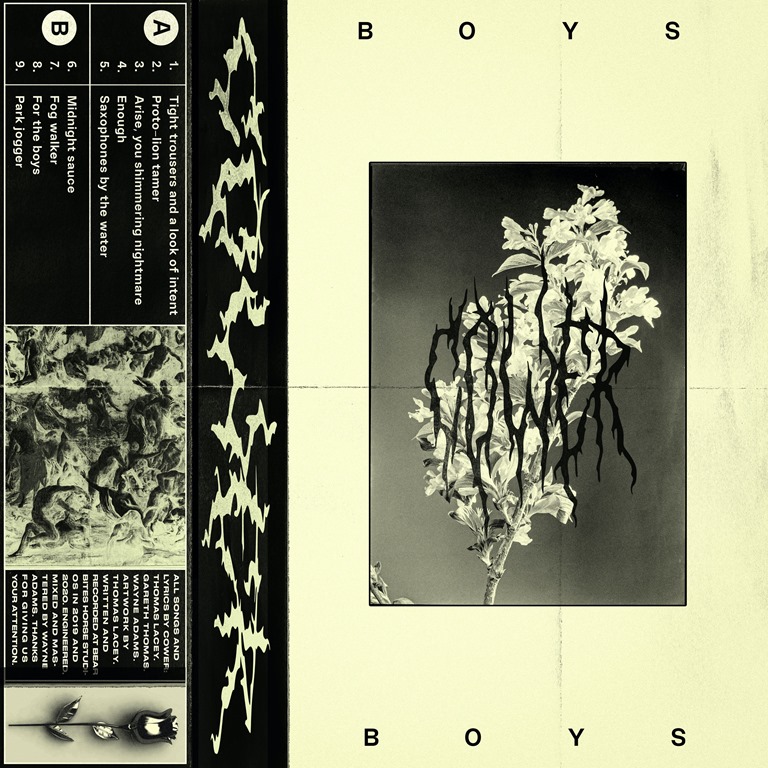
Given the pedigree of the performers who make up Cower – namely Wayne Adams (Pet Brick / Big Lad), Gareth Thomas (USA Nails / Silent Front) & Thomas Lacey (Yards / The Ghost of a Thousand) – it would be a reasonable expectation for their debut album to contain a fair bit of noise, but then equally, it would be reasonable to expect it to be a bit experimental, a bit electronic, and a bit weird. How do all of the elements brought by the component parts marry up?

The short answer is remarkably well, and Cower sound like all of the component pats simultaneously, but equally none, as they morph together to forge something truly unique, and also quite unexpected.

It begins in a pretty understated fashion, with ‘Tight Trousers and a Look of Intent’ following the path of a dense, woozy, but accessible dark electro tune. Admittedly, that pulsating bass throb is something you could drown in, but the incidentals and the vocals are quite accessible – although all hell breaks loose just halfway through and it’s wild. Initially, I was inclined to say that as an opening, it was ‘tame’, but that would be unjust: restraint isn’t an indication of weakness, but of controlling the beast. But then, when the beast breaks loose… ‘Proto-Lion-Tamer’, brings the noise, and does it in proper full-on style, a squalling, brawling mess of din – old-school noise merchants like The Jesus Lizard are in the blender with contemporaries like Daughters and Blacklisters to whip up a nasty maelstrom of noise.

Tribal drumming dominates the bleak, eerie soundscape of ‘Arise You Shimmering Nightmare’, while the downtempo mid-album slowie, ‘Saxophones by the Water’ finds them coming on like Violator-era Depeche Mode, and this trickles through into the next song, ‘Midnight Sauce’ that combined a rich, soulful vocal with some chilly synths and blasts of percussion-led noise and cinematic drama that goes fully 3D, to the extent that it gives JG Thirlwell a run for his money.

If BOYS pursues a dark, brooding, electro road as its dominant style, it’s the album’s range and diversity that is its real selling point, and the songs are all far darker than most of the titles suggest. And if much of the album feels pointed, challenging, ‘For the Boys’ is outstanding in its emotional sensitivity. Closer ‘Park Jogger’ in particular sounds like it might be light, even vaguely comedic by its title, but no: it’s a colossal electroindustrial behemoth tat packs some seriously pounding force into its short running time.

With BOYS, Cower surprise and excel: the quality of the songs is remarkable: there’s a real sense of everything having been carefully crafted for accessibility, to the extent that this is actually a pop album – making for the darkest, heaviest pop album you’re likely to hear in a long time.

AA

COWER_BOYS-CoverArtwork

Human Worth – 6th November 2020

Christopher Nosnibor

Evan Gildersleeve’s debut solo single, ‘Mortal’ is an absolute masterclass in suspenseful, atmospheric instrumental music. While incorporating ambient elements, the mellifluous piano work is clearly structured, albeit subtly as it drifts, the notes reverberating in the rarefied air. It’s deeply evocative, resonating on a level that’s at the innermost point and therefore beyond specific articulation.

That ‘Mortal’ emerged from a very personal space, with Evan’s creative process in its formation being a journey through challenges with mental health and the impact of lockdown renders it all the more poignant. While turbulence and trauma are completely removed from this soundtrack, it’s perhaps telling in itself, serving as it does as a refuge from all of that.

It may be a mere six-and-a-half minutes long, but ‘Mortal’ captures something special and moreover, has the capacity to slow time, drawing the listener into a slow suspension, with the most soothing effect.

This is music that requires you to put down the phone, step away from the keyboard, disconnect social media, the TV, all streaming news, dim the lights and breathe slowly. The video features some remarkable visuals likely to assist in soothing a crowded mind – and with proceeds going to MIND, it’s pretty much one of the essentials of 2020.

AA

Gas Lit is the new album by the multidimensional duo Divide and Dissolve, incoming on Invada Records on 29th January, and produced by Ruban Neilson of Unknown Mortal Orchestra. The album is preceded today by the second single and powerful video “Denial” which encapsulates their message behind the music: to undermine and destroy the white supremacist colonial framework and to fight for Indigenous Sovereignty, Black and Indigenous Liberation, Water, Earth, and Indigenous land given back.

Divide and Dissolve’s mighty new single “Denial” is a potent blend of ominous and unsettling sax that blows wide open into colossal riffs for almost eight glorious minutes. The accompanying video was shot in Taupo, Aotearoa by notable indigenous music video director Amber Beaton at the end of the southern hemisphere’s winter.

The vibrant, unfolding colours and delicate personality of the flowers at the beginning of the film have the potential to be in contrast with the intro of the song, but it’s actually escorted by it perfectly. It’s further varied with the colossal boom signalling the arrival of the guitars and drums while visually we start to explore the thermal grumblings of the Taupo volcanic zone. We follow the Huka falls/Waikato awa (Waikato river) up stream to settle into Taupo-Nui-A-Tia moana (Lake Taupo) as the return of the sax lulls us gently after being nourished so generously by Divide and Dissolve’s signature gargantuan tone. Thanks are given to the local Iwi\tribe Ngāti Tūwharetoa, the rightful guardians of the whenua/land and to Rūaumoko the god of volcanoes, earthquakes and the seasons.

Watch ‘Denial’ here:

AA

thumbnail_DivideandDissolveimagebyBillyEyersloresforannounce

Divide and Dissolve image by Billy Eyers

Pelagic Records – 20th November 2020

Christopher Nosnibor

The Swedish quartet’s fifth album finds them freely drawing on myriad genre references to conjure a cocktail that extends far beyond even the broadest perimeters of post-rock to render this a truly hybrid work. The scale of the ambition is immense, and for a band who rarely spent time together and only rehearse ahead of tours or to write and record albums, the way they’ve drawn everything together so organically is remarkable.

The title is quite fitting as they swing back and forth across the forms and styles, with a brooding electroambient introduction in the form of the title track which builds by stealth over the course of seven and a half minutes to a grand-scale swell of cinematic hypnotism with rolling drums driving a cyclical synth motif.

‘E22’ brings the guitars to the fore and is more overtly conventionally post-rock, but it’s got a certain progressive edge, not to mention some weight, breaking into some hefty bass-dominated riffage around the five-minute mark. There’s a pace-rock / psyche twist to ‘Mindtrip’, by far the album’s most accessible and buoyant tune, and it contrasts with the altogether more tense ‘Shelter’, which emanates a simmering tension. The absence of vocals actually accentuates the mood and renders it all the more relatable, as the listener pours the emotional contents of their own experience into the empty vessel the band present.

This, for me – and doubtless for many, having attended countless instrumental post-rock shows in the decade spanning 2002-2012 – is the draw of the genre, at least when well-executed: post-rock presents sonic expanses without authorial steer, without any insistence on specific meaning, leaving the listener to fill in the spaces. And with vast, expansive spaces in which to wander, into which to pour one’s thoughts and experiences, this is music that opens its arms to a world of freedom.

They don’t do short songs: Oscillate only contains eight tracks, but only two of those clock in under six minutes, and the final pairing of ‘Eraser’ and ‘The Headless Man’, both of which extend well past the eight-minute measure. The first of these is a dynamic rush of a tune, with propellant drumming and a solid bass throb, while the second is a redemptive sunburst of a tune, the light of dawn breaking over the horizon.

Oscillate is a strong set, and the album will indubitably appeal to fans of MONO, Explosions in the Sky, and Godspeed You! Black Emperor, but in context, comparisons are reductive: this is an album that stretches far wider than its influences and is truly impressive in its breadth and scale.

AA

a2086206515_10

Fierce Panda – 13th November 2020

Christopher Nosnibor

Fierce panda will be forever intrinsically linked to the cutting edge of indie in the 90s, emerging as it did in 1994 and immediately making a name for itself with limited edition 7”singles by big-name contemporaries initially including Ash, Supergrass, The Bluetones, and Baby Bird, not to mention Placebo, Keane, Coldplay, Embrace, and that record by Oasis.

More than a quarter of a century on, they retain that certain sense of cool-by-association, but also continue to release damn good indie singles, breaking new talent with astounding frequency. National Service are a perfect example: the label picked up the London quartet National Service from seemingly out of nowhere, releasing their debut single, ‘A Little More Time’ in the year of their formation. Three years on, and here we have their third single, a song that unpicks he seams of the mundane, the everyday, and the introspective pains of self-expectation.

‘I haven’t had a decent sleep in days / I’m overthinking when I should be happy doing something mundane / But I’m too busy thinking about the long run / That I rarely find the time to enjoy today’ laments Fintan Campbell against a welter of shimmering guitars and rolling drums.

Comparisons to The Twilight Sad aren’t unjustified, and the band mine that seam of post-punk revival / indie crossover that dominated 2002-2006 as represented by Editors, Interpol, The Cinematics and myriad others, and the bassline that cuts in at the midpoint is pure Carlos D circa Turn on the Bright Lights. None of this is in any way to suggest that ‘Caving’ is derivative or locked in time: it’s a genuine rush of a tune, and condenses all the emotional resonance into four and a half minutes. It’s taut, hooky, and packs a punch.

AA

Caving Artwork

Hummus Records – 23rd October 2020

Christopher Nosnibor

Well of course my interest was piqued: Convulsif’s fifth album, pitched as a work of ‘self-inventing gloomy rock in the abyss between such subgenres as noise, metal, jazz and grindcore’ likely to appeal to fans of GOD, Godflesh, Swans, Naked City, Napalm Death, Painkiller, Boredoms, and Neurosis. It doesn’t get any more of my noisy industrial-favouring bag than that – not least of all because the referencing of short-lived Godflesh / Techno Animal offshoot GOD seems wilfully perverse. Let’s face it, what is the real scope for techno-hued jazz/grind crossover?

The Swiss quartet eschew conventional rock instrumentation with a lineup featuring bass, drums, bass clarinet and drums, and I can already hear many wailing about the lack of guitars. Hearing the cacophonous freeform racket they conjure, however, would be enough to make even more wail, and certainly not just about their unconventional band makeup, and just to enhance the album’s commercial appeal, the bleak set’s titles are all cut up and mashed up lines of Charles Darwin’s Beagle Diary.

The first cut, the seven-minute ‘Buried Between One’ is dominated by the gut-churning, nausea-inducing rhythm section stylings of Swans circa Filth and Cop – the drums explode like volcanic detonations, slow and sporadic, and the lumbering low end stops and starts and lurches woozily, while everything else on top is just discord, and as the track progresses, it all whips into a hellish maelstrom, a brutally sustained crescendo that leaves you wondering ‘where’s left to go from here?’

The elongated drone, low, sonorous, ominous, that introduces ‘Five Days of Open Bones’ provides some respite, , before dolour bass and brooding violin drift in; the atmosphere is dense and grows from a mist to a fog as the drumming builds… the tension increases… they sustain it, but you now it’s surely a matter of time before something yields… the clarinet ebbs and flows like a layer of synth, but the fact this is organic and orchestral somehow ads something else… and then… and then… Anyone familiar with the last incarnation of SWANS will now what it’s like to endure such a seemingly endless build. It’s exhilarating and torturous in equal measure. Your heart’s palpating and your lungs feel ready to burst and you think you might vomit… and then it all breaks into a frenetically frenzied jazz noise of parping horns and hundred mile-an-hour drumming. No, that’s not right. Surely. But then, this isn’t SWANS, this isn’t your regular avant-industrial: this is the kind of experimental freakout that’s right at home at Café Oto, and ‘Five days’ feels literal in its timespan.

A couple of brief, lurching interludes make for more difficult listening, with ‘Surround the Arms of the Revolution’ sounding like ‘A Screw’ played by a drunk jazz ensemble, paving the way for the fourteen-minute finale that is ‘The Axe Will Break’, which is constructed around a tight, cyclical bass motif, which is again, decidedly jazzy in a Sly and the Family Drone sense. The endless repetition is mesmerising, hypotonic, and the tension builds almost imperceptibly… but build it does. It grinds it way through a merciless squall of noise through which filters mournful woodwind that flickers hints of post-rock reflection before being submerged in the swelling surge of chaos. The final five minutes – an eviscerating sustained crescendo of monolithic proportions – is little short of devastating. Jazz isn’t always nice.

AA

a3431541039_10

Cruel Nature Recordings – 6th November 2020

Christopher Nosnbor

The latest release from Heat Death of the Sun, aka Eugene Davies, was recorded live in Newcastle at The Cluny – a venue that provided a space for many oddball / alternative / noisy gigs and hosting many of the artists on local labels Cruel Nature and Panurus Productions – in May 2019. Yes, back when live music was a thing. There’s a semi-ironic joke to be made that people were practising social distancing at shows like this long before it became a thing, and that there’s likely less chance of catching even the most contagious of viruses at an ultra-niche gig than in your local Aldi, but the sad fact is that while it’s tough for the everyone involved in the music industry, the impact of lockdown on the micro-communities which exist through underground music is immense in mental health terms.

It may not be a fresh observation for me to note the other irony here, namely that people who are disparate, disconnected, and often prone to anxiety and low mood come together over some of the darkest, most challenging music. Often, it’s because they find it articulates their feelings in ways they can’t, and music has a near-infinite capacity to transcend words.

Listening to Drinking Oil From The Black Fountain – a single, continuous piece spanning twenty-eight minutes and documenting HDoTS set – I find myself lamenting my inability to travel to Newcastle and the fact I wasn’t present at the show. The atmospherics are deep and dark and I imagine at the appropriate volume, in a darkened room, the experience must have been immersive and fully multisensory. The range of frequencies is extensive, and winds buffet long and low against tremolo notes that seesaw and drone, intermittently interrupted by swells and glitches. Despite the distance, it holds up well as a recorded audio work.

As the piece progresses, the ruptures become more pronounced, the thudding detonations of bass more resonant, and the whole sonic web begins to tangle itself more irrevocably, twisting and knotting, with the result that what began as a softly oscillating wash transmogrifies into an unsettling, uncomfortable source of tension, and there’s still fully ten minutes to go as I ding my muscles tensing, my jaw clenching, and my stomach beginning to lurch.

Twisted folksy drones shudder in and out of the increasingly warped array of sounds as they slowly melt together before collapsing in a liquefied state as storm clouds gather and thunder rumbles ominously and culminating in a slow, looped throb to fade.

It’s a powerful, hypnotic work that evolves nicely over its course, with just enough angles and disjointed corners to render it challenging without being a total headfuck.

AA

a1428120230_10