Archive for December, 2016

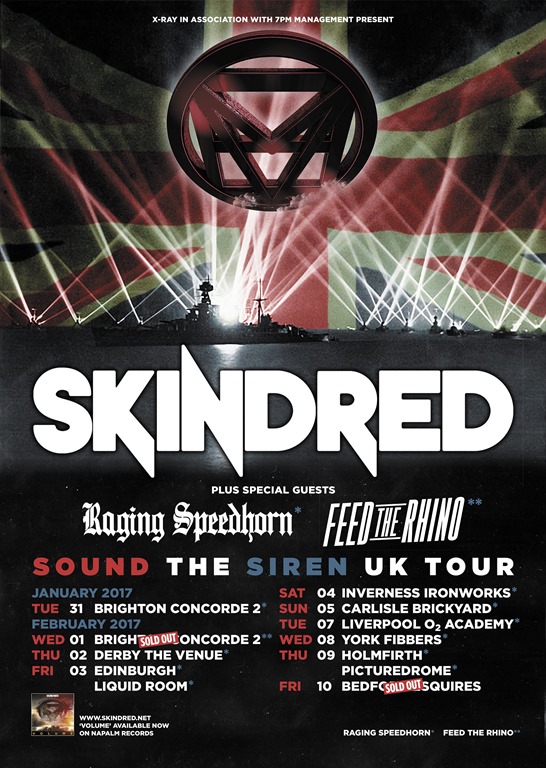
Ahead of the two sell out dates at The Black Heart in March, Raging Speedhorn are set to join ragga metallers Skindred on their upcoming February tour, following on from the success of their earlier tour in late 2016.


Guitarist Jim Palmer had this to say of the upcoming tour: “After the fun we had last year, it’s a huge honour to hit the road once again with Skindred and finish what we started! Skindred have grown into such an

incredible band so it’s an honour. It’ll be like stepping right back to those days in the early 2000’s when we last shared a stage. Bring on the party!"


Raging Speedhorn will appear on the following dates with Skindred:

Jan 31st – Brighton – Concorde 2

Feb 2nd – Derby – The Venue

Feb 3rd – Edinburgh – Liquid Room

Feb 4th – Inverness – Ironworks

Feb 5th – Carlisle – Brickyard

Feb 7th – Liverpool – O2 Academy

Feb 8th – York – Fibbers

Feb 9th – Holmfirth – Picturedrome

Skindred Tour Poster 2017

Something a bit different for us here at AA, perhaps, but Bone Cult’s new single certainly meets our general rubric… The Nottingham two-piece death-electronica band are set to release their new single, ‘Fortune And Sorrow’ on December 12th.

Formed by Sam Hartill (bass, production) and Richard Watte (vocals, guitar, production) with a desire to offer a strong alternative to "the regular four guys in jeans and t-shirt look", the band has since gained high-profile support slots with the likes of The Qemists, Slaves, Sleaford Mods and more.

Championing solid production and strong visuals, on ‘Fortune And Sorrow’ the pair channels the rage of Death Grips, and the energy of The Prodigy via the slick, accessible dance vibes of Daft Punk.

Of the track’s inspirations, bassist Sam Hartill comments: "The track is a return to our original sound on the ‘Blackwork’ EP, and explores the emotions experienced through loss and recovery.
"That feeling of loss refers to the last 18 months where we felt we lost a lot of time and only now have found our momentum again."

Get your lugs round it here: https://soundcloud.com/bonecult/fortune-and-sorrow *


* We’re having a few technical issues with embedding SoundCloud right now: we’ll have an altogether prettier version of this up soon, hopefully.


Bone Cult

Vegetable Records – VEGE003

Christopher Nosnibor

As pianist with The Necks, Chris Abrahams has built not only a substantial body of work but also a reputation as part of a highly respected avant-jazz ensemble. As a solo artist, he’s also produced no fewer than ten albums, and this is his fifth piano work. The album’s seven compositions are notable for being, in any resects, conventional, graceful, elegant and essentially contemporary classical, rather than experimental works.

There’s a crispness and simplicity to the compositions which is beguiling, with rolling melodies making for a soothing listening experience. Abrahams’ musicianship is magnificent, but there’s nothing showy or extravagant about the works. Rippling glissandos and gentle, sedate arabesques define the album, but ‘Overlap’ is arranged around a looping motif played with increasing intensity and force to stirring effect, and the trundling scales of ‘Fern Scrapes’ are performed with a sturdy vigour, and demonstrate a certain playfulness.

Abrahams’ lightness of touch which holds particular appeal, and the album finishes with a light, uptempo flourish that leaves a joyful calmness in the air.


Chris Abrahams - Climb

Elli Records – EL03 – 24th November 2016

Christopher Nosnibor

What’s with the guy with the bear’s head mask thing? What’s he doing? And why? There are press shots of the bear’s head man playing guitar on a beach. It’s not sinister, but whacky, and without any real context, rather absurd. There is no real context, beyond the fact that this is the work of Otso Lahdeoja.

Otso Lahdeoja is a Finnish composer, described as a guitarist and ‘omnidirectional researcher of all things sonic’. As such, Dendermonde is an exploratory work, which conforms to the limits of neither genre or structural conventions. Dendermonde also finds Otso explore contrasts and sonic variation, and the four tracks are each very different from one another.

‘QC’ begins with what sounds like a vocal sample playing on a loop of stretched shape, before rolling acoustic guitar flits in to occupy the foreground. But these are compositions built around continual movement and endless flux. Woozy, warping notes, formless and malformed sounds stretch and bend. ‘Banshee’ builds a slow, undulating rhythm: there are beats, but it’s the thick, murky bass which dominates. An unexpectedly ‘rock’ guitar line breaks in and drives the subtly dance-orientated groove in an altogether different direction. There’s a dubby vibe to ‘Overwinning,’ and ‘Mue end’ manifests as a long, drawling harmonica drone.

The contrasts of style, rather than making for a disjointed work, functions in a complimentary manner, and there’s a strong sense of focus and direction across the release as a whole.


Otso – Dendermonde

Bocian Records – BC-AAJ

Christopher Nosnibor

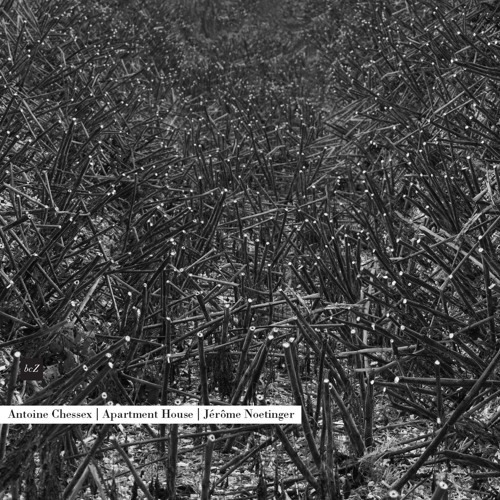
As the title suggests, this is a three-way collaboration between Swiss composer Antoine Chessex, French purveyor of electronica Jerome Noetinger, and UK experimental ensemble Apartment House. The two long-form instrumental tracks were recorded live in 2014 and 2015 at Café OTO in London.

The sheer density of the sound of ‘Plastic Concrete’ from the very outset is astounding, a force as much physical as sonic. String skitters and strikes cascade amidst explosive detonations of sound. Playful horns tiptoe through bouncing double bass lines. The Apartment House musicians demonstrate just how versatile ‘conventional’ instruments can be, conjuring an array of textures and tones to forge shifting atmospheres, while Noetinger’s electronics and reel to reel tape work bring new dimensions and depths to the soundscape. Impressively, neither aspect of the instrumentation dominates: instead, electronic and acoustic exist in synergy.

A long, booming parp, resembling a ship’s horn echoes out to signal the beginning of ‘Accumulation’ Skittering, fear chord electronics and grinding, almost subsonic bass creep around before a clamour of woozy, shimmering discord takes hold. Playful passages, bordering on neoclassical in nature, offer a contrasting atmosphere to the darker, brooding passages which congeal into a heavy, amorphous sonic mass.

This is immense music. Physical music. Music that makes the skin crawl, the nerves tingle.


Apartment House

Cleopatra Records – 9th December 2016

Christopher Nosnibor

Why? Why, Al, Why? I ask as a huge ministry fan, and also as someone who has a lot of respect and admiration for what Cleopatra Records do. I practically wore the magnetism off my copy of Christian Death’s Decomposition of Violets album in my teens. I’m not averse to dredging through the archives and giving long hours to the appreciation of murky live recordings from the early 80s, either: my copy of The Cure’s Concert and Curiosity was played until it stretched, and the number of Sisters of Mercy bootlegs, many of quite dubious quality, that I played to death and still own is testament to my obsessive bent and borderline insanity.

This release is undoubtedly of historical interest. But given Al Jourgensen’s (rightful) disavowal of the early Ministry releases, this feels like a shameful barrel-scraping exercise. It’s pretty much unanimously accepted as fact that Ministry only started to become worthwhile with Twitch.

The first four tracks which occupy side one of the double album were recorded live in Detroit in 1982. With some reedy lead synths, dry bass synths and chorused guitars, they sound like A Flock of Seagulls. Only not as polished. With a shouty, punk vocal and drum style, it’s a pretty ragged affair, the sneering, snarling Johnny Rotten style vocals echo into the abyss while the synths are almost buried at times. Even overlooking the mix – the recording quality isn’t that bad – it still all sounds pretty naff – although the material is, on balance, better than anything on With Sympathy. In context, it makes sense: Jourgensen penned much of the material which went onto Twitch and was already working on edgier sounding material before the release of With Sympathy in 1983, but the record label weren’t interested. Still, ‘Love Change’ sounds like The Human League covering ‘Funky Down’. Edgy it isn’t.

The ’82 and ’83 demos are unadulterated synthpop tunes and are very much of their era. ‘Game is Over’ casts some shades of grey with hints of Killing Joke and The Cure, but then, it’s perhaps easy to forget that the tone of much commercial rock and pop was darker than we’re accustomed to now: even acts like Howard Jones and Mr Mister had a certain dark streak to their music and lyrics. Ah, different times. ‘Let’s Be Happy’ is a bouncy goth disco track. There’s nothing fundamentally wrong with it, but it’s still difficult to reconcile with the band Ministry would subsequently become, and the less said about ‘Wait’ the better.

‘I See Red’ sounds more like Twitch: built around a thumping EBM groove, heavy electro percussion and processed vocals. Likewise, the heavily percussive, bass-driven ‘Self-Annoyed’ represents the sound of Wax Trax! in the mid to late 80s, and is immediately more recognisable as Ministry/related.

And while this is billed as a Ministry release, the myriad offshoots and side projects have produced some corking tunes through the years, so to find some of them represented here is actually a cause for celebration. That said, it’s not hard to appreciate why the unreleased Revolting Cocks cut, ‘Fish in Cold Water, failed to see the light of day before now. It may pack the sleazy disco grind of their Bigsexyland era material, but comes on like a mad mash-up of Talking Heads, U2, Bowie, and Harold Faltermeyer. ‘Drums Along the Carbide’ is way better. But then, you already know it, as a different version featured on the debut album under the title ‘Union Carbide’. Still calling to mind the attack of ‘Beers, Steers and Queers’, the battering-ram drums and scraping feedback providing a welcome cranial cleanse.

Dub versions of ‘Supernaut’ (released as 1,000 Homo DJs) and the Pailhead track ‘Don’t Stand in Line’ feel like too much filler however awesomely full-on the drum sound is, and the ‘banned version’ of ‘(Let’s Get) Physical’ doesn’t sound any different, and it would take a fair bit of time with an ear twisted to the vocals to determine any differences or the reason why it was banned.

The PTP track, ‘Show Me Your Spine’ is disappointing: it’s got a good beat, but isn’t a patch on the monotone psychopathic technoid groove of ‘Rubber Glove Seduction’, and again, it’s apparent as to why it failed to make an official release at the time.

In all, it’s rather a mixed bag. The majority of the material has curiosity value, but this is very much one for the fans. Even then, I’d recommend sticking to the albums released during the band’s lifetime, including those of the various side-projects.
Ministry_-_Trax!_Rarities_(cover)

Consouling Sounds – 9th December 2016

Christopher Nosnibor

Listening to Gnaw Their Tongues always feels like a dubious pleasure, something that’s almost masochistic. You listen to GNT to channel dark energy, to release bad vibes, for the letting of anguish and pain and anger, for an experience akin to a sonic exorcism. You don’t listen to a GNT album to feel better about life and the world, to lift the spirits. In keeping with Mories’ myriad previous releases under the Gnaw their Tongues and various other monikers, Hymns For The Broken, Swollen and Silent is an album for venting, or when feeling the need for some pugilistic self-flagellation.

Structurally, there is a certain narrative thread which is possible to interpret fromt e tracks and their sequencing. Sonically, this is the sound of hell: Hymns For The Broken, Swollen and Silent is the soundtrack of existence in purgatory.

Woozy, near subsonic bass dominates, while above, impenetrable demonic screams and below, almost submerged, drums like machine gun fire rattle at 250bpm. It’s an unholy racket. ‘Your Kingdom Shrouded in Blood’ brings a vast, cinematic expansiveness to the sound. The drums roll like thunder and crash like tsunami, reverberating through immense canyons, and monastic voices send wordless invocations to the heavens. It’s pompous and bombastic and it works magnificently, as if soundtracking the preface to a climactic battle of mythological proportions, a combat between good and evil where the two sides each summon their ultimate deities.

‘Silent Burned Atrocities’ ratchets up the pain, marrying extreme sounds at extreme volume to extreme tempos, barrages of rapid-fire beats from deep within the morass of noise, snippets of dialogue emerge, to be engulfed in a wall of noise and screams of anguish. ‘Hymns For The Broken, Swollen and Silent’ ventures into the territory occupied by Sunn O))) on Monoliths and Dimensions. The dronesome doom and the creeping fear chords are bathed in a quasi-religious light. Here, with sampled vocals floating in and out between the monumental, crushing beats the sound takes on a different perspective on eternal darkness. But dark it is, and there is no hope of finding hope here. ‘I Have Clad the Pillar in the Flayed Skins’ sounds like a black metal remix of early Swans, a punishing cacophony of noise that’s every bit as torturous as the scene the title conveys. These are the spoils of battle, and there is rejoicing in the bloody scene of victory.

The final track, ‘Our Mouths Ridden with Worms’ is the subterranean song of the dead, the defeated. It’s a dank, dark, lugubrious trudge of a track. Perhaps death is not defeat, but victory: to live in a world where this is the sound of living is a bleak prospect.

Hymns For The Broken, Swollen and Silent is not fun. It is not pleasant. It is not enjoyable. It’s dark, and darker still. It’s oppressive, and terrifying. It’s classic Gnaw Their Tongues.

Gnaw Their Tongues - Hymns

Southern Lord – 25th November 2016

Christopher Nosnibor

Anyone who’s been awaiting Martyrdöd’s pop covers album is going to be immensely disappointed by List. However, anyone else who’s on the market for a proper gnarly Martyrdöd album is likely to be happy enough with List. That said, it does mark a clear progression from previous outings. List is very much a more refined work, but of course, these things are relative. Every song still hits at three hundred miles an hour. The drums are still relentless, pounding. The bass is still a snarling throb, partly submerged beneath a messy mas of treble. It’s still as brutal as hell. But there’s a greater sense of focus, and the sound is clearer.

The title track introduces an almost Celtic lead guitar motif and a huge sense of bombast to the full-throttle thrashabout that lies beneath It’s a remarkably structured, and, even more remarkably, melody-focused track, but the demonic vocal snarl is still ever-present and ever terrifying.

‘Över på ett stick’ slows things down and takes on an amost anthemic, stadium rock quality, before ‘Harmagedon’ brings things back to familiar, snarling, dark crust territory. ‘Drömtid’ goes all folk / Metallica by way of an interlude, but it is just an interlude: the barrage that is ‘Intervention’ proves once again that they’ve not got soft, but have simply developed their appreciation of dynamics, texture and range, and it’s reflected in ‘Intervention’, which exploits, if not loud / quiet dynamics, then loud / louder / punishing dynamics and with a degree of intricacy and detail that’s impressive on a technical scale. Rather than diminish the impact, it heightens it.

Martyrdod - List

New York City duo Uniform turn the spotlight to their second full length album, Wake In Fright, upcoming on 20th January 2017 via Sacred Bones – a harrowing exploration of self-medication, painted in the colours of war.

Following their Ghosthouse 12" released last month, vocalist Michael Berdan (ex Drunkdriver, York Factory Complaint) and guitarist/producer Ben Greenberg (ex-The Men, Hubble) return with a new batch of even more punishing songs that incorporate elements of industrial music, thrash metal, harsh noise, and power electronics.

This record is primarily about psychic transition,” Berdan explained. “The distress that these songs attempt to illustrate comes from a place of stagnation and monotony. This is what happens when old ways of thinking become exhausted and old ways of coping prove ineffective. Something must change or it will break.”


Listen to ‘Tabloid’ here:

If the rest of the album’s half as good, it’ll be a belter.