While I’m still sifting through December’s releases – it seems as if 90% of 2023’s releases landed on 15th December – I’m most conscious that 2024 hasn’t only arrived, but is blasting forwards at a rocket pace. The first week has evaporated already. Where does time go? Where does life go? I find myself contemplating these questions daily, weekly, not as part of some existential fret, but simply as I jostle with the everyday contradiction of the so-called work/life balance. For the majority, the very concept is a myth. They work, they work, they work… and then they die. This is the reality of contemporary capitalism, and apparently, we need to shut up and deal with it.
I shall park the political rage momentarily, while addressing this. Here we have ‘Choppy’, the new single release from Berlin punk rock duo Circolo Vizioso, pitched as ‘a high-octane single spawned of depression and failed love story and… the first taste of their debut album Verrueckt (out March 1st) and as showcasing ‘their unique brand of high-intensity, lyric-driven punk, created with electric violin, guitar and drums. On this album, Circolo Vizioso wrestles with isolation, lack of social and human contact, and a hunger for music and art, which we all felt during recent lockdowns.’ It’s also pitched as being for fans of Sonic Youth, The Black Angels, Fugazi, Nirvana, Buzzcocks, Shellac, Gang of Four, Schleimkeim, Pisse, Abwaert, Old Time Relijun. Of the bands among those with which I’m familiar (It’s a falsehood that even the most knowledgeable music critics have heard every band, however hard they might pretend it’s so) this is all positive, and these are the kind of bands whose sound provide a sonic template for exploring some dark and complex emotions and navigating challenging situations and a messed-up society. Music is more than mere entertainment: it’s an outlet, a way of dealing with difficult things, of exploring and working through them, and on the evidence of this release, Circolo Vizioso unapologetically channel these difficulties into their creative outlet.
‘Choppy’ is as raw and primitive as it comes. Rough and scratchy, it feels like a demo – but to pretty it up with production would be to strip it of its primal immediacy. Listening to those first few bars, I’m reminded of early Pavement, in every way: it’s rattly, ragged indie, cleanish guitars fuzzing as a condenser mic on a portable cassette recorder overloads. It’s heavy with melancholy, and the tempo switches and drags and races. And the accompanying video – ultra-saturated, blurry – is an eye-bleeder which perfectly mirrors the mood and the no-fi stylings. The violin makes for an unusual slant, bringing further tension and scrapey noise to the dysfunctional party.
‘Panic’ is the new single from DC goth rockers The Neuro Farm. The song is inspired by a childhood episode of fevered delirium, and it will be featured on their next album planned for 2024.
The Neuro Farm is a darkwave gothic rock band based in Washington DC. Combining vocal harmony with soaring violin melodies, driving rhythm guitar, and ethereal sonic textures, their music has been described as hauntingly beautiful. The Neuro Farm draws on influences such as Joy Division, Radiohead, Nine Inch Nails, Siouxsie and the Banshees, Sigur Ros, Chelsea Wolfe, Portishead, and Rammstein.
So many reissues recently have taught me a valuable lesson. I don’t know nearly as much music as I thought I did. Of course, it’s impossible know all the music, and despite feeling I’m reasonably knowledgeable, and compensating what I don’t know with enthusiasm. Time was, I was worried about knowledge gaps: they made me feel stupid, ignorant, and I’ve spent evenings with people who have reeled off bands in genres I’m interested in and not recognised the name of a single one, let alone heard them. I felt like a fraud claiming to be a music enthusiast and worse still, a music writer (I never proclaim to be a music journalist. I write about music, and do so very much from a personal perspective. Sometimes, I stab at maintaining an element of objectivity, but the appreciation of art isn’t objective. As I’ve written elsewhere, the reason we appreciate art is because of the feelings it stirs in us, the way it speaks to us, not first and foremost because of its technical proficiency.
This is a lengthy circumnavigation to the confession that Die Anarchistische Abendunterhaltung completely bypassed me in the day – in fact, until today, the week of the reissue of their 1995 self-titled full-length debut. I suspect that they didn’t get much coverage in the UK music press, and this was still a while before the advent of the Internet as we know it – and I was a relatively early adopter, setting up my eBay account in 1999 following the demise of Yahoo! Auctions.
As the accompanying bio outlines, ‘The band consisted of four young, ‚classically derailed’ musicians who played their own compositions exclusively their with acoustic instruments such as violin, cello, clarinet and accordion… Their work contained influences from Roma music, Eastern European folk, klezmer and jazz, but was performed with the energy, rebellious spirit and Sturm und Drang of a bona fide punk band. DAAU was part of the fertile Antwerp scene, which also produced dEUS, Zita Swoon and Kiss My Jazz, and soon signed an international record deal with Sony Classical.’
dEUS may have briefly made a mark here in the UK in indie / alternative circles, but the others, not so much, and I suspect that even with its first vinyl pressing, this re-release will likely have a bigger landing in Germany and, indeed, the rest of mainland Europe, than this pitiful island that still celebrates Britpop, and which spent 1995 dominated by turgid sludge by the likes of Oasis, whose pinnacle release (What’s the Story) Morning Glory? and Blur’s Great Escape (which was anything but great); the best we got was The Bends, while Robson and fucking Jerome dominated the singles charts for half the year. As if we needed further proof that we’re a small, crappy island with an overinflated sense of self-importance that the longest hangover from the Empire ever. It’s embarrassing, as is the fact that this domestic Brit-centric bullshittery has denied us introductions to many great bands. Die Anarchistische Abendunterhaltung is a perfect example.
It’s perhaps not hard to grasp why this extravaganza of neoclassical extravagance and its wild woodwind and unpredictable compositional forms didn’t grab the attention of the British Music press, but they missed a work that’s hugely innovative and belongs to no one genre. It’s wild and it’s challenging , but these are positives.
Die Anarchistische Abendunterhaltung is droning strings, it’s by turns melancholy and slow, and remarkably lively. It’s an untamed beast almost with a life and energy all of its own. But the compositions aren’t in sequence!
‘V Drieslagstelsel’ is the first track, the first of five ‘Drieslagstelsel’ pieces, and it’s followed by the frenzied yet droning folksiness of ‘II Drieslagstelsel’: it’s pretty, but it’s strange. Or, it’s pretty strange. I’m on the fence, while it sounds like they’re stripping the fence with some frenzied violin work. ‘III Drieslagstelsel’ scuttles in with some cheeky chamber stylings before popping in all directions, and it’s kinda cheeky – and perhaps tongue-in-cheeky – jaunty, incredibly busy, and extremely varied. It isn’t the kind of explosive, head-spinning jazz I sometimes find myself wrestling with here, but it covers a lot of terrain in just five and a half minutes, with stage musical qualities pushing to the fore before dipping back down to something altogether less ‘production’ orientated. The last of the ‘Drieslagstelsel’ sequence is ‘I Drieslagstelsel’, and following the frenzied strings and dramatic orchestral sculptures of ‘VI Drieslagstelsel,’ it’s a compact piece of neoclassical music which fulfils the oft-underrated and oft-overlooked purpose of entertaining. It’s a fun and often frivolous piece, in parts a wild hoedown with wind instruments, with an eye-popping energy which delves in to drones and darker territory at times.
What happened to IV? Maybe it doesn’t matter. Rounding the album off is the eleven-minute ‘Doorloop’, which appears to be a traditional track, and its slow, drawn-out notes are funereal at first, before thing go g=crazy and there are even vocal.
Over the course of these six pieces, Die Anarchistische Abendunterhaltung brings massive range. Back in 95, I probably wouldn’t have appreciated it, and nor would anyone else I knew. But here we are, looking at an accomplished album with much texture and range.
And now, I appreciate it. Perhaps I wasn’t ready, perhaps it was out of step with the times for all but a few – and even fewer here in Britain – but Die Anarchistische Abendunterhaltung is a remarkable album, and one which is timeless.
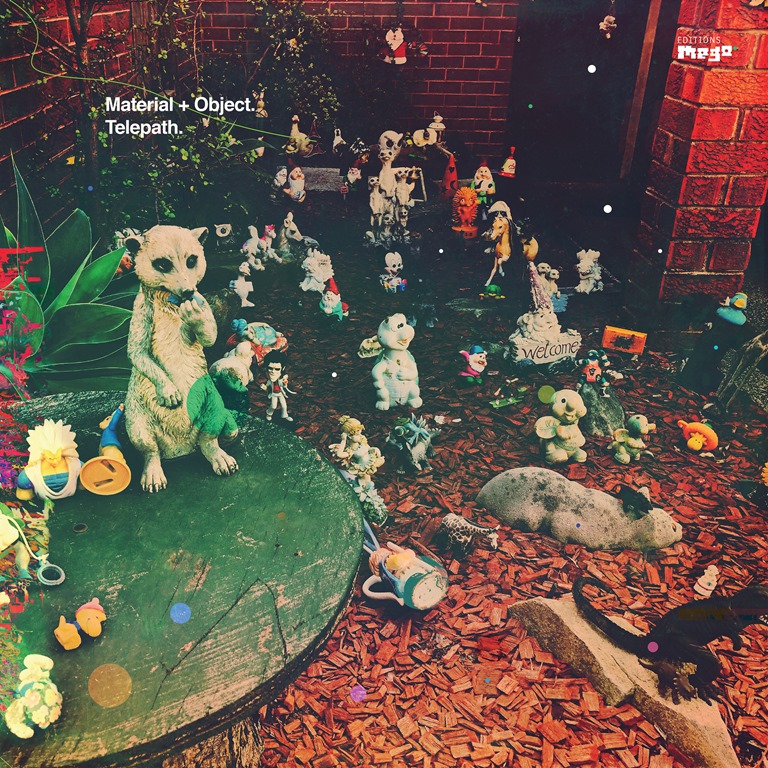
Editions Mego have since forever released ultra-niche but eternally-fascinating exploratory works. Since their inception in 1994 as MEGO, before transforming into Editions Mego, bearing eMEGO catalogue numbers, the label has given home to pretty much every significant and emerging artist working in the field of electronica given to abstraction, minimalism, glitch, and the more experimental side of things. As such, this release is a very comfortable fit in the catalogue.
As the bio details, ‘Dismantling the acoustic to feed the electronic, Editions Mego presents Telepath, the new album by Material Object. Born out of a single improvised recording session with a lone Violinist, Telepath is a startling album of future electronic music, resulting in an LP of unique and timeless tracks that reimagine a classic sound for an endless future.’
Nothing about Telepath sounds remotely like a violin in any recognisable sense. Even the long, soaring tones and strong-scrapes which sound like a violin sound, in context, processed, abstract.
It’s all about the process, of course, and it’s the literal processing and manipulation of sound which renders the output so far from the initial input. The results are interesting, to say the least.
To return to the bio for context, Telepath is presented as ‘Boldly departing from his previous canon of largely ‘ambient’ work, Material Object’s Telepath renders itself out as something much stranger, something more spacious, more subtle and gradual. Moments of bouncing minimalism meet moirés of delayed pure tones phasing in and out of resolution, giving way to a series of strobing foreground gestures arranged and offset in disorienting landscapes which scatter themselves asymmetrically amongst crystal pools of reverb.
There are moments of deep, rumbling ambience to be found here, but it’s certainly not the album’s dominant feature.
‘Enter’ isn’t quite microtonal in its focus, but does very much narrow down to an extremely small sonic spectrum in order to interrogate minor changes and the relationship between notes as they resonate and bounce off one another – and that focus is intensely concentrated, remaining fixed for some nine and a half minutes. It sets the stall for Telepath overall: the fifteen-minute ‘Hyphae’ flickers and clicks as sounds bat back and forth at a rate of rapidity that’s tension-inducing, particularly as the click-clack becomes overwhelmed by a bubbling cloud of dense sound yet remains persistently audible.
Structurally, the album alternates between longer works and shorter interludes of a couple of minutes or so: these serve, I suppose, as the sonic equivalent of palate-cleansers, and they’re necessary in breaking up the vast sonic swaths of hyper-focussed detail as interrogated over five minutes or more.
It may seem a contradiction, but while focusing microscopically on the most minute details, Telepath also covers a lot of ground. It’s all about contrast and contradictions, and arguably these are the foundations of this intriguing and often quirky work.
Following the twitchy, processed pings of ‘Thermo’, the eleven-and-a-half-minute ‘Exit’ is the perfect bookend to stand opposite ‘Enter’. And as the album leaves us reflecting the whisps of mist left in its trails, there is a hanging sense that there is something yet to come. From among the shadows, Telepath presents us with an unexpected sense of insight, both outside and in.



 Aural Aggravation