Posts Tagged ‘Tangerine Dream’

Christopher Nosnibor

Well, this one landed unexpectedly. It’s a welcome arrival, although taking a second hit of material from Uniform’s latest and quite possibly most brutal and challenging album to date does feel like an exercise in Masochism. It’s also a superb example of alternative marketing, landing this alternative version of American Standard less than a month after the album’s release, on digital and tape formats.

Context, from Uniform’s bandcamp: ‘A companion piece to American Standard, Nightmare City is essentially the same record devoid of the rock elements. By removing the presence of traditional instruments, the synths, lap steel, and pianos that sit beneath the surface of the proper album are allowed room to breathe and speak for themselves. The end result straddles the worlds of Basic Channel influenced dub, Tangerine Dream inspired soundscapes, and brutal death industrial.’

It’s a bold move, befitting of Uniform, a band who have relentlessly pushed themselves to explore ever-wider horizons, switching from their original drum-machine driven raw industrial noise to adopting live drumming, undertaking a number of collaborative projects with the likes of The Body and Boris, and especially befitting of this album, where Michael Berdan tore away the last vestiges of artistic separation to rip off his skin and purge the rawest emotions stemming from his dealing with Bulimia.

Nightmare City is another step towards stripping away the layers and presenting the naked self. ‘The bedrock of American Standard stands upon the Nightmare City. It’s not the happiest of all places, but understanding the landscape yields its own rewards,’ they write alongside the Bandcamp release.

One thing about being in a band – even if there are only two of you – is that there’s somewhere to hide, somewhere to transfer the focus. Hell, even performing solo, if there’s noise, there’s something take shelter behind. I’ve always thought that solo acoustic and spoken word performers were the bravest: there is simply no place to hide, and nothing to blur or mask any fuck-ups. Nightmare City isn’t quite solo acoustic, but it is seriously minimal.

Removing the ‘rock’ elements to reveal the bare bones of the songs shows the inner workings of Uniform, and they’re unexpected, to say the least. One would expect them to build up from the elements of drums bass, guitar. But this leads us on a different journey.

Punishing riffs and pulverising percussion, rather than supple layers and swirling instrumental ambience. As the band put it, ‘Although the finished product stands as a culmination of cohesive sounds, the individual threads that weave songs together often provide necessary nuance and exposition all of their own. Each isolated stem might be part of a greater story, but the whole cannot stand as intended without a complex series of seemingly disparate elements.’

Hearing the swirl of these ‘seemingly disparate elements’ feels like hearing the ghost in the machine, a haunting, eerie, ethereal echo, which barely seems to correspond with the structured framework of the final versions of the songs. One might almost consider this a palimpsest, an album beneath the album, submerged by process of layering and erasure. The tracks are – and I shouldn’t be surprised, but still I find I am – completely unrecognisable. Instead of being the punishing beast the album version is, ‘American Standard’ sounds more like one of the epic instrumental segments of recent SWANS works. There’s a muffled thud like a heartbeat on ‘This is Not a Prayer’ which possesses something of a womb-like quality, while ‘Clemency’ feels like a moment caught between heaven and hell, soundtracking the struggle of being pulled between the two in some purgatorial space as ceremonial drums hammer out a doomy passageway and spluttering vocals spew raw anguish.

In common with American Standard is the darkness which looms large, the tension, the suffocating gloom, the discomfort which dominates, and hearing this spectral echo of the album brings a fresh understanding and appreciation of the process and the depth of layering and everything that goes into their material. ‘Permanent Embrace’, too, sounds both like an ascent to the light and a sepulchral sigh, a funereal scene in which the grave suddenly opens like a sinkhole sucking everything down into the bowels of the earth.

Nightmare City is appropriately titled: it is a truly hellish, tortuous listening experience – but at the same time quite remarkable. Uniform, in their quest to do something different, to push themselves and in refusing to conform to genre conventions, continually find new ways to articulate the pain of the human condition.

AA

a1449843444_10

5th April 2024

Christopher Nosnibor

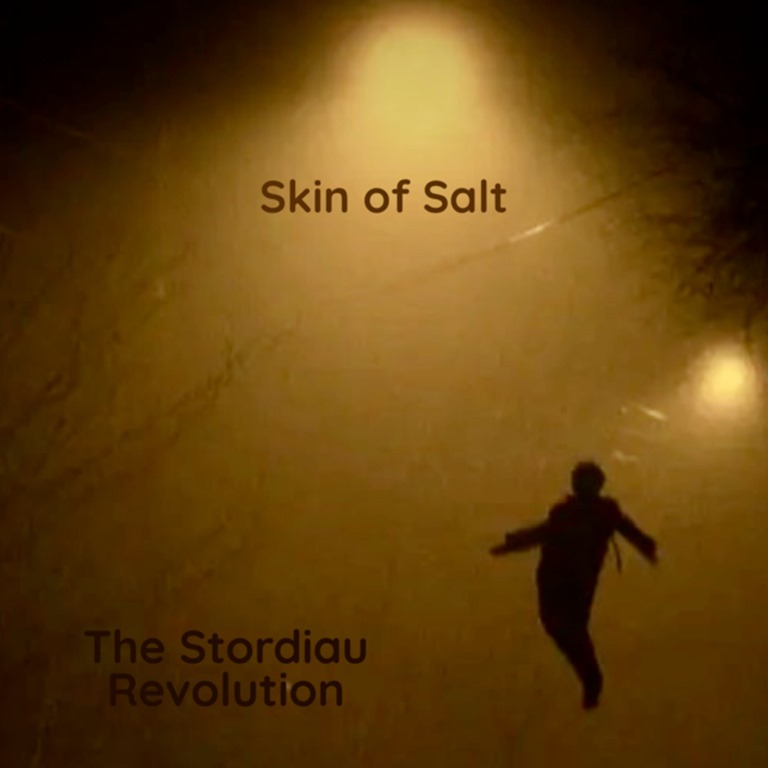
It’s been almost four years since I encountered Alaxander Stordiau, when I covered the single release by The Original Magnetic Light Parade, a collaboration between Stordiau and Edinburgh man, Harold Nono, on perennially oddball label Bearsuit Records.

With minimal info about that release – and not much more about this one, I’m mostly left to grapple with the music as it presents itself, with minimal content. This is good: and so is this EP.

A brief Internet delve uncovers that the material on this this EP was initially released a year ago, as part of an album-length work bearing the same title, slipped out on Soundcloud. Now, there are plenty of albums I think would have made decent EPs – or 7” singles – but there’s no reason to believe Stordiau has whittled this set down due to any issues with quality, and it does seem that it’s often easier to pitch an EP than an LP in our attention-deprived times. If I were to go all-out on a personal obsession, I’d make a greater deal of the fact that this four-track cut has aa running time of twenty-three minutes. There’s nothing to suggest Stordiau is a fan of William S. Burroughs or otherwise beholden to the ‘23 Mythos’, but the fact it does have a playing time of twenty-three minutes was of note to me, simply because. The twenty-threes just keep on coming.

And so to the music itself. ‘Fear Merges Easily’ is something of a teaser, an introduction, an atmosphere-builder, with wavering synth undulations creating a nice, even flow over a shuffling beat that sits off in the background. It’s got groove, but it’s subtle, and overall, it’s pretty mellow. It doesn’t ‘do’ much: one gets the impression it’s not supposed to, and nor is it necessary for it to do more. It’s vaguely background, it has some classic eighties electro and krautrock elements to it, and enough texture to keep it engaging.

‘Hearing the House Breathing’, stretching out to almost eleven minutes is the centrepiece and defining track here, and what’s interesting is how it’s centred around a core motif and built upon a solid spine of subdued beats, pulsating bass, and nagging synth shapes, but shifts and moves through a succession of segments. It’s dancey, but at the same time, it isn’t. and there are gasping, whispering vocals wheezing beneath the waves of undulating analogue ripples. Around the mid-point, it breaks into a more energetic mood, the bubbling synths bouncing over a lively robotic electro beat dominated by the whip-cracking snap of a vintage drum machine snare sound. Everything gets quite busy, and a shade hazy around this point, there’s a lot going on, and not all of it synchronous. I can’t be alone in finding this kind of busyness induces not a trance-like state, but one of feeling dizzy and vaguely overwhelmed, an experience not dissimilar to sitting in a busy pub or coffee shop and being unable to focus on reading or the conversation in front of my face for the distraction of all the babbling noise filling the air all around.

Things take a turn for the eerie, the proggy, the spacey, on the trilling title track, where a creeping dark chord sequence sits beneath altogether more vibrant tones, before giving way to a sloshing ebb and flow overlayed with some barbed organ, and there are moments here that remind me of Gift by The Sisterhood, Andrew Eldritch’s project between phases of The Sisters of Mercy: specifically, the notation the chilly closer ‘Rain From Heaven’. Closing off, ‘The Sting of the Lie’ is a relentless, cyclical composition over which blasts of wavering, quavering keyboards wander and spin.

Skin Of Salt brings together a range of elements, and not always comfortably. But why should music be comfortable, why should it always be easy, accessible? What’s wrong with discord and dissonance, lumpiness, discomfort? Why, nothing, is the answer. Life is brimming with discord and dissonance, lumpiness, discomfort. And without these elements, this would just be a bland hybrid of dance and ambient. Thankfully, it is so much more. Skin Of Salt isn’t mere mental chewing gum, but something which requires some proper chewing and a slow digestion.

AA

artwork-album_Skin-Of-Salt

Cruel Nature Recordings – 24th November 2023

Christopher Nosnibor

Spanish electronic musician Julio Tornero has been producing minimal techno, IDM and experimental music since 2015. He’s one of those people who has a million different projects and as many different pseudonyms, also recording as Dark Tibet, Oceanic Alpha Axis, Sequences Binaires, with his work published by a multitude of labels including Fmur, Intellitronic Bubble, Detriti, Phantasma Disques.

I never cease to be amazed by artists who simply effuse and froth with creative output: how do they do it? How do they have the time, let alone the headspace? Given the economics of art in the 21st century, the likelihood of a life on the further recesses of obscurity in the most obscure of genres could provide a living seems improbable, but then to have the capacity to produce art after the slog of a day-job seems almost superhuman. And this, this is not just some easy, off-the-cuff, going-through-the-motions half-arsed toss-off.

Tierra de Silencio is pitched as ‘A homage to the formative years and evolution of electronic music’, with nods to Nurse With Wound and other progenitors of that nascent industrial sound, which was born primarily out of a spirit of experimentalism, and a desire to be different, facilitated as it was by emerging technology.

It’s perhaps hard to really assimilate now how the late 70s and early 80s witnessed a technology explosion, which not only witnessed the advent of new synths and drum machines, but saw them become available on a low-budget, mass-market basis. But while many bought them up and started making synth pop, some oddballs did what oddballs always to and decided to push the kit as hard as they could. And some of the results were utterly deranged. Tape loops and all kinds of messing yielded results with varying degrees of listenability, from Throbbing Gristle to NWW to Foetus and Cabaret Voltaire.

With only four tracks, this is one of those albums which would lend itself to an extravagant 2×12” release, with a track per side, since these are very much longform works, with ‘Duermevela’ stretching out beyond seventeen minutes, and the title track lasting more than a quarter of an hour. But if the expectation is for a set of compositions which are primitive, difficult, and in some way steeped in nostalgia for that early 80s noise, this isn’t that album. Despite the analogue feel, Tierra de Silencio finds Tornero exploring the spirit of the period, rather than striving to recreate the sound.

The first track, ‘Metamorph’ splashes in at the dancier end of the spectrum with some hard groove vibes. Fast, urgent, flickery, and glittery, it’s a shimmering curtain of electronica which ripples over a driving, dynamic beat that doesn’t let up. It’s got heavy hints of DAF, but it’s still not without a taste of Yello or Chris and Cosey. And it keeps on going for eleven and a half minutes. In time, the beat peters out and we’re left in a whirlpool of fizzing electronics.

The aforementioned ‘Duermevela,’ the album’s second track, draws on 70s electronica, with endless bubbling, rippling synths and incursions of altogether harsher sounds. Blasts of dark noise deluge over the bleak explosions of dankness. The beats are busy, and also metrononomic, and the effect is mesmerising.

Something dazzles for a moment. Then the lights flicker. What is this? This is likely panic. Negatividad Absoluta binks, bonks, bleeps and tweets, and the atmosphere is 70s sci-fi, something on the cusp of strangeness, jarring, alien, robotic. There are crunches and fizzes, crackles of distortion, and top-end tones ping back and forth like ping-pong.

Tierra de Silencio is very much an album which pushes an experimental vibe, while maxing out on what feels now like more contemporary dance tropes, largely on account of the rippling synths and glooping repetition. But it also incorporates elements of Kraftwerk and early Human League in its deployment of those vintage synth sounds and layerings. It’s an intriguing and entertaining work, and it passes hypnotically in what feels like no time at all.

AA

AA

a0904785816_10

Sinners Music Records – 15th May 2023

On reviewing the debut EP by Fashion Tips recently, I commented that the northern noise ‘scene’ was, in effect, more of a community. I suppose this is something that is true of many more niche corners of the musical world, and it’s certainly true of the electronic scene, particularly that which has grown up around the EMOM (Electronic Music Open Mic) nights that take place around the country as a platform for all strains of all things electronic based (several of which I’ve reviewed, and a few of which I’ve performed at). These nights are a broad church, and have not only welcomed me, but opened the doors for myriad collaborations, as well as providing a safe space for testing stuff out as well as an opportunity for seasoned performers and novices alike to connect with an accommodating audience, and this release comes courtesy of Sinners Music Records, established by Ian J Cole, another face familiar to attendees of the York EMOM nights, who also streams the Audiophile radio podcast showcasing weird and wonderful exploratory electronica.

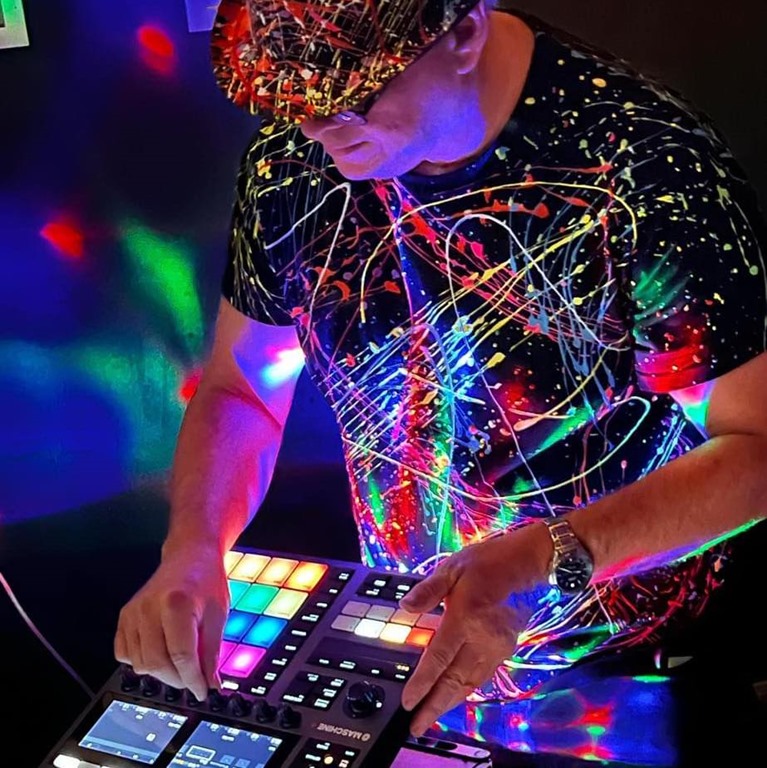
Mho – that’s ohm backwards, and pronounced ‘mo’ – is the musical vehicle of Dave Walker, who’s been a regular face at the EMOM scene, and has become established as being instantly recognisable for his stagewear, with neon-splatter t-shirt and hat. Obviously, these visual props don’t translate to the recordings, which must stand on their own merits – and they very much do.

Over the course of ten tracks, Walker showcases a broad span of styles and sounds, and the compositions are all accomplished and considered. As his bio states, he ‘began his foray into making electronic music at school when he built a Transcendent 2000 synthesiser and a ETI String Synth, as the Polymoog synth cost as much as a house back then’. He’s since switched to more contemporary kit, but his years of experience have led to a nuanced approach to musicmaking: there’s a lot of detail, but nothing’s overdone. Every drop, every time the beats bang back in, every layer, every stutter, every new sound and sample, is perfectly placed – but not in such a way that the precision leads to sterility. Walker’s tunes flow with a rare naturalness, and there are no jarring jolts or awkward lurches between segments.

Predominantly, these pieces are built around conventional piano sounds and broad strokes of synth which fill out broad spaces, and there’s a lot of analogue-style pulsations, too, cut from the cloth of Mike Oldfield and Tangerine Dream.

There’s something familiar that I just can’t quite place about the melody of ‘Nie Rozumiem’ (which will undoubtedly annoy me for days), and elsewhere, ‘Chorale’ brings ambience with low-key beats that washes along nicely, being largely undemanding but pleasant. ‘Eternal’ brings a hint of Eastern promise and a vaguely operatic vocal carried on a soft breeze of shuffling beats and rippling piano.

‘Contact’ and ‘Moon’ appear to be thematically linked, the former bursting with samples and laser-beam bleeps, and it does have quite an 80s feel to it. This, though, is true of much contemporary electronic music which isn’t overtly dance – or EDM and the encroaching Americanism would have it. The latter is a seven—minute sonic exploration that expands through time and space with crackling radio transmissions from the lunar landing of 69.

‘Take it Easy’ is pure 80s retro tootling melting into 90s euphoric trance, and while well-executed, it’s perhaps the least engaging or enticing tracks on the album, but it’s but a brief weakness in an otherwise solid album which concludes with the surprisingly light and accessible spin of ‘I Am With You’ which practically skips along.

With EMOM sets providing just ten to fifteen minutes for artists to showcase their style (these nights are absolutely bloody packed, to the point that despite being ‘open mic’, all slots are usually taken a full month in advance), it’s good to hear the full span of the elements which feature in an Mho set, and even better to hear that Mho has the material for not only a longer set, but a full album which is at once diverse and cohesive.

AA

333455632_2197845260603259_2646669291313228150_nmho1

Expert Sleepers – 25th August 2022

Christopher Nosnibor

Fallout 4 is, as the title suggests, the fourth album in Darkroom’s Fallout trilogy.

Darkroom have been going for more than twenty years now, and have built up an extensive catalogue centred around fluid ambient work, which they’re keen to point out ‘stretches the definition of the genre to its limits in many directions: from quiet, introspective and naturalistic through celestial and melodic to intense, abrasive and synthetic.’

In presenting three longform compositions, Fallout 4 affords the collective to fully explore all of these elements.

As the accompanying notes explain, ‘Darkroom’s music has always been played not programmed, with a focus on human interaction and capturing the magic of live performance’, and the first two pieces hark back to the last performance of their 2012 tour. ‘It’s Clear from the Air’ is hypnotic, rippling, mesmerising, low, undulating drones providing a subtle low end to the textured interweaving synths that overlay subtle yet complex rhythms.

It bleeds into the twenty-five minute ‘Qaanaak (Parts 1 & 2)’ and immediately the tone is darker, denser, with a grumbling low and needling pulsations that create tension within the suffocatingly thick, beatless smoggy atmosphere. You find yourself lost, in suspension, somewhat bewildered as the tones twist and change. Electronic flares whip and lash as stuttering beats emerge through the relentlessly nagging pulsations, and continue to shift and mutate to a broiling, bubbling larva as booming bass tones surge and swell. The rhythm grows in urgency, but it’s muffled, constrained, which heightens the experience of a sense of airlessness and entrapment and as much as the throbbing oscillations are indebted to Can and Tangerine Dream, their abrasive edge hints at the uneasy, wheezing synth grind of Suicide.

The third piece, ‘Tuesday’s Ghost’ is perhaps the most conventionally ambient’ of the three, and is certainly the most overtly ‘background’ as is swims and floats and chimes along fuzzy lines of slow decay and loose, vague forms that have no shape, rise and fall. There is a discreet linearity to it, as it gradually, and subtly builds in depth and density, and it’s here that it become clear just how essential that human element is to Darkroom’s work – that sense of musicians bouncing off one another and understanding one another through intuition. There is no substitute for it, and you simply can’t programme the dynamics of form. It’s this intuitive, natural fluidity that breathes life into the compositions, and in turn, it’s this sense of life that the listener connects to and engages with. Fallout 4 may be ambient at heart or by genre… but it’s also far beyond the frontier of ambient.

AA

a2945227307_10

3rd June 2022

Christopher Nosnibor

My partner in power electronics, the man behind the white noise aspect of the ‘white noised and shouting’ equation that is …(something) ruined, Paul Thingumy (he has more pseudonyms and variant monikers than the devil himself, or even JG Thirlwell), has gone and self-released another EP. Well, less of an EP than an LP: it may only contain four tracks, but with a duration of almost an hour, it’s a very long play.

Residing in Mirfield, Kirklees, West Yorkshire – or, objectively, the arse-end of nowhere, where trains are infrequent and tend not to visit after 9pm – is probably very like any other Little Britain backwater with a Tory MP. And it’s so often from our immediate environs we draw our inspiration, as the album’s title indicates. For reasons I can’t fathom, the title reminds me of Peter York’s strange book Dictators’ Homes and some TV show I can’t quite recall – probably because I never watched it – about celebrity pads. Or perhaps I’m confusing it with Pimp My Ride or some other wank. Because it all blurs, and fast. Mirfield Pads is blurry, but in a different way: everything melts together to create an ambient wash.

In something of a departure from much of Paul’s previous work – and there’s a lot of it – Mirfield Pads is surprisingly mellow, melodic, accessible. There’s a hypnotic Krautrock vibe about the shuffling oscillations, with sampled vocal snippets buried low in the mix in places. It’s an overtly synth work with a vintage leaning that’s strongly rooted in the late 70s and early 80s. If there’s a debt to Kraftwerk here with elements of Mike Oldfield and Harold Faltermeyer, then equally, Mirfield Pads is Paul’s nod to Tangerine Dream, perhaps in part spurred by the recent passing of Klaus Schulze. You wouldn’t necessarily call it a tribute, but an inspiration, almost certainly.

Tapering tones interweave and turn, glistening, fractal, kaleidoscopic, like beams of light dancing on an illuminated surface, dancing lightly across a millpond or flickering on a wall. Not a lot happens, and it doesn’t need to: the sounds turn slowly on an axis that exists in a space of its own.

‘Crystal Airfield’ – a title that evokes the spirit of JG Ballard – hits the numerical sweet spot of 23:23, and with additional guitar work courtesy of Neil Campbell, longtime collaborator and one half of another project, Early Hominids, it’s a richly atmospheric piece that rounds off the experience nicely in a wash of elongated droning feedback paired with bubbling analogue sounds.

It’s the attention to detail, to the vibe and sensation that really makes Mirfield Pads intriguing. It feels more like a document from a past time more than a nostalgia piece, and this is a good thing, because nostalgia has become dreary and weary very quickly indeed – probably because the smell of cash is so unappealing.

AA

a3443859683_10

Editions Mego – EMEGO305 – 28th June 2021

Christopher Nosnibor

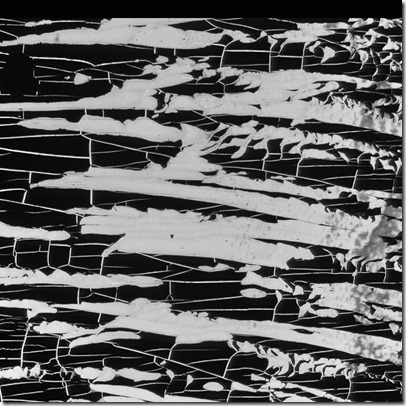
BJ Nilsen’s focus has long been the ‘sound of nature, the nature of sound and the effects these have on humans’, and his exploratory collages and soundscapes tend to draw of field recordings and myriad other sources to create often contrasting, and dissonant works, and Irreal is very much dissonant and contrasting, with moments of tranquillity and subtle, quivering elongated drones disrupted by battering blasts of difficult noise.

The liner notes outline how ‘Irreal is a selection of recordings from different situations encountered in Austria, Russia, South Korea and The Benelux. The range of sound is as wide as is the emotional impact which slides from the unnerving to the shimmering and gor- geous. Doors, bells, birds, wet snow falling from a tree, hacking of wood, water dripping in a cave are all exquisitely captured and moulded into vast landscapes of sound. Human voices, string instruments, descending trains, oceans, winds, grass, trees. These diverse sonic elements are grafted around and upon each other to create a rich tapestry of sound. Electronic embellishments harness the whole to create a singular expressive canvas. The 3 part suite concludes with the Beyond pebbles, rubble and dust, a grand glacial work which serves as a masterclass in extraordinary transcendental drone.’

I’m instantly primed for some challenging scraping drones as the first few seconds of ‘Short Circuit of the Conscious Thought’ build tense, treble scratches, and am immediately puzzled when it halts and there are just clicks in silence. It’s as if the file has inexplicably glitched. From the quiet, a trilling, rippling drone emerges and hangs like a haze – but that smooth stillness carries a tension, which ruptures with distortion and bands like a dozen car doors slamming simultaneously, and at the most unexpected of times. In the final minutes, it evolves into a slow-pulsing minimal ambient Krautrock sequence reminiscent of Tangerine Dream.

Rumbling thunder cracks and crackles all around at the start of ‘Motif Mekanik’, and it booms and grumbles all around a low, ominous drone, and the track is a tumbling tempest of amorphous noise like a raging storm circling and hovering, drifting back and forth, and it’s unsettling. The contrast of the sounds of the elements and the metallic scrape of the eternal drone is perhaps the most obvious way in which Nilsen highlights the relationship between nature and humans, the man-made and the organic. It also intimates the tensions at the heart of that relationship, as strains of ear-splitting feedback cut through the murk and mumble, and it segues quietly into the expansive final composition, the monumental thirty-eight minute ‘Beyond Pebbles, Rubble, and Rust’ – and I know ‘immersive’ is a word I probably use excessively, but it’s entirely appropriate as I find myself swimming amidst the thick, slow—moving sounds of the piece.

Lazy bleeps, like R2D2 on a low battery or the Clangers on ketamine bibble into the mix, before fading out to a drifting mist of dark rumblings that present not immediate routes into the heart of dark mass, only an impenetrable mass of sound, like a mountain rising to the heavens, its summit hidden by a low cloud base. A low bass registers almost subliminally, a single note repeated slow and regular, booming out dolorously. Not a lot happens over a very long time, but the effect is cumulative, and as you sit and stare while the drones and spectral wails of ambience envelop, you find yourself in contemplation and searching for the meaning.

There are all shades of reality, spanning the unreal and the hyperreal. But the irreal is not real. However, where the irreal is distinct from unreal lies in the perception – not just something unreal, but estranged and otherly. In drawing on so many found sounds and field recordings, Nilsen’s album is in fact rooted in the tangibly real, bur recontextualises it, shifting the axes so as to present that reality through the filter of human intervention and incongruity, and as such, distorts that reality to present an interpretation which in turn becomes a fiction and therefore not real, or irreal.

As the rain hammers outside on this early July night, following a day of heavy storms, it occurs to me that what Nilsen articulates through his sonic juxtapositions, is that the relationship between human and nature is precarious: we, as a species, are not nature’s friends, and that progress is disruptive and often damaging – and it’s the human way to command, control, and harness nature for our own ends. But that superiority is an illusion, a delusion, and humanity will always be at nature’s mercy. The relationship is not interdependent or symbiotic, and we need the natural world , whereas it does not need us. In time, we may reach a point where our planet is uninhabitable to us, and to many other species, but it will exist long after we have ceased to, just as it did before. Darkness descends, and at the close, the album tapers to silence – and this is as it will be.

AA
eMEGO305_front

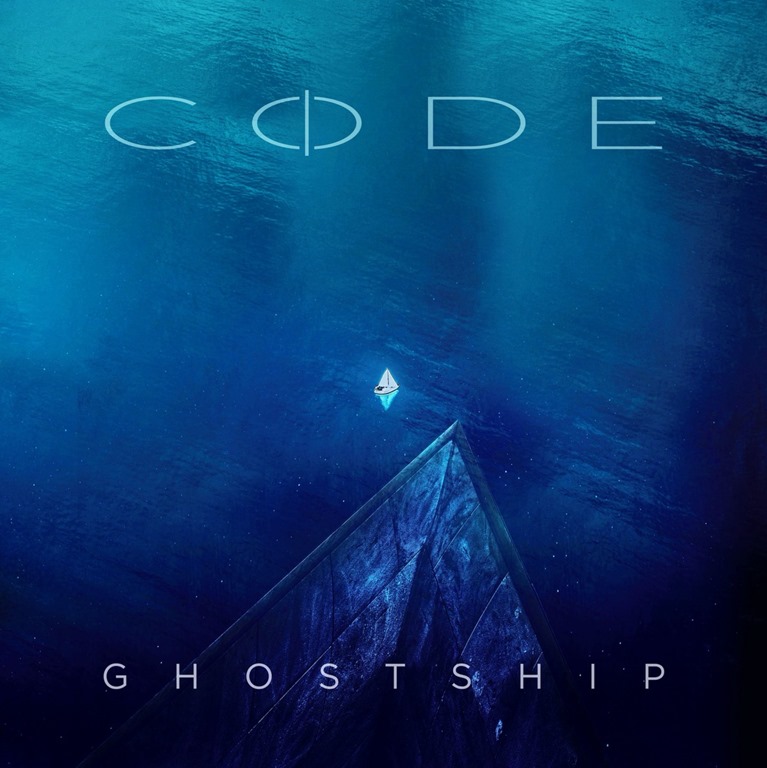
Kent based electronic quartet CODE have released a rebooted version of their 1992 debut single ‘Light Years’, which was available on white label only at that time and remains highly collectable to this day. Attracting support from John Peel at Radio 1 and Colin Faver and Colin Dale at Kiss FM, the original was a cross-genre classic; cosmic and psychedelic yet club-friendly, it pointed towards the future while acknowledging past masters such as Tangerine Dream with its sinuous, mind-bending arpeggiations and minimal melodic motifs. The 2020 upgrade remains true to its industrial techno roots but adds a contemporary dancefloor sheen. Bandcamp orders will also include a remix by Bjika, a musician who melds the spatial elements of progressive and deep house with the rawness of Detroit techno.  
The full length rework of ‘Light Years’ appears on a new album by CODE entitled ‘Ghost Ship’, their first in 25 years.

Watch the video here:

7eaaa5ea05da962bad5d421c72ccbd64ef4e4aaf