Posts Tagged ‘Sci-Fi’

Crónica – 20th January 2026

Christopher Nosnibor

As time passes, our tastes change. For some, they narrow and become more cemented, more deeply entrenched. There’s a broad acceptance that people become more conservative as they grow older – which may explain why, with our ageing population, we – that’s the western world – has become more in favour of conservative values, such as low tax and a belief that the past was a golden age in which hard work was rewarded, and of course, music was better. There is certainly more than a grain of truth in the boomer stereotype. And as a Gen X-er, I’ve observed people I grew up with, and /or have known for many years become set in their ways and their listening habits, locked in the 90s in their musical tastes, and becoming increasingly churlish about the youth of today and the like.

I consider myself fortunate to be surrounded by friends and acquaintances, both in real life and in the virtual world, who are deeply invested in new music. The fact I get sent new music of all kinds from around the globe is only half of the story, as it would be so easy to sweep vast swathes of it aside to listen to, and review, nothing but goth, contemporary iterations of post-punk and new wave, grunge, and reissues. In fact, I could devote my entire listening time and run a website dedicated to nothing but reissues and still be incredibly busy. It would probably garner a huge readership, too. But no: I am constantly encouraged to listen to new music, and the fact of the matter is that I thrive on it, and never fail to get a buzz from new discoveries. As such, since I began this journey as a music writer, my horizons have broadened beyond a range I would have ever imagined.

A measure of this is that my first encounter with the music of Rutger Zuydervelt, back in 2014, was marked by a most unimpressed four-star review, in which I said that Stay Tuned was ‘a bit of a drag’. While I don’t feel particularly inspired to revisit it now alongside my writing of this review, I feel I would likely have been more receptive to its longform minimalism now.

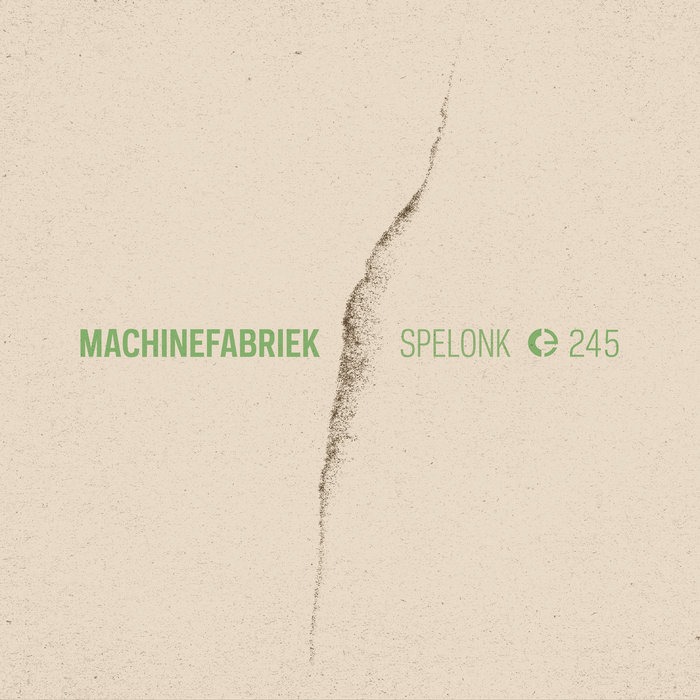
Spelonk is not quite as long in form – three compositions spanning a total of forty-two minutes, and sees Zuydervelt taking some time out from his dayjob to indulge in the act of creating for pleasure – or, perhaps, more accurately, creating out of the need to experience freedom, to feel that metaphorical – and perhaps literal – sigh of release.

As he explains, ‘Most of the music I make nowadays is commissioned for film, dance, or other projects. And I love it — it’s the best job in the world! — but sometimes I have to pull myself away from it, and make something purely for myself. My 2004 release Omval was one of these works, as is now Spelonk. These projects are always made in short bursts; once I start creating, things fall into place quickly, as if the ideas were (unknowingly) already there and just needed to get out of my system.

The three tracks that comprise Spelonk (simply titled I, II, III) are built with “hardware jams” that I recorded with my live setup. It’s all quite hands-on, with effects pedals, an oscillator, and electronic gadgets. The magic happens when combining different recordings, layering them, and hearing what happens. Listening is always a favorite moment in the process, with a welcome element of surprise. I guess it’s all about creating alien landscapes — alien also to me too — that are exciting to explore.’

‘Alien landscapes’ is a fair description of these sparse works, constructed with layers of ominous drone. On ‘Spelonk II’, there are chittering sounds which scratch like guitar string scraping against a fret, or perhaps a ragged bow dragging against a worn string, but by the same token, untranslatable voices come to mind. The drones are eerie, ethereal, and hang low like mist or dry ice: it’s not nor merely an example of dark ambient work – there is very much a 70s sci-fi feel to it, hints of BBC Radiophonic Workshop emerge between every surge and crackle as slow pulsations reverberate among the unsettling abstraction. Over the course of the track’s eighteen minutes, there is movement, evolution, and just past the midpoint, there is a shift, where trilling organ-like notes and digital bleeps emerge, evoking recordings from space travel, and, as rippling laser sounds begin to burst forth, vintage sci-fi movies and 70s TV.

There are moments of near silence as ‘Spelonk II’ drifts into ‘Spelonk III’, also eighteen minutes in duration. Here, clanks and bleeps bubble and bounce and echo erratically, unpredictably, over a backdrop of low hums and reverberations. The low-end vibrates subtly but perceptibly, and while the experience is not one which instils tension, the cave-like digital drips and sense of space, as well as darkness, is not relaxing. You find yourself looking around, wondering what’s around the corner, what’s in the shadows. And while there’s no grand reveal, no jump fright here, the second half of ‘Spelonk III’ grows increasingly murky and increasingly squelchy and unsettling.

Over the album’s duration, Spelonk grows in depth and darkness, becoming increasingly dark, strange, and unsettling. Rutger Zuydervelt makes a lot out of very little, to subtle but strong effect.

AA

Crónica 245 front

French atmospheric doom collective IXION has just revealed their latest video for the song ‘The Advent,’ directed by Hugo Le Beller and featuring performances by Raphaël Mars and Irène Bonnot.

The track is off the band’s newest EP ‘Restriction,’ and marks another exciting prelude to their highly anticipated fifth studio album, Evolution, set to be released in late October via Finisterian Dead End/Season of Mist.

“We are so excited to share with you this video for ‘The Advent’!” says the band. “The song is about androids working to replicate emotions, and the first of them to finally experience feelings. We tried to create a short story around this theme, playing with characters and surroundings…”

‘The Advent’ offers a visually stunning and thought-provoking glimpse into a world where androids strive to understand and emulate human emotions. The narrative weaves a short story that aligns perfectly with the overarching concept of their upcoming album, Evolution.

Don’t miss the captivating new video for ‘The Advent’ here:

Following the critically acclaimed L’Adieu aux Etoiles, Evolution is divided into three parts, each delving into different aspects of the human-android relationship. The album is an enthralling blend of progressive metal, melancholic, and atmospheric doom, showcasing IXION’s unique sound.

The first part of the album, ‘Extinction,’ was released on April 16 and explores humanity’s struggle with mortality amidst rapidly advancing android technology. The second part, ‘Restriction,’ released on June 14, takes listeners on a sci-fi, electronic, and ambient doom-metal journey, depicting androids’ quest for emancipation and a closer connection to human emotions.

Originally formed in 2004 as a solo project by main composer and multi-instrumentalist Julien Prat, IXION has established a distinctive presence in the doom metal scene. Their innovative fusion of ambient/electronic music with atmospheric doom metal draws inspiration from science fiction, creating a unique and immersive auditory experience.

8a1ef33e-a177-1b75-841b-6a577f8a6e72

11th January 2022

Christopher Nosnibor

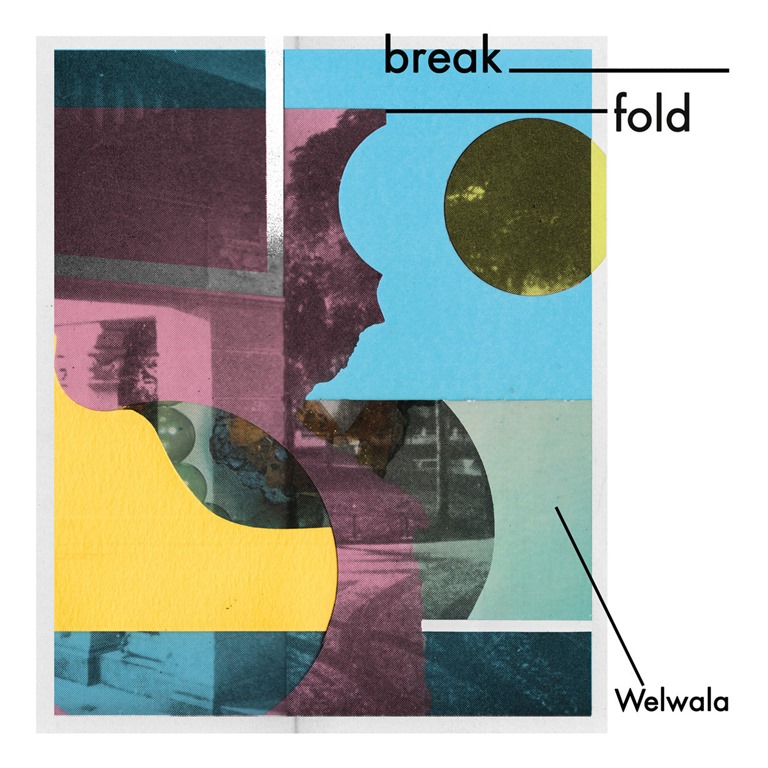
Curse my brain. It’s so unhelpful at times. When Tim Hann – aka break_fold – emailed me his new single release, I managed to misread ‘Welwala’ as ‘Welawala’, and immediately my mental jukebox struck up ‘Summer Nights’ from Grease. ‘Tell me more’, you say?

Uh-huh, ok. Having recently connected with analog horizons, with whom this is his second release ahead of the fourth break_fold album, scheduled for release towards the end of 2022, Tim’s been gaining traction with support for previous singles ‘Meanwhile.. Up in Trump Tower’ and ‘Variant’ from BBC 6 Music DJs Gideon Coe and Steve Lamacq.

As is common for Hann, it’s a TV series that in part inspired the composition: on this occasion, it’s the sci-fi show The Expanse as well as Blanck Mass’ Calm with Horses film soundtrack (as far back as the debut album by I Concur, Hann was drawing on The Wire among his wide-ranging sources).

Gary Numan-esque synths and that crisp crack of a vintage drum machine snare sound. Beneath the bold strikes builds first a later of bass, then a bubbling synth loop, and then the drums kick up a notch and beat harder. As the elements layer up, the track takes on new depths and grows in intensity. The dropdown is perfectly timed, and from there it builds again. Compositionally it’s magnificent, and there’s a lot of action and dynamic work packed into three-and-a-half minutes. It’s tight, and the production is poised, just-so, and it all comes together with a precision that at the same time feels intuitive, and it’s that intuition that really gives it some force as it pushes the listener along in its swelling current.

As the press release explains, ‘Welwala is about seeing something from two different points of view. It is structured around two contrasting synth lines with focus shifting between them, evoking both optimism and threat. These are layered with an insistent drum track in a sequence that hints at narrative evolution.’ So, a bit like ‘Summer Nights’ then. I mean, ok, not musically, but my misread was right about the telling the story from two different perspectives, right? Right?

AA

a2453954432_10

Cruel Nature Records – 11th June 2021

Christopher Nosnibor

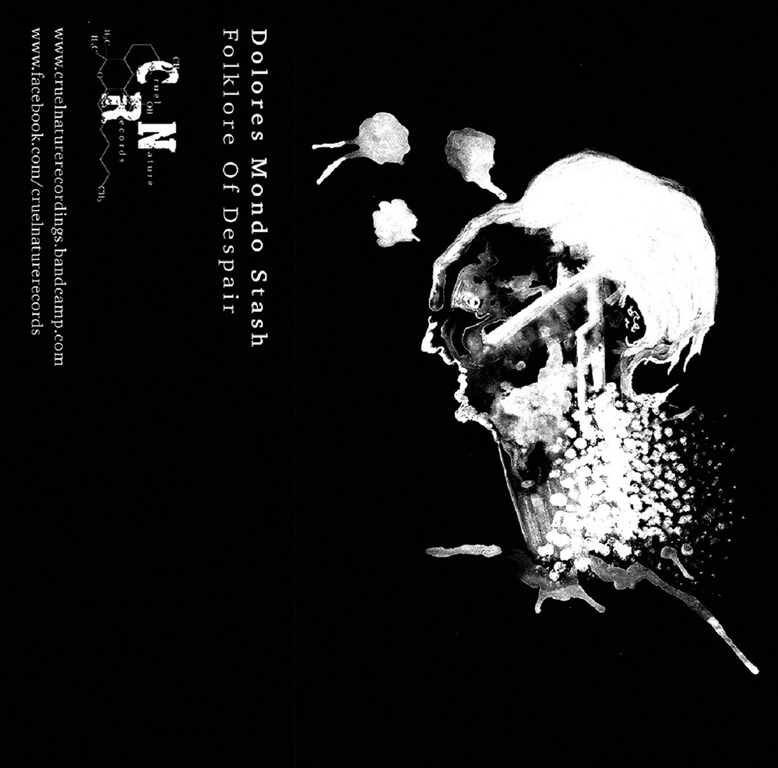
We’re in eerie electronics territory here. Haunting, creepy. Suspenseful. There’s something of a vintage sci-fi feel to this nightmarish trip, as gurgles and scrapes bibble up through swamps of whistling organ-like drones. It’s a dark record, but not because it relies on heavy drones, low, rumbling, doomy bass, hard volume or distortion: Folklore Of Despair worms its way into the psyche, prodding and poking stealthily into the recesses of the subconscious, gently rubbing and scratching at those small, nagging uncertainties that stem from the fear of the unknown. Whistles and bleeps intermingle with tense violin-type drones and quibbling analogue sounds, spooky, spectral notes and crashing crunches which disrupt the flow and create a different kind of tension, one that feels like things are going out of control and colliding on every side, a catastrophic nightmare where carks skid into one another as every third driver find their steering no longer works or their brakes have been cut. It’s disorientating, and the effect is so strong because everything about the album is so unpredictable.

There are no conventional structures here, or even any clear structures at all. Like the best suspense movies, the unexpected always occurs unexpectedly. The tense build-ups are often false markers, but then again, there’s not much letup in the tension, which they sustain and sustain, and your nerves are jangling because your gut tells you ‘something isn’t right’.

Things get really weird really fast: second track ‘Darkness is Driving the Machine of Debauchery’ is quite headfuck, as glitches and warping sounding like a stretched and buckled tape struggling to traverse over the heads. It squeaks and squeals and sounds as if whatever was recorded on the tape before is bleeding through, like voices from the other side – I’m reminded tangentially of the 7” containing sample recordings of voices from the ether that accompany Konstantin Raudive’s 1971 book, Breakthrough: An Amazing Experiment in Electronic Communication with the Dead (something that would feed into the theories expounded by William Burroughs on the tape experiments he conducted withy Brion Gysin).

An actual voice, murky, muffled, drifts, disembodied and strange through the creeping chords on ‘If the Forest Ate the Trees’, where the notes drift like fog, but there’s more to its being unsettling than that: there’s an otherness, a strangeness you can’t quite put your finger on, as if maybe the drifting fog in the graveyard scene has been filmed in reverse. It’s the fact it’s difficult to pinpoint that heightens the effect so.

Thunderous beats – distant, as if playing in a club three blocks away – pulse, deep, and bassy, on ‘Floral Patterned Gearshift’, and the sound is all but drowned out by the shrill, clamorous shrieking synapse-shattering tweets that flurry like a swarm of bats scurrying and flurrying. You have to fight the impulse to duck to avoid the aural assailants, invisible yet somehow tangible in the mind’s eye.

At times, everything simply collapses into chaotic cacophony. It’s hard to process, and ever harder to digest. Folklore Of Despair is a complex and uncomfortable album, which is nothing the title hints it may be. I’m not even entirely certain what it is, but it leaves you feeling jittery, jumpy and on edge.

AA

a0307778435_10

Distortion Records DIST15 – 30th August 2019

Christopher Nosnibor

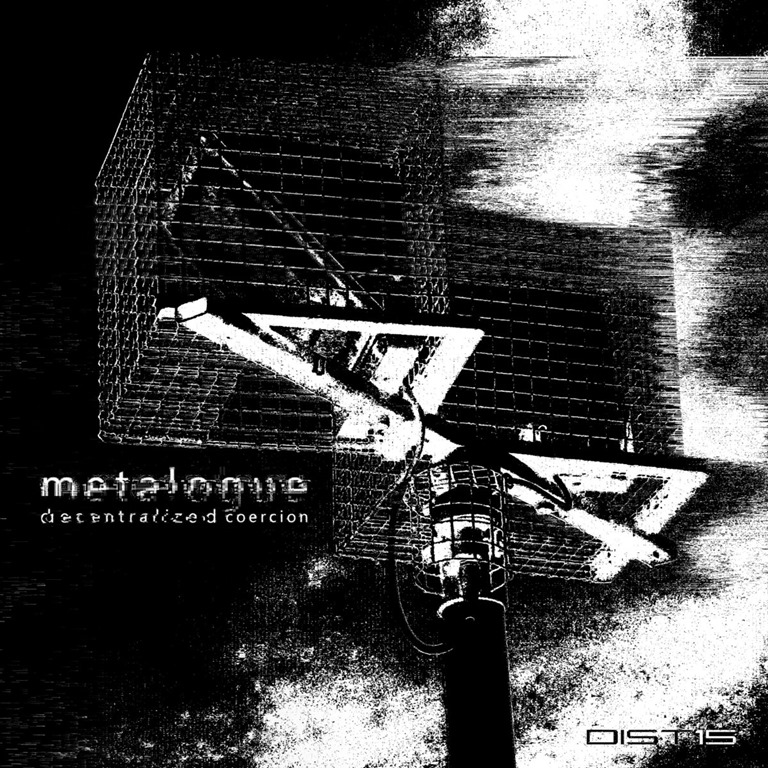
The blurb: ‘Beatmatching Metalogue’s cinematic industrial with the dark sci-fi visions of d&b/neurofunk, Decentralized Coercion deals in the threats of mass surveillance, decentralized social control, totalitarian manipulations of trust, runaway artificial intelligence and the addictive mechanisms of the attention economy. The resulting sound is that of Big Data multiplying exponentially, sucking us down in digital whirlpool.’

As well known for their remixing as their own output, and having been featured on a fair few compilations, Metalogue – the vehicle for electronic musician, programmer, and sound designer Robin Fencott – has amassed quite a substantial catalogue in a short time, with an approach to performing that lends itself well to live recordings, of which they’ve released several EPs.

However, the studio work is perhaps the medium through which the details are most discernible, with skittering synths and hectic cymbal stutters providing layers to the stark soundscapes shaped by thumping techno beats. The album’s first track, ‘New Era of Trust’ begins with sonorous atmospherics and a slow, jittery beat, before a woozy bass rolls in. It evokes Bladerunner-esqe images, conjures monochrome city scenes, dark alleys and rusted fire escapes, and 80s sci-fi. It has a certain Nine Inch Nails vibe, but the sounds are crisper, cleaner, and therefore somehow more inhuman and more detached.

Stepping up the tempo and the attack, ‘Spectral Froth Annealment’ clatters and clanks and pounds hard while whirring electronics fizz and grate to forge a bleak, paranoid space, and bleeds into the nine-minute ‘Shadow Text’, which maintains the pace. It’s not the subtle shifts in emphasis that are where these pieces appeal: it’s their relentlessness, their consistency, their clinical sharpness. The treble on the snare sound, the metallic edges, all imbue the album with a coldness that somehow reflects the zeitgeist: we’re surrounded my machines, we’re assaulted by information 24/7, and despite mankind’s unwavering belief in its superiority and capacity to control its environment, it feels increasingly s if that control is being relinquished and handed over to automation. I’m not talking about the way the industrial revolution brought us mechanisation, but that more insidious encroachment whereby Alexa is listening in and Facebook throws adverts having decided what you want to buy based on a conversation or status update from the other day, and your FitBit tells you how far you’ve walked and how many more steps you need to walk in order to burn off the packet of crisps you had mid-morning. We think we own our lives, but that sense of control is illusory. Your employer knows how long you’ve been away from your desk for the toilet, and with cameras every 30 yards (I personally pass no fewer than 13 CCTV cameras on my 23-minute walk to the bus stop on the way to work each morning, and the busses are installed with cameras as well), there is nowhere that’s private, and there is no hiding from the machines. You’re bot paranoid: you really are having your every movement watched or tracked.

Decentralized Coercion is a soundtrack to this harrowing but inescapable fact.

‘Extraction Imperative’ is bleaker, more stripped-back still, the stuttering drum ‘n’ bass rhythms twitchy and tense, and there’s little levity in the trajectory towards the album’s close, ending with the pumping yet magnificently empty ‘Behavioural Surplus’. The beats are whiplash-fast and hard as, but everything else is backed off, distant, creating a distinctly disquieting sensation.

By the finish, I’m left drained, punished, pounded, and pulverized. It’s a microcosm of life. Decentralized Coercion boils it down to a succinct sonic statement that encapsulates that life. It’s harsh, but it’s real.

AA

Metalogue