Posts Tagged ‘Room40’

Room40 / A Guide To Saints – 7th November 2025

Christopher Nosnibor

Free time? What’s that? Who actually has free time anymore? Something seems to have gone awry. Every technological advance promises more leisure time: from the industrial revolution to the advent of AI, the promise has always been that increased productivity through automation would give us more free time. So where the fuck is it? I don’t know anyone who isn’t constantly chasing their tail, running just to stand still, who doesn’t feel like they’re losing the plot or on the brink of burnout simply because the demands of working and running a household is close to unmanageable, and making ends meet is a major challenge… and the stress suffered as a consequence. N

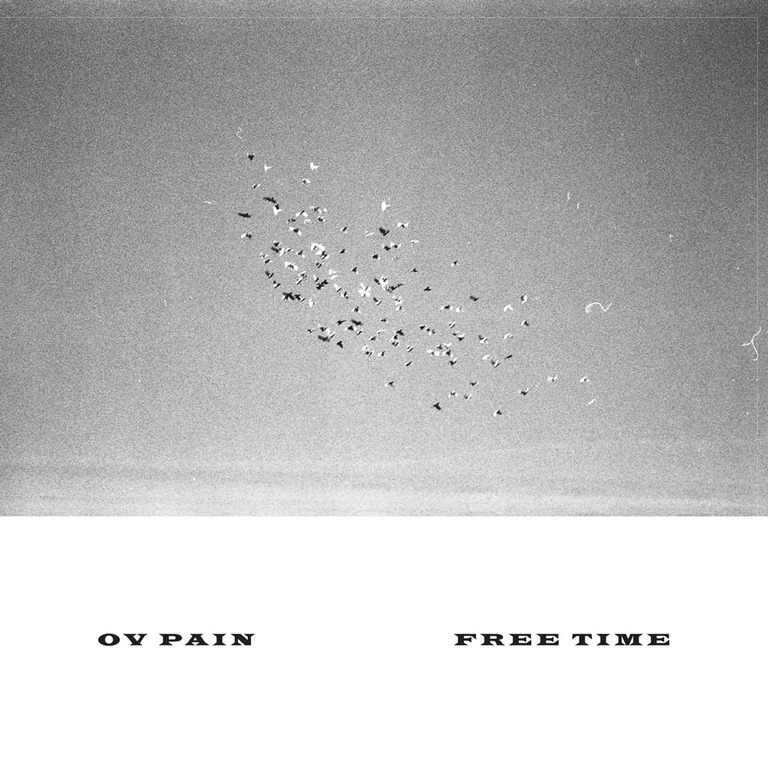
Ov Pain – the experimental duo consisting of Renee Barrance and Tim Player seemingly scraped and made time to record this album, a set of live improvisations (saving the time required to write and rehearse compositions), whereby, as Tim explains, ‘We recorded four different synthesizers – two apiece – straight into a computer pulled from a skip.’ This is how you do it when there’s no free time and no spare money. Although not explicitly detailed in Tim’s commentary, these factors are quite apparently central to the album’s creation, and by no means unique to Ov Pain. There’s a reason many acts peter out when the members reach a certain point in life: jobs and families mean that creative pursuits require some serious drive to maintain.

Tim adds, ‘One thing that is important to us is the immediacy and economy with which it was made and how that immediacy and economy becomes the thing itself.’

For all of its expansive soundscapes and layered, textural sensations, there is very much a sense of immediacy to Free Time. But, by the same token, for an album recorded quickly, it certain makes the most of time, in terms of space. There are long periods of time where little happens, where drones simply… drone on. The sounds slip and slide in and out, interweaving, meshing, separating, and transitioning organically, but not without phases of discord and dissonance.

The first track, ‘Fascia’ – with a monolithic running time of nearly eleven minutes – is a tormenting, tremoring, elongated organ drone, soon embellished with quavering layers of synth which warps and wavers, .it; s like watching a light which initially stands still but suddenly begins to zip around all over. It sits somewhere between ambient and extreme prog, with some intricate motifs cascading over that monotonous, eternal hum. Towards the end, the density and distortion begin to build, making for a climactic finale.

‘Slouching Toward Erewhon’ tosses in a neat literary allusion while bringing a sense of bewilderment and abstraction to proceedings, before ‘Comparative Advantage’ slowly pulses and trills, then crackles and buzzes, a thick surging swell of noise which is uneasy on the ear. And yet, the seconds of silence in the middle of the track are more uncomfortable… at least until the throbbing distortion bursts in atop stains of feedback and whirring static.

It may have been building for some time, but this is one of those evolving sets which after a time, you suddenly come to appreciate has expanded, and gone from a fairly easy drift to a heavy-duty drone assault.

Over the course of the album’s seven pieces, Ov Pain really do push the limits of their comparatively limited instrumentation. ‘Slander’ is a squalling, eardrum-damaging blast of gnarly treble that borders on extreme electronica, a straight-up assault on the ears and the mind. It hits all the harder because there is no let-up, and the frequencies are harsh and the sounds serrated. Around the mid-point, it goes darker, gritter, more abrasive, making for a punishing six minutes. Further layer of distortion and screaming noise enter the fray. It’s not quite Merzbow, but it’s by no means accessible. The final track, ‘Pusillanimous’ presents seven minutes of slow-pulsating ambience, and is altogether more tranquil to begin with, but before long, there are thick bursts of distortion and overdrive, and low rumbles heave and grind in ways which tug at the intestines. I feel my skin crawl at the tension.

Free Time is an album of surprises, and, more often than not of discomfort. It’s the sound of our times.

AA

AA

a2380798111_10

Room40 – 19th September 2025

Christopher Nosnibor

There are many labels putting interesting and unusual, innovative releases into the world. The majority of them are small, and supremely niche, but survive by virtue of knowing their audience – and I say audience rather than market, because while they obviously need to balance financially, often on the minutest of margins, they exist for the purpose of disseminating art rather than the production of profit. The underground operates on a very, very different model, and with very different objectives, from the mainstream.

One label which is consistent in its output is Lawrence English’s Room40. The interview I conducted with Lawrence some years ago has vanished from the Internet now, as happens when websites cease to operate and their owners stop paying for their hosting, but it will always stand as one of my favourites. This is relevant, because we touched on the subjects of William Burroughs, cut-ups, and sonic collage, and lo, English, in his appraisal of Steelwound, recounts how ‘In the early 00s, Ben had been working on cut-up electronics, spilling over with floating rhythms, humming string samples and piano splices. It was a sound realised in part through the subversion of fruity loops and also owes a debt to Ableton Live which arrived in late 2001. His works to that point, gently saturated and bristling with a fizzy distortion at times, hinted at another sound world which would become his focused in the summer of 2002 and into 2003.’

A further note on Frost’s process is also informative by way of a preface, and comes again courtesy of Lawrence, who writes, ‘Working with a Fender Twin, often with the reverb dialled in at maximum, he found a language of shimmer and saturation, of compression and collision, that set the stage for a prolonged interest in how sound performs and is perceived at volume. It also is the first time that many of the tonal and melodic inflections that have come to be recognised as his compositional language are on display.’

This is the twentieth anniversary edition of an album that likely very few people have even heard of, let alone heard, and the chances are, it will remain that way despite this reissue. That isn’t because it’s not good, but because it’s ultra-niche and on a small label. But, in those certain small circles, it will likely receive attention, and deservedly so.

As is often the case, any technical and theoretical background is lost in the listening. The album’s first piece, ‘Swarm’, is an ambient work which may well weave a certain tension, but its trickling drone reveals nothing of the aforementioned context. The same is true of the epic ‘I Lay My Ear to Furious Latin’, which in itself is anything but furious, an floats, drifts and wisps abstractly over the duration of nine minutes, before the mellifluous ten-and-a-half-minute ‘You, Me and the End of Everything’ stretches out into post-rock territory, and in doing so extends its emotional pull, also. It’s slow and ponderous, spacious, and expansive, and strains of feedback scrape and push at the delicate, soft-focus edges, before the first vocals of the album arrive, haunted, detached, and deeply moving in unexpected ways. Sometimes, the human voice affects us more profoundly when any words aren’t discernible. We hear the emotion poured into them, and we feed on what we take implicitly. Sound and enunciation, delivery, can convey emotion and meaning which is beyond words, and that is very much the case here.

The title track, emerging from the rumble of thunder and heavy rain amidst a blustery backdrop scrapes and drones, trills and whines, a representation of an industrial soundscape that veers between the graceful and the brutal, the harsh, as feedback assails the ears frequently – but there are points at which it dissipates, and submits to drifting mellowness, even then the feedback continues. ‘Last Exit to Brooklyn’, taking its title from Hubert Selby Jr’s classic, if gritty, novel is soft but with harsher edges.

It’s hard to comment on the initial resonance or impact of Steelwound twenty years ago. There likely wasn’t much. But as the whistles and wails of the title track dissipate in a gentle breeze, it does grow dark. Not SO dark, but darker that it was. This is an album of texture and detail, moving, but also captivating, a spell of gripping stillness, a pause to reflect. As the scraping, sonorous trails of ‘And I watch You Breathe’, it’s worth stepping back, taking a moment, and breathing. Just… breathing.

AA

RM403_20 front

ROOM40 – 9th August 2025

Christopher Nosnibor

It’s been some time since I’ve sat down to listen to a work created using prepared piano. It’s been even longer since I spent time with Erik Griswold’s work. Perhaps the two are related, as Griswold’s accompanying notes recount how it’s been a while for him, too:

Under the house again, just me and my very old piano. Have we got anything more to say to each other? Will some new toys spice things up a bit? The creative process seems to swing like a (Foucoult’s?) pendulum, always returning to the same spot again and again, eventually. When I last made short form prepared piano pieces in 2015 (Pain Avoidance Machine) I was “feeling stifled by the negativity of the Australian political discourse, the narcissistic excess of social media, and facing a long summer of migraine-inducing heat.” If only I had known how far we had to go.

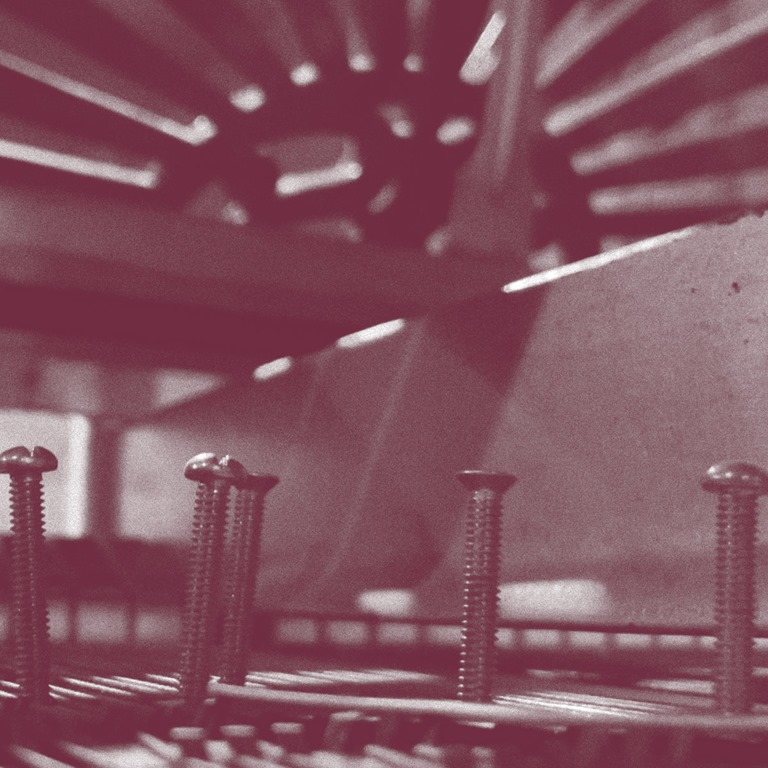
To the sounds of my 1885 Lipp and Sohn, prepared with brass bolts, strips of paper and rubber, I’ve added an analogue synthesizer, extending the exploration into the electronic. The tactile quality of both instruments is central to my approach, with small inconsistencies of sound, attack, decay, filtering all foregrounded. It’s a very intimate setting with just two C414 microphones at close distance to capture the granular details of sonic materials. The addition of “frames,” “windows,” and “sonic mirrors” produce a ritualistic aura hovering above and around the music.

I take a moment to reflect on reading this, before I can even bring myself to listen, reflecting on the title. Putting things off is… well, it’s a way of dealing, but it’s not really coping, is it? Not that Griswold hasn’t been making music: he’s maintained a steady flow of releases over the last few years, even during the COVID years – but to return to the piano is a significant step.

The title track raises the curtain here, and at times the tinkling tones are achingly beautiful, graceful, delicate, the most magnificent invocations of neoclassical perfection – albeit alternating with plinking, plonkling randomness which flips between low-end thunder and what, to the untrained ear or anyone unfamiliar with the instrumentation, sounds like clumsy stumbling.

‘Wild West’ isn’t a twanging country tune, and says nothing of the wiki-wiki-wah-wah we know, but a rolling piano piece with the prepared element adding a taut, almost electronic-sounding aspect – like the plucking of an egg-slicer – but also abstract, and strangely evocative. Meanwhile, the gentle, somewhat vague, and perhaps rather progressive-leaning ‘Ghost in the Middle’ radiates a hypnotic beauty.

The album’s mid-section takes on a dreamy, drifting, hazy quality, floating from here to there, with scratches and scrapes, forward and backward providing texture to these ponderous sonic expanses.

‘Uncertainty’ again balances neoclassical magnificence with angular irregularities and some jarring alternative tuning which continues into the trickling ‘Poly cascade’, a stack that’s subtle and in some way grounding.

‘Colours of Summer’ lands as a surprise and completely rips out those roots in an instant, being a throbbing techno track which completely goes against the grain of the album. In complete contrast, ‘Ghost of Ravel’ returns to classical territories, and is nothing short of beautiful, although as the album inches towards its close – the atmospheric bubbler that is ‘X-Mode’ which calls to mind the Krautrock bubbling of Tangerine Dream, and, more contemporaneously perhaps Pye Corner Audio’, find ourselves floating, drifting, unsure of where we are. Next Level Avoidance is full of surprises, and is in essence representative of the prepared piano, in that it’s unpredictable, unstable. Dim the lights, breathe and feel the flow.

AA

a0361562758_10

Room40 – 22nd August 2025

Christopher Nosnibor

Sometimes, I will encounter a release, and while knowing that I need to cover it, I find myself paralysed by the discovery that I am completely out of my depth. This is never more common when presented with works which represent cultures from beyond my – embarrassingly small – sphere of knowledge. And embarrassing is the word. Doubtless some would steam in and opinion with an overflowing confidence which presents itself in perfect disproportion to their knowledge, but bluffers inevitably come unstuck sooner or later, and are shown up as the arrogant cocks they are. I’ve always been of the opinion it’s better to be open about those gaps in knowledge, accept that no-one can know everything, and take the opportunities which present themselves to gain some education.

During my first or second year as an undergraduate studying for a degree in English, one tutor commented that I had squandered almost half of the first page on ‘rhetorical throat clearing’ – a magnificent and amusing turn of phrase, which summarises something I’m still guilty of some thirty years later.

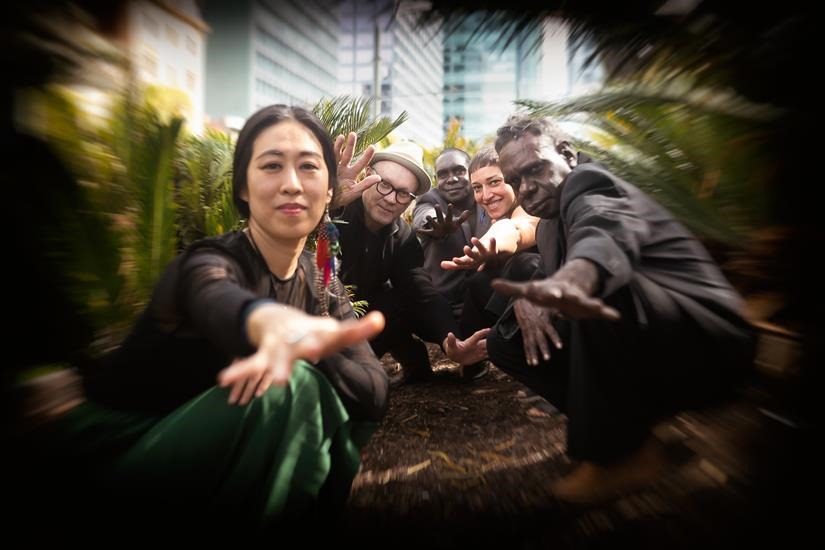
Anyway: the point is, when presented with Ŋurru Wäŋa, the new album by Hand To Earth, I find myself swimming – or somewhat sinking – at first. The accompanying notes set out how ‘A search for a sense of belonging is at the heart of what drives Hand to Earth, a group of five people, who come together from different backgrounds, different birthplaces, and different musical approaches to share their songs, and by doing that to create something new.’

Peter Knight (trumpet, electronics, synthesisers, bass guitar) goes on to explain that ‘Ŋurru Wäŋa traces notions of home, belonging, and displacement. In the two parts of the title track, Sunny Kim intones the words of Korean poet Yoon Dong Ju’s poem, Another Home, in counterpoint to Daniel Wilfred’s song, sung in the Wáglilak language. Ŋurru Wäŋa (pronounced Wooroo Wanga), translates as ‘the scent of home’, and as we travel we long for that fragrance, passing the bee, guku, making the bush honey while the crow circles calling overhead.’

The notes add that ‘The music Hand To Earth creates collisions between the ancient and the contemporary; between the ambient and the visceral.’

And indeed it does. Listening to Ŋurru Wäŋa is a transportation, and transformative experience, not entirely similar from watching a documentary soundtracked by the sounds of the peoples being documented. From the very first minutes of the spacious whispers and slow, elongated notes of ‘buish honey (guku)’ the lister finds themselves in another place, another space, another mind. It feels, in ways which are hard to pinpoint, let alone articulate, spiritual, beyond the body, but at the same time closer to the earth – closer to the earth than I have ever been or even understand how to become. I realise I have been, and become so conditioned that such senses are beyond me, likely eternally, but on listening to the ringing sounds – not unlike the droning hum of a singing bowl – and breathy incantations of ‘Ŋurru Wäŋa Part I’ and revisited in the dark, sonorous rumbling of ‘Ŋurru Wäŋa Part II’ which brings the album to a close.

In between, swerving drones and impenetrable utterances evoke another time, another place, far removed, something mystical. It’s the sound of nature, of forests, of grass, of sky, as well as of soul, of heart, exultation, of but also the sound of humanity in a form so many of us have lost, and lost our capacity to connect to. This is the music of life, and it swells and surges, it’s the sound of being alive, and celebrating its magnificence.

Under capitalism, we forget that we’re alive, we trudge along, under duress, hating every day. Making it through a day is the goal for the most part, our ambitions are tied to capital, to the drudge, to the eye on the promotion, but, mostly on the commute, the team meeting, to clocking in and out, to the wage, to the 9-5, the confines of the shift, the need to pay the rent… We are all so numb, so desensitised. We’re not even living, but merely existing. With Ŋurru Wäŋa, Hand To Earth sing of another life – and it’s another world, and one we should all aspire to.

AA

AA

a1662627484_10

Room40 – 18th July 2025

Christopher Nosnibor

Norman Westberg seems to be a man of few words. Through all of his years with Swans, I can only recall interviews with Gira and Jarboe, although I have for many a decade now admired Westberg’s stoic approach to playing: no showmanship, no seeking of attention, instead channelling the sound, often with infinite patience, screeding feedback and a single chord for an eternity. His solo material is considerably softer than Swans in tone, but no less brimming with tension and atmosphere, and this is nowhere more apparent than in his solo live sets, as I recall in particular from seeing him open for Swans in Leeds two years ago. Onstage, he was unassuming: in contrast, the sound he made, was powerful.

And so it is that the words which accompany Milan are not those of the artist, but Room40 label head Lawrence English, who recounts:

In 2016, I invited Norman Westberg to Australia for his first solo tour.

He’d been in Australia a few years before that, touring The Seer with Swans, and it was during this tour that I’d had the fortune to meet him. Since that time Norman and I have worked on a number of projects together. He very kindly played some of the central themes on my Cruel Optimism album and I had the pleasure to produced his After Vacation album.

Last year Norman shared a multichannel live recording with me from a tour where he was supporting Swans. The recording instantly transported me back to the first time I heard Norman perform.

Whilst many people know his more dynamic and tectonic playing associated with his band practice, Norman’s solo work is far more fluid. Often, when I hear him live, I imagine a vast ocean moving with a shimmer, as wind and light play across its surface.

Norman’s concerts are expeditions into just such a place. They are porous, but connected, a kind of living organism that is him, his instrument and his effects. He finds ways to create moments of connection which are at times surprising, and at others slippery, but always rewarding.

There’s a deeply performative way to his approach of live performance. There’s a core of the song that guides the way, a map of sound, but there’s also an extended sense of curiosity that allows unexpected discoveries to emerge.

Milan, which I had the pleasure to work on for Norman, captures this sense perfectly. It is a record that exists in its own right, but is of course tethered to his other works. It’s an expansive lens which reveals new perspectives on familiar vistas.

This almost perfectly encapsulates my own personal experience of witnessing Westberg performing. And Milan replicates that same experience magnificently. Admittedly, despite having listened to – and written about – a number of his solo releases, including After Vacation, I was unable to identify any of the individual pieces during or after the set. Such is the nature of ambient work, generally. Compositions delineate, merge, and while the composer will likely have given effects settings and so on, which are essential to their rendering, to most ears, it’s simply about the overall effect, the experience, the way movements – even if separable – transition from one to another.

This forty-minute set is dark, disturbing, immersive, somewhat suffocating in its density, from the very offset with disorientating oscillations of ‘An Introduction’. It flows into the next piece, ‘A Particular Tuesday’, where tinkling, cascading guitar notes begin to trickle down over that woozy undulation which rumbles and bubbles on from the previous track. And over time, it grows more warped, more distorted. Something about it is reminiscent of the instrumental passages between tracks on Swans’ Love of Life and White Light from the Mouth of Infinity, and for all the swirling abstraction, there are trilling trickles of optimism which filter through here.

Amidst a swell of bass-booming, whorling sound on sound, gentle, picked notes just – just – ring clear and give form to an amorphous sonic mass, but this too gradually achingly, passes to the next phase, and then the next again. ‘Once Before the Next’ is the sound of a struggle, like trying to land a small wooden rowing boat in a gale. And it’s in context of this realisation that there are many depths and layers to Milian, but none which make for an easy route in, and there is no easy ‘check this snippet’ segment. Instead, it’s the soundtrack which prefaced the ugly one w know is coming.

While Milan is obviously a live set – and at times, the overloading boom of the lower frequencies hit that level of distortion which only ever happens in a live setting, and the sheer warts-and-all, unedited, unmixed approach to this release is as remarkable as it is incredible in listening terms. This isn’t a tidied-up ‘studiofied’ reworking of a live show. Milan is a document of what happened, as it happened. You can feel the volume. The density and intensity are only amplified by the volume, and you really do feel as if you’re in the room. Let it carry you away.

AA

AA

a1125531819_10

9th May 2025 – Room40

Christopher Nosnibor

Souvenirs are unusual things, in that they’re intensely personal, and imbued with a resonance which is often difficult to articulate.

I will revisit an anecdote I relayed no so long ago: my dad gave me £15 spending money when I went on a Cub camp in Yorkshire when I was probably fourteen. We had a day trip to York, where I discovered an independent record shop, the now gone and sadly-missed Track Records. I blew most of my £15 on 12” singles by The Sisters of Mercy: Alice, Temple of Love, and The Reptile House EP. On returning home, my father was not happy: he’d given me the money for real souvenirs – fridge magnets, mugs, erasers… but the fact that I still have those records and tale to tell says these were the best souvenirs I could have ever purchased. Would I still have an I Heart York mug or a tea towel thirty years later?

But one thing that’s become apparent is that for fringe, niche, and unestablished acts like Sadie Powers, even when released by labels like Room40, physical releases are becoming less of a thing. It’s a sad reflection on the state of the world and how the arts in general are suffering. People don’t want to pay for stuff, or they can’t afford to pay for stuff, and the end result is the same.

Souvenir is a sad album, based on a premise which resonates on a personal level. I’ve written extensively of late on both the impact of the pandemic, and of losing my wife, and Souvenir is a work which explores grief, with a particular focus on the pandemic. Powers explains the album, its context, and its musical limitations and development in terms of instrumentation, in a fashion which warrants quotation in full:

‘Between 2020 and 2022, a significant number of friends and family passed away. Due to the pandemic, funerals became impossible to travel to or just didn’t happen. How does one grieve alone? What is that language? What is that movement? What do I do with my hands, with the muscle memory of care weaving phantom thread? What is the shape of the shelter one makes to bear this loss? If I’m not holding, will I sink to the bottom?

‘What is my last memory with them? Almost always, it is of embrace.

‘I’ve had a relationship with fretless bass for about 20 years. It’s an unforgiving instrument. It exposes everything. Like porcelain: elastic, pliable, detailed, expressive. Suggestive to subtle touches. It shows the hand of the player. I began recording improvisations with silence, thinking of those I’d lost, their embraces, those moments of stillness and when time folds in on itself, then cutting the tracks up processing and layering them, a sound collage. Programmable music box bells, sheet metal, cardboard box, and field recordings from the same spot on the back patio of my former home color the shape. Like a bird collecting items to create a nest of memory. Sounds drifting in and out like recollections, like ghosts. The practice became a life raft, or a grieving raft.

‘Is the souvenir the embrace? Souvenirs originated from pilgrimages in the Middle Ages, as a remembrance of a journey.’

The four compositions which make up Souvenirs are each approximately ten minutes in duration, and this would have made for a magnificent vinyl LP, particularly given the texture and detail of the works.

The first track, ‘Right After’ is exemplary: it begins so quietly as to be beyond range, before the crackle of a slow fade-in becomes discernible. And against this, and some rumbling dark ambience, there is the strolling fretless bass work. I can’t help but think – however fleetingly – of Duran Duran, not because it actually sounds like Duran Duran, but because that fretless bass has such a distinctive sound – thick, bulbous, rounded, warm.

‘Soft Materials: Permanent Rose’ is move overtly ambient, and ripples its way along in an understated fashion, and ‘Rabbit Hour, too, hovers and hums, clatters and clinks, plunging deeper into abstraction, drifting cloud-like and formless, hovering, while occasional scrapes and nails-down-a-blackboard feedback sounds cut through the soft waves.

‘Princess Moo Bear’ may sound soft, but the clanking chines are pitches against thick helicopter sounds and dark abstraction, before finally expanding and drifting to nothing.

Souvenir is not an easy or instant album. Quite the contrary is true. But it is detailed, layered, and has much going on.

AA

a0102366993_10

Beloved Australian ensemble Hand To Earth will release their album Ŋurru Wäŋa (pronounced Wooroo Wanga) via Room40 on 22nd August.

Ŋurru Wäŋa is an album which traces notions of home, belonging, and displacement. The title translates as ‘the scent of home’, and as we travel, we long for that fragrance, passing the bee, guku, making the bush honey while the crow circles calling overhead.”

Today, the band share the album opener, ‘Bush Honey (guku)’.

In the two parts of the title track, Sunny Kim intones the words of Korean poet Yoon Dong Ju’s poem, ‘Another Home’, in counterpoint to Daniel Wilfred’s song, sung in the Wáglilak language.

This theme – this search for a sense of belonging – is at the heart of what drives Hand to Earth, a group of five people, who come together from different backgrounds, different birthplaces, and different musical approaches to share their songs, and by doing that to create something new.

AA

DSC_1411-Edit-990000045104513c

Photo credit: Emma Luker

Room40 – 9th May 2025

Christopher Nosnibor

Merzbow is an artist who requires little to no introduction, and one with a catalogue so immense – with in excess of five hundred releases credited – it’s beyond daunting for not only a beginner, but even a keen noise-lover. This is the reasons I personally own very few releases, and have only picked up a few incidentally along the way.

As Masami Akita approaches seventy, and Merzbow marks forty-five years of noise, this output shows little sign of abating, but it does seem an appropriate time to reflect on some previous releases which may be considered either ‘classic’ or ‘pivotal’. 1994s Venereology has been receiving some retrospective coverage of late, revered largely on account of its reputation for being the loudest, harshest thing ever, ever.

But here we have a reissue of The Prosperity Of Vice, The Misfortune Of Virtue, released a couple of years later, a much lesser-known work, but still during what’s broadly considered to be the golden era of the 90s, and, as the accompanying notes suggest, it’s ‘one of a series of unique editions from his vast catalogue that reveals a side of his practice often under represented.’

During the late 1980s and into the 1990s, Masami Akita was sometimes working on film and theatre music. In this space he created a series of recordings that capture the full scope of his sound worlds.

Given the nature of these settings, his compositional approaches were varied, seeking to create both intensely crushing walls of sound and more spatial, and at times rhythmic, pieces that plot out an approach to sound making which atomises his universe of sound, and uncovered the singular detail that is often consumed in the whole.

The Prosperity Of Vice, The Misfortune Of Virtue is the soundtrack to the theatre piece Akutoku no Sakae/Bitoku no Fuko by Romantica. Based on Marquis de Sades’s Historie de Juliette ou les Prosperités du vice & Les Infortunes de la vertu, this recording was originally released with limited distribution and remains one of the lesser available Merzbow recordings.

Completely remastered and contains an additional cut from those original sessions, this reissue of The Prosperity Of Vice, The Misfortune Of Virtue presents nineteen blasts of noise and rumbling and shrieking, scraping discord and dissonance. Many of the pieces are brief – a couple of minutes or so – and there is so much texture and tonal rage here, its sonic vision is remarkable. To many, of course, it will just ne noise – horrible, nasty, uncoordinated noise. But listen closer, and there is a lot happening here. The noise is, indeed, nasty, and the output is, brain-blasting chaos, for sure. But what these untitled pieces showcase is an intense focus and an attention to detail which is so much more than brutal noise. The Prosperity Of Vice, The Misfortune Of Virtue is, comparatively speaking, not that harsh – although when it is harsh, it’s absolutely next-level brutal with shards of treble exploding in walls of ear-shredding punishment. It contains a lot of clattering and crashing, like bin lids being dropped, and cyclical, thrumming rhythmic pulsations. There are tweets and flutters, bird-like chirrups flittering above cement-mixer churning grind with gnawing low-end and splintering treble, overloading grind and would oscillations.

The Prosperity Of Vice, The Misfortune Of Virtue is the sound of a man pushing all the buttons and turning all the dials at once and seeing just how far he can tweak them. There are moments of minimalism, of slow, stuttering beats, of mere crackles, passages one might even describe as ambient – a word not commonly associated with Merzbow. But the way in which The Prosperity Of Vice, The Misfortune Of Virtue explores these dynamics, and contains quieter more delicate segments, not to mention some bleepy electronica that borders on beat-free dance in places, is remarkable: while so much noise is simply repellent to anyone who isn’t attuned to it, The Prosperity Of Vice, The Misfortune Of Virtue offers engagement and offers openings to listeners with a broader interest in experimental music.

Eclectic is the word: we hear a chamver orchestra at the same time we hear strings being bent out of shape and what sounds like a Theremin in distress. While a fire alarm squawks in the background. This is everything including the kitchen sink. Imaginative and experimental, it’s noise with infinite dimensions.

AA

RM4195 front

Room40 – 31st January 2024

Christopher Nosnibor

It begins with a rumbling roar, like a persistent strong wind rushing over moorland, before ripples of piano delicately drift over it to altogether calmer effect – although the roar continues beneath. The juxtaposition brings a balance of sorts.

Just a few days ago, I wrote on Circuits From Soft Frequencies by Jamie Lee, which was recorded among the sound mirrors at RAF Denge, in Kent, and touched on the fascinating nature of these structures, and opined that ‘often, the most alien and seemingly otherworldly creations are, in fact, man-made’.

Lawrence English’s latest work seems to contribute to this dialogue, albeit approaching from a different perspective.

‘I like to think that sound haunts architecture,’ he writes, and goes on to remark, ‘It’s one of the truly magical interactions afforded by sound’s immateriality. It’s also something that has captivated us from the earliest times. It’s not difficult to imagine the exhilaration of our early ancestors calling to one another in the dark cathedral like caves which held wonder, and security, for them.’

English also writes of the relationship between space and place, and how ‘Spaces hold the opportunity for place, which we create moment to moment, shaped by our ways of sense-making… Whilst the architectural and material features of space might remain somewhat constant, the people, objects, atmospheres, and encounters that fill them are forever collapsing into memory.’

The album comprises eight numbered segments, ETHKIB I – VIII, all formed using fundamentally the same sound palette, and which flow into one another seamlessly to create a single, continuous piece, which is best experienced without interruption.

The piano and the undercurrents, which evolve from that initial roar to altogether softer drones which drift, mist-like, develop an interplay whereby the dominant sound switches, sometimes with one or the other fading out completely – but this happens almost imperceptibly… It isn’t that you don’t listen to the music, but the preoccupation of the listening experience is absorbing the atmosphere, and it possesses almost a physicality. By ‘ETHKIB V’ the sounds has built such a density that the sensation is like being buffeted. Amidst the deep drones, there are, in the distant, whirring hums and elongated scrapes which evoke images of disused mills and abandoned factories. Perhaps there’s an element of the power of suggestion, but it’s difficult to contemplate purely abstract visualisations, or nature without some human aspect somewhere in the frame.

The soundscapes English creates are evocative, and in parts, at least, haunting – although ultimately, what haunts us is our own experience, our thoughts, our memories. And in this way, from space, we create our own sense of place, and tie things to them in an attempt to make sense of the world as we experience it.

By ‘ETHKIB VIII’, it’s the piano alone which rings out, in a reversal of the opening, and some of the mid-sections, ending on a single, low note, repeated, held, reverberating, leaving, ultimately silence, and a pause for reflection.

AA

RM4245 front

Room40 – 3rd January 2025

Christopher Nosnibor

Ian Wellman’s works are usually responses to environmental issues, be they derived from articles covering global matters or more immediate or personal situations. His latest, Can You Hear The Street Lights Glow, sits very much in the latter category, as he details in the accompanying notes, which I shall quote in full:

I moved to Pasadena during the fall last year. One of the first new sounds I noticed were the mercury-vapor street lights that filled the air as the sun went down every evening. Under the sidewalks, exhaust vents hummed along to the song of crickets and the rumble of traffic. Being away from the inner city, more individual details in the soundscape emerged.

As a way to explore the new area, I walked around at night with my equipment. I placed geophones and contact mics on every metal surface I could. I ran electromagnetic sensors across electronics accessible by the sidewalk. I put mics out on quiet streets, behind shopping areas, and in parking lots. I felt very compelled and inspired to listen and learn about my new home. Can You Hear The Streetlights Glow? is the result of these listenings.

Certainly, the first part of this is something I find quite specifically relatable – not due to relocation, but to finding myself suddenly discovering a heightened awareness of my immediate surroundings. Like many people, I used to walk around with earphones in, listening to music to cut out the noise around me. This was essential on my daily commute, as listening to music as I walked through town created a separation between home and work, and while on the bus from town to the office, it shut out the babble of other people, and created a barrier between myself and anyone from work on the bus who may have been inclined to strike up a conversation. And on the way home, the same was also true but listening to music also helped me decompress – or mirror my angst – after a day in a noisy open-plan office. Lockdown changed that. I suddenly felt the need to be alert in case of approaching runners or cyclists or people kicking off in queues for the supermarket because someone wasn’t observing the two-metre rule or otherwise losing the plot over COVID restrictions. In short, I was scared – terrified, even. Not so much of the virus, but other people. I felt I needed to be on high alert at all times, because people are simply so unpredictable. One byproduct of this was that when I left the house form my allotted hour of exercise, I became acutely aware of the quietness – the absence of the thrum of traffic, the absence of chatter, and in their absence, I could instead hear the wind, birdsong, my own footsteps. In fact, I could hear everything. In the quiet, the small sounds were suddenly so much louder. The quiet wasn’t nearly as quiet as it first seemed. It was the aural equivalent of one’s eyes growing adjusted to the dark.

The auditory voyage of discovery Wellman charts on Can You Hear The Streetlights Glow bears clear parallels to my experience, but takes things a step or three further with his use of an array of equipment in order to capture sonic happenings in these spaces and his interrogation of the sounds in order to reach a deeper, more intimate understanding of his environs.

The results are quite fascinating, and range from a cluster of brief snippets, of under a minute and a half to just over two minutes, to more expansive segments – 5G Antenna Power Box is almost five and a half minutes, and ‘Mercury-vapor Lights’ is a full twelve and a half minutes in length. The titles of the pieces are location-specific, and some are quite evocative in themselves – notably ‘Time Depleting on Bird Scooter’ and ‘Gas Pipes Behind Smoothie Shop’. On the one hand, they’re utilitarian in their descriptions; on the other, they create an image of a filmic world in which sound events happen in particular places.

Most of those sound events are different levels of hum and drone, but these varying levels of low-level throbbing serve as reminders of how mankind has interfered with the naturally-occurring sounds which are the true sounds of the outdoors. While I am likely to note the hum of the power lines as I pass a pylon, and so on, I am still attuned to the wind in the trees, the scurry of squirrels. The sounds on Can You Hear The Street Lights Glow are all entirely man-made, mechanical, and despite Wellman’s relocation to a more rural setting facilitating the opening of his ears, the locations are all noteworthy for their constructed, non-natural nature. People may interpret this differently, and Wellman’s intentions may have been different again, but the leading thing I take away from this is just how hard it is to truly escape the mechanised world we’ve made. But equally, Can You Hear The Street Lights Glow is a document which highlights the extent to which even in silence, there is sound – lots of it.

AA

a1805176232_10