Posts Tagged ‘post-apocalyptic’

24th February 2026

Christopher Nosnibor

It may only be February, but 2026 is looking like the year of the long-threatened goth renaissance. It’s been bubbling for a while, with first-wave bands like Red Lorry Yellow Lorry releasing new material for the first time in decades late last year, as well as second wave names such as Corpus Delicti making strong comebacks. And what’s noticeable is that their audiences don’t consist entirely of old bastards who’ve been adherents of the scene since the 80s: on recent ventures to see Corpus Delicti and Skeletal Family – whose current singer, it has to be said, is considerably younger than the rest of the band – I’ve witnessed first-hand a substantial proportion of the audience represented by under thirties, even under twenty-fives and teens – and they’re getting into the dressing up, the hair and makeup, too. Why? A vaguely educated guess based on observation and an A-Level in Sociology taken just over thirty years ago suggests that there are a number of factors involved here: what goes around comes around – this always happens – with an element of kids raiding their parents’ music collections or otherwise becoming nostalgic for the music they heard growing up (thanks to my parents, I have records by Barbara Dixon and Phil Collins, although I drew the trauma line at Steeleye Span and The Bee Gees) – and also the times in which we live. Depression, oppression… post-punk and the substrain that would become goth emerged from pretty bleak times – and we once again find ourselves in bleak times, bleaker, if anything. We no longer live under the shadow of the bomb as we did during the Cold War. Instead, we live in a world at war, a world where AI is taking over in a way that resembles the maddest sci-for dystopia, and where the prospects of work and home ownership for those finishing school and college are nothing short of abysmal.

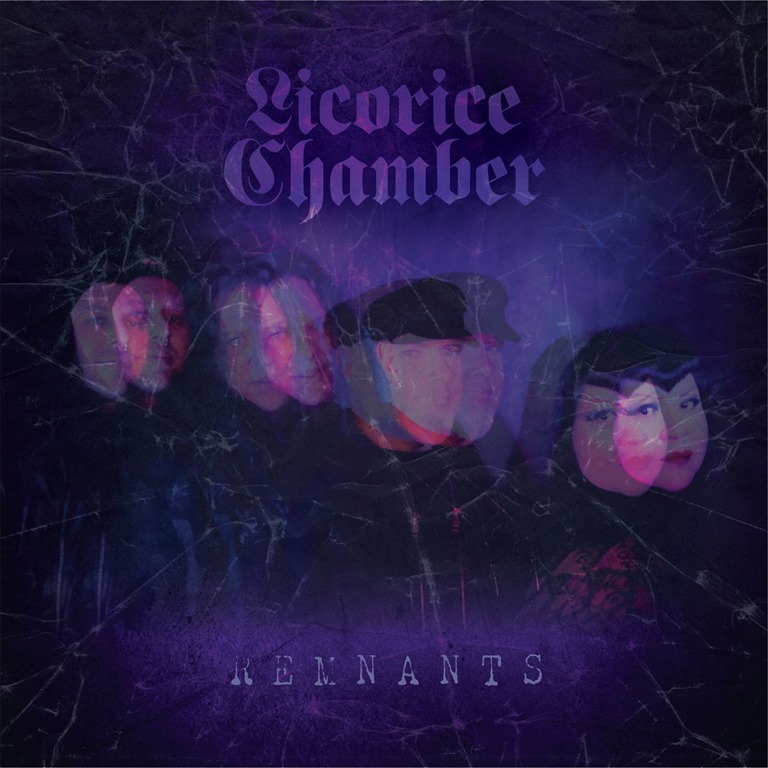
It’s not all gloom and doom, though, because… no, wait. It is, but Licorice Chamber are coming through on the emerging wave of bleak bands to provide a fitting soundrack to existential mopery.

Licorice Chamber perhaps isn’t the greatest band name ever, but it’s in keeping with the latest influx of goth and goth-adjacent acts like Just Mustard (and also reminds me of Fudge Tunnel), and since band names are inherently stupid by nature if you pause and reflect on it in any depth – dissect any band name and conclude that it’s not at least vaguely stupid, is my challenge – it’s fair to let it ride. After all, it’s the music that matters.

On Remnants, Licorice Chamber serve up three brooding slices of classic contemporary goth which are thematically linked under the banner of the EP’s title, as they explain: “The EP title Remnants suggests aftermath, what survives destruction. Rather than romanticizing despair, the songs feel like they’re exploring what’s left when illusions fall away.”

‘Feign’, the first of these three cuts, is magnificently understated, a mid-tempo song that’s as much about the space between the sound of the instruments as the instruments themselves, and while there’s a heap of reverb around everything, something in the production calls to mind the quiet flatness of The Cure’s Seventeen Seconds. But the backed-off drums and fractal guitars serve to place Layla Reyna’s powerful, emotive vocals to the fore.

Heavy by name and heavy by nature, the second song packs a far greater density, a cinematic rock workout, which builds to a climactic finale and finds Layla floating majestic through a sonic maelstrom.

The final cut, ‘Never the Same’, is the longest of the three, and is a slow-burner rendered more kinetic by some busy drumming moments, and with its picked guitar and dark atmospherics, it finds Licorice Chamber inching into the kind of territory occupied by doom / goth acts like Cold in Berlin and Cwfen – and that’s not simply a case of lumping heavy bands with female vocalists into a bracket together: there’s positive commonality here.

Remnants is dark, but bold, and in its own way, uplifting.

AA
a2548418784_10

Sub Rosa – 24th May 2024

Christopher Nosnibor

Yet another 24 May release… It really does feel as if the world had conspired to release 75% of the years albums on this one day. So I’m still working my way through them. And this release from some known names is not what I was expecting. I can’t recall precisely what it was that I was expecting but certainly not anything as heavy or as percussion-led as this.

They describe SIHR as a ‘sonic manifesto by a post-anything quartet’, a work that offers up ‘new folklore for a devastated planet’. Within these words, there’s a sense of nihilism and gloom, but simultaneously an undercurrent of ‘fuck it’ and of quintessential avant-gardism, the principle ethos of creating anew only being possible from the destruction of that which came before. There’s a sense here that the destruction – the devastation of the planet – clearly isn’t something they’ve chosen, but in the face of apparent futility, they’ve come together to create, perhaps in the hope of a brave new world, or perhaps, more likely, something to be discovered among the ashes and the ruins of society and life as we know it.

The way in which they document their coming together and the creation of SIHR has all the hallmarks of the first stages of developing a mythology, which has the potential, in time, to grow its own legend: ‘The first sonic moves of this eclectic quartet, made in a bunker studio somewhere between Paris and Berlin, urgently took the form of a quest, that of a neo-folklore for troubled times, a music seeping with many kinds of atavism and experimenting in all directions. A fertile no-man’s-land where trance and contemplation, jazz and electronica, acoustics and electricity would merge in a stimulating mystical magma. From the possible emergence of a Babelian language to the shared desire to rediscover music as a ceremonial act, this encounter took place over three days of improvised sound bacchanalia, the phases of which were all recorded by Benoit Bel.’

The first track, ‘Oui-Ja’aa’ is a nine-minute colossus of a cut, drawing together elements of electronica and ‘world’ music with a dash of Krautrock and the sensibility of Suicide, with a throbbing rhythm melting into a hypnotic bubbling sonic cauldron. The tempo twists and seems to quicken as drones and jazz horns warp this way and that as if blown by the wind and everything builds to a frenzy before collapsing, exhausted in the dying moments.

While conjured in a bunker studio, SIHR sounds as if it was improvised around a fire in the middle of a desert while string out in an hallucinogenic haze. I suppose in some respects, the two scenarios bear numerous similarities in terms of their psychological effects: while one setting is a vast expanse of space with a huge sky vista and a distinct absence of other people, so the other, equally devoid of other people, forces the contemplation of the infinite realms of inner space.

‘YouGotALight’ is slow, smoking, soporific, a crawling, sprawling, mellowed-out meditation, before the glitchy whorl of bleeps and jitters that define the sound of ‘OhmShlag (Quake Tango)’ sees things take a very different trajectory at the album’s midpoint. A pulsating, seething miasma of sonic swampiness, punctuated with a metallic tin clatter of a snare that cuts through the murk, it’s like slowly sinking, not only in boggy terrain, but in a mental fog.

‘Babel Cedex’ eliminates the fog and just goes for the mental, beginning as another slow, serpentine, hypnotic exploration before building to a deranged frenzy of frenetic percussion and howling horns and chaotic discord that’s truly brain-melting. Eastern vibes and glitchtronica ripple through the woozy ‘Black Powder’, and you find yourself marvelling and utterly bewildered by the whole experience.

My earlier visions of desert campfires dissipate life vapourising mirages during the second half of the album, and I come to conclude that SIHR is indeed the sound of bunker life: one envisages the collective huddled in semi-darkness, hunched and half-crazed after months below ground in the wake of a global catastrophe, trying to keep it together in the hope of one day being able to return above ground. How will they know when it’s safe, when the coast is clear? Or is this a scenario akin to Philip K. Dick’s The Penultimate Truth?

We live in perilous times, and likely closer to the brink than any of us know or can even compute. In this context, SIHR feels like a document, and a message to future times.

AA

a0579997776_10